Perhaps I am delusional, but I evidently remember back in highschool when professors and peers alike would rave about the freedom and mental space you unlock in college. During the hustle and bustle of senior year, everyone was preoccupied with thoughts relating to college relationships, having whatever they perceived as the euphoria experience and their eventual walks of shame. Not once did anyone address the potential for mental health issues to become exasperated or take root in college.
The highschool experience is a sham, at least for the folks in my local area. Most people simply looked towards college as a time liberated from the shackles of domestic and academic responsibility. It was through college they wished to become fully immersed in a delayed coming of age movie. The whole idea is that you are pursuing something of interest so you have time for yourself and feel sane right? Needless to say, I was absolutely alarmed by the amount of people within the first quarter going off the deep end.
To console myself, I assumed the mentality that mental health crises in college is not specific to Drexel but an international issue. As much as this mentality kept me safe, it was abundantly evident that the issues Drexel students face are unique, but common among other universities with quarter systems. Claiming that what Drexel students face has nothing to do with curriculums and structures on our campus is reductive.
Drexel does have mental health resources, such as a counseling center and various forms of therapy. This is a very promising resource for students, as it is free of charge. I can see how it can provide solace for pre-existing issues. In this regard, the benefits of the Counseling Center cannot be undermined. But does it truly help with students facing issues relating to the foundational academic systems and rigor at Drexel? Deeper conversations need to take place addressing the systemic factors fostering an afflicted student population for any large change to take place. This is a large ordeal, but not impossible. Ultimately it is promising that some changes are here at last in the form of the switch to semesters.
Posted in UncategorizedComments Off on Mental health and the quarter system dilemma at Drexel
America can not seem to avoid this recently controversial question, “Add a tip?”
Whether you are out for dinner, or at the bar having a drink with some friends, you probably do not think twice about writing in the standard 20 percent on the tip line for your server. Perhaps you are exiting an Uber and give the driver a small cash tip. But now, whether you are at a small coffee shop, or even a local brewery picking up a six-pack, you are inevitably hearing the silent movements of the cashier rotating their tablet that has one question, “Add a tip?”
What caused this to tip over the edge and into a national controversy? When did we go from casually tipping 20 percent to the waiter paying their way through college, to being asked if we want to add a 20 percent tip at fast food restaurants?
There is no doubt that the aftermath of the pandemic, the convenience of modern technology, and social pressure is causing America to experience a perfect “tip-flation” storm.
Think about it. During the Covid lockdown, after essential workers were allowed to return to work, we started offering tips to workers that we would never tip. For the ones we did, we would give more than usual to support them.
The pandemic left, but excessive tipping continues to overstay its welcome.
Partner our post-covid tipping habits with the technology around how we pay for goods and services, all you need to do is pivot the screen, and now the social pressure kicks in.
And that social pressure is cripplingly intense. According to the National Bureau of Economic Research, over 60 percent of Uber and Lyft passengers do not tip their drivers. That is because the tip prompt appears after you have already reached your destination. Even if the riders see the prompt, they will give 10 percent at most since Uber and Lyft’s software systems do not badger you with a tip prompt before paying for the ride.
But, if you have a software system that is nudging consumers, cornering them into making a decision, it makes giving a tip feel like a requirement, rather than an act of kindness. Even if you have been successfully nudged into “giving” a tip, tech companies like Square, one of the largest electronic payment software companies, are taking a cut of that tip. You are essentially giving two tips at once, one to the employee, and one to the software company who did nothing but play the middleman in the transaction.
However, a 2023 Bankrate survey shows that the excessive gratuities might be at a tipping point. According to the survey, approximately 66 percent of Americans felt a negative view towards tipping. Roughly 30 percent of respondents felt that tipping was “out of control,” due to the increasing number of businesses encouraging customers to provide a tip before payment. Finally, 41 percent of patrons believed businesses should pay employees more rather than have them rely on tips.
Let us say that “tip-flation” suddenly disappeared overnight, that does not mean prices are going to decrease. If tipping went away entirely, restaurants and other businesses would need to compensate for their increased payroll. Whether that is by adding convenience fees or raising prices, the consumer will eventually end up paying more.
I have worked in enough restaurants to know that the extra expense businesses find themselves incurring, is always turned over to the consumer. If we do not define the type of worker who deserves a tip for their service, we will continue to pay more than we should.
Posted in UncategorizedComments Off on Why is tipping such a sensitive topic?
If you walk into Urban Eatery on a casual Wednesday evening, you would be appalled at the plethora of graduate students working behind the counters. A typical view this is, if you ask any of the freshmen who come to the dining hall daily. This was a common sight from the first week of my freshman year. Transporting and delivering food to different stations, refilling coffee and hot water, cleaning up food service areas were all tasks I saw these students doing during their shifts. Slowly, as time went by, smiles were exchanged and I befriended a few of them.
I interviewed a couple of grad students who work at Urban Eatery to hear about their experiences. From what I had always seen, grad student employees stood tall and poised, ready to tend to customers in proper fashion. These 20-something-year-olds work for about 16-20 hours for minimum wage throughout the week to earn extra funds. Their shifts are generally of long durations which vary between four hours, six hours or sometimes even more. Usually, if they work more than five hours at a stretch, they are allowed to take a break of half an hour at the max.
But what is the reason that all these grad student workers strive to get this job? In the exact words my interviewee mentioned, the money they earn at this tedious job is “just enough to make ends meet.” They work hard at the dining hall to afford their rent, food and other miscellaneous expenses. Although their wages do not cover tuition fees, they are grateful to have an on-campus job and have their living expenses almost fully funded. A question that came to my mind while asking them about their work duties was, “How do you manage your studies after working strenuously at this job?” One can only imagine how exhausted these students must feel balancing an on-campus job and full-time school. To my surprise, they revealed that it was not that big of a deal. By effectively implementing time management skills, they gave equal time and effort to both their job and academics. Keep in mind, both of them were sporting a solid 3.9 GPA.
Other than their job and studies, they also had other hobbies such as sports and hanging out with their friends and in many ways, embracing their social life. I think it is wonderful to see students who are very hardworking and determined in life. Being an international student at Drexel University, it is amazing to look up to these individuals and see how they strive to get ahead. They set a good example that with effort and determination, we can make the best out of our situations and succeed.
Posted in UncategorizedComments Off on From Urban Eatery shifts to classroom victories: inside the lives of graduate students balancing work and study
Pro-Palestinians on Drexel’s campus have made their intentions clear — their ultimate goal is to push U.S. organizations to fully divest from Israel and to prompt the IDF to cease operations in Gaza. Among all of the havoc, we have lost touch with what buzzwords truly mean. The words anti-semitism, Zionism and even genocide are thrown around to a degree that the definition has become lost upon us.
Members of the encampment have made great effort to highlight causes such as “resistance is justified,” along with their devotion to prompting a ceasefire.
In the eyes of Israelis that faced detrimental loss on Oct. 7 2023 and continue to see the spewed hatred to this day, the word resistance is synonymous with mindless violence. The word uprising is reminiscent of the emergency sirens, bomb shelters and weekly attacks. The promotion of peace coinciding with chants of violent resistance is pushing a misunderstood narrative — unless the goal is to abolish the nation of Israel and the Jews that there reside.
The demands stated by the Drexel Palestine Coalition include the termination of Drexel’s involvement with Hillel and Chabad, two inherently Jewish organizations. Both groups have one primary purpose, which is to invite in as many Jews as possible in an effort to foster community, friendship and love for their ancestral homeland.
While the Pro-Palestine groups have gone to great lengths to push a narrative that anti-Zionism and anti-semitism have no correlation, the demand to abolish Jewish organizations hints at the direct opposite. Jews can only practice if they can appease those watching with a magnifying glass. They must not be too Jewish, or there will be repercussions.
When every word is misconstrued, we are reminded of the simplicity of what we are fighting for, no matter the stance. I would like to remind the students that our Jewish classmates are people longing for a home that was held under the control of others for thousands of years. Now that we have it, we know, even through the loss we have experienced and the hate we have faced, that it is worth fighting for.
Posted in UncategorizedComments Off on What is your resistance?
Chan Chung has penned an op-ed in The Triangle titled: “You can rest now. Give Up on Divestment.” The article proposes creative alternatives to the strategy of demanding American universities divest from Israel, including that student protestors demand that “their universities…use the leverage they have from being shareholders to steer companies away from Israel.” Chung’s proposal that university endowments cease purchasing corporate bonds from entities directly supporting the Israeli war on Gaza, toward the end of restricting the flow of capital to the arms industry, is thoughtful and ought to be seriously considered by protesters. Yet, their dismissal of divestment as an effective or legitimate political strategy misses the economic and moral argument underpinning the American student movement for Palestine.
Chung’s understanding of public equity markets betrays a basic misunderstanding of how a corporation’s publicly traded value affects its actual finances. “I am also confused,” they write, “at what harms there are [sic] in owning certain stocks.” They argue further: “In order for the endowment to rid itself of stocks, someone else must buy. The harms of owning the stocks have not disappeared; they have merely shifted from one institution to another.”
What the piece neglects to mention is that the laws of supply and demand dictate that selling a large quantity of stocks spontaneously depresses share price. This, in turn, depresses a company’s valuation, making it more difficult for said group to attract further investment.
Moreover, companies often use their stock as a sort of currency; in many cases, companies do not sell their entire ownership during an Initial Public Offering (IPO), and instead retain equities for sale at a later date. If said company’s fortunes are good, it can sell these additional shares of stock to raise cash for various purposes at higher rates than initially specified in its IPO. When a stock price falls, the company must sell more shares to break even.
Likewise, the personal fortunes of company executives are often tied to the company’s stock price: Executives’ pay is often linked, at least in part, to the stock’s price. If a stock price is falling, they may miss out on bonuses or even suddenly find their jobs on the line. In the event of a sudden sell-off by university endowments, many Israeli corporations would find it increasingly difficult to conduct business as usual in the midst of a 56-year-long illegal occupation and a plausible genocide.
Regardless, the economic effect would be marginal compared to the real object of divestment, which the article elides completely. As Columbia University economist Adam Tooze explains, the real object of divestment is not to harm the Israeli economy: it is to make a statement by saying that American universities will not put the force of their internationally recognized brands behind Israeli apartheid and plausible genocide. This is in hopes of breaching a broader bipartisan consensus around support for Israel, which, protestors hope, might translate to the end of American support for Israeli crimes against humanity. Contrary to Chung’s assertion that “previous divestment efforts from things like South African apartheid have failed,” it is precisely this chain of events—university divestment breaking a political stalemate, and forcing a national reckoning on complicity with crimes against humanity—which sparked the passage of stiff economic sanctions against South Africa in 1986.
It is true that selling Israel-linked equities requires universities to find buyers. Yet the point is, again, to send a political message. From an activist’s perspective, the political value of internationally recognized universities divesting from Israel, citing human rights concerns, would be tremendous. American universities play an enormous role in networks of international knowledge production, political influence, and elite formation. They are internationally recognized and internationally influential. Pension funds, mutual funds, and asset managers may manage billions in capital, but are not.
The piece’s final contention is that the potential costs of divestment to university finances would reduce Drexel’s ability to benefit from its endowment. “Endowment funds pay for many things, and a loss of endowment income would mean tuition increases,” writes Chung, helpfully adding: “No one wants that to happen!” These assumptions are deeply questionable.
First, the assumption that divestment would financially harm Drexel rests on seemingly nonexistent evidence. The limited evidence that does exist suggests, in fact, to the contrary: Israel’s economy has shrunk an incredible 20 percent since the beginning of the offensive against Gaza, and shows few signs of recovery. Israel’s civilian labor force has been redeployed toward combat in a seemingly endless war perpetrated by a government of extremists; at the very minimum, Israel expects this state of affairs to continue throughout 2024, and lacks even the semblance of an exit strategy.
A summative financial judgment of the Israeli economy is not just an abstract exercise; one must hardly rely on the analysis here. Ratings agencies that evaluate the bonds issued by governments make precisely such assessments all the time. Despite Chung’s extraordinary confidence in Drexel’s Israeli investments, their judgments of the Israeli economy’s long-term position, in light of the Gaza forever war, inspire very little confidence. On Feb. 9, explicitly citing economic damage caused by Israel’s war on Gaza, Moody’s Investors Service downgraded Israel’s credit rating from A1 to A2. It is the first time the company has done so.
Likewise, Chris Marsicano, an assistant professor of education studies at Davidson College, told PBS that research has shown that divestment in the fossil fuel context had “at worst, a negligible effect for institutions like Stanford and Dayton and Syracuse and, in many cases, may have had a positive effect.”
Such evidence is, admittedly, provisional, and students are demanding Drexel divest from far more than its Israeli holdings. Yet even granting the premise that divestment would harm Drexel financially, as Oliver Hart, an economics professor at Harvard, and Luigi Zingales, a professor of finance at the University of Chicago, write in Compact, “Students need to be confronted with moral questions, such as whether…being associated with defense contractors is worth the tuition discount.” There is no definite answer to how Drexel ought to balance its commitment to domestic and international forms of social justice—American college students ought to have these debates openly, rather than being met with suspension and police violence. “We must create spaces,” Drexel’s President John Fry writes, “to listen to one another and learn from one another.” But divestment is, contra Chung, politically effective, economically consequential, and likely financially inconsequential for Drexel itself. It is therefore seen by protestors both as an effective political strategy and a moral responsibility.
Posted in UncategorizedComments Off on A Deeper Look at Divestment
Earlier this month I had the opportunity to attend a Fan Expo in Philadelphia. The convention featured a long list of celebrities including Adam Savage, Rainn Wilson, Creed Bratton and Joe Wos. People came dressed as their favorite characters from shows, games, movies and comic books. Part of the fun of attending is seeing what people dress up as. In addition to cosplayers and art booths, there were also opportunities to attend panels on a wide variety of topics.
The most memorable panel of the day featured Charles Martinet, who voiced Mario in the Super Mario Bros games for three decades. During the panel, Martinet spoke about what it is like to be a celebrity and how important it is to treat people with respect. He mentioned how painful it would be for someone you admire to be disrespectful towards you. For people who aspire to work as voice actors, artists, directors or in any other creative profession, this is perhaps the best advice you can remember. If you make it big someday people will look up to you and it is important to act like someone worth admiring.
Other questions people asked were related to Nintendo games and what lessons could be learned from Martinet’s career. One lesson Martinet mentioned was the importance of not boxing yourself into one category. As an example, Martinet mentioned that some people insist on being voice actors. They work hard at their craft, but they never achieve much success — not because they are bad at what they do, but simply because they never catch a lucky break. Then one day, they have an opportunity to help out with a script or edit someone’s written work. Some people who really want to be voice actors end up with an opportunity to write or do something else and they find out they really love it. Martinet mentioned the importance of never turning down an opportunity in his profession, because you never know when you are going to really like doing something.
During a creator clash, an event where comic artists and creators battle in a drawing duel, a young artist mentioned the importance of surrounding yourself with supportive people. The opposing artist offered his own advice, stating how important it is to do the things that you really want to do. If the thing you love doing is your passion and you want to make a career out of it, then it won’t matter how many setbacks you have; you will find a way to be successful in it.
Whatever your dream may be, it is important to remember that there are many avenues to being successful. Brandon Rogers, a YouTuber with over 6 million subscribers, had a booth at the expo with lines longer than some of the cast members of The Office. Without the internet, Rogers likely would not have achieved the stardom that he has. Many creators got their start by finding their niche on the internet. People who are good at what they do and love their craft can find ways to do it, thanks to the technology we have. With that in mind, there is no reason that anyone reading this cannot achieve their dreams. Luck may be a piece of these career paths, but that does not mean talent won’t get you far.
In the end, being part of these industries has always been difficult. Joe Wos, who sat down with me one-on-one the day before the convention, mentioned that it has never been easy, but the people who do this work do it because they love it. Many voice actors, comic creators and artists were asked how they achieved their success at various panels, and the answer was always the same. Every person had an obsessive interest in their craft — so much so that no matter what setbacks they dealt with, financial or otherwise, they were able to keep pushing forward until they got their lucky break. If you want to work in a creative profession and know that there is nothing else in this world that you want to do, then just know that you will be successful someday if you keep pushing yourself. The key to success is to always work on the things you love and never give up on your dreams until you become the next Brandon Rogers, Charles Martinet or Joe Wos.
Posted in UncategorizedComments Off on How to make your dream of becoming a writer, actor, artist or musician come true
It is that time of year when I find myself scrolling through the sixth page of results on BannerWeb and joining waitlists of other young hopefuls who, like myself, have fallen victim to summer quarter registration. When it comes to course availability, this term is especially vexing. The selection is so sparse that it has become an annual struggle to register for a full course load, and this year is looking just as bleak.
To make matters worse, most courses only offer one or two sections. Students are playing musical chairs with the available seats from the morning of registration day up until the 5 p.m. drop deadline during week one, with the dream that they will be able to piece together a schedule that is somewhat reasonable and relevant to their studies.
While soon to be obsolete, the quarter system provides the very unique opportunity to take upwards of 20 classes during one academic year. This gives students the impression that they have plenty of time for co-ops, minors, certificates and whatever their ambitious hearts please.
In reality, fall and winter quarters offer an abundance of classes and sections to choose from, but that energy is not sustained through the spring and summer. This causes students to overwhelm themselves during the first two quarters and crash out at the end of the year. The disparity makes it especially difficult for students on a Fall/Winter co-op cycle, who are left scrambling to meet their degree requirements during the malnourished spring and summer quarters.
The quality of classes during the summer also leaves something to be desired. The number of discussion posts and group projects call into question whether or not a professor is necessary. There is this mutual understanding between the students and teachers that we would all rather be on the beach and while I appreciate the sentiment, it makes me wonder what the purpose of the quarter is if everyone has thrown in the towel.
Posted in UncategorizedComments Off on Is summer quarter the forgotten quarter?
A few weeks ago, I went home and directed a short film that I’d written.
I’d say it was the first one I shot, but it wasn’t. It was, however, the first one I completed. Geez Louise, remembering all the times I’ve attempted in the past: so many happened before I’d received any meaningful training in writing, the ball of anxiety I was in high school trying to direct — something I knew nothing about — the chunky blocks of chicken scratch I called dialogue, my friend Matt coming in from Long Island to shoot the train wreck.
Matt was usually the one on the camera and sound; I knew even less about technology than I did directing (believe me, that didn’t stop me from trying to boss him around). I met Matt in 2016 at a New York Film Academy camp, when I was around fourteen years old. After we showed our films – mine was not great, but you have to start somewhere – I went straight up to Matt and blurted out, “I want to be friends and we should work together.”
The two actors I had for this short, Rylan and Hannah, I’d also known for a while, and they had also been a part of most of my incomplete projects. Rylan was actually the first person I ever had to lookhad look at my writing. I’m proud to say he played the final person to be killed by Jon Bernthal’s Punisher in the titular Netflix show. Rylan went to the same acting conservatory I’d studied at with Hannah, but at a different time. I knew him from when I always used to ride my bike into Red Bank, NJ, and hang out at Kevin Smith’s comic shop The Secret Stash, where I spent most of my time between the ages of 12 and 16. He worked in the Starbucks across the street, so over the years I always talked to him. We eventually started hanging out and became great friends.
I met Hannah at the acting school I went to, where I learned a bit about the Meisner method of acting. She’d been going there for years and continued to go for a while after I left. Sure, I learned some stuff about acting that definitely made me better, but she really knew how to turn theory into practice — Hannah is one of the best actors I’ve seen. The fact that I wasn’t one of the most successful pupils of the school actually made the experience much more enjoyable. I got to hang with actors my age who were on sitcoms, had small roles in notable films, and were actively preparingprepping to audition for Netflix shows. I learned that they were regular people just like me, and I (like to) think some of their talent may have rubbed off on me.
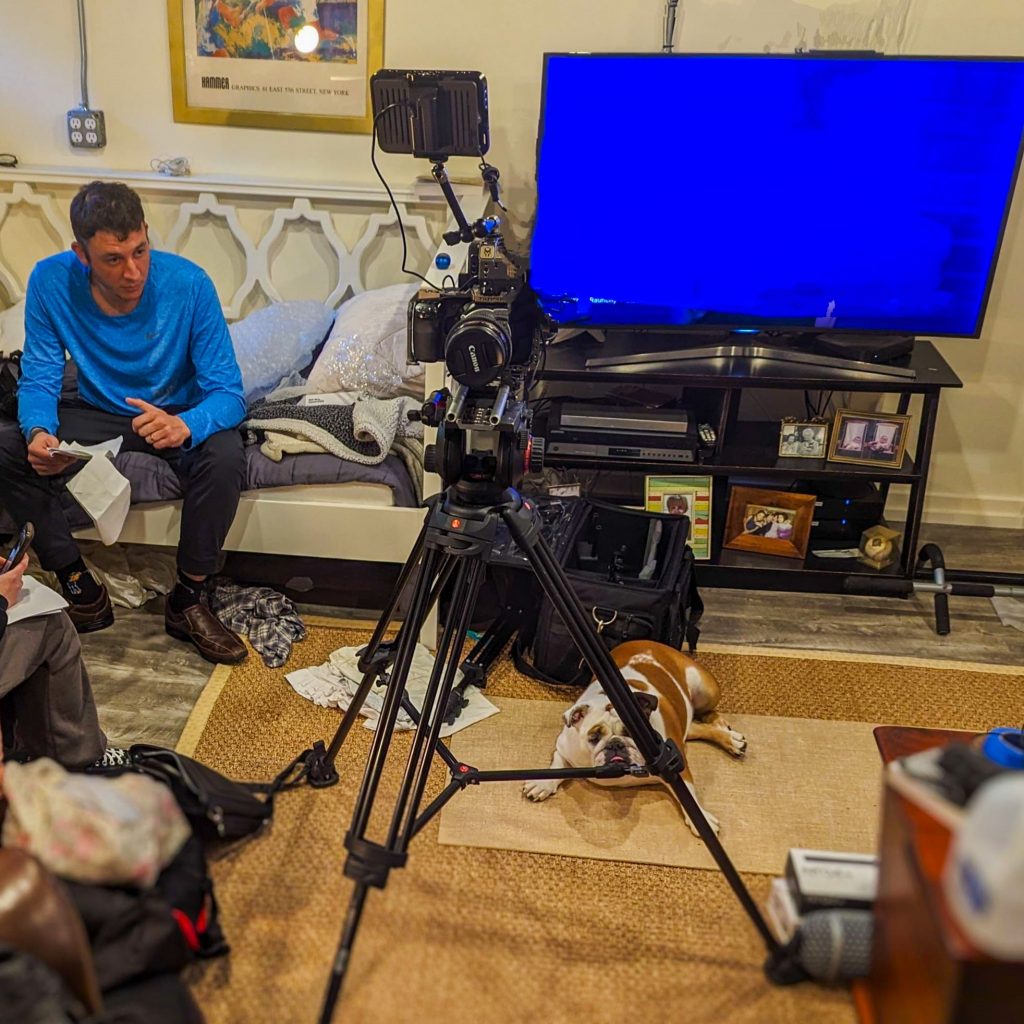
The last piece of the puzzle for the short film’s talented ensemble was Nolan, a director of photography whose contact I’d been given by someone in recovery. She said she knew someone who was a DP; little did I know that exchanging of numbers would result in me finding a new creative partner, one who I’d work with closely in the following months honing in on the look of the short. Nolan also brought along a friend of his, Nico, who assisted with lighting and also kept my bulldog calm for a while (she kept laying on the light because she thought it was a fire, and she was always barking during takes). A special round for Nico.
One last note. Between Nolan’s fee and the cost of renting a Blackmagic camera from the city on ShareGrid – don’t sleep on the look of the film – I had about $730 to cover, and that’s before buying food for everybody, something that in hindsight you should definitely factor into the savings. God, was I lucky that Matt had his own sound equipment. How did I cover this? Long story short, dog sitting. My parents had some friends that were going away for a week and needed someone to watch their dogs from Christmas through New Year’s Eve. I didn’t know how much I was getting paid, and I didn’t want to ask, but I knew I couldn’t make this film happen drawing on existing funds. It ended up covering $600 out of the $750.
I go through this lengthy prologue and outlining of context – bear with me – to show that putting together a short is by no means a formal, refined process, at least when you’re starting out. You try to cut the corners that can reasonably be cut, draw on people you know, and save up some cash where you can. In the beginning, that’s how producing something is. You’re not getting any blank checks from Paramount, there aren’t any due dates for drafts, it’s all up to you. Doesn’t matter whether you wrote it or not, when you’re taking ownership of a project, that’s what it entails.
Why the hell was I even trying then? I write, I like it, I’m sort of good at it, shouldn’t I stay in my lane? Matt was probably more of the director on all the other projects, even if I didn’t admit it at the time. But Matt told me that I’d need to get around to it eventually, because he knew that deep inside I wanted to be able to direct my own work. I guess he saw potential in me that I didn’t see in myself. I reasoned with him that this was the first thing we were really putting some money into, and the rest of the team were pros, I didn’t want to be the one to fuck it up. He should do it instead. But I couldn’t deter him, so I figured I would just do it.
Being both the writer and director, I sort of went in with the notion that the short film would come out the best if I made sure every line was said exactly as it was written. I was so wrong, and I am so grateful I didn’t stick to my guns on keeping every word the same.
I learned that actors perform the best when they say the lines in the way that feels most comfortable for them, being open to their input. More often than not that means slightly tweaking some of the phrasing and even improvising at some moments. Those gave way to some of the best takes we got. To let the actors do their work and facilitate their performance rather than block it up, I had to do two things that were hard for me: exercise trust and let go of control, control that manifested in wanting to keep the writing the same. It brings me back to those old projects where I’d give notes because I felt like I needed to. Worst case I ended up being a bit hands off, and I’m sure my self-doubt came more to the surface than I would have liked at points, but I’d take that any day over the possibility of stifling the actors’ abilities to mess around and try things out. In the beginning of the first day, I was still a little rigid, inquiring distrustfully about why Rylan or Hannah wanted to rephrase a line. I had this instinct deep inside — one I still can’t explain — that if I let a word of the writing change things would fall about.
To change such a long-held, rigid belief was equal parts jarring and freeing.
It doesn’t mean there’s something wrong with my writing, that’s not what it’s about. The thing that needs to be acknowledged — that I forgot — is that your script is a blueprint. I’m not trying to paint in broad strokes, it probably wouldn’t be good idea to have your script drastically reworded on the fly, but if the changing out of a verb, the tweaking of intonation, or — most often — cutting out a few words is what helps an actor feel more comfortable, it’s usually the right call to let that change occur.
Hopefully this piece helps writers, creators, anyone wishing to direct when it’s not their strong suit. I also have the instinct that a lot of you writing these films or shorts often take on the producing and or directing roles, so I’m hoping that my touching on how I came to know these people — and get the dough to make the damn thing — was of some use. I want to repeat again that starting out, it’s not the most calculated process. You’ll save yourself a lot of stress if you acknowledge neutrally what you do and don’t know. Also, take input from the people who do know what they’re doing, whether it’s the actors or your friends behind the camera. The title of “Director” ultimately doesn’t matter as much as knowing that all of this is a team sport. Lean on your collaborators, be nice to them, make them feel seen, and make them feel heard. The film world — and, just, the world — already has enough a–holes.
Posted in UncategorizedComments Off on Making a short film
“Did you like being on co-op more or being in classes?”
“So, you don’t take any college classes during half of the year?”
“Are you going to continue working at your co-op company and drop out of college now?”
We Drexel students are faced with a myriad of questions from people who do not understand the co-op system or are sparsely aware of how co-op and class transitions happen. I was curious too when I started Drexel – I remember bombarding an upperclassman friend of mine with a ton of questions until I had clarity. Allow me to draw examples from my experiences to clearly describe how it feels to jump back and forth between classes and co-op.
It is almost noon and I finally get a chance to catch a breath, solely because one of my morning classes ended early today. One month ago, I would have had daily standup meetings with my team at exactly this time. It is strange how my life a month ago has been completely replaced by a new one. This is not just me; this story is universal to every Drexel student who studies within a curriculum including co-ops.
For someone with a plan of study like mine, the first co-op begins right after freshman year ends. I am an international student, who came to the United States all the way from India and as soon as I started to get the hang of college – boom! It is not the same anymore; I went through a transition from classes to co-op shortly after the gigantic transition from high school to college. I personally did not hate it, but overall, this can get quite challenging for some people.
At first, students go from turning in assignments every week, to discussing weekly progress with a manager on a weekly basis. It is very different. The noteworthy point here is that starting a co-op is still a smooth process, especially if students find a good place to work at, like I did. But, the difficulty arises when you have to go back to classes. Becoming accustomed to a corporate environment can be challenging, because there are many rules and regulations, and most importantly, you welcome some true elements of adulting in your life. You are not expected to act like a kid, which you could possibly do in college with convenience. This is not how it is at the workplace. You are always expected to be responsible and accountable for your actions and what you do affects other people on a larger scale. This is something you generally never experience during your college education. After going through this metamorphosis, it feels strange to go back to classes. Some people have more time for themselves as they come back to classes, while others also complain about not having time for leisure even on weekends. Most importantly, there is no break between the end of the co-op and beginning of the classes – which is bizarre. I did not have a spring break; my last working day was a Friday and I resumed classes the following Monday. Due to this, I began the quarter exhausted, and as I approach midterms, I feel how much I needed a spring break back then.
However, I believe that being prepared for the unexpected is quite a life skill, and I certainly picked it up recently. Things would never be predictable, whether in your career or life in general. So, I see this as something that is instilling endurance in me. Each time I meet Drexel alumni, most of them thank the co-op process for giving them a professional edge over people who graduated without undergoing cooperative education. The co-op system is pretty much Drexel’s biggest selling point, and although it compels you to push your limits, I believe it largely enriches the college experience.
Posted in UncategorizedComments Off on Spilling the tea on Drexel’s co-op to class transition
The summer is a great time for students to hit the reset button and reconnect with friends they have not seen in months. What better way to spend a cool summer night than with a tabletop game? Here is a list of five must-have tabletop games for students to play this summer.
Hold’em Havoc
A unique take on the classic game of Texas Hold ‘em, Hold’em Havoc adds a unique layer of fun for poker night. I was fortunate to get a chance to try Hold’em Havoc at PAX East earlier this year. Each card has an ability that can change the dynamics of the game, including looking at other player’s cards or getting rid of community cards that are laid face-up in the middle of all players. This fresh take on Texas Hold ’em is perfect for folks who are disinterested in the pacing of traditional poker games. Hold’em Havoc is perfect for poker nights with friends who want a faster-paced game with a bit more strategy.
Settlers of Catan
Created in the early 1990s, Settlers of Catan is a game older than many Drexel students. The premise of the game is straightforward and fun. A board covered in resource tiles represents different resources players can acquire. Dice are rolled to determine who gets what resources each turn. The resources can then be used to build roads, towns or villages. They can also be used for resource cards that give players the ability to do special actions like move a robber around the field to prevent other players from collecting resources. The simple rules make it easy to learn yet difficult to master. Its popularity has made it a staple at tabletop conventions and local game stores.
Blokus
Are you a fan of Tetris? Either way this game will be one you enjoy. Blokus focuses on a similar tile laying mechanic as Tetris, but with a few unique rules. Tiles can only be laid diagonal to another tile. A layer of strategy is added into the game when considering different ways to block opponents from laying tiles down. The winner is crowned when no player can lay any more pieces onto the board. The player who has the fewest remaining blocks at the end of the game is the winner. Like other games on this list, its simplicity makes it incredibly fun and easy to learn yet difficult to master.
Quoridor
Great for fans of strategic tabletop games, Quoridor is a strategy wall building game where players attempt to move their character piece into the opposing player’s field zone to win. The rules are simple: players can either place a wall piece to block their opponent’s movement, or they can move their player piece closer towards the goal zone. The game requires a lot of forward thinking, like chess, but is much simpler due to the limited number of pieces. Quoridor received the Mensa Mind Game award in 1997, meaning it is a great game for people who enjoy a duel of the minds.
Heroclix
Heroclix is by far the most complex game on this list, but hardcore fans of tabletop games will love the seemingly endless strategy options in a unique collectible miniatures game. The rules for this game are long. You will need a YouTube video to understand all the nuances of character abilities. The game becomes really enjoyable once you get the hang of things and are able to get a game going. Players assemble a team of heroes based on various franchises (mostly Marvel but there’s others as well). The goal of this game is to defeat your opponents before they defeat you. For a more detailed list of rules, and to see if Heroclix is something you would be interested in, check out their website: wizkids.com/heroclix/gameplay/how-to-play.
Posted in UncategorizedComments Off on Top five tabletop games to play this summer