
Author Archives | Robert Zaller

Self-impeachment appears to be Trump’s 2020 strategy

Photograph courtesy of Joe Burbank at Tribune News Service

Donald J. Trump is now the fourth of our presidents to face impeachment. Two of them, Andrew Johnson and Bill Clinton, actually were impeached, although neither of them were removed from office by the Senate. Johnson survived by the margin of a single vote, but his political career was ended, and although he finished his term he was not nominated to a new one. Clinton was serving a second and final term that he completed, retiring with a high approval rating but one that has not, over the years, sustained itself.  Richard Nixon resigned the presidency as impeachment articles were being drafted, and his support in the Senate collapsed. His tenure ended in disgrace, and he remains, to this point, the most reviled of our presidents.

Now Donald Trump faces impeachment. Officially, what has opened is an impeachment “inquiry,” or an investigation as to whether Trump’s conduct warrants removal from office and on which grounds. There is little, if any, doubt that a bill of impeachment will result. About half the general population and a decisive majority of Democratic voters favor it. The Democratic majority in the House of Representatives has politically committed itself to it. It can’t be avoided under any circumstances that can presently be conceived.

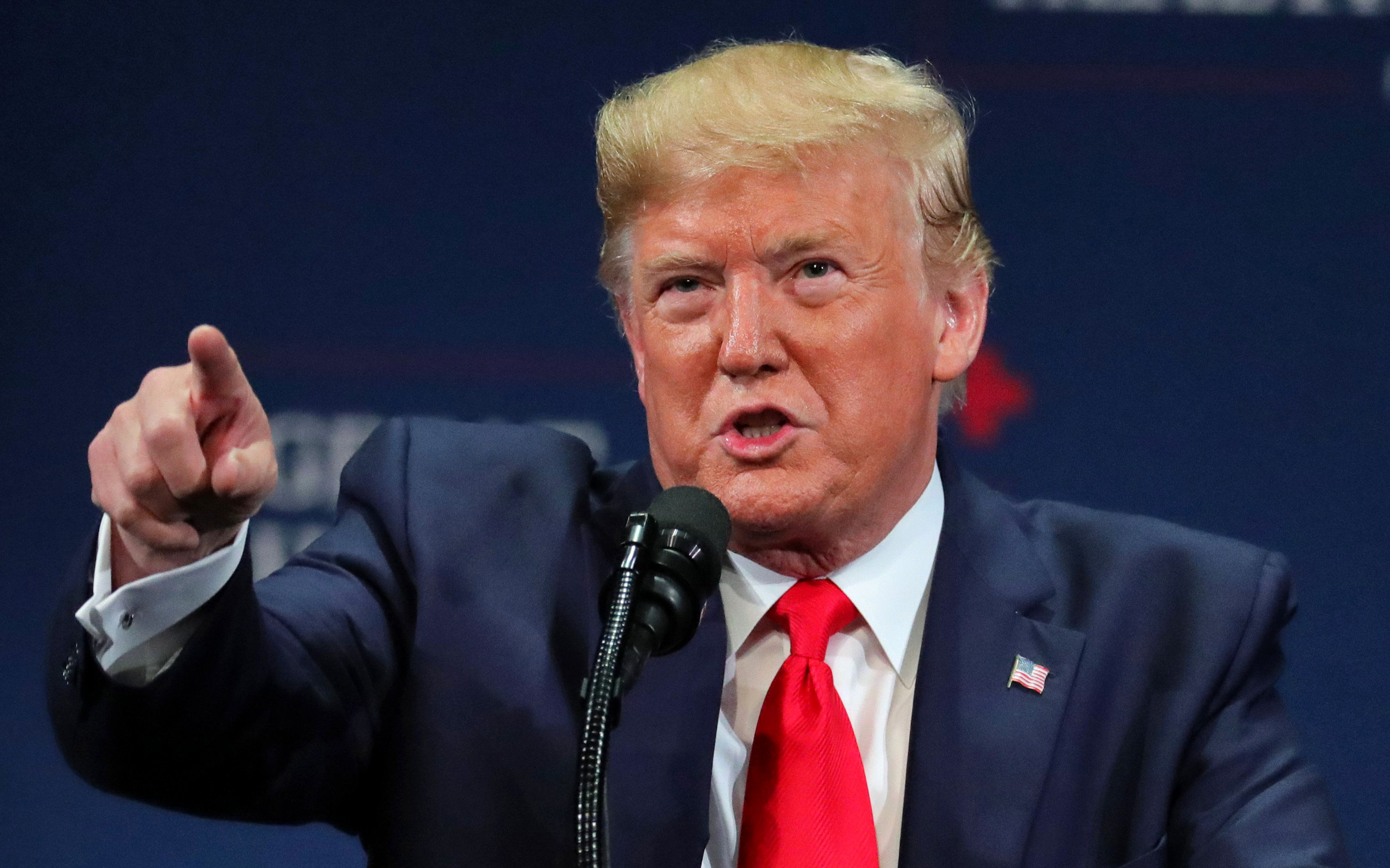
Impeachments are supposedly bad news for any president; successful or not, they are a permanent stigma. But Donald Trump seems to be not only accepting his impeachment, but courting it. In fact, he has gone so far to do so that some commentators have taken to characterizing his recent behavior as a form of self-impeachment; that is, as a deliberate confirmation of the single charge that pushed House Democrats into opening their formal inquiry.

The charge was that Trump, in a phone call to Ukrainian President Volodymyr Zelensky, attempted to coerce him into finding or conjuring up dirt on his presidential rival, former Vice President Joe Biden. In return, Trump would give his support for Zelensky’s beleaguered regime and the release of Congressionally appropriated funds for its defense. In other words, Trump was using American foreign policy to further his campaign for re-election. It is probably a safe bet that similar incidents have happened before. In this case, however, it was the President himself speaking officially on a multiparty wire, and a whistleblower made the fact public.

When this news created a furor, Trump, contrary to his usual habit, promptly released a transcript of the call. One can only assume from this that he saw, as indeed he said, nothing improper in what he had done. In his transactional world, favors are routinely exchanged for favors, and since he makes no distinction between the country’s interest and his own, there would be nothing exceptionable about his call in his view.

Trump’s Republican defenders did their best to provide damage control. Trump was having none of it, however. Before reporters on the White House South Lawn — that is, before the entire world — he not only repeated his call for Ukraine to investigate Biden, but urged China do so about Biden’s dealings with Beijing as well. In short, he was making the impeachment inquiry’s case for it and all but writing what appeared might be the critical article of impeachment himself.

Why would Trump do such a thing? In general, his practice when attacked has always been to up the ante and double the dare. It is also his tactic to accuse others of doing maliciously what he has done innocently and properly. He can then repeat his charges against them ad nauseum, with mere repetition constituting the proof required. This worked for Joseph Goebbels, and it is working for Trump; Biden’s polls are falling, and Trump will likely have the opposition candidate he prefers next year, Elizabeth Warren.

Trump may thus have stumbled into impeachment, but, unlike other presidents, he is determined to turn it to his advantage. He is already getting rid of the candidate he thinks might best have appealed to moderate and independent voters, as Richard Nixon did in 1972 by smearing Edmund Muskie to face the opponent he wanted, George McGovern. That in itself might make an impeachment worthwhile, and with Republicans in the Senate still firmly in his camp — or perhaps, terrified of straying from it — he is, as of now, invulnerable to removal from office there.

Like all demagogues, what Trump wants above all is to make every issue and every moment about himself. He knows that the opposition figure he fears and respects the most, House Speaker Nancy Pelosi, has been forced unwillingly into the impeachment battle — and he certainly plans to make a misogynistic campaign against Pelosi and Warren the centerpiece of his strategy for 2020.  It worked, after all, against Hillary Clinton. He’s piling up a huge war chest too, so corporate money certainly isn’t fleeing him. And, unlike his helter-skelter 2016 campaign, he’ll have a highly targeted program for potential voters this time around. The Democrats don’t have anything like it.

Will it all work? No one can tell what further revelations of misconduct may await, or how close to the line Trump can skate without tripping over it. But he has already survived the equivalent of a dozen Watergates, and no one can safely say when or how his luck might run out. Is a principled defense of the Constitution against his manifold abuses of power justified and necessary? Yes. Is it enough to rid us of him? Donald Trump doesn’t think an old piece of parchment, which, in Jerrold Nadler’s phrase, he’s already twisted six ways from Sunday, is going to stop him. And I have no doubt he’s right. It will take the people and their representatives to do that, if they can and will.
Posted in UncategorizedComments Off on Self-impeachment appears to be Trump’s 2020 strategy

Impeachment in Washington, Storm over London

Photograph courtesy of Dylan Martinez/PA Wire at Tribune News Service.

Something is happening that’s never happened before: the world’s two oldest democracies, Britain and the United States, are simultaneously experiencing constitutional crises they haven’t faced in a long time.

In London, the British Supreme Court — an institution only 10 years old, and fashioned primarily as a body to deal with rulings by the European Union — was forced into a political dogfight when Prime Minister Boris Johnson prorogued Parliament as soon as it convened. This was ostensibly to prepare the session’s legislative agenda but, as universally understood, actually meant to preempt debate about Britain’s controversial exit from the European Union. Essentially, the argument was about whether Johnson was lying about his purposes in ordering the prorogation, and whether he had lied to Queen Elizabeth in securing her approval for it. This was not, then, truly a legal case, but a political one. The Court, in holding the prorogation unlawful and hence void, acknowledged this in saying that its ruling should not be taken for a precedent since the circumstances were unlikely to recur. As I pointed out in my article of last week, that was precisely what had happened, since a prorogation challenged as unlawful in Parliament had occurred in the early seventeenth century and it took the bloodiest war ever fought on British soil to resolve it. At the moment, it is not at all clear where Britain’s current crisis will take it.

Meanwhile, the evolving drama over Donald Trump’s efforts to pressure Ukraine into reinvestigating Joe Biden’s dealings there during his second vice presidential term has resulted in impeachment proceedings in the House of Representatives. This is a development that could one could not have foreseen a few weeks ago, and yet in retrospect seems inevitable. More than half the House Democratic caucus had already come out in favor of impeaching Trump on charges so numerous — serial violations of the law and of his oath of office; brazen self-enrichment; incitement to racial hatred and violence; abuses of power ranging from illicit manipulation of tariffs to diversion of public funds to putting children torn from their parents in cages — that one was spoiled for choice. The problem with these accusations, however, was that they were all factually or interpretively disputable. There was, in short, no legally smoking gun.

That gun was supplied when a CIA whistleblower accused Trump of having personally shaken down the newly elected president of Ukraine, Volodymyr Zelensky, by phone for material that could compromise Biden’s own bid for the White House. When, under pressure, Trump released a preliminary transcript of his conversation with Zelensky, the text substantially bore out the accusation. The added fact that Trump’s own staffers had attempted to conceal it by placing it on a classified server suggested an attempted cover-up as well. Politically, this was the equivalent of Watergate: an effort to discredit political opponents on behalf of the president followed by an attempt to suppress the evidence. This time, however, the president himself was directly and immediately implicated: the phone call was Trump’s own.

Trump, as a candidate for president, had openly solicited damning information about Hillary Clinton from Russian intelligence. As recently as June 13 of this year, he stated that he remained open to any source, including foreign agencies, that could provide dirt on an opponent. This is statutorily and constitutionally illegal. Moreover, the statement had been made in the aftermath of the Mueller Report, which identified foreign interference in our elections as the greatest threat to American democracy, a point repeated publicly by Robert Mueller himself in his testimony to Congress July 24.  Trump’s conversation with Zelensky had occurred the very next day.

This wasn’t just a smoking gun hastily hidden. It was a smoking gun found in the President’s own hand.

After Trump himself — and perhaps even ahead of him, since he seemed not to have recognized the significance of his own action — the person most dismayed by the whistleblower’s revelation was Nancy Pelosi. Pelosi had fought for months to deflect impeachment proceedings against Trump, despite rising pressure in her House Democratic caucus and calls for it by prominent figures such as Elizabeth Warren, at this point Biden’s chief presidential rival. There’s no question that Pelosi considered Trump worthy of impeachment, as House Judiciary Committee chairman Jerrold Nadler said. Nor was her personal contempt for him any secret. But Pelosi felt that impeachment, all but certain to fail in the Republican-controlled Senate, risked potentially fatal damage to the Democrats’ chances across the board in the 2020 elections. It would undoubtedly be divisive; it would certainly be construed as partisan; it would energize Trump’s political base. Above all, it would still leave him in office.

What Pelosi realized, however, was that the Zelensky call made it impossible for the Democrats not to impeach Trump, and that, as the Party’s de facto leader, she had to get in front of the fact as quickly as possible. Even so, she labeled this as an “inquiry” into whether articles of impeachment should be drawn up, rather than a proceeding based on the assumption that they would be. She also made it clear that there would be no formal vote in the House to authorize such an inquiry, which deprived House Republicans of the opportunity to contest it.

This means impeachment will now result, for if it did not do so the Democrats would be conceding that none of Trump’s conduct as president was sufficiently offensive to require his removal from office. That, at this point, would be crushing to them. It would also be crushing to any constitutional restraint on the office of the presidency.

“If the president does it, it’s not illegal,” Richard Nixon once famously said, and Trump has said that the Constitution permits the president to do whatever he wants. Once the process of impeachment is undertaken, failing to hold Trump accountable for what he has done would make it immensely more difficult to restrain him or any successor from abuse of power. We’d still have a country. It just wouldn’t be ours.

The next several weeks or months will thus be among the most politically important of our lifetimes.  Pelosi, stuck with the last job in the world she wanted, must do it supremely well, coordinating the committees that will produce the articles of impeachment and taking the high road of patriotism. Trump will accuse the Democrats of partisanship every day, not to say treason, an epithet he has already hurled at the chair of the House Intelligence Committee.

We learned, after the fact, how close Nixon came to privately unraveling in the White House as he confronted impeachment. Trump is coming apart in public, and that is far more dangerous. Republicans, no less than Democrats, will soon be facing their moment of truth. Events may drag on through 2020, and their repercussions will certainly be felt long after. They could also come to a head very quickly. We have dealt with impeaching presidents before. But we have never dealt with a Donald Trump.

Posted in UncategorizedComments Off on Impeachment in Washington, Storm over London

History is repeating itself inside England’s Parliament

Photograph courtesy of PA Photos at Tribune News Service.

Karl Marx said that history repeats itself, the first time as tragedy and the second as farce. Of course, that doesn’t preclude tragedy following the farce.

In March 1629, King Charles I ordered the prorogation of England’s Parliament. A prorogation is a suspension of proceedings. This was well within Charles’ right, since at the time the summoning, adjourning and dissolving of parliaments was understood as part of the royal prerogative. This time, however, was different. Parliament had only the previous year tortuously negotiated an agreement with the King to forbear raising taxes without its consent or to imprison his subjects contrary to law. Charles had violated these agreements, and Parliament was examining these violations among other matters. The members of the House of Commons had good reason to believe that the prorogation of Parliament would swiftly be followed by its dissolution and that Charles might now simply attempt to rule on his own and as he pleased.

Parliament could not prevent the King from sending it home. But some members had prepared a resolution condemning anyone, not excluding the King, who violated the previous agreement as an enemy of the commonwealth. The Speaker of the House could not recognize this resolution because an order of prorogation stopped all business. But several members, rushing forward, held him down in his chair until the resolution had been adopted.

When I taught the history of those times, this moment was always a dramatic highlight. It had consequences, too. Twenty years later, after a bloody civil war, a court whose dominant figure had been a freshman member of Parliament in 1629 sentenced Charles to death as a traitor and cut his head off.

This was one piece of history I did not expect to see repeat itself. But it did this month when members of the current English Parliament rushed its Speaker, John Bercow, who had just been ordered to prorogue it, and held him down as his predecessor had been nearly 400 years ago.

There were differences, of course. The prorogation was sent in the name of Queen Elizabeth II, but was the act of England’s new prime minister, Boris Johnson. Bercow did not resist being restrained but joked with the MPs who surrounded him. No one is going to lose his head over the matter, at least literally. But it is serious business nonetheless, the gravest constitutional crisis England has had in over a century. And it suggests some of our present political crisis too.

Johnson prorogued Parliament to silence it while he maneuvered to meet an October 31 deadline to leave the European Union. This deadline was imposed after Parliament rejected the terms of withdrawal negotiated by his predecessor, Theresa May. Without a withdrawal agreement, a so-called hard British exit from the EU would leave Britain without terms of trade or border controls with most countries on the continent, and uncertain status both for Britons living in Europe and Europeans living in Britain. The general consensus is that this would lead to severe economic disruption, including shortages of vital goods and a serious contraction of British trade and living standards over a prolonged period. More time to reach an agreement would thus seem critical, and Parliament, both protesting the prorogation and before submitting to it, resolved to seek an extension. It further passed a bill declaring that Britain would not leave the EU before reaching such an agreement. Johnson responded by stating that he would ignore both resolutions, and expelled 21 members of his own party who had supported them. The case went to the courts and is likely to wind up in England’s newly-instituted Supreme Court.

Does any of this sound familiar?

Like Donald Trump, Boris Johnson breezily ignores laws he does not like. He happily flouts or perverts constitutional processes and defies any attempt by his legislature to restrain him or call him to account. He plays recklessly with the economic future of his country. And, oh yes, he is a habitual liar, blowhard and philanderer.

The English political system is very different from ours. There’s no written constitution. There’s no independent executive branch. The prime minister isn’t directly elected but is the designated leader of whichever party commands a majority in the House of Commons. There’s no term limit on service, but the party can remove him or her at will. Parliament — since 1911, essentially the House of Commons — is the principal organ of state. Its legislation can’t be vetoed or overturned by any person or body, the courts included. What keeps it in bounds is respect for traditional norms and liberties. But it can ignore those bounds if it wishes. The law is what that majority party, voting as a unit, says it is.

This sounds like a prescription for legislative tyranny. That’s not the way the present-day English system works, though. Parliament is a theater. The real power is in the hands of the prime minister. As head of government, he devises the annual legislative program. As party leader, he ensures that all party MPs vote for it on pain of expulsion from its ranks.

The prime minister also commands an executive bureaucracy that wields extensive legal and administrative powers. The military and police, the intelligence agencies, and state services in general are responsible to him. Counties and localities have no independent powers or revenues.

This is not an aberration. Most modern parliamentary systems have evolved in the direction of a sovereign executive. The same is true of our presidential system, which notionally provides checks and balances but where presidents have increased their powers steadily from George Washington’s day. Traditional monarchy, in short, may not have died with George III of England and Louis XVI of France. Under different names and circumstances, it may be alive and well in modern democracies.

Donald Trump cannot suspend Congress for weeks on end as Boris Johnson has just done. He hasn’t yet claimed the power to override Congressional vetoes. But he has invoked spurious emergencies to bend or break established laws and divert tax monies and treated the armed forces as a militia at his disposal. He defies Congressional subpoenas and orders his underlings to do so as well even when they no longer work for him. He hasn’t yet stated his intention to simply ignore acts of Congress as Boris Johnson has those of Parliament, but that may not be far off. In any case, Donald and Boris are birds of one feather. What they feed on is what remains of democratic government.

The men of 1629 who held down the Speaker of the House knew that they risked their lives and fortunes to declare acts against law to be treason, and that no court would protect them from a king’s vengeance. Does anyone on either side of the Atlantic have that kind of courage today?

Posted in UncategorizedComments Off on History is repeating itself inside England’s Parliament

The Mueller Hearings: Tragedy, Dereliction, and Farce

The Mueller hearings have come and gone, leaving us predictably no closer to a resolution of our constitutional crisis and shorn of any remaining illusion that it is likely to be meaningfully addressed in what little time remains before we are plunged into the maelstrom of the 2020 elections. The tragedy of the hearings was twofold. The lesser aspect was the spectacle of an honored public servant forced to expose himself in public as a man beset by age, and by the very fact of that to subject the final and most important work product of his career to skepticism.

The Robert Mueller who appeared for nearly six hours before the House Judiciary and Intelligence committees was a man often halting in speech and demeanor, bearing scant resemblance to the one whose acuity was fabled in Washington. But Mueller had other reasons for saying as little as possible. His inquisitors, both Democratic and Republican, each wanted something from him that he felt he should not give them. Democrats wanted a personal indictment of Donald Trump that would imply if not openly declare the necessity for Congressional action against him. Republicans sought to undermine the credibility of the Report he had been tasked with delivering to the Justice Department, which has yet to be seen in its fully unredacted form by anyone outside the Department and whose underlying evidence remains locked in its files. No one facing him was a friend. He had made clear his aversion to testifying, and appeared only under subpoena. He knew he was not in as full command of the Report’s details as he might once have been, and that questioning would reveal this. Most importantly, however, he was determined not to serve any interest other than that what he believed to be the public one as a whole, and that, as he tirelessly reiterated, had been served as far as it could be by the Report itself.

He did, in short, what he thought was right both for the country and for himself. And it was right. Protecting the integrity of the Report and those who had compiled it was an essential duty. Refusing to give himself to those who wanted the Dutch courage to follow the Report where it clearly led was also a duty. What we saw on display was thus not a purposive exhibition of forgetfulness or evasion; it was an act of patriotism. The larger tragedy of the hearings, and of the dereliction it entailed, was in the fact of having forced them on Mueller at all. The persons called to testify publicly should have been those directly implicated in the findings of his Report: Donald Trump, Jr.; former Attorney General Jeff Sessions; former White House Counsel Don McGahn; and so forth. None of them have appeared. The only public testimony before major House committees has been that of Trump’s disgraced lawyer, Michael Cohen, and now of Mueller himself.

The reason why the principals in the Report have not testified is because Trump, in defiance of Congressional subpoenas, has ordered them not to. This itself would be an impeachable offense on his part, if formal impeachment proceedings were underway. Constitution tasks Congress with the oversight of the other branches of government, and empowers it to compel testimony to that end. The impeachment power itself grows out of this. To defy subpoenas is to upend the most critical power vested in the Constitution to remedy judicial overreach and executive tyranny, and thus to protect the Constitution itself.  There could be no more serious challenge to our system of government, and to the rule of law it defines.  For the House of Representatives to submit to a defiance of subpoenas, not merely in a particular case but as a blanket rejection of its authority, is as extreme a dereliction of its own duty as could well be imagined. The response of the House has been to appeal Trump’s defiance of its subpoenas by holding some officials in contempt, and to appeal their rejection to the courts. The contempt citations have been met with contempt, and the court appeals are simply wrong. It isn’t for a federal judge to decide which powers Congress may exercise, but for Congress itself.

Moreover, as is increasingly apparent, the decades-long campaign to stack the federal bench with justices favorable to the most expansive view of executive authority has borne fruit, particularly in the Supreme Court. Only last week, the High Court ruled, astonishingly, that Donald Trump may use monies to build a border wall specifically rejected by Congress for such a purpose. This undermines the most fundamental power of the Congress, which is to legislate and appropriate. Without Congressional command of the power of the purse, there is literally no check on executive tyranny at all. The courts have recently been friendly to Trump in other ways — a suit aimed at his violation of the emoluments clause of the Constitution has been rejected, as has that over whether Trump’s unreported hush-money payments to a former mistress at the end of the 2016 campaign was not a prosecutable violation of campaign finance laws. A couple of justices have recently shown themselves sympathetic to the preposterous claim, backed by the Justice Department, that the Affordable Care Act has been nullified by the repeal of a single one of its provisions.

Congress has nowhere left to turn at this point except to itself. If it does not move to impeach, it will leave the country functionally helpless before a president who has stated his view that the Constitution leaves him free to do whatever he wants, and who has just added Afghanistan to North Korea and Iran as places he would feel free to bomb off the face of the earth — again, at his own discretion. We are at the point of farce, defined by Webster as “an empty or patently ridiculous act, proceeding or situation.” Farce is supposed to be funny. But its ultimate mask is tragedy. That brings me back to my takeaway from the Mueller hearings. It is Mueller’s own face, which through hours of testimony held a single, somber expression. I realized, watching it from first to last, that this, and not as Mueller said in the Report itself, was his true testimony. He meant to say what his face presented: a single, unemphatic, but unflinching beacon.  And what that mask told us, more than any words could, was the scope of our tragedy.

Posted in UncategorizedComments Off on The Mueller Hearings: Tragedy, Dereliction, and Farce

The Race to the Moon and Fate of the Earth

Most anniversaries wear with time. Few, however, have faded as quickly as the Apollo 11 moon landing half a century ago on July 20, 1969. More than half a billion people watched it on television screens around the world as it occurred, not an extraordinary audience in the age of Facebook and global identity theft, but an impressive number back then. Few gave it more than a shrug last week, despite dutiful media coverage.

There was never a good reason to put men on the moon, unless one counts the prodigious engineering feat of getting them there. The Wright brothers had flown their first airplane for about 12 seconds at a height of 10 feet. Sixty five years later, rockets thrust three men out of the earth’s orbit and 240,000 miles to land — with thirty seconds of fuel to spare — for the first time on an extraterrestrial world. As a feat of technological prowess it seemed unexampled, although when one considers that the Russians had already orbited the earth and placed a man in space, it was the achievement of more than a single country. Had, in fact, the Russians not gained a seeming advantage in space exploration and what was (falsely) advertised as one in rocketry — the so-called “missile gap” of the late 1950s — the crash program to put men on the moon might never have achieved political liftoff when President John F. Kennedy announced it to a half-empty stadium in September 1962.

Kennedy, having been humiliated by the Bay of Pigs fiasco, outmaneuvered by Nikita Khrushchev at their summit in Vienna, and facing uphill odds in the midterm elections two months away, badly needed a counterstroke. He was already receiving intelligence too about the Soviet nuclear buildup in Cuba, which would soon bring the world to the brink of Armaggedon. A race to the moon, whether or not Russia took the bait, was an at least rhetorical demonstration of America’s determination to remain the world power second to none. As a specimen of Kennedyesque bluster, it impressed few at the time, and Kennedy’s predecessor, the still wildly popular Dwight Eisenhower, mocked the idea as a waste of time and money. The world survived — narrowly — the Cuban Missile Crisis that threatened it with all-out nuclear war a month after Kennedy spoke, which would have canceled a great many projects besides a trip to the moon.

Kennedy did get funding for his moonride, the cost of which was ultimately $25.4 billion. By the time Neil Armstrong and Buzz Aldrin were ready to plant a flag and leave a Bible on the moon, America was a very changed place. The civil rights movement led by Martin Luther King had eventuated in riots that burned Newark, Detroit and Washington D.C. itself. The Vietnam War, a Cold War adventure that barely registered in the national consciousness in 1962, had become an all-consuming nightmare that had torn the country apart. Kennedy himself had become the first president to be assassinated in more than 60 years, a harbinger of the violence to come. The president who greeted the moon landing was Richard Nixon, who would leave office in disgrace five years later, and whose administration sowed the seeds of division and hostility that would ultimately produce Donald J. Trump. America might congratulate itself for a brief moment on what it was undeniably good at — a daring and spectacular feat of engineering driven by can-do teamwork and capped by heroic individual effort — the quintessential symbol of American enterprise. But the disparity between the technical problems it had solved in space and the human ones that pitted Americans against each other on earth then and since only threw the latter into high relief.

Scientifically, little was accomplished by sending men to the moon that could not have been achieved by unmanned missions. In all, 24 astronauts reached its surface until manned missions ceased in 1972, and the subsequent disasters of Apollo 13 and Challenger underscored the dangers of them. Our one orbital site, the space station, would ultimately be serviced by the Russians as interest in NASA programs atrophied and funds dried up. Plans to send humans to Mars crop up periodically, only to be at least thus far shelved. If you’re rich enough, you can now be posthumously shot into space, and Elon Musk says he wants to be buried on Mars. That’s about as far as it goes.

Paradoxically, the most significant result of our trips to the moon may be the famous picture taken of our blue planet from there, showing its beauty but also its vulnerability as the home we have so largely despoiled. The picture has been credited, though wrongly I think, with stimulating the environmentalist movement. Certainly the moon landings themselves, and their approach to space as such, suggest a very different mindset. Neil Armstrong’s well-rehearsed line about his boot on the lunar surface being a giant leap for mankind implies an imperial mindset, and the subsequent description of the moon — for ages a source of human wonder, and the prime image of human love — as feeling underfoot “like dirty beach sand,” will hardly rank with Shelley.

It isn’t just a question of poetry. The moon is a hot commercial property now, and there isn’t even a zoning board. Just about everyone with a booster rocket or two wants to get a piece of it, including private consortiums. Everyone who comes, moreover, deposits a pile of junk behind. One American astronaut even left a cache of $2 bills. That seals it: the moon is open for business. It even has its own bank now.

We can expect junk not only on and around the moon; we have it around Planet Earth, as more and more artificial satellites circle it, and more and more of its land and water suffer the effects of carbonization and acidification. With an American president publicly eager to militarize space, we can expect our juvenile war games to make everything and everyone a target, whether of commercialization, surveillance or destruction. We aren’t, then, simply marking an anniversary with the Apollo 11 landing; we are looking at the grim future it portended. Born in Cold War politics, baptized in the chauvinism of planting a flag, it represents now not humanity’s propensity for adventure but, in many respects, its atavism. For a species still in its moral infancy, a giant leap was not necessarily a forward one. Maybe, these days, we should think about some baby steps first.

Posted in UncategorizedComments Off on The Race to the Moon and Fate of the Earth

Drexel, the Hahnemann Debacle, and American Medicine

Photograph courtesy of Jonathan Wilson at Tribune News Service.

Drexel University finds itself smack in the middle of the Hahnemann Hospital closing, a debacle that has gained national attention, including that of presidential candidate Bernie Sanders. The hit to Drexel’s reputation is minor compared to the tragedy of Hahnemann itself, but it is significant. And it was foreseeable from the beginning.

Once upon a time, the United States invested in public hospitals to care for the poor. With this investment came oversight and responsibility, as with any public management. The country invested similarly in things like public housing and public schools and universities. Generally, the goal wasn’t, excellence, but adequacy. Medical care, still not recognized as a human right in America, was nonetheless a necessity, especially in crowded cities where untreated disease could easily spread (rural communities could largely be left to fend for themselves, as they are today where some counties have shockingly little access to basic services.). Unchecked rental costs could make housing unaffordable for the poor in conditions meeting the minimum standards of decency and sanitation.

Public education was the only practical means of meeting the requirements of a skilled labor force in an industrial economy. For a while, these public institutions met their responsibilities tolerably well. Public schools educated a modern workforce and Americanized an immigrant population. Blacks could make do with less because their intended employment was menial. Public hospitals, likewise, provided basic services. Low-cost, rent-controlled housing sprang up in big cities, ugly but functional. In the halcyon decades after World War II, some public university systems, most notably California’s, became competitive with the better and even the best private schools, until “Berkeley” and “Harvard” could even be uttered in the same breath.

All this changed once America stopped growing as rapidly as it had been, and public revenues began to shrink. Investment was replaced by divestment. The method was the privatization of public services. This did not mean that public services were simply replaced by private ones; rather, the former were still subsidized by the public purse but less adequately, with less supervision of the results and, of course, with the necessity to factor in private profit .

There was a fairly uniform outcome: services got worse, more expensive and less accountable. To make up for cutbacks in public subsidy, private capital was invited in, and consumer debt, particularly in medical services and higher education, skyrocketed. This brings us to Hahnemann and to Drexel.

Hahnemann isn’t a public hospital, technically at least. It was founded in 1848 by Samuel Hahnemann as the first homeopathic hospital in the United States, with a medical school attached. It would eventually become Philadelphia’s first designated Level-1 trauma center for adults, even  treating former President Gerald R. Ford when he became ill at the 2000 Republican National Convention. Primarily, however, it was a so-called safety-net hospital, that is, one that treated the poor and the indigent, and that was essentially supported by Medicaid. In other words, like such behemoths of the military-industrial complex as Lockheed-Martin and Raytheon, it was privately owned but lived on the public teat.

The difference — other than between saving lives and designing weapons to take them — was that the Pentagon’s corporations turned a handsome profit. Hospitals such as Hahnemann didn’t. Tenet Healthcare took ownership of Hahnemann in 1998, but its financial difficulties led it to begin liquidating its Philadelphia holdings soon after. In a city whose economy was so heavily dependent on its medical sector, this was a crisis. University of Pennsylvania and Temple University were approached by city and state officials, but both schools declined to take Hahnemann on. Drexel, with a few sweeteners, stepped into the breach. It would create a medical school of its own — something that had nothing to do with its experience or expertise, not to speak of its mission statement — but this was the era of President Constantine Papadakis, who, like Cecil B. Rhodes, never saw a border he didn’t want to cross or a country he didn’t think he could conquer. There was never a public discussion of the desirability of a medical school at Drexel, of how it might fit in with existing colleges and programs, or of its costs, risks and ultimate viability at a university with the barest of endowments. Needless to say, there was no presentation to the faculty senate, and no approval by it.

As for Hahnemann itself at that point, a senior administrator told me that everything in the place not bolted to the floor had been seized or looted. This was to be the new medical school’s chief teaching facility. The new school did grow. It lists today more than 1,000 medical students and over 500 biomedical graduate students, 550 residents, 600 clinical and basic science faculty and over 1700 affiliate and volunteer faculty. But its foundation was no more solid than that of Hahnemann itself, and the ground gave under  when its current owner, a California hedge fund tycoon named Joel Freedman, filed bankruptcy proceedings for it on June 26. Though it may seem odd for a hedge fund tycoon to purchase a hospital, the purpose behind the maneuver, was anything but mysterious. Freedman, in the predatory style of buying to liquidate that was introduced in the Reagan 1980s, had no intention of investing in a hospital, let alone running one. He merely allowed its continuing losses to mount up — in excess of $85 million last year — until he could go to court.

In a last, cynical ploy, he offered Hahnemann for sale to Drexel. In late May, Drexel declined, responding that Hahnemann had, indeed, “no financial value.” In other words, Drexel knew it was riding a dead horse. How long had it known this? What other outcome did it expect but Hahnemann’s bankruptcy and likely closure, which was immediately announced? What provision had it made for the students, faculty and staff of the medical college, not to mention the fate of its patients? What financial impact did it expect for the university itself? On all these subjects, the university was about as forthcoming as the Russians after Chernobyl.

The Hahnemann story is presidential-candidate level news because it represents in a nutshell so much of what is structurally and morally bankrupt in this country. In a city with an official poverty rate above 25 percent, a hospital primarily servicing the poor faces closure, many of its units having already shut down. The facility itself, a publicly-supported enterprise, will make a killing for the private profiteer who steered it toward disaster. The ripple effect on the city’s stressed medical system will affect tens of thousands. There will be a direct effect on Philadelphia’s infant and maternal mortality rate, since Hahnemann is one of only six remaining hospitals in the city where babies are delivered.

The medical-industrial complex in America already absorbs 18 percent of the national economy. It was only a matter of time before it, like so much else, became the plaything of financial speculators. Making money off life and death, one way or another, is what much of modern America is about. As for Drexel, one can be sure that the effects will be severe enough. The university administration insists that the medical college will survive its crisis, although at what cost to it and to the institution as a whole, it does not say. The financial one will be high, the moral one higher. When you play poker with the Devil, the only certainty is that you’ll wind up with the short end of the hand.

Posted in UncategorizedComments Off on Drexel, the Hahnemann Debacle, and American Medicine

Was Harvard Wrong to Boot Kyle Kashuv?

Photograph courtesy of Olivier Douliery/Abaca Press at Tribune News Service.

Harvard is back in the news again, after the dismissal of Ronald Sullivan from his decanal position for joining the legal team defending Hollywood mogul Harvey Weinstein against charges of sexual misconduct (Sullivan has since withdrawn from the team, but says he will be available to provide legal advice).

This time, the subject is Harvard’s decision to rescind the admission of Kyle Kashuv, a survivor of the February 2018 shooting at Marjorie Stoneman Douglas High School in Parkland, Florida, to its incoming freshman class. The Parkland students gained national attention by demanding sweeping gun control legislation in the wake of the massacre of 17 of their classmates, taking their case to the Florida Legislature and the U.S. Congress.

Kashuv declared his solidarity with his fellow students, but also his staunch support of so-called gun rights under the Second Amendment. This made him a hero among gun right advocates, and earned him a meeting with Donald Trump. It also, along with outstanding SAT and GPA scores, got him admission to Harvard, along with two other Parkland student activists on the other side politically.

Now, anyone who agrees with the Supreme Court’s infamous ruling in District of Columbia v. Heller that the Second Amendment guarantees an individual right to firearms calls his basic literacy skills into question. And any survivor of a mass shooting who holds such a view should probably have his head examined. But, hey, it’s a free country, and Kashuv wasn’t applying to Harvard’s Law School. Your freshman application shouldn’t depend on your political views.

Except that, in Kashuv’s case, those views likely did affect his admission. They “‘balanced’”the anti-gun stances of the other Parkland students accepted by Harvard, Jaclyn Corin and David Hogg, thereby protecting Harvard from any charge of liberal bias. In fact, Kashuv’s conservative views made him not only an ideal but almost inevitable candidate for admission. Harvard is the chief academic servicer of the political elite, and so it necessarily plays both sides of the street. For someone already with a foothold in the corridors of power, Kashuv was not only a suitable candidate but a prize catch.

So, your politics shouldn’t count in applying to college — and, at California State University Long Beach, where Kashuv’s application was rejected, perhaps they didn’t. But at Harvard, it seems that they do.

So the story might have rested. But some weeks ago, Harvard learned that Kashuv had joined other classmates in posting virulently racist and anti-Semitic comments on a Google study page. Kashuv’s included more than a dozen repetitions of the N–word, with the comment that “practice uhhhhh makes perfect.” Harvard, citing a policy that entitles it to revoke the admission of a student who “engages or has engaged in behavior that brings into question their honesty, maturity or moral character,” told Kashuv that he wouldn’t be coming to Harvard after all.

Harvard’s policy is clear enough. It was invoked at least 10 times in 2017 against admitted students who had shared offensive memes among a private Facebook group. None of them, of course, had Kyle Kashuv’s 300,000 Twitter followers.

Kashuv’s response segued rapidly from contrition to challenge. He initially apologized to Harvard “unequivocally” for comments that were “egregious and callous.” Even this supposed mea culpa, however, was hardly candid. Wilfully and repeatedly posting the most offensive racial slur in the language is a good deal more than callous, i.e., insensitive or indifferent; it is an expression of hatred.

Having framed his apology as unconditional, Kashuv then proceeded to reel off a series of exculpations. His remarks were made at midnight after a long study session, with others making similar ones. The purpose was thus merely to let off collective steam by being “as extreme and shocking as possible,” rather than to express actual views. In fact, Kashuv could not actually recall what he had said, and had only been reminded of it when a video exposed him.

A further line of excuse was that Kashuv, while acknowledging “a bunch of anti-Semitic stuff” in the same postings, was Jewish himself: “That’s not who I am. My parents are Jewish. I’m Jewish. I go to synagogue every single week now — I’ve been going the past few weeks.”

This ploy has had its effect; Kashuv is now being characterized in some venues as the “Jewish student” denied admission to Harvard. But it is fair to wonder why, two years earlier, the selfsame chat room contributor would be offering such pleasantries as “f–k the Jews” and “Kill all the f—ing Jews” to his fellow classmates. Perhaps a psychiatrist could unravel this, but the whiff I get is of someone ready and willing to turn anything to his advantage, no matter how vile.

Finally, Kashuv managed to flip the subject, raising the racist past of Harvard itself. Its own faculty, he noted, had included “slave owners, segregationists, bigots and antisemites,” and therefore had its own sins to atone for. If, in the light of this, it were to suggest that an individual such as himself could not be forgiven a youthful peccadillo, then it would reveal itself as “inherently racist.” “But,” he added, “I don’t believe that.”

In other words, Kyle Kashuv was willing to give Harvard a choice: either to admit him, or to condemn itself forever.

What a wonderful opportunity for institutional redemption.

Harvard has made its share of mistakes, as I’ve pointed out from time to time. Dismissing Barry Sullivan from his deanship for defending an unpopular legal client was a very recent one. But Harvard made the right call on Kyle Kashuv. You could say that a display of juvenile one-upsmanship, however offensive, should not in and of itself cost one a college admission (except that sixteen is not juvenile, and the post revealed was not Kashuv’s only racist one). You could say that stepping figuratively over the bodies of your slain classmates to become a junior spokesman for the gun lobby was not an utterly cynical act of self-promotion but an expression of sincere principle. But you can’t tell the university you’re applying to to prove it isn’t racist by accepting your explanation of your own racism. You can’t conveniently wrap yourself in your Jewish heritage after saying that Jews should be exterminated.

The Jewish students at Harvard don’t need the embarrassment and offense of Kyle Kashuv in their midst. Black students at Harvard don’t need someone who makes their own education seem disvalued. Yes, Harvard has discriminated against both groups in the past. But that is all the more reason to spare them the insult Kashuv’s presence would bring.

As for Kashuv himself, he will certainly land on his feet. Anyone with his capacity for self-serving mendacity and his complete absence of principle will surely find a home in modern conservatism.

Posted in UncategorizedComments Off on Was Harvard Wrong to Boot Kyle Kashuv?

The Mueller report isn’t enough to absolve or convict Trump

Photograph courtesy of Kevin Dietsch/Sipa USA at Tribune News Service.

Last week, after two years as Special Counsel to the Justice Department’s investigation of Russia’s meddling in the 2016 presidential election and related matters, and two months after transmitting his report to Attorney General William P. Barr, Robert S. Mueller, heading out the door on his last day on the job, appeared at last to deliver a nine and a half minute statement to a hastily assembled press corps, from which he took no questions.

For those two years, Mueller, formerly Director of the FBI, had been Washington’s great invisible man, his presence everywhere felt but nowhere seen. With a broad mandate to follow the Russian trail wherever it led, Mueller’s task force presented a series of indictments that included Trump’s national security advisor, his campaign manager in the crucial spring and summer of 2016 and his personal attorney, coming ever closer to the White House throne itself, leaving the President increasingly vocal and at last hysterical in his denunciations of it.

And as Trump’s abuses of power piled up, the Mueller investigation came more and more to be seen as the moment of truth that, amid 10,000 lies (the documented number from Trump’s mouth alone), would save the Republic. It was too much to expect and far more than delivered. The report itself came swathed in lies, as Barr preempted it with a “summary” that, preceding its redacted release by two weeks, deliberately misrepresented its substance and conclusions, as Mueller complained in a letter to him.  Barr, in a sneering appearance before Congress, dismissed Mueller’s letter to him as “snitty” and questioned whether he himself had actually written it — an extraordinary insult to one of the most respected figures of the Washington establishment.

Still, Mueller held his fire publicly until the last possible moment, and even then, simply paraphrased material from the report itself. With that, he disappeared, requesting that he not be questioned in any forum, including Congress. His testimony, he said, was the Report itself. Well, what did it say — and what doesn’t it? The first volume of the report is a sobering account of Russia’s hacking and false messaging through social media, all devoted to assisting the Trump campaign. It is richly detailed but for critical omissions relating to Trump and several key members of his family, who were never interviewed in person. And it reached the conclusion that the evidence did not support charging the campaign with conspiring with Russia to turn the election, despite repeated contacts and exchanges of information between the two.

Naturally — the Trump campaign didn’t conspire. It openly collaborated, most obviously in Trump’s own public call to Moscow to hack into Democratic Party computers, a service that promptly resulted. The call itself was a brazen violation of federal statutes, as was Donald Trump Jr.’s notorious June 2016 meeting with Russian officials to get “dirt” on Hillary Clinton, which Trump Sr. not only falsely denied knowledge of but whose substance he surreptitiously misrepresented. Crimes, yes. But criminals? Apparently, none.

The report’s second volume covers the question of whether Trump obstructed justice in the Mueller investigation itself. Here, 11 instances are set out, including a presidential order to fire Mueller and another to lie about having done so. Five of Mueller’s examples satisfy all Justice Department criteria for bringing criminal charges.  Mueller brought none, stating only that the evidence did not exonerate Trump, and, in his press statement, that his investigation did not conclude that the President had not committed a crime — a double negative as dubious in law as in grammar.

Mueller’s stated reason for not finding actual obstruction as opposed to mere illustrations cases was that he was governed by a 1974 opinion of the Justice Department’s Office of Legal Counsel that a sitting president cannot be criminally indicted. This was and remains just what it says it is, an opinion. It is not a statute or other limitation imposed by Congress, and, despite Mueller’s contention that to bring such a charge would have been “unconstitutional,” does any language in the Constitution prohibit it or any court decision suggest it. No doubt it is embarrassing and inconvenient for a head of state to face a criminal charge while in office, but Prime Minister Benjamin Netanyahu of Israel has faced and may soon again face such charges, and the Israeli judiciary does not seem to think the country is thereby endangered.

What is dangerous is permitting anyone, for any length of time, to be above the law. Standing Justice Department guidelines do permit an investigator to affirm that federal crimes have been committed, even if the presumed offender is not directly charged.  Mueller could have exercised this option, which would have amounted to a referral to Congress as the appropriate body to judge presidential misconduct. It was clear from Mueller’s press statement that he believes such a referral to be not only appropriate but necessary. What he has not done to date is to say so directly, even after Barr, without evidence or argument, preempted the prerogative of Congress by delivering his own verdict clearing Trump of obstruction.

In Mueller’s tortured view, then, he was able to conclude that Trump had not committed one offense, but unable to conclude whether he had committed another. You can’t have one power, though, without having both — that is, the power to reach a conclusion about a preponderance of innocence without the corresponding authority to find a preponderance of guilt.  Even Barr thought that was a contradictory position, as ready as he was to profit by it on behalf of his presidential client.

The Mueller Report thus provides a road map for impeachment but without any directional signals. Read it, then, and weep — or, if you so choose, act. In a gentleman’s world, the report as written might suffice. In that of Donald Trump, it is so much wasted ink. Robert Mueller needs to testify before Congress and do some plain talking. As Donald Trump says, the Mueller investigation cost a lot of time and money. The public ought to know why a report that says so much appears to mean so little.

Posted in UncategorizedComments Off on The Mueller report isn’t enough to absolve or convict Trump

Dancing towards perdition: The Don and Nancy Show

Photograph courtesy of Oliver Contreras at Tribune News Service.

As I’ve said before, I believe that when a president commits impeachable offenses on a regular basis, there is a Constitutional duty to call him to account that Congress may not shirk. I think this is clearly the case with Donald Trump. To consider only the events of the past week: Trump announced that he would proceed with an arms deal for Saudi Arabia in defiance of Congress. He continued to reject any testimony to Congress by members of his administration, past or present, even under subpoena. His Justice Department issued a 17-count indictment against WikiLeaks founder Julian Assange that, as The New York Times noted, strikes a fundamental blow at a free press. He has directed the Justice Department to investigate the FBI’s legally authorized investigation of his campaign’s involvement in Russia’s meddling in the 2016 election campaign, and to declassify any and all CIA records in doing so regardless of jeopardy to ongoing operations or personnel in the field. He has accused former FBI Director James Comey and his Deputy Director, Andrew McCabe, of high treason. Need I add that presidents cannot legally accuse any American citizen of an offense, let alone treason? And that’s just the week that was.

Many commentators, and some in Congress, have given up the pretense that Trump is violating established “norms” of presidential conduct. They have called him out as a would-be tyrant who, if unchecked, will soon be an actual one. At this point, is there serious question that this is the case? Or that the framers of the Constitution vested Congress with the powers of impeachment to deal precisely with the likes of a Donald Trump — presuming they could have imagined anyone like him this side of Nero or Caligula? So, what are we waiting for? The answer, at least for Nancy Pelosi, is twofold. Pelosi is waiting for two things. One is Republicans in Congress, or at least enough of them to assure bipartisan support for impeachment. The other is Republicans in the country, some 90 percent of whom, together with some right-leaning Independents, still support Trump. The former group will not act until the latter one shifts ground. This is a political fact, and, deplore it as you will, it is like most facts — a very stubborn thing.

So, Pelosi could probably muster a party-line vote for impeachment in the House of Representatives. But the bill would fail in the Senate, and Trump would still be President. There is still a strong case to be made even for an impeachment certain to be voted down in the Senate. The hearings themselves would bring forward damning evidence, compiling a record that would remain for history and vindicate Congress’ own responsibility in an hour of crisis. It might even sway Republican opinion. Yet a failed impeachment would still be a failure. It would more likely rally than alienate Republican voters. It would fit into Trump’s central narrative, that his presidency has been beset from the beginning by “treasonous” attempts to destroy it. It is, Pelosi has concluded, exactly the mistake Trump hopes to taunt, bully and bluff the Democrats into making.And that, in her view, is the best reason to avoid committing it.

Trump’s power, Pelosi has concluded, is in his personalistic appeal to those who support him as the voice of their own disaffection from the party system. It is the appeal of a demagogue, and the costume that best suits him is that of his followers’ beleaguered champion. She’d rather see him stripped naked, exposed as he truly is. To do this, Pelosi has adopted a two-pronged strategy. The first part is to maintain a drumbeat of Congressional investigations short of an impeachment proceeding, relying at the same time on the courts to compel the disclosure of Trump’s financial records, to force compliance with subpoenas and to rein in at least some of his more egregious violations of law. For the moment, she has persuaded the Democratic caucus in the House to follow this tack. But she knows that it alone is not enough to bring Trump down, or to effectively restrain him.

The second part of her strategy is a high-stakes gamble. It is to drive Trump nuts — to goad him into a series of breakdowns that will persuade enough of the public that he is not only unfit for office but also incapacitated for it. The trouble with this strategy is that it is Trump’s own game. He relishes slandering his opponents and mocking those who have served him, and he is completely unencumbered by principle, common decency and truth. In short, he is a masterful bully, and armed with the bulliest pulpit there is, the presidency. There is, however, one person Trump seems genuinely afraid of. It is the one person tough enough and confident enough to treat him not as a foe or an equal, but as a child, in the way a certain kind of mother deals with a particularly wayward child.

Nancy Pelosi, mother and grandmother and by far the shrewdest and ablest Democratic politician of her time, indeed the most powerful woman to ever hold public office in America, believes she is that person. Perhaps she is right. We will soon get a chance to see. Once more, as in the maneuvering last winter over the shutdown of the government, it’s the Don and Nancy show. Last week, emerging from a meeting with her caucus and just prior to one with Trump himself, Pelosi accused him of a generalized “cover-up” of his administration’s malfeasance. Trump scuttled the meeting, but he was reportedly so apoplectic over Pelosi’s remark that he felt obliged to parade five witnesses in public to attest that he had not lost his temper in a bizarre display of personal inadequacy.

The next day, Pelosi jabbed at Trump again, suggesting that he needed a crisis “intervention” by his family and that his cabinet consider invoking the Twenty-fifth Amendment to remove him from office. Again, Trump took the bait, dubbing Pelosi “Crazy Nancy.” But almost at once, he withdrew the epithet — much like a child who sees he has gone too far with his mother. Pelosi can’t do this every day. It might not work in the long run — or it might risk pushing Trump, quite literally, to the brink of a nuclear meltdown. But right now, it’s the one game in town.

Posted in UncategorizedComments Off on Dancing towards perdition: The Don and Nancy Show

America, Democracy, and the Sixth Great Extinction

Photograph courtesy of Capri23auto at Pixabay.

Is the fate of the planet — that is, of our fate on it — tied to the fate of democracy? I think there are grounds for suggesting it.

You could make a negative case for the proposition. Democracy, an experiment in the ancient world in the Roman Republic and the city-state of Athens, revived in modern times with the United States, which adopted the Roman model of republican government but tied it to a democratic ethos through the principle of popular sovereignty. It faced much resistance but gradually overcame its competitors and challengers, including communism and fascism, and with the collapse of the Soviet Union in 1991, seemed to its supporters to have decisively defeated them. The appeal of democracy rested partly on ideological grounds but also on its hospitality to the free market system called capitalism that proved an unprecedented vehicle of economic growth and technological expansion.

Much ink has been spilled over the question of the relationship between democracy and capitalism, and the question remains open to what degree or even whether they are compatible in the long run. What appears indisputable to most commentators is that, to this point, they have seemingly advanced together, which brings us to the paradox of the present moment. Capitalism has triumphed as a global system, though hardly in the form of free and open markets. It has also, through the hitherto unchecked burning of fossil fuels that powered the Industrial Revolution and the ravaging of land and ocean environments for “development,” brought us to a crisis of climate change and species destruction, popularly called the Sixth Extinction — an accelerating loss of biomass and diversity that scientists believe could create the greatest extermination of life in 65 million years, possibly including our own.

At the same time, capitalism’s supposed handmaiden, democracy, seems to many observers on the brink of an extinction themselves. Any number of recent books have charted and sought to explain its alarming decline in the Americas (the United States, Venezuela, Brazil), Europe (Italy, Poland, Estonia, Hungary) and Asia from Turkey to the Philippines. Even where pseudo-populist or quasi-fascist regimes have not come to power, political insurgencies have weakened established democracies in many places where it seemed secure, including Britain, France and Germany. Authoritarian regimes have correspondingly increased their power and control.

There is a common feature in all these stories and around the world in general. That is the growth of radical inequality in wealth between economic elites and the mass of populations, and a corresponding decline in state policies that, beginning in the late 19th century, had sought to mitigate the tendency to produce such a result — the tendency, across the board, of monopoly capital itself. Variously called welfarism or social democracy, these policies had produced unemployment and health insurance and guaranteed pensions, free public education, progressive taxation and environmental controls. What they relied upon was governmental intervention to, if not level the playing field, at least keep it from tilting too dangerously.

The problem was that government itself was in elite hands, and that the party system tended to inhibit true structural reforms. Authoritarian regimes could, in some cases, mitigate inequality better than democracies. Soviet Russia replaced private with state capitalism, but the state, with its monopoly of both economic and political power, could and did place a floor of basic social services under the general population on which its legitimacy ultimately depended. When the USSR fell, these services collapsed or were in some cases privatized, with appalling results. The quasi-fascist regime of Juan Peron in Argentina maintained price stability through public subsidies, a policy continued for decades by his successors; the austerity introduced by the present incumbent has cut living standards catastrophically. The point is that wherever unregulated or inadequately regulated capitalism prevails, socially destabilizing inequality results. Modern democracy has, in the long run, failed to deal with this. My conclusion is that, whatever the factors that historically joined it to capitalism, it must now decouple itself from it if it is to meaningfully function.

Why, though, is this critical to the crisis of climate change? Homo sapiens have survived extreme climate change before; civilized humanity has not, and humans as such have never faced a worldwide ecological crisis caused by themselves and which they alone can hope to address. To do this will require a global effort never envisioned before. That, in turn, will need a perception of humanity as a fundamentally collaborative enterprise in which the fate of one is the fate of all, and the value of each is also the value of all. Great religions have provided this sense, but religion itself is divided , and political mechanisms are needed to translate values and commitments into action. Our modern sense of human rights and global community evolved from democratic principle. Without adherence to it now, we can have little hope of forging the consensus we will need to make some of the most difficult choices we have ever faced. And democracy, with all its inherent flaws, is the only political system that, working through transnational institutions, is capable of undertaking such a task. Autocracy, which by definition reflects the will of self-interested elites or even single individuals, cannot.

Donald Trump is a case in point. His overriding slogan is “America First,” and he has consistently denigrated the idea of international cooperation, most notably in his withdrawal from the Paris Climate Accords. The Paris Accords are a mere promissory note, binding on no one. It is easy to deride them as toothless, but they were the first global recognition of the climate crisis, and as such, a model of the collective action it will require. Trump’s withdrawal from them was, accordingly, the most backward step any world leader could take. It is also a prime example of what autocrats do. “America First” means “Me First.” And that, in this crisis, is a recipe for disaster.

Democracy alone, of course, won’t save us. Nor does it seem likely to become a universal model of governance in the foreseeable future, as some assured us only a generation ago. But it seems to me an indispensable tool. With it, nothing is guaranteed. Without it, though, our prospects are significantly bleaker.

Posted in UncategorizedComments Off on America, Democracy, and the Sixth Great Extinction