Author Archives | Robert Zaller

Hello tyranny

Olivier Douliery: Abaca Press

Olivier Douliery: Abaca Press

The incessant flow of noise and static from the Trump White House  — occupied territory on American soil  — is designed, among other things, to conceal the fundamental new reality of our political situation: that we have an unelected autocrat running the executive branch of our government, and that the plan is to make it the only branch.

I repeat the point I made in a previous column: that Donald Trump is unelected, not because of any skullduggery by Vladimir Putin or James Comey, but because of massive voter suppression that deprived millions of Americans of their right to vote last November. That suppression was enabled by the decision of the Supreme Court (another unelected body) in Shelby County v. Holder that gutted key provisions of the Voting Rights Act.

The Court that ruled in this case secured its anti-democratic majority when George W. Bush was installed in office in 2000 by the selfsame Court in Bush v. Gore, a majority that perpetuated itself when Bush appointed two right-wing justices, John Roberts and Samuel Alito, and when the Republican majority in the U.S. Senate (itself a product of voter suppression) refused to consider President Barack Obama’s nomination of Merrick Garland last year to replace the deceased Antonin Scalia.

See how nicely it all works?

But not nicely enough for Donald Trump.

Trump, notoriously, is dissatisfied with the chicanery that put him in office despite being outpolled by nearly three million votes by his Democratic opponent. He couldn’t find any more votes that had been cast for himself (though he hasn’t given up trying), but he has made the claim  — rejected by the National Association of Secretaries of State, which represents every certifying body in the fifty states  — that there is no evidence of the three to six million fraudulent ballots he asserts were cast for Hillary Clinton, or of significant irregularity of any kind  — voter suppression obviously not counting. (Three million disallowed ballots would erase Clinton’s actual popular majority, but give Trump no advantage; 6 million would be better evidence of the “landslide” victory he insists he won to everyone from the Trump Tower doorman to the Prime Minister of Australia.)

Because Trump’s claims are so preposterous on the face of them  — good luck to Mike Pence, the vice presidential stooge now in charge of validating them  — they aren’t taken seriously except as evidence of the extremity of his narcissism.

We aren’t simply looking at a personality quirk, though. No dictator is ever satisfied with being unloved. Trump will keep hunting for those illicit votes, and though he won’t find them he will use their mythical existence as an excuse for further laws aimed at voter suppression, the effect of which will be quite real. It will also be a further excuse for deporting those millions of “bad hombres” who not only kill, rape, and steal on our cities’ streets, but (who knew?) sneak in to vote as well.

In short, there is considerable method to Trump’s madness. And it only begins here.

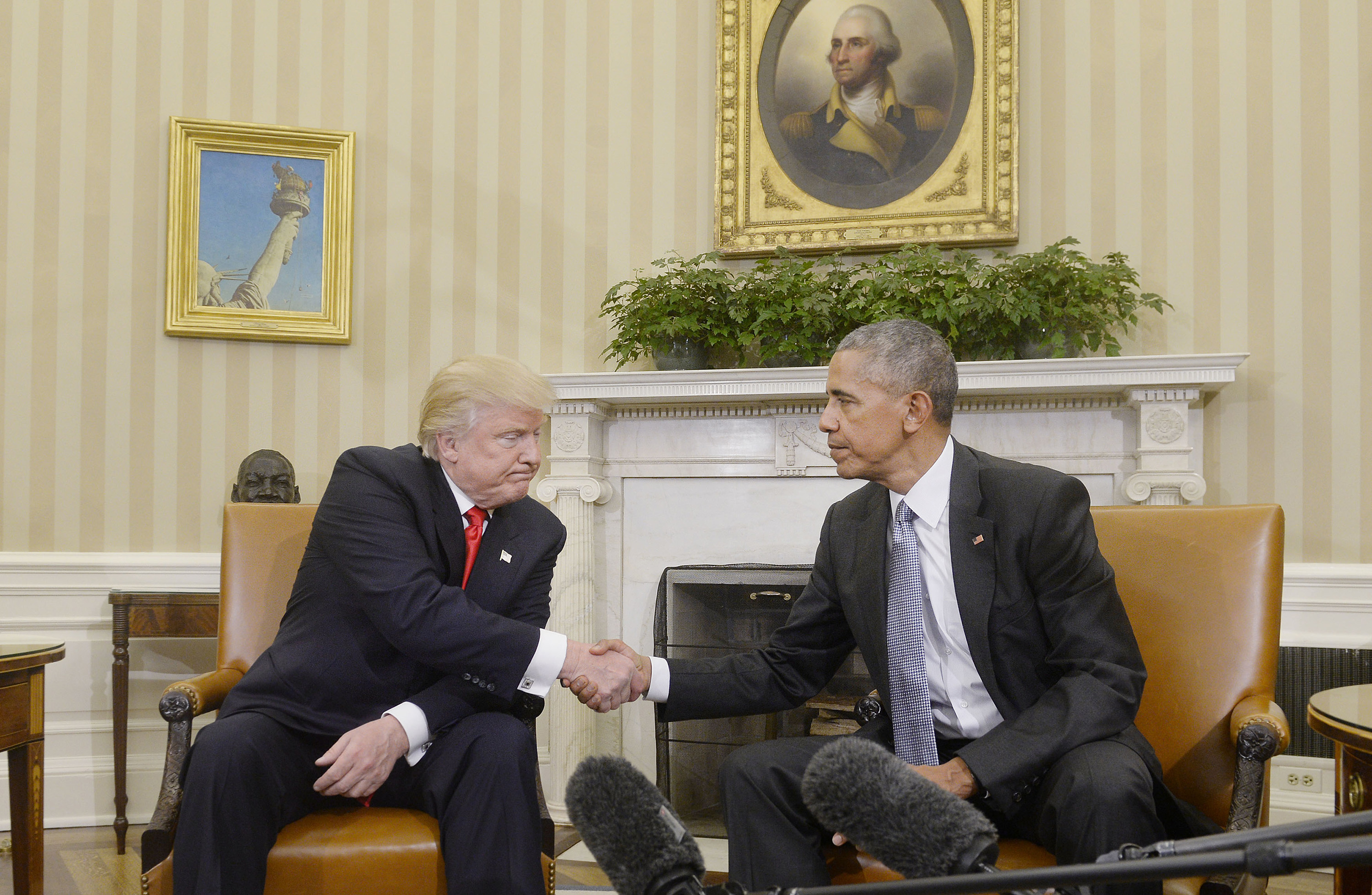
Trump’s idea of governance is the executive order. Hardly had his oath of office died on the wind when he took us to watch him signing the first of what has now become a daily series, with the hapless Chuck Schumer and Nancy Pelosi in attendance for window-dressing.

Executive orders have grown with the imperial presidency, along with the thicket of regulations that, hatched in executive agencies, are now required to “implement” Congressional legislation. Obama signed quite a bunch of orders, many pertaining to regulations, as part of his hapless effort to free himself from a stonewalling Republican Congress. Republicans decried this as tyranny, of course, but the complaint has disappeared now that their guy is president.

Many of Trump’s orders, too, have been directed at reversing Obama’s previous ones, again a tactic scarcely unique to him. But undoing one set of orders means replacing them with another set, and so legislating by executive fiat. Republicans are already beginning to find that this can be a two-edged sword.

The most notorious of the new orders has been the temporary ban on entry into the United States by persons traveling from seven Muslim-majority countries, challenges to which are now proceeding through the courts. The order was issued in such a fashion as to create a maximum of chaos at airports and confusion among the agencies enforcing it, for one of tyranny’s hallmarks is to create an atmosphere of perpetual crisis that only the Leader can clear up. It doesn’t matter whether the chaos is so great as to effectively negate the order, because it can always be “clarified” by subsequent ones. The point is to keep the flood of commands going, thereby to better accustom the country to arbitrary rule by the commander in chief. (Have you noticed, by the way, how commonplace it has become to refer to the president as “commander in chief” of the country, whereas in fact he is only commander-in-chief of the armed forces, a very small subset of the citizen body with a specific function? The distinction is not trivial. The Constitution refers to no one as El Jefe.)

The travel ban order was struck down by a federal judge in Seattle, James Robart, whom Trump instantly denounced as a “so-called judge.” As even Mitch McConnell observed, sitting judges are not “so-called”; they are actual, no less than the senators who confirm them. Nor is this the first time Trump has used the phrase: candidate Donald Trump had referred to the judge who ruled against him in the suit against Trump University, Gonzalo Curiel, in the same terms. A government of laws requires acknowledgment of and due respect for those charged with interpreting them, and it is not a matter of mere discourtesy when their authority is defamed. It is a challenge to that authority, and when that challenge comes from the president, the Constitution is in crisis.

Somewhat less noticed, but no less critical, is the attempt now underway to dismantle the Dodd-Frank law that was passed to regulate banking in the wake of the financial meltdown of 2008. Only Congress can repeal the law outright, but same objective can be achieved piecemeal by revoking the regulations that define its practical operation through executive order, just as the Supreme Court was able to kill the Voting Rights Act by cutting away its enabling provisions. The fact is that almost all Congressional legislation of any complexity is in effect only a blueprint to be fleshed out by regulatory agencies, and the process, obviously fraught with the potential for subversion, succeeds only if the agencies conscientiously interpret statutes in the spirit in which they are written. Republicans who opposed Dodd-Frank when it was passed are shedding no tears at its evisceration, but, once again, if a law you don’t like can be undone by executive action, then so can one you do like, and voted to enact to begin with. If the regulatory agencies (themselves subject to Congressional oversight) can have their work of years overturned at the whim of the president, where does that leave the legislative branch itself?

George W. Bush nicknamed himself “the Decider” during his illegitimate occupancy of the White House, but even the unabashed author of the memoranda justifying Bush’s use of torture, John Yoo, now declares himself “worried” by Trump’s power grab. I suppose we should congratulate (so-called) conservatives on discovering the virtues of the separation of powers, but it has after all hit Republican lawmakers where they live: in their jobs. If Trump can simply appeal over their heads to make his business friends happy without legislative encumbrance, then what’s the point of running for Congress in the first place? Washington is an expensive town, the pay is not that great, and if you wield none of the power that brings you big bucks from lobbyists, what’s the point of a political career?

What Donald Trump is doing is simply what tyrants do: gathering all powers of government into themselves. Make no mistake about the daily circus Trump creates around himself; it is the smokescreen by which he simultaneously subordinates all operations of government to his own will and attempts to distract us from what he’s doing. That he seems often enough not even to know what that will is  — or, what amounts to the same thing, has little care for the consequences of his acts  — is of a piece, too, with the classic tyrannical temperament.  Part of the definition of tyranny is arbitrariness; the other part, inseparable from it, is caprice. From tweet to tweet, The Donald wants to keep you guessing, and the beauty of it all is that he’s as curious as any of us about what he’ll say or do next.

The question is whether there is an agenda behind all this other than the brute concentration of power. Republicans have bet on this so far, and on their ability to shape it to their own benefit and that of their corporate sponsors. They are even figuring on impeachment or invoking the disability clause of the 25th Amendment when they have gotten what they want out of Trump. It’s the most dangerous game anyone has ever played with the country. How it ends may determine what becomes of our republic itself. For sure, the damage already done will be a long time walking back.

The American presidency has been agglomerating powers at the expense of the other two branches of government for a long time now. In three weeks, this process has leapt forward by as much as in the past several decades. Tyranny would be its logical culmination, and a would-be tyrant is already in place.

Posted in UncategorizedComments Off on Hello tyranny

Nat Hentoff and the courage of one’s convictions

Nat Hentoff died with the coming of the new year. He was someone this country can ill do without. Especially now.

Hentoff started off as a writer on jazz, and he was one of the best. He soon branched out into just about everything else, mostly in a four-decade stint with The Village Voice. He was omnivorous in his interests, fearless in his judgments, and never afraid to learn. He wrote a memoir I’d just finished before he died, and its title encapsulated his career: “Speaking Freely.”

Free speech, for Hentoff, was the precondition of a free society and the basis of all its activities. Exercising it was the basic job of a writer, and defending it was that of a citizen. There was never an excuse for denying it, delaying it or censoring it. And it was always offensive, always obscene, always irresponsible, because there would always be someone to be angered, offended or wounded by what one had to say or the way one chose to say it. But there was always a fair remedy for free speech one didn’t like, which was free speech of one’s own. There was no remedy for its absence, however, except to bring it back.

Hentoff grew up in a world where just about every racial, religious or ethnic minority in the country had nicknames designed to slur and insult, and everyone took such exchanges as a matter of course. I wouldn’t be anxious to go back to those days, though derogatory naming could serve as a rough means of socialization in a nation where immigrants were still pouring in. But neither am I happy to live in a time when almost any characterization of a group except by the term sanctioned for itself is more or less grounds for a hanging. Political correctness is as bad a form of coercion as anything Hoover ever thought of, and debates about micro-aggression and safe spaces on college campuses are just the most recent effort of the thought police for whom free speech is Enemy No. 1.

It also proves the point that it isn’t just the political right that hates the First Amendment, or at least any part of it not being exercised by itself; the left can be just as odious, and if anything even more sanctimonious.

Which brings me to the moment when Nat Hentoff himself crossed the line, and found himself shunned by friends of many years. Politically, Hentoff was a man of the left, which meant he championed the causes of civil rights, racial and sexual equality, death penalty abolition and all the other good stuff. That included, of course, so-called reproductive rights — the right of a woman to determine whether to bear or abort a child that had been enshrined in Roe v. Wade. Virtually everyone Hentoff knew was pro-choice, including the radical feminist who was his wife. He later recalled that he had only met a single person socially who was pro-life, and he put her views down to a Catholic upbringing. Hentoff defined himself as a Jewish atheist, and there seemed no reason to give the matter further thought.

What took Hentoff down what he called the road to pariahdom was the case of a baby Jane Doe born with spina bifida, whose parents had decided not to authorize a life-saving operation. The American Civil Liberties Union, on whose national board Hentoff served, defended their decision on privacy grounds; so did “Sixty Minutes,” which broadcasted a report on the case. But baby Jane Doe troubled Hentoff. Here it was not a fetus, but a born child whose independent rights had been stipulated by Justice Harry Blackmun in Roe v. Wade. To extend the parental privacy rights the court majority had found in legalizing abortion to life-and-death control of an actually living person was a stretch that, for Hentoff, abrogated constitutional rights for everyone. That took him back to the reasoning behind Roe v. Wade itself. What essential difference between a born and an unborn child deprived the latter of its right to life?

Hentoff researched the issue in the medical literature, not wishing to inject religion into it. He found no scientifically accepted point at which life could be said to begin other than at conception, and no way to consider such life as other than human. Legalized abortion, he concluded, was a license to kill, and more than a million human lives a year were being terminated in America without moral justification. Capital punishment might kill in the dozens or hundreds in a given year; a million innocent lives, disposable at convenience, was another order of magnitude entirely.

Hentoff began to do what he always did with a subject that concerned him: he wrote about it. His Village Voice colleagues tolerated his pro-life columns, though they privately thought him mad. College and other speaking engagements were canceled or disrupted. The champion of free speech, the paladin of the left on most other subjects, was not merely persona non grata. He was an object of fear, hatred and personal threat. Life at home wasn’t very pleasant either, at least whenever reproductive rights came up.

Hentoff found his way eventually into the company of such prominent Catholics as Joseph Bernardin of Chicago and John O’Connor of New York. He listened sympathetically to the pro-life Illinois representative, Henry Hyde. He did not abandon his other liberal positions, or cease to fight for them. But he did adopt a secularist version of the Catholic right to life ethic, including opposition not only to capital punishment but euthanasia. And he discovered that not all virtue was necessarily on one side of the political spectrum.

I bring this subject up not only because Hentoff’s opposition to abortion, which he maintained to the end of his long life, was prominent in all his obituaries, as if a single heresy had essentially defined his career. I do so because, as a secular Jew myself and decidedly on the left of most public issues, I found myself opposing abortion too on grounds similar to Hentoff’s, and facing the kind of incomprehension, disbelief and often anger that he had experienced, albeit less publicly.

I didn’t arrive at my position through reading Hentoff or anyone else. I came to it by observing a family that cared for a mentally challenged girl who, approaching puberty, would never have a mental capacity beyond that of a six-month-old child. The love the child received from her parents and the siblings who had been raised to value her as they did themselves struck me as have few other things in my life, then or since. I realized on that day that love is the truest choice one can make, and that denying the human in any of us is denying it in us all. I can’t say I changed my mind on that day, because, like Hentoff, I had been a casual supporter of abortion until then. Rather, on that day, I found it.

I haven’t spoken much about the issue of abortion, or identified myself publicly with the pro-life movement as I have with death penalty abolition. I haven’t picketed clinics or joined marches. I do think that the feminist argument for a woman’s right to control her body is a powerful one, and I respect those who assert it. But I think the right to life must trump all others except in the rarest circumstances, whatever personal or social inconveniences it may present.

When I ran across Nat Hentoff’s pro-life writings, I felt I’d found someone very much like myself who had come to a moral conclusion deeply unpopular in my own set. It didn’t add to my sense of persuasion, but it did hearten me. I had my conviction before, and I had it after. But Nat Hentoff had something else I realized had been lacking in my own position. He had the courage of it. I salute him for that. Whatever one’s views on abortion or anything else, it is a legacy any of us could wish for.

Posted in UncategorizedComments Off on Nat Hentoff and the courage of one’s convictions

What should the left do in the age of Trump?

Olivier Douliery: Abaca Press

Olivier Douliery: Abaca Press

Get over it, Joe Biden was advising us the other day. It’s happened, it’s done.

Well, yes. Donald Trump is our 45th president, and our cross to bear. And, okay, what next?

A lot of ink, some of it mine, has been spilled over the question of whether Trump is a legitimate president. As I’ve said, I think the answer is no, because of voter suppression in some of the swing states that gave him his Electoral College majority. That doesn’t make The Donald the first president to have gained the White House by fraud, though. John F. Kennedy probably won the presidency in 1960 when some voters rose from the dead to cast ballots in wards controlled by then-Chicago Mayor Richard Daley.

George W. Bush got into office through electoral shenanigans in Florida in 2000, and got the benefit at least of some others in Ohio in 2004. Both parties cheat, and the Democratic Party set the gold standard for voter suppression in the Jim Crow era South, when trying to vote with the wrong skin color could get you lynched.

It’s just that the Republicans are so much better at it today, and the Democrats so complaisant and feeble in their response. Among 153 parliamentary-style governments in the world today — let’s not even begin to call the vast majority of them democracies — the United States ranks 52nd in perception of electoral integrity, according to the Electoral Integrity Project. Get over it, right?

On the other hand, there is a sense in which Donald Trump’s election is legitimate indeed. He is fully and truly the nightmare product of the political system we now have, and if we don’t deal with that system then he is the prototype of what we can expect to keep getting.

First, a short primer on governments and what they do. Karl Marx got it exactly right when he wrote 170 years ago in The Communist Manifesto that “the executive of the modern state is but a committee for managing the common affairs of the whole bourgeoisie.”

This is usually abbreviated as the apothegm that the state is the executive committee of the ruling class, but this formulation is misleading; Marx knew exactly what he wanted to say, as usual. His point was that the ruling class of his time, which he called the bourgeoisie and we now call, rather less accurately, the 0.1 percent, was a profit-seeking missile with little regard for what it blew up or even rules of the road for its gilded stakeholders.

The super-rich might make their side deals so as not to get too much in each other’s way, as sharks in a feeding frenzy sometimes set on each other, but they leave too much blood in the water generally, destroying jobs and industries wholesale when it suits them and leaving the human wreckage to drift as it will.

It’s the job of the state, not the creation of the people as our constitutional charter fondly declares but the instrument of the elite, to regulate the system in the interests of maximum wealth extraction, and to deal as expedient or necessary with the incidental debris. It also, crucially, serves as a center for overall capital allocation.

Nineteenth-century capitalism would not have conquered the continental sprawl of our country nearly as quickly or efficiently without publicly subsidized railroads, or its twentieth-century successor have facilitated consumerism without the interstate highway system. Today, the government sends satellites aloft and lays fiber-optic networks to ensure the instantaneous communication on which the system now feeds. Newer technology; same deal.

General infrastructure construction and repair thus falls under the heading of state functions: capital projects too big, or too little profitable, for the so-called private sector. Not all of these projects have public utility, however, as witness the biggest ongoing one we have, the military-industrial complex.

This is a pure profit center for the industries that feed on it, and almost entirely parasitic on the economy as a whole: you can’t eat an intercontinental ballistic missile, or smoke it, or (unless you’re Slim Pickens in Stanley Kubrick’s Dr. Strangelove) ride it; and you’d sure as heck better not fire one except for practice. But we keep churning out the little darlings anyway.

Modern capitalism required a modestly literate workforce, and so we got public education. This worked too well, and so we are now degrading it as a profit center through charter schools. The Great Depression suggested the need for unemployment relief and minimal income maintenance after retirement, so we got temporary work projects and Social Security, the latter a bitter target of the super-rich even though its costs are borne almost entirely by the needy through regressive taxation. Otto von Bismarck, the Iron Chancellor of Imperial Germany, had figured this out fifty years earlier, but, hey, the guy was a bleeding heart.

What the state does, then, is to serve the interest of the elite sometimes in spite of itself. To do this, it must on occasion do things whose benefit is not immediately apparent to its master, like road repair or guaranteed health care. The dumb show of a two-party system helps grease the wheels, providing a mechanism of negotiation for agreeing to the finally obvious. People can’t simply starve in the streets, at least in excessive numbers, when the economy tanks; streets can’t keep cratering indefinitely under exploding gas lines and water mains because, even if you travel by Lear jet, you have to touch the ground sometime.

Politics, then, is the fine art of keeping enough separation between the instinctive and untrammeled greed of elites and the necessary adjustment and fine tuning required to keep the mechanism of wealth extraction functioning at maximum long-term efficiency. When a politician in pursuit of votes suggests more generous adjustments than strictly necessary, this is called demagoguery.  Such a person will be denounced, as Bernie Sanders was, in The New York Times.

The history of the past fifty years in America has been one in which the separation between the state and its employer has dangerously eroded. When an employee can never say no to his boss, even when the plant is on fire, bad things will happen. In the case of government, this means distress and disturbance from below. The result, this time, has been Donald Trump.

Trump squeaked by in the general election but, even more impressively, he strode past sixteen perfectly acceptable stooges (well, maybe Ben Carson was a bit of a stretch) to win the nomination of the Republican Party on an openly albeit right-wing populist agenda. He campaigned to bring back American jobs, gone forever of course; to scuttle free trade deals that threatened such jobs; to retreat from our imperial wars behind a Fortress America ginned up by patriotic militarism; and, of course, to fix all those potholes. Much if not most of this was perfectly compatible with elite interests, but the rhetoric behind it was inflammatory, and occasionally the policies were crude. If Trump doesn’t deliver for his core electoral constituency, as he certainly can’t and won’t, popular disturbance will grow.

What, in these circumstances, should a genuine left — assuming this country can produce one — do? It could begin by recognizing what a gift Trump is to it, because his election has revealed beyond any possibility of doubt the utter bankruptcy of both our political parties; that is, their inability to provide even minimal adjustments in the system.

That is no surprise in the GOP, which under its true leader, Paul Ryan, has cast off all pretense of doing anything but the most slavish bidding of its corporate masters. But it has also put paid to any illusion that the modern Democratic Party offers even the most marginal alternative, and therefore any toehold for progressive politics.

The Party establishment beat back the very modest populist insurgency of Bernie Sanders with both hands, and even in the past couple of weeks has scuttled Sanders’ token initiative to permit drug competition from Canadian suppliers. All the Democrats have accomplished in the past decade is to resurrect their Republican comrades-in-arms from the ashes of the electoral disaster they suffered in 2008, and put themselves in their place. They’re a dog that doesn’t deserve to be revived though, even were that possible.

What’s needed now is not even a new political party — not yet — but a grassroots movement for structural change based on a democratic labor movement and a reconstituted citizenship at the local level. This needs to be based on a very clear-sighted appraisal of our global situation in the early 21st century, with its more than obscene concentration of wealth, its degradation of labor, its suicidal assault on the natural environment, and, above all, the overarching need to present a vision of the human future that offers dignity and justice, and requires a common shouldering of responsibility to ourselves and the world we share.

That is probably asking more of even a genuine politics than it can hope to deliver. But demanding less of ourselves at this point is not worth the time of day.

Posted in UncategorizedComments Off on What should the left do in the age of Trump?

Is Donald Trump a legitimate president?

BBC: Reuters

BBC: Reuters

It will happen, it is happening, it has happened. Donald Trump will become the 45th president of the United States. It is the greatest political shock of my lifetime, and I’m sure the sentiment is shared by many.

An ignorant, bombastic, constitutionally clueless fool will sit in the Oval Office, while a gaggle of Republicans will try to run — and run away with — the country.

Now an outspoken veteran of the civil rights movement, John Lewis, has called Trump an “illegitimate president.” Barack Obama, Hillary Clinton and Joe Biden have all hinted as much, but the much-revered Lewis is the first significant public figure to say it outright. Okay, we may agree the guy is spectacularly unfit. But are there any grounds for saying he is illegitimate, that is, that he has come to office by unfair or illegal means?

Lewis based his claim on intelligence reports of Russian hacking and covert support for Trump. These reports have been long on allegation and short on evidence. When Adlai Stevenson accused Russia of harboring nuclear missiles in Cuba at the United Nations in 1962, he produced site photographs, and the missiles were indeed there, or somewhere: after a 13 day standoff when the war to truly end all wars seemed imminent, the Russians agreed to withdraw them.

In 2003, Colin Powell made a similar claim about Saddam Hussein’s alleged weapons of mass destruction in Iraq. He produced a map, but no pictures. The weapons didn’t exist, and the 600 alleged sites were all empty. We wound up with a war we’re still fighting.

I’m not saying there’s no foundation to the Russian hacking story, which now includes charges of hands-on management by Vladimir Putin and possible coordination with Trump operatives. I am saying, show me the money. And tell me, by the way, your theory of how Russian shenanigans tricked millions of people into voting against Hillary Clinton because of carelessness with her e-mail server and a hot tip on a debate question in favor of a serial bankrupt, con artist and uninvited sampler of private parts.

A second argument for illegitimacy is based on Trump’s election despite having been outpolled by nearly 3 million votes in the popular balloting.

This argument turns on the anachronism of the Electoral College, which enables — and has now produced, in five of 45 presidential elections including two of the last five — a candidate who won the popular vote but lost the election because of the Electoral College result. The disparity between Clinton’s share of the popular vote and her Electoral College vote is striking; she received 48.0 percent of the former, but only 42.2 percent of the latter (including the defection of five independent or so-called “faithless” electors).

Trump, meanwhile, with 46.0 percent of the popular vote, won 56.5 percent of the electoral vote, not counting two defectors. These are not small differences; they’re very large ones. In blowout elections, the gap is far wider: in 1936, Franklin Roosevelt defeated Alf Landon with 60.8 percent of the popular vote but 98.5 percent of the electoral vote, and Richard Nixon defeated George McGovern in 1972 with 60.7 percent of the popular and 96.7 percent of the electoral one. We don’t pay any attention to the Electoral College in blowouts, except when television networks compete to call the election by calling the magic number of 270 required for the electoral majority. But such elections show us how radically unbalanced the Electoral College distribution can be relative to popular voting. No one can seriously say that 96.7 percent of the American voting public was pleased at the re-election of Richard Nixon.

The Electoral College was put into the Constitution to court support from small and slave owning states. There are no more slave states, and small states are adequately super-represented by the provision that gives each state two members in the upper chamber of Congress, regardless of population. No serious argument exists for retaining the Electoral College today, and there is a glaring, not to say stupendous argument against it: it has given us Donald J. Trump as our president. Of course, had the electoral majority (or, in this case, plurality) ruled, that would have given us Hillary Rodham Clinton.

Since the rules of Electoral College voting were in place for both sides, and both sides understood, accepted and worked them, Trump’s accession to the presidency is no more illegitimate than that of John Quincy Adams in 1824, Rutherford B. Hayes in 1876 or Benjamin Harrison in 1888. It is arguably more legitimate than that of George W. Bush, because, although Al Gore’s roughly half million popular vote plurality over Bush was far less than Clinton’s over Trump, the 2000 election was actually decided by the single vote of an unelected Supreme Court justice in a case that a nakedly partisan court should never have accepted and had no plausible basis for deciding. That election, by the rules and by legal precedent, genuinely was stolen.

So, we can’t say that John Lewis is correct in calling Trump an illegitimate president either by appealing to a Russian state mafia or to the antidemocratic biases of the Electoral College. But is there another argument? Yes, there is, and it is one so blatant and so obvious that it does, in my view, make the case. It’s voter suppression.

Discounting the Electoral College, it is fair to say that the U.S. has enjoyed few if any truly democratic elections in its history. Up until 1865, the vast majority of African Americans were denied citizenship, and that was the least of their disadvantages. Until 1920, women were denied the vote as well. With the passage of the Voting Rights Act of 1965, it was finally acknowledged that blacks were systematically blocked from voting across the South, and strongly discouraged elsewhere. Act or not, disenfranchisement continued, overtly by the machinations of local election officials, and more subtly by functionally segregated school systems, imposed illiteracy, and the general constraints of poverty.

Concurrently, there has been a renewed effort — not merely casual or customary, but increasingly planned and implemented as a nationwide strategy — to deny the vote to minorities, to urban voters and to the poor; or in plainer terms, to constituencies inclined to vote the Democratic ticket.

This became obvious with the Florida recount in 2000, where it was apparent voters had been stricken from the voting rolls en masse on illicit grounds, or willfully denied access to polling places. Since, however, the Supreme Court struck down the central provision of the Voting Rights Act in 2013, thereby gutting it, voter suppression has become the order of the day. It’s catching across party lines, too: in this November’s election, 117,000 voters in Brooklyn, a city that has voted Democratic since the time of Pericles, were disenfranchised on the grounds that they hadn’t voted before (first-time voter alert: don’t even bother).

But the major effort has been a Republican one, on the simple grounds that a party that represents the 1 percent, in addition to bamboozling as much of the electorate as possible, has got to keep as many of the rest from the polls as possible. Thus, a concerted effort has been seen by Republican attorneys and secretaries of states, together with gerrymandering legislatures and local election boards, to suppress targeted minorities.

Why haven’t Democratic officials and supporters been more aggressive in calling this out? It may be, not only because they play the same game when it suits them, but because they closed as many of their own primaries to Independent, Bernie Sanders-leaning voters as possible to realize the death wish of nominating Hillary Clinton. House Minority Leader Nancy Pelosi and outgoing U.S. Attorney General Loretta Lynch have both pointed after-the-fact fingers at voter suppression, as did Katrina vanden Heuvel, the liberal editor of The Nation, in her commentary on ABC’s “This Week” this past Sunday.

A little late, ladies.

Of course, the Democrats didn’t expect to lose this presidential election, as the Republicans, for their part, did not expect to win it. But, can we say that voter suppression really swung the tide? Yes, I think we can. A shift in 112,000 votes among 125 million cast on Nov. 8 would have swung enough states into Clinton’s column to have given her an Electoral College majority. Two of those states, Wisconsin and Michigan, would have done the job by themselves.

In Michigan, Trump won by 10,000 votes, while 449,000 voters were successfully purged from the rolls. In Wisconsin, his victory margin was 27,000, while 360,000 voters were purged. It is a virtual certainty in these Republican-controlled states that a substantial majority of the votes successfully targeted would have gone Democratic. In short, Clinton lost the election because of the chicanery that the Voting Rights Act was specifically designed to prohibit, but no longer effectively does. And so, indeed, this means that Donald Trump’s presidency is illegitimate.

Does this mean there is no recourse against voter suppression? There is, but it is a cumbersome and uncertain one. Recently, for example, a federal court threw out Kansas’ new voter requirements, but this will be appealed, and when and if it reaches the Supreme Court, the same gang that gave us Bush and Trump will await it. There is obviously not a legislative remedy while Republicans control Congress and the presidency.

America’s political parties have never been interested in maximizing electoral participation, only in winning elections for themselves. If we want a democracy, we’re going to have to get it the old-fashioned way, by demanding it.

Meanwhile, we have Donald J. Trump.

Enjoy.

Posted in UncategorizedComments Off on Is Donald Trump a legitimate president?

Obama: The farewell address you won’t hear

Flickr: The White House

Flickr: The White House

What comes with a new administration is an inaugural speech and a State of the Union address.

Relieved of the baggage of campaign promises, the new president announces what his (or, someday, her) plans really are and the outgoing president gets a last ride in a limo on the public dime, and then gets to listen to his successor promise the moon. What the latter doesn’t get to do is to butt in; his job is silence.

The only significant exceptions to this rule have been in the farewell addresses delivered by George Washington and Dwight D. Eisenhower. Both men had specific objects in mind.

Washington wanted to warn the country of the perils of entangling alliances abroad, which was good advice in the 1790s and is even more to the point today.

Eisenhower wanted to alert us to a more insidious menace, the rise of the military-industrial complex, for which his own administration had been largely responsible. He didn’t exactly blame himself, but he did make the rueful point that presidents not only don’t do exactly what they’d like to, but sometimes the very opposite.

Washington and Eisenhower occupied unique positions among our presidents; one had won the war that established American democracy, and the other the one that had preserved it. Their fellow countrymen were willing to give them a final hearing, and both of them had something serious to say.

Barack Obama hasn’t come close to winning any wars, although he will go down as the first president to have waged them from the first day of his term to the last. It isn’t that we haven’t heard enough of his lectures, either. Governing by lecture seems to have been his fundamental approach to the job. But he has chosen to give us a final one anyway, and you’ll already have been able to hear it by the time you read this, at least if you cared to. I’ve got a pretty good idea of what will be in it, and it won’t include any of Eisenhower’s implicit mea culpa. If Obama really wanted to tell the tale of the past eight years, though, it would probably have gone like this:

My fellow Americans, folks I mean,

Who among us would have dreamt I could turn a mandate into a nightmare in eight short years? When we swept to victory in 2008, not only was I elected as the first African-American president in history but the Democratic Party had airtight majorities in both houses of Congress.

The Republicans were so flummoxed after the Bush years that they themselves didn’t expect to recover for a generation, if ever. It was our time to roll! Teddy Kennedy personally anointed me the heir to Camelot, and the Europeans were so happy about me that they gave me a Nobel Peace Prize for doubling down on the war in Afghanistan.

Well, you know how it went. I gave the Republicans mouth-to-mouth resuscitation and, as I was just saying the other day to George Stephanopoulos, if you don’t give me credit for creating the Tea Party, what justice is there?

I staggered so badly through a year of legislative ineptitude over health care reform — after borrowing the Republican plan hatched by the Heritage Foundation and already slapped up in Massachusetts by Mitt Romney — that it wound up a wet kiss to the hospital giants and Big Pharma. With all that, I got not a single GOP vote when Obamacare passed: at least they call it that, though it was Nancy Pelosi who bailed me out when I couldn’t even deliver my own party. So it should really be Pelosicare, but Nancy wouldn’t think of taking credit for the mess I’d made. That’s how I came to own a boondoggle that gave the medical-industrial complex a huge new profit center at taxpayer expense while raising everybody’s rates to pay for those lifesaving, $100,000-a-pop wonder drugs and killing single payer health care for another generation. Our just reward? Giving the Republicans control of the House again in 2010 (sorry, Nancy), and the Senate in 2014 — 20 years ahead of schedule!

Of course, it’s not as if I didn’t have plenty of other stuff on my plate. I inherited an economy in freefall, shedding jobs at the rate of 600,000 a month. They misnomered it the Great Recession instead of calling it what it was, Great Depression II. And, just as the Republicans (bless their greedy, wicked hearts) never gave me a vote for their own health care bill, so they’ve never thanked me, not publicly anyway, for bailing out the banks and insurers and the big corporations like General Motors that had turned themselves into fronts for financial scamming. No thanks, either, for letting banks recapitalize themselves on the backs of millions of home foreclosures, or for making Wall Street more obscenely profitable than ever while I tooled along a “recovery” that provided jobs for slinging hash as the robots and the wage slaves in Bangladesh took over the work that used to pay at least a halfway decent living.

Do I get credit, either, for the fact that the national minimum wage is still exactly what it was the day I took office, $7.25 an hour, even if some municipalities have gone crazy and tried to offer $15? Not a bit of it!

Or that I’ve frozen Social Security hikes three times and barely tossed anyone a dime in between, so that the purchasing value of your retirement check from the U.S. government — you know, the racket you’ve paid into your entire working life through the most regressive tax that ever got on the books — has declined 22 percent since 2000? But then, how could have I have been the savior of the 1 percent if they’d truly hailed me as their Redeemer? Some good works — great ones, even! — can’t get the nod.

What I’m really proud of, though, is that not a single bankster has ever done the perp walk on my watch. You remember how even the sainted Reagan sent the Keating Five to jail after the small potatoes of the Savings and Loan scandal in the 1980s?

That was tokenism at its finest, but I improved on it! No jail time for anyone, fatter bonuses than ever, and only corporate “fines” that hardly dented the balance sheet and came out of shareholders’ pockets anyway. No actual finance reform, just that toothless Dodd-Frank, no oversight for financial reserves or derivatives or bundling. Nada! Do you think McCain or Romney could have done a better job? But, no, all they do is gripe at me for not getting the Trans-Pacific Partnership through.

Speaking of nonaccountability, how about the way I let the Bush gang off the hook for sleeping at the switch on 9/11, lying us into the Iraq War that collapsed the whole Middle East, and legalizing torture by Justice Department memo? Then I took Superhawk Hillary on as secretary of state and Bush’s own defense secretary, that Bob Gates, so I could continue the grand tradition of the Permanent War that George Orwell preached to us in “1984.” Sorry about that, Ike: blessed are the peacemakers, but thrice-blessed are they who clip their coupons from General Dynamics or Lockheed or Raytheon.

But what, you may ask, is the true essence of my legacy, my most historic accomplishment? Well, you might say, what about letting the Walmart heirs, the Koch brothers, and a few other favored families accumulate more assets than half the U.S. population combined? Or, how about letting eight years of near-zero interest rates go by without a single significant infrastructure project, so that our gas lines explode and our roads crater and our bridges collapse while we build highways in Afghanistan for the Taliban to blow up? Or, gutting public education through Common Core and charter schools; or, finishing off the last of the unions … really, the list is too long.

I’m proudest of all, though, of this: I inherited a monstrous surveillance state that, under cover of 9/11, had expanded to spy on every American (cabinet members not excluded!), and I built it bigger than ever. When guys like John Kyriakou tried to blow the whistle about it, I jailed them under an espionage act from World War I.

Creative use of law, huh?

And as for that character Ed Snowden — I hope his Russian’s coming along, because he’s gonna be the Kremlin’s guest for many long nights to come.

So, that took care of the Fourth Amendment, or what George W. had left of it. Then I got to work on the Fifth and Sixth, condemning assorted bad guys to Death by Drone on my famous Terror Tuesdays, U.S. citizens included.

No trial, no error — right?

When some of those legal carpers complained about due process, facing charges and confronting accusers, all that Founding Fathers folderol, I just trotted out Eric Holder — you remember him, attorney general? — to explain how condemning folks behind closed doors on the basis of intelligence hearsay is just as due a process as that old-fashioned trial by jury stuff. How about that for a legacy?

Presidents can kill you.

I have to say this much for my successor. When he breaks the law, he doesn’t know what he’s doing because he knows nothing about it. But I taught constitutional law, and I knew exactly what I was doing every step of the way.

That’s what you get for electing a lawyer your president.

Good luck with the businessman.

Posted in UncategorizedComments Off on Obama: The farewell address you won’t hear

Effects of a Trump presidency

Abaca Press: Oliver Douliery

Abaca Press: Oliver Douliery

The consequences of the 2016 election have yet to unfold, although Donald Trump, having impatiently pushed his predecessor aside, is for all practical purposes already running the country.

We can say this much about it, though: it is payback for both the major political parties and goodbye to the politics of the past 50 years. The effect of those politics, embraced by Democrats and Republicans alike, has been to hollow out America’s middle class, crush its working class and usher in an era of rampant inequality — the likes of which the country hasn’t seen since the 1920s.

This effect will only worsen in the next four years.

It needs to be recalled that, largely owing to the Civil Rights movement, the momentum of New Deal reforms, stalled with the death of Franklin Delano Roosevelt, was revived in the 1960s.

In addition to the push for desegregation and the enactment of the Voting Rights Act and Medicare, Lyndon B. Johnson declared a War on Poverty that, within a decade, had roughly halved the number of Americans living in poverty.

The renewed push to realize the socioeconomic goals of the New Deal didn’t last, though.

Vietnam divided the country, and ruined Johnson’s career. Its violence spilled over into America’s streets, and, with the assassinations of Rev. Dr. Martin Luther King Jr. and Robert F. Kennedy in 1968, the country seemed on the brink of civil war.

Repression and reaction followed. They never really retreated, from Kent State and Rodney King to Guantanamo and the present standoff in South Fork.

In spirit if not in the flesh, through the administrations of both parties, our president for the past nearly 50 years has been Richard Nixon.

You reap what you sow, and Vietnam was our harvest. We killed millions and lost much of our soul. A soulless country lost its compassion, for its own as well as others. The worst, as William Butler Yeats said of another time, were full of a passionate energy, and the best lacked conviction.

America, for all its faults, had never ceased trying to make itself better. That, and not mere prosperity, was its dream. With the 1970s, and despite noble exceptions, this was no longer the case.

Segregation crept back in. Poverty made a comeback. A productive economy gave way to financialization. An American president visited an SS cemetery. Another one gutted welfare and built supermax prisons. Another normalized torture and mass surveillance.  

It came to a head in 2016.

An angry white populism swept aside professional Republican politicians and nominated a blustering demagogue to be president. A populism of the left strove to make a self-professed socialist the Democratic Party’s nominee.

The Democratic establishment beat back that effort, and, in a collective death wish, put up its least popular and least able candidate, who, in running an utterly tone-deaf campaign, enabled the demagogue to win the presidency.

Let’s not mistake that last point. It wasn’t the Democratic voters refusing to vote for Hillary Clinton who elected Donald Trump.

It was a Democratic Party that denied the popular will in a rigged primary system and put up instead the candidate who, more than any other, represented all that voters on both the right and the left were united in rejecting.

That would be, Barack Obama.

Obama, with his wife Michelle, were frequent and apparently popular surrogates on the campaign trail for Hillary Clinton. At first glance, this was passing strange. The mutual antipathy of the Clintons and the Obamas during the 2008 primaries was notorious.

If Obama brought Hillary into his cabinet as Secretary of State upon winning the election that year, it was to honor the old adage about keeping your enemies in front of you.

The Clintons, for their part, loathed the man who had denied them their expected restoration. Implicitly, though, Bill and Hillary conceded Obama his eight years in office, in return for a job that kept Hillary in the limelight, and his support for her candidacy (assuming it to be worth anything) when 2016 rolled around.

As it turned out, that support appeared to be critical. As Obama’s term approached its end, and with the prospect of either of the two most unpopular candidates in presidential history poised to succeed him, his long-dampened approval ratings rose.

Hillary hitched her flailing campaign to Obama’s star, and promised to extend his legacy — that is, to offer voters four more years of the previous eight.

That was as catastrophic a decision as any candidate for the presidency has ever made, because if there was one thing the election of 2016 was about, it was the repudiation of Barack Obama.

The sentimental uptick in his personal approval was deceptive; the more-telling polls were the ones which indicated that upwards of three-quarters of the public felt the country was headed in the wrong direction.

Obama the man, a singularly anodyne personality, was not disliked; Obama the president was a rejected figure.

It did not take polls to make this clear: the success of Donald Trump’s insurgent campaign and the near-success of Bernie Sanders’ bid for the Democratic nomination conveyed this clearly enough.

People were roundly fed up, fed up enough to go with a self-proclaimed socialist or an unprincipled demagogue. You couldn’t run the storm warnings up any higher than that.   

Kim McKinney Cohen, a liberal Colorado activist, cast her ballot for Donald Trump. When asked why, she replied: “I wanted to shake people up. Last time, the Democrats got the White House, the Senate, and the House, and did nothing.”

David Murray, an Ohio voter, complained that Clinton seemed “just another four years of what Obama has done for my area, which is nothing.”

The operative word here is nothing.

It’s easily forgotten now that Barack Obama’s election in 2008 was greeted with more hope and expectation than for any other in memory.

It was a moment of crisis. Obama inherited an economy in freefall, a pair of failed wars that continued to bleed American blood and treasure and a nation whose world reputation was at its lowest ebb in a century. It was thus a moment that called for political and moral renewal.

Obama failed the country in virtually every respect.

His underwhelming economic stimulus, little if any different from what a John McCain administration would have produced, put Wall Street on its feet again while allowing millions of main street Americans to be thrown out of their homes as well as their jobs, failed to extricate us from the morass of our Middle East wars and failed to clean our political and economic house: not a single official who had lied us into war and not a single banker who had crashed the economy was held to account.

Not a single torturer; not a single crook. Instead, Chelsea Manning went to jail, for the crime of telling us the truth.

I don’t mean to say that Barack Obama didn’t accomplish anything.

He presided over the largest surveillance state ever erected, and the most lopsided transfer of wealth into the hands of the rich in generations. He rebuilt the Republican Party from a smoking ruin to a now-thriving franchise that now owns the government on both the state and federal level.

He left a substantial part of the electorate in such a condition of frustration and rage that it was willing to embrace the demagogue who, instead of completing the destruction of the GOP — not altogether unfittingly described by Noam Chomsky as “the most dangerous organization in world history” — has once again raised it from the dead.

“Nothing” is a very polite description for an administration that has heaped such negative blessings on us.

At the end of the campaign, Obama, acknowledging that it had become a referendum on his own tenure, told black audiences in particular that he would take it as a personal insult if they did not turn out to vote for his designated successor.

This was the same audience whose votes Donald Trump had solicited by pointedly asking, “What have you got to lose?” After Ferguson, Baltimore, Charleston, Cleveland and Chicago, there was no one to make reply.

The first African American president had left African Americans themselves, their communities raddled by violence and despair, more vulnerable than ever to the racial backlash with which he is ending his term.

African Americans didn’t turn out to vindicate the leader who had betrayed them. Angry whites, their own resentments stoked by the nakedest appeals to bigotry in 50 years, came out instead.

Barack Obama then welcomed the demagogue who had questioned his birthright to the White House and described him for us, after a friendly conversation, as a “pragmatist.”

We already know, of course, what he means by this term, since in his own lexicon it indicates what he himself has been for the past eight years: a man without principle or conviction, and with no interest beyond personal aggrandizement and political survival.

Hillary Clinton turns out to have been the pawn in this tragedy. The election of 2016 was all about Barack Obama.

Very shortly, the emptiest suit in American political history will exit the stage. His legacy is the man who succeeds him.

Posted in UncategorizedComments Off on Effects of a Trump presidency

How Trump claimed victory over Clinton

Newsday: J. Conrad Williams Jr.

Newsday: J. Conrad Williams Jr.

How did he do it? The man who broke every rule in the political playbook; the man shunned, excoriated and ridiculed every day by the mass media; the man rejected by the very party that, to its horror, found itself obliged to nominate him, finds himself now the most powerful man on the planet.

Aside from the stunning fact of his victory itself, the question that will remain for many is how Donald Trump overcame a world of obstacles, any one of which would have instantly destroyed another presidential candidate — and often has.

How could a nation more than half composed of women have elected the misogynist in chief? How could a nation of immigrants have chosen a xenophobe? How could a nation increasingly composed of minorities have selected a man who dog-whistled racism?

Trump did it because, ignorant though he is of constitutional processes and the complexities of public policy, and superficial as is his grasp of the world, he has proved himself a political genius. And, for those of us who thought he would crash and burn on the political trail, or think he will certainly crash and burn in office, it is time to think again.

When Trump won the Republican nomination last spring, people asked the wrong question. They asked, “how did this happen?” instead of the more pertinent one, “how did he do it?”

Like Bernie Sanders, Trump rode a wave of popular discontent. Unlike Sanders, he went straight for the political jugular — “low-energy Jeb,” “little Marco,” “lyin’ Ted.”

Unlike Sanders, who tried to appeal to a broad spectrum of voters, Trump saw a crucial segment of his party’s base that could be detached from it and hitched to his own star and he went after it with laser-like precision. That, in a crowded field of candidates, gave him enough of an edge to gradually whittle down and finally overcome the field.

The rest of the story is that he won over a majority of the nation’s electors — not its voters — and so he will become our 45th president.

The old saying that all politics is local is never more applicable to us than in our national elections. The Electoral College system means that our politics has now devolved into a struggle for a handful of so-called swing or battleground states, mostly of small to middling size. A vote cast for a Republican in New York or California is a wasted exercise; the Democrats will (so far)

A vote cast for a Republican in New York or California is a wasted exercise; the Democrats will (so far) reliably win those states and all their electors. The same goes for Democrats voting in Texas.

So, candidates never show up in those states except to court fat-cat donors; they hold no rallies, give no speeches and kiss no babies. Running for president reduces our map to five or six states; the rest of the country might as well be on the moon. Nor does voting for the winner in noncompetitive states have full value either. Millions of people voted for Hillary Clinton in California and put her over the top in the popular vote, but every vote beyond the last one required to top Trump in the Golden State was merely symbolic, which is to say superfluous.

Nor does voting for the winner in noncompetitive states have full value either. Millions of people voted for Hillary Clinton in California and put her over the top in the popular vote, but every vote beyond the last one required to top Trump in the Golden State was merely symbolic, which is to say superfluous.

The same thing is true, of course, in every state, swing or not. The only vote that counts is the one that puts a candidate over the top; every one before that is canceled out when the winner is ascertained, and everyone after it is just piling on.

Of course, it’s impossible to say whose vote gave Pennsylvania to Trump among the more than 5 million cast: it’s a needle in a huge haystack, and no one will ever find it. Somewhere in our Commonwealth is the voter who broke the tie between Clinton and Trump, but we’ll never know who it was. Nor will he or she.

In that sense, all votes in a presidential election are symbolic, and only Pennsylvania’s 20 electors have actual votes. The electors themselves don’t have individual votes; they are a slate, bound by law or custom except in a handful of states to cast their votes according to the popular ballot.

In short, 125 million ballots were cast in the 2016 election, but none of them represent actual votes in the sense of individually sovereign acts. They were inputs into a process merely, bubbles in a souffle. Which bubble made the souffle rise or fall, no man can tell.

This isn’t a democracy, but of course the Founding Fathers didn’t set it up to be one. In this sense, Donald Trump was perfectly right to call the system rigged. And he was the one who gamed it.

The other thing to understand is that, in modern mass elections, there are no issues as well. The choices put up may look concrete — to raise the minimum wage, say, or to sign a particular trade agreement or to keep abortions legal — but they, too, are symbolic, because they are all subsumed in the emotional grid that packages the candidates.

When we choose a president — or, rather, when the process does — it is a leader that is being chosen. It is the qualities that are sold in representing leadership in any given election that determine the outcome.

Trump understood this too, and he broke it down to its most crudely effective level.

A leader is one who leads; that is, who succeeds in getting his way. Trump reduced every personal quality about himself to one: success.

There was Trump the successful businessman; Trump the successful TV personality; Trump the builder of huge skyscrapers with his name emblazoned on them; and, yes, Trump the mighty conqueror of women, who took them as his tribute because he was so successful at everything else.

Donald Trump was simply the world’s most successful brand, and that entitled him — in the cruder, cowboy sense of the term — to brand everything else.

So, what was it that made Donald Trump the successful presidential candidate? I would argue that it was the one seeming embarrassment that so many thought would stop him, the sex tape that caught Trump bragging of his sexual droit du seigneur.

For many, to be sure, Trump’s boasts were offensive and revolting, and the mass media played it as a fatal gaffe. But, you know what? It turned out that a rogue flaunting his sexual prowess was a more appealing political figure than an aging wife put on the shelf many years ago by her own rogue of a husband.

Needless to say, no one could say this publicly. But in the national psyche where such things marinate below the threshold of polite conversation or even necessarily conscious awareness, it took hold, and not merely for men.

Hillary Clinton struggled throughout her campaign, in 2008 no less than 2016, to win the support of women, whom she and everyone else considered her natural constituency. In the end, though, a lot of them didn’t want to identify with a marital loser, and, fair or not, that was the brand Hillary Clinton bore.

She was the most famous, the most publicly cheated-on wife in American history, and if she stuck it out with her husband it was, manifestly, to protect her own political future. That created the double bind she could never escape, no matter what she might put on her resume.

She was at once the pathetically dependent woman who dared not avenge the ultimate marital wrong, and a figure of coldly calculating ambition who would not allow even a deep affront to her personal dignity to stand in her way. The combination was fatal.

You can see the difference between Clinton and Trump by parsing the campaign slogans on which they ran. Donald Trump himself invented the slogan, “Make America Great Again,” and tried it out on a reporter as early as 2013.

The pundits ridiculed this, because America was, by definition always great, and anyone who suggested that it had ceased to be so was challenging the most cherished tenet of our national mythology, namely, American exceptionalism.

We were the world’s greatest country, the indispensable nation. How could we cease to be so, and who would agree that we had?

As it turns out, roughly 60 million people did.

The key word in Trump’s slogan, though, was the action verb “make.” To make it, in the colloquial sense, is precisely to succeed; in the literal one, to produce something, to bring it into being. It was what Trump supporters had once done, before America’s manufacturing base had been outsourced and its factories left to crumble.

It was what they wanted to do again, and the Wall Street types and slick academics who told them they couldn’t were telling them they couldn’t have their country back, that it was gone for good and that they themselves were irrelevant in the new cyber world that knew neither nation nor soil.

Trump told them that this needn’t be so; that he, personally, would guarantee that it wouldn’t be so; and they grasped at this hope.

Clinton’s own slogan, “Stronger Together,” was the awful, poll-tested result of 265 entries. Aside from its near-unpronounceable clunkiness on the tongue, it suggested a false unity, the chumminess of the already-satisfied, a club you couldn’t get into if you weren’t already there.

It also suggested a world already near-perfect, where all one needed was a commitment to more of the same. In a change election year, that was catastrophic.

Finally, there was the matter of campaign style. Trump stumped alone, virtually without surrogates and with a vice president who seemed at odds with him as often as not: the lone warrior.

Clinton clung to entertainment celebrities, all more glamorous by definition than she was. When Michelle Obama campaigned with her, her physical stature dwarfed Clinton’s. The image she projected was almost of someone being held up by kindly hands.

Donald Trump knew how to win this election. He overcame the odds, the campaign finance gap, the disdain and condemnation of the elites in his own party as well as his opponent’s. He may fall on his face as a president, or prove a pawn manipulated by others. Don’t bet on it, though.

Posted in UncategorizedComments Off on How Trump claimed victory over Clinton

Who I am voting for

I finally casted my ballot in this year’s election, and here’s who I have voted for: for president, I chose Bill McKibben, environmental activist and organizer of the climate change organization, 350.org. For vice president, I went with Edward Snowden, the all-time whistleblower who exposed the National Security Agency’s vast programs of illegal and unconstitutional surveillance, ramped up by George W. Bush and vastly expanded by Barack Obama.

McKibben was an easy choice for me. For nearly thirty years, he has been beating the drums on climate change, a.k.a. global warming, a.k.a. planetary disaster for many if not most of Earth’s species, including our own. Climate change isn’t an “issue” on the menu of specious political choices we’re routinely offered every four years; it’s the life-or-death crisis that the fossil fuel-driven Industrial Revolution brought upon us with frightening speed and, at this point, certain irreversibility. A few years ago, the crisis was framed in terms of averting it, and then, as we crossed the threshold of inevitability, of managing it. We will, in short order, be presented with the issue of surviving it, socially and biologically.

McKibben has written with passion and eloquence about the climate crisis in many books and articles, and also with reason and precision. His 350.org group is named for the number of parts of carbon dioxide per million the atmosphere can absorb without triggering significant climate change; we have recently passed 400 and are headed up. Four hundred means that we are in for it, and that it is no longer a question of averting climate disaster but of coping with it. We failed the first test, and we are well on the way to botching the second. Our level of engagement is summed up in the current standoff on the North Dakota oil pipeline, which has been posed in terms of property rights and sacred ground. Ladies and gentlemen, if we don’t hold all our ground sacred, and not for Native Americans only, we’ll soon be left with precious little of any kind to stand on. There are many other questions our politics must deal with — social and economic justice, nuclear disarmament and control of the runaway capitalism that is ravaging our world in every conceivable way, climate crisis being only the most urgent and evident — but climate, at this historical moment, dwarfs all else. When people look back at the late 20th and early 21st centuries, if there are any who can or care to, the one figure they may well remember is Bill McKibben. Whether they’ll remember him as only a failed prophet is up to us.

As far as I know, McKibben has no political ambitions; in fact, he has urged his supporters to vote for Hillary Clinton as the least horrific option in this most horrible of election years. It’s the only thing I differ with him about, but in a spirit of charity. As the canny political operative he also is, he knows that pushing Clinton on climate will be a lot easier than pushing Trump. But, and with regret, I do not see Hillary Clinton as anything but the agent of the very forces McKibben and the rest of us must combat. I respect McKibben’s position as a thoughtful and principled one, but I cannot imagine him, deep down, as anything but despairing in having to take it. My position is different. I’m not a lobbyist or an activist, but simply an educator and citizen, doing what I personally can, and all I can do is vote.

You might ask why, if I wanted to make a statement, I didn’t vote for Bernie Sanders instead. Sanders was a presidential candidate, and therefore his active support for Clinton has a different valence. He has been telling us directly not to vote for him, and, out of the respect I have for him, I have honored that request. Besides that, he did not make climate change the centerpiece of his campaign and although he takes the crisis seriously, he has offered few specifics for dealing with it and no particular vision for the future we must work together if we are to have one at all. To my mind, the overriding subject of this election, and the next, and the next, is climate change and how we are going to deal with it. A vote for Bernie Sanders would not have made that statement, although I would likely have voted for him had his name appeared on the ballot. A vote for Bill McKibben does, at least for me.

My vice presidential vote went to Edward Snowden, the patriot who, in exposing a sinister, secret and entirely illegal surveillance program carried out against the electronic communications of every American by the National Security Agency under the aegis of a president sworn to uphold and enforce the laws of the land, constituted (and still in essence does constitute) an existential threat to Constitutional guarantees of freedom and hence to the country itself. Simply put, the Fourth Amendment affirms the privacy of all communications, papers and memoranda not intended for public circulation from search or seizure by any agency or representative of government absent a duly sworn judicial warrant. This means you can’t see my stuff, unless a judge, on offer of proof or reasonable suspicion, thinks it material to an actual or intended crime. This is a no less important guarantee of personal freedom than the right to free speech or assembly, without which public utterance or demonstration is sharply curtailed if not completely rendered impossible. That the NSA was poking around in our mail was not a secret, but the totality of its surveillance over every recorded aspect of our lives and the unfettered access it had gained through search engines that advertised themselves as guaranteeing their users’ privacy and confidentiality, was only brought to public focus by the vast trove of documents released by Snowden, including espionage conducted against our closest allies. For this, Snowden received not a tickertape parade and the Congressional Medal of Freedom — for which he would probably have been the worthiest recipient since Tom Paine — but an arrest warrant, revocation of his passport and condemnation by the very Congressional bodies tasked with preventing the abuses he’d disclosed as a traitor.

If Edward Snowden is a traitor, then Benedict Arnold was a patriot.

So, a vote for Snowden is easy. And let it signify not merely the profound threat to our laws and values he documented in such thorough and irrefutable detail, but all the other issues pertaining to liberty and the rule of law that threaten our country: illegal wars and targeted assassinations; war crimes and the licensed criminals who commit them with impunity; the contraction of our public discourse and the suppression of dissent.

It’s true, electing Snowden would have posed a couple of problems. First, he is currently the guest of the Kremlin. It’s a rather odd place for a champion of American liberties to be; but then, these are unusual times. I’m guessing a dismissal of charges could have been arranged, though. Second, the Constitution requires that candidates for vice president be at least thirty-five years of age, and Snowden is thirty-three. But that’s a bit of antiquated ageism. Alexander the Great was in his twenties when he conquered half the known world, and Britain’s prime minister, William Pitt was twenty-eight the year the Constitution was framed, and had already been in office for five years. Under the worst case scenario, Snowden could have played golf until he turned of age. That’s what Barack Obama has spent most of this year doing anyway, and the presidency was supposed to be a bigger job — at least until Obama stepped into it.

One more point. For the past several months friends of mine, as well as people I respect and even the man I voted for, have been telling me to vote for Hillary Clinton in order to keep Donald Trump out of the White House. One friend even told my wife she would never speak to her again if she didn’t vote for Clinton. Well, I didn’t, and I don’t like being told it’s my duty to vote for any certain candidate. My vote belongs to me, to do with as I choose, and to exercise or not.  If I can’t find a qualified candidate to vote for — and there certainly wasn’t one this time around — I will make my own free choice, or none at all. It isn’t that I wouldn’t vote for an imperfect candidate; human beings come only in varying degrees of imperfection. There are minimum standards for integrity and competence, though, and when you don’t find them you can only vote for the person you’d actually prefer in office, or no one at all. The most famous modern ethical imperative is that proposed by Immanuel Kant, namely, that you should act only in a way you would be willing to see everyone else act in as well. If everyone had voted as I did, Bill McKibben would be our president-elect. If I and everyone else had chosen not to vote, then nobody would have been elected. Either result would have been preferable to what we’ve got now.

Posted in UncategorizedComments Off on Who I am voting for

A political system in need of repair

As we stagger toward the finish line of one of the most dismaying election campaigns in American political history, one thing is clear: our political system as it now stands is broken.We reached for the machinery of democracy, and what it gave us were, to use the adjective-turned-noun of one of the contenders for president, the most deplorable candidates ever put up for the job. We are invited to choose between an inveterate liar who turned the U.S. Department of State into a cash-and-carry store, and a pompadoured buffoon who can’t even be called a liar because he seems so blithely unaware of contradicting himself on an almost daily basis. A crook or a clown: sweet dreams, USA.

We should consider first how we got here. The American electorate in 2016, across the political spectrum, was in all-but armed revolt against the elites which had betrayed them. Meanwhile, the slow-burning fuse under the eviscerated working and middle classes exploded into a populist revolt against the two dominant political parties that, nowhere mentioned in the Constitution, have arrogated to themselves the right to determine those presented to fill our public offices from dogcatcher to president.

Bernie Sanders, who would in fact almost certainly have defeated Hillary Clinton for the Democratic Party presidential nomination but for a primary process stacked against him and a corporate media that trivialized where it did not ignore him, was a political independent who had spent a thirty-four-year political career outside any party (though he had latterly caucused with Democrats in the U.S. Senate).Donald Trump, who did win the Republican nomination to the consternation of party bosses, was a rogue figure who seems to have gravitated toward the GOP chiefly because the Clintons had apparently sewn up the other party’s ticket. He prevailed because he shrewdly recognized the incipient rebellion of erstwhile Reagan Democrats infuriated by the exodus of their jobs under both Republican and Democratic administrations.

A campaign that had pitted Sanders against Trump would have been a revolutionary event indeed, and it was precisely the event voters wanted. It wasn’t that both men represented the best our politics offered, although in Sanders’ case this was probably true. It was that they were both perceived as populist insurgents, and therefore as hammers to smash the establishments of both parties against the wall.

Donald Trump’s campaign has been a running battle with the Republican Party he nominally leads, and that battle is the basis of his support with his hardcore loyalists. Trump, they think, can be trusted, because he hates the same people they do. In this, in fact, they are not entirely wrong. Trump will probably leave the Republican Party in tatters — win or lose.

The Democrats, though, are experiencing a similar if not as visible a crisis. A Clinton presidency will divide the party, very likely as it was divided in 1968 but this time with possibly even more lasting results. Sanders and his Massachusetts colleague, Elizabeth Warren, have promised to hold Clinton’s feet to the fire if she fails to implement the reforms promised in the Democratic Party platform, rewritten as a sop of the left. This will get them nowhere, of course, since platforms are written to be ignored, and Clinton would be spending her time begging favors from the right while not indulging the already-hawkish instincts that have promised us an expansion of our Middle Eastern wars and the worst confrontation with Russia in decades.

Perhaps the moment is ripe for what the economist Joseph Schumpeter called creative destruction. The particular objects of destruction would be the two major political parties as they now stand, for if anything has been made clear in the present election it is that neither of them under present management is capable of addressing the major questions before our society: rapidly advancing climate change; an economic system manipulated by megacorporations and banksters and fueled by deliberate cycles of boom and bust; an existential and not merely an economic crisis of labor in which the very concept of work is at stake; a divestment in infrastructure that has left our shockingly obsolescent energy and transportation grids vulnerable to extreme weather events, terrorist threat, and even the hazards of ordinary operation; political and media systems that disenfranchise the public; unaccountable technocracies given free rein to tamper with our air, our water, our food, and, in short order, our genetic codes as well. Democracy is a messy system at best, but when it is run as poorly as this, all bets must be off.

Early modern governments distrusted organized parties as “factions,” but they have become the operating system of all states in which even the pretense of representative government is kept up. It is hard to imagine an alternative, at least in mass societies. The problem with two-party duopolies is that they tend to converge and offer, ultimately, no choice at all; the problem with multiparty systems is that they result in polarization as well as diversity. If we are going to get two parties that represent anything but the deepest pockets of those who fund them, then, insofar as they represent electoral mechanisms, we must begin by taking social control of them. That begins with public funding of elections. Bernie Sanders’ campaign demonstrated that a national political campaign could be crowd-funded with no corporate or institutional monies. Up to that point, the general assumption had been that no politician could run for office without selling his soul. That the Sanders campaign was scuttled in the end did not disprove the point: that the people can field their own candidate when they want to.

Of course, they shouldn’t have to, and even Sanders supporters had to have some spare change to give — not everyone does. Politics should not be an auction, and political parties should be treated as public utilities rather than private entities. Electoral campaigns should be limited to a few weeks, and political advertising should be barred.

That’s only a beginning, of course. The Electoral College should be retired forthwith. It has not only resulted in the election of several presidents outpolled by their rivals, most recently in 2000, but has bizarrely distorted the political landscape. Candidates now focus exclusively on a few battleground states whose voters and the interests ascribed to them are endlessly pandered to, the vast majority of the country being treated as essentially disenfranchised. Effectively, a Florida or a Pennsylvania voter will have ten times the voting power of a New York or a California one, simply because the electoral votes of the former two states are in play and those of the latter two are not. This is absurd.

Obviously, too, we need an end to gerrymandered election districts, such as the one that gave me an indicted felon for a Congressman. All districts should be as geographically uniform as possible. The French did that in 1791, when they redrew the boundaries of their Old Regime provinces to create equal-sized departments. We can do it too.

It goes without saying that we need to end revolving-door arrangements between politicians and private employment by the entities they notionally regulate, and to define bribery and corruption far more strictly than the Supreme Court now permits us to do. This isn’t all that ails us. Neither we nor anyone else on the planet can tolerate the dominance of multinational corporations and runaway capitalism. Even with the best institutions possible, too, we are a spoilsome, quarrelsome species that has fouled its nest and regularly stifles its few honorable instincts. But you have to start somewhere, and, absent heavenly guidance, the political process is where change must begin. Let’s not waste more time in fixing it.

Posted in UncategorizedComments Off on A political system in need of repair

What should we do about Rodrigo Duterte?

The biggest of the many foreign policy problems that Barack Obama is about to bequeath his successor is not the wars now raging in Syria and (again) in Iraq, or the slow-motion collapse of the European Union, but the threat to Asian stability posed by the rise of a Super-Trump dictator in the Philippines, Rodrigo Duterte.

Duterte came into office with the reputation of a thug, and has amply demonstrated his bona fides. He licensed a wave of government vigilantism against drug-dealers and users, openly inviting the participation of the public. The result has been a wave of murders and street assassinations rising into the thousands, and with it the collapse of the rule of law in one of Asia’s largest democracies. It hasn’t been a covert operation either, if operation is the word for it, but an open bloodbath with bodies plainly visible, and relatives terrified of collecting them for fear of meeting the same fate. Not even North Korea or China has witnessed such a descent into barbarism, at least recently.

The Philippines are, as the saying goes, a staunch American ally. The island nation’s seven-decade-old democracy, sponsored directly by the United States as a former colony, is a linchpin of the American position in Asia, and of our present efforts to contain the hegemonic ambitions of China in the region, currently focused on control of the South China Sea. We have a heavy military and counterterrorist presence in the country, and a substantial expatriate population in the United States whose remittances are a crucial pillar of its economy.

The Philippines have never been very stable. It has known periods of dictatorship before, notably under Ferdinand Marcos and his shoe-collecting wife, Imelda, but nothing like Duterte. And, unlike Marcos, Duterte has not been careful to maintain relations with the U.S., but has threatened to sever them. Irked by mild American criticism of his murder spree, he told Barack Obama “to go to hell” on the eve of a U.S.-sponsored Asian summit that, with the now on-hold Trans-Pacific trade agreement, was to have been a major event in the much-hyped (but so far largely substanceless) American “pivot” to Asia.

These niceties were an embarrassment, but of greater import was Duterte’s own pivot toward China, including a trip to Beijing to solicit capital investment and a hinted military collaboration. The Chinese, who had stiffed Obama personally by forcing him to deplane from Air Force One by a side ramp on a recent visit (and these things do not happen by accident in China), rolled out the red carpet for Duterte. For a prize like the Philippines to fall into their laps would be a major windfall for the Chinese, completely undercutting America’s naval position in Asian waters and sending the strongest possible message to its other major allies that accommodation with China was their only option.

Donald Trump is on record as questioning the whole point of an American military presence in Asia, and wondering aloud why major industrial powers like Japan and South Korea cannot defend themselves and even provide their own nuclear security. That is even sweeter music to Beijing’s ears, and, given the utter failure and inconsequence of American foreign policy in the Obama years from Europe to the Middle East to the Pacific, we now face a crossroads. The simple question that will be posed to Obama’s successor is, do we want a foreign policy based on large-scale security commitments around the globe of the sort that have sucked us into major conflicts in the postwar era — Korea, Vietnam, Afghanistan, Iraq and the looming confrontation with Russia — and can we, given our own domestic situation, afford them, materially or morally?

We’ve been getting into misguided and fundamentally unwinnable wars for nearly seventy years now on the excuse that our so-called “credibility” as a superpower was at stake. When the Soviet Union collapsed a quarter of a century ago, this policy seemed to have been vindicated; we were the sole remaining superpower, a uniquely powerful hegemon. A new American century seemed to be dawning, and with it a “new world order” as George H. W. Bush, borrowing a catchphrase from Hitler, was not embarrassed to call it, in which American-style capitalism and democracy would be the reigning paradigm, enforced where necessary by American might.

That hopeful moment — for anyone who took hope from it — seems very long ago now. We have had a run of three administrations that have featured the worst and most feckless foreign policy regimes in our modern history, and have left us pretty much a laughing-stock. Bill Clinton knew little and cared less about world affairs. He let a genocidal slaughter proceed in Rwanda, and a brutal civil war burn unchecked in the former Yugoslavia. With little forethought, he presided over a geopolitical expansion toward the borders of Russia that was bound to result, as it now has, in a new Cold War, with all its old potential of becoming a hot one. Clinton came to office in a country tired of foreign entanglements, and so his own personal proclivity — to ignore the world as much as possible, except for ceremonial purposes or as a facilitator of business-friendly trade deals such as NAFTA — answered to the public mood. The world wasn’t going to go away, though, as his successor discovered on 9/11.

George W. Bush’s disasters need no rehashing here: When George W. Bush left office, American prestige had sunk to its lowest ebb since it presented itself as a player on the world stage a century before.

Much was hoped for from Barack Obama, at least from America’s European allies, but his personal weakness and utter lack of strategic vision only compounded the mess left by his predecessor. He dithered over the uprisings of the Arab Spring, giving Russia an opening to return to prominence in the Middle East for the first time in four decades, and was drawn, with no policy preparation, into a war with Libya by European cheerleaders that resulted in a new failed state and a new haven for terrorists. European Union leaders, meanwhile — read, Germany — blithely ignored Obama’s warnings that economic austerity would lead to prolonged depression in the wake of the financial crash of 2008, a prediction that came true. In fact, pretty much no one has been listening to Obama about anything for a long time.

The question that now presents itself is whether Donald Trump’s suggestion — essentially, a neo-isolationism that projects national interests (“America first”) and leaves the rest of the world to deal with its own problems — is not, at least in the short term, a more realistic as well as a less expensive strategy for the country. Trump is not mistaken that America’s economic problems, notably the loss of its manufacturing base, has left it a vulnerable debtor nation, whose bill, when it comes due, will be difficult to pay. The size of our economy in the world has left the dollar intact so far as the world’s reserve currency, but that is an advantage we can no longer count on indefinitely. Without getting our own house in order, addressing its severe problems of wealth inequality, persistent underemployment, a dangerously decayed infrastructure and a dysfunctional educational system, our present discomfitures are only a taste of worse to come.

Of course, Trump was not the man to address these issues. An isolationist one moment and a jingoist the next, with no plausible program for economic recovery or anything else, he has served merely as the canary in the coal mine, pointing out disaster without the least ability to meet it. Hillary Clinton, however, promises only more of the same; unlike Obama and unlike her husband, she is in no sense a reluctant warrior. That way lies only further grief.

The United States is far too great a presence in the world to simply withdraw from it. That presence has not for a long time been a wise or constructive one, however, and it is long overdue to rethink it from top to bottom. We are not the world’s policeman, let alone its bully, and we ought to get over the illusion that we are perceived as its benefactor — nearly a quarter of the world’s population thinks rather that we are the greatest threat to global peace. We ought to be devoting ourselves to building responsible international institutions, helping to eradicate poverty and blight, and leading by example to contain climate change. At present, we are largely doing the opposite.

It may be well, too, for us to let others settle their own affairs for a change, and even to botch them. We should always be ready to render assistance, but never to impose it. That we have military bases and “advisors” in over a hundred countries is simply preposterous, and we can hardly be surprised if it earns us hatred. This will only change when we do.

As for Mr. Duterte, if he and the voters who elected him really do want us out of their country, we should be happy to oblige. There are a lot of potholes in my neighborhood that need fixing, and a lot of bridges I go over that need repair. There are a lot of kids in the city where I live who go hungry. I wouldn’t feel like a bad world citizen to deal with those problems first. And as to the South China Sea … I’m sure it’ll still be there when we get back.

Posted in UncategorizedComments Off on What should we do about Rodrigo Duterte?