Author Archives | Robert Zaller

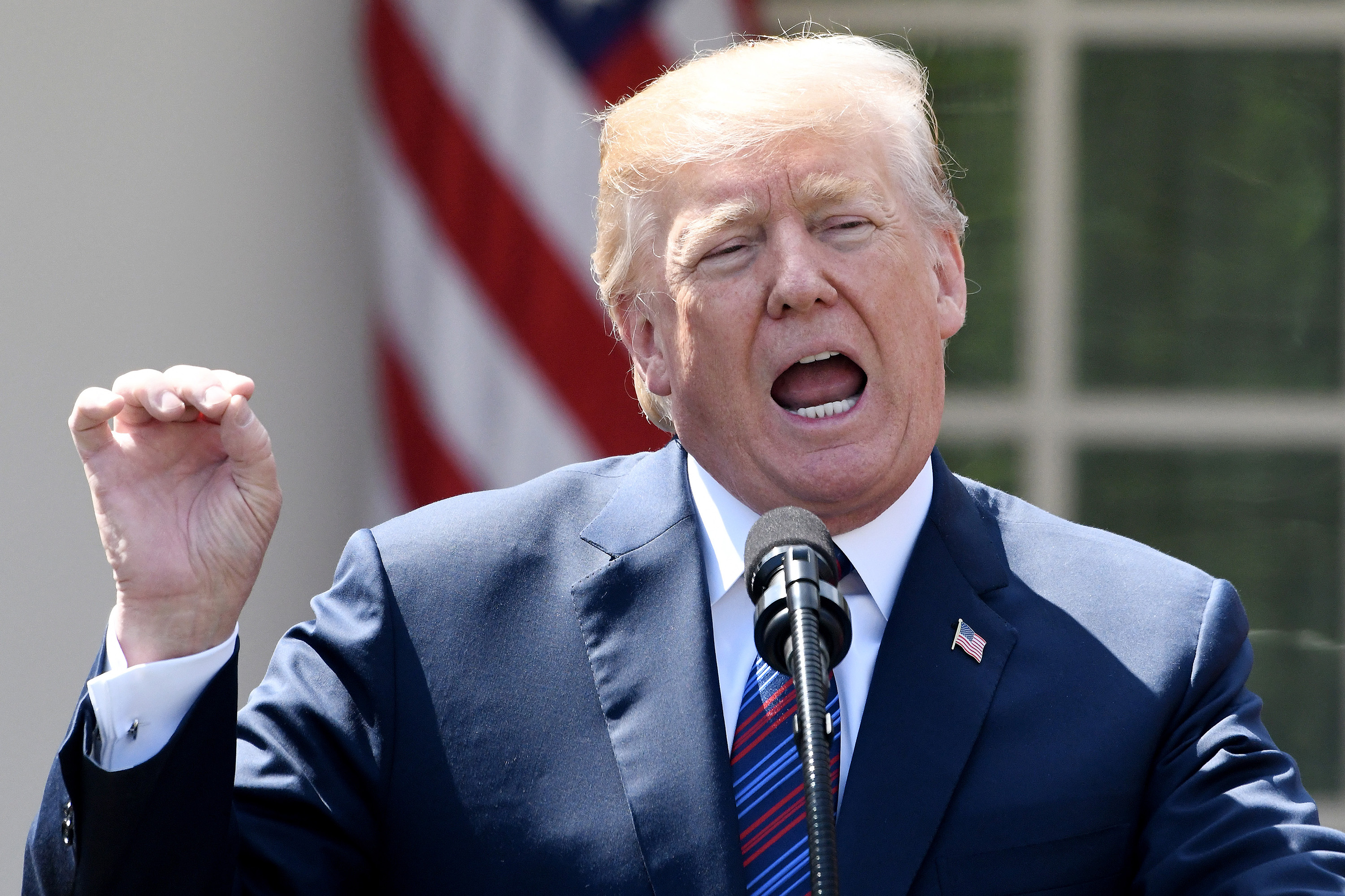
President Trump is unpredictable

Photo credits courtesy of Olivier Douliery/Abaca Press/TNS

Donald J. Trump spent his first year in the White House on a steep learning curve about what it means to be a president. He’s figured it out now: it’s a giant playbox in which his insatiable ego can command the entire world’s attention at the drop of a tweet, turn treaties and alliances upside down in 280 characters, feign wars and back off them to keep the stock market and all those big corporate hotshots who never gave him respect on a daily roller-coaster ride. Nothing’s for real and nothing has consequences, because reality itself is what Donald himself makes up as he goes along, with cues from his favorite sounding board at Fox & Friends. It’s a narcissist’s fantasyland, and a democracy’s ultimate nightmare.

Richard Nixon fell from power because he lied about what he called a third-rate burglary. Donald Trump burglarizes the country every day, nakedly exploiting his office for personal profit and charging the country for expenses. His cabinet officers fall from grace when they follow his example. He doesn’t.

Trump lies brazenly about everything — from the size of his inauguration to the Canadian trade balance to his payoff to a porn star — and calls the facts that suggest otherwise fake news and those who report them poltroons and traitors. He rewards his personal physician for lying about his physical height by giving him charge of the Veterans’ Administration. He trashes government agencies and derides the courts. He suggests that incest with his daughter might be fun. He thinks a trade war with China might be fun. He has great fun leaving us all guessing what can come next. The presidency, well, it’s the greatest fun of all.

In the terms in which he has redefined the office, Donald Trump is already the most successful president in American history. Previous presidents had to deal with Congress, public opinion and the huge executive bureaucracy itself. They had to promote an agenda, on whose success or failure they were graded. They had to manage relations with the world and maintain American interests and influence.  Trump does none of these things. He ignores Congress, sneers at individual members, and suggests treason in the opposition party. He leaves vast numbers of government posts unfilled, and critical agencies unfunded. He has no domestic or foreign agenda beyond his need for daily attention. He is indifferent to public opinion, including that of the so-called base whose core economic interests he now threatens. As long as he can find a crowd to cheer him, he has all the achievement he needs. His only standard is the amount of chaos he can sow around him, because chaos concentrates attention on the one who creates it. Success requires only utter unpredictability. By that yardstick, Donald Trump is successful beyond the wildest dreams of his predecessors.

Trump is greatly abetted by the press he affects to despise. It treats him as the responsible agent of the world’s greatest power. It calls upon him to formulate policies and follow them. It criticizes him, but as a rational actor. It parses his style of governance and speculates on the deep motives that must, surely, underlie it. It calls on him to be truthful, honorable and just. It has, in short, entered Trump’s own fantasyland.

Donald Trump is neither rational nor responsible. He has no policies, merely personal tics to which he periodically returns. He does not govern. Truth, honor and justice are entirely alien to him. Perhaps he once had some connection to a reality principle, for example in bankruptcy court. But being president means creating your own reality, and everyone else’s too. That’s the only principle to which he needs to adhere.

How did we get here? The Founding Fathers wanted to create an executive strong enough to conduct the affairs of the nation. They greatly worried about the potential abuse of such an office, and so attempted to hedge it in with checks and balances. They hoped primarily to do this by means of a Congress that would be the central institution of the new government. But presidents chafed at their restraints from the beginning, and with America’s rise to world dominion, the executive engrossed more and more of the powers of government.

A determined president, these days, can be a near-dictator, starting wars that Congress must helplessly fund and bending statutes to the will of the executive. An anti-president like Donald Trump can function to all intents and purposes as a tyrant.

James Madison and company were worried about demagogues and dictators. Donald Trump is neither. A demagogue seeks to manipulate public opinion, but Trump is indifferent to it. A dictator generally has policy objectives, but Trump has none; he seeks only “wins” in the sense of victories to declare, regardless of content. A tyrant, in the classical sense, is one who simply seeks to impose his own whims from day to day, or at least compel attention to them. That’s what Trump does, and so that is the term that fits him.

Trump didn’t enter office this way. He was merely the most spectacularly unqualified and inept person ever to assume the presidency, with disturbing personality markers all around him. It was assumed, though — or at least hoped — that he would be disciplined by the requirements of the job, and guided by advisors. The stock market boom that greeted him suggested that he would prove a useful idiot to the Republican elders who would run the show. At first, it appeared that this might be the case. Trump had no idea of how the government was supposed to work, and showed no interest, not to say capacity for learning it. He wouldn’t listen to briefings. He fled to the golf course and his nightly bedtime with a cheeseburger, and holed up in Mar-a-Lago. The generals who staffed the key policy positions quickly talked him out of his idea of getting American troops out of Middle East hot spots. He liked the photo-ops that accompanied his signing of presidential orders, if he weren’t required to read them. As long as his ego needs were met, he seemed the perfect patsy.

Gradually, though, Trump discovered that the abuse of presidential power was far more gratifying than its accustomed use, and far quicker at mainlining his ego. More, he found that an ego vested with the powers of the modern presidency could shake the world via tweet as it slept, and leave it to deal with the consequences. No Roman emperor had ever enjoyed such pleasures, nor even a Reality TV impresario.

This is the world we now find ourselves in. The political norms we had taken for granted — of civility; of respect for (even if not necessarily observance of) truth; of personal conduct or at least discretion — do not apply to Donald Trump. Our political system, paralyzed by the failure of its constitutional controls, lurches from crisis to crisis. Make no mistake: Trump’s actual incompetence will not save us. We’ve had a lot of bumps on the road in 230 years of republican government, but we’ve never faced anything remotely like this.

Posted in UncategorizedComments Off on President Trump is unpredictable

Why democracy is failing

The two famous comments about democracy in the last century were made, respectively, by America’s 28th president, Woodrow Wilson, and by Winston Churchill. Wilson declared as his primary diplomatic objective a desire to make the world safe for democracy. He was a more than slightly dubious advocate. After all, Wilson had backdoored us into a world war he promised to avoid and had thrown those who protested the war into prison under an unconstitutional sedition act. Differently, Churchill’s own more world-weary comment was that democracy was the worst of all political systems, except for all the others.

After World War I, Wilson seemed to be getting his way, at least in Europe. (He was less eager to foster democracy in the Americas, where Nicaragua was occupied throughout his term of office and during which Haiti was also subjected to long-term occupation.) The German and Austrian empires both collapsed, and in addition to Germany and Austria themselves, a host of new Eastern European nations got democratic constitutions as well. By the outbreak of World War II twenty years later, however, all these fledgling democracies had collapsed.

The end of World War II and the subsequent collapse of the British and French empires brought an even larger experiment in democratic nation-building, notably in imperial Japan and India. The only alternative model on hand, at least nominally, was Communism, but with the revolutions of 1989 against Soviet Russia, Eastern Europe was again democratized, along with the former republics of the Soviet Union and the now-truncated but still massive Russian Federation itself. To be sure, China was still a totalitarian state, but it was thought that exposure to private enterprise and free markets would lead it inexorably toward democracy. One influential commentator, Francis Fukuyama, even spoke of an “end of history” in which democracy would become the global political system as capitalism had now become its dominant if not sole economic one. It was time, in short, to see how democracy would fare when, no longer the worst system except for all the others, it was now ideologically set to be the only one.

Instead, less than thirty years after democracy’s seeming triumph, it is almost everywhere in retreat. How has this happened, and why?

It must first be observed that modern democracy is a complex system, based on a well-established legal system, protection of individual rights, and a clearly defined separation of powers. In addition, it requires what Aristotle identified nearly two and a half millennia ago as the basis of any stable government: a relatively egalitarian distribution of wealth such that power would not be isolated to the elites, and too much poverty in an underclass. In modern terms, we would translate that as a society based on a large and sufficiently prosperous middle class.

Protecting rights, maintaining an independent but responsible judiciary and balancing the exercise of sovereign power, are everyday challenges in a democracy. There is nothing routine about it, and the line about eternal vigilance being the price of liberty sums up the democratic dilemma as well as any. The more serious problem, though, is that the vaunted middle class has been mostly a myth throughout history. The prevailing reality has been dominated by small elites in which wealth has been concentrated through control, in Karl Marx’s still-handy phrase, of the means of production. Modern democracy took root in the newly-formed United States because of an abundance of the prime economic resource, land, and availability to those who would claim it. With the coming of industrial capitalism, free cultivation by smallholders gradually gave way to agricultural concentration — agribusiness today — and the growth of cities whose workers were only by dint of long struggle able to attain even modest standards of living and security, always subject to the catastrophic disruptions of the so-called business cycle. The so-called middle class was no more than 15 percent of the population in America (or elsewhere in the West) prior to the Great Depression, and it was only under the unique circumstances of the postwar reconstruction boom (c. 1945-70) that something like a substantial number of people began to achieve what Aristotle had in mind. Since 1970, the middle class has steadily contracted in the U.S., and only in places where social welfare systems have taken the edge off capital accumulation has its decline been somewhat less marked. These systems have been generally under attack by elites for some time, and the austerity policies generally pursued in the West since the financial collapse of 2008 have substantially undermined them.

The results of this have lately been seen both in America and Europe. The erosion of middle class living standards in Rust Belt states made possible the election as president of a pseudo-populist demagogue, Donald Trump, while in Europe, serious right-wing challenges in France and the Netherlands have been beaten back only with difficulty. In Eastern Europe, authoritarianism is on the rise or at the point of triumph in Hungary and Poland, while states such as Roumania are barely concealed kleptocracies. For Europe as a whole, moreover, there is an even more general crisis of democratic legitimation, namely the European Union itself. The E.U. was formed as an economic and monetary union, not a political one, which means that although some rudimentary political institutions exist, both political and economic decision-making is in the hands of unaccountable elites that march largely to the tune of Germany, whose economic preponderance gives it command authority over all twenty-eight current states of the Union. However if you want to describe such a system, and whatever local authority remains to its member states, it is in no sense of the word a democracy. Not since World War II has democracy suffered such a setback, and it is all the more insidious for having been borne in on the promise of open borders, free markets and enhanced personal opportunity: in short, the whole Pandora’s Box of elite neoliberalism.

What this means is that, apart from a few outliers such as Norway and perhaps Britain (if it ever does effectively win its independence from the E.U.), the whole of Europe has ceased to be democratic in the ways that really count. This was not yet certain in 1989 but it is clearly the case today. Democracy in Europe, if it is to have a future, must mean dismantling the E.U. in its present form, and going back, at least for the foreseeable future, to a continent of ethnically divided nation states — the arrangement that brought it to two world wars in a generation. That, in turn, raises the question of whether modern democracy is so rooted in the nation state — the soil from which it sprang — that it cannot easily accommodate the kind of transnational cooperation on which the future of the planet may depend.

While European democracy has, in effect, betrayed itself, its great global bulwark finds itself in crisis. Without U.S. intervention — as Winston Churchill well recognized — democracy in Europe, including Britain, would have been eclipsed by the Nazis, or perhaps by a Nazi-Soviet condominium. America saved democracy then, but now finds itself in the hands of a would-be strongman who has little understanding of or interest in the rule of law and who has seriously shaken the comity on which a democratic society depends. After more than two centuries, America at the moment no longer represents the citadel of democracy, but its teardown.

Around the rest of the world, the democratic prospect is in no better condition. Endemic corruption has brought Brazilian democracy to its knees; a sectarian ruler threatens it in India and another has undone it in Turkey. Russia and most of the former Soviet republics quickly reverted to authoritarianism after 1989. Even the one apparent success story of democracy in the past generation, South Africa, has now regressed, while the Arab Spring uprisings of 2011, insofar as they were interpreted (largely in the West) as an aspiration for democracy, have been uniformly a disaster. And China, of course, has not budged an inch from the guns of Tiananmen Square.

These might be viewed as temporary setbacks; democracy has had them before. But a democratic socialism has never taken firm root; historically, modern democracy has proceeded from and remains wedded to capitalism, and capitalism is a formula for maximizing inequality, the condition that contradicts democratic society as such. Democracy is certainly not the only issue at stake as we face planetary ecological crisis and the horrific political scenarios it may entail. But, as democracy has been capitalism’s stepchild, so it may also be one of its ultimate casualties.

Posted in UncategorizedComments Off on Why democracy is failing

How to choke on a big nothing burger

Photograph courtesy of Gage Skidmore at Wikipedia

In “The French Connection II,” Gene Hackman’s Popeye Doyle, quitting heroin cold turkey, asks for a big, juicy American hamburger with the blood dripping out of it and ketchup and onions piled high. It’s not available to Popeye in the movie, but it’s being served raw in the White House right now. And Donald J. Trump is about to choke on it.

The meal in question was given its sobriquet, “a big nothing-burger,” by Trump’s chief of staff, Reince Priebus, who thus described the revelation of a meeting in June 2016 between the three then-principals of Trump’s presidential campaign — son Donald Trump Jr., son-in-law Jared Kushner, and campaign manager Paul Manafort — with a Russian operative, Natalia Veselnitskaya. Thus commenced a sequence of lies and concealments with more layers than a Russian doll. It is best to strip them away one by one.

The first concealment concerned, of course, the fact of the meeting itself. Trump Jr. is not an official member of the White House staff, and Paul Manafort was dismissed as campaign manager soon after the Republican Convention when his own shady ties to a Russian oligarch were disclosed. But Jared Kushner, as a White House staff member, was required to list all contact with foreign individuals as part of obtaining his national security clearance. Kushner omitted disclosing the contact with Veselnitskaya — and, as it turned out, with about a hundred other people as well.

Once the meeting became public knowledge, Trump Jr. characterized it as relating to the question of “Russian adoptions.” This seemed an odd matter for busy campaign managers to concern themselves with on the eve of a nominating convention, but the backstory was more interesting. The case of a Russian dissident, Sergei Magnitsky, who had exposed corruption among the oligarchs and died in prison under suspect circumstances had resulted in congressional sanctions against senior figures in Vladimir Putin’s inner circle, and Putin, in retaliation, had frozen a Russian adoption program with the U.S. Veselnitskaya, as it turned out, had lobbied intensively for repeal of the so-called Magnitsky Law, a chief Putin policy objective. A meeting with her to discuss this subject would seem on the face of it to violate federal laws against interfering with the foreign policy of a sitting president; to conceal the meeting involved a raft of other laws about electioneering.

Trump Jr. tried to evade this point by suggesting that he had not known in advance about the subject of the meeting, which only raised the obvious question of how it had been put to him and why he had accepted it. Another  lie: to protect Kushner in particular, Trump Jr. further claimed that Kushner and Manafort had only been casually invited to the meeting at the last minute, and that they, too, had no idea what it was about.

Trump Jr. only came clean when The New York Times told him it was about to publish an e-mail chain leaked to it that would describe the full background of the meeting. In the interests of “transparency,” as he put it, he then put the chain online himself. The emails revealed that the meeting with Veselnitskaya had been brokered by a Trump associate, Rob Goldstone, who had allegedly been approached by Kremlin contacts with an offer of compromising information about Hillary Clinton. This broke a slew of other laws about accepting items “of value” from foreign governments pertaining to an American election. Instead of rejecting this overture, Junior responded enthusiastically — “I love it!” — and immediately copied Kushner and Manafort to bring them on board. He also indicated that he would welcome a continued flow of information from his new sources to be released at strategic moments in the summer and fall. At this point, he was going beyond statute violation into the murky area of conspiring with a foreign power to tilt a presidential election — that is, flirting with treason.

Kushner clammed up, saying only that he had failed to disclose his participation in the meeting inadvertently. Manafort refused all comment. Junior was hung out to dry, with even his father limiting himself to the ambiguous observation that he was “a highly-quality person.” Benedict Arnold had been so regarded too.

The drip of lies continued.

Junior had repeatedly stated that the meeting had been limited to the four persons named, and that when Veselnitskaya’s objective of repealing the Magnitsky Law became apparent, both Kushner and Manafort left it. Junior himself, alone with Veselnitskaya, had reportedly terminated the conversation a few minutes later. Nothing of “value” had been proffered by the Russian, he contended, and no material was left or exchanged.

Not so, alas. At least two other persons were in fact in the room: an associate of Veselnitskaya’s with a counterintelligence background and an unnamed “translator.” Possibly two other persons were present as well, thus far unidentified. And material was indeed left for Junior, to this point undisclosed.

With the e-mails now public, Junior could no longer claim that the meeting had not been set up to get dirt on Clinton. This he characterized as “opposition research” of the kind routinely done by political campaigns against each other. When what Veselnitskaya had to offer proved uninteresting, he had rebuffed her on the Magnitsky issue. Case closed — except for that business of federal election law, in which the mere solicitation of or willingness to receive objects of “value” is tantamount to accepting them, and the apparent fact that something had indeed been accepted.

At this point, the Russian objective was clear enough: to entrap the Trump campaign — collectively as well as individually liable as a matter of law — in a compromising position that would give the Kremlin leverage over American foreign policy should Donald Trump be elected. It is quite possible that the Russians dangled similar tidbits about Trump himself before the Clinton camp, or made them indirectly public — the so-called British dossier on Trump’s alleged sexual indiscretions in Moscow comes to mind. But Trump won the election, and the trap laid for Junior became the operative asset. Only The New York Times knows where its information came from; it has referred to five independent sources, who are presumed to be White House leakers. Perhaps; but even if the leaks do come from within, it isn’t clear where the faucets are. It is hard to imagine that many patriots lurking in the Trump administration, thirsting to reveal the information that might bring down their boss.

Which brings us to Donald Trump himself.

Trump has disclaimed any knowledge of the meeting with Veselnitskaya prior to its public disclosure; such knowledge, of course, would have made him a party to it, and therefore of a conspiracy to collude with a foreign power. It beggars belief that Trump would not have been informed of such a meeting when it took place, and that it would have been kept secret from him for months into his administration as Congressional and Justice Department investigations into its contacts with Russia mushroomed all around him. There is, moreover, strong contemporary evidence from Trump himself that he not only knew of the meeting with Veselnitskaya in advance, but had high expectations for it: just before it took place, he promised a speech within days with major revelations about Clinton. When the meeting fizzled, the speech was quietly shelved; but Trump would publicly encourage Russian hacking against Clinton later that summer, in effect cheering on foreign electoral interference.

A prima facie case can easily be made that Trump has, in fact, been acting as someone in fear of blackmail. His fulsome praise of Putin personally and his contemptuous takedowns of NATO; his backdoor offer, as president-elect, to revisit the question of Russian sanctions and the subsequent attempt of Jared Kushner to establish a private channel to Moscow through the Russian embassy itself; his appointment of a virtual Russian apparatchik, Michael Flynn, as his National Security Advisor; his disclosure of intelligence secrets to the Russian ambassador at a meeting barred except to Russian media; his bizarre offer of bilateral collaboration with Russia on cybersecurity. Some of these things, perhaps, could be attributed to naivete or sheer stupidity, but the sum of them is simply too damning and the conclusion to be drawn from them is too grave to ignore — namely, that American foreign policy is in thrall to a hostile power. Of one thing, at any rate, we can be reasonably sure: given Trump’s extensive business and personal history in Russia and his known association with oligarchs, Putin would have a veritable archive of material on him.

In defense of Trump, one might point out that diplomatic relations with Russia have turned not warmer but in general frostier in his six months in office. But there are many counter-pressures on him, some from the senior military figures he has gathered around him (not in all cases willingly). From this point of view, might we not regard disclosure of the Veselnitskaya affair as a shot across the bow from Putin, a warning to Trump to toe the line? Putin does not, of course, need Trump; his real goal is a weakened America with a destabilized political system. If stringing Trump along can best achieve that end — a presidency deeply suspect and mired in endless scandal — Putin will play this card; if bringing him down with the attendant chaos and division it will sow serves it better, that too is in the deck. I have to think that hawkish Republican Senators like Lindsey Graham and John McCain are having such thoughts, and their Democratic counterparts too. Meanwhile, the various investigations grind on, like so many time bombs ticking away.

America is in the midst of a crisis the like of which it has never experienced, at least not since the edgiest moments of the Cold War. Then, Joe McCarthy accused the state department of being honeycombed with Communists, and Republicans spoke, generically, of twenty years of treason. But all eyes are focused now on the Oval Office, and its present occupant. Harry Truman was, certainly, no Russian agent. But who, exactly, is Donald Trump?

Posted in UncategorizedComments Off on How to choke on a big nothing burger

Is humanity a lost cause?

Sometimes it takes a deeply conservative intelligence to get to the heart of the matter.

Such an intelligence was that of William Butler Yeats, who wrote nearly a century ago that things, not men, were in the saddle. Yeats was looking back at a world ruined by the Great War, in which Europe had sunk a generation of its young men in a futile and bottomless conflict fought for reasons that, by its end, no one could remember, and which, once begun, no one seemed able to stop.

We have no world war going today — if one broke out in our nuclear-armed world, it would almost surely consume anything we’d care to call civilization — but we do have pointless and intractable conflicts, of which the most notable example is the now six-year-old proxy war in Syria, a running sore whose effects have destabilized three continents and which now, whatever its causes, is a senseless and murderous attrition. War, moreover, although it is the nightmare that ultimately overhangs the world, is the symptom rather than the cause of our beleaguerment.

What we have lost is the thread of a capable human agency, an ability to address our common problems in a way that reflects a shared sense of justice and equity and an interest in the destiny of our planet.

The political system that emerged more than two centuries ago to answer this need was called democracy. Democracy was based on was the notion of egalitarian citizenship, the idea that each of us had a common and equal stake in the political community. Its founders in America, mindful of the experience of ancient Greece and Rome, understood it to be a perilous experiment that might fail. But democracy emerged on the ruins of what had hitherto been the only other model of general community, religion and the ethical codes associated with it. The great monotheistic religions that had their common beginnings in Western Asia, and the less credally centered but still cohesive visions of the East, Buddhism and Confucianism, had given human societies a common image of themselves.

The crisis to which democracy was a response was the decline of Western Christianity and the hope it represented was that a society founded on an essentially secular vision could sustain itself. In America, Thomas Jefferson, James Madison and Tom Paine worked toward this end, and the product that emerged from their labors, contentless in itself, a process rather than a system, they called simply the “Constitution.” Our Constitution, always spelled with caps, has frequently been referred to as our civil religion, a text of quasi-biblical authority to which we refer as the touchstone of our commonwealth. Although it was a flawed document, reflecting such contemporary evils as slavery, the political exclusion of women, and capital punishment (an evil still with us), it soon acquired a status supereminent to civil legislation, the heart of democratic process itself.

The vision of man as defined by the Constitution was that of the citizen, a (male) person pursuing his own interest — “happiness,” as defined by our other founding text, Thomas Jefferson’s Declaration of independence — but in a manner respecting and accommodating the independent pursuits of others. It was, in short, a creed of personal liberty within the framework of shared community. Jefferson’s own model of this community was the agrarian freehold, a model based on a farm economy, and, in the newly formed Union, presupposing an abundant supply of land.

Implicit in this idea was a westward expansion of the thirteen states, and with it the dispossession of the Native American nations: there were to be no more “rights” for them than for Jefferson’s own slaves. What Jefferson did not anticipate, however, was the rise of an urban, industrial society, and the strangling hold of finance capital that would come in its wake. Fifty years after his death, America had entered its first Gilded Age of corporate monopoly, worker exploitation, and radically skewed wealth distribution. Money bought politics, then as now, and it was only the crisis of the Great Depression that briefly slowed the inexorable concentration of wealth and power, and, with it, the evisceration of democratic citizenship. For the past fifty years we have been entering a new Gilded Age of prosperity for the few and economic straitening for the many, a process that is now fully mature.

Even in Jefferson’s lifetime, however, the potentially catastrophic results of his vision were apparent. The French revolutionary Louis Antoine de Saint-Just hailed “happiness” as the principle of modern society, only to use it, with his colleague Robespierre, as the pretext for the Reign of Terror, the first political purge of modern times — and the first of many to come. Jefferson had imagined happiness as the goal of freedom, but, in the hands of those who defined it for others, it could also be the justification of unbounded tyranny.

The question, then, for the early 21st century as for the late 18th, is whether the commitment to a secular humanity, ungrounded in an ethics based on transcendental religious principles, can provide a satisfactory vision and a stable basis for a just society. In practical terms and on a democratic model, this means a fluid adjustment between the claims of the individual and the requirements of a functioning community. The citizen must be free to pursue his interest within a reasonable latitude, but not at the expense of communal welfare. What is necessary, then, is a vision of humanity that embraces both the rights-bearing individual and the social whole. That, in a word, is the challenge of democratic politics. It’s a tricky game to play.

What has happened in practice is a tendency to polarize the choices. On the one hand, we have seen collectivized societies under fascism and communism (themselves both responses to the unbridled individualism of contemporary capitalism), in which the individual is radically subordinated to a collective that defines his interest for him; on the other, we have seen a ruthless pursuit of wealth and power that denies not only the needs but even the existence of society. Libertarianism is the ideology most frequently (though not always fairly) invoked to justify this latter attitude, but it was most simply put by the ablest modern spokesperson of elite capitalism, Margaret Thatcher, who flatly stated that there was no such thing as society — a rather remarkable pronouncement, when you think of it, by someone elected to lead a nation.

In fact, society is very much real, and its instrument, the state, can be lethal. The consequence of this is that humanity has been defined in terms of the rights-bearing subject and what organized social power may not do to him. The evolution of this concern, from the French Revolution’s Declaration of the Rights of Man and of the Citizen to the 1948 U.N. Declaration on Human Rights, has been striking.

The French Revolution, at its inception, envisaged no opposition between the individual in his private and public capacities, although the American Bill of Rights, grounded in English common law, did. The U.N. Declaration is not particularly concerned with the tasks of citizenship as such. Coming in response to the World War II and the Holocaust, it meant to stake out the limits of any state power over the individual, and the minimum entitlement he or she could expect. This was an essentially negative template that acknowledged human vulnerability, but did not provide a positive image of human value. Individuals had specific claims on society, such as education and the equitable sharing of social benefits, but only passive rights of action, such as freedom of conscience.

The Declaration, in short, did not state what the individual might do, but what could not be done to or withheld from him. It made the political subject, essentially, a ward of the state. A slightly earlier statement by Franklin Roosevelt and Winston Churchill, the Four Freedoms, included the guarantee of a “freedom from fear.” The implied vision was of the human subject as a scared rabbit in the crosshairs of an authoritarian state.

The U.N. Declaration represented a substantial retreat from the Enlightenment vision of the individual as a proud and personally sovereign subject. The French Declaration of the Rights of Man has long been on the scrapheap of history, and our own Bill of Rights has taken a substantial beating. Surveilled by the state, buffeted by the unaccountable winds of economic and technological disruption, the very notion of the individual, let alone humanity as such, has fallen on hard times.

Our world is one in which the individual is not only not at the center of society, but one in which individuals who can’t keep up with a dizzying pace of externally-imposed change are rendered redundant or obsolete. You might say, with little fear of contradiction, that the situation of the individual has rarely been worse.

The question, then, is whether any view of humanity not grounded in religious vision is sustainable. No civilization before our own has ever long maintained itself without one. But religion is not something you can order up, nor is it a cureall. Islam is a world religion, but it has, in the suicide bomber, produced the ultimate negation of any notion of the human as a subject freely interacting with others. If you don’t like secular tyranny, you won’t like the religious kind any better.

In general, where there is no concept of humanity, there is no secure room for humans, either. Where such a concept can come from today I do not know, but I would suggest we start in the world around us as a source not only of sustenance but value. Perhaps then we can begin to recapture our sense of wonder and — who knows? — perhaps even our sense of the sacred. Man is an end, to be sure, but not for himself alone.

Posted in UncategorizedComments Off on Is humanity a lost cause?

How long must the D.C. charade go on?

Photograph courtesy of Ad Meskens at Wikimedia

Five months into the Donald Trump presidency — or five hours, for that matter — it was clear that the White House had been occupied by a charlatan, somewhere between a buffoon and a demagogue and competent in neither role. That prospect had been clear five months previously, on the campaign trail; it was clear five years previously, or at any time earlier in Trump’s career as a bogus magnate, serial bankrupt and reality show sadist.

Some people thought giving the system a good shake would be salubrious, even at the cost of some chaos; some thought that Trump would sober up once the daunting realities of office faced him, or at least permit himself to be guided by helpful handlers. (We all remember how well that worked in the last Bush presidency with Darth Vader Cheney and Donald Rumsfeld.) And some people, whatever their persuasion, were just happy, at least in the moment, to be spared the presidency of Hillary Rodham Clinton.

It needs to be said, one last time, how bad a status quo Clinton presidency would have been. Four more years of Wall Street rule; four more years of reflexive Cold War politics; four more years of our endless wars, with no doubt a few new ones thrown in. Four more years of the Clintons themselves, with their inevitable slime-trail of sleaze. Four years of that, and a nation either on Zoloft or at the verge of rebellion.

But in 2016, we were already in a state of rebellion against both political parties and their packaged candidates. It takes more forgiveness than I can muster that the Democratic Party, faced with such a crisis, put forward the most backward-looking, personally distrusted and even viscerally despised candidate it could find, and gave the rebel flag its chance. I don’t mean the rebellion that the attempted repudiation of establishment candidates represented, and the demand to address rising inequality, a system so sclerotic it couldn’t fix the roads or send the kids to college or grandpa to a clinic without bankruptcy, and a foreign policy that simply spewed out new wars on top of old ones. That rebellion was just and necessary, and still is. I mean the rebel flag of violence, hatred and racism that the old Confederacy embodied, and that in nominal defeat has dominated so much of our politics since. That was the cause that triumphed in 2016, and confronts us with the politics of our moment — a politics not created by Donald Trump, who is too shallow an actor to create anything, but which has been channeled through him.

I’m not going to say that the election of Donald Trump was the triumph of the deplorables, as Hillary Clinton tried to. It was really the triumph of the Electoral College, the last institution foisted on us by slaveowners, and still wreaking its mischief today. But Trump brought every raw nerve in the country to the surface, whether for reasons good or bad, and he has kept them there ever since, having no other gift or capacity and being himself, in his own willful narcissism, nothing but bristling resentment. We find ourselves thus sucked into a personal psychodrama that, in a feedback loop, keeps popular fury at a boil as well.

In his first week in office, Trump asserted (1) that it hadn’t rained on his inaugural address, itself an exercise in hate-mongering paranoia; (2) that the crowd at his inauguration had vastly exceeded those at his predecessor’s and (3) that a popular vote majority in the election cast for him had been stolen by millions of illegal votes. The fact was that rain had begun just as he opened his mouth; that photographs showed far larger crowds for Barack Obama; and that each of the 50states of the Union had (no thanks to the Russians) reported a clean election without any irregularities of consequence. Trump’s claims weren’t exaggerated or implausible: they were loony. A man who thinks that the sun is shining when rain is falling on him isn’t just out of touch with reality; he is creating and living an alternative reality.  Fake news, yes — but fake weather too? Phantom crowds and phantom votes?

You had a clinical case for removing Trump from office on 25th Amendment grounds before Groundhog Day.

The problem, of course, is that triggering the 25th Amendment requires a letter signed by a majority of the Cabinet certifying presidential incapacity. Trump had insulated himself from this (or permitted himself to be insulated by his transition manager, Mike Pence) in the selection of what is surely the worst Cabinet in history, ideologues and paid hacks determined to take advantage of Trump’s one demand of them — personal fealty and unstinting praise — to grease their private agendas and gratify their paymasters. Incompetence in the boss was a prize asset, as the Republican Congressional leadership had already come to appreciate; Trump was to be the useful idiot who would enable the party’s dream of 80 years, to dismantle the regulatory state and undo the last remnants of the New Deal.

How persistent this dream has been, and how pernicious, is shortly to unfold if the Republicans’ two-pronged legislative program, to gut Medicaid and use the loot to finance tax cuts for the rich, makes it to the presidential desk. Trump will sign these bills because, well, he likes to sign his name, and because the rich are his favorite constituency. He’ll be told they represent success — his success — because presidents are judged by their legislative performance, and, lacking any agenda of his own other than the advancement of his personal business interests, he’ll be happy to have had one supplied for him.

Does this sound simplistic? Spend five minutes inside the brain of someone who can’t be bothered to read even doctored summaries of the bills he’s about to sign and spends his evenings screaming at his television set and you’ll get some idea of what our flawed if not failed democracy has inflicted on us: or, rather, what We the People have come to after 230 years of our grand Constitutional experiment.

We can’t afford this, not simply because of what it means to our own social fabric but because of what our instability means in the world. Whether on balance America has been a good or a bad thing for others is open to debate, but an America run amok is extraordinarily dangerous. The candidate who said he knew more about military affairs than the generals has ceded control of our wars to them without policy review or directive, and with it the central issues of American foreign policy. The result of this has been deepening involvement in our failed wars in Iraq and Afghanistan, a brand new one in Syria and another in the making (if not effectively underway) with Iran. It has meant confrontation with China, and Russian and American warplanes buzzing each other from the Baltic Sea to the Syrian desert. It has also meant enabling wars we do not necessarily start but wind up with anyway, and meddling ineptly in explosive local rivalries such as that between Saudi Arabia and Qatar. There’s a ripple effect to our irresponsibility too, such as the recent threatening talk between unstable, nuclear-armed India and Pakistan. We can clean up the messes we create at home with sufficient political will, at least in theory; those we foster abroad are less easily solved.

This is not to say that our chaos at home is less threatening. A rudderless presidency exacerbates social frictions; an occupant of the office who functions in isolation and flails out at enemies real and imagined, who attacks public institutions and private individuals and who shames the very idea of civic discourse with the vocabulary of a foul-mouthed five-year-old, diminishes and debases us all. We simply can’t function in this climate without lasting and potentially irreparable damage. Nor is it something we can just shrug off as a bad patch in our history. It is what our history has come to at this moment, and we have to deal with it.

Trump has already committed impeachable offenses in his brazen flouting of the Emoluments Clause — his open bargaining of foreign policy for business favors — and for obstruction of justice. If that doesn’t work for you, try his wanton disregard for the separation of powers, his baseless attacks on his predecessor, his willful discrimination against religious minorities, his failure to execute the laws or staff the agencies responsible for them, etc. Trump has actually left us no excuse not to remove him. There is plenty of cause if there is an ounce of will. The trouble is that there is no such will, at least among those in whom the power to act currently rests. The Republican Party has made its pact with darkness, and that pact was made long ago.

This isn’t to suggest that the Democratic Party offers much better. There is, too, the fear on the left that a Pence presidency, or a Paul Ryan one if Pence too is enmeshed in the burgeoning Russian scandal to survive, might function more effectively as a platform for reaction. That, though, would be an issue to be dealt with on its own terms. The reality we confront is a rogue presidency wildly misled every which way by a disastrously unprincipled and unfit man. That’s the classical definition of a tyrant. No people that hopes to govern itself can tolerate one, no matter for how short a period.

Posted in UncategorizedComments Off on How long must the D.C. charade go on?

Drexel’s two graduating classes of 2017

Photograph courtesy of Mark Ramsay at Flickr

Drexel will have two graduating classes this year.

One is the student body’s. The occasion will be proud and happy for those who have completed their bachelor’s, professional, or graduate degrees, and to all those students — some of whom have been mine — I extend my warmest congratulations and best wishes. I don’t need to tell you it’s a rocky world out there, and that some of the assumptions I could make when I stood in your shoes about a more or less stable workplace with secure employment, benefits and pensions are no longer the case. You’ll have to be nimble, and often quick. But I hope you’ll remember the virtues of friendship, solidarity and mutual care. They’re the ones that count in the end. To all of you, best of luck.

The other graduating class is a different story. Some of its members are leaving voluntarily. But many aren’t, and even for those whose decisions are entirely their own, there is a sense of unseemly haste and pressure, not to say coercion. I speak of those faculty and staff who are being pushed toward retirement by the university’s decision to terminate all post-retirement monetary benefits as of June 30 for staff and, for some faculty retirees, Aug. 31.

I’ve written about this subject before, but as I’ve spoken to faculty and staff, including both those who are retiring and those who aren’t, I’ve been all the more deeply impressed with the sense of stress, frustration, resentment, bitterness, and plain, raw anger I’ve encountered. And it isn’t lessening as the hour of severance approaches, but deepening. If there’s a single word that sums up all the emotions people are experiencing, I’d say it’s this: betrayal.

In a way, this is surprising. Surely the experience of the modern American workplace is familiar enough by now? Surely we’ve heard and read about the implosion of America’s manufacturing sector as good jobs became the country’s chief export; of the collapse of unions; of falling wages and unfunded pensions? Surely we’ve come to understand that the postwar social contract between capital and labor has long been shredded, if indeed it was ever anything but a pious fiction?

Well, yes — but a university is supposed to be different. It’s an academic community, and a community is a place where people work toward common goals and look out after each other, and where the bottom line isn’t a buck but some nobler value like education, knowledge and free exchange. All of which presupposes some personal and institutional virtues, such as dignity and respect.

But, time’s up, class. It’s time to stop trying to smell the roses, because, although there may be a few left, there are an awful lot of stinkweeds pushing up through the grass.

Exhibit A would be the Voluntary Retirement Incentive Plan.

Back in the day of defined benefit retirement plans, universities committed (once you were contractually vested) to giving faculty a lifetime retirement income typically approximating half of your last working income. Ancillary benefits were similarly guaranteed. With the advent of defined contribution plans, the university guaranteed only an annual monetary contribution, part of which was, of course, your own. Where that money went, and what it ultimately provided, was up to you: for faculty, into TIAA-CREF accounts; for staff, 401(k)s. The university washed its hands of any post-employment responsibility, other than for such benefits — medical and life insurance, severance pay, tuition remission — that it chose to offer, but could reduce or retract at will. You might say that they constituted a moral obligation, since they would have been part of the compensation package that served to attract labor. But, now you see it, now you don’t. Drexel’s medical and severance benefits were cut sharply four years ago. With this year — with the current crop of retirees — they will vanish.

Many of those now retiring have been counting on Drexel’s medical benefit, degraded as it’s been. I probably needn’t tell anyone that you don’t want to enter the health insurance racket these days with your naked wallet alone. You might want — you might need — a few extra years of employment to top off a minimally adequate retirement. But the loss of medical coverage might be too big a risk to take. Anyway, Starbucks is still hiring.

See what I mean about academia being one big, happy family?

What I don’t get, though, is how buying yourself a raft of ill will is going to solve a $72-75 million budget hole (or whatever the actual figure is). My guess is that the immediate payoff for the VRIP won’t exceed ten percent of the deficit. For that, several score people around the university have been sent rushing through a two-month retirement process that, to be orderly, should involve a minimum of two years’ personal and institutional planning. Their divisions and departments will be left scrambling for replacements, if any, or assigning new (and, of course, unpaid) duties to those who remain. There won’t be much time for goodbyes, if anyone’s in the mood for them.

These graduates of the Drexel retirement class of 2017 will not, by and large, be taking happy memories with them. I had a conversation recently with a departing departmental secretary who’d spent nearly thirty years at her job, enjoying the lively atmosphere of intellectual life around her and the good friends, both faculty and staff, that she’d made. She’d been thinking of retirement, but not the guillotine. Now she found herself with a host of transition problems she hadn’t planned for, including the need to sell a house.

A good person, a good worker, a familiar and valued colleague. See you later.

I’ve pointed out that student alumni aren’t the only ones who take the reputation of Drexel into the world with them. So do retirees. That the retirement class of 2017 won’t be doing any cheerleading is a given, but that’s only the tip of the iceberg. More retirement-eligible faculty and staff are staying than leaving, meaning that they will give up their retirement benefits to keep earning a paycheck and pursuing a career. I’ve talked to them, too, and they are just as burned as those who are going. They will do their jobs — they are professionals — but their resentments will fester, and that bad blood will find its way into the tissue of the institution.

If the senior administration has any awareness of the anger it has stoked, it certainly isn’t showing any sign of it. Perhaps it has climbed so high on its perch that it can’t see the toilers below who merely carry out the humble tasks of education. Drexel would certainly not be alone in this assumed arrogance; the administrative class that has insinuated itself at the heart of the modern university with Weberian diligence regularly confuses itself with the academic enterprise as such. That would explain why Drexel’s retirement benefits were scrapped without public notice or discussion; why the rollout of the VRIP was so botched that even those charged with implementing it had no answers to elementary questions about it; and why retirees are being hustled out the door with such indecent haste and without the slightest acknowledgment of their service.

President Fry, who likes to think about the Big Picture, recently wrote an op-ed for The Philadelphia Inquirer in which he suggested that colleges and universities “have a duty to foster healthy debates founded in civil discourse” because “University campuses are perfectly suited to bring together different people” to air their differences in an atmosphere of “respectful, thoughtful and honest dialogue — done face to face and not behind the safety of a mobile phone.”

Yes, and such dialogue would have been particularly useful this past year between the [resident and his own university community. Apparently, the thought never dawned on him.

Posted in UncategorizedComments Off on Drexel’s two graduating classes of 2017

Free speech propaganda and the right to be heard

Photograph courtesy of Fibonacci Blue at Flickr

Photograph courtesy of Fibonacci Blue at Flickr

Free speech is the most important right we have. The Founding Fathers, understanding it as the prime element in a free society, wrote it into several amendments of the United States Constitution. The First Amendment guarantees it as a right in terms of individual and collective speech on civil and religious matters, whether by personal expression, public assembly or private worship.

The Fourth Amendment protected the means behind free speech in the security of books, papers and other materials from seizure or scrutiny except on the basis of a probable cause warrant. The Fifth Amendment guaranteed the no less crucial obverse of free speech, the right not to speak where self-incrimination could result. Finally — and crucially linked to the Fourth Amendment — the institution of a free press was recognized, as the means by which the public dissemination of information critical to informed speech and judgment was based.

Free speech is also linked to another critical element of democratic value, tolerance. Free speech is challenging by its nature, and sometimes disruptive, offensive or shocking in its effect. It is also open to abuse, the proper corrective to which — libel laws apart — is more free speech. It’s a good thing you can’t get too much of, most especially when it’s used in a bad way. You don’t have a right to shut people up, but you do have the right to tell them they should do exactly that. And both of these things are as they should be.

Free speech is not only an exercise, but a climate. “Pass the salt” isn’t free speech in the sense that “impeach the president” is, but the confidence we feel in speaking our minds or communicating our needs rests generally on the assumption that we need not fear for ourselves in doing so. The confidence we may have in expressing ourselves is the basis of our social dignity and therefore of our citizenship. It isn’t without limits, but those limits are just what free speech itself negotiates everyday. We know that after one day without it, we cease to be a free people.

There is a cost for free speech, however. That cost is not simply that we may be exposed to speech that is careless, irresponsible or vindictive. It is that certain speech is knowingly false or distorted. The name for such speech is propaganda. When such speech is the only speech allowed, then you know you are living in an autocracy. But propaganda is a hazard of free societies, too.

How do we know when we are being exposed to propaganda? It comes at us every day in many forms: from the government, from lobbyists, from commercial enterprises, from so-called special interests and from the think tanks that think in only one way. There is one common denominator behind all forms of propaganda, however; the driving force behind them is not thought, but money.

It’s not wrong per se to be paid to speak. Academics and ministers of the cloth are paid to do just that, but it is their expertise (which of course includes questions of judgment and value) that is being hired, not their personal opinion. Some cases are more clouded. When Hillary Clinton received $675,000 for three speeches to the investment firm of Goldman Sachs, and when Barack Obama will — unless his better judgment prevails — receive $400,000, a sum equivalent to his presidential salary, to deliver a single speech to the same firm, we may well suspect that their listeners are not paying them to tell them things they don’t want to hear. Clinton faced much pressure to release the text of her talks during her campaign for president, which she successfully resisted. The point, though, wasn’t so much the content of her remarks as the context of her making them. Goldman Sachs was a notorious bad actor in the scandals that led up to the financial crash of 2008 and its modus operandi appears little changed today. What it was and is buying from both Clinton and Obama is respectability, or in plainer terms, whitewash.

Nobody needs to tell either speaker what to say. And, if it neither propaganda, nor free speech, it’s words for dollars.

This brings us to the currently vexed issue of free speech on campus. Outside speakers are routinely invited to address student organizations, many of which have political orientations. They’re often paid expenses and honoraria. Their expertise is sometimes expected, but it is always assumed that they will express their opinions, which is to say that they will speak freely. Recently, some conservative speakers have aroused passionate opposition from other campus groups, with a bit of scuffling involved: Charles Murray at Middlebury College, Ann Coulter at Berkeley and in the case of Milo Yiannopoulos, also at Berkeley, a fair-sized riot.

These three celebrities of the right, as I suppose we can call them, are distinct cases. Murray is an academic, best known for his argument in The Bell Curve that the poor are essentially stupider and the rich essentially smarter, a claim recently put forward more crudely by Donald Trump’s Secretary for Housing and Urban Development, the inimitable Ben Carson. Coulter is a political entertainer who specializes in bashing the left; she has a shtick and she delivers it with verve, which gets her the occasional television appearance.

Yiannopoulos is a provocateur who’ll say or do pretty much anything to get noticed; his racism and misogyny are deliberately unfiltered, and he’s managed the feat of getting himself banned both by Twitter and Breitbart News. I think it would be fair to call him the alt-right’s poster child for hate speech, except that he uses it not to express actual views but to peddle his wares.

He makes a living, in short, from hate.

Is it right to ban any or all of these personalities from campus, or to try to bar their audiences from hearing them? Ideally, free speech should reflect conviction or conscience, but that is not a requirement one can impose on it. Personally, I think the term “hate speech” is a form of censorship, and that the category of hate crimes is an abuse of the law. This doesn’t mean tolerating things one finds hateful, but combating them with speech of one’s own, and punishing violations of the law but not the presumed motivations behind them. To criminalize thought, however objectionable one may find it, is to destroy freedom at its root.

The problem I have with the current controversy over “conservative” speakers on campus is not with their views, when they actually hold them, but in who is paying to promote them. As investigative reports have revealed, some campus groups are or have permitted themselves to be turned into front organizations for alt-right agendas surreptitiously funded by outside parties, in no small part not for the purpose of fostering debate but of sowing disruption. That’s propaganda with a particularly nasty objective: to undermine the university itself as a place where genuine free speech and civilized discourse is possible, and with it the education for citizenship that is part of its essential function. It is of a piece with the debunking of the free press as a mere site of “fake news,” (propaganda) which emanates now from the office of the presidency itself. In the alt-right world, there is a small, embattled core of truth-tellers, surrounded by a vast liberal conspiracy designed to undermine American values and deliver the country to its enemies.

This isn’t conservatism in any honorable sense; it’s the paranoid fantasies of fringe racist and nationalist groups being fanned to camouflage the tightening grip of a moneyed elite. And it isn’t merely liberal editorialists who are appalled by this development and by the authoritarian bully it has helped to propel into the White House, but conservative commentators such as George Will, Charles Krauthammer and William Kristol. To be sure, there is plenty to criticize in our institutions, including universities and the press. But they are what we have, and where the hope of freedom lies. The aim of those who are trying to trash or pervert them is not to make them work better but to bend them to the interests of a few, to crush critical thinking and independent judgment, and to reduce diversity to subservience.

So, listen all you want to Charles Murray or Ann Coulter or Milo Yiannopoulos, if that’s your pleasure. They have a right to speak, or as in the case of Yiannopoulos to abuse speech. But college campuses have no obligation as such to host them, and if student organizations are going to accept subventions from outside donors to sponsor propaganda events, let them register as lobbyists so that all cards are on the table. Free speech is what comes from the heart and the mind, not from someone else’s pocket. Let’s be very, very clear about the difference.

Posted in UncategorizedComments Off on Free speech propaganda and the right to be heard

The theft of the Barnes after five years

Photograph courtesy of Ron Cogswell at Flickr

Photograph courtesy of Ron Cogswell at Flickr

For nearly 90 years, the quiet street in Lower Merion known as Latch’s Lane was a worldwide destination for art lovers.

The world’s incomparably greatest collection of Post-Impressionist and early modern art was housed there, in the Barnes Foundation. Connoisseurs such as the actor Charles Laughton came to make the pilgrimage. The art dealer David McKee told me once about how he’d driven the great British sculptor Henry Moore across the then-industrial wasteland of New Jersey for a visit.

Not everyone who wished to come was welcome. Albert C. Barnes, the self-made man who’d designed the collection, chosen each of the many thousands of works in it, and developed the curriculum of his Foundation in collaboration with America’s foremost educational philosopher, John Dewey, was not a man to suffer fools gladly. The Philadelphia poohbahs who ridiculed him, and the local critics who dismissed his unrivalled trove of Cezannes, Renoirs, Picassos, and Matisses as degenerate trash, found their rejection returned. But ordinary men and women, the humbler the better, found an open door. Barnes wasn’t just a collector and educator, but a philanthropist who, years ahead of his time in his social consciousness as well as his artistic taste, had been the chief patron of the Harlem Renaissance.

Barnes’ greatest vision, however, was for the art he’d assembled itself. He’d made his fortune by developing a drug that had saved the sight of thousands of infant children. Believing that great art could be a force for democracy, he wanted his collection to open the eyes of his fellow citizens as well. The curriculum he and Dewey developed around the collection was designed to do just that. I’ve known and spoken to many students who studied at the Barnes when it was housed in Merion in the splendid chateau-style building designed by Paul Philippe Cret, who gave Philadelphia some of its most distinctive architecture. Uniformly, they described it as a life-changing experience.

After Barnes’ death in 1951 and by instruction of his will, the collection was opened to the general public on Sundays, although the Foundation remained a teaching academy. Public access was later expanded to three days a week. Also by his instruction, no entrance fee was charged for visitors, nor any tuition for the art courses themselves. Barnes left the Foundation well-endowed, and for four decades after his death it subsisted on the funds its resources generated. Unlike public — and many private — museums, it never took a penny of taxpayer revenues. It was a gift to the world, pure and simple. It was also a unique refuge from the frenzy of the money-driven art world, and the commercialized emporiums that most public museums had become.

Above all, above even the splendor of the collection itself, it embodied Barnes’ truly Jeffersonian vision of building a democratic culture through the experience of great art.

So, naturally, it had to be destroyed.

Barnes’ fatal mistake, born of his lifelong philanthropy toward the African-American community, was to leave ultimate control of the Foundation in the hands of a small, private institution, Lincoln University. When the Foundation came under Lincoln’s active control after the death of his disciple, Violette de Mazia, in 1988, the school — without any substantive art program of its own — made good-faith efforts to shoulder its new responsibility, but control of the Foundation Board soon passed to a Center City lawyer who saw in its assets a commercial bonanza.

This opened the door for waiting vultures such as Walter Annenberg, Barnes’ long-time adversary, and the political hacks, including successive Pennsylvania governors and Philadelphia mayors, who followed in his wake and saw the collection as a gold mine if it could only be pried loose from the wilds of Merion and transplanted to downtown Philadelphia.

It is true that the art hasn’t gone far from its original home — 4.62 miles, to be exact — and that it may still be seen by the public, for a pricey admission fee. But the experience of the collection, and its educational function, has been transmogrified by the so-called museum in which it is now housed and the “cultural” carnival that now surrounds and tarts it up. What Henri Matisse once called the only sane place in the world to view art has now become just another stop on the bus tour.

The loss is incalculable for everyone, but perhaps most of all for Montgomery County, whose crown jewel, along with Valley Forge, the Barnes once was. It is also a disgrace. This is a county so sensitive to its heritage that it refuses to replace barely legible “historic” street signs, yet permitted its greatest treasure — valued commercially (as Barnes insisted it never should be) at a sum equivalent to the entire taxable property value of its 800,000 residents combined — to be stolen out from under its nose with the essential indifference of its County Commission and with barely a ripple of protest beyond a few activists who sought to mount legal and political challenges to the move against insurmountable odds.

The larger value our nation has lost is Albert Barnes’s vision of great art as the common possession of us all and as a vehicle of democratic culture and empowerment. The terrible shrinkage we have seen of our commons in the past several decades in the encroachments of privatization and the monetization of public values is both cause and consequence of the factors that destroyed the Barnes Foundation.

The empty shell of the Cret building on Latch’s Lane, which should break anyone’s heart to pass, is a symbol of the abandoned mansion of our democracy. We can still restore it. And I can’t think of a better way to begin than to put Henri Matisse back in the place where he found sanity, the place where he belongs.

Posted in UncategorizedComments Off on The theft of the Barnes after five years

Who’s liable for the Amtrak train derailment?

Photograph courtesy of Rsteilberg at Wikimedia Commons

Photograph courtesy of Rsteilberg at Wikimedia Commons

What goes around, comes around.

Seth Williams, the now-disgraced but still-serving district attorney of Philadelphia, made his bones by prosecuting a gaggle of local politicos accused of penny-ante bribery when State Attorney Kathleen Kane, had declined to do so.

Kane observed that the grafters targeted were all African-American and the sums involved, by the standards of Pennsylvania corruption, trivial.

She smelled a political witch-hunt, and, rightly or wrongly, decided to take a pass. That decision set in motion a chain of events that cost Kane her job, reputation and career, and may well cost her her freedom too. Williams himself, in the meantime, was allegedly taking bribes far larger than those of the small fry he was prosecuting.

In what will likely be the last significant action of Williams’ tenure, his office said last week that it would not bring criminal charges against Brandon Bostian, the Amtrak engineer whose train, carrying 258 people, derailed two years ago this month at Port Richmond, killing eight people and injuring scores more.

Bostian caused the derailment by suddenly accelerating his train to 106 miles per hour at a junction posted at no more than 50. Of these facts there was no doubt; the question was why he had speeded up instead of slowing down. Bostian claimed to have had no recollection of the event. He was an experienced engineer; he had no alcohol or drugs in his system at the time of the accident; he was not medically impaired.

The National Transportation Safety Board, in investigating the accident, concluded that Bostian had been become “disoriented” after hearing radio reports that stones had been flung at another train in the vicinity, and lost “situational awareness” of his responsibilities.

Williams’ office, disoriented itself by his suspension from duty, declared in its statement that the evidence in the case did not “rise to the high level necessary to charge [Bostian] or anyone else with a criminal offense” (emphasis added).

So, Seth Williams, the man who had successfully prosecuted some local pols for pocketing lunch-money level bribes, goes out as the man whose office couldn’t find anyone to charge in a matter of eight deaths.

There the story would have ended — except for a law peculiar to Pennsylvania, and possibly of dubious constitutionality, that enables complainants to file a court appeal challenging a decision not to prosecute.

This what a group of the victims’ families in the crash of Northeast Regional Train 188 did, and a Municipal Court magistrate, Marsha H. Neifeld, upheld their case, ordering Williams’ office to charge Bostian with involuntary manslaughter and reckless endangerment. The office refused, and the case was referred to the State’s Attorney, Kathleen Kane’s successor Josh Shapiro. Thus, Williams’ shattered career winds up in the very office whose authority he had challenged to begin it.

If Ms. Kane is taking some small satisfaction in this, it is hard to begrudge her.

Questions of poetic justice and separation of powers aside, though, and granted the horrific nature of the accident — whose death toll could easily have been dozens higher — is Bostian judicially as well as factually liable? Had he suffered a blackout at the Port Richmond junction that left him clinically incapacitated, it would be hard to argue that he was responsible for what ensued.

The NTSB, though, didn’t conclude that he had suffered any lapse of consciousness. It simply pitched on a term, “disorientation,” that told us nothing we didn’t already know.

Amtrak engineers on the Northeast route were well aware that objects were not infrequently hurled at trains showing up at Port Richmond, and Bostian was well acquainted with the risk factor. Assuming him to have heard a specific warning, why would that alone have sufficed to have fatally distracted him?

It may never be possible to answer this question satisfactorily, but the place to address it, it seems to me, is in open court and not at a closed hearing whose examiners were part of the system they were investigating.

Lay jurors might not come to any better conclusion than transportation experts, but victims and survivors in a tragedy of such magnitude surely deserve something more definitive than, “It just happened.” Williams’ office clearly didn’t do its job. Legal niceties aside, it won’t be such a bad thing if it gets done by another agency.

The real issue, though, isn’t what was or wasn’t on Brandon Bostian’s mind. The fact is that, even had Bostian suffered a blackout or for that matter a fatal heart attack at the switch, the derailment of Northeast 188 need not and should not have occurred. An automated system called Positive Train Control, had it been in place, would have automatically braked the train had its programmed instructions not been followed. This system had been available for 20 years. It’s standard on rail lines throughout Europe. Amtrak, though, had failed to install it at one of the most dangerous junctures on one of the most critical transportation corridors in the world.

The reason for this is, simply, money. Amtrak, sharing its tracks on the Northeast Corridor with the local transit systems of several states, has been starved of funding for years. Its rolling stock is antiquated, and its rail and signaling networks are shockingly fragile and obsolete. Its central facility, New York’s Penn Station, is a mare’s nest of converging lines in a greater or lesser state of disrepair.

Since the Port Richmond disaster, a slow-moving New Jersey Transit train has fatally jumped its tracks, and breakdowns are now increasingly common. Penn Station will have major shutdowns this summer to implement emergency repairs, and New York City will be partially paralyzed. None of this will give the Northeast Corridor, or any other line in the country, a system to serve a country three times as populous as it was when the original lines were laid down, and mostly still run on them.

And Seth Williams’ office couldn’t find anyone to hold to account for a disaster obviously waiting to happen? And can we find none ourselves for a national infrastructure, including air, rail, motor traffic, water and gas lines, telecommunications and power grid, that rates a collective grade of D from structural engineers, and whose repair, retrofitting and modernization is $2 trillion in arrears and counting?

How about, all of us?  

For reasons deeply rooted in our culture and our economic system, we do not care for what we share. We not only fail to keep up roads and bridges and rail lines and air and seaports, but public institutions in general: schools and museums and libraries and parks local or national, or pretty much anything except for Confederate monuments.

We are also catastrophically indifferent to the larger commons we share not only among ourselves but with the rest of the world, namely the planet itself. Like King Canute, Barack Obama promised to hold back the oceans, but in practice he preferred his golf greens, and we now have a president who, astonishingly, wants to roll back every step taken to “protect” the environment — more accurately, to halt or at least slow its degradation under human impact — in the past half century.

This may seem to be taking us far afield from a trainwreck, but what happened in Port Richmond is not only symbolic of but deeply connected to the deadly course we’re on as a society and even as a species.

What degree of liability Brandon Bostian had for the derailment of his train is important for a number of reasons, not least for the victims and survivors themselves. But the failure of Amtrak to install a system that would have prevented it in the first place is of far wider significance, not merely as indicative of the wilful neglect of our technological infrastructure but (in the unlovely phrase) of our human capital as well — the millions in poverty, the millions who lack healthcare and education, the millions who die prematurely after suffering needlessly.

Barack Obama, citing an old chestnut, said recently that people get the politicians they deserve. I assume he meant Donald Trump, but the remark applies as equally to him. Obama’s failure to lead, his mediocre to abysmal record on jobs policy, infrastructure and the environment, helped to make Trump possible.

We are indeed getting the politicians we deserve, and the world we have made. That powerful interests are satisfied to reap their profit from it at whatever cost or consequence is no excuse for the rest of us. We will strive for justice, or lose our souls. We will love and cherish the globe that sustains us, or lose our survival.

Posted in UncategorizedComments Off on Who’s liable for the Amtrak train derailment?

Being a citizen in the age of Donald Trump

Photograph courtesy of Cheriss May at Sipa USA/TNS

Photograph courtesy of Cheriss May at Sipa USA/TNS

“Hey, I’m president! I’m president! Can you believe it?!”

That’s what Donald Trump said in celebrating the passage of the American Health Kill bill by the House of Representatives at a beer party on the White House lawn. And, no, we can’t believe it. If you can’t, Mr. President, why should we?

The presidency is a burdensome office, and I’m sure many of those who have occupied it have wondered in dark hours whether they have the wisdom, judgment and discipline to exercise it. That isn’t the case with Donald Trump, to whom wisdom, judgment and discipline are quite unknown.

For him, it’s part business bonanza and part opportunity to mainline instant ego gratification. In short, it’s the ultimate toy. Every time you press a lever, someone jumps. One day, it’s the prime minister of Australia or the president of Mexico. Another, it’s an immigrant mother in an Immigration and Customs holding cell contemplating suicide at the prospect of being separated from her children. Sure, it’s fun to make an off-the-cuff remark on a tarmac and upset decades of diplomatic understanding. It’s a cheap thrill to tweet an attack on someone, knowing you’re safe from the rules of libel or common decency.

You’re the president. Can any of us believe it?

Whether Trump can succeed in turning America into a tyranny, or whether he will just carry water in the end for the most reactionary Republican Congress in memory, is an open question. That he is, by every aspect of temperament and inclination, a tyrant in person is at this point beyond dispute. The classical definition of a tyrant is not merely someone who does bad things, but one who does arbitrary ones, changing his mind on questions from one minute to the next and not necessarily remembering what he said or did last. Such a person cannot have advisors, because his impulses override any counsel.

Those who work for him serve his whims, clean up his messes, and “clarify” his comments. Mike Pence, Reince Priebus and Sean Spicer, respectively vice president of the United States, White House chief of staff, and White House press secretary, are the chamberlains who most visibly perform these functions. Spicer, who has to face the world on a more or less daily basis, has the toughest job; his face is that of a man in a constant condition of whiplash. But I can imagine the rest of the White House staff more or less going about the same way, their heads moving partly in a state of disbelief and partly with the reaction of someone slapped in the face or stung by a bee.  

The rest of us shake our heads only slightly less. After all, we’re not around the guy day and night. It only seems so.

On the campaign trail, people could afford to take some amusement in Trump. It was fun to watch him mock the pieties of political discourse, and get away with saying or doing more or less anything. After all, the unspeakably dull Hillary Clinton was going to become president, and we were about to have four years with the equivalent of a dental drill in our ears every day. Even if, by some miracle, Trump were to squeak through — but no, miracles don’t happen in politics, the pollsters are there to guard against it — he would have to clean up his act and become presidential in a hurry. The office was too great, the powers and responsibilities too awesome, not to change the man.

Wrong, alas, on both counts. Trump did win, and he didn’t change at all, except to become the hugely magnified version of himself — sorry, I should have said yuuugely!

The pundits, and shortly enough the historians, will try to explain how this happened. In a democracy, though, the buck doesn’t stop with the king or (pace Harry Truman) the president. It stops with us. We produced Donald Trump, and we made him happen. So we have to start by understanding that first of all.

As I’ve argued previously myself, Trump’s election may be regarded as illegitimate. Most obviously, he got nearly three million fewer popular votes than Hillary Clinton. He therefore owed his election to the Electoral College, a sop to slaveholders that outlived at Appomattox whatever evil utility the Founding Fathers may have conceived for it. In the states that put him over the top by the narrowest of margins, Republican officials had assiduously purged the voter rolls to disenfranchise likely Clinton voters.

These are valid considerations. They are also beside the point. The problem with being a democracy is that there is no place to hide. We have the system that elected Donald Trump because we have tolerated it. We have had 150 years since slavery to get rid of the Electoral College, and we haven’t done it.

We wouldn’t have poor people and minorities railroaded out of their vote if we didn’t elect Republican governors and secretaries of state, just as we would likely have far fewer problems in general if we never voted for Republicans at all, or allowed them to gerrymander their way into office regardless of the polls. The excuse political scientists make for us is something called the Iron Law of Oligarchy — that wealthy elites will dominate any political system regardless of its structure, so that they run democracies too.

Even if this is the case, it’s not the excuse. If we don’t really have a democracy, it’s time for us to get one. If that can’t be done, then let’s stop calling ourselves by such a name, because the worst form of government is one that won’t own up to what it is.

Donald Trump makes us need to face up to this. If we were Italy, we could afford to elect a Silvio Berlusconi because we wouldn’t be hurting anyone but ourselves. We’re the world’s biggest power, though, and our actions have global consequences. A Canadian friend of mine complained to me her countrymen should be able to vote in American elections because our president is far more important in their lives than their prime minister. Whatever you think of the idea, the point holds. Trump isn’t just a disaster for Americans. He’s a disaster for everyone.

Trump is also neither a novelty nor an accident. He’s the kind of opportunistic, thuggish business type who operates on the borderlands of peculation, games the tax and bankruptcy codes, and keeps an army of lawyers to hold off those he’s swindled. One frequently finds such characters around the edges of politics; think Bill Clinton and Marc Rich.

Trump is only the first to have crossed openly into politics, his appeal being based not only on his swagger but his alleged independence of the political class that, after nearly 50 years, was at last being blamed for the implosion of the American economic system: falling wages, vanishing jobs and pensions, and recurrent financial crises that stripped the working population of what was left. The plague fell on both houses, Democratic and Republican, and a glibly populist outsider with a gift for channeling resentment was able to sweep the board. Much the same phenomenon was visible abroad, sometimes coalescing around a figure and sometimes, as with the Brexit in the U.K., around an issue. The common factor — in Britain, France, Italy, and Greece — was a sudden repudiation of existing parties and personalities, and the search for a strongman who would break the impasse the governing parties represented. Only in France has such a strongman emerged, if one discounts the now discredited Berlusconi, in the philosophy student turned investment banker Emmanuel Macron. Macron’s described vaguely as a “moderate,” but the point about him is that, having broken with the ruling Socialist Party, he ran solely on his own, with no institutional backing whatever.

His mandate is simply to be himself.

Trump, too, is free of all ties, despite his nominal affiliation with the Republican Party. His home instincts — a world made safe for the billionaire class, and as profitable as possible under all circumstances for himself, his family, and those in whom he sees himself — are, to be sure, GOP-friendly, but the brazenness of their application is likely to be costly.

Trump came to power because he made himself the mouthpiece of those who felt cheated by the system and enraged by the politicians who’d abetted it, only to reveal its nature more nakedly and unabashedly than ever. After Trump, it is no longer possible to retain the least illusion about what it is and whom it serves.

This is, or should be, very bad news for the Republicans, but it is not necessarily any better for Democrats. Against the plutocratic Trump, they ran the Goldman Sachs girl, Hillary. To understand the politics of our moment, one must realize that all established parties, both in Europe and America, are viewed with anger and contempt by most of their electorates. And this anger, to judge by the economic, ecological, and ultimately moral devastation wrought by global finance capital, is eminently justified.

What, then, is the citizen to do? Our politicians, up to now, have lied to us in the words of truth — of freedom, equality, pluralism, and the community based on these values. Donald Trump demeans the language of politics every time he opens his mouth, and so requires us to reconstruct it.

This will mean building new movements and parties, and keeping them honest. It will mean forging new associative bonds, and the practices and institutions to serve them. Quite simply, Trump doesn’t leave us any other choice. If we accept, for one moment, the world he represents and from which we may no longer avert our eyes, we are lost. It’s him, or us.

Posted in UncategorizedComments Off on Being a citizen in the age of Donald Trump