Author Archives | Robert Zaller

Trump is a sympton of democracy’s failure

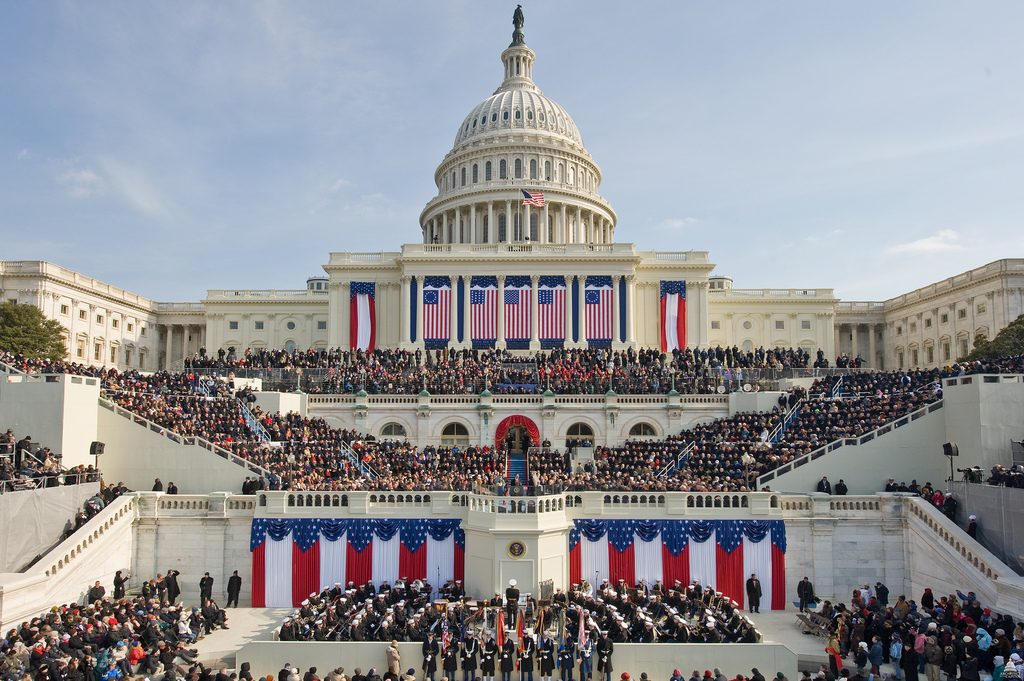
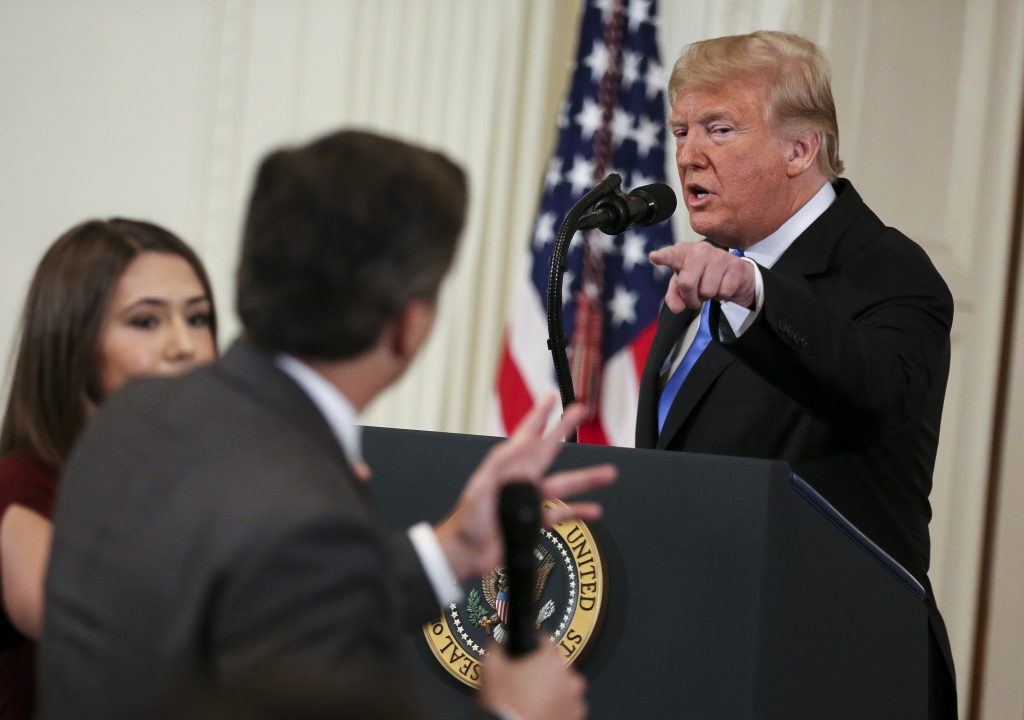
Photograph courtesy of Oliver Contreras at Tribune News Service.

A few months ago, I wrote a piece in these pages suggesting that we regard Donald Trump as our first fascist president. It set off a certain stir. Since then it has become more common, not to say fashionable, to characterize our 45th president in this or similar terms, and to invoke Adolf Hitler and Benito Mussolini in describing him.

While suggesting significant differences, the historian Christopher Browning has recently described the present moment as “eerily similar” to the political climate of the 1930s. But taxonomy is not the important issue now. The bottom line is that Donald Trump is a menace, and that, no matter the outcome of the midterm elections, the critical task of the next two years is containing and ultimately removing him from office. This will be a very hard job, and it will take principled conservatives — there are still a few — as well as progressives to accomplish it.

The conservatives of whom I speak, intellectuals such as George Will, William Kristol, Andrew Sullivan and Max Boot, along with a couple of retiring Republican senators and a few political outliers like John Kasich and Ben Sasse, are not people with whom I ordinarily have much in common. But they do recognize such things as democratic process, the rule of law, and what I have described as common decency. They do not demonize the opposition party, nor do they divide the world into allies and enemies. They have a lot on their heads for helping to create, or at least rationalize what the modern Republican Party has become, and they have to varying degrees expressed their confusion and regret. They bring little to the table in terms of influence or numbers. But they do have value in dealing with Trump, because the fight against him must embrace a wide political spectrum.

The parallel with the 1930s is instructive here. The rise of Hitler engendered calls for a common front against him. At that moment, the available alliance was one among the former allies of World War I:  Britain, France, Russia and the United States. The only political leader who saw the necessity of such an alliance was Joseph Stalin. Stalin, as the dictator of a communist state dedicated, at least in theory, to the overthrow of liberal, capitalist democracy, was an unwelcome friend. Britain and France were paralyzed by internal divisions and pacifist sentiment. The United States was profoundly isolationist, and determined not to meddle in what it saw as Europe’s quarrels. World War II resulted. We will never know whether it could have been avoided if the former allies had made common cause against Nazi Germany in time, but only one Western statesman, Winston Churchill, saw the peril at hand, and his voice was dismissed by all but a few.

We can’t afford the same mistake again, although our circumstances are different. The enemy this time is not a foreign power, but one within. Nor can we mistake the nature of the enemy. Ordinary democratic politics is a matter of give and take. Donald Trump is simply about taking. He takes, brazenly, the ordinary spoils of power, including the profit of his personal business empire. But he corrupts and undermines our basic institutions as well. He has taken over one of our two major political parties for his own, claimed virtually limitless authority for himself — for example, in the present birthright controversy, the power to rewrite the Constitution by executive fiat — attempted to use the military as a police force on American soil, and sought to destroy an independent judiciary. In all this, he is not the inception but the culmination of a lengthy process that has made our institutions vulnerable to just the would-be tyranny he represents. Browning, in his article on “The Suffocation of Democracy,” points to the partisanship of Mitch McConnell, the Senate majority leader, as the root of Trumpian evil. But the evolution of the Republican Party to its present condition goes back many decades, and McConnell, whatever his capacity for mischief, is a minor part of the story.

Nor is Trump an isolated phenomenon. Democracy is in retreat worldwide for many reasons, and Trump himself is more a symptom than a cause of this process even though he adds critically to it. As in the 1930s, a time of economic as ours is one of ecological crisis, many wonder whether it is not too cumbersome a system (or, put another way, too subservient to entrenched elites) to survive. It’s a good question, too. We have bet on democracy as a means of achieving at least a rough measure of social and economic justice. Yoked to contemporary capitalism, it has increasingly failed. But the desirable alternative, democratic socialism, must still be a government by popular consent if it is not to lapse into the tyranny represented by 20th century communism.


As Churchill memorably put it, democracy is the worst of all political systems except for all the others. So, it seems, we must do our best on behalf of the worst, and in the most unfavoring of circumstances. That means, first and foremost now, disabling Donald Trump. It won’t solve any of our other problems in and of itself. But when you start to shovel, you deal with the pile in front of you.
Posted in UncategorizedComments Off on Trump is a sympton of democracy’s failure

Common decency: the issue with the midterm election

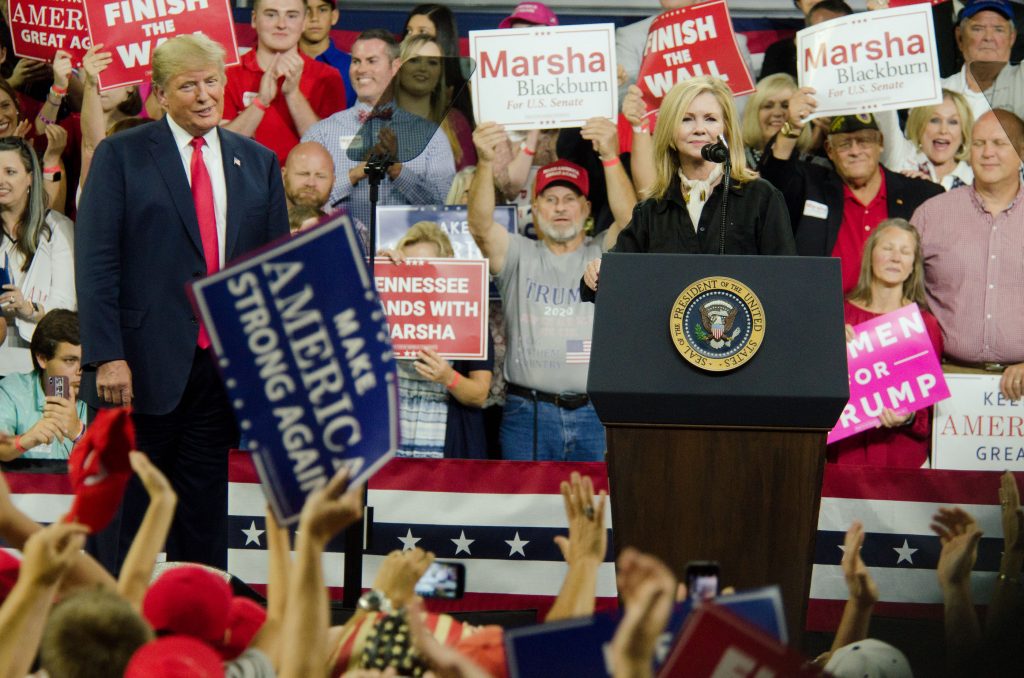
Photograph courtesy of Michael McCollum at Zuma Press/TNS

Donald Trump has wanted the 2018 midterm elections to be about one thing: himself. That is not because he wants to seek support for his record, because in a deep sense he has none, or for his principles, because he assuredly has none. It is because, like all narcissists, the world must always revolve around him, and finally reduce itself to him — that is, to the emptiness at his core that no world could ever fill. This is the one and only salient fact about him, and, for us, the stark and essential one we must confront with the only tool available to us as citizens: the ballot box. If we don’t use it now, it may not be around much longer in any meaningful sense.

Trump may not have a record — his tax cut was written by others, and his court nominees chosen by others — but he does have a long and impressive trail of destruction. He has abandoned treaties, shattered alliances, unsettled the world trade economy, destabilized the nuclear detente with Russia and Iran, threatened nuclear war against North Korea, fostered climate devastation and roused the ugliest impulses of the most confused and susceptible among us. One is spoiled for choice among the worst of these acts. But, I would suggest, there is a single overriding issue in the present election, one defined not by Trump and his acts, but by us. And that is common decency.

By common decency, I mean the ordinary, everyday behavior of the vast majority of people in a functioning society, and the unspoken but vital assumptions that lie behind it. It begins with the behavior we exhibit in our interactions with family, friends, neighbors and local community, and by extension the wider community in terms of which we define our identity and obligation. In the modern world, that leads, culturally and politically, to the nation, but, as we have learned to bitter cost in the past century, that border cannot be a final one either: in fact, there can be no such border without peril. We are all part of a wider human community, but that too is not an end point. We share our planetary habitat with a multitude of other creatures with whom we are connected in a chain of life, and with the organic life in general that sustains us. No less a sense of obligation and dependence is essential to our survival as individuals, communities and, ultimately, as a species.

This may seem to take us far beyond a notion of decency, but how we think and act is tied in the end to what we respect. And we need to begin, as most of us do every day, by respecting one another.

It is this that Donald Trump and his presidency has put at risk. We can be divided, and we have been, by a leader who lacks even self-respect, because he can neither see nor take responsibility for any of his acts. Trump needs the daily validation of “ratings,” of rallies, of ceaseless affirmation by others, because, like most narcissists, he lacks a personal core, and what he is finally about is nihilism. Such a person can be fiercely energetic, because his daily task is the impossible one of confirming himself in a world of one. Trump is indeed a man of such energy; it is the most obvious thing about him, from the 4 a.m. tweets to the nighttime rallies. Does the man never sleep?  It’s a question that’s often, if for the most part, implicitly asked. And the answer is, apart from the minimum of shut-eye the creature requires, no. Donald Trump can’t afford to sleep. He is afraid he would cease to exist if he had to.

The effect of Trump, on every level, is that of a destructive whirlwind; he is a Category 5 hurricane coming at us every day. And he spawns smaller tornadoes everywhere in his wake: the pipe bombers and the church and synagogue and school shooters most obviously; the vicious ideologues and bigots and haters who stand, actually or potentially, ready to step into their places or simply to exploit the giant vacuity that is Trump for their own purposes; the worst impulses that beset us all as our own sense of balance wavers.

Trump in himself is nothing, a serial bankrupt who hung around the margins of celebrity for decades, mostly as a joke. Clothed in the powers of the presidency, the sum of his absences — of love or empathy, of knowledge or principle, of true identity in its most basic sense — is an awesomely negative force. He wanted to make himself the issue of this election campaign as he needs to be the center of everything, and he has. So the first response we need to make is to reject him, and all those who have shown themselves willing to serve him.

That, though, is only a beginning. If we neutralize Trump but do not regain his ordinary supporters, we lose the essential battle: we harden our divisions, and leave those whose grievances and resentments have made him possible to await the next demagogue. Hillary Clinton described the most entrenched of Trump’s supporters as the “deplorables,” with whom reasoned debate was by definition impossible.  Nowadays, those who continue to support him are casually dismissed by many as fascists. What we mean by this is that they are impervious to reason and lacking what the rest of us presumably possess, namely common decency. But if we write off what the polls still tell us is roughly 40 percent of the population, to whom will we speak? To our virtuous selves alone? And what then becomes of our national community, not to say our democracy?

We need, therefore, not merely to define what we oppose but what we affirm: our common community and our common humanity. That won’t be easy. There are real and quite objective forces that do divide us: a winner-takes-all culture of personal profit and aggrandizement, deeply institutionalized; an entrenched tendency to fear and suspect those unlike ourselves; a loss of connection and respect for the natural world that sustains us. Any number of elections won’t fix this. But we have to start somewhere, and that is on Nov. 6. When we do, let us vote both with and for the garment we wake up in every day before we put on our clothes: our common decency.

Posted in UncategorizedComments Off on Common decency: the issue with the midterm election

Democracy is at risk

Photograph courtesy of John Ramspott at Wikimedia Commons.

As American democracy descends further into its present impasse — or abyss — we can trace the steps by which we have arrived at our unhappy moment. There’s never been a time when our politics hasn’t been a blood sport, and the wrangling for power among the Founding Fathers, including a fatal duel, was second to none. It needs, too, to be remembered that we were not given a democratic constitution at the beginning but a republican one, in which a majority of the adult population, both women and slaves, lacked many where not all rights, including suffrage, and the upper house of Congress was elected not by direct popular vote but by state legislatures. As for the lower one, gerrymandering distorted electoral results as early as 1812. Finally, the Electoral College made it possible for both the president and the vice president to be chosen by a minority of even the minority entitled to vote, and by 1824 this had occurred with John Quincy Adams’ victory over Andrew Jackson.

The right to vote was gradually extended to those originally excluded, although it took a civil war that cost 700,000 lives to (theoretically) enfranchise black males, and over a half century more to include women.  Inclusion immediately generated suppression; it was not until the last third of the twentieth century that African Americans in the South could vote as a practical matter except at the risk of their lives. Since actual mass murder would not do, poll taxes were the mechanism of choice for minority suppression, and when these were gradually outlawed they were replaced by the more cumbersome but ultimately quite profitable system of mass incarceration, which, with associated lifetime bans in many states on voting by ex-felons, have produced the same result. Such bans are still in force in many places.

It was only with Abraham Lincoln’s formula of government as a thing of, for and by the people that democracy gained footing on an even theoretical level. It was a long way from reality when he pronounced it at Gettysburg in 1863; it has been a battle ever since. Actual control of the levers of government belonged, at first, largely to a slave-owning aristocracy, and, after the Civil War, to a business class that no less effectively dominated the political process by its control of the economic one.  Nonetheless, the struggle for popular democracy continued, as trust-busting replaced abolitionism as the primary locus of struggle.

It was the patrician Franklin D. Roosevelt who gave democracy its second wind during the Great Depression, although his consolidation of executive power in the Second World War laid the foundations for the imperial presidency that besets us now. A last pushback against this in the 1970s fell lamentably and predictably short, and a combination of voter suppression and manipulation of the Electoral College has given us two minority presidencies among our last three, both unapologetically wedded to business interests.  But a more formal strategy for a minocracy, as I will term rule by a minority, emerged around the same time with the now infamous memorandum of Lewis Powell, the later Supreme Court justice, which outlined a strategy for permanent governance by the Republican Party, the preferred political vehicle of business interests. It involved dominance of the executive and the court system, and the gradual neutering of Congress, designed by the Founding Fathers as the chief instrument of government. Voter suppression, gerrymandering and the undemocratic nature of the U.S. Senate, half of whose seats come from states representing only 18 percent of the population, have helped a demographic minority control Congress, and gridlock politics, rigorously applied over the past quarter century, has done much of the rest.  The spigot of corporate money opened by the Supreme Court’s decision eight years ago in Citizens United institutionalized our practical Constitution of today: government of, by and for business.

The election of Donald Trump as president in 2016 has opened yet another chapter of democratic decline.  Trump leapfrogged over the party system to create his own political constituency, generally referred to as the “base,” substantially comprised of angry white voters kept at a boil by incendiary rallies that bear no small resemblance to those of fascism and devoted to the bizarre cult of personality Trump fostered while campaigning and has perfected in office. Politicians were supposed to be responsive to the wishes of their constituents; with Trump, they are terrified of them, and not on the Republican side alone. But Trump is of course no populist, and the prime beneficiary of his shenanigans remains the business class, including his personal empire. In practical terms, his presidency has been an extension of that of George W. Bush, with business-dictated tax cuts and partisan packing of the courts. Nonetheless, it represents a further erosion of democracy, and the opening of a demagogic politics that has paved the road for actual tyranny.  Presidents used to pay a price for lying, personal profiteering and the abuse of power in office. Trump has openly relished these displays, and redefined them for his base—and for much of a numbed public beyond it—as normative and even gratifying. This, too, is how tyranny comes.

We are at a turning-point in our long national history, and we will have to decide who and what we are.  That has been the challenge of democracy from the beginning. The hope cannot lie in any reform of the established system by itself. It must come, as democracy always does, from the body of the people itself.  If that fails, then the age of Caesars truly begins. And you won’t like it one bit.

Posted in UncategorizedComments Off on Democracy is at risk

Polarization in the U.S. has put democracy in danger

Photograph courtesy of Olivier Douliery at Tribune News Service

To have democracy, you have to have civil society. In the broadest sense, the term is inclusive of everyone who lives in a given country or federation of states; in a more restricted one, it means all those who possess citizenship and can exercise the rights and responsibilities that come with it. A civil society isn’t necessarily democratic, but it may be or become one for those who embrace its burdens and opportunities.

Civil society isn’t necessarily civil. A democratic society means a pluralistic one, and pluralism means a competitive marketplace of ideas, values and beliefs. The competition can be rough, and the stakes can often seem high. Democracy only works if majoritarian sentiment provides accommodation for minority views. Including distasteful ones. You need a high tolerance for difference, and protection for it as well.

All of this makes for the possibility of friction on many levels. The friction can be bracing and vitalizing, but it can make for or reflect harm. This is true of any democratic society; it is true of ours. You can have a civil society without popular debate or decision. In the monarchies that preceded democracy, this was the norm, and patriotism was identified with a sovereign who was generally accepted as the source of the law and the enforcer of it. Our democracy evolved out of the monarchy that originally ruled us — that of England. When we decided to govern ourselves as a republic, we set ourselves down the path to democracy. Abraham Lincoln described it as government of the people, by the people and for the people. It is our ideal, if not our fully or even adequately achieved reality. For us to give it up, if or when we do, is to give ourselves up.

At the same time, our democracy is not only about differences, but divisions. These divisions are carved into our history and the fiber of our being. We began as a slave society, a substantial portion of whose population was not recognized as part of human, let alone civil society. That cleavage remains with us as racism, and its consequences as poverty and inequality. We thought we had made some progress to transcend this legacy with the election of an African-American president. In fact, this unexpected step forward has now forced us two steps back.

There are many other divisions in our body politic: gender, sexuality, religion and sectionalism. We have just had an exceedingly painful demonstration of the habits of thought and behavior that still oppress women and deny them their rightful voice. We have not yet fully embraced the separation of church and state that our founding fathers intended, and with it the understanding that churches are as fully subject to the law of the land as any other institution. We are still in many ways fighting the Civil War that nearly destroyed us as a nation and martyred our greatest leader.

We understand these divisions if we do not always appreciate their depth and intransigence, and try to cope with them. We try and often fail, or succeed for a while and then fall back. But what is perhaps our greatest division is the one we appear to recognize the least. That is class. The division of older societies by differences of wealth and status, including ones now democratic, is a part of their historical DNA, and that elites typically rule them despite the formalities of elections does not take them by surprise. When we turned our backs on aristocracy and monarchy, however, embracing at least rhetorically the idea that freedom and equality were inseparably entwined, we uniquely defined ourselves as individuals responsible for our own destiny for good or ill. This is a fine ideal, but it is a very poor description of the facts. When America was still a land of open spaces — that is, of ones taken from its native inhabitants — it was possible for some of the more enterprising to make their fortunes. But when capitalism and industrialism conquered the frontier, the concentration of wealth and power in the hands of a few created what contemporaries called the Gilded Age. The reforms necessitated by the Great Depression and the global hegemony afforded us by World War II temporarily mitigated our profound structural inequality, but in the past 50 years a new Gilded Age has taken shape, and is now fully upon us.

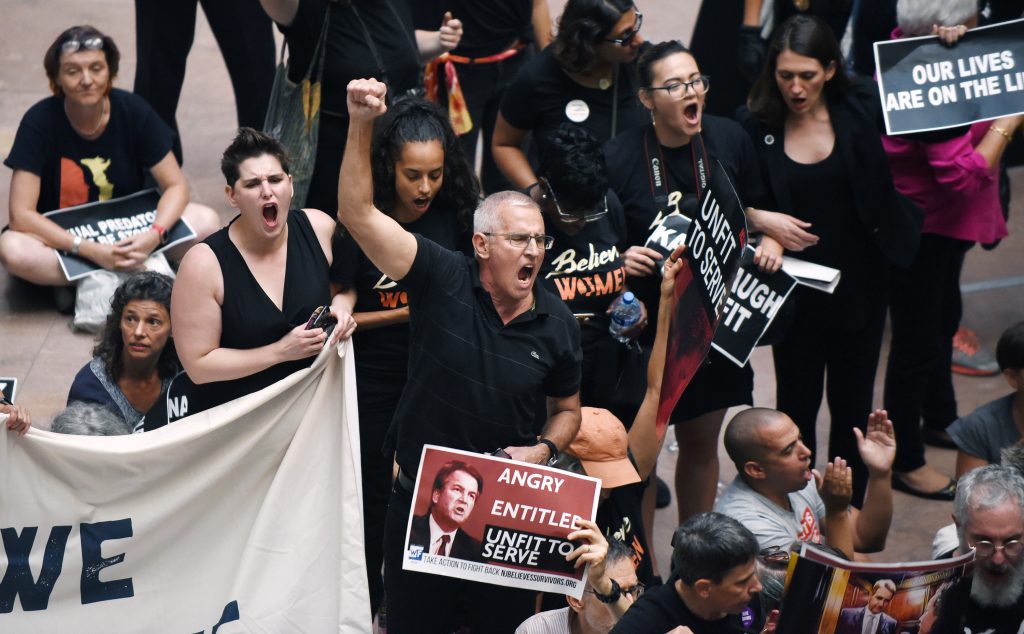
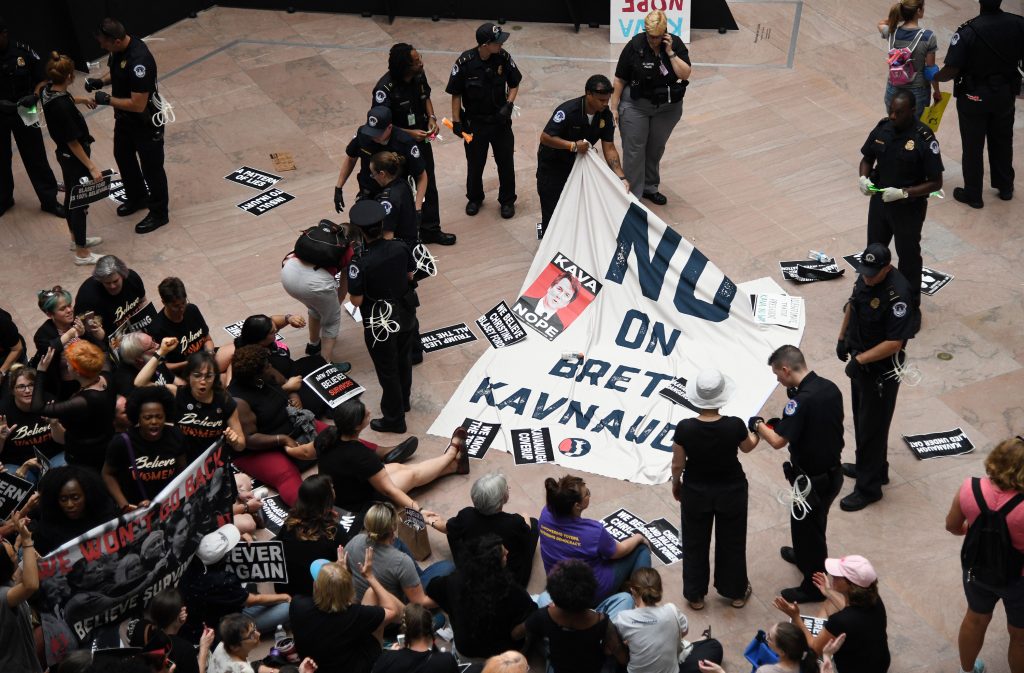
This second Gilded Age is no more an accident than the first one was, and it has many of the same attributes: giant corporations effectively beyond the reach of the law; runaway monopoly and technology; captive political parties, legislatures and judiciaries. Its flashpoint, at the moment, is the Supreme Court confirmation of Brett Kavanaugh, a scion of privilege, groomed for power as an ideologue and credibly accused of sexual assault against a minor, whose vote has now given the Court a license to roll back decades of hard-won gains for labor, civil liberties, minority rights and environmental regulation for decades to come.

Kavanaugh represents the culminating moment of an orchestrated effort to consolidate elite control of our economic, social and political processes, and to nullify democracy in all but name. Those who’ve suffered its consequences are angry and bewildered; those who fear the consequences yet to come are loud (if thus far ineffectual) in protest. This apparent epidemic of bad manners — of incivility — has been called by solemn pundits “tribalism.” We have, we’re told, increasingly retreated into ethnic, gender and other isolating enclaves that confront rather than reason, and thus can no longer strive for the common good on which a democratic polity ultimately depends.

This, I submit, has it backwards, elevating to a cause what is in fact a symptom of massive social and political dispossession. Yes, we are divided, and that division has exacerbated each and every one of our lesser differences. But the division is between obscene wealth and structural economic inequality; between the few with power and the many without; between those in the palace and those outside the gate. Our democracy is embattled as it has not been for nearly a century, and if we want to save it — that is, save it as a goal to which we can still aspire — we will have to fight hard and fight smart.

Posted in UncategorizedComments Off on Polarization in the U.S. has put democracy in danger

Brett Kavanaugh shouldn’t have a seat on any court

Photograph courtesy of Olivier Douliery at Abaca Press/TNS

Last Thursday, we saw a woman of dignity, composure and courage describe the worst moment of her life. I can’t imagine what reserves of spirit it took for Christine Blasey Ford to speak before 21 senators, half of them relentlessly hostile, and millions of people outside the cramped room of the Senate Judiciary Committee. I cannot say for a certain fact that the story she told about her sexual assault was accurate in every respect, and were I sitting on a trial jury for her accused assailant, Brett Kavanaugh, I would be unable to convict him on the basis of the evidence thus far disclosed. But I found Blasey utterly truthful, and what I cannot prove I must say I do believe. I know that such a story had never been told before outside a courtroom, a confessional or a therapist’s office. I don’t think this country will ever be the same after it. As the husband of an abuse victim myself, I know that I won’t.

Should all this, though, disqualify Kavanaugh from the Supreme Court? The argument has been made that he is sitting for a job interview, not in jeopardy of his career or, like Bill Cosby, his freedom. He has, that is, neither an absolute entitlement nor an absolute liability; it is sufficient that his accuser is credible, and that what others have attested raises serious questions about his character. His own obnoxious and revolting Senate testimony, particularly the contemptuous attitude he displayed toward the women who questioned him, would I think suffice to scuttle him for any position of responsibility, let alone one that would enable him to rule on questions affecting his fellow countrymen. Still, is it quite fair to judge a man by one bad, even very bad day; by a single uncorroborated accusation; and by hearsay countered by glowing testimonials to the contrary and a supportive rating by the principal body of his peers, the American Bar Association? To be sure, to sit on the Supreme Court is not an entitlement; but neither is it any job. A nomination for it carries weight, and should not be dismissed without substantial and substantiated cause.

Such a stipulation actually makes the case easier, however — far easier. To begin with, had Barack Obama’s last Supreme Court nominee, Merrick Garland, not been refused a hearing of any kind out of hand by the Republican Senate majority, there would have been no open seat on the court for Kavanaugh to occupy. That wasn’t bad manners, or hardball politics. It was a violation of the very framework of our political order. A president has the duty and responsibility to nominate a justice for any federal vacancy and the Congress has a corresponding duty to act by accepting or rejecting it. For Congress to refuse this duty is to deny a president one of the most important powers of his office, and where such an action directly impacts the function of the third, coequal branch of government, it creates a constitutional crisis. The crisis remains unresolved, and the precedent will almost surely come up should Kavanaugh not be confirmed and the Democrats regain control of the Senate in the coming election. It might be added that Kavanaugh himself had described Garland as “supremely qualified” when his nomination was announced. You might think that a person of some integrity would decline to stiff a colleague on his own behalf, let alone to deepen a major crisis. Of course, we are talking about Washington, D.C., and about Brett Kavanaugh.

Kavanaugh began his career as a zealot pursuing conspiracy theories in the case of Vince Foster, an aide in the Clinton White House who committed suicide. He joined the staff of Kenneth Starr in hunting Clinton himself, but then, working for the administration of George W. Bush, who lied us into two wars and shredded due process, he discovered a sudden fondness for the imperial presidency. Well-justified concerns about his suitability delayed his appointment to the federal bench for three years, while he promoted the judicial appointments of two of even Bush’s worst nominees, William Pryor and Charles Pickering. Asked about the latter in Congressional testimony, Kavanaugh falsely denied his role. Despite his role as a senior advisor, he also denied any knowledge of or participation in Bush’s torture of enemy combatants, his indefinite detention of prisoners without trial and charge and his illegal surveillance of tens of millions of American citizens. In this, too, he lied.

By a conspiratorial agreement between the former Bush administration and the present administration of Donald Trump, some 90 percent of the documents pertaining to Kavanaugh’s service to Bush have been withheld from Congressional scrutiny. If Kavanaugh has nothing to hide — if, in short, he is telling the truth — he should be the first to ask for, if not insist upon, the full disclosure of his record. His silence on the subject says it all.

Meanwhile, Kavanaugh’s record on the bench — anti-labor, anti-civil libertarian — is somewhere to the right of Genghis Khan. Of course, this would fit him right in with what would then be the ideological majority on the Roberts Court. Don’t call that ideology conservative, though. It is merely a cover for the interests of the corporate oligarchy that runs the country. There once was a conservatism that represented a political philosophy. Under Teddy Roosevelt, it actually busted trusts. But that is long gone. To elevate Kavanaugh would simply put a rubber stamp on reaction for the indefinite future.

The larger question is the role of the Supreme Court itself in our constitutional order, which is a subject for another day. But Brett Kavanaugh, by the full record of his career, belongs nowhere near any position that defines the law. It’s not in the end what he allegedly did as a 17-year-old to Christine Blasey Ford, as chilling as that story is. It’s what he’s done ever since.

Posted in UncategorizedComments Off on Brett Kavanaugh shouldn’t have a seat on any court

Defining democratic socialism

Photograph courtesy of Phil Roeder at Flickr

What does “democratic socialism” mean? When Bernie Sanders, the man who brought the term back into public use, is asked to define it, he typically responds by reeling off a set of proposals long established as policy in other developed countries or formerly enjoyed in the United States: universal health care, a minimum wage reflecting actual subsistence needs, tuition-free college education and so forth.

Such proposals barely meet the standard of moderate reform, and in most cases not only reflect the working assumptions of Canada, Western Europe and Japan, but achievements won and then lost in the U.S. itself. We had, for example, tuition-free, college-level public education of outstanding quality in mid-20th century America, and if the national minimum wage of 50 years ago had merely kept pace with inflation and productivity, it would be today not the $15 per hour that Sanders advocates but more than $20, with the average wage (which Sanders doesn’t address) not the less than $45,000 it currently is but $75,000. As for universal health care, now at last a part of the national conversation again, it was a plank of the Democratic Party platform in 1948 when Harry Truman was running for president.  How futuristic can you get!

None of this amounts to “socialism,” of course, because the above benefits and more, are routinely provided elsewhere by center or center-right governments such as Theresa May’s in Britain, Emmanuel Macron’s in France or Angela Merkel’s in Germany, and no country in the world, large or small, is outside the orbit of international finance capitalism today. So, “democratic socialism,” far from being a term that defines itself, seems an almost utopian conception that even those who drape themselves in it are unwilling or unable to discuss.

I won’t begin with Karl Marx, who was contributing journalism to the New York Tribune as America’s Civil War broke out, but with Abraham Lincoln, who defined it as a struggle to see whether “government of the people, by the people, and for the people,” might survive on earth. Lincoln’s description of democracy seems to me to imply the goals of socialism as well. A government of and by the people was necessarily one that was “for” it too, in the sense of promoting the common welfare. Democracy was, then, a process, and socialism a result, subject to change as the people redefined their welfare in terms of evolving circumstances and values. This did not mean that socialism would have no fixed content. Marx believed that socialism entailed collective ownership of the means of production. This need not entail a rejection of private enterprise as such, but rather its supervision and control by the polity: an economy, too, that would be by, of and for the people. It certainly should not mean the monopolistic state capitalism that misnomered itself “socialism” in the Soviet Union or Communist China.

Part of the confusion arising from democratic socialism is the term social democracy, which is often used interchangeably with it. These are not the same things. Social democracy is a term that describes the state-supervised capitalism that was introduced into northern Europe in the 19th and 20th centuries, which provided core benefits — education, health care, unemployment insurance, pensions — that attempted to cushion the general population from the shocks of private markets and the so-called business cycle of recurrent economic crises. But such benefits, even if long established, are not finally secure in a capitalist system, as their rollback in France and elsewhere today makes clear. In America, where such benefits fell far short of European models and were often, as in health care, linked to exploitive private markets, their fate has been even grimmer.  Free public higher education has been lost, and primary public education has all but collapsed except for affluent localities with their own tax base, to be replaced by for-profit charter schools. Pension plans, underfunded for decades both by private employers and the state, are in crisis, exposing present and coming generations of seniors to penury.

Such disasters are not accidents. Publicly funded higher education was lost to a long-term shift of the tax burden from businesses to the general taxpayer over many decades. Pension underfunding resulted from the lack of public oversight, which is to say, of democracy.

Put simply, democracy does not function under a capitalist system, and therefore “social democracy” is as much a misnomer under it as “Soviet socialism” was under Stalin. No one, certainly, can believe that ordinary citizens have any effective control over a system dominated by giant corporate monopolies that dictate the terms of their economic existence and buy the politicians and judges they need to enforce their will. Whenever I have asked my students how many of them feel they have or expect to have any control over the society in which they live, I have been met with complete silence. So much for a democratic capitalism.

It is argued that representative government only emerged with the development of free market capitalism itself. This isn’t true. Popularly elected legislatures go back to the Middle Ages, and the 17th century English parliaments I have studied were in many respects more responsive to public welfare and threats to the rule of law than our present-day Congress. If that was true in a period of so-called absolute monarchy, what exactly have we got to brag about today?

The fact is that every victory won over monopoly capitalism has been the result of bitter popular struggle, and that the same battles must be fought again and again. Democracy will always only come from below, until the distinction between “below” and “above” no longer exists. To expect that any rights or benefits can be relied on from any political system that is not truly democratic is a fool’s game. The state is us, or it’s an oppressor. The economy is ours, or we are its slaves. It may be a negative way to define it, but that’s what democratic socialism is. If we keep our eye on that ball and refuse to settle for anything less, and if we remember that democratic socialism is not a finished product but always a process, it is achievable.

Posted in UncategorizedComments Off on Defining democratic socialism

Trump is destroying the U.S.’ global image

Photograph courtesy of Olivier Douliery at Tribune News Service

After 19 months of Donald Trump being the president, it might seem folly to seek a single area in which he has done the most damage. But I’d like to suggest one, which seems to me at least the most comprehensive: he has undermined the rule of law, both nationally and internationally.

The damage he’s done nationally to legal norms is well recognized. He has personally violated the law, both constitutionally and statutorily, in conspiring with a foreign power to turn the 2016 elections in his favor; in obstructing justice by seeking to thwart the investigation of the matter, including the dismissal of the chief investigator; in profiting grossly from his office in violation of the Emoluments Clause of the Constitution; in attacking and discrediting the fundamental instruments of law and justice, the courts, Congress, and his own Justice Department; in systematically undermining laws he doesn’t like and bending others to his will against their express intent. He has acted, in short, despotically.

And yet, I’d suggest, it is in the world at large that he has done the greatest damage. He’s played the schoolyard bully around the globe, smashed or neutered long-established alliances, walked out on treaties, thrown the world economy into disarray, and threatened annihilation against those who defy his will. This has received far too little attention at home, and very little pushback. But the rest of the world has paid great attention, and the image of America as a nation gone rogue will have lasting consequences that will be hard to undo.

To understand this, we need to place America’s unique historical role in the world in context.

America was born in revolution; that is, in the violent usurpation of existing government and established law. No other nation in the world had been created in that way before. America thus faced a crisis of legitimacy from its inception, even as in the first decade of its independence it struggled to create a new form of government. It had no natural friends, and the power that had materially aided its quest for independence, France, would within two decades be at war with it. Its first president, in his farewell speech, warned it against “entangling alliances” with others, and, a quarter of a century later, it introduced in the Monroe Doctrine a “cordon sanitaire” designed to keep any and all foreign powers out of the Western Hemisphere.

The tradition this initial defensiveness inaugurated came to be called isolationism, a term out of favor since World War II but clearly a part of Trump’s mindset. Other countries are all potential enemies, or in Trump’s preferred usage, “foes”; they seek advantage over us, and we should deal with them, when we must, one on one, since treaties and alliances where we are simply one among many are never in our interest.

At the same time, two other traditions matured around us, partly entwined with isolationism and partly distinct from it. One was imperialism. Our Founding Fathers, from the Northwest Ordinance on, saw the United States as a continental power whose destiny lay on both oceans that defined its eastern and western land mass. Thomas Jefferson bought Louisiana from the French; the advocates of Manifest Destiny drove Mexico from the Southwest and California. The Monroe Doctrine essentially declared the Americas ours. By the end of the nineteenth century, having forced ourselves on Japan militarily, colonized Hawaii, and conquered the Philippines, we were a Pacific power. By 1945, after two world wars, we were the world’s major power, and, in the ensuing decades, we inherited much of the British and French empires. With the collapse of our only apparent rival, the Soviet Union, in 1991, we were prepared to declare a unipolar world in which our political system, our economic order, and our national will would be law for all.

Such a denouement might seem the very reverse of isolationism; in fact, it was in many ways its logical extension and triumph. The best way to gain security from others is, after all, to achieve dominion over them.

But there was a third tradition in our politics, one we partly claimed and partly had thrust upon us. That was internationalism. We were not shy about declaring ourselves based on universal principles applicable to all, notably personal liberty and political equality. This doctrine took root, and in 1789 and 1848 Europe was convulsed by revolutions based roughly on its ideas. For shorthand, it came to be called “democracy.” It was belied, of course, by our continued practice of slavery, and when the Civil War came it was not Abraham Lincoln alone who asked whether we could endure half slave and half free. To an extent we hardly appreciate even today, the world watched our struggle, and when France presented us with the Statue of Liberty — perhaps the most magnanimous gift ever made by one nation to another — it was to say that the land of the free had, finally, freed itself.

As time has taught us, from the failure of Reconstruction to Charlottesville, neither is history simple nor are its bills easily paid. But ideals aren’t simply specious either. It was America that, in the wake of two world wars, sought to create the first international organizations dedicated to world peace and human rights, the League of Nations and the United Nations, and if both were flawed (and, in the case of the League, ultimately rejected by American opinion itself), these institutions made the point that humanity could only survive in the modern world by thinking and acting globally.

It is this foundational truth that Donald Trump has done his best to trash and betray. It was an ideal; today, it is a necessity. In our warming and crowded planet, we will face challenges in this century and beyond that will require cooperation and sacrifice that are still beyond our practical, and especially our political conception. By its size and power, but beyond that by the best of what it has represented for nearly two and a half centuries, America needs to engage these challenges creatively and responsibly with its fellow world citizens. That will mean, frankly, putting our own house in order. It will also mean attaining a sense of our common human obligation and a due respect and humility toward the natural world whose recent guests we are, and which alone sustains us.

I don’t know whether we are up to this, but it’s going to be our job.

Posted in UncategorizedComments Off on Trump is destroying the U.S.’ global image

Trump is risking America’s alliances abroad

Photograph courtesy of Olivier Douliery at Tribune News Service

It’s hard to tell whether Donald Trump is more preoccupied with wrecking civil discourse and public institutions domestically in the United States, or shattering the American alliance system abroad. It should be clear that he is doing a pretty good job of destroying both, but that observation alone does not take us far. The question is whether there is a method to his madness, or at least a thought process of some sort.

The answer to the question of his domestic mayhem is less difficult. Donald Trump does not understand the presidency as an office in a system of checks and balances within which it is designed to work, and whose limitations he is obliged to respect. This is partly because his only personal experience of executive power has been that which he has (and still does) exercise over his business enterprises. That experience is one of absolute control, where his wishes are the only rule, and in which his fixers handle any questions that arise from disputes with contractors, payouts to porn stars or violations of law. Trump’s style in dealing with either such problems has been unfailingly preemptive and aggressive: sue them before they sue you.

In the White House, his problems have thus far arisen from media criticism and from the watchdog functions of the Justice Department, the FBI and other agencies whose independent operation he can neither understand nor tolerate. His reaction to this has been to demand personal “loyalty”— that is, submission to his wishes — or, when he cannot get it, to attack, slander and besmirch whatever stands in his way. Thus, his attacks on the “fake news” of the press, on the “deep state” machinations within, most notably, the Justice Department and the FBI, and, most relentlessly now, on the Mueller investigation that appears to be the largest threat to his unfettered power.

The business model that Trump has brought to the White House is not that of the standard CEO. His former secretary of state, Rex Tillerson, was disastrous enough in his own right, but Tillerson did understand the difference between running a giant corporation and conducting the diplomacy of the United States. As others who have worked for him, notably James Comey, have pointed out, Trump is actually closer to a mafioso whose ultimate reference point is violence: in political terms, that is, his instinct is that of a dictator, not to say a tyrant.

This fact makes it easier to understand what has appeared to be Trump’s curious affinity for strongmen abroad: Xi Jinping in China, Kim Jong-un in Korea, Rodrigo Duterte in the Philippines, and of course, Vladimir Putin in Russia. These men run their countries as Trump would wish to run the United States. Correspondingly, he has little use for leaders who are subject to the constraints of democratic norms and rule-bound societies: they can’t make the one-on-one deals he prefers, and they can’t insure how long they’ll stick around.

General agreements and alliances with such leaders, or with the international community in general, are even less appealing to Trump, because they commit the United States to policies and obligations over lengthy periods whether or not they serve “America first” (or simply Trump first) interests. Examples of each, all challenged, derided or unilaterally exited by Trump, are NAFTA, NATO, the Iraq nuclear deal and the Paris climate accords. The Trump Doctrine, put simply, is that America, as the most powerful nation on earth, exercises its power most effectively with single parties. The bully, in short, rules the schoolyard.

Trump does recognize that two powers are, if not America’s equal, its significant rivals. These are Russia and China. There is a third and, in his view, an artificial power that has significant throw-weight, the European Union. The EU is nominally our ally, but in Trump’s world, allies are covert competitors who are hitching a free ride, in this case the military umbrella against Russia represented by NATO. This makes them, in fact, enemies. At the G7 and NATO meetings this year, Trump has made it clear that what has been regarded as the core extension of American power in the world since 1945, the Western Alliance, is, in his view, an expensive and obsolete nuisance at best and a serious impediment to our interests at worst. Russia has no such encumbrance, nor does China. They dominate the smaller powers in their respective orbits without formal alliances, more or less as we do in Latin and South America. It’s each bully in his own schoolyard.

As Michael T. Klare points out, this vision of the world is remarkably similar to the dystopian one described in George Orwell’s “1984,” with its division of the planet among three powers: Oceania, Eurasia and East Asia. Orwell’s giants divert their publics with ritual wars that consolidate elite power and totalitarian controls at home; the world is a low-level bloodbath whose purpose is to maintain material scarcity and political conformity through military waste. Trump factors warfare into his equation too, but it may be pointed out that the vaunted liberal world order his detractors defend against him arguably doesn’t look much different. The military-industrial complex bemoaned nearly 60 years ago by Dwight Eisenhower continues to find new wars to fight — Korea, Vietnam, Iraq, Afghanistan and a dozen different fronts at any given moment — meanwhile leaving America with decaying cities, a dwindling middle class and an imperial presidency presiding over a surveillance regime with a more than passing resemblance to Big Brother. Trump himself is the product of this order, however superficially he contests it.

Does Trump’s zero-sum vision of the world make all that difference, then? Yes, and for a very simple but critical reason. There are two existential threats to world civilization. One is the proliferation of nuclear weapons, which can only be controlled by international agreement and vigilance. The other is climate change, a vastly more complicated and, to a large extent, already an intractable problem that will require great wisdom, forbearance and global coordination if it is not to doom our world as we have known it. Trump’s climate denial, so perplexing to many, is not mere willful ignorance or cynical deference to fossil fuel interests. It is based on his bedrock view of the world as a Hobbesian clash of interests in which any notion of a common good — or necessity — is a mug’s game. If such a view prevails, it’s curtains for us all.              


Posted in UncategorizedComments Off on Trump is risking America’s alliances abroad

Democracy in the U.S might not have a future

Photograph courtesy of USCapitol at Flickr

The question this essay asks — does democracy have a future? — must start, I think, with the question of what its present condition is. Democracy is both a means and an end.  As a means, it denotes, roughly, majority rule through public institutions. As an end, it has no fixed goals, but it does have certain essential principles that are not always easy to reconcile with one another.  Those principles include personal freedom, but also public welfare. We should be free to seek our own fulfillment, with due regard for that right in others. But we should also have that opportunity in practice and not merely in theory. That, more or less, is what Thomas Jefferson meant by his shorthand formulation that all men are created free and equal. Neither term explains itself; we are not free to choose the willful harm of others, and we are not equal without fair access to the goods we need to sustain ourselves materially and to realize our human potential. Democracy, in practice, is the day-to-day task of sorting these questions out in deliberation with our fellow citizens.

Modern democracy arose in the context of an acquisitive capitalism that burst the bonds of elite rule but also threatened to strangle its baby in its crib. Capitalism is a mechanism for fostering inequality, and the only freedom it recognizes is that of the market: buy if you have money, and starve if you don’t.

By the early nineteenth century, many thinkers had reached the conclusion that unregulated capitalism was incompatible with democratic goals. They divided in turn between those who believed that such regulation could be effective, and those who did not. The former came to be called liberals, and the latter socialists. The latter today are all but extinct. “Socialism,” for those who use the term, designates moderate reformers who tinker at the edges of a triumphant capitalism that, now globally integrated, makes mock of all local, that is nationally based, efforts to control it.  This has produced two large consequences. The first is a rapidly growing worldwide inequality of income and goods that in and of itself dooms democracy. The second is a planetary ecological crisis that threatens species’ survival, including our own.

Capitalism cannot be entirely blamed for the ecological crisis, although today it has no competitors. The world knew no more environmentally destructive regimes than those of 20th-century Russian and Chinese Communism; Chernobyl is their monument. The failure of our species’ relation to the planet is ultimately a moral one, which even the best-designed democracy cannot of itself overcome.

Without dealing with this question, however, we can say that democracy is doomed, since its slow, deliberative processes are ill-equipped to deal with the ecological havoc that awaits us. We have seen this in the beginnings of a mounting immigration crisis that has already shaken and in some places destroyed democracy; Hungary is one such example, and America may well be another. The pressure of immigration has, thus far, had a largely economic and political component. But climate change is already becoming a driver, and it will soon be the principal one.

What would a would-be despot do to speed the destruction of democracy? He would focus on immigration above all else as the prime threat to national security, and he would demonize migrants as criminal and sub-human by definition. Sound familiar? The genius of any despot is to appeal to the worst in us, and by that yardstick, Donald Trump is, as he likes to describe himself, a very stable genius indeed.  

But we must not overlook the role of capitalism in the migrant crisis, too. Capitalism has always produced forced migration; the United States was built on it, and had the vastness of the Americas not offered a haven for the dispossessed, Europe would have been riven by savage class wars long ago.  What capitalism wants, therefore, is open borders. The European Union, one of its creatures, insisted upon such borders, which created in Britain the Brexit crisis as impoverished East European migrants undercut the British labor market.

When capitalism and democracy clash sufficiently, fascism has its opportunity. Traditional fascism has been about the closer integration between capital and the state, and it is unlikely to lose this character.  But fascism has also always been overlaid with a false populism, and that is where the managerial despotism of the future will come in. Trump understands this instinctively, too. He is certainly no manager of anything but chaos, but more rational successors may await us, at least until ecological crisis unveils the dystopias of the future.

Should we simply resign ourselves, then, to the end of democracy? No: we should strive for its reinvention because, for all its drawbacks, it is the only decent form of government — the only one compatible with the full exercise and realization of human dignity. If we give up on it, we give up on ourselves.

At the same time, though, we must not underestimate the immense challenges it will face, beginning with a worldwide economic system that cannot be reconciled with the values it must profess and an unfolding climate crisis that will tax its best intentions and judgment. I wish I had a master blueprint for this, but that is what democracy is about: finding, slowly and searchingly, the best collective wisdom of which we are capable and testing it at every turn, conscientiously following it.

A betting man usually doesn’t put his money on a slow horse. But it’s the only one I want to ride.

Posted in UncategorizedComments Off on Democracy in the U.S might not have a future

The U.S. should cutback its involvement in Saudi-Iranian conflict

Photo credits courtesy of Mike Theiler/Sipa USA/TNS

You have seen this movie before. Someone provokes the United States. The country retaliates, firing off missiles from a safe distance. The craters they leave are counted; the bodies blown up are not. The Pentagon has flexed its muscles. The president crows. Nothing changes.

Donald Trump indulged himself in this scenario last week, attacking Syria, as previously, for an alleged chemical weapons attack against civilians. It’s the same subject that vexed his predecessor, Barack Obama. You will see the movie again.

Chemical weapons are despicable. So are the other weapons of war. When you’ve used depleted uranium, though, as we did against Saddam Hussein’s Iraq, or Agent Orange, as in Vietnam, you’ve lost the moral high ground to complain about how others kill. And then there’s how we ended the war against Japan in Hiroshima and Nagasaki.

The point is war itself.

What began as the Syrian civil war is now seven years old. At a rough estimate, half a million people have been killed in it among a population formerly estimated at 22 million. That is about the same ratio of deaths to population as occurred on all fronts in World War II.

Syria is now an international war zone with armies and proxies from a dozen different places fighting a series of discrete conflicts across ragged and shifting battlefronts. Syria’s strongman, Bashar al-Assad, is mopping up the remnants of his home-grown opponents. Iran, having pitched its tents in Iraq, is now planting them across northern Syria to link with its Hezbollah allies in Lebanon, in a corridor of power from Tehran to the Mediterranean. That in turn is part of a larger power game being played out between Iran and Saudi Arabia for regional hegemony, themselves backed respectively by the US and Russia. Russian bases are now the strongest single military element in Syria, while a feckless American contingent notionally fights the remnants of ISIS and trains those ever-popular freedom fighters — some reportedly former ISIS operatives — for some mythical mission. Meanwhile, the Turks and Kurds duke out the latest round of their 100-year -war, also in northern Syria. Looming above it all is the specter of a major war between Iran and Israel, already underway on Syrian soil.

Most of these combatants have an idea of what they’re fighting for. The US does not. It provoked the Syrian civil war in the first place, directly by calling for Assad’s ouster in 2011 and indirectly by destabilizing the entire Middle East through its pre- and post-9/11 interventions in the region, most specifically its destruction of Iraq. Syria does not exist as a state. Nor does Afghanistan, Iraq, Yemen, Libya, Sudan and Somalia, all on the receiving end of American invasion or intervention over the past 40 years. Somewhere in this tableau of suffering and carnage was, once upon a time, a tale of horrendously misconceived imperial aims and interests. Whatever the point might once have been, however, the net effect of American intentions has been that of a giant wrecking ball, destroying whatever it touches.

Even President Donald Trump was able to get the point — sort of. When Barack Obama contemplated bombing Syria over chemical weapons use in 2013, Trump ridiculed the idea of an American interest in the country. He campaigned for president on the basis of a general pullback from the Middle East, Israel excepted. Only a couple of weeks ago, he suddenly announced an immediate withdrawal of American troops from Syria, only to be pulled back by his Pentagon handler, Jim Mattis. You wonder, speculatively, whether the chemical attack that reengaged him wasn’t, as some have suggested, a false-flag operation. Reading a prepared statement, Trump declared that America’s national interest now involved the elimination of chemical weapons, in Syria and everywhere else. That clearly implied the removal of Assad, in Trump’s description the “monster” and “animal” who had again ordered their use. Back to square one. As in 2011, Bashar al-Assad had to go.

Assad isn’t going anywhere, of course, at least for the present. Russia, whose vassal he is, is the dominant presence in Syria, as it aims to be in the Middle East as a whole. This isn’t a new ambition. Russia played the “great game,” the great-power rivalry for control of Central Asia, long before Americans could find the region on a map. It also paid the price: an ill-fated intervention in Afghanistan was critical in bringing down the Soviet Union, and costing Russia its own Central Asian republics. At that point, Russian influence in the Muslim world was near zero. Its recovery under Vladimir Putin, abetted by the catastrophes of American policy, has been one of the major political developments of the century.  

Geography alone dictates Russia’s interest in Central Asia and the Middle East, which it borders across a long southern frontier. The American interest, Cold War politics aside, was far simpler: oil. But America is no longer dependent on Middle Eastern oil, and its futile, unending wars in the region have produced no result except failed states, refugee floods, and jihadist terrorism. In his dim, jingoistic way, Trump perceived the bankruptcy of American policy, bankruptcies being one of his few areas of expertise. He won’t get to follow his America First instincts in this part of the world, though, our penchant for military quagmires now being part of the national DNA. Blunder followed by tragedy, tragedy followed by blunder, will go on. Failing empires generally go this route.

As we have noted, the issue of the moment in the Middle East is the Saudi-Iranian struggle for regional supremacy, a conflict with deep sectarian roots. The Russians, having reaped the strategic reward of our destruction of Iraq, have made Iran the stalking-horse of their interests. At the same time, they have cultivated the Turks, and, in the power vacuum that is northern Syria, they will draw the Kurds to them as the power to which they must appeal. Israel, too, will increasingly depend on Russian influence to curb Iran, whose presence in Syria it perceives as an existential threat. The Saudis, meanwhile, will continue to use us for their own purposes, as they have successfully done for some time. What interests of our own we are intelligibly pursuing are far more difficult to discern.   

America needs a general reconsideration of its role in the world, including its planetary responsibility as the largest contributor to climate change and global inequality. That isn’t going to happen on Donald Trump’s watch, which, day by day, undermines such standing as we still have.

Until we have a responsible government, the best advice we can follow is the old Hippocratic oath physicians swear to: Do no harm — or, at any rate, no further harm. That would mean getting out of the numerous wars we’re currently fighting, and standing down from our posture in the Saudi-Iranian conflict. The kind of disengagement that would be really salutary, both for us and the Middle East, is probably unattainable at the moment. But we can stop being a cat’s-paw for the Saudis, stop pretending that we can do anything in Afghanistan and Iraq but add to the miseries we’ve created, and clear militarily out of Syria. This isn’t isolationism, but prudent retrenchment.

As for the Russians, if they want to break their teeth on the Middle East as they did thirty years ago in Afghanistan, let them be our guests. There are certain parameters we need to draw; we need, for example, to keep a degree of leverage with Turkey, and our security commitment to Israel is a moral as well as a strategic one. For the time being, though, less of us will be more.

Posted in UncategorizedComments Off on The U.S. should cutback its involvement in Saudi-Iranian conflict