Author Archives | Robert Zaller

America: Where we are and where to go

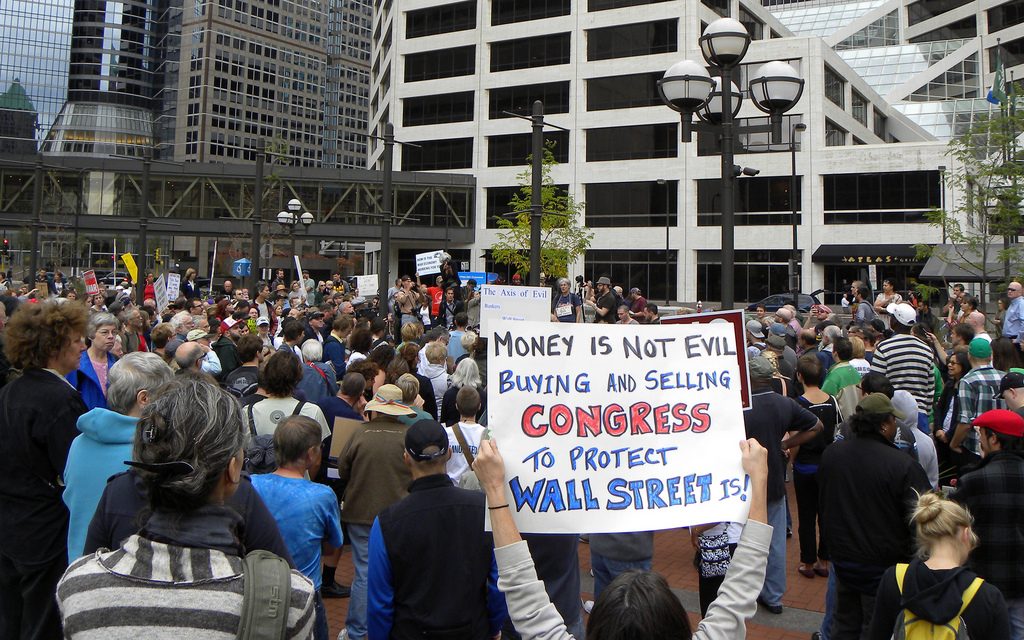
Photograph courtesy of Fibonacci Blue/Flickr

To judge how far America has regressed since Richard Nixon took office in 1969, we need only look at the story of national reform since 1890.  Since that moment — the height of the Gilded Age, when a tiny elite controlled the economy, dictated its politics, arrogated to itself its wealth and crushed all resistance to its dominion — there have been, broadly speaking, three major movements to expand democracy, rein in corporate power and offer the social safety net that other industrial countries would provide their populations.  These movements were Progressivism in the pre-World War I period, the New Deal in the 1930s and the New Left of the 1960s. They accomplished a good deal, if not enough to realize Lincoln’s prescription for a government of, by and for the people. Today, their accomplishments are largely in ruins.

The alarming growth of monopoly in the American economy produced a wave of legislative and executive action from the Sherman Anti-Trust Act of 1890 to the trust-busting administration of Theodore Roosevelt in the early 1900s.  Since capitalism tends not to cause free markets but monopolistic consolidation — a phenomenon abundantly observed in all capitalist societies — continual vigilance was necessary to forestall industrial and financial combination — giant corporations and giant banks.  Relaxed controls in the post-World War I period brought about the Great Depression of the 1930s, essentially a crisis of credit that paralyzed the world economy for a decade. Beginning in the 1970s and taking off with the merger mania period of the 1980s, such controls were relaxed again, with a similar result:  the crash of 2008, and the severe international depression that resulted. Today, monopoly is again the order of the day, abetted by governments whose policies are essentially in corporate hands. So great has the concentration of corporate wealth become that cities and local governments, no longer with an adequate tax base to provide essential services, come begging to entities like Amazon for capital — at a price that beggars them further.

Progressivism climaxed with three major reforms:  the institution of a graduated income tax under the 16th Amendment the direct election of U.S. Senators, and women’s suffrage.  The graduated income tax peaked in the 1950s, with notional rates of up to 90 percent for the very wealthy. This should in theory have led to a redistribution of income appropriated by monopoly to the general public (in other words, a return of the fruits of its own labor), but after 70 years the concentration of income remained where it had been prior to graduated taxation. From that point, in the Reagan era, taxes on the rich and on corporate earnings have steeply declined. The result is that income inequality is now at its highest level in more than a century, if not higher than it has ever been.  By no coincidence, poverty levels have increased, and the middle class has been eviscerated.

The direct election of Senators, meanwhile, has not led to any meaningful democratization of the Upper House, since half its membership is selected by less than a fifth of the population.  Nor has women’s suffrage addressed the major problem with our elections: the deliberate distortion of Congressional districts by gerrymandering, and the exclusion of minorities by various strategies of voter suppression, abetted now by the U.S. Supreme Court.

The catastrophic effects of the Great Depression led to the beginnings of a social safety net, buttressed by the full recognition of unions.  That net has been frayed to the point of collapse for many. Unions have all but vanished from the private sector, leaving the vast majority of American workers without a voice.  While all other major Western nations have long since implemented national health care systems, we remain at the mercy of industrialized, for-profit medicine, which Medicare props up at taxpayer expense.  Unregulated pensions have been systematically underfunded for decades, leaving older Americans to face penury. Toward the end of his presidency, Franklin D. Roosevelt admitted that America had only made a start toward social justice. We haven’t gone forward since then, but mostly turned back.

The New Left reiterated much of the earlier critique of American capitalism, and expanded it to embrace the American empire that had emerged after World War II.  Under Lyndon Johnson, the New Deal seemed to get a second wind. Racial strife and the Vietnam War discredited him, and the Great Regression began. The consequences are all around us:  broken cities, vast stretches of which seem to belong to the Third World; a collapsing infrastructure buffeted by climate havoc; the systematic undermining of public education and the growth of a student debtor class; a declining life expectancy, with vast divergences between social classes (in Philadelphia, the upper eighties for its richest neighborhoods, and the mid-’60s for its poorest); general insecurity and rising levels of despair.  And if one measures poverty not by a paycheck but by personal resources, nearly half of America qualifies as poor, since that is the number without the personal resources to meet an immediate emergency of only a few hundred dollars.

And, oh yes, we have a president who wants to make the Great Regression a total one, and is dead set on undermining every norm of decency, civility and respect for the rule of law that makes democracy possible.

So, what are we to do about all this?  

The very modest reforms proposed by Bernie Sanders and Elizabeth Warren are at least a start, though in most respects they are only a return to where we were or should have been long before. In the long run, however, we need a new, post-capitalist society based not on greed and exploitation but a vision of our common humanity and a commitment to keep the shrinking lifeboat we call Earth a place habitable for future generations — and for this one, too. You can call this socialism or anything you like, but it has to start from the recognition that you can’t make a society that asks for the best in us but systematically rewards the worst.

I spoke of the long run.  But if we don’t get started on it soon, it will be a frighteningly short one.
Posted in UncategorizedComments Off on America: Where we are and where to go

The Great Regression: America in the last 50 years

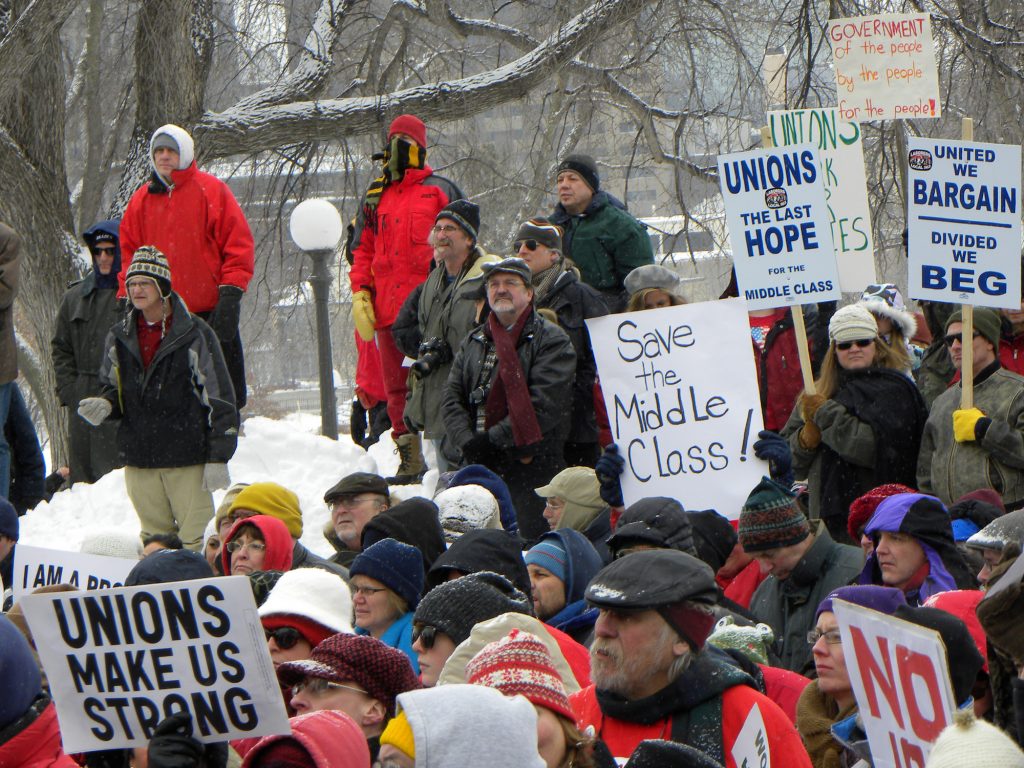
Photograph courtesy of Fibonacci Blue at Flickr

The year 2019 offers several landmark dates: the 100th anniversary of the Treaty of Versailles, the 70th of the founding of NATO and the 30th of the fall of the Berlin Wall. However, it also marks the 50th year of America’s long retreat from the promise of the 1960s. I call it the Great Regression.

To understand the Great Regression, it’s important to understand what preceded it. Postwar America, reconverting to a peacetime economy after World War II had ended the Great Depression of the 1930s, was uniquely placed to enjoy a spell of global dominance. With Soviet Russia and soon Communist China quarantined, and with its wartime adversaries, Germany and Japan, reduced to client states, the U.S. bestrode the worldwide capitalist economy. At home, this produced the greatest prosperity in the nation’s history, and, thanks to the lingering effects of New Deal reform, a powerful labor movement that produced, in major American industries, an implicit grand bargain: large corporations would provide decent wages and job security in return for labor peace. There was more than enough wealth to go around, and the baby boom that followed the war seemed to ensure that there would be the consumer demand to sustain it. Returning GIs, too, had been told they were fighting for a better America. It seemed only prudent, not to say fair, to give them one.

Thus was the American middle class born, with its suburbs and highways, its cars and station wagons, its modern kitchens and backyard barbecues. It was a whole new way of life, whose implicit promise was that if you worked hard and played by the rules, life would be reasonably good and perhaps even better for your children. They called it the American dream.

African-Americans heard about the dream too, but they weren’t invited to share it. As for women, their role in it was as unpaid domestic workers whose satisfaction would be the replacement of washing boards by washing machines. Accordingly, the 1960s brought the civil rights movement and feminism.  The Vietnam War ruptured the superficial social peace of the preceding decade, and the first of the baby boomers, coming to maturity, would question the bland materialism they had been told to accept as the good life. An increasingly polarized country erupted in violence.

Then came Richard Nixon.

Nixon, entering the White House in 1969 after the country’s most divisive election since the Civil War, had no grand plan. He did, however, have shrewd instincts. He put together a political coalition, based in the Southern and Heartland states and playing on the fears of workers newly risen into the middle class. It worked. Despite Nixon’s own fall, Republicans would control the presidency for 20 of the next 24 years. He and his successors would systematically pack the courts with conservatives, a tactic that rewarded the Republican Party with the presidency of George W. Bush when the Supreme Court usurped the 2000 election and decided it for itself. With the election of Donald Trump, Republicans controlled all three branches of government for the first time since the Great Depression.

Republicans not only won command of the levers of power, but also of ideology. The department of economics at the University of Chicago, led by Milton Friedman, updated the myth of the unregulated market as the most efficient engine of wealth growth and distribution. Under the rubric of so-called supply side economics in the Reagan Era, it redefined the role of government as stimulating growth by cutting taxes and eliminating agencies and regulations designed to assist the poor, protect the environment and avoid a new depression. Government, as Reagan explained, was not the solution to social ills such as racism, poverty and inequality, but the problem. It was best for it to simply get out of the way.

In all of this, Republicans were simply being Republicans, the devoted party of Wall Street. Since the administration of Woodrow Wilson, all progressive movements had ultimately channeled their efforts and energies through the Democratic Party. Having lost control of the political narrative in the 1970s, however, the Democrats turned GOP-lite, posing no threat to the growth of rampant inequality that began under Reagan and offering no alternative to the emergence of a new Gilded Age. At the same time, the U.S. lost its privileged position in world markets as other economies rebounded. Corporate profit margins suffered, and the grand bargain of the postwar decades disappeared. Labor unions were put on the defensive, and, as the manufacturing sector collapsed, they virtually disappeared from the private economy. Without collective bargaining, workers found themselves returned to the conditions of 19th century capitalism. Over the past five decades, tens of millions of them have fallen out of the middle class into a limbo of shrinking wages, evaporating pensions and job insecurity. Exploited where not redundant, with neither unions to protect them nor a government to shield them, they are a new class of the dispossessed for which no name yet exists. As technology eliminates their jobs and the medical insurance tied to them, they are an illness away from pauperdom. No longer a working class but closer to a servant one, they are without a future they can imagine, let alone a dream they can hope to achieve.  

And so came Donald Trump.

The election of Trump was made possible by the cratering of the middle class and the pent-up misery and frustration of those abandoned by its collapse. Trump said he would fix things for them; instead, he has provided a new bonanza for the rich in a spasm of unbridled greed and political reaction. Whether this will at last trigger a response that can translate itself into sustained resistance remains to be seen. Nothing, however, was ever won without a struggle, and the struggle necessary to reverse the Great Regression will be a long one.

I have lived most of my political lifetime watching my country march backward. I don’t know about you, but I’m ready for something different, like common decency and the common good.

Posted in UncategorizedComments Off on The Great Regression: America in the last 50 years

Amazon would have had contributed to gentrification in NYC

Photograph courtesy of Jonathan Weiss at JetCity Image/Dreamstime/TNS

Amazon may swallow the world in the end. But it won’t get Long Island City.

That was the big news out of the Big Apple, as the world’s largest, nastiest and, by several lightyears, most arrogant corporation abruptly dropped its plans to colonize a big chunk of the borough of Queens. Thereby, casually destroying a struggling but still viable middle-class neighborhood by bringing to New York the big tech blight that has rendered Silicon Valley and much of San Francisco uninhabitable except by the super-rich and the minions who digitize the world for them.

Walk this back a little. When Amazon, having swallowed Seattle, announced that it would build a second headquarters on the other side of the Mississippi, it invited bids for its favors by cities large and small. As with other megacorporations bestowing the blessings of their presence on communities desperate for investment, it demanded, in a manner analogous to the medieval droit du seigneur — the medieval custom allowing lords to be with a bride on her wedding night — privileges, exemptions, concessions and above all vast tax breaks for the promise of new jobs and, eventually, enough economic activity and revenue to make up for emptying their treasuries.

If you look it up in the textbooks, capitalism is a system by which privately owned wealth — capital — is invested in creating markets for goods and services in return for profit. In the alternative economic system, misnomered socialism, the state monopolizes capital and decides how and where to use it, also to create markets. But there’s a third system, the one you actually see with Amazon and its fellow behemoths. It hasn’t got a name yet, but it combines the worst features of both the recognized systems. In it, private corporations commandeer public resources to profit themselves, thereby eliminating the prime justification for private profit, the assumption of risk.

You can only create such a system by having achieved a monopolistic economy dominated by corporate giants and a public sector so starved for money that it cannot fulfill its essential functions of education, environmental protection, safety and policing, infrastructure maintenance and, yes, the guarantee of health care. Unregulated capitalism tends to grow rapidly in this direction; regulated capitalism a bit more slowly.

With Amazon, which now controls half of American retailing and an increasing share of its production, we have arrived at the endpoint. For the past several years, cities and states have fallen over themselves, begging for the opportunity to enrich Amazon further in the hopes of a pittance for themselves. The risk, needless to say — the upfront outlay — is theirs.

New York Governor Andrew Cuomo and New York City Mayor Bill de Blasio, who see eye-to-eye on little else, were beside themselves at the chance to win at least some of Amazon’s promised largesse for a mere investment of $3 billion in taxpayer money, plus the sacrifice of one of the city’s older neighborhoods. For what would have happened to Long Island City is what has happened so often elsewhere. New “development” comes in, and with it the promise of new, well-paying jobs — in this case, a suppositional 25,000 of them, at an average salary of $150,000. The skilled new workforce, however, comes from outside; the local residents are driven out by rising costs and rents. Where they go and what becomes of them is their problem. It’s an old story called gentrification. When it comes courtesy of an entity like Amazon, it’s at warp speed.

For the governor and the mayor, the math was simple: for all the lives wrecked, the bottom line for the state and city treasuries would someday, maybe, indirectly, be bigger.  It’s called seeing the big picture, rather than the little guy. That’s the bold vision we pay public officials for, and what big business buys them for.

So, how did this story turn out differently, at least for now? A coalition of community activists, union leaders (who noted that Amazon’s new jobs, like all its old ones, would be nonunion) and a few politicos trying to catch the wave that swept in a new cohort of progressives in the 2018 midterm elections, raised enough of a fuss for Amazon’s tetchy honcho, Jeff Bezos, to walk away. After all, dozens of other cities were still slavering for the opportunity to empty their purses and sell their souls. And if you’re the world’s richest man, as Jeff is, you don’t tolerate peasant rebellions — or politicians who can’t deliver.

Is Long Island City’s story a blip on the screen, or the start of something big?  Progressivism has had too many false starts for any premature cheering; remember Bernie Sanders, Occupy or Barack Obama’s “Change we can believe in”? But you take good news where you can get it. In the age of Donald Trump — a phrase I keep promising myself not to use — even keeping the IRS open can seem like a victory.

And oh, by the way, for all those governors and mayors waiting for Amazon’s riches to pour in? The amount of taxes paid last year by Amazon to the federal government for all those roads it delivers your purchases on was $0.00.

And the year before that? $0.00.

And what it will be this year? Well, if your guess is as good as mine: $0.00.

Posted in UncategorizedComments Off on Amazon would have had contributed to gentrification in NYC

Afghanistan: The United States’ longest and most unjust war

Photograph courtesy of Curtis Compton at Tribune News Service.

We got into Afghanistan without thinking it through. We effectively abandoned the fight there within a year, as the George W. Bush regime began to illegally shift monies appropriated for it to the war being secretly prepared against Iraq. Nonetheless, the war has dragged on bloodily now into its 18th year, the longest period of active American fighting (other than against Native Americans) in national history. So, how and why did we get into it; why did we abandon it; and why, as it seems, can’t we end it?

The “why” is only superficially explained by the World Trade Center attacks on Sept. 11, 2001. Those attacks were never proved to have come from Afghanistan. They were planned in Hamburg, Germany, carried out mostly by Saudi Arabians and chiefly financed by the Saudi government. It is true that the terrorist organization that conducted it, Al Qaeda, had military bases in Afghanistan, but Al Qaeda had bases elsewhere as well.

The only link between Afghanistan and 9/11 was that Osama bin Laden, Al Qaeda’s self-proclaimed leader who had ties with the Saudi royal family, claimed credit for the attacks. Bin Laden was living in Afghanistan, allegedly at the sufferance of the Taliban, recently victorious in the country’s brutal civil war. President Bush demanded the surrender of Bin Laden and the dismantling of Al Qaeda’s bases, neither of which the Taliban was in a position to do since the bases were outside its area of control. Had the bases been of material interest, the United States could have destroyed them from the air. Instead, it enlisted the support of warlords opposed to the Taliban to oust it from the national capital, Kabul. In doing so, it defined the Taliban as the prime state actor responsible for 9/11, although such a claim was absurd. It also defined victory as driving the Taliban from Kabul and installing a puppet government. This was accomplished without great difficulty. However, the Taliban simply took refuge in the countryside, armed and supported by neighboring Pakistan, the sponsor whose intelligence agencies had largely brought it into being. As for Bin Laden, he escaped into Pakistan with its aid, where he lived under its protection for a decade.

If, then, President Bush had been serious about pursuing the state sponsors of the 9/11 attacks, he would have targeted Saudi Arabia and Pakistan. But the Bush family fortune had been built on Saudi oil, and rather than permitting uncomfortable questions to be asked, he authorized the evacuation of Saudi embassy personnel from Washington on the day after the attacks when all other commercial flights in the United States were grounded. Pakistan received a similar pass, being designated an “ally” in the so-called war on terror. Only when Bin Laden was finally run to ground under the Obama administration was it revealed that he had been living openly under Pakistani military protection.

By that time, the corrupt narco-state that had emerged in Kabul had long since shown its incapacity to defeat the Taliban or govern generally despite massive American aid and a futile attempt by American forces to regain the military initiative under President Obama. Outside Kabul, control of the countryside was a mirage, and the capital itself was exposed to attacks at will. Afghan military forces proved as apt to attack their American trainers as to fight the supposed enemy. In the field, their performance was appalling, a fact masked only by official lying. As American forces were again drawn down and essentially removed from combat, the war receded from view outside Afghanistan itself. It has proceeded nonetheless.

In a quite startling admission of failure, it has now been revealed that some 45,000 Afghan soldiers have been killed since 2014. Such losses, comparable to those suffered by American forces in Korea and Vietnam, cannot be replaced. The war is far worse than lost. It is unsustainable.

Quite evidently, such news could only have come courtesy of Washington. It coincides with the well-publicized American negotiations with the Taliban, which have ostentatiously excluded Afghanistan’s government. Does this mean that, as President Donald Trump has several times indicated, the U. S. is finally preparing to withdraw from its longest war? We have been down this road before. I have little doubt that President Trump would like to get out of Afghanistan and for an essentially simple reason. He sees wars, as he sees alliances and treaties in general, as transactional: if they pay, okay, and if not, no. President Bush started the Afghanistan war on the false pretext of punishing the perpetrators of 9/11. It slowly morphed into a crusade to bring progress and democracy to a benighted land, the same shill trotted out for Iraq and, before it, Vietnam. Obama repeated it on his watch. President Trump, refreshingly, has not the slightest pretense of interest in Afghanistan and its people. He simply sees a bad deal with nothing in it for the United States — that is, for himself. He does not care if America’s allies take this as a sign it cannot be trusted, because he has no interest in allies. He does not care if the world sees it as an American defeat. He has been through bankruptcies before.

It may be one of the larger ironies of modern American history, but it might take a man as odious as Donald Trump to get us out of a war as odious as the one in Afghanistan. We have been sowing misery and death in that country for nearly 40 years, beginning with our response to the Soviet invasion of it in 1979. No one can truly assess the toll it has exacted or the cost of the civil war it will doubtlessly leave behind. The one certainty is that we have brought only ill, and our continued presence will only bring more of it.  

This doesn’t mean, of course, that Trump will succeed in pulling out of Afghanistan or staying out if he does. The entire policy establishment is opposed to it: Congress, the Pentagon, the State Department. The Pentagon has plans to stay indefinitely, as in Germany, South Korea and Japan. Trump’s only natural allies are mavericks on the left, and the editorial board of what he likes to refer to as the “failing New York Times.” The Taliban may also have their own reasons for wishing to protract the war, or at least have their own timetable for America’s withdrawal from it.

If this is an endgame, it will be interesting to see it unfold. But don’t bet on our longest war going away anytime soon.

Posted in UncategorizedComments Off on Afghanistan: The United States’ longest and most unjust war

Government rule under one demagogue leads to tyranny

Photograph courtesy of Olivier Douliery at Abaca Press/TNS

In “Politics,” the book that founded the study of political science, Aristotle distinguished three basic forms of government: kingship, or rule by a single person; aristocracy, or rule by a minority; and democracy, rule by a majority. Each, Aristotle felt, had both advantages and liabilities. Rule by a single person concentrated authority and permitted rapid action, which might be essential in times of crisis. It also tempted abuse and limited access to the population ruled. Sufficiently abused, it led to what we would today call tyranny.

Rule by a presumably enlightened minority widened the scope of discussion, while not unduly frustrating action, but tended to concentrate wealth and encourage self-interest at the expense of the common welfare. The downside here led to oligarchy, the selfish rule of a few.

Majority rule made for, at best, popular consensus that conferred legitimacy on the actions and functions of government. But it also meant including the less educated, able, affluent and virtuous in the exercise of power. Persons of reasonable means but not excessive wealth could consult the popular interest. The overriding need of the poor would be to alleviate their poverty, and so the redistribution of wealth would be their chief agenda.

Democracy had a further drawback: the potential persecution of minorities. Other forms of government had to take into account the interest of the majority on some level, if only to forestall rebellion. Majority rule had no such check. To some extent, law and custom might protect minorities, but prejudice could undercut this, and in time of crisis, minorities were apt to be persecuted or even killed.

Aristotle concluded that the best and most stable form of government combined elements of aristocracy and democracy, a responsible elite governing a population with the right of consent. He felt broad-based distribution of goods was essential, such that extremes of wealth and poverty were minimized if not wholly eliminated. Political stability would thus rest on a healthy middle class.

Our Founding Fathers had read their Aristotle, and studied the fate of ancient republics. They created what they hoped would be a viable system in which democratic elements were checked by an aristocracy of merit. This would, in effect, constitute the political class. It would be, in Lincoln’s terms, a government for the people, but it would not necessarily, or even desirably, be one of and by it. The people would choose by elections and consent by the operation of representative institutions. They would not, except by such indirect means, control.

This system, inscribed in the Constitution, did not survive the turbulent election of populist Andrew Jackson. It was compromised from the start by the institution of slavery, which nearly destroyed the federal Union. Afterwards, the planter aristocracy having yielded to industrial capitalism with its immense concentration of economic power, the country was torn by labor struggles and mass protest. At the height of the so-called Gilded Age of the late 19th and early 20th centuries, an estimated 2 percent of the population controlled 75 percent of the nation’s wealth. Aristotle could not have foreseen the Industrial Revolution, but he would have fully understood the consequences of so much power in the hands of so few.

Protest over such inequities did bring some reform: the direct election of U. S. Senators, the graduated income tax and women’s suffrage. These were insufficient to check the concentration of wealth, however, and it was only with the Great Depression that the government stepped in to effect a modest redistribution of wealth. This, with the Second World War, created for the first time what looked like an Aristotelian middle class. This class was the basis of the mythical American dream. It lasted about 40 years, and has been crumbling ever since. Wealth concentration today is approaching Gilded Age levels once more. This time, however, the rich have taken care to defang the democratic process. Labor unions are toast. Both major political parties have been captured by wealth, differing only marginally in their policies and rhetoric. Of the two, however, it is the modern Republican Party that has most overtly and unashamedly made itself the tool of power. It courts various interest groups, but, unabashedly, it serves the rich.

To win elections, the Republicans have created a new form of governance that should perhaps be set alongside the classic ones of Aristotle. I call it “minocracy,” rule that in a nominal democracy works not by means of a majority, but with minority support alone, both electoral and institutional. Electorally, it means playing on economic, social and racial resentments to create a core constituency that is fashionably called a “base” today. But the party more resembles a tenuously united and geographically dispersed mob. Such a group typically votes against what others regard as its objective class interests, and tends to be a minority. To win elections, then, it is necessary not only to maintain the base but to discourage or deny the votes of ethnic and racial groups such as Blacks and Latinos. This is done by gerrymandering and systematic voter suppression through ID requirements, name cross-checking and reduced access to the polls. These tactics, long practiced but now reduced to a science, have been highly effective.

Institutional means are even more critical. These include a U.S. Senate so skewed by the Constitutional provision that each state have two senators regardless of population that half of the present-day upper house of Congress is elected by 18 percent of the population. The Electoral College has similarly made it possible for the presidency to be decided by a minority of popular votes, as it was in 2000 and 2016. Republicans have systematically stacked the federal courts with conservative, not to say reactionary, judges. The U.S. Supreme Court opened the floodgates to elections bought by money in 2010, and three years later, gutted the enforcement provisions of the Voting Rights Act, which enfranchised Southern Blacks a century after the abolition of slavery. And if any doubt could remain about the Republican campaign against the vote, Senate Majority Leader Mitch McConnell scotched it for good when he described the recent proposal to declare Election Day a national holiday as “a power grab.” Right. If it were easier instead of more difficult to vote, if the franchise were actually respected, who knows? The majority might actually elect those who govern.

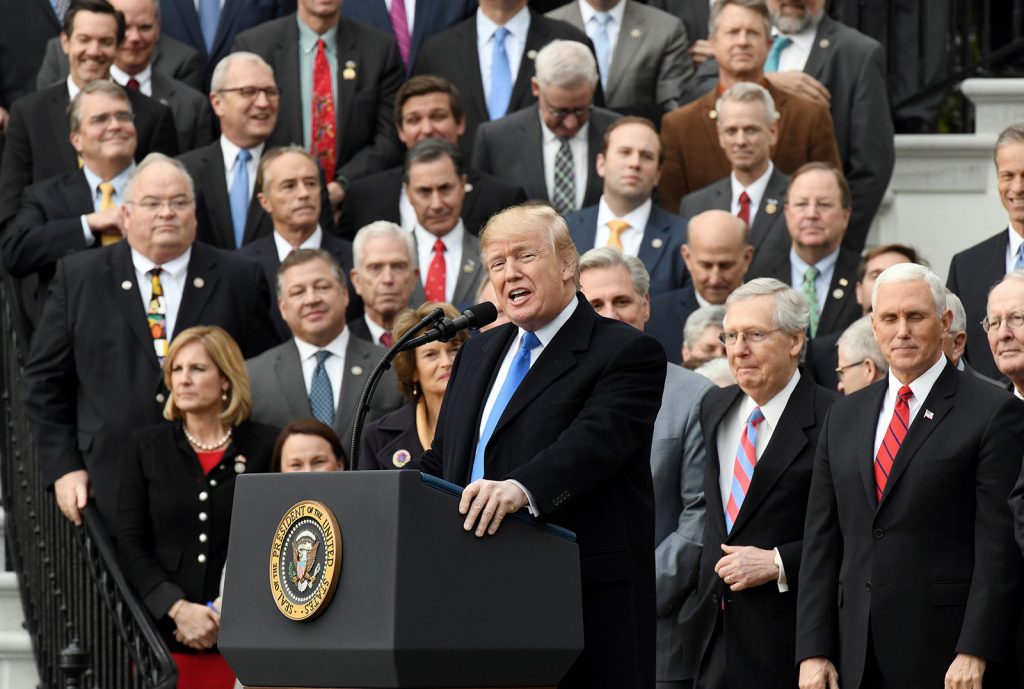
Donald Trump has put the capstone on the “minocratic” state by cultivating a base unified less by policy or prejudice than by identification with a demagogic leader. Republicans will support Trump to the end in hopes of consolidating this base behind his successors, much as Ronald Reagan did in the 1980s. The demagogue will be the new executive model.

Down this road lies what Aristotle thought we had to fear only from kings: tyranny.

Posted in UncategorizedComments Off on Government rule under one demagogue leads to tyranny

Pelosi vs. Trump: a showdown during the government shutdown

Photograph courtesy of Mark Wilson at Tribune News Service

It’s anybody’s guess how the present government shutdown will end, or at what cost. What is clear is that Donald Trump has met his match in a wily, tough-minded experienced adversary who, after two years of national political paralysis, finally has the tools to take Trump on.

First, we might look at what we have lived through until now: minority rule, or rather, minority support for one-man rule. He was rejected by a majority of the American electorate in November 2016, receiving nearly 3 million fewer votes than his principal opponent. He hasn’t been supported by a majority of the public on many issues in polls taken before or since the 2016 election, and, when he cast the 2018 midterms as a referendum on himself, his party lost control of the House of Representatives by the widest margin of any race since 1974, the year Richard Nixon was driven from office.

From Trump’s conduct in office, you’d have thought we were living in a banana republic, and a bizarre one at that. From the fact that Trump has never enjoyed a day of majority support, you’d think we were living in an autocracy. And, although there has been pushback from the media and the courts, you wouldn’t be far wrong. Legally and constitutionally, we have been functioning without majority rule for more than two years. Of course, this has happened before. It happened in 2000 when George W. Bush was chosen to be president by a U. S. Supreme Court that hijacked the election. We got a leader whose inattention cost us 9/11, who lied us into open-ended wars, and who crashed the economy.

Majority rule doesn’t always produce optimal results either. But it sure beats the alternative. Too bad the Founding Fathers, patrician gentlemen all and slaveowners some, were too often more concerned with checking majorities than ensuring them.

We’re a long way from getting majority rule back, two years at least even in the event of a Trump impeachment. But at least we have one of the two houses of Congress in majority hands now, and a leader with the will and capacity to challenge and maybe even thwart the infant in the White House — the nasty, surly, 239-pound infant who has tossed government institutions and constitutional restraints around like  toys. Nancy Pelosi isn’t a new personality and, temperamentally, she wasn’t made to be president; her talents are legislative rather than executive, and of course her gender made it a struggle to rise in Congress itself. But it should be apparent by now that she is the most talented Democratic politician of her time, and, since few Republicans have been anything but calamitous, arguably the best one we have had over the past three decades. She did more than anyone else to rein in the last two years of the Bush presidency, and she singlehandedly rescued the Affordable Care Act when Barack Obama was about to abandon it, thus rescuing his administration from a disaster that would have made him a one-term president. The work of a legislator, though, is mostly done away from the spotlight, and so Pelosi’s career has received little general attention away from the beltway. It will get a lot more now.

Republicans have been paying Pelosi the backhanded compliment of attacking her more than any other figure in the Democratic Party for the past decade. Democrats, with their almost unerring instinct for folly — remember, they nominated Hillary Clinton — made Pelosi’s vote for a second speakership a needless and embarrassing trial. Think, please, of where we would be now without her.

Some have cautioned that, in personalizing the confrontation between Donald Trump and the Constitution as a contest between particular individuals — the playing field Trump likes best — Pelosi risks her own political capital, and with it that of the Trump opposition. I would judge that, at least to this point, she has gauged the problem shrewdly. You have to stand up to Donald Trump as you would to any schoolyard bully; that is, someone has to take the responsibility to say no. It can’t be a delegation, even if it represents one. Someone has to look the bully directly in the eye, and call him out. It’s not necessarily the end of the story — certainly not in this case — but it is the beginning of it.

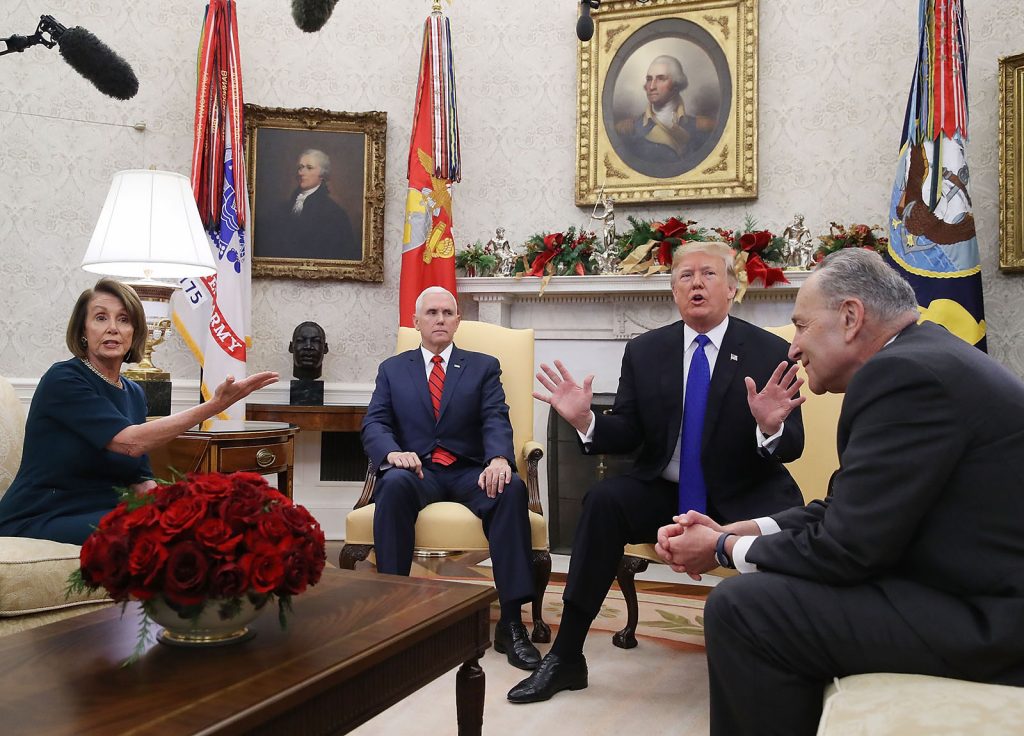
Pelosi did just this when, at a White House ambush called by Trump specifically for the purpose of denigrating her in front of TV cameras, she calmly asserted herself as the coequal head of a coordinate branch of government. The point was widely taken. Pelosi had not in fact yet been chosen speaker; she was, at that moment, simply the House Minority Leader. But her calm demeanor and assurance of election clearly disarmed Trump.

Pelosi’s critical strategic challenge, however, was to refuse Trump, at least for now, his State of the Union platform in the House of Representatives: an act within her authority, as many were no doubt surprised to learn, although couched in terms of a “security” problem. In suggesting that Trump might deliver his address from the Oval Office instead, she underscored his political isolation in the shutdown crisis, and his robotic inability to function without an audience. It also created a trap into which he promptly fell by forcing her to cancel a scheduled trip to, among other places, Afghanistan, a war zone Trump has yet to visit after two years. The strategy was not without risk; Pelosi needs to personalize the resistance to Trump, but not so far as to make it appear as a standoff between two contending egos. She has been careful to appear in public with Senate Minority Leader Chuck Schumer, even to the point of awkwardly sharing a podium with him in their joint response to a nationwide Trump address earlier this month. No doubt there will be other mistakes. But thus far Pelosi has held her ground and, most vitally important, her Congressional caucus. She also holds a card she can play out over many months. It is she who would have the decisive role in initiating a presidential impeachment.

Posted in UncategorizedComments Off on Pelosi vs. Trump: a showdown during the government shutdown

A national emergency may be possible

Photograph courtesy of Olivier Douliery at Abaca Press/TNS

As the shutdown that has closed a quarter of the federal government for nearly a month proceeds, the likelihood that Donald Trump will declare a state of national emergency to access money for a southern border wall grows, in Trump’s own expansive single-sentence syntax, from possible to probable to definite. And this would present us with a constitutional crisis of the first order.

We associate executive proclamations of national emergency with authoritarian states. In fact, we have had a slew of them since Woodrow Wilson announced the first one as he prepared to enter World War I. Emergency decrees go back even further, including Abraham Lincoln’s suspension of habeas corpus during the Civil War — and, hey, weren’t Lincoln and Wilson supposed to be among the good guys?

Emergencies do occur; when George W. Bush suspended all commercial aviation after 9/11 (except for the flight that carried potentially implicated Saudi officials back home to Riyadh,) there was no complaint. But presidents have certainly abused the authority before, as when Franklin D. Roosevelt ordered the internment of Japanese Americans during World War II, or when Harry Truman used a proclamation of emergency to cover our entry into the Korean War in lieu of requesting a Congressional Declaration of War. That latter event effectively stripped Congress of its Constitutional war making powers; no president since has requested such a Declaration, and no Congress has sought it.

The U. S. Supreme Court did reject Truman’s seizure of steel industry plants two years later in Youngstown Sheet and Tube v. Sawyer, but without effectively constraining the president’s general discretion to declare emergencies or attempting to define their scope and reach. This was a problem that the post-Watergate Congress sought to address. Richard Nixon did not attempt to invoke a state of emergency to defend his collapsing presidency in 1974, but the fear that a future president might do so under similar or comparably unjustified circumstances prodded Peter Rodino, who as Chairman of the House Judiciary Committee had been one of the heroes of Watergate, to introduce what became the National Emergencies Act of 1976.

The intent of the Act was to legislatively define and thereby contain the presidential power in declaring states of emergency. In its original version, it provided that Congress might rescind a state of emergency by a joint resolution of both houses. Ronald Reagan objected to this as an infringement on presidential authority, and in 1985, the Act was modified to require executive approval of such a resolution. In effect, that made the president the final judge of his own actions, and so gutted the Act.

One might have thought the Act had pretty much slumbered until now, with the exception of 9/11. In fact, there have been 58 proclamations of national emergency since 1976, of which 31 remain in force. Trump’s predecessor, Barack Obama, issued twelve of them (Trump has thus far issued three). Many of these proclamations relate to the imposition of sanctions on foreign countries, such as Iran, of whose behavior we disapprove. None of them, except the 9/11 proclamation that has been used to justify our open-ended War on Terror, has been particularly controversial until now. Trump’s wall proclamation, if it comes, would be in a different category altogether. There is no emergency at the border, assertions to the contrary notwithstanding. Attempted illicit border crossings have declined by more than 75 percent since 2000. The number of suspected “terrorists” stopped at the border last year was not 4,000, as claimed by the administration, but 12. The number of reported terrorist attacks in the U. S. from southern border crossings since 9/11 is zero. As for the necessity or even utility of a wall — which experts almost uniformly dispute — Trump has made no serious attempt to procure funding for it until now. So, what’s the emergency?

To answer that question, we must look at the circumstances of the present crisis. In mid-December, Trump was reportedly ready to sign off on an appropriations bill that had requested but contained no wall funding. He abruptly backtracked when criticized by a couple of Fox News loudmouths, reinstating his original demands. There was no strategy here, merely the President’s usual inattention and incompetence, and his hurry for a Florida vacation. The shutdown that resulted was, accordingly, a political miscalculation that morphed into a showdown when Congressional Democrats refused to have the government held hostage to a spending demand.

Trump may have blundered into the crisis, but he quickly saw value in it. A shutdown of the government would divert attention from embarrassing Congressional probes, the testimony of Michael Cohen and others and the long-anticipated Mueller Report. Best of all, by invoking a national emergency, Trump could get access to wall funding from monies allocated to federal disaster relief without Congressional approval at all. Since his particular betes noires, Puerto Rico and California, were among the recipients of such aid, that amounted to an irresistible trifecta. If he held his ground, a proclamation of national emergency would be the only way to reopen the government, whose closure, as the weeks progressed, was rapidly becoming the critical issue.

The constitutional crisis, meanwhile, is clear. There are three essential powers that define Congressional authority: the power to declare war, the power to check abuses in the executive and judiciary and the legislative power itself, most especially the power of the purse. Congress abdicated its war making power when it bowed to Truman’s preemptive entry into Korea. It failed to make the president’s emergency powers accountable after Watergate. And it now faces a precedent in which the president can effectively control the public purse by invoking emergencies, real or spurious. That would make him, effectively, a tyrant.

Almost 400 years ago, a similar crisis pitted the English Parliament against its ruler, King Charles I. Charles demanded forced taxation from his subjects to support a war policy that Parliament and most of the country opposed. Parliament recognized that its own future was at stake, and with it the rule of law. Its leaders resisted the King. The eventual result was civil war, and the King’s execution for treason. The end of the story was modern liberty, which is now at stake again, and not in America alone.

We will see how Congress meets its own historic test.

Posted in UncategorizedComments Off on A national emergency may be possible

Trump has isolated himself with his irrational thoughts

Photograph courtesy of Pedro Portal at Tribune News Service.

When future generations look back on the second decade of the 20th century, they will mark the point when it began as the day in 2015 when Donald Trump declared his candidacy for the presidency. It was an announcement that, at the time, received little notice, and that derisive: to be sure, a pizza magnate had run for the Republican Party nomination in 2012, but a serial bankrupt whose signature line in the midst of a recession was, “You’re fired?” Even in the carnival of American politics, some acts won’t play, even for laughs.

The joke, if that’s what it is, is on us.

As the third year of the Trump presidency approaches, we find ourselves at the mercy of a man who now fits the classical definition of a tyrant: a ruler himself ruled by petty insecurity and whim, but with the power to bend an entire nation to his momentary will. You have to go back to Caligula (the guy who made the Roman Senate acknowledge his horse as chief minister) and Nero (who killed his mother after even she tired of him) to find the like. True, Trump hasn’t offered his golf cart a cabinet post, and his close relations are still well and accounted for.

But, consider last month, Trump provoked a crisis over a routine appropriations bill, threatening to shut down large portions of the government unless it included funding to build his oft-insisted upon border wall at the southern border. Now, the wall was never Trump’s idea to begin with. It was the brainchild of former campaign advisors who thought it up to give him a concrete image to fix on as a symbol of his demonization of illegal immigrants. Trump doesn’t care about the wall, or for that matter about immigrants. What he does care about is that immigration is the issue that galvanized the anxieties and resentments of his core supporters, who provide him with the adulation he craves daily. Even that, however, didn’t hold his attention long enough to prevent him from agreeing to a bipartisan bill that made no mention of a wall. It was only when a couple of Fox News commentators held his feet to the fire that he abruptly welshed on his commitment and retreated to his original demand. But welshed, as in backing out of a deal, isn’t the operative word either. Trump didn’t break his word. He simply erased it as if it had never been given, and that there had never been a bill at all. Of course, if the bill never existed, then in what sense does Congress itself exist? Right, you guessed it: it can’t, except, like Trump’s cabinet, as an ornamental expression of his will.

This event was not exceptional. It is the way Trump has been doing business from the beginning. He has abused, ignored or sought to delegitimize his own justice department and intelligence agencies, the Pentagon, the justice system in general and the Federal Reserve Board. The agencies that operate with his approval are the ones performing the opposite of their mandated functions: an Environmental Protection Agency that despoils the environment, a Consumer Financial Protection Bureau that protects predatory lenders, an education department that shackles students to their debts and so on. Congress could hardly have expected different treatment.

The difference is that Congress is the one institution with the power to remove a president from office. That it hasn’t done so has been due, to this point, to Republican control of both its houses, and to the high barrier of a two-thirds majority in the Senate to approve a bill of impeachment. Under a ministerial system of government, a chief executive behaving as Trump has would have been gone long ago. Even if the votes were there, the risk of how Trump might react to such a prospect is too dangerous to contemplate. A negotiated resignation that included the promise of a pardon for any legally actionable offenses has been floated as a possible alternative. But the agreement could not include the pardon itself, which could only be conferred by Trump’s successor unless Trump’s position that he can pardon himself were accepted. Such a precedent would place the presidency above the law, and be itself actionable. And as for waiting on the 2020 election, that is itself a nightmare scenario. Trump might win another term, or foment a crisis to postpone or suspend the election if his defeat seemed likely. If beaten, he might challenge the election result, as he suggested he would if defeated in 2016. This time, he would have all the powers of the presidency at his disposal in doing so.

In short, 2019 or 2020 won’t be 1974, when Richard Nixon agreed to obey the Supreme Court’s order that he turn over the White House tapes, and resign without the written promise of a pardon when confronted at last by GOP elders. Nixon was a lawyer, a Republican, and, when all was said and done, a man constrained by reality. Trump is none of these things. It might actually take a palace coup or a military insurrection to get rid of him (which is one reason he has disposed of the generals who once surrounded him). And that would be a solution as dangerous as the problem.

We have, in short, terribly underestimated the peril we are in. On the one hand, Donald Trump is already a man profoundly isolated despite his ready access to media attention, and no doubt despised by those who work for him. Nor does he have, as a rational despot might, any clear idea of what he wants from one day to the next. On the other hand, he is a megalomaniac who, made desperate enough, is capable of anything.  

I think there are many in Washington who appreciate all this. House Speaker Nancy Pelosi has just said, in a public interview, that Donald Trump would like to “abolish” Congress. She wasn’t being hyperbolic or provocative; I think she said exactly what she meant. The question is whether Pelosi and her colleagues have any idea what to do about it.

Meanwhile, the government shutdown threatened by Trump continues. He seems content at the moment that parts of the executive as well as the legislative branch should disappear, in his words for months or years. In his fantasy world, his will alone suffices.

Posted in UncategorizedComments Off on Trump has isolated himself with his irrational thoughts

George W. Bush’s image is being wrongfully whitewashed

Photograph courtesy of Elizabeth Robertson at TNS

George Orwell must be tired of turning over in his grave in the age of President Donald Trump, but the biggest whopper of all has nothing to do with The Donald. It’s the award of the Liberty Medal by the National Constitution Center to George W. Bush, the latest and most bizarre step in the attempted rehabilitation of our 43rd and still arguably worst president. Donald Trump has done many damaging, disgraceful and disgusting things, and he is obviously in many ways in a class by himself. But he hasn’t started a war on false pretenses that has spawned several more in its wake, and led to the death or exile of millions. He didn’t write the practice of torture into the military handbook, much as he may approve of it, and he didn’t create black sites and the indefinite imprisonment of so-called enemy combatants, both in violation of international law and the Constitution itself. He didn’t initiate the assassination of American citizens abroad. George W. Bush did. He is, simply, a war criminal on the loose.

If you can add insult to this kind of injury, the National Constitution Center cited Bush’s work on behalf of war veterans as the reason for honoring him. Can you top that? Four million American servicemen and women have gone through the grinder of our still ongoing wars in Afghanistan and Iraq, many maimed in body and spirit, and some 7000 brought home to be buried. None of their sacrifice, suffering and death would have been necessary had Bush not ignored the warning signs of 9/11, created a diversionary war in Afghanistan to protect his Saudi allies (and his family’s oil interests) and launched a further war of imperial annexation in Iraq. No other American president has abused the idea of military service more cynically and unconscionably.

One might dismiss this episode as the latest prank by the National Constitution Center. But the whitewashing of Bush actually began Jan. 20, 2009, when I watched in astonishment as Barack Obama rode chummily to his inauguration with his predecessor, and made nice all the way through the ceremony. Yes, that’s the way the torch is supposed to be passed, with a politesse that affirms the lawful transition of presidential power. But Barack Obama had been elected by many to restore a rule of law that had been broken, not to say dishonored, by the man he was replacing.

I’d hoped that Obama would have ignored Bush as pointedly as possible, as a man who’d disgraced the office he was inheriting and which he was now left to repair. Such repair would have required, among other things, thoroughly investigating the lies and lawbreaking of the Bush regime, and holding its chief actors, beginning with Bush himself, to account. But Obama would do no such thing. From the moment of his own accession, he normalized Bush’s actions, and in significant ways extended them. Yes, he did repudiate the use of torture, and he did promise to close down the infamous detention center at Guantanamo Bay, which of course is still open. But he protracted the Afghan War, and when he declared a formal end to the one in Iraq, he embraced the Bush lie that it was fought for freedom and democracy. With that, he recast a naked war of aggression as a noble cause, and waved an implicit presidential pardon over those who had designed and waged it.

Obama didn’t simply mean to rewrite history. He did not end but extended the wars he inherited, including the sub rosa one we continue to wage in Iraq, and fomented or supported new ones in Syria, Libya and Yemen. He tripled our forces in Afghanistan. To minimize American casualties, he greatly increased the use of drone strikes begun by Bush, deliberately understating the civilian deaths they inflicted. He also extended the use of targeted assassinations that included American citizens. When this latter practice was criticized as a violation of the due process clauses of the Constitution, he trotted out his Attorney General, Eric Holder, to explain that due process was satisfied by secret intelligence findings that required no public charge or trial, but simply his own personal approval.

All of this meant that George W. Bush would not only be normalized, but embraced. The Obamas and the Bushes became closer, not only politically but socially, and we have recently seen a picture of Michelle Obama with an arm around Bush in a positively familial manner. Of course, the spectacle of Donald Trump has made such accommodation easier. For those of short memory and with nine years of whitewash under our belts, the affable Bush, with his aw-shucks manner and grin, can readily be taken for the distant uncle who once got into trouble but still belongs at the table.

It would doubtless have been too much for Obama to have given Bush the presidential Medal of Freedom, in the manner of popes canonizing their predecessors. But the Liberty Medal serves well enough, and who in fact did place the medal around Bush’s neck at the award ceremony but Obama’s vice president, Joe Biden? I have seen many strange things in American politics, but the sight of the man elected to succeed Dick Cheney beamingly honoring Cheney’s boss within hailing distance of Independence Hall was perhaps the most surreal of all.

Donald Trump himself is no accident in our politics, and future historians may see more continuity than contrast in the first three administrations of the 21st century. Obama, be it recalled, not only continued and extended Bush’s wars, but undermined the First, Fourth, and Fifth Amendments by attacking whistleblowers and the protections of a free press, by his unprecedented surveillance of American citizens, and by replacing due process with a Star Chamber proceeding presided over by himself. These acts link him both to Bush and Trump in expanding the usurped powers of an imperial presidency. We will have a great deal of work to do in restoring our country’s liberties.

Posted in UncategorizedComments Off on George W. Bush’s image is being wrongfully whitewashed

War never ends

Photograph courtesy of Health.mil

This past week has seen the commemoration of the 100th anniversary of the end of World War I, hosted by President Emmanuel Macron of France. In parts of France, there is still a so-called Red Zone which cannot be entered because unexploded shells, now a century old, are still buried in its terrain. So, in the area around Verdun, site of the war’s most remembered battle, are some 80,000 to 100,000 bodies from soldiers slain in it and never recovered.

Wars do not truly end. They bleed into each other. The First World War was a result of the Franco-Prussian War of 1870 and the alliance system it bequeathed that divided Europe into hostile camps. World War I was not, as President Woodrow Wilson fondly hoped, the war to end all wars, but the first chapter in what, twenty years later, would be a new and yet greater war. World War II, which divided Europe again and also much of Asia, would be the mother of all wars since, including those in Korea and Vietnam, the Arab-Israeli wars, the war over the breakup of Yugoslavia and the present war in Ukraine.

War breeds war. It never makes for peace. And wars come home, no matter how far the noncombatants may be from the battlefield. We have learned that twice this month.


Four million men and women have rotated in and out of our wars in Afghanistan and Iraq since 9/11.  Two of them now give us pause.


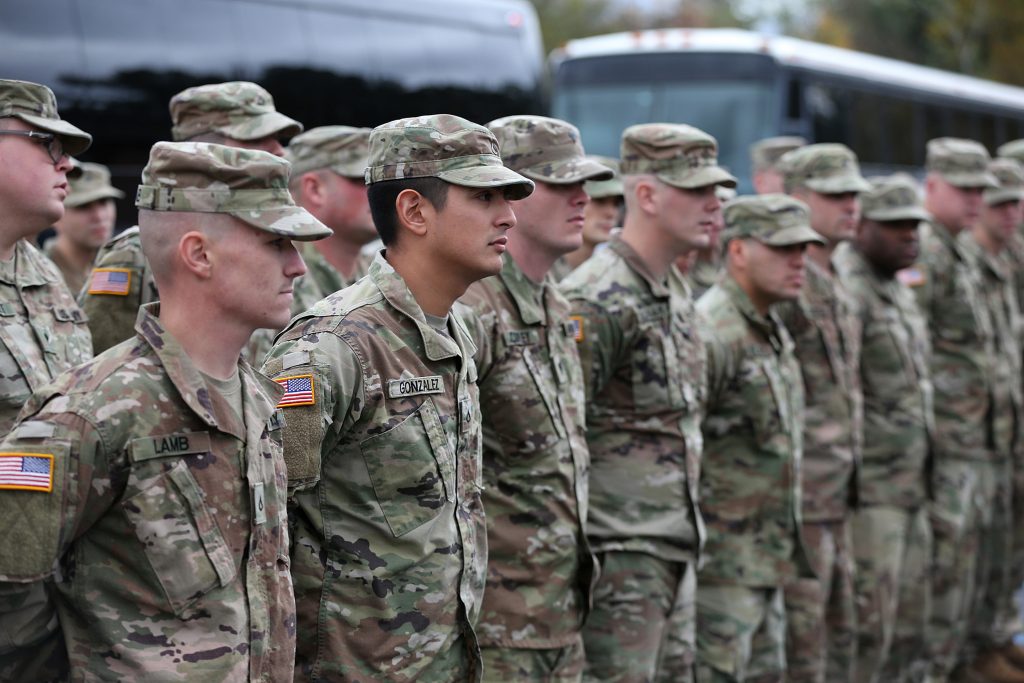
Brent Taylor, a 39-year-old father of seven and the mayor of the small town of North Ogden, Utah, was killed in Afghanistan in what was overall his fourth tour of duty there and in Iraq. Taylor didn’t die in battle; our remaining troops in Afghanistan are rarely exposed to combat, their principal task now being the training of Afghan soldiers. He was killed in an insider attack, as such events are called when Afghan soldiers (or Taliban or Al Qaeda infiltrators; it’s often hard to tell the difference) turn on their American handlers. Almost half the American deaths in Afghanistan now occur in such attacks.

Here’s a question: what are we doing training Afghans to defend their own country after seventeen years of warfare? And here’s another: what is a father of seven with a community to serve doing on such a fool’s errand after three previous tours of duty?

The war in Afghanistan was a diversion to begin with; the chief state actor in the 9/11 attacks against us was Saudi Arabia. It was effectively abandoned when the George W. Bush administration secretly diverted funds appropriated for it to the planned war in Iraq. Since then, it has continued only because successive American presidents have not had the courage to concede its failure. After seventeen years, the Taliban now control more of Afghanistan than at any time since 9/11. Both the Obama and Trump administrations have sought to negotiate a face-saving compromise that would enable us to proclaim, if not victory, then at least mission accomplished. Apparently, the Taliban prefer to fight. The Afghan army — and its American sponsors — are an easier target than the warlord armies and terrorist competitors they would otherwise face.

So, why did Brent Taylor go back to Afghanistan?  Friends tried to dissuade him. He’d done his part, they told him. Taylor’s reply was that he’d fallen in love with Afghanistan and its people. It would be idle and unseemly at this point to dispute this. But I think we’ve heard the one about bringing freedom and democracy to a faraway land before. And all of Taylor’s five brothers had also enlisted after 9/11.  You wouldn’t want to be the family shirker. Perhaps, too, there is a simpler explanation. Perhaps Brent Taylor had become a warrior. I can’t know; perhaps no one can. What I do know is that he died in a long-lost war that the politicians have been too cowardly to end. In that sense, he was not only a casualty but a victim of it.

I think it disservices Brent Taylor to call him a hero, as even the editorial page of The New York Times has done. Of course, all the fallen soldiers of our misbegotten wars have been so anointed. It is a way of dodging the truth, which is that unjust wars aren’t justified on the backs of the dead. There were nine million soldiers who died in World War I. They all died in vain.

Another soldier came back from Afghanistan. Ian David Long said he wanted to go there to kill people.  It was a much more straightforward explanation than most. When Long came home, he apparently hadn’t had enough. A week and a half ago, he shot up a bar and grill in Thousand Oaks, California, and killed twelve people before turning his gun on his real target, himself.

How many Ian Longs are there, actually or potentially, in the four million soldiers who’ve fought our wars in Afghanistan and Iraq? How many more are there, maimed in body and spirit, whom we dismiss with the sterilized diagnosis of Post-Traumatic Stress Disorder? They’ve been to hell, and some of them have brought it back with them.

We are a country of violence that lives in a climate of violence. Some of us would prefer that this wasn’t so. But the bodies pile up, day-by-day and month-by-month, here and far away.                  


Posted in UncategorizedComments Off on War never ends