
Author Archives | Maria Krylova

In defense of public schools: What should they be teaching students?

Isabel Bustos / The Cougar

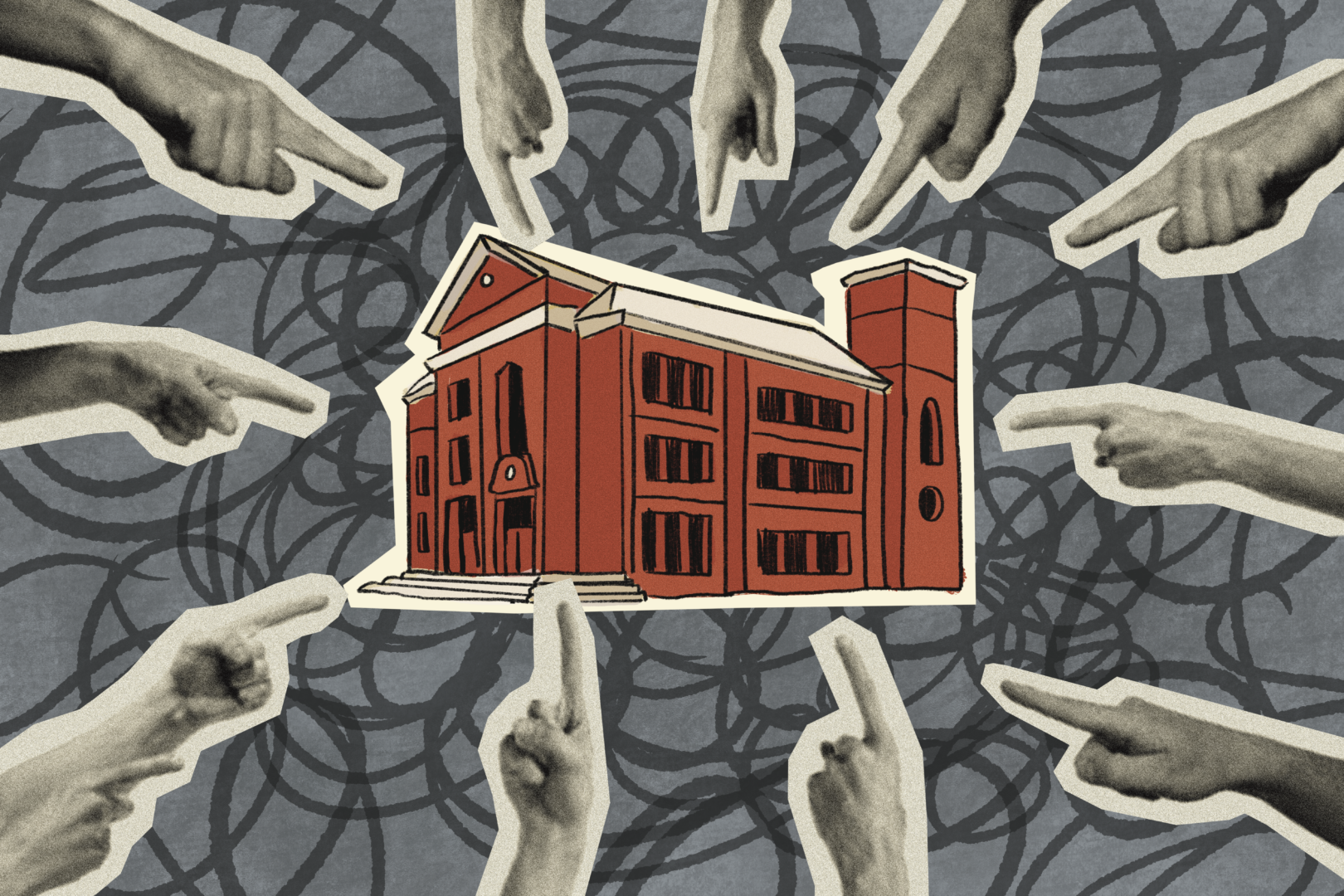
“I wouldn’t even send my cat to a public school!” she said, slamming her hand on the counter.

I overheard this declared loudly by one of my coworkers. She was ranting about public schools “brainwashing” children, how unsafe their campuses are and how they fail to prepare students for the real world, while a woman nearby intensely agreed. Why are there 20-year-old college students, they asked, studying to be doctors who can’t do their own laundry?

The cynical view that schools exist to squash children’s individuality and pump out workers is an unfortunately common one. Public schools, especially, are criticized for teaching students supposedly useless information instead of practical life skills.

In one survey, the average American felt that they used “just 37 percent of the information they learn in school.” Some of the information that Americans found “most useless” included the Pythagorean theorem, the number pi and social activities like making paper snowflakes. Respondents expressed a desire for more practical instruction, such as how to file taxes or perform car maintenance.

What schools are actually responsible for

While this is a reasonable desire, it ignores the fact that basic life skills are and should be parents’ responsibility to teach at home. It’s unfair to criticize schools for not filling gaps left by parents. If a person reaches adulthood and doesn’t know how to wash dishes, the question should be: What support were they receiving at home over the last 18 years?

In addition, most basic skills are straightforward to learn on one’s own with the proper motivation. When I stayed away from home the first time for a work trip, I had to figure out how to use a dryer because I’d never seen one before; my family dried our clothes on a clothesline. 

What did I do? I read the knobs on the machine and figured it out. I learned how to change my car’s oil from a YouTube video. As for the classic example of tax filing, there are free apps like TurboTax that make it very easy. Almost everyone has access to the internet, and the internet has become its own form of public education

But most importantly, basic history, math, writing and literacy skills are real-world skills. Lower-level education is designed to expose children to a broad range of knowledge so that they can discover their strengths and interests and decide which subjects to pursue as adults. 

It’s true that not everyone needs to know the Pythagorean theorem, but Jane, who will go on to become an architect, needs to learn it at some point. And before she can discover that she wants to be an architect, she first needs to discover that she enjoys and excels in math.

What students are actually learning

Another skill that people commonly claim school doesn’t teach is media literacy: the ability to recognize how messages are formed and manipulated, and to do the same.

In reality, media literacy is practiced constantly in English class. Analyzing rhetorical strategies and authorial intent in literature builds foundational skills for understanding the world around us. 

While a student grumbles about analyzing the use of metaphors in Shakespeare’s “Macbeth,” they are learning to decode manipulative language and see through false advertising.

When a student is forced to write an essay about “Jane Eyre,” they are really practicing writing a persuasive argument and articulating their thoughts into words, which is useful in law, business and everyday conversation.

However, the best thing public schools teach is how to live in a world much bigger than yourself. Almost 49,000 students attend the University of Houston, and counted amongst them are conservatives and drag queens, niqabis and furries, frat bros and gender-neutral bathroom enthusiasts. Going to UH can be challenging, fun, exciting and different, which is a much better preparation for “the real world” than the more insulated environment of a private school.

opinion@thedailycougar.com

—
“In defense of public schools: What should they be teaching students?” was originally posted on The Cougar

Posted in UncategorizedComments Off on In defense of public schools: What should they be teaching students?

In defense of public schools: What should they be teaching students?

Isabel Bustos / The Cougar

“I wouldn’t even send my cat to a public school!” she said, slamming her hand on the counter.

I overheard this declared loudly by one of my coworkers. She was ranting about public schools “brainwashing” children, how unsafe their campuses are and how they fail to prepare students for the real world, while a woman nearby intensely agreed. Why are there 20-year-old college students, they asked, studying to be doctors who can’t do their own laundry?

The cynical view that schools exist to squash children’s individuality and pump out workers is an unfortunately common one. Public schools, especially, are criticized for teaching students supposedly useless information instead of practical life skills.

In one survey, the average American felt that they used “just 37 percent of the information they learn in school.” Some of the information that Americans found “most useless” included the Pythagorean theorem, the number pi and social activities like making paper snowflakes. Respondents expressed a desire for more practical instruction, such as how to file taxes or perform car maintenance.

What schools are actually responsible for

While this is a reasonable desire, it ignores the fact that basic life skills are and should be parents’ responsibility to teach at home. It’s unfair to criticize schools for not filling gaps left by parents. If a person reaches adulthood and doesn’t know how to wash dishes, the question should be: What support were they receiving at home over the last 18 years?

In addition, most basic skills are straightforward to learn on one’s own with the proper motivation. When I stayed away from home the first time for a work trip, I had to figure out how to use a dryer because I’d never seen one before; my family dried our clothes on a clothesline. 

What did I do? I read the knobs on the machine and figured it out. I learned how to change my car’s oil from a YouTube video. As for the classic example of tax filing, there are free apps like TurboTax that make it very easy. Almost everyone has access to the internet, and the internet has become its own form of public education

But most importantly, basic history, math, writing and literacy skills are real-world skills. Lower-level education is designed to expose children to a broad range of knowledge so that they can discover their strengths and interests and decide which subjects to pursue as adults. 

It’s true that not everyone needs to know the Pythagorean theorem, but Jane, who will go on to become an architect, needs to learn it at some point. And before she can discover that she wants to be an architect, she first needs to discover that she enjoys and excels in math.

What students are actually learning

Another skill that people commonly claim school doesn’t teach is media literacy: the ability to recognize how messages are formed and manipulated, and to do the same.

In reality, media literacy is practiced constantly in English class. Analyzing rhetorical strategies and authorial intent in literature builds foundational skills for understanding the world around us. 

While a student grumbles about analyzing the use of metaphors in Shakespeare’s “Macbeth,” they are learning to decode manipulative language and see through false advertising.

When a student is forced to write an essay about “Jane Eyre,” they are really practicing writing a persuasive argument and articulating their thoughts into words, which is useful in law, business and everyday conversation.

However, the best thing public schools teach is how to live in a world much bigger than yourself. Almost 49,000 students attend the University of Houston, and counted amongst them are conservatives and drag queens, niqabis and furries, frat bros and gender-neutral bathroom enthusiasts. Going to UH can be challenging, fun, exciting and different, which is a much better preparation for “the real world” than the more insulated environment of a private school.

opinion@thedailycougar.com

—
“In defense of public schools: What should they be teaching students?” was originally posted on The Cougar

Posted in UncategorizedComments Off on In defense of public schools: What should they be teaching students?

Texas doesn’t need more highways. It needs trains

Eddie Ducote/ The Cougar

In March, I packed a suitcase and took off on a road trip to Big Bend National Park. Driving through the West Texas desert, I couldn’t help noticing the small patches of civilization scattered amongst miles of barren highway- places that feel like they’re slowly being left behind.

One of these lost places was a town called Shafter. A green road marker labeled it a “ghost town,” but it was once the largest silver-mining hub in Texas. Now the whole place was little more than a church, a graveyard and some ruins overlooked by the mountains on the horizon. Population: 33, and falling every year.

And towns like Shafter aren’t disappearing by accident.

When I got back to Houston, I was shocked by the sheer number of people. While I was glad to be home, the crowds and the smell of car exhaust felt more overwhelming than ever. My 18-mile commute to campus, which would take 20 minutes in the countryside, took me 45.

The uneven population distribution is a concerning trend that’s been escalating in recent years. While Shafter was abandoned in the 1940s, many towns today are following suit.

There are about 511 ghost towns in Texas, even though our cities are some of the fastest-growing in the nation. Houston had the second-highest population increase in 2024, beaten only by New York City. 

While rural towns in West and Central Texas are slowly bleeding out their residents, Houston gets more crowded every year. As Sandy Fortenberry, chair of the Lubbock County Historical Commission, predicts, “The day of the small town is probably gone.”

But that doesn’t mean small towns are doomed. If we want to keep rural Texas alive, it may be time to stop building highways and start laying down railroad tracks to our remote neighbors. If we don’t, I-10 might just end up with another lane instead.

A state built for trains

Texas already has some rail infrastructure in place connecting its major cities. Yet, most Texas trains are freight trains, and passenger lines like the Texas Eagle serve limited areas in Central and West Texas. Texas, like most of the U.S., also lacks any high-speed rail, forcing people to rely on cars and planes.

The biggest thing killing Texas towns like Shafter is the lack of economic opportunity for its residents. However, wherever rail is built, people tend to follow.

The construction of railroads would revitalize small-town economies by creating jobs, while faster, more affordable transportation of people and goods would attract tourists and encourage businesses to settle permanently.

This would greatly ease the burden on cities like Houston; if downtown were just a quick train ride away, farmers and people seeking opportunity wouldn’t have to move right into the city.

Randal O’Toole, a writer for Forbes, argues that high-speed rail became obsolete in 1958, when Boeing’s 707 entered commercial service. He believes building a network of rail would be a massive money sink because airplanes are faster than even the best bullet trains. He also cites that the average cost of airfare is lower per mile than that of an Amtrak ticket.

However, O’Toole doesn’t account for the fact that most people aren’t taking planes to travel within their own state. Intrastate flights make up only a small fraction of American air travel, and traveling by plane is more of a hassle since you have to get through security and board at a specific time.

If a person misses their flight, they must reschedule and lose hundreds of dollars, whereas high-speed trains require little more than a ticket, have no luggage limits and arrive every few minutes.

Why trains still matter

The benefits of bullet trains cannot be reduced to their speed alone. O’Toole believes trains will never replace cars because “The United States doesn’t have enough conventional train riders for high-speed rail lines to succeed.”

However, even car lovers could be incentivized to make a lifestyle change if they grew tired of high gas prices. In 2025, the average American household spent about $2,400 on gas, or 3.1% of its annual budget. This doesn’t even include the environmental and time costs of personal vehicles.

Trains emit much less greenhouse gas than cars, which will reduce the effects of climate change and help mitigate it. This would also mean Houstonians breathe in less smog. Moreover, bullet trains would reduce the horrible congestion on our roads and give people more time with their families and hobbies. 

If you sit in traffic 30 minutes a day, five days a week, you are wasting two and a half hours of your life on the road. Billions of dollars in national debt doesn’t seem like such a high price when it pays for our time, sanity, health and planet.

America used to be a technological trendsetter. Our thinkers invented light bulbs, cotton gins, smartphones and steam engines. Yet we are refusing to adopt a technology used by many global leaders because of our fixation on cars and the convenience of air travel. 

Ironically, the United States was the first country in the world to complete a major transcontinental railroad, a revolutionary act that unified the nation’s economy and led to the establishment of many brave pioneer towns, such as Shafter.

It’s time for America to take care of its former frontiers and invest in intrastate high-speed rail, before we get left behind by countries like China.

opinion@thedailycougar.com

—
“Texas doesn’t need more highways. It needs trains” was originally posted on The Cougar

Posted in UncategorizedComments Off on Texas doesn’t need more highways. It needs trains

The parts of you that aren’t yours

Hailey Nguyen/The Cougar

“As soon as you are born, you’re given a name, a religion, a nationality and a race. You spend the rest of your life defining and defending a fictional identity.”

I found this line on Facebook, accompanied by a melodramatic picture of a baby with a barcode on its forehead. It’s one of the millions of “deep” quotes on Facebook of ambiguous origin, but it made me wonder: are our identities fictional if most of our basic traits are assigned at birth? And how loyal should we be to the parts of ourselves inherited through geographic chance?

Of the four traits often tied to identity, name, religion, nationality and race, the first three are surprisingly flexible. Names can change, whether through nicknames or legal documents, and people can even hold multiple at once. 

Breaking down identity

My legal name is Maria. It’s the name I use with friends, teachers and strangers. But my family calls me “Masha,” which feels more right. Even then, it’s not perfect; if I could choose my own name, it would be something else entirely, but social norms hold me back. 

Does that mean “Maria” is false? It’s not quite what I want, but how can I throw it away when it’s what my best friend calls me?

Religion feels just as unstable. My parents are Orthodox Christians, but they never fully passed that faith down to me. I grew up with vague, nondenominational beliefs, saying I believed in God without much thought. 

At 17, I opened a Bible for the first time, but it didn’t resonate. I became the only atheist in my family. Had I been raised differently, I likely would have believed. Like most people, my faith wasn’t chosen; it was shaped by circumstance, family and geography.

If I’d been born elsewhere, I might have followed a completely different religion. What should be a personal conviction often feels like an inheritance.

Nationality, too, is something we don’t choose. I was raised in the United States by Russian parents and hold dual citizenship, an uneasy mix given the tension between the two countries. I feel connected to Russia through language and culture, yet I’ve only been there twice. 

At the same time, I question what it means to claim that identity, especially when I don’t agree with its politics. Still, there’s a loyalty I can’t fully shake. Identity isn’t just what we choose; it’s also what we’re given.

Race is the one part of identity that cannot be changed. It’s a constructed system, created to categorize people, yet its effects are very real. Even if race is, in many ways, a man-made concept, it shapes how others see you and how you move through the world. 

You can reject it, question it or redefine it, but you can’t escape it. Until we reach a truly post-racial world, it remains an unavoidable part of who we are.

The takeaway

There’s a classic philosophical theory called the Ship of Theseus that asks if a ship is still the same ship if every plank is replaced over time. When we apply this idea to humans: if I ran away and became a Buddhist Swedish national named Erik, I would still be, at my core, “me.” There is something about identity, something in that mysterious “I” that exists outside of classification.

Hyper-individualism isn’t the answer. The identity one is born into can’t just be cast aside like an old coat; our “fictional” identities have real-world consequences and imprint on us whether we want them to or not. 

However, people should seriously examine their thoughts and values to understand what they sincerely believe and what they have absorbed unquestioningly from their family and culture.

It takes bravery to self-reflect and find that core aspects of yourself were placed there by someone else, or to discover that you think differently from your family and community. But only by consciously shaping your identity can you become your true self rather than a fusion of external influences.

opinion@thedailycougar.com

—
“The parts of you that aren’t yours” was originally posted on The Cougar

Posted in UncategorizedComments Off on The parts of you that aren’t yours