Author Archives | Maria Krylova

The parts of you that aren’t yours

Hailey Nguyen/The Cougar

“As soon as you are born, you’re given a name, a religion, a nationality and a race. You spend the rest of your life defining and defending a fictional identity.”

I found this line on Facebook, accompanied by a melodramatic picture of a baby with a barcode on its forehead. It’s one of the millions of “deep” quotes on Facebook of ambiguous origin, but it made me wonder: are our identities fictional if most of our basic traits are assigned at birth? And how loyal should we be to the parts of ourselves inherited through geographic chance?

Of the four traits often tied to identity, name, religion, nationality and race, the first three are surprisingly flexible. Names can change, whether through nicknames or legal documents, and people can even hold multiple at once. 

Breaking down identity

My legal name is Maria. It’s the name I use with friends, teachers and strangers. But my family calls me “Masha,” which feels more right. Even then, it’s not perfect; if I could choose my own name, it would be something else entirely, but social norms hold me back. 

Does that mean “Maria” is false? It’s not quite what I want, but how can I throw it away when it’s what my best friend calls me?

Religion feels just as unstable. My parents are Orthodox Christians, but they never fully passed that faith down to me. I grew up with vague, nondenominational beliefs, saying I believed in God without much thought. 

At 17, I opened a Bible for the first time, but it didn’t resonate. I became the only atheist in my family. Had I been raised differently, I likely would have believed. Like most people, my faith wasn’t chosen; it was shaped by circumstance, family and geography.

If I’d been born elsewhere, I might have followed a completely different religion. What should be a personal conviction often feels like an inheritance.

Nationality, too, is something we don’t choose. I was raised in the United States by Russian parents and hold dual citizenship, an uneasy mix given the tension between the two countries. I feel connected to Russia through language and culture, yet I’ve only been there twice. 

At the same time, I question what it means to claim that identity, especially when I don’t agree with its politics. Still, there’s a loyalty I can’t fully shake. Identity isn’t just what we choose; it’s also what we’re given.

Race is the one part of identity that cannot be changed. It’s a constructed system, created to categorize people, yet its effects are very real. Even if race is, in many ways, a man-made concept, it shapes how others see you and how you move through the world. 

You can reject it, question it or redefine it, but you can’t escape it. Until we reach a truly post-racial world, it remains an unavoidable part of who we are.

The takeaway

There’s a classic philosophical theory called the Ship of Theseus that asks if a ship is still the same ship if every plank is replaced over time. When we apply this idea to humans: if I ran away and became a Buddhist Swedish national named Erik, I would still be, at my core, “me.” There is something about identity, something in that mysterious “I” that exists outside of classification.

Hyper-individualism isn’t the answer. The identity one is born into can’t just be cast aside like an old coat; our “fictional” identities have real-world consequences and imprint on us whether we want them to or not. 

However, people should seriously examine their thoughts and values to understand what they sincerely believe and what they have absorbed unquestioningly from their family and culture.

It takes bravery to self-reflect and find that core aspects of yourself were placed there by someone else, or to discover that you think differently from your family and community. But only by consciously shaping your identity can you become your true self rather than a fusion of external influences.

opinion@thedailycougar.com

—
“The parts of you that aren’t yours” was originally posted on The Cougar

Posted in UncategorizedComments Off on The parts of you that aren’t yours

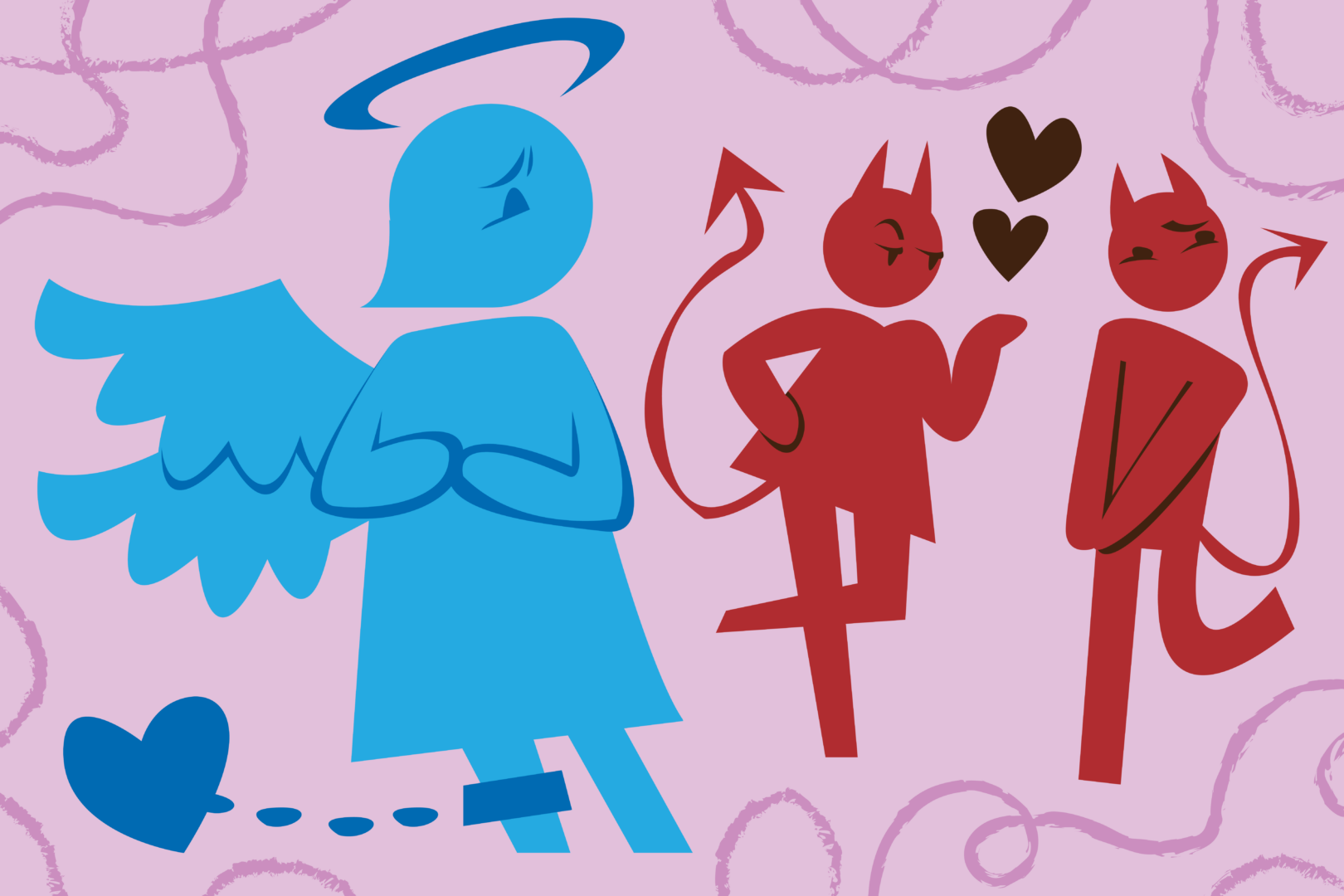
Hookup culture isn’t ruining romance

Eddie Ducote/ The Cougar

“Promiscuous” is a dirty word in today’s society. There are thousands of articles and videos claiming that Gen Z has ruined romance with hookup culture, even though casual sex is actually declining among teens and young adults.

Nevertheless, people who have casual sexual partners are derided as lacking in self-respect or being somehow corrupted in character. Women especially bear the brunt of the social ridicule, a trend which stems from religious and cultural ideas about purity.

However, putting religious doctrine aside, one has to question what makes having sex outside of romantic relationships so apparently degrading. Sexual attraction and arousal are basic desires of the body that are expressed by most people. What makes acting upon it in a casual, low-stakes way any dirtier or more immoral than, say, using the restroom?

Morality is the guiding set of principles that “conceptualize the tenets of human character or behavior as good or bad, right or wrong.” It is highly subjective and differs across individuals and cultures, but its general purpose is to promote well-being and reduce suffering in a community. Therefore, the question becomes: do casual sexual experiences lead to suffering or promote well-being? The answer is: it’s complicated.

The risks and rewards of casual sex

It’s true that participating in hookup culture has physical, mental and emotional risks. Some studies have found a correlation between casual sex and increased rates of anxiety and depression. General feelings of sadness, shame and low self-esteem are also common amongst participants. Women, especially, are vulnerable to feeling used or regretful after a sexual encounter with a stranger. There is also the risk of contracting sexually transmitted infections from unprotected sex or of being assaulted by a violent partner.

However, the research isn’t as one-sided as one might think. Casual sexual relationships or experiences can also be neutral or positive experiences, depending on the person and situation. They can help people explore their sexuality, boost confidence and self-perception, decrease stress,and even improve sleep. In fact, a comprehensive review of 71 studies in 2020 found that most people who engage in casual sex have a positive emotional outcome.

The takeaway

If casual sex were inherently harmful, why doesn’t it cause universal harm? Why does it leave some people feeling dirty and empty and acts as a healthy outlet for others? 

Researchers note that certain risk factors make negative effects after hookups much more likely. These include drug or alcohol use before the encounter, lack of sexual satisfaction and feeling pressured to perform acts you don’t want to do. Lack of protection is also a significant source of post-hookup distress. It’s clear that the act of hooking up isn’t inherently harmful, but rather that harm can manifest depending on the circumstances and people involved.

Social stigma

The broader social context surrounding sex is also a significant cause of post-coital anxiety. There’s a reason men who engage in hookup culture tend to fare much better than women. Causal sex “takes place in the context of a sexual double standard in which men are socially rewarded for sex and women are socially sanctioned.” 

Purity culture acts as a vicious feedback loop; it teaches women that expressing their sexuality is wrong and gross, and if they do it anyway, the instilled shame is designed to come flooding in. All it takes to see the double standard is to look at the language surrounding intercourse; there are many more degrading terms for sexual women compared to men.

How to move forward

One might argue that coercion, alcohol use and poor decision making, the “risk factors,” are hookup culture. To that I say: it doesn’t have to be. 

Casual sexual relationships can be built on honesty, respect and mutual satisfaction if society viewed sex in a positive or at least neutral light. Focusing on education, safety and consent instead of repression would do a lot to fix the emotional damage, abuse, risk of diseases and other problems considered as intrinsic flaws with casual sex.

Sex positivity doesn’t mean encouraging people to change their sexual habits, but rather their sexual attitudes. Everyone has different preferences, and it’s valid to abstain from hookups for personal or religious reasons, or if it’s simply not right for you. However, the era of public shaming needs to end.

Instead, we must equip people with the tools they need to make the right decisions for themselves, be their own advocates and return privacy to pleasure.

opinion@thedailycougar.com 

—
“Hookup culture isn’t ruining romance” was originally posted on The Cougar

Posted in UncategorizedComments Off on Hookup culture isn’t ruining romance