

Author Archives | Fatoumata Traore

The police next door: What Ring and Flock say about our safety

Lily Huynh/ The Cougar

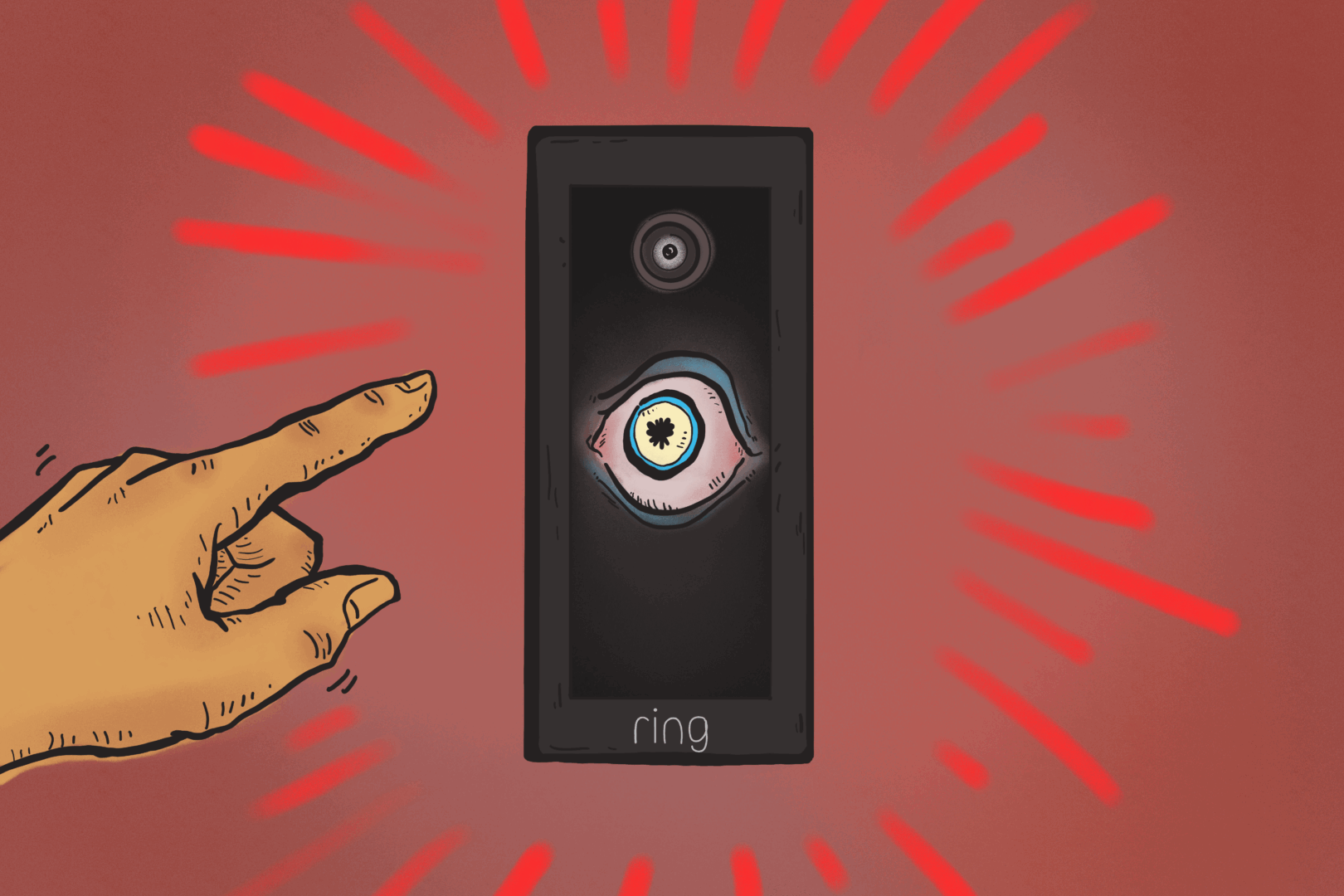
Amazon-owned doorbell company, Ring, and security technology company Flock Safety announced a working partnership in late 2025 to integrate a community request feature that would allow law enforcement to request video footage from Ring customers who also use the Neighbor’s app. 

Although Ring camera users would be able to opt in and opt out of these features, there is an undeniable cynicism in framing mass data extraction as voluntary “community participation,” especially when the power dynamic between residents and law enforcement is so stark.

By treating surveillance as a civic obligation, we see who bears the brunt of policing, who is trusted to report it and how these patterns institutionalize bias, particularly against Black, brown and immigrant communities.

Vigilante surveillance 

“Ring emphasized that the integration ‘simply streamlines’ how local police seek community help, but privacy researchers counter that it blurs the boundary between voluntary cooperation and crowd-sourced surveillance,” said Anthony Kimery, a biometric technology journalist.

By embedding law-enforcement requests within a privatized, community-facing app, Ring and Flock collapse the distinction between neighborly vigilance and state surveillance. This is especially a concern for communities that are disproportionately facing overpolicing. The app’s option to opt out of police surveillance seems hollow, as for black and brown communities, abstention does not dismantle their ability to be surveilled. 

As the United States Immigration and Customs Enforcement increasingly relies on third-party surveillance and data brokers, the integration would allow immigration efforts to scale up without any accountability. According to the American Civil Liberties Union, “Amazon’s deal also highlights the efforts of Flock and its competitor Axon (which already had a deal with Ring) to become police departments’ centralized ‘operating system’.” 

The significance of the phrase “operating system” is that it enables not just data collection but the integration and cross-referencing across jurisdictions and agencies. In this case, data precedes legal justification rather than the reverse, and safeguards such as warrants and proper court orders are swept behind an app’s terms of service.

First prejudice, then evidence

In a similar light, the Neighbor’s app functions less as a tool for communication and more as an infrastructure of radicalized suspicion. Posts and footage collected on the app are shaped by implicit bias; this means surveillance power is assumed long before police make a request. 

Once that biased data enters an integrated law-enforcement ecosystem, it gains institutional legitimacy because it shapes where a search effectively begins. From there, footage and reports that originally started as private prejudice are reframed as objective evidence. There is no neutral standpoint when submitting this type of footage, and the app simply being privatized does not insinuate that it’s apolitical. 

Not to mention that the individuals shared through this app have no notice that their data could be transmitted to law enforcement, which also means they aren’t allowed to contest its accuracy or context.

Safety at what cost

In the context of recent ICE escalations, the lack of notice or correction in vigilante surveillance is particularly dangerous because indirect leads through third-party data could lead to life-altering consequences. Due process is highly overlooked in the case of immigration, which is why we often see arbitrary detention. 

In final remarks, the integration creates a system where implicit bias and prejudice fester, eating at the legitimacy of marginalized communities. This feature positions minorities as inherently “suspicious”, exploiting fears that majority communities profit from too well. 

When you police the vulnerable and shield those in power,  the illusion of democracy crumbles. Now that the undocumented immigrant is detained, and the innocent Black man is criminalized, who will be left to blame? Neighborhood? Ring and Flock? Or will it be the very political surveillance infrastructure promoted by law enforcement, packaged “for public safety” and integrated into systems that shape policy and even the next election? 

So I ask once more, safety at what cost?

opinion@thedailycougar.com

—
“The police next door: What Ring and Flock say about our safety” was originally posted on The Cougar

Posted in UncategorizedComments Off on The police next door: What Ring and Flock say about our safety

The next Great Depression of higher education

Lily Huynh/ The Cougar

The Great Depression was defined by more than just a financial collapse; the result weakened the working and middle classes, ultimately leading to the collapse of entire systems. The Great Depression echoes in this modern era, as the current government’s efforts to reduce the status of a professional degree. 

According to the U.S. Department of Education, in conformity with President Trump’s “One Big Beautiful Bill Act”, the agency was required to identify professional degree programs that are eligible for up to $200,000 total in federal lending limits. 

The law requires that starting early July of 2026, the federal program Grad Plus, which allowed students to borrow up to the full cost of their graduate degrees, will be eliminated. As these degrees are removed, the cost burden shifts entirely onto students, creating a barrier that will certainly and disproportionately lock out the working and middle classes.

Gatekeepers of knowledge

When the government reduces funding for higher education, the implication is not just trimming professional programs. The government and the Department of Education are essentially reshaping who gains access to specialized knowledge and, by extension, who holds power in society. 

Withholding the classification of certain degrees creates a structural shift in essentially who is qualified for regulated professions, the limited supply and high demand of credentialed experts, and the consolidation of power among institutions that can still afford to produce these specialists. 

Professional degrees are known for traditionally producing autonomous experts who are trained deeply enough to critique government policy and hold institutions accountable. 

In “Distinction a Social Critique of the Judgement of Taste”, written by Pierre Bourdieu, he remarks on the social relationship between professional and doctoral degrees. Bourdieu claims that institutions and those in the academy not only decide which students receive educational attainment from their professional degree programs, but also, by selecting these students, who become leading scholars in society. 

Therefore, as stated by the National Library of Medicine, the definition of elite social and cultural capital becomes intertwined with that of scholarly excellence, thereby determining access to the top strata of education and to faculty positions. It may be naive to deny that narrowing professional education limits not only individual opportunity but also reshapes the balance of power between the public and the private.

The next Great Depression

As previously mentioned, the Great Depression was caused by more than just a financial collapse. The reduction in professional degrees mirrors the fragile workforce created during the Great Depression. 

The U.S. economy today is more volatile compared to previous years, and the growing use of Artificial Intelligence is making it more technologically complex. Under these circumstances, these risks create a workforce that is overqualified for low-paying jobs but underqualified for positions that would require professional degrees. 

Education is a human investment in human assets and human infrastructure. When reducing avenues for mobility and financial freedom, the government and its decisions actively divest from human investment. 

Overall, this is pushing the workforce into positions that offer neither stability nor autonomy. When society again restricts mobility by limiting access to education and credentials, it reflects the systemic weaknesses that helped create the Great Depression in the 1930s.

Ethical implications

Immediately, it’s the ethical questions that are the most relevant. Education is one of the few institutions that are widely accessible and designed to level the playing field between different socio-economic classes. However, when certain degrees become financially inaccessible, the ethical question becomes: Who gets to become a professional and who does not? 

A few of the degrees cut fell into the categories of social work, public health, nursing and physical therapy. This prompts society to question whether the government’s decisions were intentional in limiting access to professions that serve the public good. This alludes to the chilling truth that long-term development of a skilled and diverse workforce is less important than the administrative convenience that degree cuts offer.

Finally, what is the moral implication of those in power, like President Trump, who pass laws that knowingly deepen societal inequality? Is it that we are moving towards a society that values education less? Or is it that the working and middle classes are expendable? 

Final remarks

Although the Department of Education and the government may suggest that the professional degree cuts are merely a renaming, not a devaluation of certain degrees, let us not be fooled. 

This law, under President Trump’s “One Big Beautiful Bill Act”, is intentionally designed and financially deprives an overwhelming number of students of access to higher education. By eliminating funding limits on higher education, the government not only reshapes who is educated enough to dictate and hold public and private power, but also disproportionately affects the working and middle classes. 

Suppose access to professional and doctoral education becomes a privilege rather than a human investment. In that case, we risk creating a future defined not by innovation or shared prosperity, but by deepening inequality and the concentrated control of powerful institutions. In the same light, how can a nation claim to invest in its future while dismantling the educational structures that make that future possible?

The implications of all these decisions can be captured in a single question. Who benefits most when expertise becomes a luxury reserved for fewer, and perhaps more privileged, people?

opinion@thedailycougar.com

—
“The next Great Depression of higher education” was originally posted on The Cougar

Posted in UncategorizedComments Off on The next Great Depression of higher education