
Author Archives | Fatoumata Traore

The next Great Depression of higher education

Lily Huynh/ The Cougar

The Great Depression was defined by more than just a financial collapse; the result weakened the working and middle classes, ultimately leading to the collapse of entire systems. The Great Depression echoes in this modern era, as the current government’s efforts to reduce the status of a professional degree. 

According to the U.S. Department of Education, in conformity with President Trump’s “One Big Beautiful Bill Act”, the agency was required to identify professional degree programs that are eligible for up to $200,000 total in federal lending limits. 

The law requires that starting early July of 2026, the federal program Grad Plus, which allowed students to borrow up to the full cost of their graduate degrees, will be eliminated. As these degrees are removed, the cost burden shifts entirely onto students, creating a barrier that will certainly and disproportionately lock out the working and middle classes.

Gatekeepers of knowledge

When the government reduces funding for higher education, the implication is not just trimming professional programs. The government and the Department of Education are essentially reshaping who gains access to specialized knowledge and, by extension, who holds power in society. 

Withholding the classification of certain degrees creates a structural shift in essentially who is qualified for regulated professions, the limited supply and high demand of credentialed experts, and the consolidation of power among institutions that can still afford to produce these specialists. 

Professional degrees are known for traditionally producing autonomous experts who are trained deeply enough to critique government policy and hold institutions accountable. 

In “Distinction a Social Critique of the Judgement of Taste”, written by Pierre Bourdieu, he remarks on the social relationship between professional and doctoral degrees. Bourdieu claims that institutions and those in the academy not only decide which students receive educational attainment from their professional degree programs, but also, by selecting these students, who become leading scholars in society. 

Therefore, as stated by the National Library of Medicine, the definition of elite social and cultural capital becomes intertwined with that of scholarly excellence, thereby determining access to the top strata of education and to faculty positions. It may be naive to deny that narrowing professional education limits not only individual opportunity but also reshapes the balance of power between the public and the private.

The next Great Depression

As previously mentioned, the Great Depression was caused by more than just a financial collapse. The reduction in professional degrees mirrors the fragile workforce created during the Great Depression. 

The U.S. economy today is more volatile compared to previous years, and the growing use of Artificial Intelligence is making it more technologically complex. Under these circumstances, these risks create a workforce that is overqualified for low-paying jobs but underqualified for positions that would require professional degrees. 

Education is a human investment in human assets and human infrastructure. When reducing avenues for mobility and financial freedom, the government and its decisions actively divest from human investment. 

Overall, this is pushing the workforce into positions that offer neither stability nor autonomy. When society again restricts mobility by limiting access to education and credentials, it reflects the systemic weaknesses that helped create the Great Depression in the 1930s.

Ethical implications

Immediately, it’s the ethical questions that are the most relevant. Education is one of the few institutions that are widely accessible and designed to level the playing field between different socio-economic classes. However, when certain degrees become financially inaccessible, the ethical question becomes: Who gets to become a professional and who does not? 

A few of the degrees cut fell into the categories of social work, public health, nursing and physical therapy. This prompts society to question whether the government’s decisions were intentional in limiting access to professions that serve the public good. This alludes to the chilling truth that long-term development of a skilled and diverse workforce is less important than the administrative convenience that degree cuts offer.

Finally, what is the moral implication of those in power, like President Trump, who pass laws that knowingly deepen societal inequality? Is it that we are moving towards a society that values education less? Or is it that the working and middle classes are expendable? 

Final remarks

Although the Department of Education and the government may suggest that the professional degree cuts are merely a renaming, not a devaluation of certain degrees, let us not be fooled. 

This law, under President Trump’s “One Big Beautiful Bill Act”, is intentionally designed and financially deprives an overwhelming number of students of access to higher education. By eliminating funding limits on higher education, the government not only reshapes who is educated enough to dictate and hold public and private power, but also disproportionately affects the working and middle classes. 

Suppose access to professional and doctoral education becomes a privilege rather than a human investment. In that case, we risk creating a future defined not by innovation or shared prosperity, but by deepening inequality and the concentrated control of powerful institutions. In the same light, how can a nation claim to invest in its future while dismantling the educational structures that make that future possible?

The implications of all these decisions can be captured in a single question. Who benefits most when expertise becomes a luxury reserved for fewer, and perhaps more privileged, people?

opinion@thedailycougar.com

—
“The next Great Depression of higher education” was originally posted on The Cougar

Posted in UncategorizedComments Off on The next Great Depression of higher education

The next Great Depression of higher education

Lily Huynh/ The Cougar

The Great Depression was defined by more than just a financial collapse; the result weakened the working and middle classes, ultimately leading to the collapse of entire systems. The Great Depression echoes in this modern era, as the current government’s efforts to reduce the status of a professional degree. 

According to the U.S. Department of Education, in conformity with President Trump’s “One Big Beautiful Bill Act”, the agency was required to identify professional degree programs that are eligible for up to $200,000 total in federal lending limits. 

The law requires that starting early July of 2026, the federal program Grad Plus, which allowed students to borrow up to the full cost of their graduate degrees, will be eliminated. As these degrees are removed, the cost burden shifts entirely onto students, creating a barrier that will certainly and disproportionately lock out the working and middle classes.

Gatekeepers of knowledge

When the government reduces funding for higher education, the implication is not just trimming professional programs. The government and the Department of Education are essentially reshaping who gains access to specialized knowledge and, by extension, who holds power in society. 

Withholding the classification of certain degrees creates a structural shift in essentially who is qualified for regulated professions, the limited supply and high demand of credentialed experts, and the consolidation of power among institutions that can still afford to produce these specialists. 

Professional degrees are known for traditionally producing autonomous experts who are trained deeply enough to critique government policy and hold institutions accountable. 

In “Distinction a Social Critique of the Judgement of Taste”, written by Pierre Bourdieu, he remarks on the social relationship between professional and doctoral degrees. Bourdieu claims that institutions and those in the academy not only decide which students receive educational attainment from their professional degree programs, but also, by selecting these students, who become leading scholars in society. 

Therefore, as stated by the National Library of Medicine, the definition of elite social and cultural capital becomes intertwined with that of scholarly excellence, thereby determining access to the top strata of education and to faculty positions. It may be naive to deny that narrowing professional education limits not only individual opportunity but also reshapes the balance of power between the public and the private.

The next Great Depression

As previously mentioned, the Great Depression was caused by more than just a financial collapse. The reduction in professional degrees mirrors the fragile workforce created during the Great Depression. 

The U.S. economy today is more volatile compared to previous years, and the growing use of Artificial Intelligence is making it more technologically complex. Under these circumstances, these risks create a workforce that is overqualified for low-paying jobs but underqualified for positions that would require professional degrees. 

Education is a human investment in human assets and human infrastructure. When reducing avenues for mobility and financial freedom, the government and its decisions actively divest from human investment. 

Overall, this is pushing the workforce into positions that offer neither stability nor autonomy. When society again restricts mobility by limiting access to education and credentials, it reflects the systemic weaknesses that helped create the Great Depression in the 1930s.

Ethical implications

Immediately, it’s the ethical questions that are the most relevant. Education is one of the few institutions that are widely accessible and designed to level the playing field between different socio-economic classes. However, when certain degrees become financially inaccessible, the ethical question becomes: Who gets to become a professional and who does not? 

A few of the degrees cut fell into the categories of social work, public health, nursing and physical therapy. This prompts society to question whether the government’s decisions were intentional in limiting access to professions that serve the public good. This alludes to the chilling truth that long-term development of a skilled and diverse workforce is less important than the administrative convenience that degree cuts offer.

Finally, what is the moral implication of those in power, like President Trump, who pass laws that knowingly deepen societal inequality? Is it that we are moving towards a society that values education less? Or is it that the working and middle classes are expendable? 

Final remarks

Although the Department of Education and the government may suggest that the professional degree cuts are merely a renaming, not a devaluation of certain degrees, let us not be fooled. 

This law, under President Trump’s “One Big Beautiful Bill Act”, is intentionally designed and financially deprives an overwhelming number of students of access to higher education. By eliminating funding limits on higher education, the government not only reshapes who is educated enough to dictate and hold public and private power, but also disproportionately affects the working and middle classes. 

Suppose access to professional and doctoral education becomes a privilege rather than a human investment. In that case, we risk creating a future defined not by innovation or shared prosperity, but by deepening inequality and the concentrated control of powerful institutions. In the same light, how can a nation claim to invest in its future while dismantling the educational structures that make that future possible?

The implications of all these decisions can be captured in a single question. Who benefits most when expertise becomes a luxury reserved for fewer, and perhaps more privileged, people?

opinion@thedailycougar.com

—
“The next Great Depression of higher education” was originally posted on The Cougar
Posted in UncategorizedComments Off on The next Great Depression of higher education

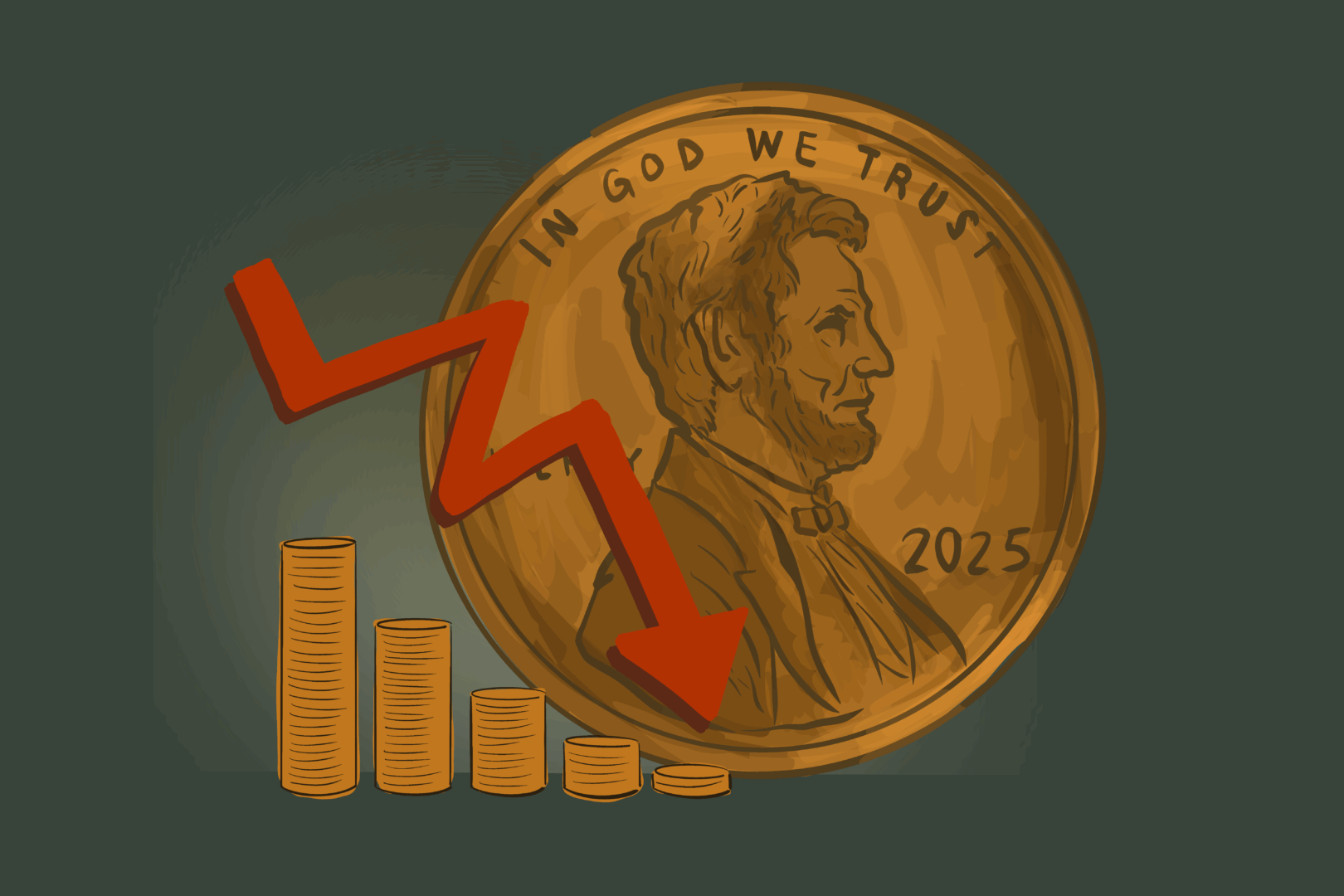
How much does a dollar cost?

Lily Huynh/ The Cougar

In a generation where quarter zip jackets and six-seven are the topic of discussion, it is quite easy for pernicious information to be disregarded. The US government is meant to stop producing new pennies for circulation by early 2026.

The US Treasury states that the penny will remain legal tender for transactions, but the cost of producing a penny has increased by 2.27 cents per penny. 

In an economy where the lowest denomination of currency has lost its value, society can feel a disconnect between what was and what is.

That is, if society has not already been desensitized and groomed to this transition. My concern lies not simply in the elimination of the penny but in the erasure of tangible assets. 

100 pennies

A coin’s typical lifespan is approximately 30 years. In the past 30 years, darkroom printing has been replaced by digital cameras, print media has gone or is going completely online and street performance and folk art are facing a decline.

It sounds like these art forms have died when, in practicality, they’ve shifted for convenience and mass production. 

Convenience and mass production, however, devalue skill, craft time and uniqueness. Why learn calligraphy when you can download a font? What’s the value in learning to play an instrument when digital auto-software can replicate any sound? 

In a capitalistic society, mass production defeats tradition and isolates creation into brands, industries and algorithms. As a result, handcrafted furniture, woodwork and textiles grow more expensive because capitalism inflates the cost of anything produced in limited supply.

What should be most concerning about this version of capitalism is that it dissolves community traditions into profit, and with that, the art loses its roots.

20 nickels 

In a society that is always rushing and constantly overworked and underpaid, it seems irrational to stop and handwrite multiple signatures when you could just type them into a font and paste them.

If you had to take your time flipping through every page that required a signature, you’d be more inclined to read before consenting. 

The shift to digital paperwork is intentional; the fewer barriers a system has, the less likely users are to slow down and read the details. Similarly, tap-to-pay is another example of convenience serving capitalism. The faster the friction disappears, the easier it becomes to spend without reflection. 

When you place a dollar bill in a child’s hand, they cling to it because its value is tangible. They can picture the toy it might become because they can grasp its meaning. But transfer that value into an Apple Pay wallet, and watch as the connection weakens. 

This is because digital money lacks the physical cues that signal worth. Without any cues from our five senses, our brains may struggle to register value. Spending becomes limitless, and physical wallets hold no weight if not just to collect more credit and debit cards.

10 dimes

As we become desensitized to convenient digitization, there is a growing disconnect that reflects across generational lines. Older generations who grew up feeling the daily weight of the dollar and the sound of coins from the bank teller may find the abstraction of money to be disorienting.

As time moves forward, the younger generations who were taught to count through physical money may find this tradition fading as it will become a purely abstract exercise. 

The next most alarming concern of all, however, is rounding up or down for cash-paying customers. Forbes explains that rounding down would only apply to purchases ending in one or two cents.

However, anything above two cents would make cash-paying customers disadvantaged, as their transactions would be rounded up to the nearest five cents.

“The National Association of Convenience Stores also suggested that rounding for cash customers could violate the terms of the Supplemental Nutrition Assistance Program,” said Forbes. 

Not to mention that the calculation of sales tax is not definitive, as companies are confused about the calculation of sales tax and whether it should be regarded before or after the rounding. 

Four quarters

When tangible assets like the penny, textiles and apprenticeships lose their value or disappear completely, society should ask how grounded they truly are in the material reality that keeps us connected to value.

Capitalism disguises the digitization and ultimate death of human experiences in the name of convenience and efficiency. But let us not forget how real it feels to finish handwriting an essay or hearing the slight imperfections that make music human.

The small rewards of seeing a photo take shape in a darkroom, waiting for bread to rise or watching paint slowly dry capture the essence of the human experience, which is anchored in patience and intent.

 It is crucial to remain human in a capitalistic state that values profit over art and dollars over pennies. Be careful in becoming complacent because it takes a hundred humble pennies to make a dollar’s worth.

opinion@thedailycougar.com

—
“How much does a dollar cost?” was originally posted on The Cougar

Posted in UncategorizedComments Off on How much does a dollar cost?

You’re being watched: How AI learns who you are, uses it against you

Lily Huynh/The Cougar

On Thursday, Oct. 16, Dr. Safiya U. Noble delivered a presentation titled “AI and Our Future: How AI and Search Engine Algorithms Reinforce Oppression.” 

Before the presentation, I knew two true things about artificial intelligence: AI data centers extract water from low-income communities to sustain operations, leaving residents to bear the financial burden and secondly, artificial intelligence’s power creates exploitative digital media and perpetuates faulty information. 

After leaving, however, I learned one more thing. It became clear that artificial intelligence carries a critical undertone that shapes every institution in the country, highlighting the urgency of addressing this issue.

Surveillance Capital

Artificial intelligence operates as a system of surveillance. It gathers personal information, behaviors and identities as data points that fuel larger structures of control. Companies such as Waymo, Friend and Palantir Technologies are marketed as meaningful contributions to society when they are indubitably not.

Take Waymo, for instance. It offers a driverless robotaxi with the brand slogan “The World’s Most Trusted Driver.” The irony in this phrase is that Waymo is an algorithm, and the paradox behind the word ‘trust’ is that it is a human emotion; therefore, it shouldn’t be extended to an algorithm. 

What is most cynical about this play on words is that Waymo is a surveillance algorithm. The danger of companies like Waymo is that their surveillance often goes unheard of because it is sold amongst corporations. Noble makes a point of how surveillance companies set up in urban areas; Black communities are often invisibly surveilled. 

This monitoring is highly consequential; It facilitates the gentrification of urban spaces. Gentrification is the leading factor in the loss of neighborhood identity and heritage, as local history is overwritten or commodified vastly in Black and minority communities.

Leila Ullmann states in her article “What Does Waymo See?” that an increase in acquiring data through digitization manifests a trend towards privatization, surveillance and capital extraction.

This translates to people becoming more data and less human. When a society is reduced to data points, human lives become just numbers on a ledger, easily counted and easily discarded. This reinforces inequities embedded within both data analytical and societal institutions. 

Weapons of Recognition

Weapon recognition tools are deployed in schools, supermarkets, airports and to racially profile communities. Notice anything off about that? Facial recognition algorithms are used inhumanely, helping propel racism through their outputs. 

In the 2019 article, “What is Facial Recognition and How Sinister is It?” author Ian Sample explains how facial recognition is primarily trained on white males. As a result, the system is prone to misidentifying the faces of women and people of color, meaning it is less accurate. Minimal accuracy leads to more people being profiled and questioned. 

Although this article was published over six years ago, its concepts remain highly relevant. As facial recognition algorithms have evolved, are we foolish enough to believe their biases haven’t? 

Systematic injustice is fueled by systems that reinforce a stereotypical racism that most institutions are founded on. Through facial recognition mishaps, those who are already systematically oppressed are welcomed with another layer to their oppression by being sold digitally and marketed globally. 

In the 2020 documentary Coded Bias, it was determined that the more melanated you are, the less an algorithm will be able to confirm your identity. This is not simply a technical issue, as it reflects deeper social and institutional biases that are now embedded in technology design. 

“Search engines are not neutral because nothing is neutral. Algorithms are also political,” said Noble. 

Algorithms trained primarily on lighter-skinned faces or male-centric datasets systematically exclude large population segments. This renders the excluded population virtually invisible and unaccounted for. 

If these algorithms are intentionally not trained to identify women and people of color, then the racism and sexism that govern their data analytics are actualizing harmful outcomes. Bias is built into their design, and the companies that create and deploy them complicate the outcomes.

Final Remarks 

Unsurprisingly, AI companies have found ways to embed systemic oppression into their algorithms. The weaponization of facial recognition and the constant surveillance of urban communities for capitalistic gain raise urgent questions about how society values human life and the ethical implications of reducing people to data points. 

Such practices deepen the layers of oppression that have long shaped social and economic hierarchies in the U.S. Despite the severity of this issue, the methods to combat this type of power are overwhelmingly unresolved. 

Nonetheless, I left Noble’s presentation with a grounded perception of AI and one additional claim: algorithms and their data projects demand immediate accountability as they wreak irreversible damage and deepen systemic injustice. 

opinion@thedailycougar.com

—
“You’re being watched: How AI learns who you are, uses it against you” was originally posted on The Cougar

Posted in UncategorizedComments Off on You’re being watched: How AI learns who you are, uses it against you