Author Archives | Sloan Salinas

The Devil Wears Prada and Fit For A King Drop IN to Atlanta

As September turns to October and fall arrives, the air turns cooler, leaves change colors and, for rock music fans, calendars fill up with show dates of bands beginning their fall tour season. On Sunday, Oct. 8, Heaven at the Masquerade filled with people ready to see metalcore heavyweights The Devil Wears Prada and Fit For A King. 

The Atlanta stop on the “Metalcore Dropouts” tour, a co-headliner between the two bands, sold out the largest of the three venue spaces at the Masquerade. Supporting them as show openers were LANDMVRKS — all the way from Marseille, France — along with Connecticut natives, Currents.

While it is standard for alternative music shows to have two to three opening bands, co-headliners often only have two to divide the headlining time evenly between the two main acts. The Devil Wears Prada and Fit For A King had 13 songs on their respective setlists, ensuring that both bands got equal time onstage and equal love from the audience. 

Another common trait of co-headlining shows is the interchanging order in which the headliners perform each night. At the Atlanta date, The Devil Wears Prada was the first of the two, with Fit For A King performing after. This also meant Fit For A King would play the show’s encore song as part of their setlist. 

Following the opening acts, the house lights went down, eliciting a cheer from the packed crowd. The only light from the stage was a faint red illuminating the white letters “tdwp” on a cloth backdrop. The silhouettes of the six-person band strolled out, taking their respective places around the stage. 

The Devil Wears Prada, originally from Ohio, was formed in 2005 and was named for the book by the same name. The founding members were all practicing Christians and reportedly based much of their music’s themes on their religious values — specifically anti-materialism. This led to their music being classified as “Christian Metal,” in addition to metalcore. Now, 18 years into their career, the band has not marketed itself as a religion-based band in a long time, as many of the current members do not identify as Christians (according to lead guitarist Kyle Sipress). 

The band has released eight studio albums, with their most recent, “Color Decay,” dropping in September 2022. Most of their lead vocals are done by Mike Hranica, along with Jeremy DePoyster, who also plays rhythm guitar. 

In addition to the standard stage lights, the stage was outfitted with vertical LED cylinders that lit up in various colors (often red), patterns and degrees of brightness.  

They began their set on Sunday night with Exhibition, a song from “Color Decay.” The energy was instant and it didn’t take long for a pit to form in the center of the floor. This would be the first of many throughout the night. For the rest of their time onstage, The Devil Wears Prada catered to fans new and old, playing primarily from Color Decay but also pulling from five other albums. They closed their set with a song called “Hey John, What’s Your Name Again?”’ which was from their 2007 album “Plagues.” It was the oldest song they played. 

Throughout their 13 songs, neither the band nor the crowd lost stamina, even during “slower” songs like “Broken” and “Chemical.” Whether people were moshing, crowd surfing or just singing along, everyone seemed to be enjoying themselves. 

As a fun “intermission” after The Devil Wears Prada, during the preparation for Fit For A King, a giant beach ball was released into the audience and was met with much delight. People cheered if the ball ever reached the balcony level and they booed when security eventually removed it before the next band. 

Fit For A King started strong with “Annihilation” from their 2020 album “The Path.” Like The Devil Wears Prada, they also utilized the upright LEDs in front of a cloth backdrop with the band name written in near-illegible —  but classic — metal band font. 

The Texas-based band has been around nearly as long as their co-headliners, having formed in 2007. Since then, they have released seven studio albums, with the most recent, “The Hell We Create,” coming out in October 2022. 

Their setlist stretched across five different albums, the oldest being the title track of their album “Slave to Nothing.” If there is anything that the five-member group wanted known, it was that they liked things rowdy. Lead vocalist Ryan Kirby encouraged every kind of pit and, during one song, told the crowd that he wanted to see as many people crowd surfing as possible. He charged those who weren’t crowd surfing with helping anyone who wanted to crowd surf do so.  

After playing “When Everything Means Nothing” as their “last song,” the band announced that they were not going to leave the stage between the regular set and the encore; it did not make sense for them to leave the stage if they were already there. 

Instead, they launched into their encore song, “God of Fire,” prompting a huge “wall of death”, which is a particular kind of mosh pit in which the crowd splits in two to create a large empty space through the center before both sides run at each other, slamming into one another. Though it sounds dangerous, no one gets seriously injured and everyone looks out for one another. Moshers make sure not to involve any audience members who do not want to be involved and hastily pick up anyone who falls down. 

The song concluded with bassist Ryan “Tuck” O’Leary and guitarist Daniel Gailey crowd surfing along the front of the venue, their instruments held out above them. 

The “Metalcore Dropouts” tour was packed with heavy vocals and instrumentals, intense energy and passionate fans. If The Devil Wears Prada and Fit For A King proved anything, it’s that they definitely did not drop out of metal.

The post The Devil Wears Prada and Fit For A King Drop IN to Atlanta appeared first on Technique.

Posted in UncategorizedComments Off on The Devil Wears Prada and Fit For A King Drop IN to Atlanta

‘Ni Do To’ tell powerful story through interactive art

Beyond the front doors, the atrium of Ferst Center for the Arts transforms into an interactive exhibit that takes viewers through the experiences of people with Japanese ancestry in the United States after the attack on Pearl Harbor during World War II. Called “Ni Do To,” which translates to “Never Again,” the exhibition is another segment of dancer, choreographer and artistic director Yayoi Kambara’s “Sankei,” a three-part multimedia project that began with the performance of “IKKAI Means Once” at the Ferst Center for the Arts in early September.

“Ni Do To” is a self-described “XR pilgrimage,” XR being short for extended reality. The different areas within the entire installation utilize various storytelling methods, spanning from digital to physical formats.

In one area, singular chairs and desks form a circle around an abstract sculpture made to look like an invisible force is throwing clothing and assorted belongings into a suitcase.

Here, visitors can participate in an activity on iPads where they receive mere minutes to decide what things they would find most important to bring if they had to leave their homes. The exercise intends to simulate how hard it is to determine which parts of your life matter more than others.

Japanese Americans faced the same decisions following the signing of Executive Order 9066 in 1942, which forcefully removed them from their homes, businesses and land.

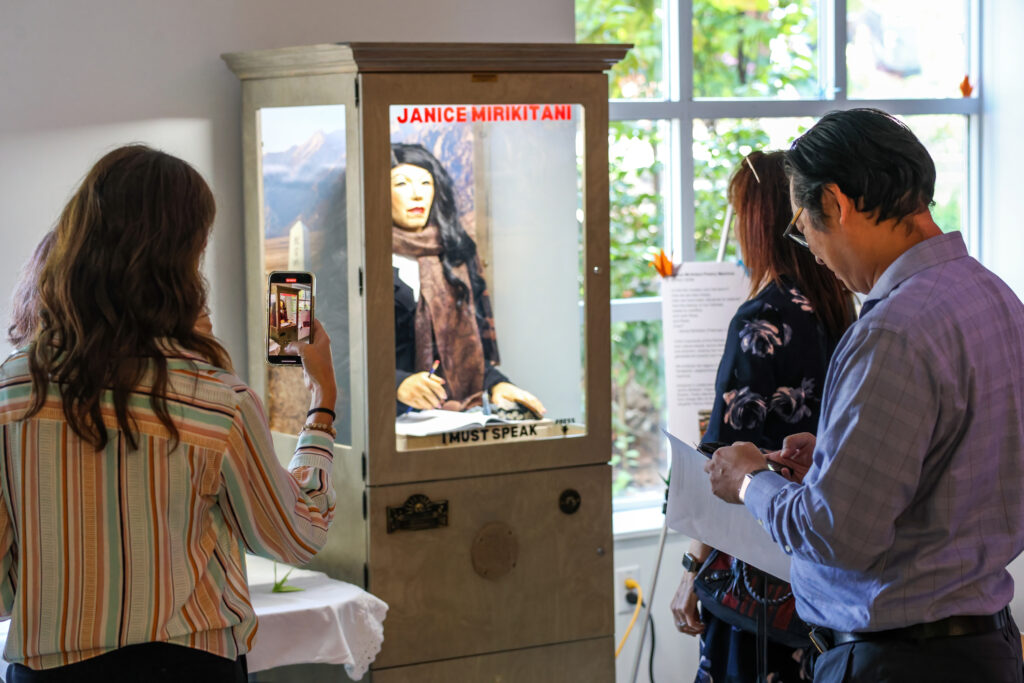
Several feet away, a recreation of a vintage “Zoltar” fortunetelling machine stands against the wall. However, instead of a vaguely culturally insensitive animatronic inside, “Ni Do To’s” machine is made in memoriam of Janice Mirikitani and contains an old-school animatronic with

her likeness. Mirikitani was a renowned Japanese American poet and activist in San Francisco until her passing in 2021. A year after she was born, she and her family were forcefully moved to the Rohwer War Relocation Center, an internment camp in Arkansas. Instead of dispensing fortunes, the “Ni Do To” machine dispenses Mirikitani’s poetry on textured paper, speaking aloud in what is [presumably, her voice.

In yet another exhibition area, behind black-out fabric walls, is the “Spirit of Obon Hologram.” A video of musician and activist Nobuko Miyamoto invites visitors inside a small open space where they can learn a folk dance called “Kangie” (pronounced “KAHNGee-Eh”) from dancers on a small television screen. Alongside the visitors is a colorful hologram of a dancer projected onto a special kind of gauze.

Integral to the success of the holographic exhibit is Noah Posner, a Tech researcher and lab manager at the School of Industrial Design’s Interactive Product Design Lab (IPDL). Posner offered the IPDL’s resources for the high-tech parts of the show, namely the high-brightness projector that displayed the dancer onto the gauze.

Regarding the use of Tech equipment within the exhibit, Posner believes that the production will show students not only what kind of resources they have access to but also that the blend of technology and arts is reflective of the idea that “the creativity involved with arts-type thinking is really somewhat similar to a lot of the [creativity] required for problem-solving…if [they think] more like artists, [they’d] come up with better engineering solutions.”

The possibilities that come from collaboration between art and technology are often overlooked, but the different parts of “Ni Do To” show the powerful effects that interactive art can have.

Someone who shares that sentiment is professor Ida Yoshinaga, who worked with the students in her “Oral Traditions to Screenplay” class to create origami fortune tellers filled with pictures, quotes and stories of Japanese American incarcerees.

Yoshinaga challenged her students to strengthen the bond between “low tech” and “high tech” mediums by asking “how do you bring culture into technology, or how can you use technology to reproduce culture and communicate the good stuff about culture and community?”

While talking about the importance of “Ni Do To,” Yoshinaga explained that lessons learned from the unjust incarceration of Japanese Americans in the 1940s extend to the marginalized people of today’s day and age.

“When we have vulnerability and people who don’t have full access to political power, economic power and cultural presence, then it’s easy to beat up on them, to target them and make them the issue, as opposed to the deeper, real issues and the structural issues.”

On the same tables as the fortune tellers are paper luggage tags and pens, on which visitors are encouraged to reflect on what they saw and how to prevent it from happening again. These tags get hung up in another art installation.

Also included in the overall experience of the exhibition is the dance film titled “Out of the Dust.”

The short movie combines music, poetry and elements of the Japanese American folk dance “Ei Ja Nai Ka” to conjure the ghosts of those incarcerated at Manzanar Detention Camp in California during World War II to tell their stories through purposeful, emotional expression.

By September 1942, less than one year after President FDR authorized the removal of anyone with Japanese ancestry from their homes to “relocation cen- ters,” Manzanar held over 10,000 men, women and children of Japanese descent; over half were U.S. citizens by birth.

“Out of the Dust” poses the question, “[a]fter the closing of the camps, who and what memories were left behind in the windy dust-laden desert of Manzanar?”

As a whole, the “Ni Do To” exhibit and the “Out of the Dust” film conjure memories and legacies of the thousands of people incarcerated during World War II because of prejudice and fear.

The interactive nature of each element creates an immersive cultural experience for visitors to participate in rather than just observing, resulting in a powerful experience.

“Ni Do To” and “Out of the Dust” are open Tuesday to Saturday at the Ferst Center until October 27.

Posted in UncategorizedComments Off on ‘Ni Do To’ tell powerful story through interactive art

Dragon Con soars yet again

This past Labor Day, the city of Atlanta once again welcomed Dragon Con to its hotels and streets. The annual convention started 37 years ago and now spans across the Hyatt Regency Atlanta, the Atlanta Marriott Marquis, the Hilton Atlanta, the Westin Peachtree Plaza Hotel and the Courtland Grand Hotel (formerly known as Sheraton Atlanta). In addition to the five hotels, AmericasMart Buildings 2 and 3 are also used for additional programming and vendors.

On Saturday morning, around 10:00 A.M., Peachtree Street was blocked off to clear the course for the Dragon Con parade, which featured upwards of 3,000 costumed characters ranging from Halo fighters to Disney characters to horror movie villains. The most popular one this year was definitely the many iterations of Barbie, from classic Barbie to “Barbenheimer” crossover Barbie to Dragon Con Barbie.

Characters from different fandoms walked together in groups, sometimes even accompanied by vehicles from their respective universes (i.e., the Surfer Boy Pizza delivery van from “Stranger Things: Season 4” and the Umbrella Corporation SUVs from “Resident Evil”). The parade’s finale came in the form of an entire tribe of Jawas, the desert planet scavengers from “Star Wars.” The hooded, glowing-eyed aliens toted stolen/“scavenged” items with them from other pop-culture universes, such as Captain America’s shield, Dorothy’s ruby slippers, The Doctor’s T.A.R.D.I.S and – to the delight of many in the crowd – a Tech T. 

Dragon Con is much more than just the Saturday parade, though. One of the largest pop culture conventions in the world, DragonCon was attended by approximately 70,000 people this year — around 5,000 more than in 2022. Attendees (known as “Members” by the convention) have access to various panels, workshops, competitions and other miscellaneous events throughout the five-day event. There are panels with popular cosplayers, trivia sessions, Jackbox competitions, movies, live music and more. 

The weekend is also host to a plethora of celebrity guests ranging from actors — like Paul Bettany (J.A.R.V.I.S., “Iron Man”), Billie Piper (Rose Tyler, “Doctor Who”), Elijah Wood (Frodo Baggins, “Lord of the Rings”) and Freddie Prince Jr. (Fred Jones, “Scooby Doo”) — to artists and musicians. These celebrity guests moved between panels where they answered fan questions, signed autographs and took pictures with fans. 

This year’s celebrity-fan interactions were slightly different than past ones due to the WGA and SAG-AFTRA strikes that are still ongoing. Actors could not discuss any of the specific roles or franchises they are a part of and fan questions were filtered through a Discord submission system instead of the usual in-person format to ensure no questions were asked about struck work. Signs were also posted around the con’s autograph area, reminding fans not to ask unanswerable questions. These changes, however, led to some fun, non-traditional panel discussions that allowed fans to get to know some of their favorite actors beyond their careers and roles. 

Another crucial part of the convention is the different unofficial “experiences,” which are just as popular as the official ones. For example, one Dragon Con experience is “side-questing,” in which members dress up as “NPCs” (non-playable characters) and hand out different mini “quests” that other members can do in exchange for some kind of reward. These challenges can range from finding a man carrying around a cooler full of Jell-O shots to finding someone in a mismatched outfit; attendees completing these side-quests must get a photo or video evidence as proof to bring back to the “NPC.” 

Another tradition, “Swag n’ Seek,” is when fans bring small “swag” with them — such as stickers, keychains or tiny figurines — to trade with, give to other people or leave lying around the hotels to be discovered. Though it is not organized by the Con, “Swag n’ Seek” has gained so much popularity over the years that DragonCon organizers built time into the official schedule solely for exchanging tiny treasures. 

“Badge Ribbons,” another Dragon Con staple, are exactly what they sound like — little sticky ribbons that can be collected and attached to the bottom of the con badges that all attendees are required to have with them at all points. Fans will print their own with different sayings and graphics to hand out over the 5-day event and many will try and see just how many ribbons they can acquire.

It is impossible to fully explain all the unique and distinct aspects of the Dragon Con community that separate the convention from any other. Truly a fan-run event through and through, the traditions of Dragon Con are brought to life by con attendees wanting to connect with each other in fun ways and through events of cons past. Some past events grow to such popularity that they become officially recognized (such as the “Cult of the Marriott Carpet”) and others are spread from DragonCon veterans to the novices with each new year (like the so-called “Cult of Jon”).

To truly get a sense of the magic that is the five-day spectacle of Dragon Con, one has to experience it firsthand. It is a good thing that the planning for the next year’s convention begins almost immediately after the weekend’s end!

Posted in UncategorizedComments Off on Dragon Con soars yet again

‘Holding Absence’ finds healing within pain

Welsh rock band “Holding Absence” released their newest album, “The Noble Art of Self Destruction.” Their third full-length album concludes a trilogy representing the first “chapter” of the band’s career. Woven throughout the 10-song tracklist is a message of introspection, self-doubt and hope. 

“The Noble Art of Self Destruction” is not what some might call a traditionally “happy” album. However, compared to the first two within the trilogy, “Holding Absence” and “The Greatest Mistake of My Life,” it contains a more hopeful theme. The emotional growth the band channels into the recent album makes it the perfect way to close out the journey they started with the previous two works. 

Like all of Holding Absence’s discography, each song has a raw genuineness that combines lyrical poeticism with lead singer Lucas Woodland’s passionate vocals to create a product that resonates with listeners everywhere. In an interview with Upset Magazine, Woodland explained that the depression, grief and heavy sadness of the past albums helped him learn more about feeling positive emotions; the negativity gave him the ability to believe in something better. Woodland said that he thinks fans can hear the difference between the person he once was and who he is now in the band’s new music. 

Since the beginning, the band has placed high importance on undeniable honesty in their lyrics. The band has been classified as alt-rock, post-hardcore, metalcore and other variations of similar genres. Regardless, they built their foundation on the sincerity and heart they work hard to paint with words and chords, transcending whichever genre they may be boxed into. Opening with “Prison Head Blues,” the album begins with a gripping and melodic metaphor about feeling trapped in one’s own mind. The first words, “Here I am, heart in hand,” lay the whole album on the table for listeners. Each song is a part of Woodland’s inner self, brought to fruition through his lyrics and voice, along with the beautifully fitting instrumentals of guitarist Scott Carey, bassist Benjamin Elliot and drummer Ashley Green. “Crooked Melody” follows the same metaphor, but instead of being trapped inside his head, Woodland sings about the lies he has to tell himself to persevere through the bad towards the better side. 

 “False Dawn,” one of the tracks originally released as a single, documents the common, yet often devastating, experience of coping with failure and letting go of expectations. The song concludes with a near-seamless transition to “Scissors,” which is about growing as a person through sacrifice and letting parts of oneself go. The fourth track on the album, “Scissors,” is widely considered one of the hardest-hitting, with its emotional lyrics and gritty, desperate vocals. 

“Death Nonetheless” brings out the more post-hardcore, emo-sounding version of Holding Absence, complete with prominent, racing drums and a chanted outro reminiscent of the early emo sounds that have influenced
the band’s journey.

All of the songs, though, are simply a build-up to what might be one of the band’s best songs to date. “The Angel in the Marble” is the album’s closer and a culmination of the journey represented throughout the album. The song title comes from Michelangelo’s famous quote about his angel sculpture from the Ark of Saint Dominic: “I saw the angel in the marble and carved until I set him free.” The other notable art reference within the song is the same reference depicted on the album cover itself. Kintsugi is a Japanese art form in which broken pottery is repaired by filling the cracks with gold lacquer, accentuating the flaws to make a new, equally beautiful piece. Woodland calls himself a kintsugi sculpture as a way of saying that despite the trauma he has been through and how he has broken down in his life, he is learning his self-worth and continuing to grow every day. 

Woodland’s lyrical talent reaches its truest, unbridled form in the bridge through the lines, “I am a puzzle, I am a painting/I am a work of art in the making/Trust in your hand and/ trust in the process/I am a work of art in the progress/I learned from my flaws, and I cut myself open/glued myself better/Golden; unbroken. Now, all I have left is/A handful of hope and/A thousand laments that I can’t leave unspoken.” The lines that eventually become the album’s final words perfectly summarize the intended message of “The Noble Art of Self Destruction.”

Theatrical melodies, deeply vulnerable lyrics and emotional vocals combine to create a story that will resonate with anyone who has ever struggled with the challenges of being human. While referencing self-doubt
and pain, the music also represents a hopeful message of healing and growth. A meaningful conclusion to Holding Absence’s first chapter of their career, “The Noble Art of Self Destruction,” is proof that the band puts their all into their art, and they will only continue to grow through whatever their next step is.

OUR TAKE: 5/5 STARS

Posted in UncategorizedComments Off on ‘Holding Absence’ finds healing within pain

‘The Beast You Are’ delves into the mind

From American author and editor Paul Tremblay comes a new collection of short stories, “The Beast You Are.” Known for other works like “A Head Full of Ghosts” and “The Cabin at the End of the World,” Tremblay specializes in horror, dark fantasy and science fiction. Readers can find each genre within the 15 works in this new collection. 

Ranging in length, point-of-view and setting, the stories in “The Beast You Are” all share one thing: monsters. Not in the traditional sense of the things that hide under children’s beds, in their closets or lie deep in the woods — the monsters in Tremblay’s latest stories are more abstract, dealing more with the horrors of the mind than the horrors of sharp claws and fur. 

“The Postal Zone: The Possession Edition” is a series of emailed letters to a magazine regarding [fictional] staff writer Karen Brissette’s breakdown and critique of a horror-based reality television show. 

After each review, Brissette responds to the respective writer with gratitude, rebuttal, sarcastic quip, intrigue or some other commentary.  

In “The Last Conversation,” a patient known only as “____” wakes up in a sealed, sterile room. Throughout the person’s recovery, they receive instructions and care from a woman’s voice named Anne over an intercom. Finally, “____” is allowed to leave the room, and what they learn is as devastating as it is unexpected. The story is told in second-person, a point-of-view that uses “you” instead of “he,” “she” or “they” in reference to the protagonist, making the readers imagine themselves as the main character. 

In “The Dead Thing,” a teen and her brother cope with their parents’ divorce and  struggles with addiction. The girl’s younger brother brings home a box, which she thinks is a dead “thing,” but she cannot convince him to show her or get rid of it. Instead, she dwells in an uncomfortable, unsafe house while feeling swells of unequivocal fear at what her brother might have brought into his room. 

The collection’s titular story, “The Beast You Are,” is written as a free-verse epic poem featuring a world of anthropomorphic animals that must perform a gruesome ritual to appease the giant monster that rampages on their town every 30 years. The plot focuses on a dog and a cat whose fates become intertwined with one another, the monster and an ominous doomsday cult.

While intentional, some readers may find themselves frustrated with the vagueness of Tremblay’s antagonists or overall plot lines. In many of the tales, audiences will never find descriptions of actual creatures; instead, they watch the characters come to seemingly horrifying realizations or meet some unnatural — and unclear — fate. This vagueness in some of the stories creates a sense of unease and dread, which makes sense given Tremblay’s strength in horror and dark tales. In others, the suspense leaves readers slightly confused and sometimes underwhelmed by the lack of overt action.Regardless of opinions on the way the stories end, Tremblay undoubtedly has a talent for writing surrealist-horror scenarios inhabited by characters that audiences cannot decide whether to root for or not. Most, if not all, of the short stories have underlying themes of pandemics, trusting one’s subconscious, jealousy or grief. To be able to see these threads running through the text, however, it might take more than one read. Given how different each story is, Tremblay does not have an explicitly consistent writing style throughout the anthology. Instead, he leaves his signature in the works in the way that his writing evokes emotions from his readers. From first-person memory recalls to third-person narratives to letters and blog posts, “The Beast You Are” contains a multitude of writing styles for a wide variety of readers. This collection has the ability to satisfy fans of horror, dark fantasy, science fiction and anything just plain weird.

OUR TAKE: 3/5 STARS

Posted in UncategorizedComments Off on ‘The Beast You Are’ delves into the mind

‘Red, White & Royal Blue’ colors the summer

This month, Amazon Prime gave “international relations’’ a new definition with its latest movie, “Red, White & Royal Blue.” The LGBTQ+ romantic comedy is an adaptation of Casey McQuiston’s novel of the same name. It follows the enemies-to-lovers journey of Alex Claremont-Diaz (Taylor Zakhar Perez, “Minx”), the son of the President of the United States, and Prince Henry (Nicholas Galitzine, “High Strung”), the second in line to the British Throne. 

After an argument with Henry at Henry’s older brother’s royal wedding leads to an international scandal, Alex is sent back to Britain by the President (Uma Thurman, “Kill Bill: Volume 1”) to do “some good old-fashioned
damage control.” 

Alex and Henry have to make public appearances together in Henry’s home country to convince the world that they are actually best friends, despite hating each other’s guts. However, as they spend more time together, their relationship turns unexpectedly romantic. The two young men go from being forced to spend time together to dreading having to be oceans apart. 

Roadblocks that transcend the typical romantic media tropes have riddled Alex and Henry’s love story: they start the story hating each other, arguing with the other whenever they are as near as within the same room. As the plot progresses, Alex works to accept his bisexual identity while simultaneously working to help his mother win re-election. At the same time, Henry struggles to balance his identity as a closeted gay man with his duties as part of the royal family. Their respective countries of residence bring a fresh spin to the term “long-distance relationship.” 

As their love for each other grows, other outside forces pose challenges for the two men’s possible future together. Alex treats his love for Henry the same way that he does everything in his life: he throws his all into it with a signature display of self-assuredness. However, he still has to be hyper-aware of being in the nation’s spotlight so close to an election that decides whether his mother will be the president again. 

On the other hand, while Henry loves Alex immensely, he still cannot let their relationship feel too real, or the potential consequences become too overwhelming. He knows that he was born into a bloodline that will always be ruled by centuries of tradition that do not allow for an openly gay prince. 

Despite leaving out a substantial amount of material from its source, the movie still manages to bring the printed words to life onscreen with the help of actors Galitzine and Perez. Perez captures Alex’s politically-driven workaholic personality while not leaving out his animated cheekiness, complemented by Galitzine’s portrayal of Henry’s poised yet deeply caring demeanor. Together, the actors take the audience through the protagonists’ whirlwind romance, filled with constant text banter, passionate hook-ups and tender, emotional moments. 

In the book, Henry’s struggle as a gay royal is more drawn out and so is Alex’s bisexual “awakening;” there are also many other seemingly vital characters that did not make the final movie cut. However, given the complicated process of translating 432 pages into less than two hours, director Matthew Lopez successfully picked out critical scenes and dialogue that fans of the novel would deem necessary. Lopez also sped up the book’s “slow burn” plot considerably without the relationship’s development feeling significantly rushed. Through those choices, the movie stays close enough to its source material to satisfy readers while not having an absurdly long runtime.

While parts of “Red, White & Royal Blue” are predictable by traditional rom-com standards, it handles queer identities and stories without infantilizing or sensationalizing them. Though television and movies have begun to highlight LGBTQ+ relationships more and more, many of them include heartbreak, rejection and pain as primary characteristics, which is not all there is to queer relationships. While movies such as “Moonlight,” “Firebird” and “A Fantastic Woman” gained critical acclaim and are well-done in execution, ≠≠audiences deserve movies that do not end in tragedy, be it by death or loneliness. “Red, White & Royal Blue” offers such a movie. It does not erase the struggles of the queer community, but it gives viewers a happy, hopeful and fulfilling conclusion that shows that same-sex couples can have the same “fairytale ending” as straight ones.

OUR TAKE: 4/5 STARS

Posted in UncategorizedComments Off on ‘Red, White & Royal Blue’ colors the summer

Hidden gems of ATL and where to find them

In college, finding ways to have fun and unwind is just as important as getting good grades. Exploring a new city as a first-year student can be daunting, especially in a bustling city like Atlanta. With as many options as the city has, skip the tourist staples like the Georgia Aquarium and World of Coca-Cola and instead check out these worthwhile  hole-in-the-wall gems below!

Doll’s head trail

A few miles away from Tech’s campus is an urban nature preserve made from the reclaimed ruins of an old brick company’s industrial site. The pits that had originally been for digging clay filled with rainwater, creating the park’s namesake: Constitution Lakes. In the early 2000s, Dekalb County bought the site and added trails through it, making the preserve official.

The park has a rather unusual walking trail known as “Doll’s Head Trail.” Dedicated to “found art,” visitors who walk the path will see art pieces made from found litter, many of which include decapitated doll heads, hence the trail’s title. 

Other pieces that can be found along the trail include bottles, pieces of old, decorated bricks and truck parts. 

The trail is meant to be an exploration and implementation of reclaimed art — the art pieces themselves are created from trash and discarded items found around the park.

Amongst the natural flora, Doll’s Head Trail turns what would otherwise be litter into art without adding more litter (meaning that bringing outside items to add to the trail is discouraged, as it just creates more discarded materials as opposed to repurposing what was already there).

Though it can be a bit creepy to some, Doll’s Head Trail is a beautiful blend of nature and art that makes a great trip for those who enjoy the outdoors. 

CDC Museum

This museum is near Emory University and the Center for Disease Control and Prevention facility in downtown Atlanta. 

The CDC museum is dedicated to the research, science and societal impacts that come with overseeing public health and just so happened to open its doors a year after the 1995 film Outbreak led to public paranoia over the transparency of CDC secrets. 

The exhibits include items such as the evolution of the hazmat suit, “cryo shippers” meant to transport sensitive cultures and vintage news clippings, informative handouts and propaganda regarding the prevention of diseases like Malaria, Typhoid fever and — more recently — obesity. Visitors might also see sections on HIV testing and the bodily effects of different chemicals. 

While some of the suits may look like something out of “The Walking Dead” or “The Maze Runner,” the museum lacks any fictional or dramatized content, choosing to stick to the facts and genuine responsibilities of the CDC. 

Whether students are from a STEM or humanities backgrounds, the artifacts displayed here are fascinating to see up close.

Tiny doors ATL

This Atlanta staple does not have just one address. Tiny Doors ATL is an art initiative started by an Atlanta artist who wanted to inspire curiosity through whimsically decorated doors “hidden” around different landmarks in the city. 

The doors themselves are only seven inches tall, meaning those searching for them (or even those who are not) have to look down with the intent of spotting them to notice. Each door is decorated differently and complete with tiny architectural details; some even include tiny people, animals or household items. While there is a map to the doors on the project’s website, hunting for these doors without it provides a great opportunity to see new areas of Atlanta. The intricate details on these small-scale doors show the care and dedication put into each one. They are usually painted to reflect the creativity that surrounds them, bringing even more life to the vibrant art that decorates the city of Atlanta.

Doctor Bombay’s tea party

This tea shop’s name is just as quirky as its decor, filled with paper lanterns, upside down parasols, wooden bird cages, vintage paintings and wildly patterned furniture. The tea shop serves baked goods, quiches, ice cream, sandwiches and, of course, many kinds of tea. From floor to ceiling, the walls are covered with used books that visitors can buy for just a dollar each. 

This shop does not only serve food and drinks though. A portion of all proceeds go towards funding scholarships for girls who age out of orphanages in Darjeeling, India. These scholarships cover education, housing and medical expenses. Some of the girls’ pictures announcing their graduation are hung around the shop. 

The fun and funky atmosphere of this impactful tea shop provides a chance to not only get some delicious snacks but also to help change the lives of other young people; it is a great place to check out for a peaceful day of tea, reading or spending time with friends.

Posted in UncategorizedComments Off on Hidden gems of ATL and where to find them

Weezer makes a pit stop in Georgia on tour

Few things go together like “summer” and “road trips” — the whole family crammed into the car, the trunk and backseat over-flowing with suitcases and snack wrappers, roadside attractions and lots of pictures. Rock band Weezer clearly had the same idea when embarking on their “Indie Rock Road Trip Tour” in early June with support from bands like Modest Mouse, Momma, Spoon, White Reaper, Joyce Manor and Future Islands. On June 25, the road trip reached its next stop in Alpharetta, Georgia at Ameris Bank Amphitheater.

No vacation is without its unexpected weather, and the band’s visit to Georgia was committed to the road trip experience, with the evening starting with severe thunderstorms and a weather- driven shelter-in-place. Fans who had yet to enter the venue when the sky began to darken were instructed to wait under the box office awning or in their cars until the warning passed.

Despite the pouring rain and rumbling thunder, a venue employee reassured soggy concert- goers that the band would play “no matter what.” Fortunately, the weather soon cleared, and people could make their way through security again with plenty of time to spare before the opening acts.

Despite the inclement weather, the show began on time with enthusiastic performances by Joyce Manor and Future Islands.

When the screen advertisements disappeared and “Africa” by Toto began to play over the loudspeakers, cheers erupted from the crowd in anticipation of the headlining act. On the stage was a mock car dashboard, framing the backdrop like a windshield complete with illuminated gauges, radio dials and the Weezer logo on the wheel of the car.

From the speakers, a “radio” switched stations every few seconds. Grainy talk show segments played as well as an assortment of Weezer song clips stylized to fit a variety of genres, including reggae and country.

Amid the build-up, the band strolled onstage, taking their places and launching into the first song. Drummer Patrick Wilson sat at a drumset on top of the “dashboard” rather than on the main level of the stage with the other three members. How- ever, the others would soon join Wilson on the higher platform during the show.

As Weezer played through their first song, “My Name Is Jonas,” animated scenery passed by while a cartoon highway was projected into the “windshield” of the dashboard set. Each song had its own view, varying from the streets of Beverly Hills during their hit song of the same title to fire- works at Mount Rushmore with a drive-in movie. These projected designs added flair to the stage’s road trip aesthetic.

Frontman Rivers Cuomo – wearing a casual flannel and playing a sticker-covered guitar – exuded “dad” energy as he per- formed. At one point, the singer played several chords before deciding the sound was not loud enough. After asking the crowd if they agreed and being met with cheering; Cuomo walked over to one of the oversized knobs on the dashboard set and turned it a bit as if adjusting the radio’s volume. Deciding the guitar was still not loud enough and checking that the audience shared this sentiment, he grabbed hold of the knob again and spun it around with both arms. This time, the guitar sounds came through the speakers significantly louder, and the next song began.

During another moment between songs, Cuomo brought out a vintage-looking Polaroid camera and told the crowd, “It ain’t an official road trip until dad takes a family photo. Smile, kids!” In true dad fashion, the man proceeded to have camera troubles, with guitarist Bryan Bell heckling him to “just use somebody’s iPhone.” The frontman eventually gave up, grabbing an iPhone to take a selfie with the crowd. With an impressive 15 albums and over 400 songs released during the group’s career so far, their 23- song setlist for the Georgia show featured 10 different albums and a cover of the song “Blast Off,” a Cuomo original from Weezer’s hiatus from 1997 to 2000.

With so many songs in their discography, many of them are not performed during tours; however, in the spirit of “road-tripping” through Weezer’s repertoire, the lead singer explained that they had been playing a different song at each stop that either had never been played on tour before or had not been in many years.

Georgia audience members got to hear “Lover in the Snow,” another one of Cuomo’s originals. The Alpharetta show would be the demo track’s live debut. The song was performed acoustic with Cuomo being the only member onstage. The set included a short acoustic segment of several songs. In barbershop-style, Bell, Cuomo and bassist Scott Shriner all shared one mic during “Susanne.”

Despite Weezer’s long career, their fanbase shows no signs of dwindling as hundreds of people were willing to brave severe weather to see them play. Attendees included people of all ages – older adults, teenagers and ex- cited parents with equally excited young children. The band them- selves sound as good as they did years ago, with their talent and stage presence just as alive as the love for their music.

Weezer will continue their journey across North America through September.

Posted in UncategorizedComments Off on Weezer makes a pit stop in Georgia on tour

Ain’t It Fun Rocking Out with Paramore?

On Thursday, May 25, the area outside State Farm Arena was packed with people excitedly waiting for the venue doors to open. Somewhere inside the building, the rock band Paramore was getting ready to take the stage in a few hours. Many fans awaiting that night’s show had been looking forward to it since it was announced in November 2022. Paramore was officially formed in 2004 when Atlantic Records signed 14-year-old Hailey Williams. Initially brought on as a solo artist, Williams was adamant that she not only wanted to be part of a band but wanted their music to fall in the pop-punk genre. The label agreed, and Paramore soon became one of the most influential emo pop-punk bands of the mid-2000s. 

Over the next few years, the group worked to build their fanbase with albums and tours such as the iconic “Vans Warped Tour,” but it was their 2007 album “Riot!” that truly cemented the band’s place in the industry’s big leagues. The album quickly went platinum and earned Paramore their first Grammy nomination. 

The band’s success  continued, though it also brought internal conflict among members, eventually leading to several departures from the group. Despite this, Paramore pressed on, winning their first Grammy for “Best Rock Song” in 2013 with “Ain’t it Fun” off their self-titled album. 

However, in 2018 came the announcement that the band would be going on hiatus following the release of their fifth album, “After Laughter.” A later interview revealed that this decision came at the behest of the whole group for mental health reasons, with guitarist Taylor York saying that “nothing is worth risking our health.” 

After a 5-year break, Paramore — now consisting of Williams, York and drummer Zac Farro — teased new music and, to the delight of fans of all ages, appeared on the festival lineup for When We Were Young Fest’s debut year. 

Now on their first arena tour since the hiatus, the band’s fanbase is stronger than ever, and their Atlanta show was a testament to that. After energetic sets by openers Genesis Owusu and Bloc Party, Paramore took to the stage with an electrifying and confetti-filled start. The stage design was minimalistic, with a small secondary stage platform backed by a large video screen. During different songs, the screen displayed intricate line designs, pieces of song lyrics and live video footage of the band and crowd. In addition, the footage occasionally appeared edited in real-time, surrounded by bright, funky frames and covered with different filters. These elements – combined with skilled light design – added to the sense of pure joy that Paramore delivered throughout the show. Above the stage was a stack of trapezoidal rings that illuminated with different colors, moved up and down and tilted independently depending on the song. 

The setlist itself was filled with songs from almost every one of Paramore’s albums – a wide variety perfect for old and new fans. It also included a song from one of Williams’ solo albums and another from Farro’s side project, “HalfNoise.” 

Despite being a singer for almost 20 years now, Williams’ vocals are still beautifully clear and powerful; her prowess shows no signs of diminishing anytime soon. Between songs, she interacted with the crowd; her anecdotes met with loud cheering from the arena. 

The singer maintained a contagious energy with every song she sang. To everyone in attendance, it was clear that she was not just there to do her job but also to have fun and enjoy the show with the band’s fans. 

The other members worked to match the frontwoman’s energy. York and touring guitarist Brian Robert Jones would frequently interact with each other as York traveled around the stage as he played. 

The group, touring members included, had the kind of chemistry that was instrumental to the success of the caliber of their live performances. Among the different interactions between Williams and the audience was a special moment during one of Paramore’s most well-known songs, “Misery Business.” 

Released in 2007, the song also went through a “hiatus” of its own in 2018 due to an online debate on whether or not one of the lyrics was “problematic.”

However, in 2022, the band put the song back on their setlists. Williams announced she had time to reflect on the song and found it was “very nice to feel like there’s a reason to bring it back that’s positive.” 

Thursday night, the band brought a fan onstage to sing part of the song, something they have been doing at each show of the tour. 

Paramore was a pivotal part of many now-young adults’ teenage years, and their earlier music, for many, provides a familiar sense of comfort for fans.

 However, the audience turnout at State Farm Arena was not just for nostalgia’s sake. It was because the band remains one of the most iconic groups in the pop-punk/alternative rock genre. 

With the release of their newest album, “This is Why,” they continue to add another generation of listeners to their still-growing fanbase.

Posted in UncategorizedComments Off on Ain’t It Fun Rocking Out with Paramore?

Your complete guide to Eurovision 2023

This spring, the birthplace of the Beatles will have the honor of hosting the 67th annual Eurovision Song Contest. Liverpool, England was chosen to host the show this year, despite Ukraine’s win last year, due to the ongoing Russo-Ukraine conflict. The British Broadcasting Corporation (BBC) and European Broadcasting Union (EBU) have been working with Ukraine’s public broadcaster, UA:PBC, to organize the show with the tagline of “United by Music” and to still show Ukraine’s victory in 2022. 

The songwriting competition first began in 1956 as an experiment: a live, transnational and simultaneous television broadcast across Europe with seven countries participating. This year, there are 37 participants from countries primarily around Europe. 

Certain non-European countries, such as Israel and Cyprus, are permitted to enter the contest based on the reach of the European Broadcasting Area, which extends into some countries outside of the continent; the union can also invite them, as is the case with Australia. Notable winners from previous years include ABBA and Celine Dion. 

In May, Liverpool will host two semi-finals and one grand final. The competing nations are divided between the semi-finals to compete for a spot in the grand final. 

The top 10 competitors from each semi-final will qualify for the grand final, in addition to what the competition calls “The Big Five.” The Big Five comprises Germany, France, Italy, Spain and the UK. These countries are automatically guaranteed a spot in the grand final due to being the highest-paying donors contributing to the show’s funding. 

The final 25 countries perform their songs in the televised final, after which voting is open to the general public of all countries within the EBU (even those not participating in the contest) and a national jury from each participating country. Once the scores are totaled, the winner of that year is announced, and the group plays their song again.

With the first two semi-finals set for May 9 and 11 and the grand final set for May 13, here is a quick look at this year’s contestants: 

Albania 

Vocalist Albina Kelmendi performs alongside her mother Albana, father Bujar, brother Albin and sisters Vesa and Sidorela. The family will be performing on stage together, singing their song “Duje.” The song is about the ups and downs of life and family and the role of familial love and is sung entirely in Albanian.

Armenia 

Lifelong singer-songwriter Brunette sings an emotionally-charged ballad, “Future Lover,” about a man she has yet to meet. Accompanied by a full orchestra, the young singer’s poetic lyrics are sung in English, except for the final few lines, which close the song out in Armenian.

Australia 

Performing for the only country in Eurovision not to fall within the European Broadcasting Area is Voyager. Made up of five members — vocalist Daniel Estrin, guitarists Simone Dow and Scott Kay, drummer Ashley Doodkorte and bassist Alex Canion — the progressive metal band has been together since 1999 and has already toured the world several times. Their song, “Promise,” is an energetic rock song with a hint of synth interwoven within.

Austria

Competing with a satirical song titled “Who the Hell Is Edgar?,” dyadic team Teya & Salena will be representing Austria this year. The duo drew from their experiences as female songwriters, writing a song that captures how women work harder to gain credit for their work.

Azerbaijan

Twins Tural and Turan, going by the name TuralTuranX, are a pair of young street performers performing their song “Tell Me More,” inspired by 60s and 70s music, which can also be seen in the duo’s fashion sense. 

Belgium 

Nicknamed the “pop prince” on the Eurovision website, Gustaph made his first record deal at 18 and has since risen to stardom for his vocal talents. Now, the openly LGBTQIA+ artist is competing on behalf of Belgium with his upbeat and uplifting song, “Because of You.” 

Croatia 

Representing Croatia is the eccentric group: Let 3. Known for their social commentary and over-the-top performances and costumes, the energetic group is competing with their song “Mama ŠČ!.” The song joins the grouping of non-English songs, as all the lyrics are in Croatian.

Cyprus

Though he competed for the chance to represent Australia last year, this year, Andrew Lambrou was selected to represent his parents’ home country of Cyprus. His song, “Break a Broken Heart,” is a ballad full of emotion, torn love and renewed strength after the end of a relationship.

Czechia 

All-girl group Vesna brings the powerful message of women uplifting other women with their song “My Sister’s Crown.” With a sound somewhere between folk and pop and a colorful music video to accompany it, the song’s lyrics are a mixture of English, Czech, Ukrainian and Bulgarian. 

Denmark 

Denmark contestant Reiley got his start on social media, amassing several million followers on TikTok and gaining immense popularity in South Korea. His soft-pop song, “Breaking My Heart,” contains light vocals and heartfelt lo-fi vibes.

Estonia 

Experienced performer Alika was selected as Estonia’s competitor, singing an emotional song titled “Bridges.” Alika wrote the piano-accompanied ballad to vent her anxiety when preparing to record a new song. Her powerful vocals bring the swells of emotion to life. 

Finland

Käärijä is a singer, songwriter and rapper from Vantaa, Finland. In his song, “Cha Cha Cha,” the energetic (and often shirtless) artist combines rapped Finnish lyrics with metal-esque power chords, electronic music, pop and a German genre called Schlager.

France

France has chosen disco as their genre for this year, selecting self-taught musician La Zarra to represent the country. The singer’s glamorous Hollywood style channels Marilyn Monroe and she sings in poetic French during her song “Évidemment,” pairing tragic lyrics with a disco groove.

Georgia 

Coming from Georgia is a returning champion from Junior Eurovision, Iru. The singer won the junior songwriting competition in 2011 with her band Candy. Now singing “Echo” on her own, Iru has a lilting voice that is clean and powerful.

Germany

Representing Germany this year is Lord of the Lost, a genderfluid industrial metal band that already has a considerable fanbase in their home country. Their song, “Blood & Glitter,” is full of heavy guitar chords and powerful drums with lyrics about picking oneself up from hardship and
becoming even stronger.

Greece 

Victor Vernicos is the youngest contestant to represent Greece in Eurovision. He will be performing his song “What They Say,” which draws inspiration from artists like Ed Sheeran and Coldplay in its acoustic guitar and piano backing. Despite his age, Vernicos’s full voice communicates the emotion in his honest lyrics.

Iceland

Iceland’s contestant, Diljá, has always dreamed of representing her country in Eurovision; that dream will come true this year. Though a new name on the music scene, Icelandic people grew to quickly love her and her song, “Power,”  which promotes self-improvement and empowering oneself without needing others. 

Ireland 

Hailing as Ireland’s competitor is Wild Youth, a four-piece band that has an alternative-pop sound. They won their Eurovision spot playing on “The Late Late Show” and have opened on tour for artists like Niall Horan and Lewis Capaldi. Most of their songs — including their Eurovision entry, “We Are One” — are written by frontman Conor O’Donohoe and have an upbeat tone.

Israel

Fully confident in their selection, the Israeli selection committee announced Noa Kirel as their participant eight months before the deadline. Singing since she was 14, the pop star enjoys performing spontaneous shows for fans and will be representing her country with the confident song “Unicorn.” The lyrics are mostly in English, with several Hebrew interludes and speaks of embracing power in individuality.

Italy

Marco Mengoni performs his song “Due vite” as the representative from Italy. Experienced in his musical career, the singer will compete on Italy’s behalf with his strong vocals and heartbreaking Italian love song.

Latvia 

Competing for Latvia is the quartet Sudden Lights. The title of their song, “Aijā,” is in their native language of Latvian and has no known English equivalent as of now. However, the lyrics of the song are sung in English, as the group wanted the song to be felt by as many people as possible. The band members wrote the song to try and provide comfort for all the dark things happening in the world.

Lithuania

Monika Linkytė is back again after representing Lithuania in 2015. Her song, “Stay,” is a powerful ballad with messages of striving for self-love. Though mainly in English, the lyrics “Čiūto tūto” are repeated throughout the song. Those words are commonly heard in Lithuanian folk dances as magic enchantments. 

Malta

The Busker, a band, will be representing Malta this year with “Dance (Our Own Party).” The song is pop, funk and soul with a unique saxophone accompaniment. The lyrics of the song dive into the experience of social anxiety and leaving a party to hang out with friends in a more
comfortable environment. 

Moldova

Moldova’s contestant, Pasha Parfeni, represented the country at Eurovision in 2012, and now he is back. 

This time, he is joined by his wife, Iuliana Perfeni, for the song “Soarele și Luna” — which she wrote. The song is in Romanian and has a folk sound, with a booming timpani drum and intricate flute notes. 

Netherlands

Mia Nicolai and Dion Cooper were paired up by the 2019 Eurovision winner Duncan Laurence and his partner. Together, Nicolai and Cooper deliver an emotionally-charged performance of their song “Burning Daylight,” their voices blending together seemingly perfectly. 

Norway

Alessandra is the Norwegian-Italian singer-songwriter who will be representing Norway at Eurovision 2023. Her entry, “Queen of Kings,” is her debut single, making her widely known on TikTok. The song is centered around a message of self-love for people of all ages and all genders. 

Poland 

Blanka is the half-Polish, half-Bulgarian singer who will be representing Poland with her song “Solo.” The song has a very upbeat vibe, with lyrics to match. “Solo” is all about being confident and happy by oneself after a breakup.

Portugal 

Portugal’s contestant this year will be an artist by the name of Mimicat. Her voice is soulful and sultry all throughout her fast-paced song “Ai Coração.” Translating to “Oh, Heart,” the song’s lyrics are quick Portuguese, sounding like the perfect soundtrack for a ballroom dance. 

Romania 

Theodor Andrei is a singer, composer and actor who has been performing in theater and voice-acting for a significant portion of his life. Now, he will be representing Romania with his song “D.G.T. (Off And On).” The entry has a sassy attitude and a rock sound, with half-Romanian and half-English lyrics. 

San Marino 

The Piqued Jacks are an alt-rock band competing on behalf of San Marino with their song “Like An Animal.” Despite being from a small town, the group has a big stage presence to bring to the
Eurovision semifinals. 

Serbia 

Serbia has chosen young indie-techno-pop artist Luke Black to compete in Eurovision this year. Having gained the title of the “Serbian pop alchemist” from his media back home, Black combined experimental, indie, pop and cinematic sounds with terse lyrics in Serbian to create the song “Samo mi se spava.”

Slovenia

Performing for Slovenia is the five-person band Joker Out. Their sound has been described in many ways, from “shagadelic rock ‘n’ roll” to “energetic but seductive softboi rock.” All members are reportedly huge Eurovision fans and will be bringing their cheery mood and Slovenian lyrics to the competition with their song “Carpe Diem.”  

Spain

Spain’s selection committee chose singer Blanca Paloma to represent the country in the songwriting contest. Her song, “EAEA,” was inspired by the sounds of flamenco and heavily syncopated beats underneath the Spanish lyrics. The entry is immensely representative of the singer’s love of blending modern styles with those that have yet to be explored. 

Sweden

Returning to Eurovision is the 2012 winner, Loreen, back again with her song “Tattoo.” The singer’s distinctly enchanting voice pairs with her general artistic expression and passionate pop sound to potentially win for the second time. 

Switzerland 

21-year-old Remo Forrer will be singing for Switzerland this Eurovision. Despite his young age and face, the performer has a deep and rich voice and his powerful vocals that bring his
selected song “Watergun” to life. The song’s meaningful lyrics were inspired by the war and conflict of today’s world and the consequences of what society does and does not do.

Ukraine

Ukraine is hoping to defend its current Eurovision championship title with TVORCHI. The duo will be competing with their song “Heart of Steel,” which has a modern electronic vibe with English lyrics (and some Ukrainian thrown in) about pushing through hardship to reach freedom in thought, expression and feelings.

United Kingdom

Representing this year’s host country is Mae Muller, a singer-songwriter with a sassy attitude and a large social media following. Her song “I Wrote a Song” is a perfect dismissive breakup song about building oneself up after heartbreak instead of letting it break them down.


Posted in UncategorizedComments Off on Your complete guide to Eurovision 2023