
Author Archives | Sarah Fiedorek

What would the ideal Drexel semester look like?

Photo by Anushka Khandelwal | The Triangle

In a recently published article, The Triangle revealed via an email sent to faculty from President John Fry that Drexel would be switching to semesters. Upon hearing the announcement, many people had one question: What would a Drexel semester look like? In his email, Fry noted that, “based on the experience of peer institutions such as Northeastern and Rochester Institute of Technology . . . I am reassured that moving to semesters can significantly improve recruiting, retention, and the student experience at Drexel.”

Fry stated that Northeastern University and Rochester Institute of Technology are both peer universities due to their integration of the co-op program and semester system. Northeastern switched from quarters to semesters in 2003 and RIT switched in 2013, making them good models for semester/co-op structure.

In terms of timing, Fry expects the change to be completed in three years. This means that students in the classes of 2027, 2028 and the incoming class of 2029 should expect to experience aspects of the semester system for the first time. 

Northeastern and RIT operate on semester schedules with two summer sessions between the spring and fall terms. For the 2023-2024 academic year, Northeastern started its fall semester on September 6, 2023, and RIT started on August 28, 2023. Classes from past year’s calendars usually begin the last week of August or the first week of September. 

During the fall term, there is a Thanksgiving break, which at both schools takes place from Wednesday to Friday. Both universities ended classes around the first week of December, giving one week for final exams. Northeastern’s winter break lasted four weeks from December 18, 2023 to January 8, 2024. RIT’s official break was from December 23, 2023 to January 15, 2024, a three-week break. Including holidays and finals week, Northeastern’s fall semester lasted 15 weeks, and RIT’s lasted 17 weeks. 

During the spring semester, Northeastern students get a week off for spring break during the first week of March, and RIT students get a spring break during the second week of March. Northeastern’s spring semester runs from January 8, 2024 to April 29, 2024, a total of 16 weeks. Similarly, RIT’s spring semester takes place from January 15, 2024 to May 10, 2024, which is also 16 weeks. Both have a week-long break before the start of the summer terms.

To make the six-month co-op work, both universities offer a condensed summer term which is split up into two sections. RIT has a twelve-week summer term, and students can take classes over the entire term or split it up into two six-week “short session” summer terms. Northeastern’s summer sessions are longer as the summer period is 16 weeks long, making the Summer 1 and Summer 2 terms eight weeks long.

According to the Northeastern co-op calendar, students have the option of completing two co-ops in four years or three co-ops in five years. On the website, they give multiple examples of different schedules students could have. Below is an example of a student on a Spring/Summer I, three co-op cycle at Northeastern. 

Fall Spring Summer I Summer II
First year Class Class Break Break
Second year Class Co-op Co-op Class
Third year Class Co-op Co-op Class
Fourth year Class Co-op Co-op Break
Fifth year Class Class

This schedule differs from Drexel as students on this schedule at Northeastern get a summer break in both their first and fourth year and are still able to complete three six-month co-ops.

While Northeastern is a mandatory co-op school, they allow students to complete up to three co-ops. Students can replace a co-op with, for example, a six-month combination of study abroad and research, which would still count as “experiential learning.”

Despite Northeastern and RIT marketing themselves as semester schools, they really operate under a trimester system with fall, spring and summer terms. This system allows students to complete a six-month co-op even though there are two four-month semesters. 

Justin Huang, second year cybersecurity major at RIT, had interesting insights into potential schedule implementations that the new Drexel system can utilize. First, while RIT only has one ‘reading period” day before their two week long final exam period, the concept of a reading period in itself is certainly something that can now be implemented by the Drexel semester system. Universities around the country like Harvard and Yale have implemented a week long period after classes end and before finals start, and it is intended to be a period for students to “rest, reflect, and prepare for finals before the semester ends.” Not only can students recuperate from the hectic semester and spend undivided time preparing for their final exams, but students with final commitments to clubs and organizations can fulfill their obligations without the pressing need to prepare for finals at the same time. 

It is important to note, especially with the co-op class schedule of RIT, that students who are on co-op are provided their winter, spring and fall breaks. In the quarter system structure, Drexel co-op students are not formally offered a break between classes and their co-op, prompting many students to go from a six month co-op to consecutive terms of full time classes without breaks. Integrating breaks into the new model will be one step to addressing the burnout currently observed in Drexel students. 

In an email sent to students on May 8, President Fry formally announced that he wants to accommodate the University Advisory Committee’s recommendation to switch to semesters. 

He stated that students would have “greater flexibility and more choices to design their paths based on desired learning objectives and outcomes.” These paths include “the six-month co-op, with up to a total of three co-ops;  significantly more study abroad opportunities; shorter internship options; and undergraduate research experiences.” 

President Fry also highlighted the importance of Drexel’s relationship with its co-op employers. “I want to ensure that we will retain our co-op partners’ full support and participation. We have spent decades building relationships with our co-op employers who rely on Drexel and our talented students. I also want to ensure that the benefits of moving to semesters will far outweigh the financial and qualitative costs. If these concerns are satisfactorily addressed, I will support this recommendation.”

In reconstructing the co-op schedule, constructing semesters to better align with outside internships may also prove to be instrumental to student mental health. In its current schedule, the Drexel spring term ends in the middle of June, which is much after most internships for the summer start. This limits students almost entirely to Drexel provided opportunities which seriously limits the opportunities for professional development and personal growth. 

In an interview with The Triangle, English professor and Writing Curriculum Initiatives Coordinator, Daniel Driscoll, shared his opinion on Drexel’s switch to semesters and what that will mean for both students and faculty. 

“…When I think about classes and the academic experience…I’m in favor of making the switch. I think it could be really good,” said Driscoll. “One thing that will happen is we’ll all be thinking about our individual courses, but there’s larger curricular questions…You’ll be in classes for the same amount of time, but you’ll take fewer courses. So we’ll be thinking about what courses are complementary and combine, how we can both lengthen our courses but also incorporate other things into them.”

Driscoll explained how his writing-focused course curriculum will change: “We can do things like capitalize on a full semester’s worth of thinking instead of just a quarter’s worth of thinking. I think there’s lots of opportunities for deeper and maybe better writing experiences.” 

He also commented on how students may benefit from the semester system because not only will they have more time to grasp their course material, but also more time to develop a relationship with their professors that they may not get in 10 weeks. 

“I think over a semester, it’s a longer time to engage with students for us professors. It’s more time for you students to get comfortable with us, to get comfortable with the material, to get help when you need it. You get that second chance. If things are not going well from weeks one to seven in a quarter class you’re almost all the way through the term. In a semester, it may be bumpy for the first half of the semester, but then you have more time to recover,” said Driscoll.  

Many improvements can be made to the new semester model. Addressing these improvements will be an essential step to moving in the right direction to addressing Drexel’s student mental health crisis. 

Chan Chung contributed to this report. 

This article is part of a grant awarded to The Triangle from the Solutions Journalism Network investigating student mental health at Drexel University.
Posted in UncategorizedComments Off on What would the ideal Drexel semester look like?

Students celebrate Filipino culture with dance and theater

Photo by Ty Wong | The Triangle

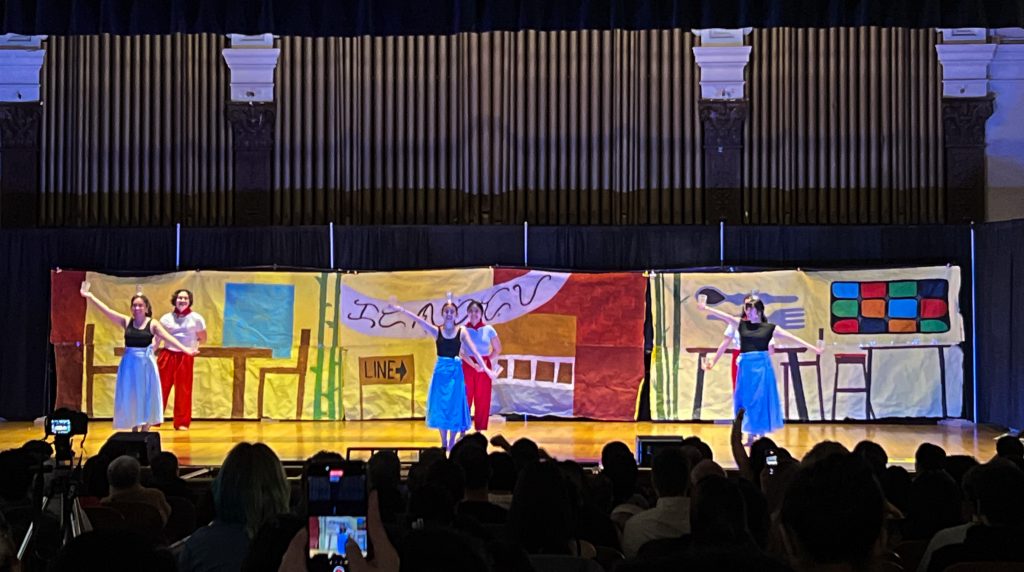
The Filipino Intercultural Society of Drexel University hosted its annual Barrio cultural celebration at the Drexel Main Building on May 4.

Barrio, FISDU’s longest-planned event of the year, hosts a communal dinner, play and dance performances to expose Drexel students to glimpses of Filipino culture and the Tagalog language in one night. 

 “We try to include as much Filipino culture as possible, anything from dances to the story itself, and we tend to include dinner with the performances as well. Before the show starts, we’ll host a dinner where guests will be able to enjoy an assortment [of] Filipino food,” said Nicolo Agbayani, a third-year computer science major and a Barrio co-chair.

According to Kai Thompson, a fourth-year marketing major and a Barrio co-chair, “We take a popular modern story and incorporate it into a theater performance with a Filipino twist.”

“This year, the theme is ‘Kung Fu Panda 3,’ but our take is Kali Panda, Kali being a Filipino martial art.”

Some dances featured in Kali Panda included Tinikling, a traditional Philippine dance, and Singkil, a tribal dance, as well as four modern dance routines. 

“This performance to me is an amazing opportunity to spread Filipino culture to people that might otherwise not know about,” said Mikealani Perales, a second-year mechanical engineering major and FISDU’s secretary. 

For the performances, FISDU offers any general body member the opportunity to participate in planning, preparing or performing in the massive cultural function, to symbolize the value of being in a community. 

With any role in the play up for grabs, the FISDU Barrio committee faced challenges in solidifying an official cast roster as Barrio members sometimes became unreachable with the event’s planning spanning three quarters each year. 

“[When it comes to] getting things confirmed and committed, I think a lot of people are hesitant to commit themselves to the amount of work that gets done, so it’s hard to get a good scope and timeline because commitment and availability shifts especially when people switch from class to co-op, sometimes people are gonna dance, but then they have to drop because [they] have to take a class that conflicts with dance practice, [so] you always be ready for change,” said Thompson.

With those challenges, the Barrio committee takes advantage of that hardship to capture the works in a documentary, shown during the play’s intermission, as well as comedic skits inspired by reality shows like ‘Single’s Inferno,’ performed aside from the main play.

“We also have a documentation committee, whose job is to document the Barrio process, as well as a public relations committee, who reach out to local businesses to help gather support for Barrio which wouldn’t be something you’d find in typical theater performance,” Thompson added.

FISDU’s take on putting on a communal cultural event in the form of Barrio has just as many uniqueness as challenges. However, the Barrio chairs leveraged that uniqueness and broke the mold of what a typical theater production can be, demonstrating more than one method to showcase a culture and FISDU’s community dynamics.

“Because there is so many different committees in Barrio and each of them have their own role part, first stepping into the role can be a little overwhelming, having to manage everything and make sure everything is on track, [from] making sure scripts are done on time so casts can get their recordings in, the dances are on track, the props are in production, [and] have everything properly documented to save for future years,” said Agbayani.

This article is part of a column dedicated to supporting underrepresented Asian student organizations on Drexel University’s campus.

Posted in UncategorizedComments Off on Students celebrate Filipino culture with dance and theater

Drexel faculty and J&J executives co-host health equity event

Photo by Shreeya Gounder | The Triangle

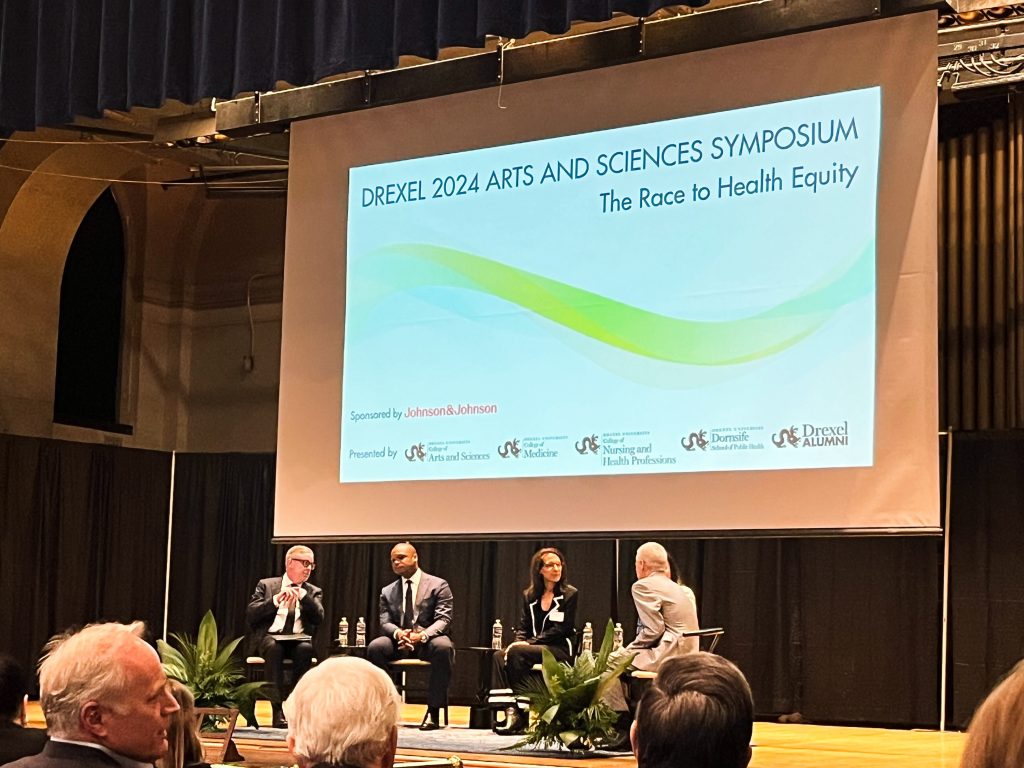
Drexel University’s College of Arts and Sciences recently instituted an annual series of Arts and Sciences Symposiums. The inaugural event, “Race to Health Equity,” brought together key leaders in Drexel’s fight for health equity in Philadelphia, and the global efforts of Johnson and Johnson (J&J). Eight speakers took the stage over a span of three hours Wednesday afternoon for a community health panel and keynote event. Speakers discussed a variety of issues including their individual efforts in the area of health equity and company-wide initiatives in the case of J&J. The event was a joint effort between the College of Arts and Sciences, Medicine, Nursing and Health Professions and Dornsife School of Public Health. 

The first segment was an hour-long faculty panel moderated by Dr. Veronica D. Carey and featuring Senior Associate Dean for the College of Medicine’s Office of Community Health Dr. Annette Gadegbeku, College of Arts and Sciences faculty Dr. Naomi Goldstein and College of Nursing and Health Professions faculty Monica Harmon and Judy Ensslin. The event focused primarily on the community health interventions conducted by each of the speakers to different degrees in a variety of fields.

Gadegbeku started off by describing the mini courses that the College of Medicine has started to offer at the Science Leadership Academy Middle School housed next to the Health Sciences Building. Drexel students, faculty and staff discuss topics related to health sciences in order to provide young students with the opportunity to learn how to care for themselves and learn more about health professional jobs and opportunities early on. “If they can’t see it, they can’t be it,” said Gadegbeku, emphasizing the importance of making opportunities both available and visible to local community members to create a more diversified healthcare workforce. 

Harmon, the executive director of the Community Wellness Hub, emphasized the importance of building trust and being consistently physically present with community members as the only real way to increase attendance and engagement at community health events and educational opportunities, an issue which many health educators struggle with. These key points tied back to the overarching theme of ensuring that all members of the community are provided with equity in opportunities for professional development and personal growth. 

Goldstein described her efforts to rework the juvenile justice system throughout Powelton Village and Mantua at a systemic level. As Director of the Juvenile Justice Research and Reform (JJR&R) Lab at Drexel, Goldstein described that students previously processed in the system struggle with housing, benefits and education throughout their life. The solutions to these issues range from preventing students from being placed in the system in the first place, minimizing their time in the probationary and justice system, and providing services supporting health and health equity following their release. The focus of her lab is partnering with police departments to change policies and diverting students to community-based services. Ensuring that students who made a mistake in their youth are not heavily impacted throughout the rest of their life is key, she emphasized.

Ensslin, the Director of Drexel’s PA SNAP-Ed/Eat Right Philly program, focuses on food insecurity and food access and education in Philadelphia. Partnering with the School District of Philadelphia and local food organizations, Eat Right Philly provides educational opportunities and personnel to assist in distributing food to high school students and community members. 

In response to a question regarding the most frustrating aspect of working with health equity and social determinants of health, speakers emphasized the present awareness around the social determinants themselves with an actual lack of initiatives addressing them. Additionally, in the case of juvenile justice reform, implicit bias and subjective decision-making leads to disproportionate success of interventions on white individuals rather than minorities. 

Following the initial faculty panel, the second “Leadership experts panel” event moderated by Drexel President John Fry included key J&J executives like Chairman and CEO Joaquin Duato, U.S. Patient Engagement Strategy Leader Danielle DeFeo, Vice President Head of Cross Therapeutic Area Delivery Unit Dr. Michelle Kramer and Global Head of Global Health Equity Howard Reid. This event, which primarily focused on the recent development and goals of J&J rather than the health equity focus of the previous session, also included two Drexel graduates, DeFeo and Kramer.

To start, Duato described the recent changes of J&J, including transforming into a medical innovation service last year. “The progress of the medical field is in its golden era,” he said, emphasizing how recent advancements in technology and medicine have provided the opportunity for analyzing large quantities of data and advances in drug development and discovery like never before. Cancer in particular, he emphasized, is being tackled like never before with the cell and gene therapy innovation occurring around through J&J. 

Reid, whose primary focus is eliminating health inequities for the betterment of humanity at J&J, described his process of both defining health and outlining the most important issues to tackle in health equity and wellness.The principle that “Health is a human right”is key to ensuring health equity, he emphasized. One of his goals, to eliminate health inequalities for people of color, was something he aligned to the J&J innovation with pharmaceuticals. Focusing on large-scale impacts while aiming for deep health equality, Reid describes how operations and business are key locations to implement such initiatives. Kramer and DeFeo reflected similar ideas.  DeFeo specifically works with the HIV and LGBTQIA+ communities and other marginalized communities. Humanity and health communication is key, she emphasized. 

Ending off the event, all speakers emphasized that “healthcare is lifelong learning,” and should be treated as such, and urged students to take chances and try new things to potentially end up in unexpected places.

Posted in UncategorizedComments Off on Drexel faculty and J&J executives co-host health equity event

Drexel public relations organization hosts TikTok influencer

Photo by Taylor Clark | The Triangle

Drexel University’s Public Relations Student Society of America welcomed Bran Flakezz to their club of over 20 students on May 6 in Gerri C. LeBow Hall. 

Bran Flakezz, also known as Brandon Edelman, spoke to Drexel students about his experiences in public relations, social media and marketing. As a social media influencer with 638,000 followers on TikTok and 181,000 followers on Instagram, he is known for making lifestyle and young adult content.

Edelman is also a co-host of the Between Us Girlies Podcast and a Philadelphia native. He graduated from Thomas Jefferson University in 2018 with a degree in Fashion Merchandising. Despite being turned away from a job he was determined to receive after graduating, Edelman found himself pursuing a greater career, working at Anthropologie as a Production Assistant, before becoming a Merchandising Specialist and TikTok Creator and Strategist at Gopuff. 

“I just thought about my college experience and how badly I wish I had people that I actually was genuinely interested in that I could speak to and learn from,” he said.

Since May 2022, Edelman has been working full-time as a content creator.

He is currently expanding his career opportunities by speaking at universities to teach students about creating a brand with real-life experiences and advice. Over the past year, Edelman has spoken at numerous other universities including Temple University, St. Joseph’s University and Villanova University. 

Edelman spoke about brand deals he has made with various companies and invited students to critique the proposals sent to him. He described the interaction as a hands-on way to make smart public relations and marketing decisions in the role of his manager. 

“I just want to inspire them … Find what you’re passionate about and use the skills that you learned to figure out how to build a brand because that’s what I did,” said Edelman.

Previously, PRSSA has welcomed many other speakers with backgrounds in public relations and marketing such as Philly PR Girl, Sony Music, En Route Marketing and the Philadelphia Public Relations Society of America. 

Their meetings provide students opportunities to gain connections in the world of public relations and teach industry experience. They host meetings biweekly on even weeks fall through spring talking and doing activities on different public relations subjects. 

Posted in UncategorizedComments Off on Drexel public relations organization hosts TikTok influencer

Triangle Talks with Drexel Thrift

Photo courtesy of Drexel Thrift

Founded this term, Drexel Thrift is a student-run group that was created to promote sustainability on Drexel University’s campus. The first thrift drive event was held on March 10 on Lancaster Walk. 

The founding board includes Ameyalli Griffiths, a third-year animation student, Riley Smith, a fourth-year environmental studies and sustainability major, Mariana Barbosa, a fourth-year biology student and Ryleigh Ford and Zoe Warren, who are second- and third-year psychology majors. 

This interview has been edited for length and clarity. 

Nicole Marie: What encouraged you to start Drexel Thrift?

Ryleigh Ford: We have a class called Psychology of Sustainability [PSY 352], and… we were asked to come up with a concept to make Drexel more sustainable… Last year, my RA from my dorm building had us thrift each other’s clothes to help not throw them out. So, I was like, “So, what if we do that bigger?” And we kind of just bounced off ideas and came up with Drexel Thrift.

Riley Smith: We all love thrifting and thought making a club out of it was a cool idea…and making a community out of it… He [their professor] wanted us to make a behavior change and we thought about that and were like, “Well, how can you deal with overconsumption?” That’s a giant issue to tackle but thrifting, giving something a second life before going in the trash, is the first step to get there. 

Zoe Warren: Some of my favorite clothing items that I have are thrifted, which is awesome… It was just like, “What do we all love to do that can also be something that we can contribute to campus to make it more sustainable?” And it’s also just fun!… Seeing the excitement on people’s faces of just finding things was really awesome.

RS: Giving people accessibility to clothes that are free, I think is really important, and with all the thrift stores around Center City that are overpriced, I feel like we could have really good stuff too, and hey, it’s free. 

Ameyalli Griffiths: And with whatever clothes…didn’t get picked up, we’re going to donate them to a women’s shelter… I volunteered at a women’s shelter a couple years back and really seeing where these clothes go, how much they actually help people, was honestly really impactful to me and a big reason why we discussed donating to women’s shelters, because they really need it. And I feel like a lot of clothes are just taken for granted.

ZW: I contacted NAMI, the National Alliance on Mental Illness. I had a co-op with them last year, so I have that connection there. I emailed them, “Hey, what are some places around Philly that take donations?” and they gave me a whole list.

Mariana Barbosa: I also volunteer at a cat shelter named PAWS…they take anything like blankets or towels or bedding, so anything that we have that can be used for them, I’ll just bring over my next shift.  

AG: And we’re trying to see if maybe there’s items that are a little too used up, we’re trying to see if we can donate them to Westphal for the fashion department so they can use it.

NM: How did your first event go?

RS: We had our first event yesterday and it went well… we had a lot of people come. We had Mars, which is our mascot, which is [Mariana’s] cat, and he’s great and he came and a lot of people showed up just to pet the cat and then they were like, “Oh, clothes!”

ZW: We didn’t have a table, we were supposed to have a table… so we grabbed chairs on Lancaster Walk and just set up all the chairs… We labeled everything… We also had some volunteers come out and just help… Some people knew of the event from our Instagram and then other people were just walking by, saw the cat, said, “I want to pet the cat,” and then we were like, “Hey, we’re giving out clothes for free!”

RS: It was a little chilly, but we’re hoping that [at] the next event, there will be more people out walking around and it will be sunny and nice.

AG: We also had to move it because it was supposed to rain on Saturday, so ended up moving it to Sunday…but it went well overall. 

NM: What was the process like for organizing this event?

ZW: We set up boxes around campus first. We had four boxes. There was one in here [Korman], there was one in the Rush Building, the Main Building, and Stratton Hall. Some of them were missing, but we advertised where the boxes were on campus so that people would know where to drop off their items.

AG: We tried to give as much time as possible. The boxes were out there for like a month and literally, we grabbed them yesterday right before the event… We also got it from people just by talking to people… I was telling everybody for like a month and a half, like, “Hey, do you have any clothes?”

RF: I think advertising on Instagram as much as possible, and trying to get people to get to know us so they want to. And then we also included a QR code in our presentation. Yesterday, we got 100 followers, and today we have 115, so it’s growing very fast… It was difficult to organize just because it is such a small group. That’s why if we become an actual club and recruit people, it’ll be so much easier.

NM: It sounds like at this point, you don’t receive any support from Drexel. Do you hope to in the future?

AG: We’re hoping to become an official club and apply next quarter, because you can only apply during spring terms. So we are hoping to do that this upcoming quarter.

RF: Another cool thing on Instagram is like, we have so many actual Drexel clubs that follow us, so it’s almost like even though Drexel doesn’t see us, other clubs do… We didn’t know this was going to become a big thing as much as it has.

RS: We got a shoutout from a radio station.

ZW: I was genuinely surprised at how big it turned out. I was hoping it would become that, but for it to have actually happened is a completely different feeling.

NM: How do you hope to improve moving forward?

ZW: One thing that I thought of that would be really helpful is if we were able to get a room in the Rush Building and have a clothing rack in there, and then people could donate their clothes. We could put them up on a hanger, or we just leave them in the bins, and then everything is just in one place. I think that would make things a lot easier, to have everything in one place. And then, whenever we have an event, we would just bring everything from that room out onto  Lancaster Walk.

RF: Or an event inside.

RS: People can go in the bathroom, try stuff on, like fitting rooms and stuff.

ZW: That would be ideal.

RF: It would be really cool to have a place in the Rush Building because that’s the building for Student Center for Diversity and Inclusion… and that’s all about being gender inclusive and being diverse, and I think with thrifting and having it being free, it also helps people find clothes that match their gender identity. Because sometimes it’s too expensive and you can’t do that, so I feel like we can also collaborate with them.

AG: It’s also not as gendered either… It also helps with that a little bit, especially for those that struggle with gender dysphoria, or having to go to different male or female sections of clothing.

ZW: Having more people, having more of a variety of items, because a majority of the items we got were women’s clothing. So I think having just a more diverse array of clothes for people is great too.

RF: It’s cool to have feminine clothes and be a group that’s mainly women, but our thing is sustainable for everyone. We need other representations.

ZW: I think just like getting the word out, because people who don’t know about our Instagram, they don’t know about what’s happening. 

RS: Also would love to connect with the West Philadelphia community.

RF: Drexel’s whole thing is to give back to its surrounding community…Well, that’s sort of their mission statement, so why don’t we do that? We could be the group that does that.

RS: They want to market the fact that they have this giant biowall, and they’re sustainable. Well then, hey, Drexel Thrift, make it more accessible, make cheap options for clothes, give jackets to people who need them.

Drexel Thrift hopes to host more events, especially earlier within the upcoming terms, but are continuing to accept clothes at any time. Students can donate any non-clothing items, such as books, DVDs or cat items along with any washed items, including clothes and blankets. Event updates are available through their Instagram, @drexelthrift. Students can message them with any questions or to request help to transport donations to campus.

Posted in UncategorizedComments Off on Triangle Talks with Drexel Thrift

SHARP and USGA partner up to provide hygiene kits

Photo by Rae Sattar | USGA

Sanitation Health Aid Relief Project is a student organization at Drexel University dedicated to addressing water, sanitation and hygiene issues, locally in Philadelphia and internationally. In a recent collaboration with the Undergraduate Student Government Association’s Civic Engagement committee, SHARP organized a kit-packing event to contribute to the hygienic needs of marginalized populations.

During the event at the Lindy Center for Civic Engagement, attendees prepared hygiene kits containing “essential supplies that support dignity and health” according to Joelyne Jacob, civic engagement chair of USGA. 

Items included soap, sanitary napkins, toothbrushes, socks and more. Recognizing the diverse needs of recipients, SHARP ensured that kits were tailored for everybody.

In total, 105 hygiene kits will be donated to the Center for Hope in Philadelphia, an organization working to support individuals experiencing homelessness in their journey toward self-sufficiency through rehabilitation and education.

The event was about more than just kit-packing, as attendees had the opportunity to hear from Prayag Shah, a speaker from the Maternal and Child Health Student Organization, about maternal health issues and news from the organization. 

“We look forward to making this an annual event and hope to inspire more students to join us in promoting sanitary aid and menstrual equity for marginalized groups within our community,” said Jacob.

In previous years, SHARP directed its efforts toward international organizations to address global sanitation and health challenges. This year’s event was made possible by Rebecca Lefevre, associate director for Student Engagement, who allowed SHARP access to the Lindy Center.

SHARP organizes various events ranging from volunteering initiatives to fun activities such as soap-making and macrame.

Students who want to contribute to SHARP’s future community outreach events can stay connected through their Instagram account, @drexel.sharp,  USGA, @drexelusga  and @lindycenter.

Posted in UncategorizedComments Off on SHARP and USGA partner up to provide hygiene kits

Drexel Ascend Chapter hosts Lunar New Year event

On Feb. 15, the Drexel Ascend Chapter in partnership with the Drexel Alumni Department hosted a Lunar New Year celebration at Creese Student Center, for Ascend Greater Philadelphia, allowing Ascend alumni to celebrate the Year of the Dragon and offer some professional wisdom to current members.

“Everyone is from a different background, everyone’s got a different story, I think all of us have a different journey, and we are all in the same place, we all just need to treat each other kindly, and bringing different cultures like this together really makes more sense in helping break the barriers between folks,” said Fanny Chu Fong, executive director of Drexel University’s Alumni Relations. 

The celebration featured a fireside chat on AAPI Philadelphia history between Hon. Ken Wong, president of CIG Asia, Ltd and an Ascend Chapter Advisor, and John Chin, executive director of the Philadelphia Chinatown Development Corporation. Joanna Kan ‘00, founder of Blue Story and Ascend Chapter advisor made a keynote speech, and closing remarks were made by Drexel Ascend President Jason Fung, a fifth-year business analytics and management information systems major. 

Behind all these speeches was a large amount of planning to organize and convince the event’s sponsors and speakers to lend their support.

“Alums and sponsors are critical because one, Drexel and Ascend [National] has a strong relationship, they have a chapter here,” Chu Fong added. “Many of the people at Ascend are Drexel alums as well, so it’s really a celebration of all the partnerships that Drexel as part of this community is.” 

The presence of the Drexel Ascend alumni makes the celebration even richer because it gives current Drexel Ascend Chapter members a chance to learn from their co-op experiences and stories.

“My favorite part about this event is getting to hear from the Drexel alums. Ascend, we’re built on the previous generation of Drexel students,” said Mel Tonobanua, a second-year marketing and business analytics major and Ascend’s marketing chair. 

“I met [a former Ascend] president Victor Lam ‘21 a while back, and he told me all about his experiences building [Drexel’s] club, and so getting to hear the Drexel alums’ experiences really allows us to know where they came from and how to improve on that.” 

When it comes to helping students make connections, the Drexel Ascend chapter also prides itself on helping its members with skills like interviewing, networking and resume building, all tools needed to help grow their networks to take them far in their professional careers. 

“My favorite part [about Ascend] is the people I got to meet and work with. Without them, Ascend wouldn’t exist today. This is not a one-man-show,” said Fung. “Everything they’ve helped me accomplish, I’m truly proud of everything we’ve done, and it makes me feel like this is not just an extracurricular or a job, but it really gives me a sense of purpose and responsibility that I can kind of give back to these wonderful people around me.”

With Drexel alumni’s interest in bringing alums to visit and Drexel Ascend’s desire for more career-building opportunities, the two organizations partnered to put on an event that brought new ideas and professional stories to the Drexel Asian American student diaspora for them to learn and grow from.

“[We should] have just as much strength as the dragon does to get through each day, and be happy with what we have, and celebrate each other, and lean on each other. I think, honestly, there are folks who don’t realize how everyone’s like them and look at each other to find similarities rather than differences,” said Chu Fong.

This article is part of a column dedicated to supporting underrepresented Asian student organizations on Drexel University’s campus.

Posted in UncategorizedComments Off on Drexel Ascend Chapter hosts Lunar New Year event

President John Fry’s salary moves up the rankings

Photo by Kasey Shamis | The Triangle

Drexel University President John Fry is in 10th place for the highest paid private college president in the country, according to a recent study from The Chronicle of Higher Education. 

The Chronicle study looks at the salaries for 313 chief executives at private colleges with expenditures of $100 million or more in 2021. President Fry joins the ranks of the presidents of the University of Pennsylvania, Columbia, New York University, University of Southern California and more. 

In 2022, President Fry’s total compensation was $2,584,592, a 26.9 percent increase since 2021. 

On May 4, 2022, the Drexel Board of Trustees voted unanimously to extend President Fry’s contract by another five years until June 30, 2028.  

“The accolades for John are many,” said Board Chair Richard A. Greenawalt in a press release. “He continues to transform the University, while also navigating the University through a pandemic, creating a more inclusive institution and confronting the many challenges of the rapidly changing higher education landscape. He is the ideal leader to move the University forward successfully in the coming years.”

President Fry’s salary has been steadily on the rise since he first took on his position at Drexel on March 10, 2010. Fry succeeded interim President Celestino Pennoni who was serving as interim president following the death of President Constantine Papadakis. 

President Fry’s compensation first reached $2 million in 2019 at $2,024,282. His salary dropped in 2020 to $1.2 million but quickly surpassed his pre-pandemic numbers at $2,037,295 in 2021.  

Currently, President Fry is the longest serving university president in Philadelphia.  

In 2021, President Fry told the Philadelphia Inquirer he was unsure about his future and “that 2021-22 could be his last full year at Drexel.” 

“The art of this game is you don’t overstay your welcome,” Fry said to the Inquirer. “I’m starting my 12th year. I’ll finish that out and who knows beyond that, but not a whole lot more. It’s time for the natural cycle of change.”

The latest available financial information on President Fry’s salary is 2022. Below is the president’s salary since he first took his position at Drexel. 

2022 – $2,584,592 

2021 – $2,037,295

2020 – $1,204,239

2019 – $2,024,282

2018 – $1,094,748

2017 – $1,343,353

2016 – $1,899,337

2015 – $1,267,218

2014 – $1,271,335

2013 – $1,058,504

2012 – $1,021,739 

2011 – $292,514 

Posted in UncategorizedComments Off on President John Fry’s salary moves up the rankings

Pennoni Honors College Dean Paula Marantz Cohen steps down

Photo by Samuel Gregg | The Triangle

Dean Paula Marantz Cohen will be stepping down as dean of Drexel University’s Pennoni Honors College at the end of the academic year, after ten years in the role. The decision was announced Oct. 26, in a letter from President John Fry and Provost Paul E. Jensen.

Cohen says she is stepping down to focus on other pursuits. She will be taking a sabbatical to write a book based on a talk she presented on the current state of universities. She also plans to spend more time with family, particularly after the recent birth of her granddaughter. After her leave, she will return to teaching at Drexel as a Distinguished Professor of English.

Cohen is excited to see someone else step into the role and to watch the college continue to evolve.

“I’ve been a dean for ten years; I feel I’ve accomplished more or less what I wanted to, and so I’ll step back into the faculty,” Cohen added.

Still, she describes the change as bittersweet. The college has a staff of sixteen people, and honors students represent about ten percent of the student body. Also, professors from across the university teach honors courses. Cohen feels saddened to leave behind the Pennoni community.

Cohen graduated from Yale University with bachelor’s degrees in English and French. Afterwards, she spent a year teaching English to high school students in France as part of a Fulbright Scholarship. Back in the states, she received a PhD in English Literature from Columbia University. In New York City, she held a few teaching jobs before starting at Drexel.

As a professor, Cohen specializes in 19th-century British literature, her personal favorite period. She has taught a variety of English classes, as well as courses in film. A literature lover at heart, she keeps a framed portrait of Jane Austen next to her desk computer.

She is the author of five nonfiction books and five novels. Her works reflect her academic interests, as seen in her debut novel “Jane Austen in Boca,” which reimagines “Pride and Prejudice” as the story of a group of retirees trying to find love again. 

“I consider myself a writer just as much as a dean or a professor,” Cohen said.

Cohen is only the third dean in her title. Cohen says she has followed in the footsteps of her predecessors, while continuing to push the college into the future. Most notably, during her tenure she oversaw the renovation of Calhoun Hall into Bentley Hall. The renovation expanded the building to include classrooms, offices, and meeting spaces for Pennoni Honors College, which had previously been scattered across campus.

Cohen also initiated several programs, including a weekly community Shakespeare Read-Aloud and the Center for Civil Discourse, which creates a platform for students to engage in conversation about difficult topics. Cohen believes in the benefits of the honors college and the seminar style coursework it offers.

“I have a great affection for this university and especially for my students,” Cohen said.

Posted in UncategorizedComments Off on Pennoni Honors College Dean Paula Marantz Cohen steps down