Author Archives | Robert Zaller

Why the Republican Party belongs to Trump

As an organization of national governance in a democratic society, the Republican Party no longer exists.  As a cabal determined to dominate government at all levels, it is very much alive.

A single, oft-cited statistic makes this clear.  The Republican Party has won the popular vote in only one of the past eight presidential elections (That number is actually misleading, if not incorrect).  Yet the party has occupied the White House for three terms during this period. In 2000, the Democratic presidential candidate, Al Gore, won the national popular vote by approximately 525,000 votes.  Victory in the Electoral College went to George W. Bush by a contested majority of 537 votes in Florida. A recount authorized by the Florida State Supreme Court, in whose jurisdiction the election resided, was halted when a Republican-dominated U.S. Supreme Court usurped it, thus effectively declaring the Republican candidate, George W. Bush, the victor by Florida’s winner-take-all Electoral College votes system.  Bush was narrowly reelected over John Kerry four years later; however, had Gore been the incumbent, and absent Bush’s disastrous wars in Afghanistan and Iraq, Gore would likely have won reelection.

In 2016, Hillary Clinton defeated Donald Trump by some 2.9 million popular votes, only to lose the presidential election in four narrowly contested states after a campaign in which Trump openly solicited the support of a hostile foreign power, Russia, which promptly provided it.  Such a solicitation was statutorily illegal, not to say seditious.  The Republican Party did not withdraw its nomination of Trump, nor did Barack Obama’s Justice Department challenge it.

In 2020, Joe Biden defeated Trump’s bid for reelection by 7.2 million popular votes, and an indisputable Electoral College majority. Trump immediately rejected the result, claiming that the election had been “stolen” from him by a plot that involved mail fraud, ballot stuffing, voting machine manipulation and dead voter balloting. More than sixty courts across the country found no evidence of electoral irregularity that would have affected the outcome of any state contest.  In Georgia, where Trump claimed that 10,000 dead voters had cast ballots, election officials, investigating the claim, found submissions on behalf of two.

Undeterred, Trump and his agents put together slates of false Electoral College electors—electors not officially designated by the two major parties—in seven states, Arizona, Georgia, Michigan, Michigan, Nevada, New Mexico and Wisconsin. Who were these electors? In Pennsylvania, with its twenty Electoral College votes, they included, among others, a former Congressman, Lou Barletta; Andy Reilly, national committee chairperson  for the Republican Party of Pennsylvania; Sam De Marco III, chair of the Allegheny County Republican Committee; Pat Poprik, chair of the Bucks County Republican Conference; Marcela Diaz-Myers, former President of the Pennsylvania Republican Hispanic Advisory Council; Josephine Ferro; former President of the Pennsylvania Federation of Republican Women; and Kevin Harley, former spokesperson for ex-Governor Tom Corbett—in short, officeholders and titled officials of the state Republican Party. Almost all the remainder were Republican lobbyists and operatives. Some Republicans did decline membership on the false slate, but not a single prominent Republican challenged the slate itself, the appropriate process for choosing which ought to have been well known to them.  Those actual electors met, as prescribed by law, to certify Joe Biden’s election on December 14, 2020. The false electors met the same day to declare Donald Trump the elected president instead, and sent their own tally to Congress. No Congressional Republican challenged or decried this act, in Pennsylvania or any of the other false elector states. Had they done so, Trump would have had no opportunity to demand that Mike Pence reject the legitimate electors that had already sent their certifications of Biden to Congress in the targeted states.

In short, Congressional Republicans had effectively invited the false electors into their chamber, subject only to Pence recognizing them. There might still have been an insurrection on January 6, but no false Electoral College votes, only the genuine ones already cast and counted and simply waiting to be announced.

In the event, when the rioters set upon the Capitol by Trump had been dispersed and the Electoral College vote resumed, an overwhelming number of House Republicans with a smattering of Republican senators (147 in all) voted against accepting the certified election of Joe Biden.  They voted, in short, against the winner of a free and fair election, and thereby to nullify the will of the American people. They voted against democracy itself, even in the tortured form of an Electoral College which has five times negated the national popular presidential vote. They voted against their own legitimacy as representatives of the people.  Nor, with a few exceptions, have they reversed themselves since.  

To this day, although these rebel Republicans have passed legislation to be signed by Biden and approved Cabinet, diplomatic and other appointments submitted by him, they have not recognized him as President of the United States. One wonders why Biden himself recognized Kevin McCarthy, who, having first as Minority Leader of the House of Representatives and now as Speaker refused to publicly acknowledge him as president, as a partner in negotiating the recent raising of the national debt limit. If McCarthy hasn’t recognized Biden’s own title to office, why should Biden recognize his—and, for that matter, how can McCarthy himself negotiate with a non-president? Trump aside, we find ourselves in a constitutional crisis, not to say charade.

Falsely challenging an election is not a Trump novelty; it has been part of the Republican playbook for a long time. In 1993, an obscure one-time Republican ward leader in Philadelphia, Mike Roman, sued on behalf of a special election Senate loser, Bruce Marks, alleging ballot interference. The claim was false, but a federal judge upheld it and declared Marks the winner.  This attracted attention, and Roman, working himself up the Republican ranks as a fraudster, organized Trump’s elector scheme in 2020 (he is now under congressional investigation). Trump, anticipating defeat in the 2016 election, declared it to be fraudulent not only before, but after winning it, a tactic he revived in 2020. Indeed, The Donald knows whereof he speaks in the larger sense, having admitted in 2018 that the Republican Party would never win a national election without falsehood and chicanery. Truth has never been Trump’s strong point, but he spoke it there, at least as far as presidential elections since 1988 are concerned.

How, then, does Trump himself maintain his apparent stranglehold over the Republican Party? It is not by personal victory; he was defeated in the national popular vote both in 2016 and 2020, and the candidates he endorsed in gubernatorial and Congressional offices in 2022 were for the most part soundly defeated.  What he does have, however, is a dedicated and at the moment growing base of disgruntled Republican and crossover Independent voters who channel the inchoate rage he gives voice to about the direction of American society and the corruption of its core institutions. Whatever his personal fate may be legally and politically, that rage will await the next demagogue to exploit.

Editors Note: In the story sent at: 10.05.2023 22:30

. This is corrected repeat.
Posted in UncategorizedComments Off on Why the Republican Party belongs to Trump

Donald Trump, the Deplorables, and democracy

Graphic by Becca Newman | The Triangle

Note: A previous version of this article contained a typo made by the editor incorrectly citing Richard Nixon’s share of the 1968 popular vote as 34.1%, not 43% percent.

Fifty-two years ago, the future Supreme Court justice Lewis Powell circulated a memo in Republican circles, candidly noting that the party, despite its momentary ascendancy thanks to the defection of Southern states from the Democrats in the wake of the civil rights movement and the Nixon presidency, was a permanent political minority. If it was to hold national power, it needed a strategy for winning and holding it.

Richard Nixon, himself a minority president with only 43% of the popular vote in his first term, was thinking much the same thing without speaking it aloud. Nixon realized that Congress belonged, at least for the foreseeable future, to the Democratic Party, which had controlled it in all but two years of his adult lifetime. But six people, between them, could actually run the country: the president himself and a five-member Supreme Court majority. The powers of the presidency had grown steadily — in fact, all but continually — since Washington’s time, and the position was at this point the functional sovereign of the country. Only twice in its history had Congressional opposition truly foiled a president: when Andrew Jackson’s proposal for a national bank had been defeated, and, 80 years later, when Woodrow Wilson’s creation, the League of Nations, was rejected in Congress. Nixon himself, of course, would be forced to resign in his second term, but only because of a scandal he precipitated. After a brief attempt to reassert Congressional authority, the so-called imperial presidency was revived under Ronald Reagan, and has proceeded apace since. 

While in power, Nixon reshaped Earl Warren’s liberal Supreme Court, returning it to its traditional conservative, not to say reactionary, role as the protector of vested interests and white supremacy. The Court’s role as the arbiter of the law, usurped in the early Republic, enabled it to overturn state and Congressional acts, thus effectively nullifying the legislative powers of representative bodies past and present. This has created a structure in which a Court complicit with a Republican president could roll back long-established laws, including its own prior decisions. That has been precisely the case in this century. But by the 1990s Congress too had come increasingly under Republican control, abetted by gerrymandering and voting restrictions, and the Supreme Court’s evisceration of the 1965 Voting Rights Act. By the 2010s, Democratic candidates for Congress often required 60% of the vote to achieve a majority. The minority strategy had prevailed.

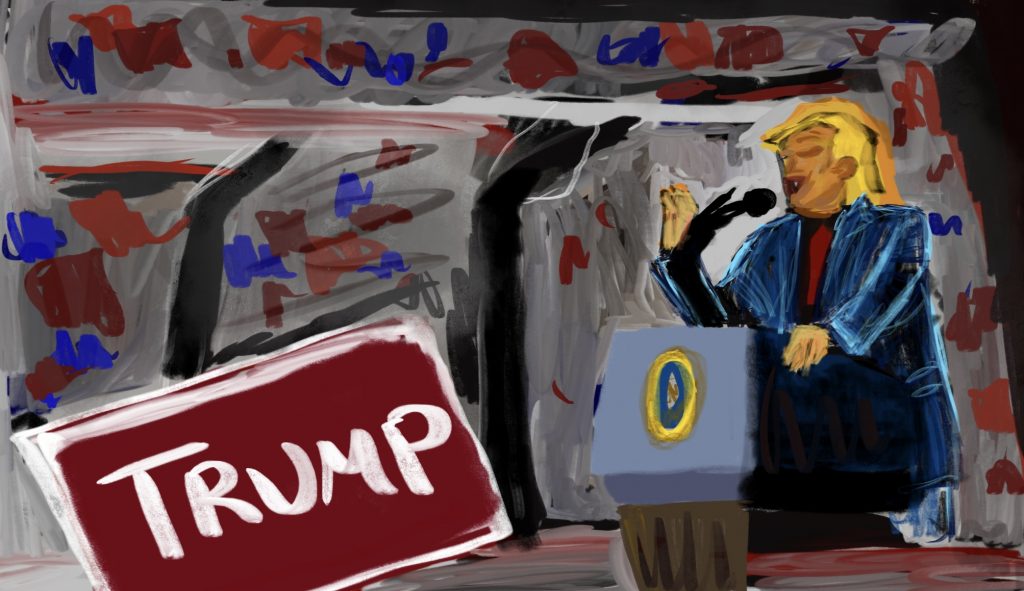
Enter Donald Trump, who would become the candidate of a minority of Republicans themselves in 2016 — in effect creating a party within a party, the so-called “Base.” Trump’s candidacy was dismissed by establishment Republicans, and he campaigned on what was effectively an anti-Republican platform of tax hikes for the rich and opportunity for the displaced middle class. Although the Base was at first relatively small, Trump cultivated it assiduously and, with sixteen other Republican candidates in the race, he won the Republican nomination by pluralities in the primaries. The Republican Party did not disavow him even when, in blatant violation of the law, he appealed for political support from Russia. Nor did Barack Obama’s Justice Department intervene, thereby setting a precedent for its inaction under Joe Biden even after the insurrection of January 6. Trump, who had built his personal empire by circumventing, if not defying, the law, now found that he could break it with impunity. Republicans, who had gamed it themselves for decades, now learned their final lesson: they could now simply join Trump when he broke it directly. And Democrats themselves had paved the way.

Trump thereby grew the Base as well. Identifying with his disregard for the laws, they felt symbolically empowered in him. For his part, Trump continued to cultivate them from the White House with demagogic rallies that pointedly excluded the public at large, a caballero rather than an elected leader. 

It is not a unique story. It is, with variance of detail, how Mussolini in Italy and Hitler in Germany seized power, each leading a fanatically devoted group of followers in a time of civil unrest. The Base is, put simply, the germ of a one-party state.

Hillary Clinton, in her failed campaign for the presidency, was the first to give the Base a descriptive name. She called it the Deplorables. The Deplorables embraced not a cause, not a program, but a man. To be sure, Trump made them promises, none of which he kept in office — not even one as simple as building a wall. And now, when he has nothing to offer them in the moment, he presents himself as the martyr cheated by a stolen election; the man who, like them, has had taken what was rightfully his. He himself is their cause.

This makes not for a political party or faction, but a cult. And that is precisely what gives the Base its power. As the past three elections have shown, the Republican Party is still in the national minority. It must still govern by suppressing the vote. As such, it cannot afford to alienate its most unified component, the Base. 

The besetting problem of the Republican Party is thus that it cannot win a national election without Trump, although he himself has never won a majority of the popular vote of the country, even in an opinion poll. If the Deplorables were to defect from them, they could not keep national power. Trump’s identifiable supporters are thus a minority of Republicans, but that minority determines the fate of the whole, and thus the current course of American politics.  

The Powell strategy has thus come back to haunt the Republicans themselves. However much the Republican establishment may despise Trump, he is their creation. He seized a moment largely made by them, with a downsized, deindustrialized middle class — no more than two-thirds of what it was fifty years ago — long frustrated and embittered, faced by the looming job extinctions of artificial intelligence, and now primed, as the citizens of postwar Italy and Depression-era Germany were, for a demagogue. The numbers of that disenfranchised class grow daily as the nation’s wealth is concentrated in fewer and fewer hands, will continue to grow when Trump is gone, and will be ready fodder for whomever succeeds him.

When disaffected voters cling to a savior, despotism begins. This is aggravated by a loss of the shared reality on which democratic process and the rule of law ultimately depend. This is complicated in a digital society where truth, measured in “likes,” is the triumph of propaganda, and democracy thereby made a mockery of itself. Trump does not so much abuse truth as satirize it, so that it is one thing today and its opposite tomorrow, until it is simply whatever falls from his lips at any moment. And this is how truth ceases to exist, when what is believed is the sayer and not the thing said. Under such circumstances, democracy itself gradually becomes impossible. Trump’s supporters may not be deplorable, but the condition they have been led to is.

In 1933, Germany was the most educated nation on earth, and, measured by its achievements in the arts and sciences, the most accomplished. Within months, it was publicly burning books. We know the end of that story. Donald Trump tells us how close we are to embarking on it. It is important to take him out of electoral politics, and it is the failure of the Biden administration to do so that is its greatest — and potentially most fatal — mistake. Even more important, though, is the struggle to set America back on the long road to a just society. Only with that will the Base itself recede.

Posted in UncategorizedComments Off on Donald Trump, the Deplorables, and democracy

Democracy Gets a Reprieve

The votes are still out in the 2022 midterm elections, partly a result of the patchquilt system of 50 states, each with its own rules of when and how to count them. Dear Georgia could not call a winner in either of its senatorial races two years ago because, uniquely among the states, it requires an absolute majority for victory. It is giving us the same rigmarole this year for the race between incumbent Raphael Warnock and Herschel Walker, which will not be rerun until Dec. 6. Welcome to the 13 colonies, now grown too large and strange for their own good.

Still, the elections have been run in reasonably good order, with no militias to guard the ballot boxes and no street riots about the outcomes. There are two major takeaways from the elections—two major losers, not winners. The first is the media, still colloquially known as the press. For many months, it had all but uniformly predicted the Red Wave that would firmly ensconce the Republican Party in power on all levels, leaving only a powerless Joe Biden in the White House. This was partly a repetition of the gospel that the party in power typically loses seats in midterm election and partly the conclusion drawn from polls that inflation, inarguably a phenomenon of Biden’s watch although a worldwide one as well, had eclipsed all other issues in voters’ minds, including the revocation of abortion rights by the U.S. Supreme Court in its Dobbs v. Jackson decision this June. Democrats had presumed that this issue would trump all others, having been the most divisive in the country for half a century. It had prompted nationwide protest marches last spring—it was the issue on which both parties had taken the strongest stands pro and con. Nonetheless, the pollsters saw it almost vanishing as the election approached, with barely a tenth of the electorate reporting it to be its chief concern. Inflation, the media reported, now overwhelmed everything else.

When exit polls were finally conducted, it turned out that 27 percent, not 11 percent, of voters had indicated abortion as their primary interest. How could repeated statistical surveys, scientifically conducted, get things so wrong? An obvious reason that suggests itself is that many voters chose not to be candid about what was really on their minds. Abortion is controversial. It divides families and communities. No one favors inflation, except the giant monopolies whose strangleholds enable them to profit from it.

Beyond this was the question of narrative. The job of the free press used to be to report what happened. Increasingly, and not only with digital media but what remains of print, what almost every news outlet now concentrates on is speculating about what will happen; that is, not reporting the news but handicapping it. The result is that most media compete in constructing narratives. The most favored narratives, liberal or conservative, get the widest attention, hence gaining acceptance. Once inflation became the narrative—and, to be sure, it was a strong issue, easy to elicit complaints from frustrated shoppers—competitors dropped out. Hence, the big Election Day surprise: the Democrats not only more or less held their own but fared far better than the party in power usually does in the midterms. This was not because they were suddenly loved, but because the underwater issue of abortion bobbed to the surface as votes were actually cast.

There was another issue, too, more difficult to quantify but arguably present, namely the fate of democracy itself in a race between a party that accepted the peaceful transfer of power and one in which many prominent figures did not. The Democrats tried to make this their campaign keynote at the end when abortion had seemingly failed them. But the argument seemed too frightening for many to accept, at least overtly, and it required Republican voters to reject not only their party’s candidates but the party itself. Nonetheless, it did apparently gain traction among Democrats, some Independents and even Republicans in the Liz Cheney camp. That was because, thanks to Donald Trump, it struck such voters as all too plausible. 

The other loser was, of course, Donald Trump. Trump has been dragging the Republican brand down since 2016, when he won the presidency—the greatest defeat the Republican Party had ever suffered—while losing the popular vote. His formula was never to win a majority, but to create a loyal base within the Party large enough to give him control over the whole. His model was the Tea Party caucus, which briefly held sway over the GOP, but lacked the single unifying figure—the demagogue—around which it could coalesce. Trump provided such a figure and spent most of his term in office cultivating it. He understood that the way to forge a political movement out of a mélange of disparate mob elements was to personalize it. It was not a new idea; Hitler and Mussolini both used it. The Republican Party, built since Richard Nixon atop constituencies of resentment—racists, Evangelicals, frightened suburbanites and a deindustrialized working class—was ready for a leader even more outlandish than Trump’s fascist avatars, if not as daring.

It worked, for a while. But Trump’s fatal weakness was his inability to accept defeat of any kind, especially from what appeared to be the pinnacle of success: the American presidency. His reelection, as he contended, could only have been “stolen” from him. It was the theme he clung to. It was one that resonated with his followers, who felt their lives too had been stolen from them. But it could not sell to the mass of Americans still wedded to their own dreams of success, and to the lesser-but-still-critical notion that their votes could count even if they did not go to candidates anointed by Donald Trump. It’s a slender thread for democracy to hang on. But, at least in 2022, it was enough. 

Posted in UncategorizedComments Off on Democracy Gets a Reprieve

Democracy Is On The Ballot

What may well be the most important political election of our lifetimes is on the ballot this week. The principal subject isn’t inflation or the general state of the economy, heavily as they weigh on the minds of millions. It is not even larger issues such as mounting public violence, the legality of abortion, the rampant abuse of social media, the  ever-widening income inequality that mocks the idea of our common welfare or the climate disaster that already enfolds us. Any of these concerns would be enough to fully occupy us. But we cannot hope to address any of them without the functioning democracy that undergirds our republic. It is this that is most nakedly at risk on the ballot.

The range of practical problems we face, and the world in general with us, is daunting. Over the long run, democracy—and the good faith of nations it represents—is the only way to address them. Democracy is slow and messy. On many days, it can seem frustratingly inadequate Yet, , if we keep it in good order, it can bring us together in ways no other system of government can and win consent for common solutions that often require patience, confidence and shared sacrifice. At no point in our history have we required these things more. The alternative to democracy at present, autocracy, can move more swiftly and apparently more efficiently. We can clearly see its defects at work. In China, we have already seen the effects of such a regime there in the COVID-19 policy that has repeatedly locked down tens of millions in urban prisons that have devastated the national economy and left them at the risk, and sometimes the reality, of mass hunger. In Russia, a dictator has plunged his country into a brutal war of aggression that threatens a continent with starvation and the world with the specter of nuclear conflict. Autocracy is, simply, a standing threat to humanity.

In contrast, what democracy requires to function is the broadest popular consent. That consent is conferred by elections. Elections require honesty, transparency,and above all else, the willingness to accept certified results. When power is transferred, it must be done peacefully. 

    In the United—and frequently disunited—States, this process is complicated by the fifty states and thousands of local jurisdictions, many corrupted by gerrymandering and, in national elections, subject to the antiquated and fundamentally anti-democratic institution of the Electoral College. These hurdles have caused a good deal of difficulty over time. They now place our entire system of government in jeopardy as one of our two major political parties has set about systematically challenging election results that deprive it of political power. As Republican voters go to the polls, two-thirds of them reportedly believe that the most recent presidential election was “stolen” from them by devices ranging from sheer theft of votes to electronic interference by space satellites despite the absence of any evidence and the formal certifications of all fifty states. Many Republican candidates have stated or implied that they reject in advance any unfavorable electoral outcome, not only for themselves but for others and consequently for their party as a whole. The logical implication is that only Republicans may rule: in short, autocracy. Donald Trump argued this for himself in his two previous presidential campaigns. After his loss in 2020, he took his case to more than sixty courts that rejected him and when that failed, orchestrated a violent insurrection that threatened the U.S. Congress, including its Republican caucus and the vice president. 

This episode, unique in our nation’s history, has thus far not only failed to lead to Trump’s punishment by Congress or the courts, but has instead been met with the endorsement of his potential run for the presidency in 2024 by numerous Republican officeholders and seekers, including some of those whose lives were endangered by him on January 6. Not since the imperial purges of the Senate in ancient Rome has such a spectacle been witnessed. Plainly spoken, the Republican Party has ceased to exist as an instrument of the people. The likelihood that it will reclaim at least one house of Congress means that democracy will have crippled itself in the land of its modern rebirth. The consequences, both here and abroad, could be incalculable.

For some, the present situation represents the temporary capture of the Republican Party by a populist figure who rejects democratic norms. This is a mistaken reading. Donald Trump is not an aberration in our political system, but he is the logical, if unanticipated, result of a long-schemed campaign to make the Republican Party a permanent ruling instrument that goes back to an infamous 1971 memorandum by Lewis Powell that outlined how this might be achieved by gaining effective control of the presidency and the High Court while emasculating—and, in the January 6 insurrection, literally threatening—the national legislature. 

Of course, not all in the Republican Party reject majoritarian, two-party government, and most of its prominent figures initially dismissed Donald Trump as a vanity candidate who actively campaigned against the Party’s agenda. A small minority still reject him, but those who have spoken out have almost without exception seen their political careers sidelined if not ruined. Even Democrats, while denouncing Trump’s crimes and abuses, tiptoe around holding him accountable. There are only two figures who have actively and effectively challenged Donald’s  demagoguery, each from a different end of the political spectrum. One has been Nancy Pelosi, the liberal House Speaker who famously walked out on a meeting with Trump, tore up a State of the Union address as he delivered it and (ultimately) stage-managed two impeachments against him. The other is the arch-conservative Liz Cheney, who has steadily denounced Trump from her seat on the January 6 Committee and is forming a political movement to challenge him should he be renominated for president by what has been her life-long party.

Cheney’s case is at the moment the most interesting. Her father, Dick Cheney, gained the vice presidency in 2000 when the Republican-dominated Supreme Court overturned more than 100 million votes to install George W. Bush as president in what remains the single most notorious episode in American electoral history. Liz Cheney herself not only launched her own political career from this event, but has been consistently one of the most conservative, not to say reactionary, figures in Congress. But she has drawn the line at election denialism per se, and the refusal to accept the peaceful transfer of power on which democracy fundamentally depends. 

This display of principle has already made her a permanent figure in American democracy, if it survives. Pelosi, who has already paid for her courage with her own near-assassination and that of her husband, will likely lose her speakership to one of Trump’s most despicable toadies if Republicans win the House of Representatives. Liz Cheney, if she does form a conservative third party that reaches across the aisle, might just garner enough votes to deny Trump a second (and perhaps a third and fourth) term. It’s a long shot, but if she does so I’ll decorate her statue myself. First, though, democracy has to survive the election of 2022.

Posted in UncategorizedComments Off on Democracy Is On The Ballot

What We Owe Vladimir Putin

Photo by Remy Steinegger | World Economic Forum

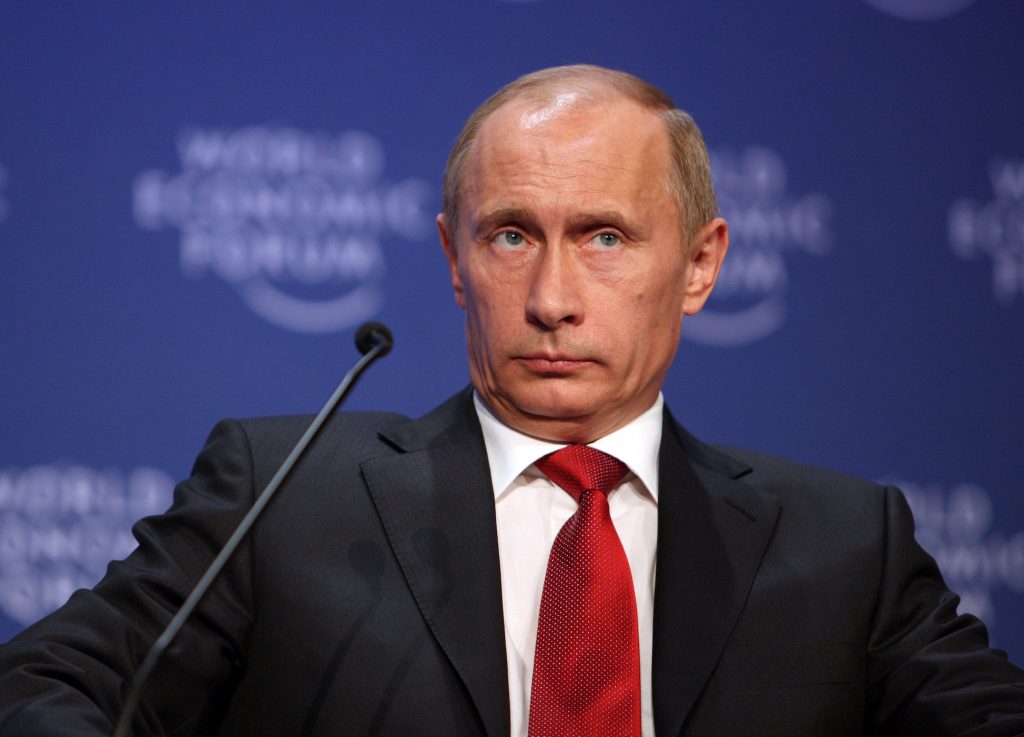
Let there be no mistake: Russia’s President Vladimir Putin holds the current title as the world’s wickedest and most dangerous man.  He is waging a nakedly brutal war of aggression against Ukraine in violation of every standard of decency and the international protocols of warfare recognized since the end of World War II.  He has driven, in the current crisis alone, 14 million people from their homes and abducted uncounted tens of thousands more.  He has crushed, over more than 20 years, every vestige of popular government and every expression of dissent in the vast territory he controls. He has imprisoned, tortured and poisoned political opponents. He has dropped them from tall buildings. He has reduced whole cities to rubble, at home and abroad. His reckless threats and conduct have created the greatest threat of nuclear calamity since the Cuban Missile Crisis of 60 years ago.  He is one bad dude, and although he has plenty of competitors, at the moment no one else is even close.

He has also done us a favor.  He’s taken the heat off us.

Since World War II, no other nation has fought anywhere near the number of wars we have, or at such length. When Putin invaded Ukraine, calling it not a war but a “special military operation,” he took a page from the book of President Harry Truman, who called our war in Korea a “police action” not requiring the Congressional Declaration of War mandated by the Constitution. That “action” took over 50,000 American, millions of Korean, Chinese, and Allied lives.  Almost 70 years later, it has not been formally ended.  Not one of our many wars since Korea has been declared one.  The last such one was World War II itself.

No sooner had the Korean War resulted in a ceasefire, still perilous, then we were embarked on one to prop up the dying French empire in Vietnam, in which some of our military leaders, like Putin, suggested using nuclear weapons.  That morphed into a 20-year war, justified by the false claim of a naval attack, engulfing three nations, and ending in ignominious defeat. While that was ongoing, we also invaded the Dominican Republic and Cuba and carried out the overthrow, sometimes by assassination, of various foreign leaders. 

After a brief but far from inactive pause, we fought another 20-year war against our erstwhile ally, Iraq, the invasion of which was justified by its alleged possession of weapons of mass destruction, none of which were ever found.  At the same time, we fought a second 20-year war in Afghanistan in supposed retaliation for 9/11, which ended too in defeat.

You get the picture. Vladimir Putin may not have intended to burnish our image, but he has certainly given it a breather. This may help us to better understand why many nations, especially in Asia and Africa, have been noticeably cool to the sanctions we have imposed on Putin, taking advantage of his cheapened gas and oil exports to buy them at bargain prices. Even where, as in China and India, leaders Xi Jinping and Narendra Modi have recently paid lip service to the principle that wars of aggression are beyond the pale in the modern world order, their statements reflect more Russia’s parlous position in Ukraine than anything else.

In fact, Putin has lost his war, whatever its military outcome.  He based it on two premises.  The first was the proposition that most of the Eurasian continent was properly Russky mir or “Russian Earth,” despite the many peoples who inhabit it and who had separated themselves from the former Soviet Union at its fall. The second was that the Russian military, regenerated by Putin, was again the invincible Red Army of yore. The lie was given the first premise not only by the stout resistance of Ukraine but the unanimous rejection of former Soviet republics from the Baltic Sea through Central Asia to union with Putin’s Russian Federation, the puppet regime of Belarus alone excepted.  The second premise collapsed with the disastrous failure of Russian forces in Ukraine, where, having anticipated capitulation within days, they now find themselves in the eighth month of a bitter struggle that finds them everywhere on the defensive and desperately short of manpower, equipment, and strategy.  The effect of this on morale, civilian as well as military, cannot be overestimated.  If there was one thing the Russian nation could take pride in was its victory against Nazi Germany in what Russians still call the Great Patriotic War, where—at superhuman cost—they had thrown back and defeated what had been considered the greatest military force ever assembled.  The Red Army has been Russia’s myth and legend.  Its successor now lies not only in defeat but disgrace.  

Nothing Putin can do, however long he wages his war or whatever price he exacts, can rescue him from this failure.  Instead of a weakened North Atlantic Treaty Organization and a divided Europe, he finds himself—so far—with a strengthened and expanded one.  Instead of a superpower, he presides over a shell. Instead of a nation united in defense of its soil, he confronts military reservists and potential draftees fleeing the country from every available exit. He is still dangerous, all the more so for being cornered. But his days, I submit, are now numbered.  

When the Soviet Union collapsed in 1991, we thought the Cold War was over.  Instead, the policies we adopted—and failed to adopt—have given it a new chapter. This time, and if our luck holds, we must think harder and do better.  And not with Russia alone.    

Posted in UncategorizedComments Off on What We Owe Vladimir Putin

The Incredible Shrinking Presidency of Joe Biden

Is it too early to call the Biden administration a catastrophe? It is time, I am afraid, to tell it like it is.

Example A is the complete rout we are now suffering in Afghanistan. Yes, it was long past time to end a war that should never have begun. But there are many ways to lose a war, and Joe Biden chose the worst: with a date certain for the Taliban to plan against; with intelligence that failed even the test of common sense; with a puppet government and a paper army, sunk in corruption; with no coherent plan to protect and evacuate the tens of thousands of Afghans foolish (or greedy) enough to have worked with us over the years and now with targets on their backs. Biden promised that we would not see a repeat of the helicopters flying off the roof of the U.S. embassy at the end of the Vietnam War. Instead, we got precisely that and more, including the sight of desperate refugees clinging to the sides of planes already in the air. It is hard to imagine a once-great power suffering a more humiliating retreat.

No, Biden was not responsible for the war in Afghanistan, but he will be forever tainted by the fiasco of its end, just as the fall of Saigon remains the indelible image of the Gerald Ford presidency. To have exposed himself to such a calamity in the first year of his administration was both arrogant and stupid. Nor will any member of his administration escape a loss of credibility. 

The cost of this loss will be exceedingly high for the remainder of Biden’s agenda, but he had already squandered much of his political capital by senselessly dallying with his Republican opposition — an opposition that, still in thrall to Donald Trump, largely rejects the legitimacy of his election even now. This folly — or worse — he called bipartisanship, the premise that legislation is the art of leaching out principle by compromise. There could be no worse time to indulge it than the present, when power at all costs, including democracy itself, is the only principle the other side recognizes. And if, in fact, Biden’s goal was simply to restore Republicans to their Congressional majority, he could not be going about it more deliberately. But I cannot make the point more clearly than Marc Thiessen, the former George W. Bush speechwriter turned arch-reactionary columnist, as he wrote in the Washington Post earlier this month:

“With passage of the bipartisan infrastructure bill this week, Senate Republicans have scored a policy and political trifecta: They have saved the filibuster, complicated Democrats’ plans to pass their partisan $3.5 trillion non-infrastructure spending package and made it more likely that the GOP will take back the House and Senate next year.”

Thiessen makes all the essential points. For the Democrats to pass their legislative agenda, including programs to address desperately needed reforms in infrastructure, voting rights, tax and income inequality, immigration reform, domestic violence and above all climate change with slim majorities in both houses of Congress, they needed above all else to eliminate the Senate filibuster that enabled the Republican minority to virtually paralyze the legislative process at will. But Biden has set himself — without explanation — squarely against eliminating it.

The only way to get around a filibuster would be a so-called reconciliation bill, a time-consuming process that suspends the filibuster in the case of bills involving budget appropriation. Biden did invoke it to pass a relief package in the first weeks of his administration, but instead of doing the same for his large infrastructure bill, he broke it into two parts to placate Republicans who refused to support any legislation promoting clean energy, an increase in the minimum wage, or help of any kind beyond broadband expansion for struggling families, debt-ridden students, and families crushed by medical bankruptcy. This had the effect of enabling Republicans to claim credit for a bill that, weakened as it was, was actually rejected by most of them, while alienating the Democrats’ own far larger progressive caucus in the House of Representatives where no Republican support was assured and virtually every Democratic vote needed.

In order to hold progressives in line, House Speaker Nancy Pelosi announced that she would not consider a vote on the shrunken infrastructure bill until the far larger package originally attached to it was approved in the Senate, presumably by reconciliation. This in turn left the latter bill hostage to a handful of Democratic “centrists” in the Senate who objected to various elements of its costs and provisions. Meanwhile, both bills languished, with passage of neither assured. 

In short, as Thiessen notes, Biden has bitterly divided his own caucus, while throwing a lifeline to a Republican Party that has no national legislative agenda of its own and therefore no record to run on except mischief, obstruction and fealty to a former president soundly repudiated at the polls — a problem his party was preparing to fix by a raft of restrictive voting laws in almost every state of the Union. 

Or did the country actually elect a Republican surrogate to the White House last year whose name happened to be Biden instead of Trump? To judge by Biden’s conduct to date, it seems a pertinent question to ask. Yes, Biden has talked the talk. He goes on about ensuring voting rights, enacting gun control and police reform, and dealing imperatively with the climate apocalypse that has already turned the world’s weather upside down. He declared victory over COVID-19 to celebrate the Fourth of July, only to have it roar back for a fresh run. And he was too distracted by whatever may have been on his mind to deal with the threatened eviction of millions of Americans from their homes until the last possible minute.

Afghanistan is just the icing on this cake. But let us not underestimate it, or consider it a momentary embarrassment. It is not only the greatest debacle in American military history — defeat in a week after a 20-year war — but it marks our definitive eclipse as what was once called a superpower. Was it only months ago that Joe Biden declared America “back” to lead the world as the champion of freedom, democracy, and human rights? That world now sees a small man adrift in a divided nation that can issue no clear call to anyone, its former allies included. And he is shrinking by the day.

Posted in UncategorizedComments Off on The Incredible Shrinking Presidency of Joe Biden

The peonization of Higher Education

Why should anybody not be able to have the college education I got? I spent four years getting my bachelor’s degree, followed by eight earning my master’s and doctor’s degrees. I never paid a penny of tuition, or borrowed a penny, either. My undergraduate tuition, at Queens College of the City University of New York, was paid in full by New York State. In addition, I had a scholarship that paid my other educational expenses. I attended two graduate schools, Brown University and Washington University in St. Louis. I had a full scholarship at Brown, and a teaching assistantship at Washington. Tuition was fully paid at both institutions. After I completed my residence at Washington, I received a scholarship that enabled me to research my doctoral dissertation for a year in London. After my classes finished, I was able to support myself while completing my doctoral dissertation on a project at Yale and as a lecturer at Queens College. I did not live rich, but I paid my bills and got to visit a dozen or so countries — I figured a European historian should know the terrain a bit. After 12 years, I owed friends and mentors a great deal, but not a red cent to anyone.

The world has changed since then. College debt is now the largest single source of private debt anywhere in America, even exceeding the medical debt that still annually bankrupts hundreds of thousands. Students carry loans that burden them for years, if not decades, pauperizing themselves and their families. Some, even with loans, work two and three jobs just to keep their heads above water. Education is now a form of indentured servitude.

The vast majority of student debt is owned by the federal government, at interest rates that compete favorably with your local loan-shark. Higher education used to be an investment in culture, citizenship and professional training. Now it is a punitive extraction of labor as the price of entering a workforce that, for most, demands more for less.

No, not every public university was tuition-free when I went to school, but some of the best were (New York, California), and all were far cheaper than today’s. As states’ support for public education decreased, the federal government propped up the techno-university system by compounded taxation that has resulted, in effect, to a modern serfdom.

Why can’t students get the education I got, and that most developed countries give? There is not a single defensible reason for it. Why can’t the federal government forgive student debt? Because those trillions need to go to corporations and the obscenely wealthy, so they can pay few if any taxes at all. It is a system alright, or a shakedown. What it is not is a society devoted to the common welfare, the coming generation, or anything remotely approaching what was once imagined as a democracy.

Faculty are not in better shape than they used to be, either. They, too, work harder for less, and with less security than they have had in nearly a century. There are many reasons for this, also none of them justified. The crucial issue here is the decline — not to say evaporation — of tenure, the system by which faculty can, after showing sufficient competence (now upgraded, by administrators who seldom show any of it themselves, to “excellence”) over a span of time to achieve ongoing employment at one’s institution until retirement. Job security is, of course, a crucial issue here, both for the individual faculty member and for the faculty as a whole. Faculty continuity is critical to the maintenance and promotion of academic standards, to freedom of expression without fear of reprisal, and to what is called shared governance — the co-equal participation of the faculty in the mission and development of the institution and the deployment of its resources. No university worthy of the name can properly conduct itself without a tenured faculty.

That makes a robust discussion of tenure, or what is left of it, all the more urgent. It has become urgent enough even to be noticed by The Chronicle of Higher Education, usually a mouthpiece of administrations and boards of trustees, which largely devoted its April 16 issue to the subject. Most of what was written was rubbish, but the article by William Deresiewicz, who does often think out of the box, struck me as of some interest. Deresiewicz thinks the best way of retaining tenure, or what’s left of it, is to divide the professoriate into two distinct groups: research and teaching faculty. Each group would have its own standards for achieving tenure, but neither would interact with the other. Research faculty would devote their time exclusively to producing scholarship (Deresiewicz says nothing about who would conduct graduate education, that is, education devoted to producing the next generation of scholars). Such faculty, he asserts, typically have no interest in teaching, or aptitude for it: “There is no shortage of brilliant scholars and scientists,” he says, “who are utterly incompetent as teachers, and utterly indifferent to their incompetence.” On the other hand, many academics who are gifted teachers — some of them scholars retired from active research — are treated as second-class citizens, and if hired as so-called teaching faculty have no opportunity for tenure. Deresiewicz thinks it would be wise to recognize that teaching and scholarship are separate skills but of equal value in the life of the university, and so should have comparable recognition and reward.

Extending tenure to teaching faculty would help keep it alive for all, but Deresiewicz also wants us to keep what he perceives to be another reality in mind: that the idea of shared governance in a university system that is increasingly corporatized is simply an illusion. Trustees and administrators have always run the joint, and it will help faculty to recognize that it will only be more so in a competitive and commercialized academic marketplace. For faculty to do so will not only save them a lot of time and frustration in a game utterly stacked against them, but in shedding the pretense of managerial responsibility they will be able to unionize, preferably on a national level, and thus exercise the only real power they might have, namely the government-recognized right to negotiate fair and decent working conditions — tenure among them.

Deresiewicz is both right and wrong about these things. There are faculty more suited to teaching than research and vice versa, but plenty who can do both well, and good reasons for exercising both skills: a formal division between teachers and scholars might benefit a few, but would I think impoverish the university as a whole. In any case, that division, which as a matter of practice has been made by administrators, has had nothing to do with actual aptitude but has been simply a means of creating a second-class body of faculty with reduced salaries and benefits and without job security.

Deresiewicz is right that shared governance in the present academic world is a joke and that unionization may be the only way for faculty to protect academic freedom, not to mention more mundane interests. But to surrender the idea of governance is to give up on the soul of higher learning, and that would be as profound a blow to society itself as I can imagine. Yes, academics must unite collectively on some level if they are to make a stand for the values they should represent. But they should not give up the ship simply to have a more comfortable berth in the lower quarters.

Posted in UncategorizedComments Off on The peonization of Higher Education

It’s 9/11 All Over Again

The date the Champlain South Tower collapsed in Surfside, Florida — June 24, 2021 — may not live in infamy the way December 7 and September 11 do, but it is one that is potentially no less significant for us. The sudden collapse of a large urban building, reduced to rubble in a single crash with major loss of life; the desperate, painstaking search for survivors; the slow acceptance of the calamity’s scope — all this cannot help but bring to mind the similar trauma of the World Trade Center attack 20 years ago.

Of course, the differences are as great as the pictorial resemblance. 9/11 was a planned terrorist attack from abroad, a deliberate act of war. It mobilized not only our own resources but also those of our NATO allies. It was condemned around the world. The Champlain Tower catastrophe was, if anything, a disaster inflicted on ourselves. We have no external enemy to fight because of it. But it should wake us up no less.

In hindsight, 9/11 was foreseeable. It was the product of our long effort to assert dominance over the Middle East and the many wars we have directly or indirectly engendered there as a result. The perpetrators of the attack were, in some ways, our own creation; Osama bin Laden, the chieftain who took credit for it, had begun his career on the CIA’s payroll. 9/11 was violence coming home to us. We did not see it because we were complacent, because we thought ourselves invulnerable, because we believed ourselves immune to the consequences of our acts.

We were wrong, and now we drag ourselves in defeat out of a 20-year war we should never have begun and could never have won. No, the Champlain Tower South had nothing to do with that. But it comes as a kind of exclamation point that mirrors the terrible one that began it, and it suggests a deeper resemblance. Towers of Babel do collapse. And America as a whole, at this moment, resembles nothing so much as a Tower of Babel.

The Tower of Babel (Genesis 11: 1-9) was, of course, a giant structure meant to reach the heavens, a symbol of unlimited ambition and hubris. God destroyed it in Scripture by destroying the common language the builders spoke, thus making them incomprehensible to one another.

We are certainly a nation incomprehensible to ourselves today, and though we share a common language we do not share common meanings, values, intentions or beliefs. If God had been a little more patient in Genesis, he need not have changed a word of what men spoke. He could simply have let their common meanings erode and disintegrate. It has happened here. On Jan. 6, our closest approach to a national Tower of Babel, the Capitol Building, did symbolically come down. Although its doors and windows have been repaired and those who work there carry on, there is no common language, and the American President who thinks he can find one is destined for disappointment.

The Capitol Building was built on foundations that have long become shaky. The Champlain Towers complex was built, like many around it, on porous limestone through which saltwater intrudes. It was poorly designed and, in some places, shoddily constructed. The warnings conveyed in its last structural assessment were ignored, if noticed at all.

There are no doubt a great many buildings in the United States that answer to such a description, and a great many more whose sheer dilapidation requires no building inspector to certify their impending collapse. The same goes for roads and bridges, and the general connectivity we call infrastructure. They are all related and, if you will, wired together.

On the one hand, we do not build the things we use to last, or maintain them properly if we do. On the other hand, material structures themselves are of no value except to serve human communication and interaction. Although the Digital Age has vastly increased the possibility of such interaction, it has degraded it as well. The internet serves as a source of information but also as a font of lies that has increased the noise of Babel. We have gained facts but lost truth.

And now, one more wreck lies before us: the shell of Bagram Air Force Base, the pivot point of our long-failed and now to-be-abandoned war in Afghanistan. It was once a 14-acre city, the command center and beating heart of the war begun for us by 9/11, a place raised from the dust and now already to returning to it. It, too, was a Tower of Babel, and its foundation was a lie — the lie that one of the most backward nations on earth brought down the towers that symbolized the wealth of its most powerful one.

What goes around comes around, and what went around 20 years ago is now coming home to us. But much else has fallen too. It is not, perhaps, too late to rise. The odds are not too good, though, unless we remember the common project — liberty, equality, the common welfare — that, though imperfectly conceived and too seldom fully realized, makes us Americans.

Posted in UncategorizedComments Off on It’s 9/11 All Over Again

Is a Two Party Solution Possible in the U.S?

People these days are talking about whether a two-state solution is possible between Israelis and Palestinians, as they do after each fresh outbreak of violence between them. But there is a pressing question closer to home: is there a two-party solution possible at the moment in the United States, and what might it look like?

Democracies can exist with a multi-party system, if sometimes uncomfortably: just ask the Israelis themselves. But they cannot do without a minimum of two parties, and those two must be predicated on one shared principle: that power is conferred by popular elections, and that in these elections there are winners and losers. If you can’t ever win, you can’t govern; if you can’t ever lose, no one else can.

We are now at a moment when this principle is no longer accepted by one of our two major parties. The Republican Party is no longer prepared to lose. That means it is no longer a party in the most essential sense, but a clique or a cabal, and that, to the extent it is subservient to the will of a single individual claiming to represent it, a cult. This is the situation of the organized rebellion against democracy that calls itself the Republican Party.

Apologists for the party blame this situation on the buffoonish sociopath (yes, you can be both at once) whom it chose as its presidential candidate in 2016 and 2020, and who continues to dominate it today. But the Republican problem goes back a much longer way. In the late 19th century, it became the party of monopolistic capitalism, or big business as it was more casually called. This is not to say that its rival, the Democratic Party, was not also a party of big business. To compete electorally, however, it needed to open itself to other constituencies. One was the post-Civil War South, whose dominant white majority gravitated to it because of the brief but bitterly resented ascendancy of Reconstructionist Republicans who sought to democratize it.

This segment of the Democratic Party, the so-called Dixiecrats, gave the Party a reliable — albeit insufficient — base of electoral support based on the replacement of slavery by the more efficient and less controversial system of exploitation known as Jim Crow. The other available constituency was that of big-city labor, whose political interest was to claim precisely the economic freedom and security denied to Black Southerners. These constituencies were antithetical, and the party that cultivated them both was, to that extent, an ideological absurdity. But political parties can be absurd if they collect enough votes; Democrats called it having a big tent. The tent was big enough to contain a vocal minority of progressives, who came to be called liberals until that term fell of favor, and are now in a turn of fashion called progressives again.

Progressives, in a word, are people who think capitalism needs to be regulated, something few capitalists agree with (unless, by collusion, they do it among themselves), and which no Republican has ever supported except for Theodore Roosevelt, who was run out of the party for doing so. However, such was both the practical power and the ideological dominance of big business that when Calvin Coolidge famously declared in the 1920s that the business of America was business, no contradiction was heard.

All of this changed with the Great Depression. Suddenly, there was no business to be had; a quarter of the American workforce was unemployed and another quarter subemployed; world trade fell by two-thirds, and the price of raw commodities by 90 percent. In Europe, the consequence was fascism; in the United States, the election of a Democratic president for the first time in a poll not clouded by a third party insurgency in 40 years. The new president was another Roosevelt, FDR. He rescued American capitalism with a program of massive government investment: the New Deal.

The New Deal dominated American politics until Lyndon Johnson pushed the civil rights legislation of the 1960s. This drove Dixiecrats into the waiting arms of Republicans, who embraced white supremacy, and, in short order, racism generally. From there, they developed a “politics” of class and cultural resentment aimed at breaking down the distinction between church and state (another nod to white supremacy); crushing organized labor; hollowing out the urban middle class by budget cuts, school defunding and regressive taxation; and leaving the country awash in guns and the violence attendant on them. All the while, they faithfully serviced their Wall Street and Silicon Valley masters, fostering the greatest concentration of wealth, unaccountable power and unchecked monopoly in a hundred years. The story is too long to tell in brief space, but the summation is simple: the Republican Party of the past half-century, especially since the Reagan presidency, has been a retrograde and destructive force, and its contribution to public welfare has been zero. Under Donald Trump, whose thumb is still on it, it has simply reached the nadir of political, intellectual and moral bankruptcy. It is beyond rescue or repair, and — as many former Republicans agree — there is no point in trying.

This leaves us with only one functioning political party. As we have noted, that is not a healthy state for democracies, nor, in the long term, a viable one. As President Biden has recently said, the country has need of a conservative party. But it already has one in the Democratic Party, and Joe Biden himself is its leader. For a brief while it seemed that Biden, propelled as Franklin D. Roosevelt had been by circumstance, might be reviving a modernized form of the New Deal. He passed a large economic stimulus bill, and proposed a relatively ambitious infrastructure package that would be a start, at least, on climate policy and social assistance. But it is clear now that he is dithering about the latter, and it is time to question whether he is actually serious about it at all. The same may be said for other aspects of his announced agenda that lie dead in the water at present: voting rights; gun control; policing reform; immigration; health care expansion; affordable housing; education debt forgiveness and free community college tuition; affordable housing; a moratorium on the federal death penalty; an increase on the corporate tax rate and on the income the wealthy (i.e., a slight rollback on the enormous tax breaks they have been receiving for decades).

Biden has in effect coopted much of the program of the progressive wing of his party, only to leave it to die a death by a thousand cuts, which Republicans are only happy to inflict and which, in unilaterally offering to cut a quarter of his own infrastructure bill, he is now delivering himself. A good question is why; the vital one is what Democrats who embraced his supposed agenda are going to do about it. In Donald Trump’s loss, the Republicans may have elected the candidate they really wanted. Democratic progressives, meanwhile, may finally discover that they need a party of their own. It’s a conversation that needs to begin.

Posted in UncategorizedComments Off on Is a Two Party Solution Possible in the U.S?

The Real Forever War: Israel and the Palestinians

Joe Biden’s decision to withdraw American soldiers from Afghanistan before Sept. 11 is not an end to the war in Afghanistan itself, a 40-year conflict that began with the Soviet occupation of the country and will continue, much like the present war in Syria, as a civil war with foreign proxies. But there is one seemingly forever war that, well over a century old, shows no sign of abating: that between Jews and Palestinians for control of what both sides claim as both homeland and Holy Land.

Jewish emigration to Palestine began in the late 19th century as a movement for a return to Jewish ancestral homeland, spurred by the growth of an increasingly hostile European nationalism. As Jews settled, Arab Palestinians increasingly viewed them as a threat to their own culture and livelihood. By the 1920s and 1930s, both sides were in violent confrontation.

World War II brought this strife to a head. The Holocaust, which wiped out a third of world Jewry, left millions of survivors displaced and destitute.  Many fled to Palestine, where the Jewish community welcomed them. At the same, Britain (which had controlled Palestine under the aegis of the former League of Nations) abruptly abandoned its responsibilities and withdrew its forces. The question of Palestine fell into the hands of the newly-formed United Nations.

The UN swiftly concluded that Jews and Palestinians could not coexist peacefully in a now-ungoverned territory, where both sides had already taken up arms. The UN solution was that both sides govern their respective communities. But most communities had a mixed population.  Separation, by agreement or by sword, seemed inevitable.

Managed population transfers had precedent. In 1923, the Greek population of Turkey and the Turkish one of Greece were exchanged following a bitter war. At the end of World War II, Germans were expelled from Poland and Czechoslovakia. In both cases, great powers oversaw exchanges between existing states. There was no governing authority, however, to conduct such measures in Palestine. The Jewish community, facing assault, declared itself the State of Israel. The 12-member Arab league rejected this and intervened on behalf of the Palestinians. A succession of wars resulted in 1948, 1956, 1967 and 1973.

The 1967 war gave Israel control of the West Bank of the Jordan River, to which most Palestinians had fled and where they lived as refugees under the de facto control of Arab Jordan. Israel also took control of the Gaza Strip, a small, tightly-packed Palestinian enclave on its southern border. Other Palestinians remained in Israel, where they lived uneasily but gained limited citizenship. A good number of them resided in East Jerusalem, a city divided in 1948 but united under Israeli control in 1967. None of these arrangements were ratified by treaty, and it was not until 1993 that, under American aegis, negotiations for a two-state political settlement between Israelis and Palestinians were undertaken.

These negotiations failed to achieve peace. A Palestinian authority was set up on the West Bank, internally self-governing but subject to Israeli control. Hamas, a militant organization rejecting the legitimacy of the Palestinian Authority and the recognition of Israel, took power in the Gaza Strip. Its stated goal was the establishment of a unified Palestinian state and the destruction of the Jewish one.

The intransigence of Hamas was matched by that of the Orthodox Jewish population of Israel, the Haredim, whose own goal was to annex the West Bank and the Gaza Strip as part of the sanctified territory of Israel.  Hamas, a self-described liberationist organization, is generally considered a terrorist one because of its commitment to violent struggle. The Haredim, who enjoy influence far in excess of their numbers, are a crucial part of the Benjamin Netanyahu’s embattled governing coalition. The collision of these two groups has now produced war.

At issue was the eviction of six Palestinian families from homes, ceded to them in East Jerusalem by Jordan during its occupation of the West Bank but claimed by the Haredim after Israel’s victory in the 1967 war. The matter slept until recently, when the Haredim pressed their claim, creating a flashpoint in the long-running controversy over Israel’s piecemeal annexation of Palestinian holdings. The issue was compounded by a dispute over the religious observances that conclude Ramadan and the conflicting Israeli celebration of its unification of Jerusalem.

Ordinarily, a few eviction notices and an argument about a call to prayer is not a cause for war. Between Israel and the Palestinians, it can be more than enough, especially when extremists on both sides position themselves. The Haredim provoked Palestinians on a point particularly critical to them. Hamas took the opportunity to assert itself in the struggle against Israel with a barrage of rockets. Israel, inevitably, responded in kind. The consequences, this time, may be far-reaching.

To understand why this is so, one must look at the regional politics since the last confrontation between Israel and Hamas, the 50-day war of 2014. Hamas found itself isolated in that conflict as Arab powers, rhetorical support aside, stood by to let it run its course.

A more significant concern had materialized by then: Iran’s aggressive bid for dominance in the Middle East and the coalition mobilized by Saudi Arabia to oppose it. Israel, to whose destruction Iran has long committed itself (and of which it is, unlike Hamas, fully capable), offered its military and intelligence capabilities to the Saudis. On the eternal principle that the enemy of my enemy is my friend, this vital-if-unspoken collaboration had begun to yield something once all but unthinkable: a degree of economic, cultural and finally diplomatic rapprochement between Israel and much of the Muslim world. Correspondingly, the Palestinian cause was sidelined as an impediment to wider interests. In the Israeli view, too, an at least pragmatic acceptance of it by long-antagonistic neighbors was a key to its own security.

This has plainly been the policy of the Netanyahu government. Its success to date has enabled it to put the Palestinian question on a back burner, a strategy pursued with the tacit support of the United States. This has left the Palestinian Authority with little ability to resist settler pressure and Hamas as largely a nuisance to all sides. The Haredim have now offered them an opportunity to grab some bloody headlines again.

Thus far, the Arab response has been a muted one. The real damage, however, has been done between Israeli Jews and Palestinians, where violence has erupted to such an extent that Netanyahu has been forced to call upon both sides to cease “lynching.” The only successful political experiment in living between Jews and Palestinians since the establishment of Israel has been between these two groups. Whatever tensions, grievances and worse lie beneath the surface, they have been part of a functional society, perhaps not as a model for a political solution but surely a precondition for it: neighbors working side by side, accommodating each other and, however grudgingly, recognizing one another’s humanity. If this too is to be a casualty of war, there may indeed be no end to the conflict but tragedy.

Posted in UncategorizedComments Off on The Real Forever War: Israel and the Palestinians