
Author Archives | Michael Davis

Can we trust U.S. News & World Report rankings?

Photo by Kasey Shamis | The Triangle

Prestige holds significant power in the United States. The notion that a person’s reputation hinges so heavily on the names they associate with seems shallow and insincere, yet the reality is hard to overlook. Nowhere is this more evident than in the U.S. News & World Report.

Once a year in September, parents, children and college presidents await the U.S. News & World Report to publish the latest edition of their biggest claim to fame: the rankings of the best colleges in the United States. The U.S. News college rankings are often regarded as the most influential college rankings in the country and for fair reason. They have a long history of precisely refining and updating the algorithm they use to determine these rankings. Many are familiar with these rankings but not as many have familiarized themselves with the algorithm that these rankings descend from. Something peculiar starts to happen when you do: the whole system begins to seem a little less prestigious.

The ranking criteria are available to be analysed and dissected on the U.S. News website. At a glance, the list seems sensible. Student-to-faculty ratio making up four percent of the total score? Makes sense. First-year retention rates making up five percent? Seems plausible. Most of the list looks like this, but then you arrive at one particularly massive criterion that makes up a baffling 20 percent of the total ranking: the peer assessment. For reference, the second most influential criterion is graduation rate performance at 10 percent.

The peer assessment survey is the subject of much criticism directed towards the U.S. News college rankings. Once a year, university presidents, provosts and deans of admissions receive a survey asking them to rank fellow institutions on a scale from 1 to 5—institutions they have likely never worked for, attended or visited. As Sonia Cardenas, the vice president for academic affairs and dean of faculty at Trinity College, put it in her article criticizing the subject, “Judging the quality of an institution at which I’ve never worked, studied or conducted an accreditation review is like asking a culinary expert to rate the signature dishes at hundreds of restaurants where they’ve never eaten.” This is because the peer assessment is not a measure of a school’s academic and educational quality; it is a measurement of a school’s reputation.

At the end of the day, that is what the U.S. News is about. The goal is not to measure the actual quality of education at universities; the goal is to uphold a legacy status of prestige, and prestige is not a direct indicator of quality. Although prestige and quality may correlate, prestige as a subjective metric is susceptible to bias and misinterpretation.

While the peer assessment score is the largest single criterion in the U.S. News rankings, it still only makes up 20 percent of a school’s total score. Does that make the U.S. News rankings still 80 percent reliable? What if a school were to decide that it wanted to climb the U.S. News rankings by targeting all the other criteria?

Well, if Drexel University decided that it wanted to do exactly that, where might it start? The first step would be to increase the school’s graduation rate. And an easy way to do that is to eliminate those pesky dropouts who cannot continue their education for financial reasons, which is the number one reason why students drop out of college. Now, we could prevent this by providing extra financial aid to students in need, but that would mean less money in the bank for us to spend on other ranking criteria, such as faculty salaries. But the good news is, the U.S. News & World Report does not care about how good we are at keeping less privileged students on track; they only care about results. What if we instead choose to only admit students who are going to graduate no matter what? What if we only admit extremely wealthy students? While the U.S. News does consider Pell grant (a FAFSA grant given to the nation’s lowest income students) graduation rates as a metric, we could still game this metric by preventing the admission of the most financially challenged Pell grant students. And if we go that route, we can do ourselves a couple more favors in the process. Already wealthy students are more likely to earn a higher salary after graduation, which is a measurement that makes up five percent of the rankings. More selective applications also mean a better student-to-faculty ratio. And if only the most elite and powerful children in the world are allowed to enter our institution, just imagine what that would do for our peer assessment score.

The process would be straightforward enough. It would simply mean giving out less financial aid to discourage less wealthy students from attending or even rejecting them outright. Instead, we could put more money into fancy residence halls and extravagant amenities that would attract those used to a certain degree of luxury. It would mean inflating the amount of sports scholarships given out, especially for sports that, in order to master, would require special access to world-class clubs and coaches (ever wonder why Harvard offers more varsity sports than any other university in the country?). All of this can be done without putting a single thought towards bettering the quality of the education our students will be receiving.

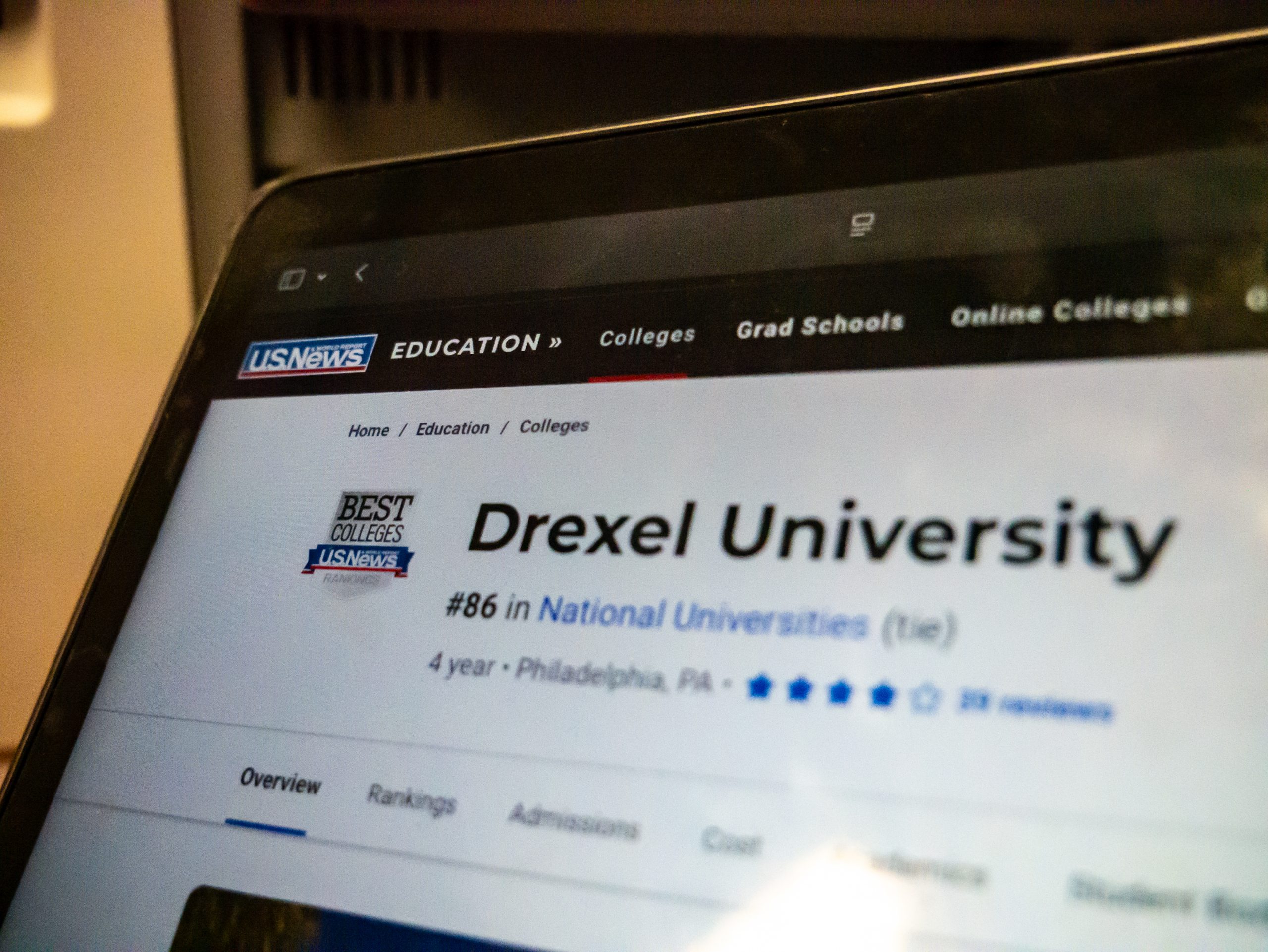
Prestige is indeed indeed a powerful thing in the United States. It shapes our education and our careers. It influences how we consider the credibility of our fellow human beings. Currently, Drexel University is ranked 86th in the U.S. News & World Report’s list of college rankings. It has moved up 19 spots in just the last two years. But after knowing what sort of measures schools can take in order to secure higher positions on that list, it becomes increasingly difficult to be proud of this accomplishment.
Posted in UncategorizedComments Off on Can we trust U.S. News & World Report rankings?

Majoring in Debt?

Photo by Lucas Tusinean | The Triangle

As a wise man once said, “Education costs money, but then so does ignorance.” As we ponder the value of a college degree in 2025, one cannot help but wonder: would that wise man have been quite so pithy if he were staring down the barrel of $30,000 in student loan debt? Welcome to the Great College Debate of 2025, where the only thing more inflated than tuition prices is your sense of optimism after freshman orientation.

Let us start with the good news. The College Wage Premium — yes, that is a real thing and not just something your parents made up to get you out of the house — still holds strong. A 2015 study shows that men with bachelor’s degrees rake in about $900,000 more over their lifetimes than high school grads. Women make around $630,000 more. That is a lot of avocado toast — even if you never get to afford a house to eat it in.

Thanks to the internet doing what it does best (reducing complex decisions to clickable dashboards), students can now also compare over 30,000 degree programs with ROI tools that analyze everything from graduation rates to post-grad earnings.  The Foundation for Research on Equal Opportunity recently released an innovative online tool that allows users to compare the ROI of over 30,000 bachelor’s degree programs, factoring in costs, graduation rates, post-graduate earnings and more. STEM fields? Solid bets. Interpretive dance theory with a minor in 18th-century Icelandic poetry? Maybe look twice.

But despite this data, skepticism about the universal value of a degree is mounting. Tuition growth has far outpaced inflation and wage growth for decades now, leaving many students and families drowning in debt. The average student loan burden for a bachelor’s degree recipient is now over $30,000. Stories abound of debt-saddled graduates working as baristas and Uber drivers, struggling to make loan payments with jobs that do not require their costly degrees. One cannot help but wonder, would some of those students have been better off pursuing shorter, more affordable vocational or technical training pathways directly aligned with in-demand careers?

Thus, alternative pathways are out here staging a quiet revolution. Bootcamps, micro-credentials, YouTube tutorials with suspiciously cheerful instructors — they are all gunning for the traditional four-year throne. Even Peter Thiel, tech investor and professional college skeptic, famously said, “Learning is good, credentialing is bad.” (He said this while probably sipping overpriced coffee in a Wi-Fi-enabled treehouse made of stock options). Some see a future where the traditional degree is displaced by lifelong, skills-based learning pathways more responsive to the dynamic needs of employers and learners… especially if it means avoiding debt, soul-crushing finals and group projects where one guy ghosts and still gets an A.

There is no one-size-fits-all answer. College can be a golden ticket — or a gilded trap. Like any investment, much depends on individual variables — the student, the institution, the program of study or the career goals. A low-income, first-generation student who graduates from a top-tier university debt-free thanks to financial aid and goes on to a lucrative banking career has realized an unequivocal return on investment. If you land a full ride to a top school, major in something employable and graduate on time (miracles happen), you are probably set. But if you rack up six figures of debt majoring in something you cannot explain to your grandmother, well… see you in the barista union.

The best advice? Treat college like any other expensive, life-altering purchase. Crunch the ROI numbers. Research like you are stalking your ex on LinkedIn. And when in doubt, remember: you can always move back into your parents’ basement. I hear it is all the rage in 2025.

College is still a big decision, make it wisely. Or at least make it with good Wi-Fi and a backup plan.

Posted in UncategorizedComments Off on Majoring in Debt?

Why the Balkans are being washed with waves of protests and why you should care

Photo by Kasey Shamis | The Triangle

Lately, it feels like the world is simmering. Political unrest has surged all across the globe. Among the loudest voices are those arising from the Balkans, who are more concerned and charged than ever, driven not only by discontent, but also by a heightened awareness of what “can be”. Considering the similarity of the protest culture and the causes that led to these uprisings, the protests in Balkan regions feel a lot like waves that are part of the same storm. 

The Balkans, culturally and politically, refer to a southeastern European region that includes countries such as Serbia, Bosnia and Herzegovina, Montenegro, North Macedonia, Albania, Croatia, Slovenia, Bulgaria, Romania, Greece and often Turkey, Georgia and Hungary. What unites these lands is a shared history of turbulent transitions, fragile politics and unstable economies. But they are also places where the people are loud, loving, passionate and resilient, with a deep sense of collective identity. In 2025, this spirit has been particularly visible in their protest cultures.

In Serbia, the collapse of a railway station canopy in 2024 resulted in 16 deaths and triggered an anti-corruption movement that has grown into one of the largest in history. Over 400 towns have joined. As a result, Prime Minister Miloš Vučević resigned in January 2025, but protests continue calling for greater transparency and accountability.

In Greece, the second anniversary of the deadly Tempi train crash brought hundreds of thousands into the streets in February 2025. The phrase ‘I have no more oxygen’, repeated by protestors, has become a symbol of dissatisfaction with the government’s inability to provide safety and justice to its people.

Bosnia and Herzegovina, as well as Montenegro, are also seeing demonstrations by students pleading for justice and safety. In Bosnia, protests followed a deadly landslide reportedly caused by illegal quarry operations. Meanwhile, in Montenegro, mass shootings triggered demand for security reform. 

In Hungary, more than 50,000 people gathered in Budapest for one of the biggest protests the country has seen in years. Many were frustrated with corruption, declining media freedom and the weak economy. 

Protests in Georgia have continued daily since October 2024, following parliamentary elections that were widely criticized for vote-buying and growing authoritarianism. The response from authorities has been harsh, including arrests, surveillance and violent crackdowns. 

In Romania, people protested across major cities over judicial reforms that people fear will weaken the independence of the courts. These protests are part of a longer struggle in Romania to protect democratic values and prevent political interference in the justice system.

A different kind of protest–economic–has emerged through coordinated boycotts across Southeastern Europe. Rising prices and corporate malpractice have led to large-scale backlash in countries like Croatia, Serbia, North Macedonia and Montenegro.

A fascinating feature across the Balkanic region is the predominantly student-led nature of these protests. Young people have taken initiative to both organize and shape the tone and ethics of protest culture, an exemplary showcase of the art of protesting. Symbolism is frequently used by protesters as an elegant form of expression against harsh backlash from the police. These student movements are conscious, informed, well-targeted and often careful not to be misdirected or taken advantage of by partisan agendas. The crowds can organize instantly. They are deterring but never responding with the same violence that they receive from the government enforcement. They unite and use social media purposefully. Despite everything going on, it is roseate to see that the youth dares to remain youthful. 

Fueled by the youth, Turkey’s protest movement this year began with the imprisonment of Ekrem İmamoğlu, the opposition mayor of Istanbul and a key contender in the next presidential election. The arrest was widely viewed as politically motivated, and citizens saw it as a direct insult to democracy. Even though this incident drew the initial trigger, the movement quickly grew into something larger and deeper, just like the Gezi Park protests in 2013.

The Gezi protests began as an effort to stop the demolition of a park and its trees in central Istanbul, but turned into a nationwide movement about freedom of speech and democracy. Moments of beauty defined the protests. They made it a show: singing songs, reading poems and giving out flowers. The current movement echoes many of these same values, even the humor, from the witty signs to the Pikachu-costumed protestor running away from the police.

Today’s protests are about reclaiming power, safety and stability. This is clear not only in the marches but in nationwide boycotts, where the economic power of the citizens is showcased, withdrawing support for companies and events affiliated with government entities. This was even reflected in the entertainment industry, as the English band Muse, long loved in Turkey, listened to their audience’s concerns and canceled their concert scheduled for the summer of 2025 by sharing a statement supporting the people’s cause of boycotting the organizer. 

As before, citizens are exercising their legal right to protest, which is protected by Turkey’s constitutional law. And as before, they are being met with police violence and illegal legal consequences such as arrest. Families of protestors, as well as those who share their views, are afraid but choose to stay silent. I would appease them by saying that it is far scarier to imagine a Turkey where democracy is handed over quietly and without opposition. It would be a Turkey where erratic men have unchecked power, where the people are unable to predict the agenda even for the next day.

Even if these protests, boycotts and social media appeals do not result in any actual change in the governmental systems, they still matter. The uproar was covered by foreign media, creating pressure from the international conscience that functions like a ‘superego’ in Freud’s terms. More importantly, they are a reminder and a chance for people to come together and remember that they are not small or alone in their endeavors. 
Fascism tries to isolate individuals and reduce them to silence and fear. The body under fascism is nervous, hypervigilant and tender. This is not metaphorical but somatic. The body is politicized, then pathologized. By extension, roaming the streets of your city while peacefully shouting out slogans with your people is therapy. In the end, all of these movements are from and for a concern for the future, and keep reminding us of our shared humanity.

Posted in UncategorizedComments Off on Why the Balkans are being washed with waves of protests and why you should care