Author Archives | Michael Davis

The Love Triangle: Ten years since infamous infidelity-promoting website hack

Photo courtesy of James Maskell | Flickr

If there is one thing most people in relationships can agree on, it is this: nothing ends love faster than infidelity. Cheating is not just a mistake. It is the most commonly cited reason for spousal breakups, according to research spanning 160 cultures. Now, take the unfortunate commonality of infidelity ripping marriage apart at the seams and add a catalyst. Since 2002, that catalyst, dressed up as a sophisticated dating website promoting adultery, has been Ashley Madison.

The website, which proudly displays the tagline “Life is Short. Have an Affair” on its front page, was the first ever adultery-promoting dating site to go heavily mainstream. Launched in 2002 by creator Darren Morgenstern, Ashley Madison carved out a controversial niche by openly marketing itself as a platform for paying customers in committed relationships seeking discreet affairs. By 2015, it reportedly had over 37 million registered users worldwide. The site’s rapid growth reflected a strong demand for secretive physical and emotional connections outside users’ primary relationships, but also introduced challenges related to fake profiles and user trust. These challenges reached their crescendo on July 12, 2015, when a data breach occurred on the site. And the outcome was not pretty.

Approximately ten years ago, the site, which was already infamous for its promiscuous reputation, faced even greater backlash when a massive data breach exposed the personal information of its users to the public.

It left people asking: Was this a cruel invasion of privacy? Or was this justice?

The Impact Team, a hacker group formed specifically to dismantle the site, released a small gathering of sensitive information. This small gathering of information included Ashley Madison documents as well as a limited amount of user information. The Impact Team, along with these leaks, sent a warning to the company threatening that if they did not shut down in approximately a month, the Impact Team would release even more information they had collected. 

On August 18, 2015, that is exactly what they did. The site did not shut down despite the threat. The Impact Team released a full list of Ashley Madison users, along with sensitive personal information. Marriages collapsed. Careers ended. Reputations – some belonging to public figures – were publicly shredded. And those who had long wished for the site’s downfall, untouched by the breach, scrolled through the leaked data with a disturbing mix of curiosity and satisfaction. 

Now, the situation stood at the intersection of two ethical breaches: the exposure of extremely personal data and the business of infidelity itself. Some people viewed the hack as a necessary wake-up call – a dramatic consequence for a corporation that profited off secrecy and broken trust. To them, Ashley Madison had it coming. But others saw it differently. They argued that no one, regardless of their choices, deserves to have their private life dumped online for public consumption.  After all, what happens in a relationship – good or bad – should be left to the people in it, not turned into an internet spectacle.

Open and honest communication is one of the most important pillars of any healthy relationship. If you are feeling unsatisfied or disconnected, it is always better to talk about it directly rather than let resentment build. Maybe you need more words of affirmation. Maybe you crave more quality time or physical affection. Whatever it is, voicing those needs is essential. No one deserves to be blindsided by the discovery that their partner is cheating, whether it is a physical betrayal or an emotional one. Affairs not only break trust but also fracture the very foundation a relationship is built on and leave lasting damage that affects a person’s ability to trust others for years to come.

In regards to the hack, breaking the law to leak extremely sensitive information about millions of individuals is not justifiable either. No matter how controversial or morally questionable the platform may be, violating personal privacy on that scale is a serious ethical breach. Condemning the hack does not excuse the behavior it exposed and the creation of the site itself – all actions can be wrong at once. 

What is most disappointing is that it took a breach of this scale for Ashley Madison to even begin reckoning with the damage its business model had caused. Later revelations, such as a huge majority of female users actually being bots and fake security awards, only added fuel to the fire, exposing just how much of the site was built on misleading promises. Ashley Madison made millions in revenue off what many now view as a cleverly marketed, morally bankrupt scam. And even today, the site remains online. Its flashy marketing may have faded away, but its controversial legacy still looms.

Posted in UncategorizedComments Off on The Love Triangle: Ten years since infamous infidelity-promoting website hack

Neurology meets theology with Dr. Ozdemir

Photo by Suhani Dheer | The Triangle

In this article, I will introduce you to a very special person. Professor Gazi Ozdemir, MD, was born in 1944 in Antakya, Turkey. He graduated from Istanbul University’s Faculty of Medicine in 1969. In 1988, he became a professor of neurology. Being one of the leading figures in Turkish neurology in 1993, he founded the Turkish Cerebrovascular Diseases Society and served as editor of the society’s journal for 10 years. He held international roles as the Turkish Representative of the European Stroke Council, Member of the European Stroke Scientific Board, and Board Member of the Mediterranean Countries Stroke Society. In 2001, he was awarded the Stroke Fellow title by the European Stroke Council. In 2019, he was awarded the “Award for Contribution to Neurological Science and Outstanding Service” by the Turkish Neurological Society. Today, he continues to see patients at his clinic in Turkey and is also a respected author dedicated to educating the public through his theological research. 

As a graduating neuroscience student who has endless curiosity about human psychology and belief systems, I have been following Dr. Ozdemir’s work closely for some time. Having this interview with him is a great honor for me.

Parts of the transcript from this written interview have been translated from Turkish and lightly edited for length and formatting. 

Interviewer: Dr. Özdemir, thank you very much for taking the time to do this interview. I know that you are an incredibly productive and therefore a very busy person. You’ve published 20 books in the past 18 years, and you continue to try and reach people through both your YouTube videos and newspaper pieces. To begin, I would like to talk about your medical career and your 2010 book “Religion and the Brain”. How did your medical training and your many years of interacting with patients shape this work, as well as your perspective on religion in general?

Dr. Ozdemir: In Antakya, Hatay, where I was born, communities that believe in the rules of life found in the Torah, the Bible and the Quran have lived together peacefully for centuries, without hostility or conflict. While I lived peacefully among these communities, I kept asking myself: “If God is singular, then why are there different religions, and why do these different divine books exist? Why are there also sectarian divisions within these belief systems?” and I began searching for answers. Along with reading books, I started visiting religious leaders and clergy of these communities to ask my questions. As my research continued, I began reading the Torah, the Bible and the Quran. During my medical studies, I became increasingly awed by the perfection of the human body, and my belief in a divine power grew stronger. As I began my neuropsychiatry residency and learned how the brain works, I noticed that the Quran includes some of the same guiding principles as the brain. Some examples include:

  1. The use of a bell-curve-like distribution
  2. The principle of making choices between dualities in balance
  3. The emphasis on justice (not equality), and equal opportunity
  4. The principle of making things easier, not harder
  5. The system of monitoring, warning, assisting, rewarding, and penalizing
  6. Benefiting from learning and tradition, but not through imitation
  7. Moderation brings benefit, extremes bring harm

Based on these principles, I increasingly believed that what we call religion is a set of foundational life rules, and that the brain’s role is to maintain and develop life, both in fact pointing to similar truths. These insights also helped me begin to find answers to my existential questions.

Interviewer: Your first non-medical publication, “What Remains of Mevlana,” published in 2007 was a compilation of quotes by the famous Sufi thinker Rumi. I would like to quote one: “All other voices are echoes of that blessed voice.” Many religions and mythologies include the belief that God can be found in the sky, the sun, the sea, beneath the earth, in trees, in animals, within us and in each other. What are your thoughts on this based on your research?

Dr. Ozdemir: The concept of God, whose attributes we cannot fully know, is thought to have created all material and spiritual beings. Awareness of God can stem from recognizing the perfection of its creations.  Thus, it would make sense that in every created being, whether living or nonliving, God is present in some way and imparts consciousness. In my opinion, one could say that God has hidden itself within these creations. That is why the Quran begins with the word “read,” encouraging believers to gain knowledge and seek God through awareness and science. In this sense, in God’s creations, scientific principles like mathematics and geometry have been applied with great precision and harmony that can be observed.

While studying Rumi’s works, I realized that he had deeply read and studied the Quran and drew extensively from it. His works, especially the “Mesnevi,” actually reflect many Quran verses. Once I noticed this, I started conducting a study mapping Rumi’s words to specific Quran verses across all of his major works. The result became a book titled “The Mevlana Who Uncovered the Quran,” which was published three months ago.

Interviewer: I am very excited to read it. It’s impossible to not notice the cyclical nature of everything in, well, nature. Yet humanity still likes to think of itself through exceptionality and permanence. That said, interest in reincarnation or the cycle of samsara (birth-death-rebirth), from Indian-origin religions like Buddhism, Hinduism, Jainism and Sikhism, has grown significantly in recent years. Do these beliefs have any parallels in Abrahamic religions or other traditions?

Dr. Ozdemir: In India and nearby countries, this belief is defined as Tanasuh which is the idea that a person may be reborn in an animal’s body. Reincarnation, however, refers to a person being reborn in another human body in order to continue their spiritual learning across many lives. Such claims have been reported in Turkey, actually, interestingly, in the Hatay region and to a lesser extent in Adana, Mersin, and Tarsus which are the southern parts of Turkey that have a coast to the Mediterranean Sea. Almost in all such examples, the claims are made by children between the ages of two and five, and no scientific research has conclusively proven a match between the children’s claims and the deceased individuals they refer to. In the Quran, a verse says: “We are able to recreate even your fingertips” – which might be a hint worth investigating. I hope researchers will compare individual characteristics like fingerprints, handwriting and other biometric features – it is an interesting research venue.

Interviewer: A systematic review article from 2022 suggested that spiritual practices are associated with neurobiological markers such as increased cortical thickness and altered brain connectivity, which may have protective effects against mental disorders like depression and addiction. This study is one of many that point to the psychological and biological benefits of belief in a higher power. In your opinion, how does one find happiness? I would love to hear your advice based on your theological and medical expertise, as well as your personal life experience.

Dr. Ozdemir: Belief in God and the immutable core rules we call “religion” is influenced by many factors. There are even theories suggesting that certain brain structures, like the pineal gland and temporal lobe, affect a person’s tendency to believe. Faith can stem from both genetic predisposition and environmental influence. For example, whether one grows up in a religious environment before adolescence can significantly impact the brain’s neural plasticity, shaping belief pathways or allowing them to atrophy.

In my case, being born into a society of diverse faiths, my highly questioning personality, strong sense of free will and critical thinking were naturally reinforced. My medical training greatly enhanced these abilities. Additionally, I had to finance my own education since primary school, which contributed to my resilience. These traits helped me fulfill my responsibilities and contribute to society throughout my career – this can be thought of as a form of happiness. Looking back, I can now recognize the invisible support I received during the hardest moments of my life. 

Interviewer: It was a true privilege to engage in this meaningful conversation with you Dr. Gazi Özdemir.

Dr. Ozdemir: Ms. Yılmaz, your efforts in informing the public are truly valuable. I sincerely thank you for involving me in this endeavor and considering me suitable for the interview. I wish you health, happiness and success throughout your life.

Interviewer: It was my pleasure! Thank you again for your time and for sharing years worth of wisdom and hard work with us. 

Posted in UncategorizedComments Off on Neurology meets theology with Dr. Ozdemir

The Negative Effects of Modern Social Media

Photo by Gabby Rodriguez | The Triangle

Buzz! Ring! Alarm! That is the constant and recognizable sound of our phones and technology notifying us about the news, a text or a call. We seek out the never-ending stream of information, desperate to stay connected with friends, family and the world. With this constant stream of social media, it is important to remember that only in recent generations has information been so readily available. From libraries to word of mouth to textbooks, all of the solutions to curiosity have been in-person. So, what this generation takes as normal – walking down the sidewalk with phones in our hands – is just a perception that has never been seen before. Generations before the era of technological devices, the world looked very different, from smiling and talking to people outside to reading books. Many people were participating in activities that required movement and social interaction more than they typically do today.

For example, walking with our phones in hand has developed an increased pressure on our neck muscles to support a head constantly facing downwards. In addition, frequent use of phones and devices leads to repetitive motions, forcing the body into a downward posture. Over time, this strain can cause muscle spasms and pain in the hands, wrists and neck. While technology is essential in daily life, it is important to recognize its physical impact. If possible, keeping devices eye-level instead of down, and standing to give the body breaks are positive practices that can be enabled to lessen the physical effects. 

Furthermore, the use of technology is so normalized in today’s culture that our generation thinks that mental health problems are too. There is a positive correlation between those that use social media more regularly and mental health issues. With the increase in technology access, younger children have been more exposed than ever to world events and news, and frequent consumption of negative news leads to anxious thoughts. People between the ages of mid-teens to mid-twenties are also typically the demographic to not receive treatment. The time gap means that there are more people sitting with the symptoms of mental health disorders without the help that they need, which usually leads to an increase in symptoms. 

The use of AI in social media is also an important factor to consider, as many try to distinguish the reality amongst all of the TikToks and Reels that they are consuming. There are easy ways for people to add a background or filter on their stories to make it seem like their lives are better than reality. Comparisons, combined with the impressionable minds of young adults and teens, heighten dissatisfaction in their own lives—even more than social media initially did. Now, someone can fake being on a tropical vacation, when in reality, they are in their backyard. AI makes it easier for content creators and other social media users to display the life they want, rather than the one they have. 

Lastly, while these negative impacts should be monitored, it is up to the user to decide how to take the information and limit the use of social media and technology. Limiting screen time, deleting some social media accounts and refraining from following celebrities/influencers could be seen as a positive step in reducing the amount of fake content and improving mental health. Despite its negative impact, social media and technology provide an important outlet for people to connect with their generation and like-minded individuals, which keeps them coming back. It is also important to recognize that the use of technology in society is here to stay and advance, and it is equally important to practice safety tips to help stay healthy while on social media and devices.

Posted in UncategorizedComments Off on The Negative Effects of Modern Social Media

Can we trust U.S. News & World Report rankings?

Photo by Kasey Shamis | The Triangle

Prestige holds significant power in the United States. The notion that a person’s reputation hinges so heavily on the names they associate with seems shallow and insincere, yet the reality is hard to overlook. Nowhere is this more evident than in the U.S. News & World Report.

Once a year in September, parents, children and college presidents await the U.S. News & World Report to publish the latest edition of their biggest claim to fame: the rankings of the best colleges in the United States. The U.S. News college rankings are often regarded as the most influential college rankings in the country and for fair reason. They have a long history of precisely refining and updating the algorithm they use to determine these rankings. Many are familiar with these rankings but not as many have familiarized themselves with the algorithm that these rankings descend from. Something peculiar starts to happen when you do: the whole system begins to seem a little less prestigious.

The ranking criteria are available to be analysed and dissected on the U.S. News website. At a glance, the list seems sensible. Student-to-faculty ratio making up four percent of the total score? Makes sense. First-year retention rates making up five percent? Seems plausible. Most of the list looks like this, but then you arrive at one particularly massive criterion that makes up a baffling 20 percent of the total ranking: the peer assessment. For reference, the second most influential criterion is graduation rate performance at 10 percent.

The peer assessment survey is the subject of much criticism directed towards the U.S. News college rankings. Once a year, university presidents, provosts and deans of admissions receive a survey asking them to rank fellow institutions on a scale from 1 to 5—institutions they have likely never worked for, attended or visited. As Sonia Cardenas, the vice president for academic affairs and dean of faculty at Trinity College, put it in her article criticizing the subject, “Judging the quality of an institution at which I’ve never worked, studied or conducted an accreditation review is like asking a culinary expert to rate the signature dishes at hundreds of restaurants where they’ve never eaten.” This is because the peer assessment is not a measure of a school’s academic and educational quality; it is a measurement of a school’s reputation.

At the end of the day, that is what the U.S. News is about. The goal is not to measure the actual quality of education at universities; the goal is to uphold a legacy status of prestige, and prestige is not a direct indicator of quality. Although prestige and quality may correlate, prestige as a subjective metric is susceptible to bias and misinterpretation.

While the peer assessment score is the largest single criterion in the U.S. News rankings, it still only makes up 20 percent of a school’s total score. Does that make the U.S. News rankings still 80 percent reliable? What if a school were to decide that it wanted to climb the U.S. News rankings by targeting all the other criteria?

Well, if Drexel University decided that it wanted to do exactly that, where might it start? The first step would be to increase the school’s graduation rate. And an easy way to do that is to eliminate those pesky dropouts who cannot continue their education for financial reasons, which is the number one reason why students drop out of college. Now, we could prevent this by providing extra financial aid to students in need, but that would mean less money in the bank for us to spend on other ranking criteria, such as faculty salaries. But the good news is, the U.S. News & World Report does not care about how good we are at keeping less privileged students on track; they only care about results. What if we instead choose to only admit students who are going to graduate no matter what? What if we only admit extremely wealthy students? While the U.S. News does consider Pell grant (a FAFSA grant given to the nation’s lowest income students) graduation rates as a metric, we could still game this metric by preventing the admission of the most financially challenged Pell grant students. And if we go that route, we can do ourselves a couple more favors in the process. Already wealthy students are more likely to earn a higher salary after graduation, which is a measurement that makes up five percent of the rankings. More selective applications also mean a better student-to-faculty ratio. And if only the most elite and powerful children in the world are allowed to enter our institution, just imagine what that would do for our peer assessment score.

The process would be straightforward enough. It would simply mean giving out less financial aid to discourage less wealthy students from attending or even rejecting them outright. Instead, we could put more money into fancy residence halls and extravagant amenities that would attract those used to a certain degree of luxury. It would mean inflating the amount of sports scholarships given out, especially for sports that, in order to master, would require special access to world-class clubs and coaches (ever wonder why Harvard offers more varsity sports than any other university in the country?). All of this can be done without putting a single thought towards bettering the quality of the education our students will be receiving.

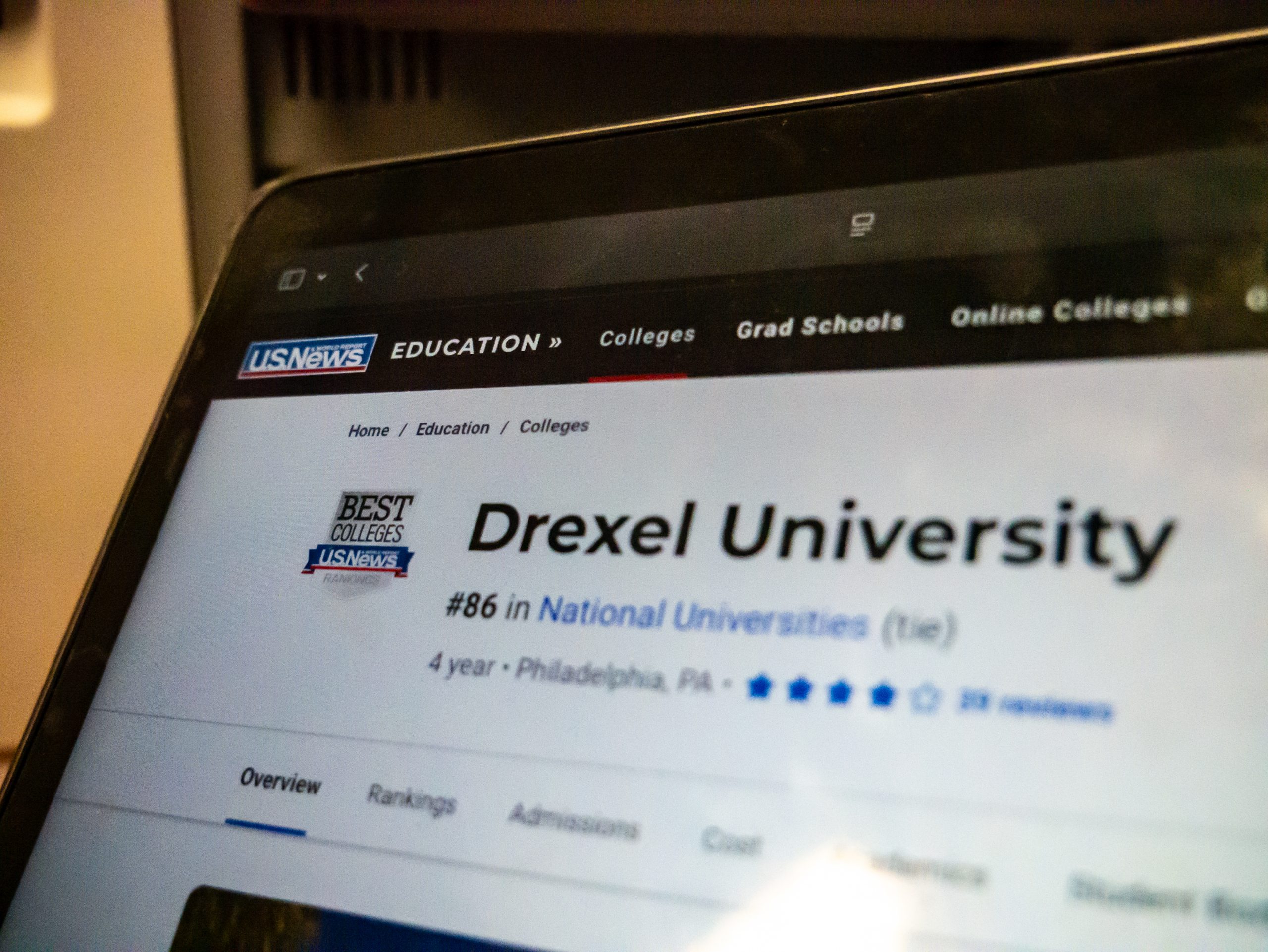
Prestige is indeed indeed a powerful thing in the United States. It shapes our education and our careers. It influences how we consider the credibility of our fellow human beings. Currently, Drexel University is ranked 86th in the U.S. News & World Report’s list of college rankings. It has moved up 19 spots in just the last two years. But after knowing what sort of measures schools can take in order to secure higher positions on that list, it becomes increasingly difficult to be proud of this accomplishment.

Posted in UncategorizedComments Off on Can we trust U.S. News & World Report rankings?

Generative AI is nothing but another innovation

Photo by Gabby Rodriguez | The Triangle

I was recently perusing the Triangle website when I stumbled upon an interesting little article by Sam Gregg about the dangers of ChatGPT. While this is not the first article that has popped up in the last couple of years as tech panic surrounding generative AI has been on the rise, it does make an interesting case about diminishing the human drive to learn and search. This is an overly pessimistic take on a minor danger of generative AI.

Do not mistake me for a zealot of the temple of OpenAI, but I do not believe the prime danger of platforms like ChatGPT is the loss of our humanity. Some generative AI models have been utilized to provide information quickly and easily to users, and the argument could be made that it kills the human desire to search deeper on any given subject. The truth is, this argument neglects the fact that Google made finding information far easier than ever before but did not diminish the drive to learn. We may not be digging through library stacks anymore, but that does not mean we have lost anything more than inconvenience. It is not uncommon to assume that convenient technology begets laziness–even Socrotes hated the written word fearing human memory would begin to atrophy. That being said, convenience does not mean that the ability to search and learn is lost with each new innovation.

While generative AI might provide simple and easy-to-understand explanations, it cannot provide the deeper understanding that a person would need for meaningful applications. For example, the AI-generated blurb at the top of a Google search gives a simple explanation of how to drive a car, but it will not get me anywhere close to my license. That would require much more research and a personal desire to learn. Learning will still occur to those who desire. The only people who may lose their desire to learn are the ones who barely had it to begin with.

Academia has been a threatened space since the very birth of ChatGPT, with the fear that students who use generative AI for their assignments are not properly learning the material. The rise of AI checkers mitigates a portion of this danger, however, even if they are not perfectly accurate, it is also a self-correcting problem as ChatGPT cannot sit in the lecture hall for a midterm. Furthermore, those who would use generative AI for unethical practices would have used the old-fashioned method of looking up Quizlets, going on Chegg, looking up the answer sheet, etc. ChatGPT is only a marginally better cheating assistant for an exam than Google. The cases where AI and only AI can be used to cheat on an assignment would be so few and far between that the “dark age for the internet and humanity”, as Gregg claims, is far from the future we will live in.

Therein lies the rub with worrying that generative AI will take over every field and diminish the learning and innovation of humanity: AI is only ever going to be perfectly average. That is the goal of any user data-driven model, and the very reason there is fear of generative AI “taking over”. The argument is that it is less capable than human effort as it lacks the creativity, expertise, and “humanity” of a human. That means it would also be less capable and less effective at any given task than a human who is driven or even mildly educated or experienced. The only situations where generative AI seems like a viable option are when the task is mundane or otherwise simplistic, where average work for cheap is the answer. If I wanted a quick and easy set of marketing emails, ChatGPT would be a great option, but if I wanted advanced marketing approaches I would look to a well-educated human.

On the academic front, there is an arguable use for AI. If a professor teaches a subject poorly, ChatGPT could make a half-decent stand-in. The textbook and class notes will still be used, but the simple overview provided by generative AI can make or break when a teacher fails to cover the content. There is also minimal danger to some AI-generated assignments. (This point is entirely hypothetical. I am by no means advising the use of AI in unethical manners for assignments). If the meager performance of AI is good enough to get me a good grade, and I would have learned little from completing the assignment, then there is no danger in letting ChatGPT handle it. I would like to say that busy work that teaches us little is uncommon in the academic world, but I think we all know that is not true. A research paper that requires eight sources and an APA bibliography should be done with a human brain, but a flawed discussion board that gives full credit for any understandable text and inherently limits real discussion is an entirely different story. 

I think a more accurate perspective is that generative AI has opened up a new field of what is possible, and it will continue to, but this is not the end of humanity. It is not the beginning of some dark age where humans are incapable of learning and AI has become the go-to for written communication. It is simply another step in technological advancement. Some jobs may disappear, and academia will have to adapt much like it already is, but this is not the first time. The word “computer” used to refer to a profession, not a device. And much like how mathematicians took the backseat to the computer, I am sure some professions may fade away, but humanity will adapt and correct. Technology is constantly evolving, and society changes wildly with it, but the end of the world we know is not the end of the world.

Posted in UncategorizedComments Off on Generative AI is nothing but another innovation

Is artificially generated work considered art?

Photo by Gabby Rodriguez | The Triangle

According to Merriam-Webster, technophobia is defined as “fear or dislike of advanced technology or complex devices and especially computers.” When grocery stores and retail chain stores implemented self-checkout machines, it was the technophobes who provided the most pushback, arguing over privacy and theft concerns, as well as the potential elimination of cashier workers. Following the groundbreaking release of ChatGPT in 2022, it was the technophobes who warned that “AI will take our jobs.” Despite the generalized fear of AI’s potential to replace humans, the emergence of AI-image generators, such as DALL-E 2 and Midjourney, has sparked more meaningful debates over whether art developed by artificial intelligence should be considered real art. Is this another wave of technophobic pushback, or are artists expressing valid concern about their livelihoods?

To explore this, we must ask: What defines art?

Plato developed the idea of art as “mimesis” – or imitation when translated from Greek. He believed art was a form of representation and should be valued according to the degree of which it replicated its subject. During the Romantic movement, artwork was meant to evoke an emotional response from its audience. In the 20th century, Immanuel Kant argued that art should be judged not by aesthetic beauty, but by its formal qualities, which was a key factor as art became more abstract.

Joshua Issa, in his blog post on Medium.com, argues that when we consider art as a sensory, creative and interpretive work, art may then be defined as “something that was intentionally created to provide a sensory experience for the sake of interpreting the world.” Issa then argues that AI art cannot be art, emphasizing that for something to be considered art, there must be some level of intentional creativity and meaning – something generative AI lacks.

Considering Issa’s definition of art, along with the three elements that help define art, it is difficult to make a compelling argument for generative AI art to be considered a true form of art.

When it comes to evaluating art, it is crucial to make a distinction between creation and imitation. While AI models like DALL-E 2 create accurate depictions of the inputs you make, it was not an original creation.  There is no point-of-view being expressed, no invitation for self-reflection. AI does not ask itself what to include, what message it wants to convey, what colors it should use over others, it isjust high-probability outputs.

Another distinction that must be made is authorship. If AI is just a tool, then who is the actual creator of the work? The IT engineers? The person who provided the prompt? Tools like the paintbrush, musical instruments and even cameras still require a human touch to allow one’s emotions to speak through their work. An AI model cannot illustrate emotions the way humans can, regardless of how many lines of code are written to mimic them.

While AI is certainly here to stay, it might be better to view AI-generated images as design simulations rather than artistic expression. Maybe I am underestimating its ability, but as an amateur in the world of AI, because I am not studying computer science, generative AI tools cannot produce real art. After all, AI is artificial, and no amount of data used to train AI will replace an original work of art. True intelligence coincides with a certain level of self-awareness, something AI will never achieve.

Posted in UncategorizedComments Off on Is artificially generated work considered art?

Generative AI is nothing but another innovation

Photo by Gabby Rodriguez | The Triangle

I was recently perusing the Triangle website when I stumbled upon an interesting little article by Sam Gregg about the dangers of ChatGPT. While this is not the first article that has popped up in the last couple of years as tech panic surrounding generative AI has been on the rise, it does make an interesting case about diminishing the human drive to learn and search. This is an overly pessimistic take on a minor danger of generative AI.

Do not mistake me for a zealot of the temple of OpenAI, but I do not believe the prime danger of platforms like ChatGPT is the loss of our humanity. Some generative AI models have been utilized to provide information quickly and easily to users, and the argument could be made that it kills the human desire to search deeper on any given subject. The truth is, this argument neglects the fact that Google made finding information far easier than ever before but did not diminish the drive to learn. We may not be digging through library stacks anymore, but that does not mean we have lost anything more than inconvenience. It is not uncommon to assume that convenient technology begets laziness–even Socrotes hated the written word fearing human memory would begin to atrophy. That being said, convenience does not mean that the ability to search and learn is lost with each new innovation.

While generative AI might provide simple and easy-to-understand explanations, it cannot provide the deeper understanding that a person would need for meaningful applications. For example, the AI-generated blurb at the top of a Google search gives a simple explanation of how to drive a car, but it will not get me anywhere close to my license. That would require much more research and a personal desire to learn. Learning will still occur to those who desire. The only people who may lose their desire to learn are the ones who barely had it to begin with.

Academia has been a threatened space since the very birth of ChatGPT, with the fear that students who use generative AI for their assignments are not properly learning the material. The rise of AI checkers mitigates a portion of this danger, however, even if they are not perfectly accurate, it is also a self-correcting problem as ChatGPT cannot sit in the lecture hall for a midterm. Furthermore, those who would use generative AI for unethical practices would have used the old-fashioned method of looking up Quizlets, going on Chegg, looking up the answer sheet, etc. ChatGPT is only a marginally better cheating assistant for an exam than Google. The cases where AI and only AI can be used to cheat on an assignment would be so few and far between that the “dark age for the internet and humanity”, as Gregg claims, is far from the future we will live in.

Therein lies the rub with worrying that generative AI will take over every field and diminish the learning and innovation of humanity: AI is only ever going to be perfectly average. That is the goal of any user data-driven model, and the very reason there is fear of generative AI “taking over”. The argument is that it is less capable than human effort as it lacks the creativity, expertise, and “humanity” of a human. That means it would also be less capable and less effective at any given task than a human who is driven or even mildly educated or experienced. The only situations where generative AI seems like a viable option are when the task is mundane or otherwise simplistic, where average work for cheap is the answer. If I wanted a quick and easy set of marketing emails, ChatGPT would be a great option, but if I wanted advanced marketing approaches I would look to a well-educated human.

On the academic front, there is an arguable use for AI. If a professor teaches a subject poorly, ChatGPT could make a half-decent stand-in. The textbook and class notes will still be used, but the simple overview provided by generative AI can make or break when a teacher fails to cover the content. There is also minimal danger to some AI-generated assignments. (This point is entirely hypothetical. I am by no means advising the use of AI in unethical manners for assignments). If the meager performance of AI is good enough to get me a good grade, and I would have learned little from completing the assignment, then there is no danger in letting ChatGPT handle it. I would like to say that busy work that teaches us little is uncommon in the academic world, but I think we all know that is not true. A research paper that requires eight sources and an APA bibliography should be done with a human brain, but a flawed discussion board that gives full credit for any understandable text and inherently limits real discussion is an entirely different story. 

I think a more accurate perspective is that generative AI has opened up a new field of what is possible, and it will continue to, but this is not the end of humanity. It is not the beginning of some dark age where humans are incapable of learning and AI has become the go-to for written communication. It is simply another step in technological advancement. Some jobs may disappear, and academia will have to adapt much like it already is, but this is not the first time. The word “computer” used to refer to a profession, not a device. And much like how mathematicians took the backseat to the computer, I am sure some professions may fade away, but humanity will adapt and correct. Technology is constantly evolving, and society changes wildly with it, but the end of the world we know is not the end of the world.

Posted in UncategorizedComments Off on Generative AI is nothing but another innovation