
Author Archives | Mariya Yasinovska, Opinion Editor

Life interrupted: Resilience in a war-torn Ukraine

Nearly three years since Russia’s full-scale invasion, war has become an inescapable backdrop to daily life in Ukraine. For Ukrainian citizens, the initial shock of the February 2022 invasion has long since given way to a brutal, exhausting routine of air raids, power outages and uncertainty. 

An overnight Russian drone strike on Dec. 2 hit critical infrastructure and left parts of Rivne and Ternopil without power. A drone struck a residential apartment building, and one person died with others receiving injuries. 

The next day, life continues. On a cold December morning in Ternopil, Ukraine, a school bell rings just minutes after an air raid siren finishes blaring through the city. Students file into classrooms clutching their backpacks, while teachers ensure their lesson plans are accessible offline, just in case the power cuts out. 

Amid the destruction, air raid sirens and power outages, people have adapted, finding ways to work, study and celebrate even as their cities are bombed. These stories of resilience illuminate a truth that is both sobering and inspiring: life will never be the same again, yet life must go on.

Ternopil resident Yaryna Yasinovska is growing up with the war all around her. The 13-year-old attends school and art club, used to the constant air raids and nightly power outages. 

“What else are we supposed to do? Life goes on, and we do our best,” said Yaryna’s father, Andriy Yasinovskyy.

In the distance, a bakery owner flips a “We’re Open” sign on her window, knowing a missile strike could shatter it any day. Life here is lived in fragments, yet somehow, it continues.

For many Americans, war is an abstract concept, confined to history books or fleeting headlines. But for millions of Ukrainians, it has become a relentless backdrop to ordinary life. As international focus shifts and political dynamics evolve, Ukrainians suffer, adapting to a reality where the future remains uncertain and the world’s commitment to their cause appears increasingly tenuous.

In a significant geopolitical shift, the United States, under President Donald Trump, has altered its stance on the war, shifting support away from Ukraine and breaking away from years of American sanctions on Russia.

Recent actions include voting alongside Russia against a United Nations General Assembly resolution condemning Russia’s actions in Ukraine and engaging in bilateral negotiations with Russia, sidelining European allies. These developments have left many Ukrainians questioning whether their struggle for sovereignty remains a priority for Western powers.

For regular people in Ukraine, life has been forever altered by a war they did not ask for. 

Civilians, who often have no involvement in the conflict, face disproportionate consequences such as displacement, loss of livelihood and psychological trauma. According to the United Nations, over six million Ukrainians have been displaced within the country, while another six million have sought refuge abroad. This staggering figure represents nearly 30% of Ukraine’s pre-war population, underscoring the immense human toll of the conflict. Children account for nearly half of these refugees, with many growing up in unfamiliar environments or without access to proper education.

Women and children are particularly vulnerable to the war’s ripple effects. A report by the World Health Organization highlights how maternal and child health services have been disrupted in conflict zones, leaving many without critical care. 

Psychological trauma is also widespread, with over 80% of displaced Ukrainians reporting symptoms of anxiety or depression, as documented by a recent survey from the International Organization for Migration.

In communities directly affected by the war, civilians are finding ways to survive despite immense challenges. Many neighborhoods have organized volunteer networks to distribute food, clothing and medical supplies. Local schools have set up underground classrooms to continue teaching children during air raids. Despite these efforts, the long-term effects of the war, including economic devastation and intergenerational trauma, will be felt for decades to come.

Their lives may never return to what they once were, but they press on in the face of relentless adversity. Because for them, there is no other choice.

Olena Hudz, a journalist who now spends her days as a war hospital volunteer, described the profound toll the war has taken on ordinary Ukrainians. 

“Basic everyday necessities have been stripped away,” Hudz said. “No electricity for eight hours is common. Outside of the rapes, stealing — everything the Russian soldiers are doing — how do we explain this?” 

Although she knew war was inevitable, she never imagined it would be this devastating. 

“We never sleep,” Hudz adds, explaining how Ukrainians rely on Telegram channels for updates on incoming threats like rockets, ballistic missiles and Shahed drones. The warning systems, she notes, are loud and located close enough to be effective, but they have become a constant, relentless backdrop to daily life.
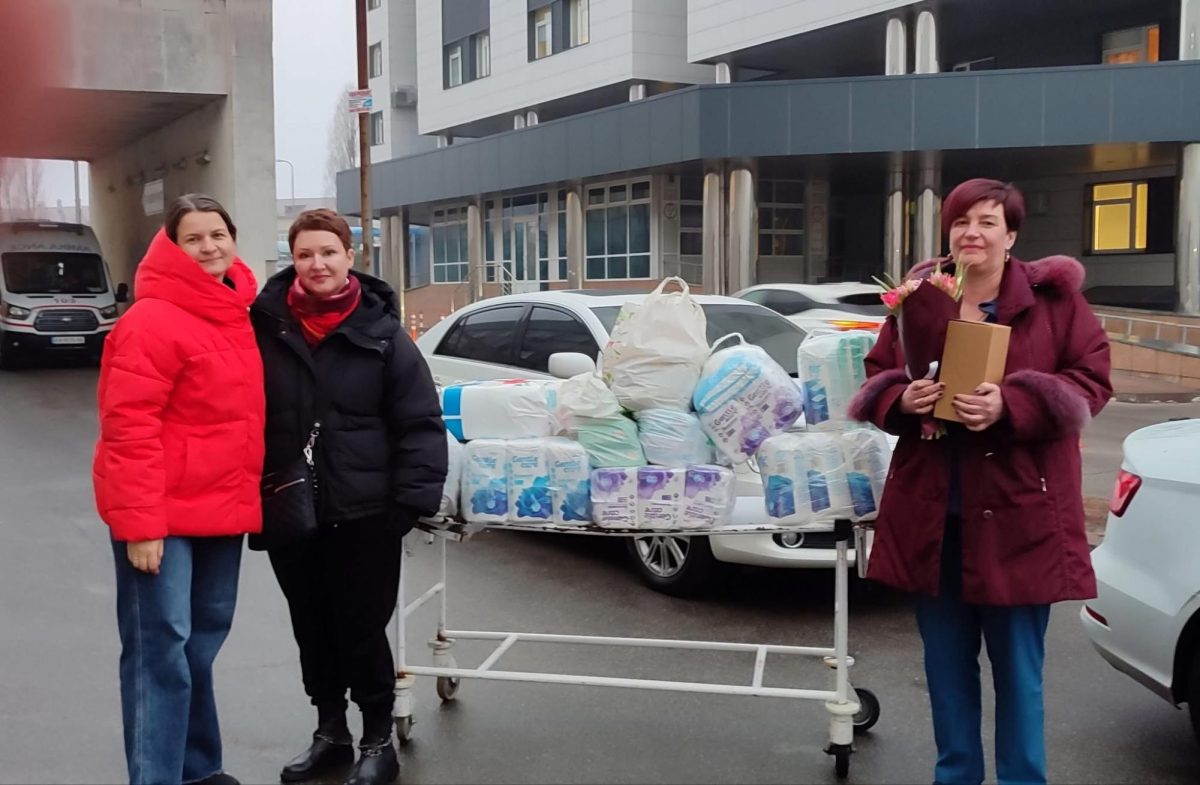
 

Olena Hudz, left, and her fellow volunteers stand next to a cart of collected feminine products, diapers and hygienic products for people in need on February 6, 2025, in Kyiv, Ukraine. Photo courtesy of Olena Hudz.

Despite the danger, Hudz and her neighbors no longer go to shelters when the sirens sound.

“We don’t have good bomb shelters around here,” Hudz said. Instead, they sleep in hallways, adapting to the circumstances each new day brings. 

“It’s terrifying that we are used to it, that we have adapted,” Hudz said. Like many Ukrainian parents, she wrestles with the choices she has made for her family. “Of course, I ask myself all the time if this was the right choice, if I should have stayed and kept my kids here to be kids of war.” 

Yet, she continues to face each day with resilience, embodying the unyielding spirit of those determined to endure.

In Ukraine, civilians like Hudz have organized resistance efforts, fought to defend their communities and supported each other despite immense challenges. This kind of civic resistance underscores the dual role civilians play as both victims and active participants in shaping their futures. 

There have been large changes in Ukraine’s social fabric. Families gather in candlelit rooms during blackouts, finding solace in shared moments. These acts of normalcy are not merely survival tactics — they are declarations of humanity. 

Ternopil Yasinovskyy lives in Ternopil, Ukraine, with his wife and two children. At the end of 2021, they bought a house out in the country, hoping to finish renovations on it within the year and move in. The war has stalled those efforts almost completely, Yasinovskyy explained, with many contractors enlisting, leaving the country, or taking on significantly fewer jobs because of a worker shortage and how stretched-thin resources are. 

In addition to the struggle to find workers, the financial burden of the war weighs heavily on families like the Yasinovskyys. A significant portion of many Ukrainians’ income goes toward donations, usually not to large humanitarian funds but directly to volunteers they know. 

Fundraising efforts for drones, Starlinks, charging stations, vehicles and repairs are constant, and often, the people collecting are raising money for brigades where their own relatives serve. Financial contributions are a way to protect loved ones and support those on the front lines.

Yasinovskyy showed The University News pictures of the house, as well as the renovation plans, explaining how they are trying to be patient even though the process has been frustrating.

“We had planned everything out for that house, had a complete design mock-up, knew where we wanted to put the plants in the living room. But of course, none of that happened. Two years later, the house still had no stairs connecting the main and second floors,” Yasinovskyy said.

This stagnation is happening all over the country. Businesses are being forced to close. Volunteer efforts that boomed in support in 2022 are finding it hard to garner support. Fundraising is getting harder and harder, whether overseas or from their own countrymen. 

In February 2022, there were long lines at enlistment offices as the number of people willing to join the army exceeded the military’s needs, but those numbers have fallen, with many casualties in the last three years and a general large drop in passion for the war effort. Throughout the last three years, the military has been carrying out constant mobilization measures to replace those who have died or been seriously wounded.

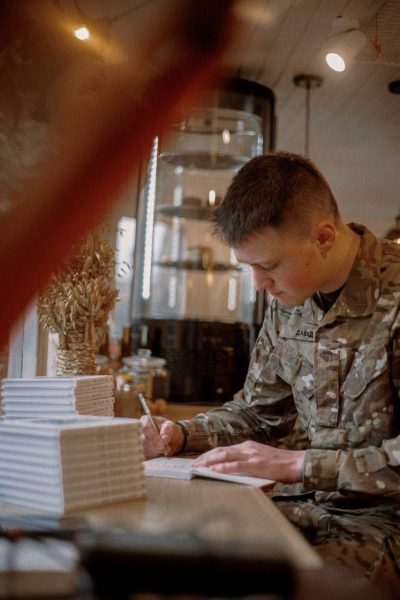
Poet and soldier Artur Dron smiles in uniform, holding a copy of his poetry book, “We Were Here,” a collection of wartime poetry, during a series of promotional book events across Western and Central Ukraine in May 2024. Photo courtesy of Artur Dron.
Poet and soldier Artur Dron signs copies of his book, “We Were Here,” a collection of wartime poetry, during a series of promotional book events across Western and Central Ukraine in May 2024. Photo courtesy of Artur Dron.


Artur Dron, a young Ukrainian poet who joined the front lines in 2022, said it is sad to see global attention diminish and support wane around the war, even as the situation worsens. 

“I always want to emphasize that abroad, the saturation of information about the war in Ukraine is becoming less and less, but in our country, the war is a daily reality. An American in 2022 heard much more about the war than now, so it may seem to him that it is winding down and ending. But it is not so. Nothing has ended, people die in our country all the same,” Dron said. 

The diminishing media coverage frustrates many Ukrainians, who fear that their suffering will be forgotten. Dron’s poetry captures the heartbreak of living through a war that the world seems eager to move past, even as bombs continue to fall.

“To me, describing pain should never be the goal. The goal should be to outline light—something that stands in contrast to war’s horrors, which will inevitably be present in the poem anyway,” Dron said.

He writes poetry from the front lines, but his poetry is “not about war.” The poems describe events and people he has encountered. Dron’s book, “We Were Here,” was originally published in Ukraine in 2023, and an official English version is available for preorder on Amazon.

“[Poetry] can tell the readers a little more about the purely human aspects of our experiences. Without comments about any political, global things,” Dron said.

People’s motivation lies in community, with young people who are vocal about their beliefs and willing to fight for them, like Dron. In the efforts of local volunteers like Hudz, working to rally their communities and get support for wounded soldiers who often feel forgotten. In children like Yaryna, who go to school and art class despite the daily bomb threats, knowing that soldiers are fighting to protect their rights. 

Hudz said that it is hard to rely on politicians or the outside world when you live in a country that has been at war for three years. Aid packages can be deferred, slowed and even revoked. Promises are not always kept, both by foreign leaders and the country’s own. 

“You need to be your own hope,” Hudz said. “When everything feels hopeless, I have to believe in myself.”

Posted in UncategorizedComments Off on Life interrupted: Resilience in a war-torn Ukraine

Misinformation thrives when we stop learning

Learning does not stop when you graduate high school, college, or obtain any sort of degree. It is a lifelong process, and we are all responsible for participating in it. The way we consume media directly impacts our understanding of the world, shaping our perspectives, beliefs and ability to engage in meaningful conversations. However, in an era of bite-sized content — 30-second videos, short social media posts and attention-grabbing headlines — it’s easy to mistake surface-level engagement for true knowledge.

Short-form content has its place. It can introduce new ideas, provide quick updates or entertain. But it is often oversimplified, stripped of necessary context and inherently biased because it is only a small part of a larger conversation. If we rely solely on these snippets, we risk developing shallow perspectives and reinforcing echo chambers. True learning requires depth, nuance and critical thinking — things that cannot be condensed into a single viral clip.

This is why long-form media is so important. Reading books and feature articles, listening to in-depth podcasts, watching well-researched documentaries and engaging with thoughtful discussions all contribute to a more informed and well-rounded worldview. These formats allow for complexity, present multiple viewpoints and encourage deeper reflection. They challenge us to think critically, ask questions and recognize the broader context behind any issue.

Being an active participant in media consumption means seeking out diverse perspectives, questioning sources and understanding that knowledge is not static — it evolves. In a world flooded with information, the responsibility to stay informed and continue learning falls on each of us. Choosing depth over convenience, engagement over passivity and education over ignorance is what sets lifelong learners apart.

Fascist governments have always relied on misinformation to maintain control. The less people know, the easier they are to manipulate. Historically, authoritarian leaders have sought to suppress education, limit access to diverse viewpoints and flood the public with propaganda to create a population that does not question authority. 

We are seeing the same patterns play out in the United States today, particularly in how education is being targeted as a political battleground. Republican lawmakers are counting on the fact that people are not educated enough to recognize the harmful effects of the new legislation they are introducing. 

There are already significant educational disparities between red states and blue states, with many conservative-led states restricting curricula, banning books and downplaying critical thinking in favor of ideological conformity to “traditional Catholic values.” This is not accidental. 

A well-educated population is harder to control because education fosters curiosity, skepticism and the ability to challenge false narratives. It is much easier to govern a population that lacks these tools.

This is exactly why Trump and his allies have consistently attacked the Department of Education. By weakening national education standards, they create an environment where misinformation thrives, and people are more likely to accept whatever they are told without questioning it. It is also why Trump has a well-documented disdain for fact-checkers and independent journalism — because the more people question his claims, the less power he has over them.

Many of Trump’s supporters do not actually believe in all of his policies or even fully understand them. Instead, they blindly follow his rhetoric, trapped in ideological bubbles where misinformation is constantly reinforced. 

Religious indoctrination plays a role as well — those who have been conditioned to accept authority without question are more likely to apply the same mindset to political leaders. The result is a base that remains fiercely loyal, not because of an informed agreement with his positions, but because they lack the critical thinking skills to see beyond the narratives they are fed.

This is why media consumption matters. A society that prioritizes education and critical thinking is a society that is harder to deceive. Engaging with long-form, well-researched content is not just about personal growth — it is a political act. It is a commitment to truth, to resisting propaganda and to ensuring that future generations inherit a world where knowledge is valued over blind obedience.

All content under the opinion section is not a direct reflection of The University News, but expresses the opinion of the writer, not necessarily the organization as a whole.

Posted in UncategorizedComments Off on Misinformation thrives when we stop learning

NCAA’s transgender athlete policy sparks national debate

In response to President Donald Trump’s recent executive order titled “Keeping Men Out of Women’s Sports,” the NCAA has announced a significant change to its transgender student athlete participation policy. Effective immediately, competition in women’s sports is restricted to student athletes assigned female at birth. This policy shift aligns the NCAA’s regulations with the federal directive, aiming to establish a uniform standard across collegiate athletics.

NCAA President Charlie Baker emphasized the importance of consistent eligibility criteria, stating that a clear national standard is preferable to a “patchwork of conflicting state laws and court decisions.” The updated policy also permits student athletes assigned male at birth to practice with women’s teams and access associated benefits, such as medical care, while practicing. However, trans women athletes are prohibited from participating in official women’s competitions.

This development follows the Department of Education’s directive urging the NCAA and the National Federation of State High School Associations to revoke records, titles and awards previously earned by transgender women in female categories. The department asserts that these accolades were “misappropriated by biological males,” and their action seeks to restore recognition to cisgender female athletes. 

The executive order and subsequent policy changes have ignited legal challenges. Notably, two transgender teens, Parker Tirrell and Iris Turmelle, have filed a lawsuit against the Trump administration, contesting the constitutionality of the executive order. Represented by GLAD Law and the ACLU of New Hampshire, the plaintiffs argue that the order discriminates against transgender individuals and infringes upon their rights. 

The NCAA’s policy shift is part of a broader pattern of actions by the Trump administration that have targeted transgender individuals. Since returning to office, Trump has repeatedly framed transgender rights as a threat to traditional values, particularly focusing on athletics as a battleground for what he calls “fairness in competition.” However, many advocacy groups argue that this focus is disproportionate given the small number of transgender athletes competing at the collegiate level. The Williams Institute estimates that transgender individuals make up only about 0.6% of the U.S. adult population, and an even smaller percentage compete in organized sports.

Critics argue that this executive order is less about preserving competitive fairness and more about fueling a culture war against an already marginalized group. The American Civil Liberties Union, Human Rights Campaign and other civil rights organizations have condemned the policy, stating that it fosters unnecessary hostility toward transgender athletes and ignores existing research that suggests transgender women do not inherently have an unfair advantage, particularly after undergoing hormone therapy.

Despite these criticisms, the policy has gained support from conservative lawmakers and organizations that claim it protects the integrity of women’s sports. Supporters argue that allowing transgender women to compete against cisgender women undermines the spirit of fair competition.

As the debate continues, the NCAA has committed to assisting member schools in fostering respectful and inclusive athletic environments, in line with its constitutional commitment to support the mental and physical health of all student athletes. However, with pending lawsuits and growing national outcry, it remains to be seen how this policy will evolve and what long-term effects it will have on collegiate athletics and transgender inclusion in sports.

Posted in UncategorizedComments Off on NCAA’s transgender athlete policy sparks national debate

SLU’s student-run DARLA mission set to launch in 2025

A student-created satellite designed to advance spacecraft autonomy is set to launch in 2025. This is just the most recent satellite project that Saint Louis University’s Space Systems Research Laboratory (SSRL) has built. 

The DARLA (Demonstration of Artificial Reasoning, Learning and Analysis) mission was originally set to launch in December 2024, a deadline that had the members of SSRL racing against the clock. With environmental testing scheduled for October, many of DARLA’s critical systems needed to be fully operational. Long nights and early mornings had become the norm for the SSRL team as they prepared for the final stages. 

Just as the December deadline loomed, the mission’s launch date was pushed to May 2025. The news was both a relief and a shock for the research lab members. While it granted the team more time to refine their satellite, it also shifted the finish line after countless hours of work. Now, with a few extra months, the team, which is comprised almost entirely of undergraduate students, is determined to perfect DARLA and ensure the satellite is ready for orbit.

Nathan Brubaker, the chief engineer of DARLA, recalls the intensity of balancing lab work with classes, sharing how hard the team worked to keep the project on track before the launch date was pushed back. 

“There was a period of several weeks where several of us on the DARLA team were working in the lab past midnight every day, often until two or three in the morning. Keeping up with classes during that time was incredibly difficult, not even considering also getting sleep,” Brubaker said.

DARLA represents the culmination of nearly a decade of iterative design. Dr. Michael Swartwout, the faculty advisor for the mission, explains that the project’s focus is on advancing spacecraft autonomy, which would allow the satellite to make decisions on its own, such as when to take images or send data back to Earth.

“Autonomy carries immense potential for efficiency, but it also brings significant risk. One wrong decision from the spacecraft, and you could jeopardize the whole mission,” Swartwout said. 

DARLA, he added, is just one of many “baby steps” toward more autonomous space missions, developed with his long-time collaborator and the team’s software engineer, Keith Bennett.

This is not the first time Swartwout has overseen a student-run satellite mission at SLU; DARLA is one of five successful missions the university has built since 2013, each under NASA’s CubeSat Launch Initiative. Through this program, NASA provides free launches to university programs, although building the spacecraft itself requires external funding and grants. 

“NASA doesn’t fund flight missions like ours,” Swartwout said. “We’ve had to piece together our budget from competitions and smaller grants.”

The DARLA mission is a learning experience, not just for the students, but for the future of space exploration. The satellite aims to demonstrate how autonomous technology can function in space, so the project represents a stepping stone in making space missions more efficient.

Junior Melanie Reym is the project manager of DARLA and structures lead. She oversees the project and manages other SSRL leads, along with Brubaker. For Reym, one of the hardest parts has been adjusting to setbacks without losing momentum. 

“Accounting for slips in our timeline and mitigating them can be challenging at times. Especially during final integration, one error or delay on a part can set us back days which leads to some of us working very long hours and making abrupt schedule changes,” Reym said.

Disassembled components of the DARLA hardware wired for flight configuration testing set out on a tabletop in McDonnell Douglas Hall on Sept. 7, 2024. Pictured is the external power source, solar panels, a raspberry pi and a printed circuit board. (Photo courtesy of Nathan Brubaker)

The success of the entire club relies on students showing up and putting in the work. 

Owen Binkley, the mission operations manager of DARLA and ground subsection lead, spoke positively about the team’s efforts.

 “We’ve been very lucky in that we have a lot of people who are actually dedicated and are showing up constantly and doing the work that needs to be done,” Binkley said.

Dedication is only part of the challenge. The steep learning curve in such a technical and competitive environment can be daunting for the students. 

“It’s very easy to be discouraged when you’re around people who have so much knowledge in their specialized skill set. It took me a while to get over that hump,” sophomore lab manager Casey Roberts said. 

Roberts is only in her second year with SSRL and is already in charge of managing the lab and its members and making sure everyone has what they need. 

“I had to change my mindset from being discouraged to being inspired,” Roberts said.

 The mission experience opens up a variety of opportunities for students’ futures. 

“Mission design is something I really enjoy,” Brinkley said. “I don’t want to work on weapons, like a lot of people who do aerospace stuff. I want to work on missions to other planets, more exploration-type things, trying to advance the knowledge of the human race.”

Senior Shelby Slomski, the communications lead and ground co-lead of SSRL, echoes that sentiment, mentioning that space has been a goal for many years. 

“I want to work on spacecraft and space systems. I’ve narrowed it down to wanting to work on satellites, doing all the work in this club, being involved and learning as much as I have has shown me that is really a possibility,” Slomski said. 

However, managing a project of this scale is not easy. Between tight deadlines, limited resources and the inevitable technical challenges, the DARLA team is constantly navigating obstacles, according to their faculty advisor. 

“It’s too easy for students to design something that turns out to be too difficult to build,” Swartwout said, reflecting on the challenges of space hardware. “The real world is messy, and space is even messier. Every component has to withstand the harsh conditions of space: extreme temperatures, radiation, vacuum, all of which are actively trying to break your spacecraft.”

The team has run into a variety of technical issues preparing DARLA for launch.

“The spacecraft radio is a finicky beast,” Slomski said. Slomski has focused largely on the spacecraft and ground radios.

There have been multiple issues with the radios’ communications throughout the last couple of months. 

“It’s a very complicated process. It doesn’t seem that complicated until you’re the one staring at the coding files,” Slomski said. 

These technical hurdles are not just obstacles but learning opportunities that push students to adapt and grow.

“We have had so many preventable and non-preventable setbacks,” Roberts said, shaking her head. “You know, it’s experimental learning, not every experiment can be successful.” 

Despite these challenges, the DARLA mission is well on its way to success. The team is preparing for environmental testing in December, a crucial milestone before the May launch date.

 “The real challenge isn’t just getting the design right,” Swartwout said. “It’s making sure the hardware works in the real world. Space doesn’t forgive mistakes.”

Overcoming these challenges is what positions DARLA as more than just a student project. DARLA is part of a broader effort by universities to contribute to the future of space exploration. By participating in NASA’s CubeSat Launch Initiative, SLU students are helping to push the boundaries of what is possible for space missions.

Posted in UncategorizedComments Off on SLU’s student-run DARLA mission set to launch in 2025

War and resilience in Ukraine through the eyes of a first-generation immigrant 

My great-grandmother was afraid of storms her whole life. I used to laugh about it when I was young, thinking it was silly. It was just thunder; what was there for a grown-up to be scared of? Only later did I realize those sounds brought her back to her childhood — that every time it stormed she would hear bomber jets. War came to her homeland again, in 2014 and 2022. My great-grandmother survived a world war, but those horrors never let her go. She was afraid until the day she died. 

I was born in Cherkasy, Ukraine, in 2003, 11 years before Russia forcefully annexed Crimea, Ukraine, and 19 years before the full-fledged invasion. When Russia invaded Crimea in 2014, I cried in sixth-grade social studies class because we watched a CNN video about it. I stepped out of class, and my teacher followed me to check in, saying she understood this was a sensitive situation. I told her the war scared me, and she told me there was no war. I felt angry — there were foreign soldiers killing people in my country. 

Feb. 24, 2022, is a day I will never forget. For weeks beforehand, my anxiety grew as both Ukrainian and American news outlets reported on the thousands of Russian troops gathering near the border. Every day, I feared the worst would come. That day, it did. My mom called, her voice cracking through the phone. She looked like she had been crying for hours. “Mariya, they’re bombing Kyiv… I don’t know what will happen,” she sobbed. I had never heard her sound so scared.

Russia violated the Budapest Memorandum when it launched a full-scale invasion of Ukraine. This treaty and many other international agreements were supposed to guarantee Ukraine’s sovereignty and protection in case of attack.  Russia not only attacked a sovereign nation but also undermined the very foundation of international diplomacy and trust. 

‘Full-scale invasion,’ the New York Times alerted me while I frantically tried to call my grandparents to make sure they were okay. When my grandmother finally answered, her voice was faint. “We’re okay for now, but the air raid sirens just went off again,” she told me. I could feel the distance between us more than ever before.

Russia launched a simultaneous ground and air attack, the largest on a European country since World War II. I did not notice the tears flowing down my face until I saw my reflection. I looked like a ghost, and I felt completely numb. 

There is no way to prepare for something like this. I went through the motions — class, lunch, conversations — but it all felt fake. My world had just stopped. I ran on autopilot for weeks. I will never be the same person I was before the invasion. Some days, I still have panic attacks when I think about it. 

The relentless bombings and shellings that followed have taken the lives of over 70,000 Ukrainians and left between 100,000 and 120,000 wounded. More than 10,000 of these casualties are civilians — ordinary people whose lives were brutally cut short. Each number represents a stolen future, mothers, fathers and children whose lives could have been filled with dreams and joy. These are not just casualties of war — they are fragments of the world I was born into, erased forever.

There are so many children in Ukraine right now who will grow up afraid, just like my grandmother. Air raid warning sirens ring out every night in many regions of Ukraine, marking a new generation’s trauma. They will be haunted by these sounds long after the war ends.

I moved to the United States at the age of six, and I have many fond memories of my early childhood in Ukraine. I did not grow up afraid. My mother used to take me to Crimea every summer for vacation. I remember the beautiful beaches and befriending the resort owner’s daughter. Together we would look for tide pools and hold snail races, thinking we would do this every summer, forever. They are now incredibly bittersweet with the knowledge that no Ukrainian child can experience what I did all those years ago because their childhood is being stolen from them. 

So many everyday people have taken up the cause to help their country in whatever way they can, like my mom’s close friend and former magazine editor, Helen Hudz. She leads volunteer efforts in her community for the third year to gather money and supplies for the war efforts. Sometimes, Hudz doubts if she made the wrong choice by choosing not to evacuate her family. “My daughter, Solomia, is six years old, and now for half of her life all she has known is war,” she stated.

The war has weighed incredibly heavily on my heart these last three years. My mom and I cannot talk about what is happening in our homeland without both of us breaking down into tears. “There is not a single family that doesn’t have someone who’s at the front, someone who died. Everyone is affected, every single person,” she said, and I could see the sorrow in her eyes when she thought of all the stories she had heard, all the people who died.

Even though I live thousands of miles away, I feel a deep connection to my homeland. I think of the summers spent with my grandparents, the scent of freshly cooked varenyky filling their kitchen, and the vibrant blue and yellow flags lining the streets during Independence Day celebrations. 

Now, I watch videos of those same streets reduced to rubble, destroyed by Russian attacks. But amidst the destruction, there is resilience. Ukrainians have a strong, unbreakable spirit, which is one of the many things this brutal war has highlighted. The country has come together in ways that fill my heart with hope and pride.

Hudz discussed the wavering international support and explained that the same phenomenon is occurring within Ukraine’s borders, as well. People are tired of hearing about the war, tired of donating and helping, and most of all, tired of living it. “You need to be your own hope. When everything feels hopeless, I have to believe in myself,” Hudz said. 

It has been nearly three years of war. The Russian army targets museums, hospitals and kindergartens. On Oct. 23, a Russian attack decimated a Cherkasy bus station that I used when I visited my great-grandma. Yet, much too often, I have to remind the people I come across in my everyday life that the war is still happening. 

Americans have the privilege and luxury of forgetting, but Ukrainians do not. They cannot forget about the rockets or drones flying overhead and being shot down over their cities. They cannot forget about the husbands, sons, daughters and wives who have perished to protect our nation, nor about those who are currently fighting for their lives. 

Artur Dron is a soldier in the Ukrainian National Army and an internationally recognized poet. He is also a 24-year-old journalism major from a small town in the Ivano-Frankivsk Oblast. Dron lived a normal life before enlisting in 2022 — he finished his bachelor’s degree, wrote poetry and worked at his dream job as an event manager at Old Lion Publishing House, one of Ukraine’s largest publishing houses, building connections with Ukrainian authors. 

I got to know him when he collaborated with my mom and contributed poetry for one of her books. He has been on the front lines ever since, fighting for his country and writing earth-shattering poems about the war. The poet discussed the toll of the war and the importance of aid and support. 

He also highlighted that a large part of the Ukrainian army is made up of volunteers, people who had never expected to be soldiers before 2022. Dron emphasizes, “It is a war of ordinary people, ordinary people take part in it, fight and die. Just like ordinary Americans, with the same life goals and dreams. But in order to afford such an ordinary life, we now have to pay a huge price.”

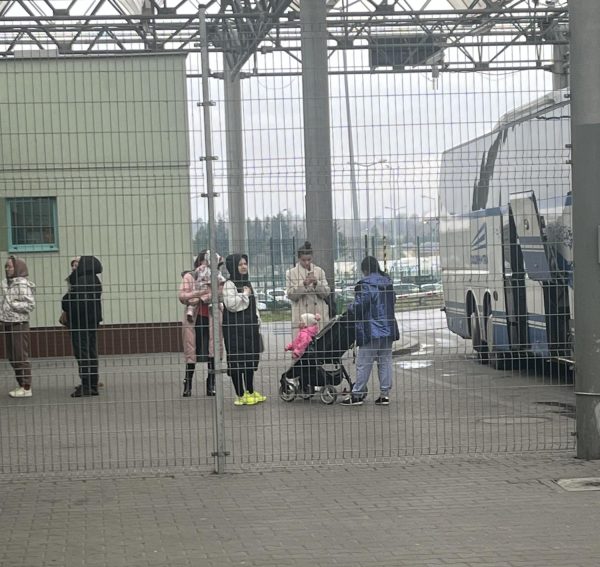
The Ukrainian-Polish border crossing, circa March 2023. Since the start of the full-scale invasion, airports in Ukraine have closed down and the only way to enter the country is across the border. Whether traveling by car or bus, all passengers, both citizens and non-citizens, must go through a border checkpoint and have their passports checked to enter or exit the country.(Mariya Yasinovska)

The Ukraine-Russia war is so much more than a battle for territory — it is a fight for sovereignty, democracy and justice, but most importantly it is a struggle for the survival of the Ukrainian people to exist as a nation. During the current election cycle, the topic has been a major point of discussion. Candidates debate the role of the U.S. in providing aid and support to Ukraine, with Democrats arguing that America has a moral obligation to defend Ukraine, while Republicans largely question the financial cost of such involvement and say that America has already poured too much money into this war. Donald Trump has made it clear that he would push Ukraine into negotiations with Russia, valuing a makeshift truce above sovereignty and actual peace.
For me, this is not just a political debate; it is personal. It is about the place I was born, the people I care about and the future I see for Ukraine. I cannot stand by and silently watch my homeland be destroyed. And while I am incredibly proud of Ukraine’s resilience, I also know that we need global support to keep that fight going. 

The nonprofit Nova Ukraine — which means new Ukraine — is a great project to donate to or get involved with. Since 2014, Nova Ukraine has run a variety of successful humanitarian projects in Ukraine. I urge everyone reading this to consider how they can help — whether through donations, advocacy or simply educating themselves and others in their lives.

The world cannot afford to turn away. Ukraine’s fight is not just its own, but a stand for democracy and freedom as we know it. 

Ukrainians are strong, but no one should have to face a threat like this alone. Supporting Ukraine is not just the right thing to do, it is a stand against tyranny and for the values we all hold dear.

Posted in UncategorizedComments Off on War and resilience in Ukraine through the eyes of a first-generation immigrant 

‘Agatha All Along’ is the comeback Marvel fans have been waiting for

One of the largest franchises in modern television history, Marvel has been chasing the success and mass media impact of its past projects ever since “Avengers: Endgame.” Many of the movies, shows and storylines released since then have fallen short, making fans wonder if the studio had taken on more than they could handle.

Just as many longtime fans started to lose hope in the franchise, Marvel recaptured its spellbinding allure with “Agatha All Along,” a highly anticipated “WandaVision” spinoff that centers on the character of Agatha Harkness, played by the ever-enigmatic Kathryn Hahn. After a recent period of mixed audience reactions and box office missteps, “Agatha All Along” feels like a breath of fresh air for the Marvel Cinematic Universe (MCU), blending wit, magic and a storyline that embraces inclusivity in a way no Marvel project has before.

At its core, “Agatha All Along” brings powerful, complicated female characters to the forefront, following a trend that the media has increasingly embraced in recent years. Female-driven stories have already proven successful in the MCU with characters like Black Widow, or Natasha Romanoff, and Wanda Maximoff, or Scarlet Witch, in their own respective projects. Agatha’s journey builds on that momentum. 

The series dives deeper into Agatha’s internal and external world as she journeys through the Witches’ Road — a mystical path that holds the secrets to her lost powers. Accompanied by Joe Locke’s Teen, a queer character whose identity is normalized within the storyline, Agatha unites a coven of unique personalities, each adding depth and representation to the series without making identity the central plot device​. 

This groundbreaking and unpatronizing depiction of LGBTQ+ identities is one of the most praised aspects of “Agatha All Along.” Marvel has taken a decisive step toward normalizing queer identities within the superhero genre by introducing characters like Teen and Rio, portrayed by Aubrey Plaza, giving them a narrative presence that feels authentic yet unforced. Besides Locke’s character, who has a boyfriend, there is also a romantic storyline between Agatha and Rio, adding backstory and depth to Agatha, who served as the villain of “WandaVision.” 

Seeing representation on screen is becoming more widely discussed and accepted, and it is reassuring to see that Marvel is finally keeping up with the times. Many queer fans have expressed a flurry of support for the show, pointing out that moments like Agatha’s lesbian flag-colored bracelet in episode five or scenes of Teen texting his boyfriend have made them feel connected to the characters in an incredibly special way. 

The show embraces an environment that is dark and enchanted yet campy, building on Agatha’s established persona from “WandaVision.” It does all this while infusing a deeper exploration of self-acceptance, camaraderie and identity within a magical setting​. The costuming and design evoke a gothic, witchy aesthetic that embraces Agatha’s dramatic flair, channeling a look reminiscent of drag-inspired theatricality. This approach was influenced by showrunner Jac Schaeffer’s vision of Agatha as an “icon” and a performer adept at “code-switching” to fit her surroundings. 

The themes and plot points have resulted in the series being dubbed one of Marvel’s “gayest” projects to date — a title that Hahn humorously confirmed. This avoidance of patronizing queerness as a plot device allows for a wider variety of characters and stories to emerge, grounding Agatha’s journey not only in magic but also in community and acceptance. 

Locke described his character’s queerness as “not the driving force of the plot,” a choice that lets identity exist naturally within a magical and thrilling storyline. This approach mirrors the real world, where identity is just one part of who a person is, adding a touch of realism to the supernatural drama and making the show feel both contemporary and forward thinking​. 

Marvel delivered a series that seamlessly blends powerful storytelling, character depth and representation, making “Agatha All Along” an unforgettable addition to the MCU. Its innovative choices and powerful female leads prove that Marvel is back in its prime, reconnecting with audiences in a way that is exciting, inclusive and undeniably magical.

Posted in UncategorizedComments Off on ‘Agatha All Along’ is the comeback Marvel fans have been waiting for

Why I voted for Kamala Harris for president

I voted for Vice President Kamala Harris for president, and I think you should too. This year’s election is unlike any in recent memory. For many U.S. citizens, it’s a defining moment, and as a woman, an immigrant and a member of the LGBTQ+ community, this was not a decision I made lightly. 

This election is not just about policy differences but about the very survival of democracy, civil rights and the protection of minority communities. I voted for Harris not because I agree with her on every single issue, but because the stakes are far too high to risk a return to a Trump-led America.

Women in politics are constantly held to impossible standards that men, especially white men (who dominate American politics), rarely face. Harris, as both a woman and a woman of color, is subject to scrutiny far beyond what’s applied to Trump or even male leaders within her own party. While Trump can openly make inflammatory comments and maintain his base, Harris’s every word and move is dissected with an intensity that suggests women must be above reproach to even be considered competent.

Unlike Trump, whose supporters often disregard his past actions, Harris faces a huge double standard,  judged by expectations that her male colleagues do not meet. She faces an even higher bar than Hillary Clinton did, as Harris’s identity brings additional prejudice — she’s a target not only as a woman but as a Black and South Asian woman, forced to navigate biases that compound as she rises in political power.

I voted for a Black woman for president and I can celebrate that progress while also admitting that she does not hold the same values that I do. I do not agree with Harris on every single issue. She is not my ideal candidate for president. I am not buying merch or begging to worship at her feet, but she secured my vote because the alternative option is descending into fascism. The alternative option is saying goodbye to our democracy as we know it. 

Since the overturning of Roe v. Wade, we have seen countless cases where women have been denied life-saving healthcare. Women have died, some bleeding out in parking lots. Women have been denied life-saving care and have been stripped of their autonomy. Women across the country have died from complications, forced to wait until their lives were in immediate danger before doctors could act. Girls, still children themselves, have been coerced into motherhood under laws that strip them of their bodily autonomy. 

Harris, who staunchly defends reproductive rights, offers a way forward. Although we may not agree on every issue, her commitment to protecting women’s health and autonomy is non-negotiable, especially in the face of a Trump administration eager to further erode these rights.

On LGBTQ+ rights, the choice is similarly stark. During Trump’s term, we saw an emboldening of hate and discrimination against LGBTQ+ individuals, with policies such as the transgender military ban. Harris has consistently advocated for equal protections under the law, offering an alternative to Trump’s divisive rhetoric. A second Trump term could mean a rollback of marriage equality, adoption rights and even basic anti-discrimination protections that many in the LGBTQ+ community, including myself, depend on daily.

Trump’s foreign policy is equally alarming, especially regarding both Gaza and Ukraine. Harris has received a lot of criticism for refusing to condemn the genocide and continuing to support Israel despite everything that has happened in the last year. Many voters have been disappointed that despite proclaiming support for a two-state solution, she continues to voice support for funding Israel’s actions. Yet, even in her most criticized stance, she is nowhere near as radical as Trump. 

Trump has aligned with forces seeking to devastate Gaza, displaying a blatant disregard for Palestinian lives by equating all Palestinians with terrorists. He has openly backed policies that support the destruction of Gaza, a stance that endangers countless innocent lives and further undermines America’s role as a theoretical mediator in the Middle East. Trump has promised to level Gaza to the ground. Trump and his circle have called Harris a supporter of terrorists and made it clear that they deeply hate all Arabs and do not care for their well-being. 

Then, there’s Trump’s “promise” to end the Ukraine-Russia war in 24 hours — a statement that suggests capitulation to Russian demands rather than a genuine solution. Ukraine needs more support and permission to strike back at Russian targets, not to be forced into a harmful and false peace deal with Russia. 

As a Ukrainian immigrant, I know what’s at stake for Ukraine. Trump’s cozy relationship with Vladimir Putin, evidenced by his secret provision of COVID-19 tests to Russia during a pandemic shortage in the U.S., suggests that he would trade Ukraine’s sovereignty to appease a dictator. Harris, though imperfect, recognizes the importance of supporting Ukraine’s sovereignty and standing firm against authoritarianism.

The Jan. 6, 2021 insurrection was an unprecedented attack on American democracy that cannot be brushed aside or forgotten. It seems that, as a country, many of us have moved on much too quickly. On that day, after Trump and his allies amplified false claims of election fraud, supporters stormed the U.S. Capitol in an attempt to prevent the certification of the 2020 election results. This violent event led to injuries, deaths and over a thousand arrests. Even Trump’s former vice president, Mike Pence, who was directly targeted by the mob, refused to endorse Trump’s 2024 candidacy — a remarkable stance that speaks volumes about the level of danger Pence perceives in a second Trump term.

Trump’s role in inciting the insurrection has been documented thoroughly, from his speeches urging followers to “fight like hell” to his hours-long inaction as events unfolded. He has encouraged violence, hate and division throughout his career, with frequent endorsements of dangerous ideas. His record also includes numerous accusations of racism and misogyny, not to mention many credible allegations of sexual misconduct. 

Jan. 6th stands as a reminder of the risks Trump poses to democracy and the extremes to which he will go to retain power — no matter the cost.

In an election this high-stakes, the choice between a major-party candidate and a third-party candidate is a luxury we simply cannot afford. Voting for a third party may seem like a way to hold out for “better,” or vote in a way that’s better aligned with one’s morals, but in reality, it risks splitting the vote, especially among those who oppose Trump’s destructive policies. As unfortunate as our current political system is — a two-party system that utilizes the flawed electoral college — this is the legal system under which we live. 

This is a two-party system; our options this election are Trump or Harris. I find it difficult to believe that those who support progressive values genuinely think both would lead us to the same future.

Casting a vote for Harris does not mean blind allegiance or agreement on every policy. I will not be buying campaign merch, making obsessive memes about her or treating her like a savior. But I recognize that, at this moment, she’s the leader who can protect the rights and values we hold dear. Choosing Harris is a choice for progress over prejudice, for hope over hatred.

Posted in UncategorizedComments Off on Why I voted for Kamala Harris for president

John Green on the intersection of storytelling and advocacy

Before captivating a packed audience of Saint Louis University students on Sept. 24, bestselling author John Green discussed his approach to writing, the intersection of storytelling and advocacy and how his own experiences have shaped the narratives his readers love.

Known for his deep exploration of human emotions in young adult (YA) literature, Green shared how his personal growth has shaped both his creative process and his perspective on social change. Green’s relationship with writing has transformed over the years. Early in his career, his stories were often closely tied to his personal experiences, but as his life has progressed, he has gained a more nuanced understanding of how those experiences impact others.

“You become more self-conscious, you become more self-aware,” Green said of his years of experience in the publishing world. “I am more protective of my life and the people in my life than I used to be as a writer. I used to think if it’s a good story, it’s going in the book, and if that hurts people’s feelings, such is life. Now, I think pretty differently about that stuff. I value my family a lot more than I value my writing life.”

As he continues to grow as a writer, Green’s work continues to reflect a strong sense of hope. 

“I think all really true stories are hopeful,” he explained. “I think that despairing stories or hopeless stories don’t tell the whole truth, just as happily-ever-after stories don’t tell the whole truth. I want to write stories that are as honest as I can make them, and that means making them hopeful.”

Green talked about how being a parent has changed the way he writes about families and parental relationships. 

“I don’t think I could have written ‘The Fault in Our Stars’ if I hadn’t been a parent to my son, because when my son was born I immediately realized that love is stronger than death,” Green said.

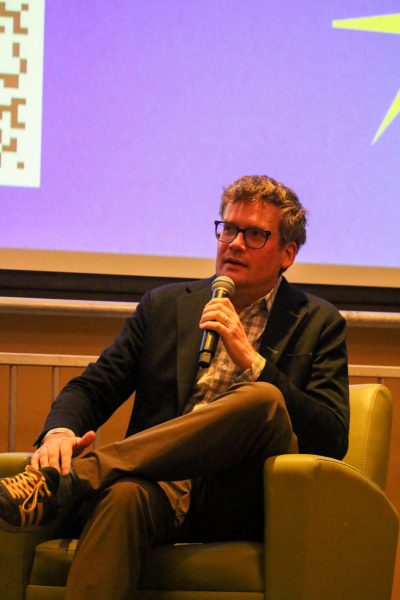
John Green talks books, philanthropy and Crash Course during the Great Issues Committee Event in the Wool Ballroom on Sept 24, 2024. (Aditya Gunturu)

This realization, he said, became central to shaping the hopefulness in his novel about young people facing terminal illness. 

“That was essential, not to the plot of the book, but to understanding how the book can be hopeful,” Green said. 

Parenthood gave him a new lens through which to view the world — one that allowed him to write about love and grief in a way that was both honest and hopeful.

Despite being a prominent figure in YA fiction, Green is quick to admit that he doesn’t always understand the slang or trends of modern teenagers. However, what he does grasp, and what truly matters to him, is the deeper connection readers have with his characters. 

“There’s a deeper kind of identification that’s much more interesting to me. When you connect with someone on a deeper level, in terms of the things they worry about, the way they approach the world, the places they feel stable or unstable,” Green explained. This emotional resonance is something Green believes is universal, transcending age and time.

Green also discussed his writing process, calling it somewhat unconventional. Juggling his career as a content creator on YouTube with his writing, Green admitted that he doesn’t follow a strict routine. 

“If I treated it as my only job, I think I would love it less because it’s still an escape for me,” Green said. “I just write when I can and as long as I can, whenever I get the chance.”

At the heart of Green’s message is a belief in the power of storytelling to connect people and foster empathy. He hopes that his readers not only see themselves in his characters but also learn to understand others in new and meaningful ways.

When asked about his role as a social advocate, Green was clear that he doesn’t write books with the intention of sending a specific message. However, he does hope his stories inspire change. 

“I want that to be a byproduct of my books. I want that to be something that emerges from them naturally,” Green said. By focusing on telling real stories, Green believes that his work has the potential to truly help others. “If I’m doing my job, then I’m telling a human story. In telling a human story, it humanizes people that are often dehumanized by society.”

Posted in UncategorizedComments Off on John Green on the intersection of storytelling and advocacy

Too little, too late: Melania Trump voices support for abortion rights a month before presidential election

In a move that has raised eyebrows across the political spectrum, Melania Trump has voiced her support for abortion rights — a stance she has never publicly endorsed before. The timing could not be more suspect, given its proximity to the 2024 presidential election where abortion rights are a top issue, largely due to Donald Trump’s role in overturning Roe v. Wade by appointing justices who were explicitly against it.

Donald Trump has campaigned on an anti-abortion platform since his first presidential run in 2016 and has only doubled down since the overturning of Roe v. Wade, bragging that he “killed Roe v. Wade.” Since then, he has completely ignored the devastating healthcare risks that women now face, including life-threatening pregnancies and restrictions on reproductive autonomy.

Laws across the country have grown increasingly severe, with states not only targeting abortion access but also limiting birth control and in vitro fertilization, leaving women’s health and choices more restricted than ever.

What is most strange about this is that Melania Trump stayed completely silent on key women’s issues, specifically abortion, during her husband’s presidency, even as it became one of the most divisive issues in the United States. In her upcoming memoir, she claims that she’s supported abortion rights for her whole adult life. 

In an exclusive “Sunday Morning Futures” interview, Melania Trump said, “He knew my position since the day we met, and I believe in individual freedom. I want to decide what I want to do with my body. I don’t want government in my personal business.”

Now, just weeks before a critical election, she’s suddenly speaking up. Her opinion raises questions, but she’s not the first Republican first lady who has supported abortion rights despite their husband’s policies, and while certainly headline worthy, it does not change anything in the grand scheme of things — she is not the one running for president.

Donald Trump’s political legacy is closely tied to his conservative Supreme Court appointments, and his base remains strongly anti-abortion. So why now? Is Melania Trump’s statement an attempt to distance herself from his extremist stance or soften his image? I doubt she is even the one calling the shots on when to speak up. Likely, it is a desperate attempt to appeal to suburban women voters who have been deeply alienated by Donald Trump’s policies on reproductive rights.

Melania Trump has largely stayed out of political debates throughout her husband’s time in office, rarely voicing her personal opinions on key issues. This is the first time Melania Trump has openly contradicted Donald Trump’s hardline anti-abortion stance. In her upcoming memoir, she reportedly emphasizes the importance of individual freedom and criticizes government restrictions on abortion, positioning herself as an abortion-rights supporter. It should be evident to educated voters that this move is less about Melania Trump carving out her own political identity and more about strategic posturing. It is no secret that Donald Trump is struggling with female voters, particularly in swing states. 

While Melania Trump’s declaration may stir conversation, it is hard to take it seriously when Donald Trump has made his position — and its consequences — clear. Her words do nothing to undo the damage already done to reproductive freedoms, nor do they carry significant political weight in her husband’s campaign. It feels like an empty gesture, one that will likely not sway American voters who are focused on actions, not words, as they head to the polls.

Her statement might spark conversation but does little to change the reality of Donald Trump’s anti-abortion record or the damage already done to reproductive rights in the United States.​

Posted in UncategorizedComments Off on Too little, too late: Melania Trump voices support for abortion rights a month before presidential election

New study names SLU ‘Most Dangerous School in Missouri.’ What do experts say?

Saint Louis University was named the most dangerous university in Missouri in a recent study by SafeHome.org, reigniting concerns over campus safety. For prospective students and their families, safety is a top priority, and SLU’s location in St. Louis, a city with an often-publicized crime rate, may appear worrisome. However, crime rates are going down, and a deeper look into the data and the reality of life on campus reveals a different story.

Each university is legally required by The Clery Act to collect and report crime data. However, they are not required to volunteer it for studies, such as this one. This study makes broad claims based on voluntarily reported data from a small sample of universities, explained Ness Sandoval, a sociology professor at SLU with years of experience analyzing St. Louis crime data. 

“This study lacks clarity,” Sandoval said. “I understand the motivation behind it, but I believe scholars in the field may have concerns about including every type of crime in a single index. I would find it difficult to replicate the study because so much information is missing in the methodology.”

St. Louis regularly ranks among the U.S. cities with the highest crime rates. The city reported approximately 6,017 violent crimes in 2022, making it one of the highest per-capita crime rates in the nation.

However, the city’s crime statistics are often presented without key context. Unlike most major metropolitan areas, St. Louis City and St. Louis County are politically and geographically separate entities. Crime in St. Louis County, which includes many affluent suburbs, is not included in the city’s overall crime rate, which creates an inflated perception of the city’s crime. 

A significant portion of St. Louis’ crime occurs in a few high-crime neighborhoods, many of which are many miles away from SLU’s Midtown campus. Midtown, like other parts of St. Louis, has undergone extensive redevelopment, and SLU’s campus sits within a relatively well-maintained area with a strong security presence.

Shayne Clegg, a senior majoring in criminology and forensics, said many of his peers joke about how dangerous the city is. 

“My parents came to visit me in the spring for the first time since freshman move-in, and I remember just how shocked they looked driving over the Delmar Divide,” Clegg said. “The city’s long history of racism and division has always been a factor in crime, and just as racism continues to persist so strongly, high crime rates will too.”

St. Louis has long been affected by structural issues such as racism, segregation and gerrymandering, all of which have influenced the allocation of resources and perpetuated disparities across neighborhoods. Redlining policies from the mid-20th century segregated Black communities, pushing them into underfunded areas where crime rates have historically been higher. 

Many of these communities have since been left with fewer resources for schools, infrastructure and policing, creating pockets of poverty that experts say correlate with higher crime rates.

“I am not from St. Louis, and when I told colleagues at my previous university that I was coming down here, they asked me if I had lost my mind,” said SLU Department of Public Safety (DPS) Chief Melinda Heikkinen, who came to SLU in 2021, discussed safety on campus and beyond. “They, like many people, looked at the numbers and nothing else. Yes, St. Louis does have a fairly high crime rate, but it is also known for tight-knit communities, a great sports and food scene and free access to parks and museums.” 

Heikkinen also explained that people who focus only on the high crime rate tend to miss a key point: crime rates are going down. 

“In August, KSDK reported that violent crime overall has gone down 2.2%, property crimes have gone down 12.6%, crimes against society—such as drug violations, betting, prostitution and driving under the influence—have gone down 6.3%, and unspecified crimes have gone down 26.2%. There is still a way to go, but it is moving in the right direction,” Heikkinen said. 

Graph from KSDK news depicting a decrease in St. Louis’ crime rates over the last thirty-seven years. (FBI)

The university takes the safety of its students and staff seriously and has invested heavily in campus security measures, like 24/7 campus patrols and a network of emergency blue light phones scattered across campus, Heikkinen said. DPS also partners with the St. Louis Metropolitan Police Department. 

“We are currently one of the largest campus public safety departments in the state of Missouri,” Heikkinen said. The campus is also equipped with a state-of-the-art surveillance system, and DPS offers safety escorts for students who may feel uneasy walking alone at night. Heikkinen said these measures are part of SLU’s comprehensive approach to campus safety, which is designed to prevent incidents before they occur and respond swiftly if they do.

According to data from SLU’s 2022 Clery Report, the university reported 22 cases of on-campus burglaries and 24 cases of motor vehicle theft. While these numbers may seem concerning, Heikkinen notes that the vast majority of incidents involve property crimes, not violent offenses. By contrast, property crime rates are far lower than those at other urban universities across the country. 

Athena Valera-Barrios, a senior international business major and St. Louis native, says that she has “never felt unsafe on SLU’s campus.” Explaining that she has heard crime stories from others,   she said, “I’m from here, and I have been taught to be self-aware.”

Public perception of St. Louis is also heavily influenced by media coverage, which tends to focus on crime in the most troubled neighborhoods. This contributes to the city’s negative reputation, often ignoring the safe and vibrant communities within the city, including Midtown. St. Louis, like many major cities, has a patchwork of neighborhoods with varying safety profiles, but media narratives can conflate the entire city with its most dangerous areas. 

The perception problem is compounded by the fact that most people who haven’t lived in St. Louis are unfamiliar with the nuances of these neighborhoods, said Valera-Barrios. 

“I’ve listened to enough stories about people who are not St. Louis natives. There are rare cases where people put themselves in a situation that is unsafe, and then they tell that story, and the story spreads,” Valera-Barrios said. “People already come in with the idea that St. Louis is unsafe, so it makes it feel more unsafe.”

SLU may be located in a city that struggles with its public image, but for many who live, study and work here, the reality of safety on campus is far from scary. 


Posted in UncategorizedComments Off on New study names SLU ‘Most Dangerous School in Missouri.’ What do experts say?