
Author Archives | Mariya Yasinovska, Opinion Editor

The rise of modern misogyny and the new manosphere

We are living in what many experts are calling a “male loneliness epidemic.” Surveys show that men, particularly younger men, report higher levels of isolation and lower rates of close friendships than ever before. While this crisis deserves attention, the solutions being offered by alpha male influencers and online communities dubbed manospheres are not just unhelpful, they are actively harmful.


In recent years, a disturbing subculture has gained traction across social platforms: the “manosphere.” What began as loosely organized forums of self-described “men’s rights activists” has evolved into a highly visible network of influencers, podcasters and online personalities who promote rigid, regressive notions of masculinity. These figures, from Andrew Tate to Joe Rogan, preach a worldview in which empathy is weakness, women are adversaries and the only currency of male value is dominance.


At the heart of this rhetoric is the revival of the “alpha male” archetype: a man who is unemotional, physically superior and inherently entitled to power. Podcasts like Fresh & Fit and Whatever market themselves as spaces for self-improvement but are often little more than echo chambers for misogynistic posturing. 


Women are brought on not as participants in conversation, but as foils to be humiliated, interrupted and dismissed. The hosts tout traditional gender roles and the idea that men should strive to be emotionless providers — an image that aligns closely with far-right, conservative ideals of male authority.


This obsession with the “alpha” identity reinforces the belief that vulnerability and care are inherently feminine and, by extension, undesirable in men. That belief has devastating consequences. Instead of encouraging men to develop emotional literacy or build meaningful connections, the manosphere offers them a script of isolation: be alone, trust no one, dominate or be dominated. And all of this is packaged not as insecurity, but as empowerment.


A central tenet of this ideology is the claim that men, not women, are the true victims of gender injustice. This narrative reframes social progress as a zero-sum game, in which every gain for women represents a loss for men. 


They tout obedience to the point of encouraging women to accept domestic violence. Feminist efforts to draw attention to rape culture are recast as attacks on male dignity. 


High-profile figures in the manosphere frequently, and falsely, claim that false accusations of assault are more common than actual incidents, despite overwhelming evidence to the contrary. The goal is not to protect men, but to delegitimize the experiences of women and rewrite the cultural script around consent.


Language is crucial in understanding how this worldview takes shape. Women are routinely described in transactional terms, valued — or devalued — based on superficial markers such as their appearance or sexual history. The term “high-value woman” is often used to mean submissive, young and sexually inexperienced. 


In these communities, women are not people. They are assets to be measured, ranked and, ultimately, controlled. This kind of dehumanization is not only sexist but incredibly dangerous.


The consequences are not limited to online spaces. The messaging has seeped into broader political discourse, reinforced by public figures whose influence lends legitimacy to these ideas. Andrew Tate, one of the most well-known hypermasculine online creators, was arrested on charges related to human trafficking and sexual exploitation but continues to enjoy a platform. His brand of ultra-violent masculinity has only gained popularity among young men, despite his legal controversies. 


Joe Rogan, with a massive Spotify following, routinely hosts guests who push anti-feminist rhetoric under the guise of “free speech.” President Donald Trump, whose public persona is inseparable from a legacy of misogyny, including sexual remarks made to minors and lewd comments about his own daughter, remains a touchstone for those who equate cruelty with strength.


Underlying this cultural shift is a broader resentment toward the redistribution of power. Many of these men are angry, not because women are unqualified, but because qualified women are finally being recognized. There is a growing hostility toward the idea that women might earn more, lead teams or refuse to settle. This is not about a meritocracy. It is about entitlement.


We also see this mindset reflected in the way fatherhood and caregiving are discussed. In manosphere circles, being a present father or taking on domestic responsibilities is viewed as emasculating. Men are discouraged from participating in childcare or showing affection for their children, lest they appear “weak.” But real strength is not in detachment. It is in presence, responsibility and care, traits that have been redefined as feminine only because they require emotional labor.


Rather than unlearning their negative habits around emotions and communication, these men are demonizing women. The irony is that feminists have been advocating for decades for men to be allowed to express emotion, build deeper relationships and participate equally in the private sphere. 


The very tools that could alleviate male loneliness — therapy, community or emotional openness — are being rejected by the manosphere in favor of hyper-independence and performative dominance. The alpha male mindset is not solving the problem, but actively worsening it.


The manosphere sells a fantasy of male superiority that collapses the moment it is interrogated. It tells young men that they are owed status, sex and success, not earned through kindness, intelligence or partnership, but through aggression and control. 


This ideology will not build healthier relationships. It will not solve loneliness. It will not bring fulfillment. What it will do is isolate men further, alienate them from those who care about them and normalize misogyny under the guise of “self-improvement.”


If we are serious about addressing the crisis in male mental health, we must reject these hollow definitions of masculinity. We need to model and celebrate alternative forms of male identity — ones rooted in empathy, humility and emotional courage. The answer to male loneliness lies in connection, not isolation. 
Posted in UncategorizedComments Off on The rise of modern misogyny and the new manosphere

The rise of modern misogyny and the new manosphere

We are living in what many experts are calling a “male loneliness epidemic.” Surveys show that men, particularly younger men, report higher levels of isolation and lower rates of close friendships than ever before. While this crisis deserves attention, the solutions being offered by alpha male influencers and online communities dubbed manospheres are not just unhelpful, they are actively harmful.


In recent years, a disturbing subculture has gained traction across social platforms: the “manosphere.” What began as loosely organized forums of self-described “men’s rights activists” has evolved into a highly visible network of influencers, podcasters and online personalities who promote rigid, regressive notions of masculinity. These figures, from Andrew Tate to Joe Rogan, preach a worldview in which empathy is weakness, women are adversaries and the only currency of male value is dominance.


At the heart of this rhetoric is the revival of the “alpha male” archetype: a man who is unemotional, physically superior and inherently entitled to power. Podcasts like Fresh & Fit and Whatever market themselves as spaces for self-improvement but are often little more than echo chambers for misogynistic posturing. 


Women are brought on not as participants in conversation, but as foils to be humiliated, interrupted and dismissed. The hosts tout traditional gender roles and the idea that men should strive to be emotionless providers — an image that aligns closely with far-right, conservative ideals of male authority.


This obsession with the “alpha” identity reinforces the belief that vulnerability and care are inherently feminine and, by extension, undesirable in men. That belief has devastating consequences. Instead of encouraging men to develop emotional literacy or build meaningful connections, the manosphere offers them a script of isolation: be alone, trust no one, dominate or be dominated. And all of this is packaged not as insecurity, but as empowerment.


A central tenet of this ideology is the claim that men, not women, are the true victims of gender injustice. This narrative reframes social progress as a zero-sum game, in which every gain for women represents a loss for men. 


They tout obedience to the point of encouraging women to accept domestic violence. Feminist efforts to draw attention to rape culture are recast as attacks on male dignity. 


High-profile figures in the manosphere frequently, and falsely, claim that false accusations of assault are more common than actual incidents, despite overwhelming evidence to the contrary. The goal is not to protect men, but to delegitimize the experiences of women and rewrite the cultural script around consent.


Language is crucial in understanding how this worldview takes shape. Women are routinely described in transactional terms, valued — or devalued — based on superficial markers such as their appearance or sexual history. The term “high-value woman” is often used to mean submissive, young and sexually inexperienced. 


In these communities, women are not people. They are assets to be measured, ranked and, ultimately, controlled. This kind of dehumanization is not only sexist but incredibly dangerous.


The consequences are not limited to online spaces. The messaging has seeped into broader political discourse, reinforced by public figures whose influence lends legitimacy to these ideas. Andrew Tate, one of the most well-known hypermasculine online creators, was arrested on charges related to human trafficking and sexual exploitation but continues to enjoy a platform. His brand of ultra-violent masculinity has only gained popularity among young men, despite his legal controversies. 


Joe Rogan, with a massive Spotify following, routinely hosts guests who push anti-feminist rhetoric under the guise of “free speech.” President Donald Trump, whose public persona is inseparable from a legacy of misogyny, including sexual remarks made to minors and lewd comments about his own daughter, remains a touchstone for those who equate cruelty with strength.


Underlying this cultural shift is a broader resentment toward the redistribution of power. Many of these men are angry, not because women are unqualified, but because qualified women are finally being recognized. There is a growing hostility toward the idea that women might earn more, lead teams or refuse to settle. This is not about a meritocracy. It is about entitlement.


We also see this mindset reflected in the way fatherhood and caregiving are discussed. In manosphere circles, being a present father or taking on domestic responsibilities is viewed as emasculating. Men are discouraged from participating in childcare or showing affection for their children, lest they appear “weak.” But real strength is not in detachment. It is in presence, responsibility and care, traits that have been redefined as feminine only because they require emotional labor.


Rather than unlearning their negative habits around emotions and communication, these men are demonizing women. The irony is that feminists have been advocating for decades for men to be allowed to express emotion, build deeper relationships and participate equally in the private sphere. 


The very tools that could alleviate male loneliness — therapy, community or emotional openness — are being rejected by the manosphere in favor of hyper-independence and performative dominance. The alpha male mindset is not solving the problem, but actively worsening it.


The manosphere sells a fantasy of male superiority that collapses the moment it is interrogated. It tells young men that they are owed status, sex and success, not earned through kindness, intelligence or partnership, but through aggression and control. 


This ideology will not build healthier relationships. It will not solve loneliness. It will not bring fulfillment. What it will do is isolate men further, alienate them from those who care about them and normalize misogyny under the guise of “self-improvement.”


If we are serious about addressing the crisis in male mental health, we must reject these hollow definitions of masculinity. We need to model and celebrate alternative forms of male identity — ones rooted in empathy, humility and emotional courage. The answer to male loneliness lies in connection, not isolation. 

Posted in UncategorizedComments Off on The rise of modern misogyny and the new manosphere

The rise of modern misogyny and the new manosphere

We are living in what many experts are calling a “male loneliness epidemic.” Surveys show that men, particularly younger men, report higher levels of isolation and lower rates of close friendships than ever before. While this crisis deserves attention, the solutions being offered by alpha male influencers and online communities dubbed manospheres are not just unhelpful, they are actively harmful.


In recent years, a disturbing subculture has gained traction across social platforms: the “manosphere.” What began as loosely organized forums of self-described “men’s rights activists” has evolved into a highly visible network of influencers, podcasters and online personalities who promote rigid, regressive notions of masculinity. These figures, from Andrew Tate to Joe Rogan, preach a worldview in which empathy is weakness, women are adversaries and the only currency of male value is dominance.


At the heart of this rhetoric is the revival of the “alpha male” archetype: a man who is unemotional, physically superior and inherently entitled to power. Podcasts like Fresh & Fit and Whatever market themselves as spaces for self-improvement but are often little more than echo chambers for misogynistic posturing. 


Women are brought on not as participants in conversation, but as foils to be humiliated, interrupted and dismissed. The hosts tout traditional gender roles and the idea that men should strive to be emotionless providers — an image that aligns closely with far-right, conservative ideals of male authority.


This obsession with the “alpha” identity reinforces the belief that vulnerability and care are inherently feminine and, by extension, undesirable in men. That belief has devastating consequences. Instead of encouraging men to develop emotional literacy or build meaningful connections, the manosphere offers them a script of isolation: be alone, trust no one, dominate or be dominated. And all of this is packaged not as insecurity, but as empowerment.


A central tenet of this ideology is the claim that men, not women, are the true victims of gender injustice. This narrative reframes social progress as a zero-sum game, in which every gain for women represents a loss for men. 


They tout obedience to the point of encouraging women to accept domestic violence. Feminist efforts to draw attention to rape culture are recast as attacks on male dignity. 


High-profile figures in the manosphere frequently, and falsely, claim that false accusations of assault are more common than actual incidents, despite overwhelming evidence to the contrary. The goal is not to protect men, but to delegitimize the experiences of women and rewrite the cultural script around consent.


Language is crucial in understanding how this worldview takes shape. Women are routinely described in transactional terms, valued — or devalued — based on superficial markers such as their appearance or sexual history. The term “high-value woman” is often used to mean submissive, young and sexually inexperienced. 


In these communities, women are not people. They are assets to be measured, ranked and, ultimately, controlled. This kind of dehumanization is not only sexist but incredibly dangerous.


The consequences are not limited to online spaces. The messaging has seeped into broader political discourse, reinforced by public figures whose influence lends legitimacy to these ideas. Andrew Tate, one of the most well-known hypermasculine online creators, was arrested on charges related to human trafficking and sexual exploitation but continues to enjoy a platform. His brand of ultra-violent masculinity has only gained popularity among young men, despite his legal controversies. 


Joe Rogan, with a massive Spotify following, routinely hosts guests who push anti-feminist rhetoric under the guise of “free speech.” President Donald Trump, whose public persona is inseparable from a legacy of misogyny, including sexual remarks made to minors and lewd comments about his own daughter, remains a touchstone for those who equate cruelty with strength.


Underlying this cultural shift is a broader resentment toward the redistribution of power. Many of these men are angry, not because women are unqualified, but because qualified women are finally being recognized. There is a growing hostility toward the idea that women might earn more, lead teams or refuse to settle. This is not about a meritocracy. It is about entitlement.


We also see this mindset reflected in the way fatherhood and caregiving are discussed. In manosphere circles, being a present father or taking on domestic responsibilities is viewed as emasculating. Men are discouraged from participating in childcare or showing affection for their children, lest they appear “weak.” But real strength is not in detachment. It is in presence, responsibility and care, traits that have been redefined as feminine only because they require emotional labor.


Rather than unlearning their negative habits around emotions and communication, these men are demonizing women. The irony is that feminists have been advocating for decades for men to be allowed to express emotion, build deeper relationships and participate equally in the private sphere. 


The very tools that could alleviate male loneliness — therapy, community or emotional openness — are being rejected by the manosphere in favor of hyper-independence and performative dominance. The alpha male mindset is not solving the problem, but actively worsening it.


The manosphere sells a fantasy of male superiority that collapses the moment it is interrogated. It tells young men that they are owed status, sex and success, not earned through kindness, intelligence or partnership, but through aggression and control. 


This ideology will not build healthier relationships. It will not solve loneliness. It will not bring fulfillment. What it will do is isolate men further, alienate them from those who care about them and normalize misogyny under the guise of “self-improvement.”


If we are serious about addressing the crisis in male mental health, we must reject these hollow definitions of masculinity. We need to model and celebrate alternative forms of male identity — ones rooted in empathy, humility and emotional courage. The answer to male loneliness lies in connection, not isolation. 
Posted in UncategorizedComments Off on The rise of modern misogyny and the new manosphere

The rise of modern misogyny and the new manosphere

We are living in what many experts are calling a “male loneliness epidemic.” Surveys show that men, particularly younger men, report higher levels of isolation and lower rates of close friendships than ever before. While this crisis deserves attention, the solutions being offered by alpha male influencers and online communities dubbed manospheres are not just unhelpful, they are actively harmful.


In recent years, a disturbing subculture has gained traction across social platforms: the “manosphere.” What began as loosely organized forums of self-described “men’s rights activists” has evolved into a highly visible network of influencers, podcasters and online personalities who promote rigid, regressive notions of masculinity. These figures, from Andrew Tate to Joe Rogan, preach a worldview in which empathy is weakness, women are adversaries and the only currency of male value is dominance.


At the heart of this rhetoric is the revival of the “alpha male” archetype: a man who is unemotional, physically superior and inherently entitled to power. Podcasts like Fresh & Fit and Whatever market themselves as spaces for self-improvement but are often little more than echo chambers for misogynistic posturing. 


Women are brought on not as participants in conversation, but as foils to be humiliated, interrupted and dismissed. The hosts tout traditional gender roles and the idea that men should strive to be emotionless providers — an image that aligns closely with far-right, conservative ideals of male authority.


This obsession with the “alpha” identity reinforces the belief that vulnerability and care are inherently feminine and, by extension, undesirable in men. That belief has devastating consequences. Instead of encouraging men to develop emotional literacy or build meaningful connections, the manosphere offers them a script of isolation: be alone, trust no one, dominate or be dominated. And all of this is packaged not as insecurity, but as empowerment.


A central tenet of this ideology is the claim that men, not women, are the true victims of gender injustice. This narrative reframes social progress as a zero-sum game, in which every gain for women represents a loss for men. 


They tout obedience to the point of encouraging women to accept domestic violence. Feminist efforts to draw attention to rape culture are recast as attacks on male dignity. 


High-profile figures in the manosphere frequently, and falsely, claim that false accusations of assault are more common than actual incidents, despite overwhelming evidence to the contrary. The goal is not to protect men, but to delegitimize the experiences of women and rewrite the cultural script around consent.


Language is crucial in understanding how this worldview takes shape. Women are routinely described in transactional terms, valued — or devalued — based on superficial markers such as their appearance or sexual history. The term “high-value woman” is often used to mean submissive, young and sexually inexperienced. 


In these communities, women are not people. They are assets to be measured, ranked and, ultimately, controlled. This kind of dehumanization is not only sexist but incredibly dangerous.


The consequences are not limited to online spaces. The messaging has seeped into broader political discourse, reinforced by public figures whose influence lends legitimacy to these ideas. Andrew Tate, one of the most well-known hypermasculine online creators, was arrested on charges related to human trafficking and sexual exploitation but continues to enjoy a platform. His brand of ultra-violent masculinity has only gained popularity among young men, despite his legal controversies. 


Joe Rogan, with a massive Spotify following, routinely hosts guests who push anti-feminist rhetoric under the guise of “free speech.” President Donald Trump, whose public persona is inseparable from a legacy of misogyny, including sexual remarks made to minors and lewd comments about his own daughter, remains a touchstone for those who equate cruelty with strength.


Underlying this cultural shift is a broader resentment toward the redistribution of power. Many of these men are angry, not because women are unqualified, but because qualified women are finally being recognized. There is a growing hostility toward the idea that women might earn more, lead teams or refuse to settle. This is not about a meritocracy. It is about entitlement.


We also see this mindset reflected in the way fatherhood and caregiving are discussed. In manosphere circles, being a present father or taking on domestic responsibilities is viewed as emasculating. Men are discouraged from participating in childcare or showing affection for their children, lest they appear “weak.” But real strength is not in detachment. It is in presence, responsibility and care, traits that have been redefined as feminine only because they require emotional labor.


Rather than unlearning their negative habits around emotions and communication, these men are demonizing women. The irony is that feminists have been advocating for decades for men to be allowed to express emotion, build deeper relationships and participate equally in the private sphere. 


The very tools that could alleviate male loneliness — therapy, community or emotional openness — are being rejected by the manosphere in favor of hyper-independence and performative dominance. The alpha male mindset is not solving the problem, but actively worsening it.


The manosphere sells a fantasy of male superiority that collapses the moment it is interrogated. It tells young men that they are owed status, sex and success, not earned through kindness, intelligence or partnership, but through aggression and control. 


This ideology will not build healthier relationships. It will not solve loneliness. It will not bring fulfillment. What it will do is isolate men further, alienate them from those who care about them and normalize misogyny under the guise of “self-improvement.”


If we are serious about addressing the crisis in male mental health, we must reject these hollow definitions of masculinity. We need to model and celebrate alternative forms of male identity — ones rooted in empathy, humility and emotional courage. The answer to male loneliness lies in connection, not isolation. 

Posted in UncategorizedComments Off on The rise of modern misogyny and the new manosphere

Life interrupted: Resilience in a war-torn Ukraine

Nearly three years since Russia’s full-scale invasion, war has become an inescapable backdrop to daily life in Ukraine. For Ukrainian citizens, the initial shock of the February 2022 invasion has long since given way to a brutal, exhausting routine of air raids, power outages and uncertainty. 

An overnight Russian drone strike on Dec. 2 hit critical infrastructure and left parts of Rivne and Ternopil without power. A drone struck a residential apartment building, and one person died with others receiving injuries. 

The next day, life continues. On a cold December morning in Ternopil, Ukraine, a school bell rings just minutes after an air raid siren finishes blaring through the city. Students file into classrooms clutching their backpacks, while teachers ensure their lesson plans are accessible offline, just in case the power cuts out. 

Amid the destruction, air raid sirens and power outages, people have adapted, finding ways to work, study and celebrate even as their cities are bombed. These stories of resilience illuminate a truth that is both sobering and inspiring: life will never be the same again, yet life must go on.

Ternopil resident Yaryna Yasinovska is growing up with the war all around her. The 13-year-old attends school and art club, used to the constant air raids and nightly power outages. 

“What else are we supposed to do? Life goes on, and we do our best,” said Yaryna’s father, Andriy Yasinovskyy.

In the distance, a bakery owner flips a “We’re Open” sign on her window, knowing a missile strike could shatter it any day. Life here is lived in fragments, yet somehow, it continues.

For many Americans, war is an abstract concept, confined to history books or fleeting headlines. But for millions of Ukrainians, it has become a relentless backdrop to ordinary life. As international focus shifts and political dynamics evolve, Ukrainians suffer, adapting to a reality where the future remains uncertain and the world’s commitment to their cause appears increasingly tenuous.

In a significant geopolitical shift, the United States, under President Donald Trump, has altered its stance on the war, shifting support away from Ukraine and breaking away from years of American sanctions on Russia.

Recent actions include voting alongside Russia against a United Nations General Assembly resolution condemning Russia’s actions in Ukraine and engaging in bilateral negotiations with Russia, sidelining European allies. These developments have left many Ukrainians questioning whether their struggle for sovereignty remains a priority for Western powers.

For regular people in Ukraine, life has been forever altered by a war they did not ask for. 

Civilians, who often have no involvement in the conflict, face disproportionate consequences such as displacement, loss of livelihood and psychological trauma. According to the United Nations, over six million Ukrainians have been displaced within the country, while another six million have sought refuge abroad. This staggering figure represents nearly 30% of Ukraine’s pre-war population, underscoring the immense human toll of the conflict. Children account for nearly half of these refugees, with many growing up in unfamiliar environments or without access to proper education.

Women and children are particularly vulnerable to the war’s ripple effects. A report by the World Health Organization highlights how maternal and child health services have been disrupted in conflict zones, leaving many without critical care. 

Psychological trauma is also widespread, with over 80% of displaced Ukrainians reporting symptoms of anxiety or depression, as documented by a recent survey from the International Organization for Migration.

In communities directly affected by the war, civilians are finding ways to survive despite immense challenges. Many neighborhoods have organized volunteer networks to distribute food, clothing and medical supplies. Local schools have set up underground classrooms to continue teaching children during air raids. Despite these efforts, the long-term effects of the war, including economic devastation and intergenerational trauma, will be felt for decades to come.

Their lives may never return to what they once were, but they press on in the face of relentless adversity. Because for them, there is no other choice.

Olena Hudz, a journalist who now spends her days as a war hospital volunteer, described the profound toll the war has taken on ordinary Ukrainians. 

“Basic everyday necessities have been stripped away,” Hudz said. “No electricity for eight hours is common. Outside of the rapes, stealing — everything the Russian soldiers are doing — how do we explain this?” 

Although she knew war was inevitable, she never imagined it would be this devastating. 

“We never sleep,” Hudz adds, explaining how Ukrainians rely on Telegram channels for updates on incoming threats like rockets, ballistic missiles and Shahed drones. The warning systems, she notes, are loud and located close enough to be effective, but they have become a constant, relentless backdrop to daily life.


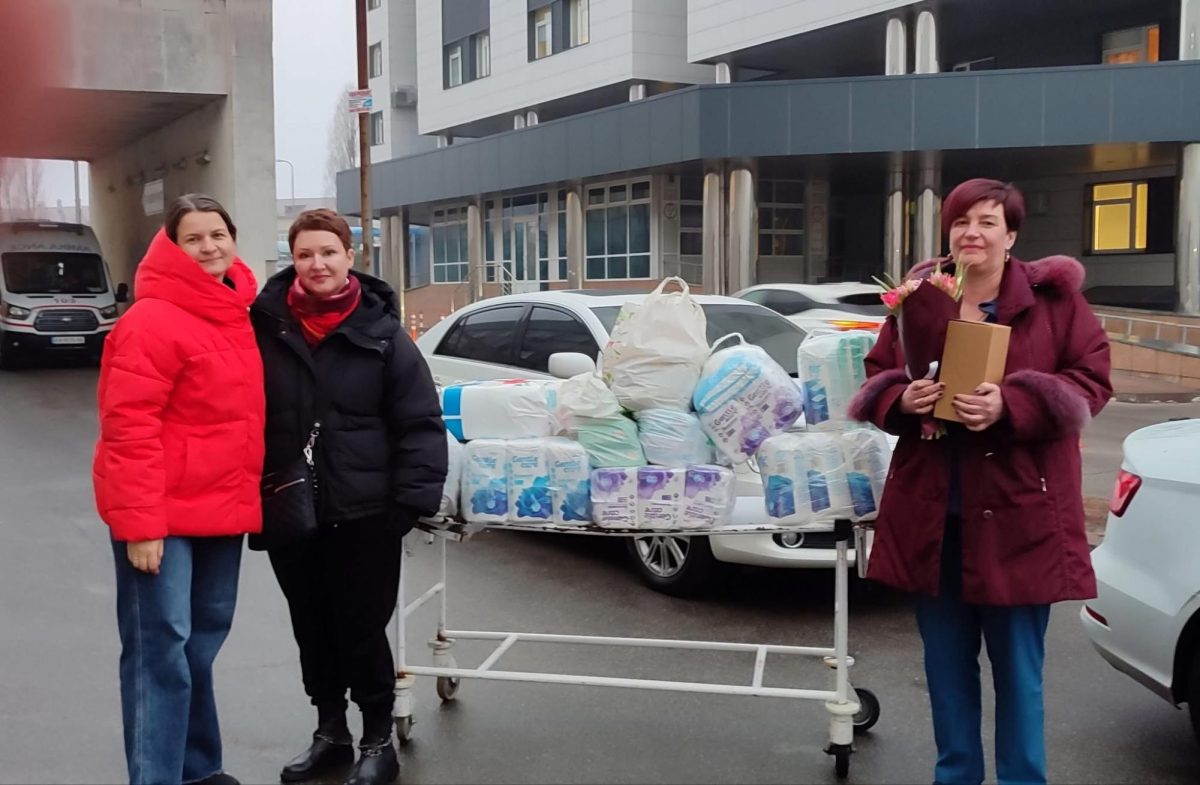
Olena Hudz, left, and her fellow volunteers stand next to a cart of collected feminine products, diapers and hygienic products for people in need on February 6, 2025, in Kyiv, Ukraine. Photo courtesy of Olena Hudz.

Despite the danger, Hudz and her neighbors no longer go to shelters when the sirens sound.

“We don’t have good bomb shelters around here,” Hudz said. Instead, they sleep in hallways, adapting to the circumstances each new day brings. 

“It’s terrifying that we are used to it, that we have adapted,” Hudz said. Like many Ukrainian parents, she wrestles with the choices she has made for her family. “Of course, I ask myself all the time if this was the right choice, if I should have stayed and kept my kids here to be kids of war.” 

Yet, she continues to face each day with resilience, embodying the unyielding spirit of those determined to endure.

In Ukraine, civilians like Hudz have organized resistance efforts, fought to defend their communities and supported each other despite immense challenges. This kind of civic resistance underscores the dual role civilians play as both victims and active participants in shaping their futures. 

There have been large changes in Ukraine’s social fabric. Families gather in candlelit rooms during blackouts, finding solace in shared moments. These acts of normalcy are not merely survival tactics — they are declarations of humanity. 

Ternopil Yasinovskyy lives in Ternopil, Ukraine, with his wife and two children. At the end of 2021, they bought a house out in the country, hoping to finish renovations on it within the year and move in. The war has stalled those efforts almost completely, Yasinovskyy explained, with many contractors enlisting, leaving the country, or taking on significantly fewer jobs because of a worker shortage and how stretched-thin resources are. 

In addition to the struggle to find workers, the financial burden of the war weighs heavily on families like the Yasinovskyys. A significant portion of many Ukrainians’ income goes toward donations, usually not to large humanitarian funds but directly to volunteers they know. 

Fundraising efforts for drones, Starlinks, charging stations, vehicles and repairs are constant, and often, the people collecting are raising money for brigades where their own relatives serve. Financial contributions are a way to protect loved ones and support those on the front lines.

Yasinovskyy showed The University News pictures of the house, as well as the renovation plans, explaining how they are trying to be patient even though the process has been frustrating.

“We had planned everything out for that house, had a complete design mock-up, knew where we wanted to put the plants in the living room. But of course, none of that happened. Two years later, the house still had no stairs connecting the main and second floors,” Yasinovskyy said.

This stagnation is happening all over the country. Businesses are being forced to close. Volunteer efforts that boomed in support in 2022 are finding it hard to garner support. Fundraising is getting harder and harder, whether overseas or from their own countrymen. 

In February 2022, there were long lines at enlistment offices as the number of people willing to join the army exceeded the military’s needs, but those numbers have fallen, with many casualties in the last three years and a general large drop in passion for the war effort. Throughout the last three years, the military has been carrying out constant mobilization measures to replace those who have died or been seriously wounded.

Poet and soldier Artur Dron smiles in uniform, holding a copy of his poetry book, “We Were Here,” a collection of wartime poetry, during a series of promotional book events across Western and Central Ukraine in May 2024. Photo courtesy of Artur Dron.
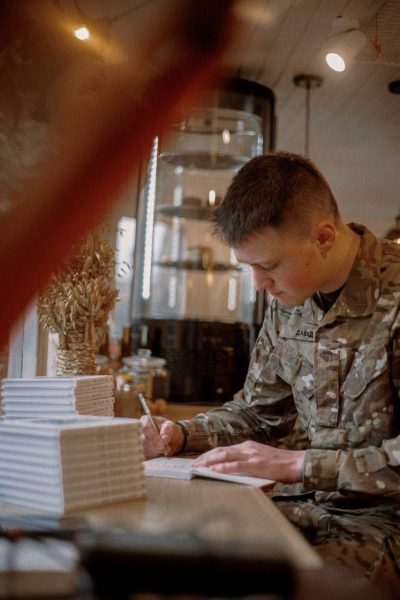
Poet and soldier Artur Dron signs copies of his book, “We Were Here,” a collection of wartime poetry, during a series of promotional book events across Western and Central Ukraine in May 2024. Photo courtesy of Artur Dron.


Artur Dron, a young Ukrainian poet who joined the front lines in 2022, said it is sad to see global attention diminish and support wane around the war, even as the situation worsens. 

“I always want to emphasize that abroad, the saturation of information about the war in Ukraine is becoming less and less, but in our country, the war is a daily reality. An American in 2022 heard much more about the war than now, so it may seem to him that it is winding down and ending. But it is not so. Nothing has ended, people die in our country all the same,” Dron said. 

The diminishing media coverage frustrates many Ukrainians, who fear that their suffering will be forgotten. Dron’s poetry captures the heartbreak of living through a war that the world seems eager to move past, even as bombs continue to fall.

“To me, describing pain should never be the goal. The goal should be to outline light—something that stands in contrast to war’s horrors, which will inevitably be present in the poem anyway,” Dron said.

He writes poetry from the front lines, but his poetry is “not about war.” The poems describe events and people he has encountered. Dron’s book, “We Were Here,” was originally published in Ukraine in 2023, and an official English version is available for preorder on Amazon.

“[Poetry] can tell the readers a little more about the purely human aspects of our experiences. Without comments about any political, global things,” Dron said.

People’s motivation lies in community, with young people who are vocal about their beliefs and willing to fight for them, like Dron. In the efforts of local volunteers like Hudz, working to rally their communities and get support for wounded soldiers who often feel forgotten. In children like Yaryna, who go to school and art class despite the daily bomb threats, knowing that soldiers are fighting to protect their rights. 

Hudz said that it is hard to rely on politicians or the outside world when you live in a country that has been at war for three years. Aid packages can be deferred, slowed and even revoked. Promises are not always kept, both by foreign leaders and the country’s own. 

“You need to be your own hope,” Hudz said. “When everything feels hopeless, I have to believe in myself.”

Posted in UncategorizedComments Off on Life interrupted: Resilience in a war-torn Ukraine