Author Archives | Jason Sobieski

Crime Report – March 15

Photograph by Ben Ahrens for The Triangle.

The following crimes occurred on or near campus and were reported to The Triangle by the Drexel University Department of Public Safety between Feb. 25 and March 12. All information included in this report is taken from law enforcement or Division of Public Safety incident reports.

ROBBERY (1)

March 6, 4:26 p.m., 3100 Market Street

A non-Drexel affiliate reported that an unknown male entered the Santander Bank, produced a demand note and fled with an unknown amount of cash that included a dye pack. No injuries were reported.

ASSAULT (3)

Feb. 28, 8:58 p.m., 3500 block of Lancaster Avenue

Drexel Police arrested a non-Drexel affiliate for domestic assault after he assaulted his significant other. Minor injuries to the complainant.

March 6, 4:47 p.m., 3300 block of Brandywine Street

A non-Drexel victim was shot several times in his body by unknown males who fled the area. The victim was taken to Presbyterian Hospital and is in critical condition.

March 7, 1:46 a.m, 2900 block of Chestnut Street

Two security officers reported that they were assaulted by an unknown male inside the evo lobby. Minor injuries to the complainants.

THEFT (9)

Feb. 25-28, 3300 Race Street

Four Drexel students reported that an unknown person(s) entered their unlocked rooms and took cash and personal property that was left unsecured.

Feb. 27-28, 200 N. Broad St

Three Drexel students reported that an unknown person(s) took their backpacks containing a laptop, iPad and personal property that was left in view in an unlocked conference room.

March 1, 8:45 p.m.,3400 Lancaster Avenue

A Drexel student reported that  they met with an unknown male to sell their gaming system, and the male paid them with cash that was later found to be counterfeit.

March 2, 11 p.m.,3100 Chestnut Street

A non-Drexel affiliate reported that an unknown male entered their business, ordered and consumed food and then fled without paying his bill.

March 3, 4:47 p.m.,3300 Market Street

Drexel Police arrested a non-Drexel affiliate male after he took items from a store and attempted to leave without paying for them. Upon police arrival, the male struggled with police to flee.

March 6-7,3200 Market Street

A Drexel student reported that an unknown person(s) entered an unlocked office and took their wallet that contained their credit cards. Several unsuccessful attempts were made to use their cards.

March 7, 3:02 p.m., 200 N. 34th St.

A non-Drexel affiliate reported that an unknown male entered his business, took food items and fled the store without paying for the items.

March 9-10, 3400 Hamilton Street

A Drexel student reported that an unknown person(s) entered their auto through an unlocked door and took their backpack that contained their laptop and cash.

March 11, 12:28 p.m., 3300 Market Street

A non-Drexel affiliate reported that an unknown male fled the store with food items that he failed to pay for.

OTHER (1):

March 12, 11:42 a.m., 3200 Baring Street

Drexel Police observed an auto operating recklessly in the area, and upon stopping it, arrested the operator for DUI.

During the period from Feb. 28 to March 12, there were three Policy Violations for Alcohol. The reports were sent to the Office of Student Conduct for review.


Posted in UncategorizedComments Off on Crime Report – March 15

Drexel students get a taste ‘Roma’ at Gran Caffe L’Aquila

Photograph by Sakyra Hayes for The Triangle.

Mario De Lorenzo, along with many other members of Drexel’s Italian Pride Student Organization and fellow Drexel students, attended “A Taste of Roma” at Gran Caffe L’Aquila in Rittenhouse Square March 8. Marketed as a way to “Come discover Rome through history and cuisine,” students were to there not only to eat, but also to learn.

The sophomore is the head of Drexel’s IPSO and the Italian native was getting as close to home as he could get in Philadelphia, if only for a few hours. What began being planned in the fall term was finally coming to fruition, and it was a lot of hard work being paid off.

With a visual-heavy powerpoint presentation of a “virtual walking tour” through Rome, those who attended could not only see what Rome looked like at its various monuments and plazas, but also hear about the history behind each one. The kicker? The owner of Gran Caffe L’Aquila, Riccardo Longo, helped deliver the presentation.

The Roman native and Philadelphia transplant was actually the one to establish contact about the event. The Drexel MBA grad wanted to give back to the Italian community of his former university, and he wanted to personally make sure that “A Taste of Roma” was authentic as it could get. So much so that the event started a few minutes after its scheduled 1 p.m. start time due to Longo finalizing the presentation and dishes.

Along with the food and the history of Rome, Gran Caffe L’Aquila itself is about as authentic as it can get.

The original Gran Caffe was an exceptional cafe in the city of L’Aquila, the capital city of the Abruzzo region of Italy, winning cafe of the year for all of Italy in 2007. On April 6, 2009, an earthquake crippled the city of L’Aquila, badly damaging the restaurant. Original owners Stefano Basiani, gelato champion of Italy, and Michele Moreli, award-winning Italian coffee roaster, opened up an outpost on the outskirts of L’Aquila, continuing to produce their mastered crafts.

During one of Longo’s visits to Abruzzo, he came upon Basiani and Moreli’s outpost. He tried their coffee and gelato, and decided to invite the two to Philadelphia.

A majority of the restaurant itself was constructed in Italy and sent over to Philadelphia, where the pieces were put together for their Christmas Eve opening in 2014.

But of course, this was “A Taste of Roma” after all. Gran Caffe L’Aquila did not hold back, providing four authentic dishes — much to the delight and awe of the Drexel students attending.

De Lorenzo especially enjoyed them, and after one of the courses was finished, he turned to me and said, “It’s like I’m eating at home.”

There to serve each course was Longo himself, seeing each dish made it to the table. The four courses were as follows:

The first course was Suppli con Bruschetta e tomate, followed by the Spaghetti alla carbonara con guanciale. The third course was the Bucatini all’Amatriciana — the crowning pasta jewel of Rome — before finishing up with a spoon Gran Caffe’s gelato flavor called “Desire.”

Each course was brought out with an accompanying explanation of its history and cultural connections to Rome. The suppli and bruschetta are common street foods in Rome, and are typically seen as a light snack. The spaghetti alla carbonara is a popular dish in America, but the Westernized version is far from authentic.

“The carbonara here in America … it’s nothing like the actual dish. There isn’t any cream or milk or butter, so don’t expect that,” Longo explained. For reference, Longo expounded on what makes up the authentic carbonara. “The [traditional] ingredients in this dish are the pasta, eggs, guanciale, black pepper and pecorino romano.”

The third course, being the most traditional pasta dish of Rome, held the most cultural importance to the event. It was the truest taste of Roma that Gran Caffe could offer.

The lunch was finished off with some of their gelato from Basiani’s world-class makings. “Desire” incorporates both milk from Lancaster Farms in Pennsylvania with sour amarena cherries from Italy, and the creation is symbolic of the unity between Philadelphia and Abruzzo at Gran Caffe L’Aquila.

“This will be the first event of many here at Gran Caffe,” De Lorenzo explained. “Today is about Roma, and I initially wanted to focus on Sicily, but Gran Caffe had already offered ‘A Taste of Roma’ and I couldn’t say no. We will get to Sicily in the future.”

He was excited to begin to plan more, and is looking towards next term to expand Drexel IPSO’s reach and event schedule, especially with Gran Caffe.

“The restaurant seems to be really interested in educating people about the culture of Italy,” De Lorenzo said. There is the potential to not only eat Italian food, but to be immersed in a place full of Italian culture and to further the learning outside of the classroom.

You can contact Drexel Italian Pride on DragonLink, and sign up for updates from the organization about future events.


Posted in UncategorizedComments Off on Drexel students get a taste ‘Roma’ at Gran Caffe L’Aquila

Triangle Talks with Therapy Dogs’ owner

Janine Erato poses with furry friends Chai and Espresso, Drexel’s therapy dogs. (Photograph by Prachi Gaddam for The Triangle)

Janine Erato is the owner of Drexel’s therapy dogs: Chai and Espresso. She brings Chai and Espresso to campus events throughout the term.

This interview has been edited for clarity and style.

The Triangle: Tell me about Chai and Espresso. How are they different from each other?

Janine Erato: Chai is 6 years old — he’s more mellow and calm. I named him after my favorite drink, which is chai. Espresso is 4 years old and he’s a shot of pure energy. He’s so athletic — he always tries to win any competition he’s in. My husband named him after his favorite drink. Their names are really fitting! They both spend 8-10 hours every week on all three campuses.

TT: How does a dog become certified to become a therapy dog?

JE: Training is usually done either at a training center or at home — if you know what you’re doing. There’s a test with a lot of different components and the certification is pass/fail.

TT: Where can students find Chai and Espresso?

JE: Chai and Espresso can be found during events on each of Drexel’s campuses. One can also follow their social media.

TT: Besides Drexel, where else do these dogs make appearances?

JE: Well before coming to Drexel, Chai and Espresso used to make appearances at other places but right now they’re at Drexel full-time.

TT: What is the overall purpose of bringing these dogs to Drexel and other college campuses?

JE: There are a couple of reasons: first, Drexel’s aim is to create a home away from home and that includes time with the family pet. While Chai and Espresso won’t be able to replace the memories of a real family pet, they are a pretty good substitute. They’re very friendly and calm dogs. Second, they play a major role in campus involvement: they get people to come to events! And the last reason — the most important one — being they help alleviate a lot of stress.

TT: How can students benefit from spending time with these dogs?

JE: Being around Chai and Espresso elevates happiness — students can snuggle with them, talk to them and just have a little piece of home with them.

TT: Why is this especially important during finals weeks and other busy parts of the term?

JE: I mean, Drexel is always busy. Students are constantly taking exams and working on assignments, which is why Chai and Espresso are available all term. Finals week is definitely the most stressful though and these dogs do a great job at making students feel better.

TT: Are you looking to expand the program further?

JE: Yes! We’ve actually expanded our program recently — we recently hired an unpaid intern. We also are hosting our first official event that was funded by donations on March 21 from 4 to 6 p.m. in the Recreation Center lobby. It’s a stress buster event in memory of Irish journalist Ryan Cornelius.

TT: What’s one thing you think students might not know about the dogs?

JE: Chai and Espresso are not service dogs; they’re therapy dogs, which means that they’re not around to help me or anything so I can’t bring them into restaurants or other public places. Their main role is to provide comfort for others.

TT: What have you learned from working with these dogs and introducing them to students?

JE: Well the students have just been so welcoming. Even though they’re such big dogs, most students aren’t afraid of them because of how calm and friendly Chai and Espresso are. When the dogs are exposing their bellies completely to you guys, that’s the most submissive position a dog can be in. They’re being vulnerable — that means they’re comfortable with the students and I’m so proud of that. The students have also been so nice and supportive of our newest dog in training, Java.

TT: What’s the best part about working with Chai and Espresso and bringing them to campus?

JE: All the free kisses!

Photograph by Prachi Gaddam for The Triangle.

Posted in UncategorizedComments Off on Triangle Talks with Therapy Dogs’ owner

Academy panel: city’s grapple with inevitable climate change

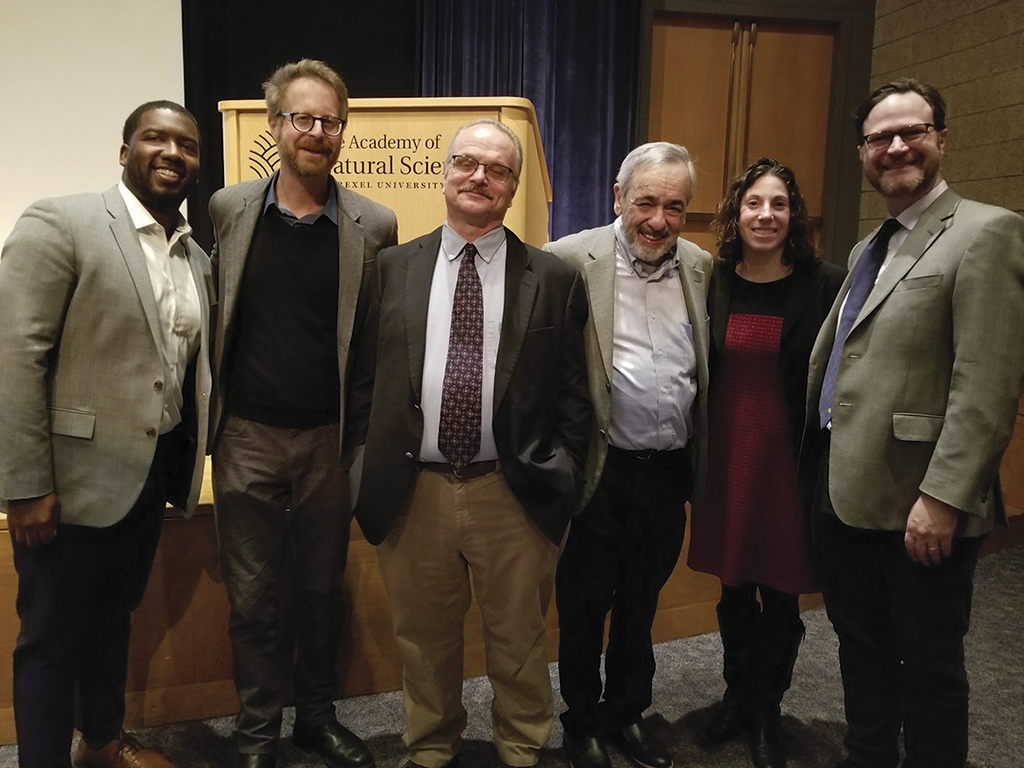
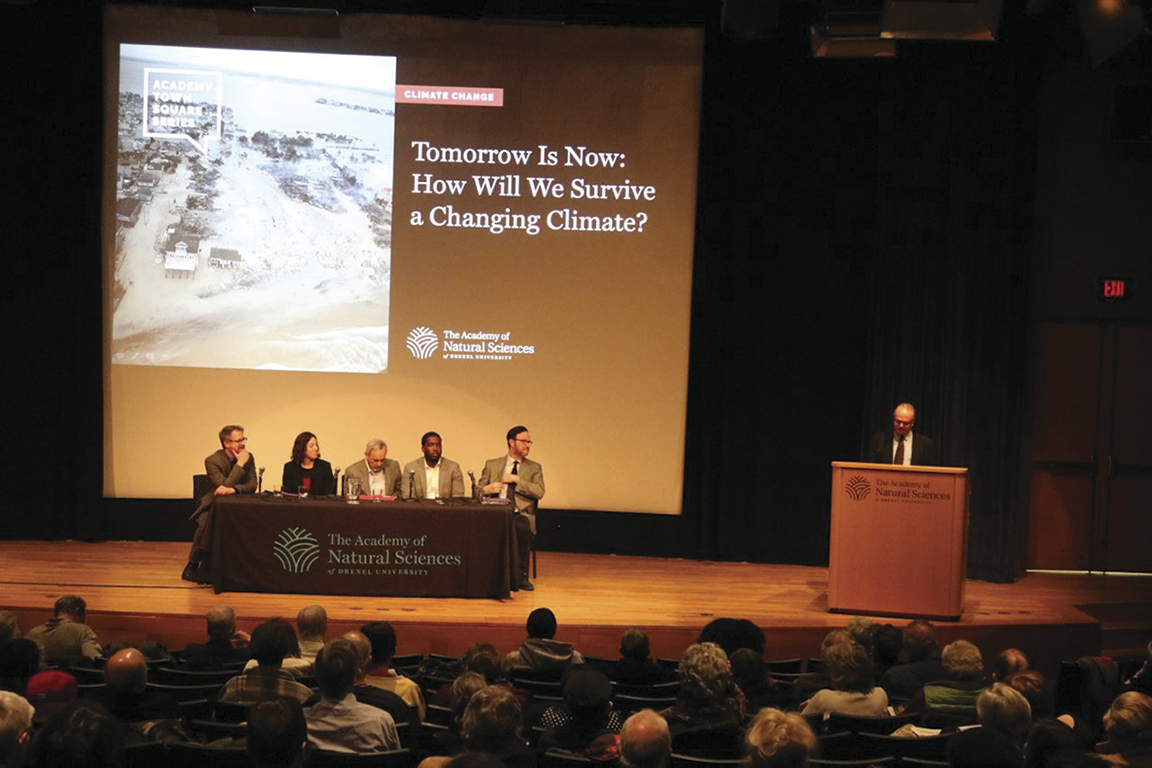
The head of Drexel’s Department of History moderated a panel with a Drexel professor and other industry experts about steps the city of Philadelphia is taking to combat climate change. (Photograph courtesy of Carolyn Belardo.)

A panel held at The Academy of Natural Sciences of Drexel University March 4 titled “Tomorrow Is Now: How Will We Survive a Changing Climate?” focused primarily on the steps the city of Philadelphia is taking to combat climate change.

Moderated by urban disaster expert and head of Drexel’s Department of History, Scott Knowles, the panel included Saleem Chapman, deputy director of sustainability of the City of Philadelphia; Howard C. Kunreuther, a professor of decision sciences and public policy and co-director of the Risk Management and Decision Processes Center at The Wharton School at the University of Pennsylvania; Mira S. Olson, an associate professor in the civil, architectural and environmental engineering department at Drexel; and Nathaniel Popkin, an author, editor and historian.

Chapman first mentioned how the Office of Sustainability has been contributing to the climate change fight in a variety of ways. In addition to publishing the first climate production publication in Philadelphia in 2014, the department has also published “Growing Stronger,” a report that identified vulnerabilities and existing climate resilient strategies in 2015.

However, he said that the next step for the office is city-wide adaptation planning in order to create an in-depth engagement process for all of those who reside in Philadelphia.

“Even though climate change affects everyone, not all people are impacted equally,” Chapman said. “Many factors such as racism, health status, income and wealth can influence the communities sensitivity to climate change.”

He showed a map of Philadelphia, proving this point through racial and income data mirroring the neighborhoods’ vulnerability towards climate change. Chapman also mentioned that this difference is related to which neighborhoods have been gaining tree coverage.

Since the process should be community driven towards proposing social collusion and social capital, workers in the Office of Sustainability went to several neighborhoods in North Philadelphia and engaged people in a six-month process where more than 500 citizens were surveyed in order to foster the trust in the people and obtain a solution to this issue, which he said could be in the capacity of the community.

Chapman concluded that the plan will be released in the incoming months, and it will have to do with cooling centers to lessen the effects of hot days in the community.

Kunreuther, the second panelist, said that it is difficult for humans to identify the high consequences of climate change due to our intuitive thinking where we do not have the experience of past global crises like this one. He said that we do not have the intuition to respect this phenomenon, and a set of systematic biases that do not serve us well in terms of how to deal with this, often take over our thinking process.

He proposed to focus on more deliberate thinking in order to look at the tradeoffs in our decisions. He said that it is important to highlight the interconnections in communities and to simultaneously think about long-term strategies — though he added that it is extremely hard to do this.

Kunreuther referenced the book he co-authored,“The Ostrich Paradox: Why We Underprepare for Disaster.” He spoke of some of the biases that prevent people from understanding the consequences of climate change. Some phenomena he described are miopia, when people limit their horizons of the benefits of acting for this cause; amnesia, when people, after some years, forget the sequels of natural catastrophes and stop being precocious; optimism, when people think that the probabilities of global warming having any results are really low in the most proximate years; inertia, when people advocate for keeping the status quo rather than chang with it; simplification, when people believe the issue is below their area of concerns; and the hurting effect,when, among the community, people are not worrying about it and others start to question then why should they worry as well.

Olson brought the conversation back to Philadelphia, speaking about how rising sea levels are affecting some of the water systems in the city.

She explained that the city’s water systems are drained from storms where water and water waste are gravity driven.

“As the sea level rises, that difference in the height of the water decreases and water, as you know, goes from high to low, and when the difference between the water sources is even, there is no flow of water,” she said.

Once the water does not flow, the water waste and the incoming water remains stuck and may lead to a flood or a shutdown of Philadelphia’s water systems, she said.

She said this poses a serious question: what to do with the city’s infrastructure. She went on to explain that sea level is also related to the salt line.

There are two water intakes to the city of Philadelphia: the Delaware River, which has freshwater and its intercepting intake, the Atlantic Ocean, which has saline water. If the sea level increases, the salinity line may affect the Delaware River and our drinking water, she added.

Popkin, the last panelist, introduced his speech with a phrase from his opinion piece published in the Philadelphia Inquirer Feb. 27.

“Each one of us is responsible for the spiraling consequences of actions produced collectively across vast time and space — an impossible fate for a moral being” he said.

He raised two questions. The first question he posed is who will be responsible for combating climate change: future generations, like his grandchildren when they suffer the consequences of it, or the present generation? The second question was what can individuals in society do?

There are 89,000 government units in the U.S., and many operate in contradiction to each other regarding this issue, making it more difficult to manage the environmental crisis that has been merging for decades and not having any political response as other crises like the Holocaust, Popkin said.

He said that scientists and policy makers mask this by calling it a period of man’s apparent domination of the Earth, while he describes this phenomenon as the dynamic of an interconnected gesture of global warming, deforestation, extinction, mining exploitation, among other issues.

Consequently, he mentioned that climate change is not addressed because of two aspects: the inside aspect where people justify themselves as saying it is not in their control, and the outside aspect where people cannot imagine to an extent what to do.

“No one can stand and talk about the ecological crisis and global warming for more than five minutes or the other person would walk away, so this event tonight is wonderful,” Popkin said.

He said another reason for the paralysis of action towards this issue is the questioning of people: who are they to save the planet from getting worse, and who are they to be responsible for climate change?

“Everyone is more than capable of accounting all of the kinds of people in the world of climate change. Everyone is in equal parts problematic and in no way given the political order of reconcile in thousands,” Popkin said.

To conclude the panel, the audience was granted the opportunity to ask questions.

The panelists were asked what the city of Philadelphia is doing to lessen the consequences of climate change. Olsen answered that the water planning systems of the city are being productive towards the issue, and Popkin added that the city has a history of knowing how to overcome problems so he thinks they will also overcome this one.

Photograph courtesy of Carolyn Belardo.

Posted in UncategorizedComments Off on Academy panel: city’s grapple with inevitable climate change

Drexel research expands the use of silicon in batteries

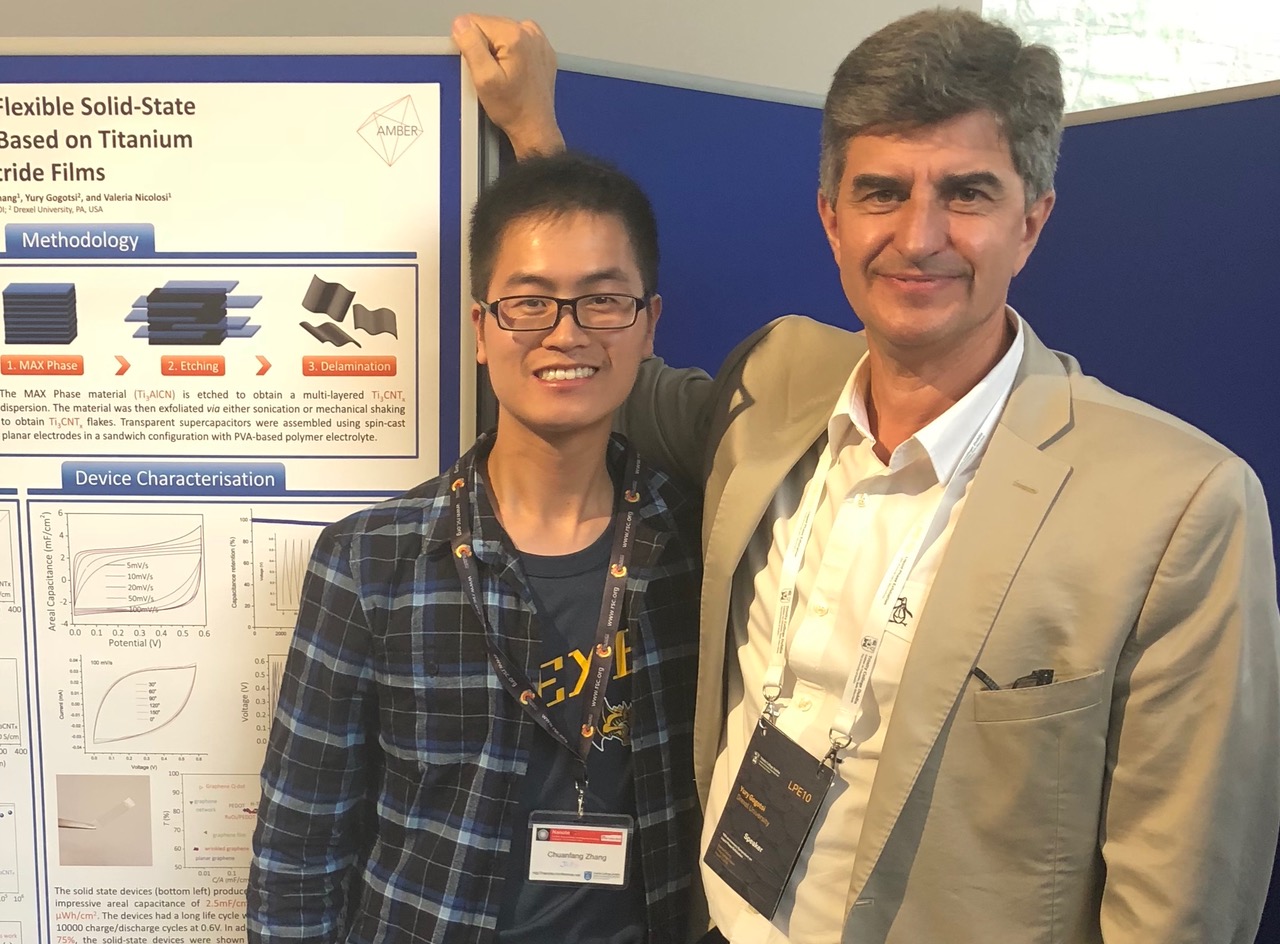
Photograph courtesy of Yury Gogotsi

Lithium-ion batteries are used to charge anything from portable electronics to pacemakers to electric cars, but with a silicon anode — the part in which the current enters — there is a higher chance of breaking during charging. However, researchers at Drexel University are working to solve this problem.

New research from Drexel and Trinity College in Dublin, Ireland looks to extend the lithium-ion batteries’ life up to five times by controlling and preventing silicon anode expansion with MXene materials.

A battery’s charge is delivered as the ions travel from the anode to the cathode, returning to the anode when the battery is recharged. A greater ability for electrodes to send and receive ions means the battery will have a longer life. By using silicon, the anode can accept four lithium ions instead of just one. On the other hand, silicon expands up to 300 percent as it charges, causing the anode to break and the battery to malfunction.

Co-author of the study Yury Gogotsi, the director of the A.J. Drexel Nanomaterials Institute, explained that one cannot use a battery that swells during charging.

“Silicon can only be used as nanoparticles, as larger particles break during charging-discharging, and the battery degrades after just a few cycles,” he told The Triangle. “The practical solution that was found is combining silicon nanoparticles of about 100 nanometers in size (roughly, 500 times smaller than the diameter of a human hair) with carbon by either coating silicon with carbon or just mixing with graphene. Carbon conducts electrons and accommodates expansion of silicon particles.”

Gogotsi’s team combined MXene ink with powdered silicon nanoparticles to produce a hybrid silicon-MXene anode. The MXene nanosheets distribute randomly, forming a continuous network wrapped around the silicon particles. This network organizes the ions to prevent expansion while still keeping the conductivity of the silicon.

Gogotsi said the team first attempted to develop carbon encapsulated silicon anodes over a decade ago, though it was hard to produce fast results with almost no external funding and just a single student involved.

But in 2010, they made an attempt to use the titanium silicon carbide MAX phase, developed by materials science and engineering professor Michel Barsoum,  in anodes of lithium ion batteries. This finally led to progress — the discovery of MXene. This, Gogotsi said, is one of the biggest and most impactful discoveries ever made at Drexel.

And since titanium carbide MXene has higher electrical conductivity and mechanical strength compared to amorphous carbon or solution-processed graphene used previously, he said they decided to check if it may work better than carbon in silicon anodes. At last, the task was accomplished in 2017, and they developed promising silicon based anodes with the help of MXene nanosheets.

Out of the 30 types of MXenes produced, the researchers selected the MXene titanium carbide and titanium carbonitride for silicon-MXene anodes. The anodes had higher lithium-ion capacity compared to graphite or silicon-carbon anodes.

“Titanium carbide MXene shows the highest electrical conductivity of all MXenes studied to date,” Gogotsi said.

Due to MXenes’ high electrical conductivity, they have been used worldwide for a broad range of applications. In addition to being outstanding material for brain electrodes, antennas and electromagnetic interference shielding, he said that their high surface area allows for their use  in urea removal from blood and improving the dialysis process for patients with kidney disease. Moreover, the ability of some MXenes to transform infrared light into heat very efficiently led to their investigation in destroying cancer tumors by the method of photothermal therapy.

“And this is just the beginning of the list of their applications,” he said, explaining that MXenes can also purify water, reenforce plastics and ceramics and do many other useful things better than other materials.

Unlike most nanomaterials produced in milligram quantities in laboratories, he said that MXene anode production is easily scalable. However, a large volume of production is required to make the material inexpensive.

So while the batteries may not yet be ready for cars, he said that he’d consider MXene use for cell phones and other small battery-powered electronic devices — though he has high hopes for the future.

“Hopefully, large-volume production will push the prices down within a few years to make large-volume applications in batteries and elsewhere possible,” he said.

He said that they also hope to keep exploring other nanomaterials, including carbon materials such as graphene, nanotubes and porous carbons, often in combination with MXenes, for energy storage.

But overall, the impact of the MXene discovery cannot be overlooked, he said.

“The analysis of the literature shows that the discovery of MXenes made at Drexel in 2011 has already led to more than 1000 research publications from more than 600 organizations in 44 countries around the globe,” he said. “We hope to capitalize on this tremendous interest to MXenes, maintain Drexel leadership in the field and commercialize MXene technology for dozens of applications.”

Posted in UncategorizedComments Off on Drexel research expands the use of silicon in batteries

Employers seek all students at engineering and tech career fair

Drexel University’s Steinbright Career Development Center hosted an Engineering and Technology Career Fair Feb. 27 in the Drexel Recreation Center with over 100 companies in attendance.

During the event, which was open to both undergraduate and graduate students, students across all majors were given the opportunity to network for a wide range of opportunities, ranging from temporary co-ops to permanent hires.

The employers that attended represented a diverse selection of the STEM industry. Transportation-focused companies, including the National Highway Traffic Safety Administration, the Pennsylvania Department of Transportation and SEPTA recruited electrical, mechanical and civil engineers among other disciplines.

In the healthcare sector, Johnson & Johnson, GlaxoSmithKline, Merck & Co. Inc., Zimmer Inc. and many more recruited not only biomedical and chemical engineers, but students of many different majors for interdisciplinary work.

Chemical and materials engineers were popular recruiting choices for manufacturing companies like Crayola, and computer engineering majors, as well as engineering technology majors, were widespread across all companies’ networking objectives.

Several technology-focused companies, including Vanguard, Lutron and io-consultants, were in attendance looking for computing and informatics students.

Drexel’s online resources encouraged students to begin learning about the industry before the fair by researching employers of interest. They also recommended that students update their resumes, dress professionally for the event, prepare questions for employers and practice their 30-second introductions.

For those students are either not enrolled in technology or engineering degree programs or who are looking to work in other fields, they have certainly not been forgotten by the Steinbright Career Development Center.

The next career fair will take place on April 17 and will have a wider variety of networking opportunities for majors both in and outside of engineering and technology fields. Steinbright will offer preparation workshops to students prior to the event.

Posted in UncategorizedComments Off on Employers seek all students at engineering and tech career fair

Flower Show displays society’s dependence on horticulture

The show features the world’s leading floral and garden designers to convey how flowers produce a wide range of emotions and messages. (Photograph courtesy of Wayne Lin)

The Philadelphia Flower Show is in town and is currently open to the public until March 10. Put on each year by the Pennsylvania Horticultural Society, the Flower Show has become a major attraction bringing thousands to Philadelphia each spring.

Many visitors have already flocked to the Pennsylvania Convention Center on Arch Street to see 10 acres of floral and garden displays as part of the largest, longest-running horticulture event in the nation.

In addition to many decorative displays, the Flower Show hosts competitions in multiple areas, including horticultural and artistic flower arranging, gardening presentations and demonstrations, and special events. Judges for the Flower Show rank displays based on cultural perfection, distinctiveness, bloom, fruit, maturity, difficulty and rarity.  

“The world’s leading floral and garden designers will explore how flowers convey a wide range of emotions and messages in a universal language that transcends cultures and borders,” according to the 2019 PHS Flower Show website. “Stunning landscapes, imaginative gardens and breathtaking floral displays will interpret flowers’ power to inspire, decorate, style and enrich our lives.”

The “flower power” theme of this year’s show is built around six distinct areas of effects that flowers have on humans, according to Karen Barsotti, an information desk volunteer for the Philadelphia Flower Show.

“The theme for this year is ‘flower power,’ which is based on the 50th anniversary of Woodstock and ’60s power, but it is also based on every aspect of power that flowers and plants have on everyday life,” Barsotti said. “There are a number of areas. One is to inspire people, one is to heal, one is to form community, one is to help celebrate. Another is an economic driver — a lot of businesses thrive through horticulture. Lastly, one is communication — even if people don’t speak the same language, they can speak the language of flowers. Those are what I see as the six powers of flowers.”

Photograph courtesy of Wayne Lin.

In conjunction with the “flower power” theme and the powerful connections flowers have with humans, there is a strong sense of togetherness and friendship conveyed throughout the Pennsylvania Convention Center floor.

One park display features a “Buddy Bench,” a wooden bench dedicated to celebrating meaningful relationships.

“The only way to have a friend is to be one,” is painted on one of the bench rails.

The powerful floral and garden displays are sure to spark emotion, and some even tug at the heartstrings as they focus on difficult topics including pediatric cancer and Alzheimer’s disease.

“One [display] actually made me cry when I looked at it,” Barsotti said. “It has five different categories of how flowers communicate through different colors and different themes. Spring and new beginnings, death and solemnity, there’s love — if you look at it, there’s a lot of communication. The way they communicate with words and then plants, I thought it was really beautiful.”

Those looking to visit the Philadelphia Flower Show can purchase tickets online at www.theflowershow.com, and Drexel students can receive discounted student tickets. The Flower Show is open to the public at the Convention Center until March 10.

Photograph courtesy of Wayne Lin.

Posted in UncategorizedComments Off on Flower Show displays society’s dependence on horticulture

Crime Report — March 1

Photograph by Ben Ahrens for The Triangle

The following crimes occurred on or near campus and were reported to The Triangle by the Drexel University Department of Public Safety between Feb. 8 and Feb. 26. All information included in this report is taken from law enforcement or Division of Public Safety incident reports.

ROBBERY (2)

Feb. 14, 12 a.m., 3200 Spring Garden Street

A non-Drexel affiliate reported they were involved in a disagreement with unknown person(s) and upon exiting their vehicle, they were struck in the chest with a blunt object and had their cell phone stolen from their automobile. Complainant suffered a minor injury.

Feb. 25, 11:10 a.m., 3400 block of Lancaster Avenue

Drexel University Police Department officers arrested a non-Drexel male after he took items from the 7-11 store and threatened the owner at knifepoint. The offender was apprehended at 36th Street and Lancaster Avenue, and the stolen items were recovered. No injuries were reported.

BURGLARY (2)

Feb. 16, 4:30 p.m., 3600 Spring Garden Street

The complainants, a Drexel student and three non-Drexel students reported that upon returning to their residence, they discovered that their residence had been entered by unknown person(s) by breaking the glass in a back door. The complainants discovered a suitcase containing their jewelry and personal items left in their rear yard.

Feb 18., 12:28 p.m., 3200 Chestnut Street

Drexel police arrested a non -Drexel male for trespassing, after the male was cited in the past and informed that he is not permitted in Drexel buildings.

THEFT (16)

Feb. 8-11, Unit South 33rd St.

A Drexel staff member reported that an unknown person(s) entered his office, no sign of force, and took a laptop computer from his desk.

Feb. 10, 3 p.m., 400 N. 33rd St.

The non-Drexel complainant  reported they let a female known to them borrow their vehicle, and when the automobile was not returned by Feb. 13, they reported the automobile stolen.

Feb. 15, 12:55 a.m., 3300 Market Street

Drexel Police arrested a non-Drexel male after he fled the Wawa store with merchandise that he failed to pay for. The items were recovered.

Feb. 15-18, 3100 Ludlow Street

A Drexel staff member reported that unknown person(s) removed an iPhone that was shipped to them from its package prior to them receiving the package.

Feb. 17-23, Unit Block N. 36th St.

The complainant, a Drexel student, reported that an unknown person(s) removed the vehicle registration plate from the rear of their vehicle.

Feb. 18, 7:58 p.m., 3300 Market Street

Drexel police arrested a non-Drexel male,  after he fled the Wawa with energy drinks that he failed to pay for. The items were recovered.

Feb 18, 9:02 p.m., 3300 Market Street

Drexel police arrested a non-Drexel affiliate after he fled the Wawa with food items without paying for them. The items were recovered.

Feb. 19, 10:50 to 11:37 a.m., 3100 Market Street

A Drexel student reported an unknown person(s) took their backpack that contained their laptop computer, charger and textbooks that was left unattended in a common area.

Feb. 20, 5 to 5:37 a.m., 200 block N. 15th St.

Unknown person(s) took a bicycle that was equipped with a GPS and secured to a bike pole with a cable lock. The bike was recovered at 1400 Wood Street.

Feb. 22, 2:30 to 2:40 p.m., 300 N. 36th St.

The non-Drexel complainant reported an unknown person(s) took their laptop from their book bag after it was left in a common area.

Feb. 23-24, 2900 Queen Lane

A Drexel affiliate reported that an unknown person(s) broke the driver side window to their auto and took personal items that were left inside the auto.

Feb. 25, 2 p.m., 3000 JFK Boulevard

The non-Drexel complainant reported an unknown person(s) took their wallet containing cash and ID from their coat pocket without their knowledge.

Feb. 25-26, 3300 Arch Street

A Non-Drexel affiliate reported an unknown person(s) entered their food truck by forcing a window and took food items from inside.

Feb. 25-26, 3200 Chestnut Street

A Drexel staff member reported that an unknown person(s) entered their unlocked office and took their laptop computer that was left on their desk.

Feb. 26, 8 a.m. to 5:15 p.m., 300 N. 33rd St.

A Drexel student reported that an unknown person(s) entered their apartment, no sign of force, and took a cordless charger.

VANDALISM (1)

Feb. 17, 4 to 9:10 a.m., 3300 Race Street

A Drexel student reported that unknown person(s) placed inappropriate graffiti on a name card that was attached to their outer residence hall door.

DRUGS (1)

Feb. 15, 11:46 a.m., 3200 Market Street

Drexel police arrested a non-Drexel affiliate after he was found to be in possession of heroin.

During the period from Nov. 9 to Nov. 24, there were nine Policy Violations for Alcohol and four Policy Violation for Drugs. The reports were sent to the Office of Student Conduct for review.

Posted in UncategorizedComments Off on Crime Report — March 1