Author Archives | Evelyn Maruszak, Staff Writer

Should I stay or should I go?

There is a common gag that schools never cancel for a blizzard, but will cancel for a few snow flurries. However, winter school cancellations are not just about snow. They can be for ice, downed heaters in buildings and temperature, reasons some commuter students said should have led Saint Louis University to close Tuesday and Wednesday.

Since Sunday night, the St. Louis region has been under different winter weather advisories for the risks of snow and bitter temperatures.

On Tuesday morning, the St. Louis Metropolitan area received less than an inch of powdery snow. By the afternoon, the natural temperature was a high of 15 degrees and a low of nine degrees. But the windchill, similar to the “feels like” temperature, was negative four degrees. 

How can these cold temperatures put students, faculty and staff in danger?

According to U.S. News, 46% of SLU students live off campus and commute for classes. That is about 6,476 students, graduate and undergraduate. An updated advisory message from the National Weather Service – St. Louis (NWS) at 3:18 p.m., specifically stated that “Travel could be very difficult… Hazardous conditions could impact the Tuesday morning and evening commutes.”

The risks that these winter weather conditions can pose are health hazards such as frostbite and hypothermia; driving hazards such as reduced reaction time and car battery/engine failure; and public transportation delays, cancellations and more. 

Caitlyn Borst, a junior commuter student said she struggled with the decision to stay home or commute when she woke up to snow on Tuesday. 

“On days with inclement weather such as today [Tuesday], I find it quite challenging as a commuter to decide whether or not I risk my safety by driving to class,” Borst said. “As someone who has previously had an accident in snow/icy road conditions, I take my safety very seriously in these situations.”

Without a university-wide closure, some professors have taken it upon themselves to cancel classes to keep their students and themselves safe. 

A University News Instagram poll asking “Did your professor cancel class?” got 503 votes: yes, 64; no, 181; some, 180; online, 78. A second University News poll asked “Should classes have been canceled?” received 501 responses: yes, 373; no, 62; indifferent, 66. 

For classes that still met in person, students faced the difficult decision to come to class or stay home for their safety. Some students like Borst also had to weigh their options of taking a loss in attendance points or risking their safety to get to class. 

“As someone who holds a high academic standard, this question can be very challenging to answer and leaves me with a headache,” said Borst. “I believe some of my professors may think that I’m using the weather as an excuse to get out of class, but that simply isn’t true and frustrates me.”

On Tuesday, students also took to YikYak, the anonymous discussion threads app, to post their grievances about the university not closing. 

One user parodied SLU’s motto by saying “‘Caring for the whole person’ while my whole person is pushing cars out of the snow right now.”

Some users posted similar messages throwing SLU’s “serving the greater good” back at the university. Others complained about the university’s and specific professors’ attendance policies. 

“When this happens, I feel a lot of pressure in needing to attend,” said Borst.

Missouri Department of Transportation officials urged St. Louis drivers to get home early and stay off of the roads. 

Snowfall on campus Tuesday evening, Feb. 18. (Evelyn Maruszak)

Another user wrote, “This is f**king unbelievable. I commute roughly 40 minutes. The highways are terrible, side roads even worse. I made it… but I still had several close calls. Just unacceptable.”

Junior Brady Loehr had a similar experience on his Tuesday morning commute. 

“As soon as I get into the city, the quality of the roads decreases tremendously as they are slippery and unsafe,” said Loehr. 

Chuck Graves, an earth and atmospheric science professor, said last October that the biggest flaw in SLU’s weather preparations is pre-event planning. He said there is not enough communication between the department of public safety and students before severe weather strikes. 

“SLU is reactive rather than proactive,” Graves said. “The most important piece is an established line of communication. But since we are getting a lot more impactful weather events, the need to communicate that to faculty, staff and students becomes essential.”

A user asked on YikYak “Why is the office of the Dean of Students closed, but we still have class?”

To confirm this, The University News called the office, and no one picked up. 

Loehr shared some of his thoughts about how SLU can do better in times of inclement weather.

“I would like to see a bit more consideration when it comes to the thousands of students that commute every day,” Loehr said. “Especially since I know there are people who have it a lot worse than me.”

Borst shared a similar sentiment saying “SLU could help commuters by implementing a plan where if conditions are favorable for hazardous weather, they can have a campus-wide virtual learning day.”

This would keep anyone who travels to campus safe from dangerous roads and allow for learning to continue, Borst said.

Additional snowfall hit the St. Louis region late Tuesday night and early morning Wednesday, Feb. 19 with no communication from the university about class cancellations for today.
Posted in UncategorizedComments Off on Should I stay or should I go?

Winter Storm Blair hits St. Louis bringing troubles and frustrations

Since the start of 2025, extreme, deadly weather has been one of the nation’s biggest challenges. From winds and fires on the West Coast to snow and tornadoes in the high plains and eastward, Americans are feeling the brunt of Mother Nature. 

On Jan. 5, Winter Storm Blair hit the St. Louis region, receiving above average snowfall totals. Although this winter storm did not break any records, this storm dropped the most snow seen in the region since 2013, according to the National Weather Service (NWS). Over its roughly two days, the storm caused dangerous driving conditions and disruptions to daily activity. 

St. Charles, Missouri, had the most snowfall at 9 to12 inches, and cities like Kirkwood, Missouri, and Mt. Olive, Illinois, received 6.5 inches.

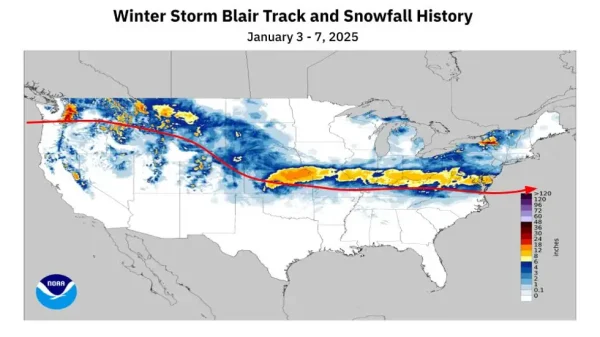
Winter Storm Blair first made landfall in Washington on Jan. 3, bringing in snow and ice. It traveled across the Rocky Mountains and into the Plains and Midwest before hitting St. Louis on  Jan. 5. Bair ended its tour on the East Coast on Jan. 7. 

How exactly did Blair form? Blair was a low-pressure system that mixed cold, Arctic air with moisture from the Gulf of Mexico allowing precipitation to fall. The jetstream, a fast flowing air current, also had a role in determining the path of the storm. 

The Weather Channel named the storm “Blair” through their storm naming system that looks at the timing of the storm, public awareness and alphabetical naming. Storms switch off between male and female names each time. A similar process occurs for hurricanes as well. 

This graphic shows Winter Storm Blair’s tracks and snowfall amounts across the United States from Jan. 3 to 7, 2025. Graphic courtesy of the Weather Channel.

Zooming in to St. Louis, the local conditions were the perfect ingredients for what the region received. Temperatures ranged from the 20s to low 30s, favoring snow and ice rather than sleet.

The region faced many impacts from Blair. The snow and ice made road conditions hazardous, causing at least 436 car crashes and one fatality in Missouri by Jan. 7, according to the Missouri Highway Patrol. 

The region’s several school districts were mostly in agreement when it came to school closures due to the inclimate weather. Saint Louis University also closed its doors and paused all campus activities on Jan. 6 and 7. 

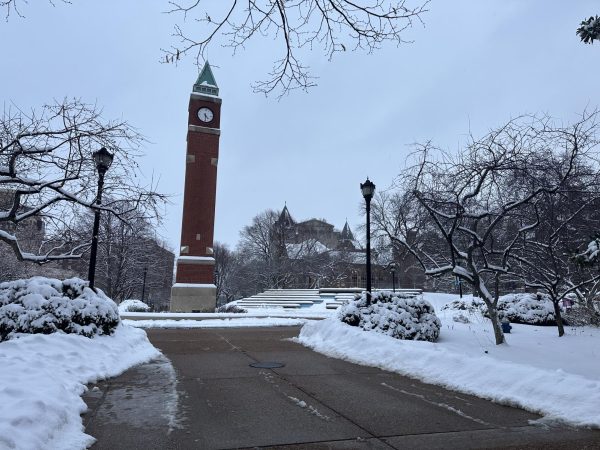
Snow piled up around the Clock Tower on Jan. 10, several days after campus closures due to inclement weather conditions.  (Evelyn Maruszak)

When it came to snow plowing, some Missouri residents felt let down by St. Louis City and the Missouri Department of Transportation (MoDOT) for their preparation and handling of the storm and its impacts. 

“As a taxpayer, I don’t understand why that money is not going towards funding for snowplows and the workers,” said Byron White, a frustrated St. Louis resident.

Even with the new investment in MoDOT for plows, many parts of the city still saw multiple inches of snow on the roads as of Thursday, Jan 9. 

The city takes care of residential and local streets, while MoDOT clears the interstates and highways. St. Louis City streets with a higher volume of traffic and residents will have a higher priority of being cleared, but days after the storm, some residents are still waiting for their streets and neighborhoods to be plowed. Frustration from the community is growing, but the city continues to ask for patience. 

St. Louis has had a history of snowplow worker shortages and tensions, including threats of strikes. 

The community faced closed roads, schools and businesses earlier this week, but that would not be the end of it. The St. Louis region once again received more snow from a winter storm advisory on Jan.10. Most cities in the area received 1-4 inches of snow.

Posted in UncategorizedComments Off on Winter Storm Blair hits St. Louis bringing troubles and frustrations

St. Louis is stuck in a rain-drought pattern. SLU experts explain why

The St. Louis metropolitan region saw extreme rainfall this month. In a matter of just 24 hours from Nov. 4 to 5, 7.64 inches of rain fell in the region, breaking a previous record of 6.9 inches set in 1915. 

The flooding killed two people in Missouri and many residents reported flooding in their homes. 

The historic rain came amid a four-week-long drought in Missouri. From the end of September, when the region received rains from Hurricane Helene, to the start of November, the state was one of several in the Midwest to fall victim to drought.

As droughts stretch on in many parts of the world, the chance of rainfall may seem like a welcome relief. However, the gift of rain can quickly turn into a danger, especially when the rains come too heavily or too suddenly.

This weather event had the National Weather Service (NWS) post severe weather and flood warnings for the greater St. Louis region. 

The biggest threat in the St. Louis metro area was flash flooding, which occurs when the ground is so unsaturated that it cannot handle the high amounts of rain.

“Excessively dry ground and high amounts of rainfall can actually work against each other,” said meteorology graduate student Lizzie Bannon.

When precipitation cannot be absorbed, it becomes groundwater, which usually travels downhill, leading to flooding. 

Flash flooding can be dangerous due to man-made infrastructure as well. 

“Metro areas are prone to flooding because of the amount of surfaces that cannot contain groundwater, like roads and parking lots,” Bannon said. 

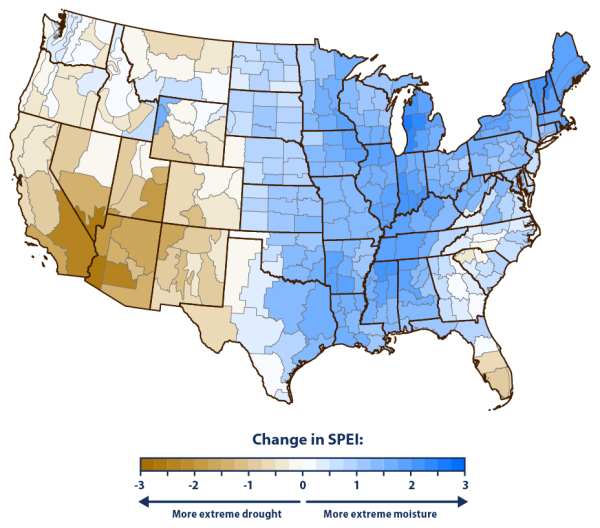
This figure shows that the Midwest has had more frequent wet conditions since 1900, while the West has had more frequent drought conditions since 1900.
(Graphic courtesy of United States Environmental Protection Agency. June 27, 2024)

Not every major city is prone to flooding, but the geographical location of St. Louis does not help its case.

St. Louis is located on the outskirts of the Ozark Mountains, making the region hilly. The city is also in the cross-section of two major river basins: the Mississippi and the Missouri. The metropolitan area is riddled with other rivers and creeks that contribute to additional flooding.

“With the hilly terrain, the downhill momentum is what causes the flash flood,” said Brady Wurmnest, a junior studying meteorology. “The racing waters can pick up debris along the way, which adds additional danger.”

It is important to know how to stay safe during flood warnings. If you come across a flooded road, do not drive through.

“The saying ‘turn around, don’t drown,’ is more than just a rhyme,” Bannon said. “It only takes a few inches of running water to float a vehicle.”

This is not the first time that St. Louis has had extreme floods similar to the ones on Nov. 4 and 5. Climate change can make extreme drought and extreme floods more frequent and more dramatic. 

“In Missouri, we are overall seeing an increase in flood frequency and flood magnitude,” said Carly Finegan-Dronchi, a doctoral student studying geoscience.

Finegan-Dronchi said there is a pattern where heavy rainfall is followed by a period of dryness; but once it rains again, it will be consistent for two to three days.

“Thinking about this fall, the month of October was very dry overall, and now we can’t seem to escape the rain,” Finegan-Dronchi said.

Scientists say climate change has contributed to an overall increase in atmospheric moisture, leading to heavier rainfall in some regions, including the Midwest. 

Global warming brings warmer temperatures, which means that the atmosphere can hold more moisture, contributing to intense rainfalls when conditions are right.

Due to a projected weak La Niña, a wind pattern that occurs in the Pacific Ocean, St. Louis will see some cooler temperatures mixed with a below average chance of winter precipitation for the rest of the year and into early 2025.

Posted in UncategorizedComments Off on St. Louis is stuck in a rain-drought pattern. SLU experts explain why