
Author Archives | Evelyn Maruszak, Staff Writer

ABC’s Linsey Davis and SLU alum John Krull talk to students about journalism in troubling times

Saint Louis University’s department of American studies and College of Arts and Sciences co-hosted ABC’s Linsey Davis and SLU alum John Krull to speak to students, staff and community members about the importance of journalism in this day and age. 


Donna LaVoie, the dean of the College of Arts and Sciences, introduced Davis and Krull and explained the mission for hosting the event. 


“In a time when public discourse can feel fractured, the interdisciplinary lens of American studies provides something essential:
the capacity to connect ideas, question narratives and discern meaning amid uncertainty,” LaVoie said. 


The conversation is being held at a time when there has been a rise in instances of censorship of student journalism and media since late 2024. For example, at Indiana University, where the student newspaper’s faculty advisor was fired after refusing to comply with the university’s order to “print no news in the newspaper.”


In November 2025, The University New wrote an editorial in response to the situation at Indiana University.


The event, called “Candid Conversations in Troubling Times,” allowed attendees to submit questions for the speakers to answer during the talk. 


Krull is a professor of journalism at Franklin College, where he got his bachelor’s degree in journalism and history. He later studied at SLU to get a master’s degree in American studies. 


Krull began the interview with Davis, who shared a little bit about herself and how she became a broadcast journalist and anchor. 


Davis began as a psychology major at the University of Virginia with no plans of becoming a journalist. While studying abroad in London, she took journalism classes that inspired her to pursue the profession. Davis later completed her master’s in communication at New York University. 


When Davis began her career in broadcast journalism, she was a reporter before she became a weekend anchor in Indianapolis, Indiana. Davis shared that she prefers reporting to anchoring. 


Then in 2007, the ABC News network hired her on as a reporter for Good Morning America, 20/20, Nightline and World News Tonight, where she anchors on Sunday nights. 


Other titles Davis has are children’s book author, marathoner and mother. 


The tone shifted to a more serious conversation as a question was asked about the media coverage of the tragic events in Minneapolis, where aggressive ICE raids and enforcement led to the fatal shootings of Renee Good and Alex Pretti. 


Davis and Krull touched on the fact that in other periods of history, the first to attack injustice is the media, whether it’s news or social media. 


“It was fortunate on the side of truth that there was video,” said Davis in regard to the murder of Alex Pretti. “I don’t see my role [in media] as getting you to determine something. I am a purveyor of information, of truth.”


Davis and Krull acknowledged that there is some distrust of the media. 


“A reason why trust is so fragile now is because there are so many more people speaking,” said Krull. 


Davis then explained that people turn to the news to see if their world is safe.


“There is an understanding that there are still places you can turn to for the truth and greater understanding,” said Davis. 


As the discussion deepened, one question cut to the emotional core of the profession: How do journalists stay human while covering conflict, tragedy or social unrest?


Davis shared that her faith and running are her escape when she is at home with her family. 


“At home, I don’t watch the news. I try to find some outside distractions,” Davis said. 


Krull answered from a different perspective. 


“You have to allow the humanity you possess to guide you,” said Krull. “You have to allow yourself to feel.”


Krull referenced a moment when he told his editors at the Indianapolis News that he could no longer cover drive-by shootings, as they had become too much to handle. 


“Don’t be afraid to stand up for yourself, take care of yourself,” said Krull. 


Both Davis and Krull are involved with Trust for Trauma Journalism, an organization that supports journalists in reporting on traumatic experiences while also helping them care for their own well-being as they encounter trauma in their work.


As the conversation came to a close, Davis and Krull’s message to students was clear: journalism is not just about reporting facts, but about caring for the people behind them — both audience and reporter. 


For the students in attendance, the discussion served as a reminder that telling the truth is difficult, but necessary work, especially in troubling times.
Posted in UncategorizedComments Off on ABC’s Linsey Davis and SLU alum John Krull talk to students about journalism in troubling times

ABC’s Linsey Davis and SLU alum John Krull talk to students about journalism in troubling times

Saint Louis University’s department of American studies and College of Arts and Sciences co-hosted ABC’s Linsey Davis and SLU alum John Krull to speak to students, staff and community members about the importance of journalism in this day and age. 


Donna LaVoie, the dean of the College of Arts and Sciences, introduced Davis and Krull and explained the mission for hosting the event. 


“In a time when public discourse can feel fractured, the interdisciplinary lens of American studies provides something essential:
the capacity to connect ideas, question narratives and discern meaning amid uncertainty,” LaVoie said. 


The conversation is being held at a time when there has been a rise in instances of censorship of student journalism and media since late 2024. For example, at Indiana University, where the student newspaper’s faculty advisor was fired after refusing to comply with the university’s order to “print no news in the newspaper.”


In November 2025, The University New wrote an editorial in response to the situation at Indiana University.


The event, called “Candid Conversations in Troubling Times,” allowed attendees to submit questions for the speakers to answer during the talk. 


Krull is a professor of journalism at Franklin College, where he got his bachelor’s degree in journalism and history. He later studied at SLU to get a master’s degree in American studies. 


Krull began the interview with Davis, who shared a little bit about herself and how she became a broadcast journalist and anchor. 


Davis began as a psychology major at the University of Virginia with no plans of becoming a journalist. While studying abroad in London, she took journalism classes that inspired her to pursue the profession. Davis later completed her master’s in communication at New York University. 


When Davis began her career in broadcast journalism, she was a reporter before she became a weekend anchor in Indianapolis, Indiana. Davis shared that she prefers reporting to anchoring. 


Then in 2007, the ABC News network hired her on as a reporter for Good Morning America, 20/20, Nightline and World News Tonight, where she anchors on Sunday nights. 


Other titles Davis has are children’s book author, marathoner and mother. 


The tone shifted to a more serious conversation as a question was asked about the media coverage of the tragic events in Minneapolis, where aggressive ICE raids and enforcement led to the fatal shootings of Renee Good and Alex Pretti. 


Davis and Krull touched on the fact that in other periods of history, the first to attack injustice is the media, whether it’s news or social media. 


“It was fortunate on the side of truth that there was video,” said Davis in regard to the murder of Alex Pretti. “I don’t see my role [in media] as getting you to determine something. I am a purveyor of information, of truth.”


Davis and Krull acknowledged that there is some distrust of the media. 


“A reason why trust is so fragile now is because there are so many more people speaking,” said Krull. 


Davis then explained that people turn to the news to see if their world is safe.


“There is an understanding that there are still places you can turn to for the truth and greater understanding,” said Davis. 


As the discussion deepened, one question cut to the emotional core of the profession: How do journalists stay human while covering conflict, tragedy or social unrest?


Davis shared that her faith and running are her escape when she is at home with her family. 


“At home, I don’t watch the news. I try to find some outside distractions,” Davis said. 


Krull answered from a different perspective. 


“You have to allow the humanity you possess to guide you,” said Krull. “You have to allow yourself to feel.”


Krull referenced a moment when he told his editors at the Indianapolis News that he could no longer cover drive-by shootings, as they had become too much to handle. 


“Don’t be afraid to stand up for yourself, take care of yourself,” said Krull. 


Both Davis and Krull are involved with Trust for Trauma Journalism, an organization that supports journalists in reporting on traumatic experiences while also helping them care for their own well-being as they encounter trauma in their work.


As the conversation came to a close, Davis and Krull’s message to students was clear: journalism is not just about reporting facts, but about caring for the people behind them — both audience and reporter. 


For the students in attendance, the discussion served as a reminder that telling the truth is difficult, but necessary work, especially in troubling times.


Posted in UncategorizedComments Off on ABC’s Linsey Davis and SLU alum John Krull talk to students about journalism in troubling times

Lessons from the March 14 tornado outbreak

On Friday, March 14, a tornado outbreak left a trail of destruction in Missouri, including the St. Louis area. This string of tornadic events and severe thunderstorms disrupted communities, killed 10 people in the state and raised concerns about severe weather preparedness. 

The intense low-pressure system responsible for the tornado outbreak also generated straight-line and non-convective winds and an influx of warm, dry air across the region throughout the day. 

As a result, sporadic wind damage occurred even before the line of storms arrived. These winds also sparked numerous wildfires across Missouri and Illinois. 

After surveying damage, the National Weather Service (NWS) announced that 12 tornadoes touched down in the St. Louis County Warning Area. 

Closer to the city, the area was littered with EF1s and EF2s, classifications on the Enhanced Fujita scale that measure tornado intensity based on wind speed and damage. One tornado touched down in Chesterfield, MO, at 9:16 p.m. and was on the ground for 37 minutes when it dissipated in Alton, Illinois, after traveling about 40 miles. This EF2 had peak winds at 122 mph, and was three-fourths of a mile wide at its largest. 

Maryland Heights, Florissant, and Old Jamestown were also in the storm’s path and sustained damage and power outages. 

Joey Heitzler, a junior meteorology student, said he was monitoring this tornado as it came closer to his house in Old Jamestown.

“I saw my neighbor’s tall pine trees bending over so incredibly far, I don’t know how they didn’t break,” Heitzler said. “After that, I ran to the basement, and that is when I lost power.”

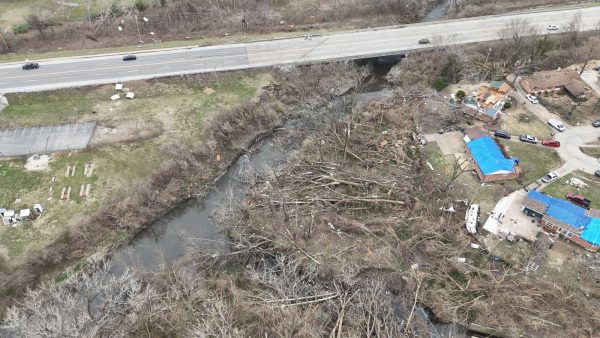
A tornado in Florissant, Mo left downed trees and structural damage on March 14. (Photo courtesy of NWS Survey Damage Team.)

Another local EF2 was recorded south of the city traveling from Morse Mill to Mehlville Missouri, heavily damaging Arnold, Missouri. This storm was on the ground for 21 minutes and travelled 25.33 miles with winds of 115 mph. 

Parts of the system traveled along both I-44 and I-70, affecting towns like Rolla and Columbia, Missouri. While Columbia only had strong winds and heavy rain, Rolla was struck by an EF2 tornado. This storm only lasted eight minutes, but in that time, it covered 9 miles with 120 mph winds and left devastating damage to the community. 

Rolla is home to University of Missouri Science and Technology (MS&T). The university is home to 7,155 students.

MS&T sophomore Hayden Davies was in Rolla at the time of the storm. Davies lives just off campus at his fraternity house, which lost power during the event.

“I honestly didn’t realize the severity of the weather until the next day,” Davies said. “In our house we just noticed no power.”

How to prepare for the next storm

For college students – many of whom live in dorms or off-campus housing – being unprepared during different types of weather can be dangerous. Knowing how to stay informed and where to seek shelter is crucial, especially in states prone to severe weather events. 

The first step to being a weather-prepared student is to understand the risks. Tornadoes can develop quickly, leaving little room for reaction. Thus, it is important to know the weather terms that meteorologists are using in their reports.

What is the difference between a tornado watch and a tornado warning? A  tornado watch means that conditions are favorable for tornado formation. A warning means that rotation has been detected via radar and/or observed by a trained storm spotter. 

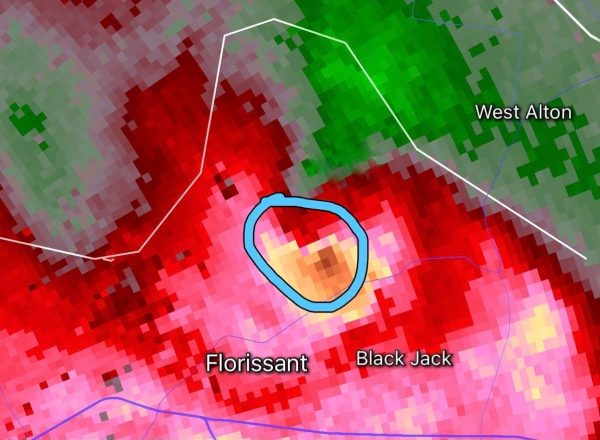
A velocity scan on March 14 shows an EF2 tornado in Florissant. (Photo courtesy of Joey Heitzler via RadarScope.)

The second step is to have methods to stay informed. Being aware of potential severe weather is crucial. Always have your emergency alerts on your phone enabled and have multiple alert sources like the NWS and your local broadcast meteorologists. 

If you want to go the extra mile, you could get a weather radio that provides real-time weather warnings, even during power outages. 

Fun Fact: SLU is StormReady certified by the NWS, meaning that every building has a safe shelter place and a weather radio. 

Universities send out alerts to their students once the area is placed under a tornado warning. These alerts serve as the primary source of information for many students. 

The third step is to make a safety plan. Storms can strike at any time. Whether you are at home, class or out and about, you should have a plan. 

Always identify shelter locations ahead of time. The best places are the lowest level of the structure and away from exterior walls and glass. Basements, bathrooms and closets are your safest places.

“I was out with friends, but made sure to make it back to the house in time,” Davies said. “Our basement is a very safe location.”

If you live on campus, review your dorm/apartment procedures. If you are caught outdoors, find the lowest ground possible like a ditch. Bridges and overpasses are not safe to shelter under.

Lastly, prepare an emergency kit. This is something that is often overlooked or incomplete. A quality emergency kit has a first aid kit, flashlight, batteries, chargers, bottled water and non-perishable foods.That is something Davies prepared ahead of time.

“We made sure to have plenty of water, food and candles for light,” Davies said. 

Bonus points: As you prepare for a weather event, make sure to be wearing closed-toed shoes in case there is damage done to your structure that leaves glass, branches and other debris. 

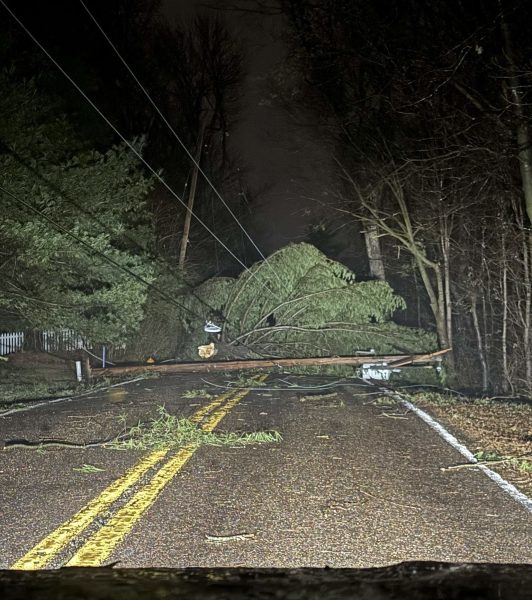
A tree-toppled powerline blocks a road after a tornado hit Old Jamestown, Mo on March 14, 2025. (Photo courtesy of Joey Heitzler.)

Make sure to also have clothes that will keep you warm. This is one of the most important things to have for several reasons: the temperature drops once severe storms pass through; your home could get damaged, thus exposure to the elements; and power outages mean no heat during the night.

By understanding the risks, staying informed and having a plan, college students can significantly improve their chances of staying safe during a severe weather event. 

“If you’re not weather aware, it could significantly impact your life,” Charles Graves,meteorology professor said.

Make sure to listen to these alerts and shelter when alerted by the NWS, broadcast meteorologists and your university. 

Pay attention to the warnings instead of having the mindset that nothing ever happens,” Davies said. 

Posted in UncategorizedComments Off on Lessons from the March 14 tornado outbreak