
Author Archives | Celene Boureslan

Jasmine Crockett visits UH for Texas Tough Tour

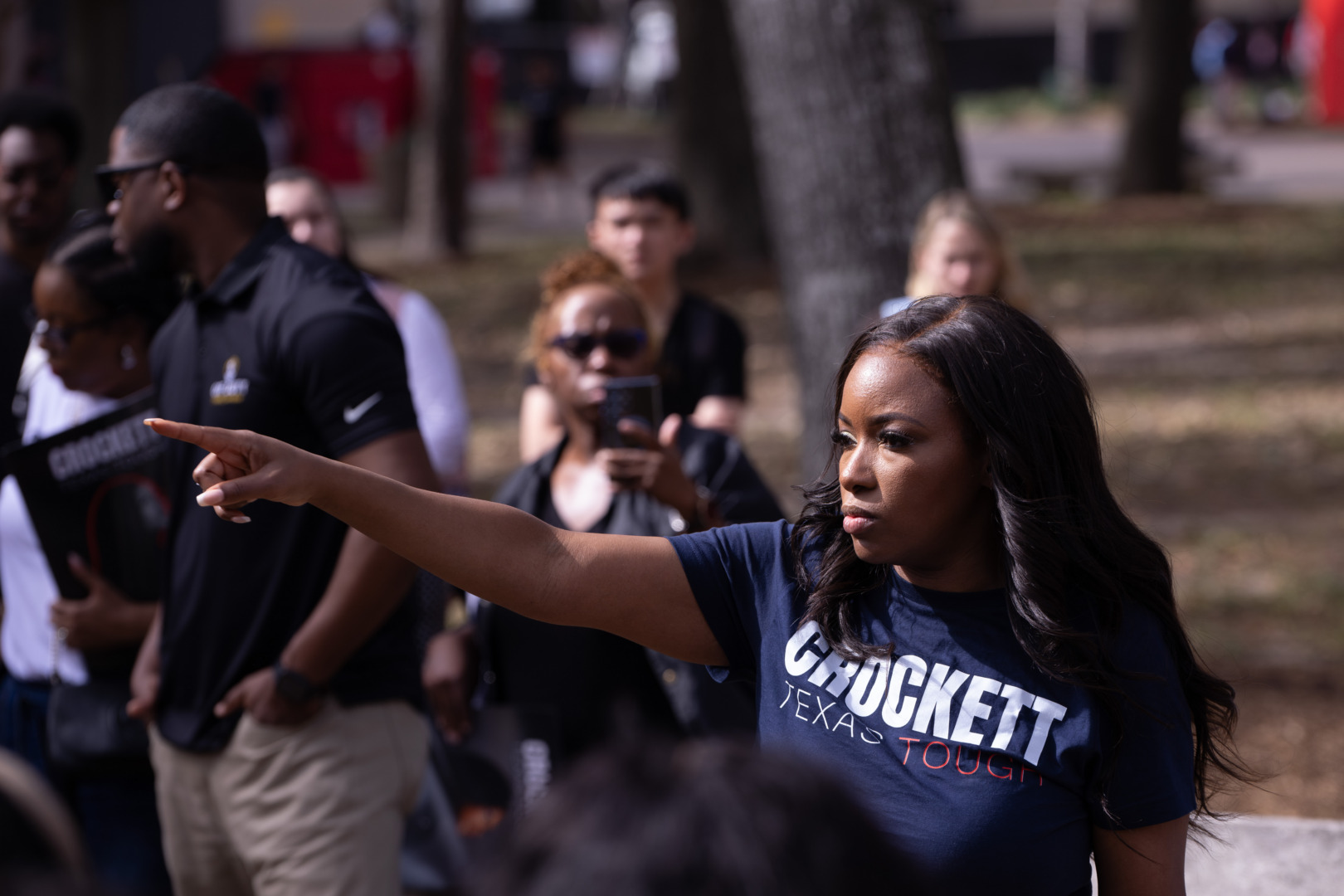
U.S. Rep. and Senate candidate Jasmine Crockett speaks to a student crowd on Wednesday, Feb. 25, 2026, in Houston, Texas. | Raphael Fernandez/The Cougar

Jasmine Crockett visited the University on Wednesday, Feb. 25, as part of her Texas Tough Tour, urging students to vote in the March 3 primaries and to support candidates who advocate for equal opportunity.

During her speech, Crockett encouraged civic engagement and stressed that equal access to opportunity is central to the American identity.

“What makes America great is us having the same opportunities, no matter what zip code or country we come from,” Crockett said. “That is what America is about. And that is the America that I’m trying to get us back to.”

Crockett criticized the Trump administration, saying recent cuts to research funding have reduced opportunities for students and researchers to make significant discoveries.

 She also addressed reductions to the Supplemental Nutrition Assistance Program, noting that many college students rely on the benefit.

Crockett shared that she was a SNAP recipient during her time as a college student.

“A lot of our students on campuses actually receive SNAP benefits,” Crockett said. “For some people, they try to pretend as if that is the real drain on our economy, but it’s not. And frankly, if that means that that’s one less job that you have to work to keep your focus on school, then it matters.”

She also voiced opposition to the actions of U.S. Immigration and Customs Enforcement, saying she is prepared to push back against what she described as overreach.

“I personally believe that you are fed up with this idea that ICE should be running around our streets,” Crockett said. “I personally believe that you give a damn about your future, and so you have decided that you are going to participate. No matter what you do, so long as I become the next senator in the state of Texas, you don’t have to worry about somebody having your back.”
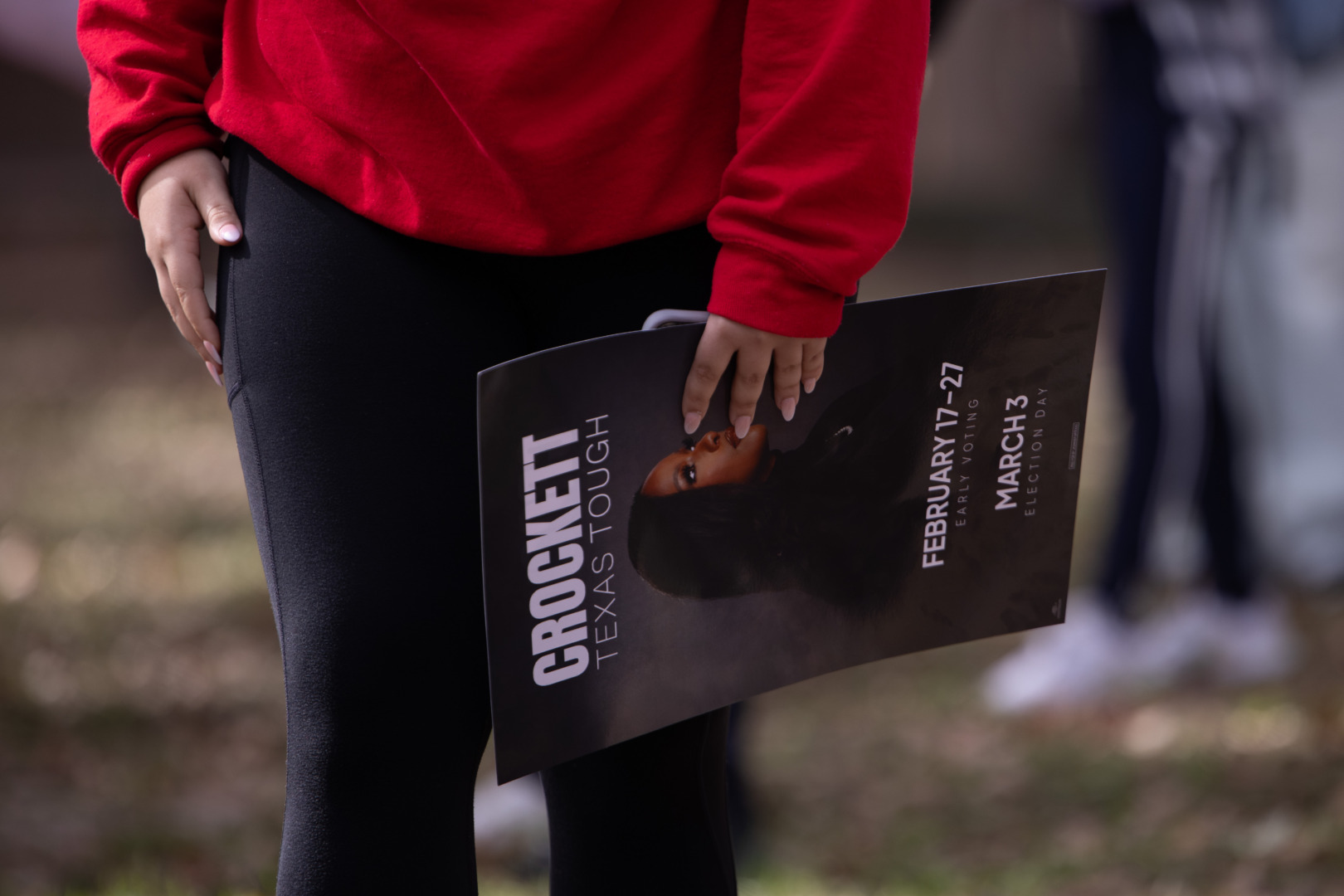
Student holds a campaign sign for U.S. Rep. and Senate candidate Jasmine Crockett on Wednesday, Feb. 25, 2026, in Houston, Texas. | Raphael Fernandez/The Cougar

Students react

Students gathered around Crockett during her visit, with several saying her message resonated with them.

Psychology sophomore and pre-law student Madison Johnson said she admired Crockett’s advocacy for minorities, particularly Black women.

“I loved how she emphasized how she always thinks about us minorities in the courtrooms and places where we, Black women, were not allowed in,” Johnson said.

Johnson added that she believes Crockett will advocate for increased financial assistance for college students.

“The economy is not good at all right now,” Johnson said. “I feel like Crockett is fighting for students to have the assistance that they need, to not have to worry about funding in college.”

Public health senior Laura Guajardo said she connected with Crockett’s stance on immigration enforcement.

“I love what she’s doing for the Hispanic community when it comes to ICE. She has stood up for our people,” Guajardo said. “What’s been happening recently hits close to home, because my family came across the border from Mexico, and they finally fixed their papers, so it’s sad to see all these families that are getting ripped apart.”

Construction management junior Noe Delgado said he was initially hesitant to support Crockett but changed his mind after speaking with her.

“I like Crockett, but at first, I was definitely reluctant to vote for her because of her previous support of Israel-funded bills. However, she mentioned how the AI data centers are killing us faster than we expected, and she wants to create regulation,” Delgado said. “She was able to place accountability on these corporations.”

news@thedailycougar.com

—
“Jasmine Crockett visits UH for Texas Tough Tour” was originally posted on The Cougar

Posted in UncategorizedComments Off on Jasmine Crockett visits UH for Texas Tough Tour

Jasmine Crockett visits UH for Texas Tough Tour

U.S. Rep. and Senate candidate Jasmine Crockett speaks to a student crowd on Wednesday, Feb. 25, 2026, in Houston, Texas. | Raphael Fernandez/The Cougar

Jasmine Crockett visited the University on Wednesday, Feb. 25, as part of her Texas Tough Tour, urging students to vote in the March 3 primaries and to support candidates who advocate for equal opportunity.

During her speech, Crockett encouraged civic engagement and stressed that equal access to opportunity is central to the American identity.

“What makes America great is us having the same opportunities, no matter what zip code or country we come from,” Crockett said. “That is what America is about. And that is the America that I’m trying to get us back to.”

Crockett criticized the Trump administration, saying recent cuts to research funding have reduced opportunities for students and researchers to make significant discoveries.

 She also addressed reductions to the Supplemental Nutrition Assistance Program, noting that many college students rely on the benefit.

Crockett shared that she was a SNAP recipient during her time as a college student.

“A lot of our students on campuses actually receive SNAP benefits,” Crockett said. “For some people, they try to pretend as if that is the real drain on our economy, but it’s not. And frankly, if that means that that’s one less job that you have to work to keep your focus on school, then it matters.”

She also voiced opposition to the actions of U.S. Immigration and Customs Enforcement, saying she is prepared to push back against what she described as overreach.

“I personally believe that you are fed up with this idea that ICE should be running around our streets,” Crockett said. “I personally believe that you give a damn about your future, and so you have decided that you are going to participate. No matter what you do, so long as I become the next senator in the state of Texas, you don’t have to worry about somebody having your back.”

Student holds a campaign sign for U.S. Rep. and Senate candidate Jasmine Crockett on Wednesday, Feb. 25, 2026, in Houston, Texas. | Raphael Fernandez/The Cougar

Students react

Students gathered around Crockett during her visit, with several saying her message resonated with them.

Psychology sophomore and pre-law student Madison Johnson said she admired Crockett’s advocacy for minorities, particularly Black women.

“I loved how she emphasized how she always thinks about us minorities in the courtrooms and places where we, Black women, were not allowed in,” Johnson said.

Johnson added that she believes Crockett will advocate for increased financial assistance for college students.

“The economy is not good at all right now,” Johnson said. “I feel like Crockett is fighting for students to have the assistance that they need, to not have to worry about funding in college.”

Public health senior Laura Guajardo said she connected with Crockett’s stance on immigration enforcement.

“I love what she’s doing for the Hispanic community when it comes to ICE. She has stood up for our people,” Guajardo said. “What’s been happening recently hits close to home, because my family came across the border from Mexico, and they finally fixed their papers, so it’s sad to see all these families that are getting ripped apart.”

Construction management junior Noe Delgado said he was initially hesitant to support Crockett but changed his mind after speaking with her.

“I like Crockett, but at first, I was definitely reluctant to vote for her because of her previous support of Israel-funded bills. However, she mentioned how the AI data centers are killing us faster than we expected, and she wants to create regulation,” Delgado said. “She was able to place accountability on these corporations.”

news@thedailycougar.com

—
“Jasmine Crockett visits UH for Texas Tough Tour” was originally posted on The Cougar
Posted in UncategorizedComments Off on Jasmine Crockett visits UH for Texas Tough Tour

Jasmine Crockett visits UH for Texas Tough Tour

U.S. Rep. and Senate candidate Jasmine Crockett speaks to a student crowd on Wednesday, Feb. 25, 2026, in Houston, Texas. | Raphael Fernandez/The Cougar

Jasmine Crockett visited the University on Wednesday, Feb. 25, as part of her Texas Tough Tour, urging students to vote in the March 3 primaries and to support candidates who advocate for equal opportunity.

During her speech, Crockett encouraged civic engagement and stressed that equal access to opportunity is central to the American identity.

“What makes America great is us having the same opportunities, no matter what zip code or country we come from,” Crockett said. “That is what America is about. And that is the America that I’m trying to get us back to.”

Crockett criticized the Trump administration, saying recent cuts to research funding have reduced opportunities for students and researchers to make significant discoveries.

 She also addressed reductions to the Supplemental Nutrition Assistance Program, noting that many college students rely on the benefit.

Crockett shared that she was a SNAP recipient during her time as a college student.

“A lot of our students on campuses actually receive SNAP benefits,” Crockett said. “For some people, they try to pretend as if that is the real drain on our economy, but it’s not. And frankly, if that means that that’s one less job that you have to work to keep your focus on school, then it matters.”

She also voiced opposition to the actions of U.S. Immigration and Customs Enforcement, saying she is prepared to push back against what she described as overreach.

“I personally believe that you are fed up with this idea that ICE should be running around our streets,” Crockett said. “I personally believe that you give a damn about your future, and so you have decided that you are going to participate. No matter what you do, so long as I become the next senator in the state of Texas, you don’t have to worry about somebody having your back.”

Student holds a campaign sign for U.S. Rep. and Senate candidate Jasmine Crockett on Wednesday, Feb. 25, 2026, in Houston, Texas. | Raphael Fernandez/The Cougar

Students react

Students gathered around Crockett during her visit, with several saying her message resonated with them.

Psychology sophomore and pre-law student Madison Johnson said she admired Crockett’s advocacy for minorities, particularly Black women.

“I loved how she emphasized how she always thinks about us minorities in the courtrooms and places where we, Black women, were not allowed in,” Johnson said.

Johnson added that she believes Crockett will advocate for increased financial assistance for college students.

“The economy is not good at all right now,” Johnson said. “I feel like Crockett is fighting for students to have the assistance that they need, to not have to worry about funding in college.”

Public health senior Laura Guajardo said she connected with Crockett’s stance on immigration enforcement.

“I love what she’s doing for the Hispanic community when it comes to ICE. She has stood up for our people,” Guajardo said. “What’s been happening recently hits close to home, because my family came across the border from Mexico, and they finally fixed their papers, so it’s sad to see all these families that are getting ripped apart.”

Construction management junior Noe Delgado said he was initially hesitant to support Crockett but changed his mind after speaking with her.

“I like Crockett, but at first, I was definitely reluctant to vote for her because of her previous support of Israel-funded bills. However, she mentioned how the AI data centers are killing us faster than we expected, and she wants to create regulation,” Delgado said. “She was able to place accountability on these corporations.”

news@thedailycougar.com

—
“Jasmine Crockett visits UH for Texas Tough Tour” was originally posted on The Cougar
Posted in UncategorizedComments Off on Jasmine Crockett visits UH for Texas Tough Tour

Get to know about the different UH programs

Graduate programs are offered from a robust variety of colleges at UH on Sunday Jan 8, 2026, in Houston, Texas. | Raphael Fernandez/The Cougar

For most students, spring semester is the best time to begin researching post-graduation schools or programs.

Here is a list of accredited graduate programs available at UH.

C.T. Bauer College of Business

The Bauer College offers graduate students a wide range of domestic, online and international programs.

For its traditional programs, the college offers three MBA options and seven Master of Science options.

For its MBA programs, Bauer College offers an Online MBA, a Professional MBA and an Executive MBA. Its M.S. degrees include accountancy, business analytics, finance, management information systems, marketing, real estate, sales and supply chain management. Many of these M.S. programs, such as marketing and accountancy are offered online.

Bauer students can also go international. Graduate students enrolled in courses such as International Legal Environment of Management and Global Human Resource Management are eligible to participate in a six-day program in Berlin, Germany, from May 24-30.

Students enrolled in International Business in the Current Global Environment can also participate in an eight-day program in Brazil, from June 5-13.

Students enrolled in courses such as Microfinance: Local and Global Impact, Closed Loop Supply Chain and Sustainability and Regional Issues in Global Management: Asia can also participate in a two-week program in Dubai, United Arab Emirates and India, from May 16-30.

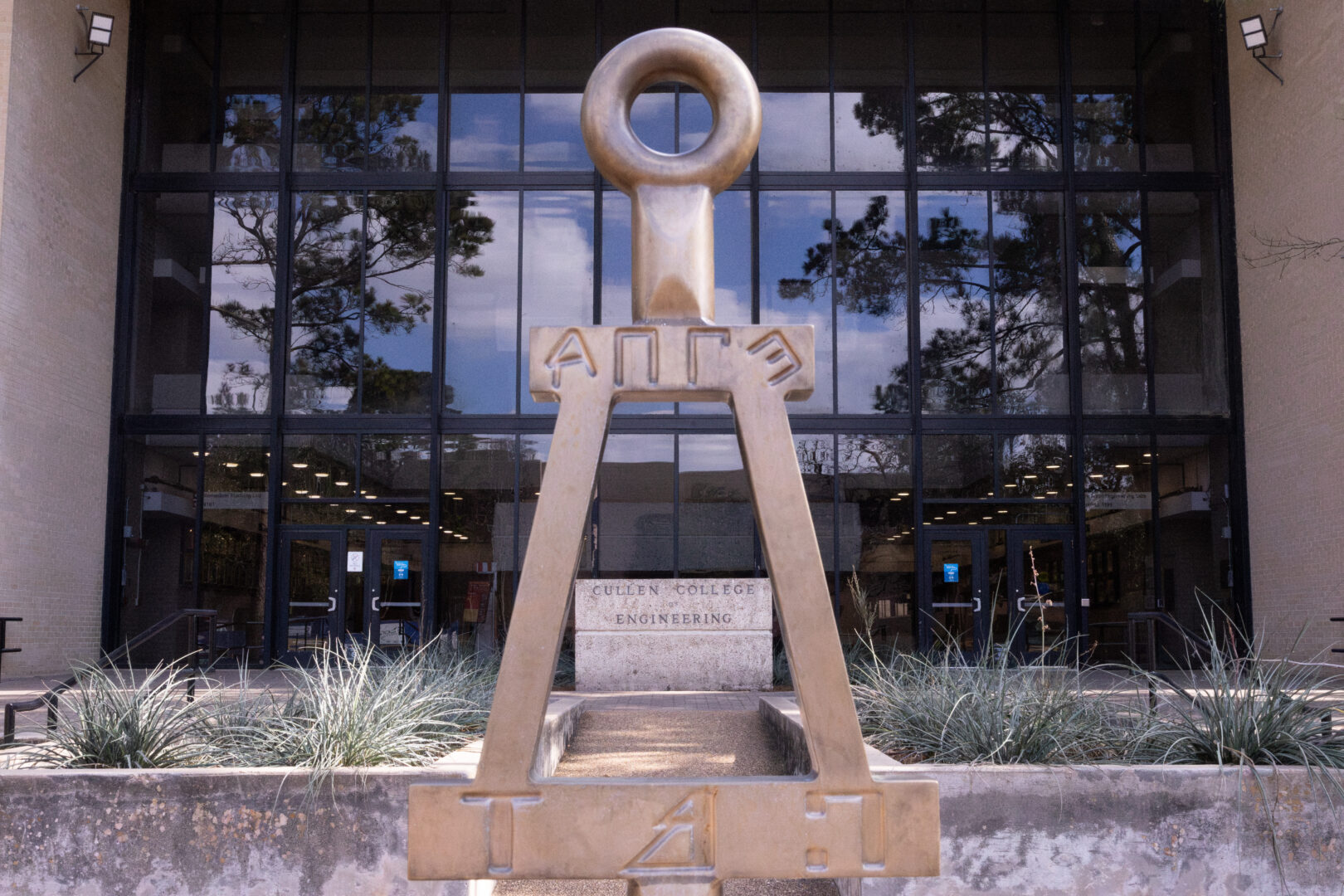
Cullen College of Engineering

Cullen College is known for its strong reputation and graduate outcomes. It offers one of the largest selections of graduate degrees, providing students with expansive education across different types of engineering.

Its prominent M.S. degrees include chemical engineering, civil engineering, electrical engineering, industrial engineering, materials engineering, mechanical engineering and petroleum engineering.

As of 2025, the M.S. in petroleum engineering and chemical engineering ranked No. 7 and No. 31, respectively, in the U.S. News & World Report Best Graduate Schools rankings.

Degrees offered internationally include the Master of Computer & Systems Engineering with an option in industrial power systems, the Master of Computer & Systems Engineering with an option in telecommunications systems, the Master of Industrial Engineering and the Master of Petroleum Engineering.

Graduate programs are offered from a robust variety of colleges at UH on Sunday Jan 8, 2026, in Houston, Texas. | Raphael Fernandez/The Cougar

UH Law Center

The Law Center is home to two of the nation’s highest-ranked graduate programs: part-time law and health care law.

Part-time law is an evening program designed for working professionals who wish to earn a juris doctor. Health care law is a master’s degree focused on policy analysis of the legal aspects of health care and biotechnology.

Other LL.M. degrees include energy, environment and natural resources law, health law, intellectual property and information law, international law, tax law and U.S. law.

College of Education

The College of Education is nationally accredited for the quality of its online programs and its speech-language pathology program.

As one of the programs in the department of communication sciences and disorders, the master of Arts degree prepares students for careers as speech-language pathologists.

Online programs at the college include a master of Education in administration & supervision, higher education and special populations.

The College of Education offers a variety of M.Ed. and Ph.D. degrees, including M.Ed. degrees in curriculum and instruction, counseling, administration and supervision and special populations, which is also offered online, and Ph.D. degrees in curriculum and instruction and school psychology.

The college also offers a Doctor of Education in professional leadership.

Gerald D. Hines College of Architecture and Design

Among the prominent postgraduate degrees offered are the M.S. in architecture and industrial design, and M.A. in architectural studies.

The Master of Architecture is a two-year program separated into two parts: Architecture, MArch – Level I and Architecture, MArch – Level II.

The program is one of two Hines College programs accredited by the National Architectural Accrediting Board, the only agency recognized by registration boards in U.S. jurisdictions to accredit professional degree programs in architecture.

College of Liberal Arts and Social Sciences

The College of Liberal Arts and Social Sciences offers students a wide range of programs exploring artistic, literary and scientific disciplines.

Its doctoral programs include Ph.D. degrees in communication sciences and disorders, economics, English, creative writing and literature, kinesiology, Spanish, political science, clinical psychology, industrial/organizational psychology, social psychology and developmental, cognitive and behavioral neuroscience.

Its master’s degrees include master of Arts degrees in communication, communication sciences and disorders, anthropology, applied economics, creative writing, English, nutrition, sport and fitness administration, Spanish, U.S. Hispanic studies, history, philosophy, political science and sociology, as well as the Master of Athletic Training.

The college also offers graduate certificates in African American studies, sport and fitness operations management, Spanish as a heritage language, applied linguistics in teaching Chinese and WCL graduate certificates.

news@thedailycougar.com

—
“Get to know about the different UH programs” was originally posted on The Cougar

Posted in UncategorizedComments Off on Get to know about the different UH programs

Get to know about the different UH programs

Graduate programs are offered from a robust variety of colleges at UH on Sunday Jan 8, 2026, in Houston, Texas. | Raphael Fernandez/The Cougar

For most students, spring semester is the best time to begin researching post-graduation schools or programs.

Here is a list of accredited graduate programs available at UH.

C.T. Bauer College of Business

The Bauer College offers graduate students a wide range of domestic, online and international programs.

For its traditional programs, the college offers three MBA options and seven Master of Science options.

For its MBA programs, Bauer College offers an Online MBA, a Professional MBA and an Executive MBA. Its M.S. degrees include accountancy, business analytics, finance, management information systems, marketing, real estate, sales and supply chain management. Many of these M.S. programs, such as marketing and accountancy are offered online.

Bauer students can also go international. Graduate students enrolled in courses such as International Legal Environment of Management and Global Human Resource Management are eligible to participate in a six-day program in Berlin, Germany, from May 24-30.

Students enrolled in International Business in the Current Global Environment can also participate in an eight-day program in Brazil, from June 5-13.

Students enrolled in courses such as Microfinance: Local and Global Impact, Closed Loop Supply Chain and Sustainability and Regional Issues in Global Management: Asia can also participate in a two-week program in Dubai, United Arab Emirates and India, from May 16-30.

Cullen College of Engineering

Cullen College is known for its strong reputation and graduate outcomes. It offers one of the largest selections of graduate degrees, providing students with expansive education across different types of engineering.

Its prominent M.S. degrees include chemical engineering, civil engineering, electrical engineering, industrial engineering, materials engineering, mechanical engineering and petroleum engineering.

As of 2025, the M.S. in petroleum engineering and chemical engineering ranked No. 7 and No. 31, respectively, in the U.S. News & World Report Best Graduate Schools rankings.

Degrees offered internationally include the Master of Computer & Systems Engineering with an option in industrial power systems, the Master of Computer & Systems Engineering with an option in telecommunications systems, the Master of Industrial Engineering and the Master of Petroleum Engineering.

Graduate programs are offered from a robust variety of colleges at UH on Sunday Jan 8, 2026, in Houston, Texas. | Raphael Fernandez/The Cougar

UH Law Center

The Law Center is home to two of the nation’s highest-ranked graduate programs: part-time law and health care law.

Part-time law is an evening program designed for working professionals who wish to earn a juris doctor. Health care law is a master’s degree focused on policy analysis of the legal aspects of health care and biotechnology.

Other LL.M. degrees include energy, environment and natural resources law, health law, intellectual property and information law, international law, tax law and U.S. law.

College of Education

The College of Education is nationally accredited for the quality of its online programs and its speech-language pathology program.

As one of the programs in the department of communication sciences and disorders, the master of Arts degree prepares students for careers as speech-language pathologists.

Online programs at the college include a master of Education in administration & supervision, higher education and special populations.

The College of Education offers a variety of M.Ed. and Ph.D. degrees, including M.Ed. degrees in curriculum and instruction, counseling, administration and supervision and special populations, which is also offered online, and Ph.D. degrees in curriculum and instruction and school psychology.

The college also offers a Doctor of Education in professional leadership.

Gerald D. Hines College of Architecture and Design

Among the prominent postgraduate degrees offered are the M.S. in architecture and industrial design, and M.A. in architectural studies.

The Master of Architecture is a two-year program separated into two parts: Architecture, MArch – Level I and Architecture, MArch – Level II.

The program is one of two Hines College programs accredited by the National Architectural Accrediting Board, the only agency recognized by registration boards in U.S. jurisdictions to accredit professional degree programs in architecture.

College of Liberal Arts and Social Sciences

The College of Liberal Arts and Social Sciences offers students a wide range of programs exploring artistic, literary and scientific disciplines.

Its doctoral programs include Ph.D. degrees in communication sciences and disorders, economics, English, creative writing and literature, kinesiology, Spanish, political science, clinical psychology, industrial/organizational psychology, social psychology and developmental, cognitive and behavioral neuroscience.

Its master’s degrees include master of Arts degrees in communication, communication sciences and disorders, anthropology, applied economics, creative writing, English, nutrition, sport and fitness administration, Spanish, U.S. Hispanic studies, history, philosophy, political science and sociology, as well as the Master of Athletic Training.

The college also offers graduate certificates in African American studies, sport and fitness operations management, Spanish as a heritage language, applied linguistics in teaching Chinese and WCL graduate certificates.

news@thedailycougar.com

—
“Get to know about the different UH programs” was originally posted on The Cougar
Posted in UncategorizedComments Off on Get to know about the different UH programs

Lecture explores past, future of civil rights law

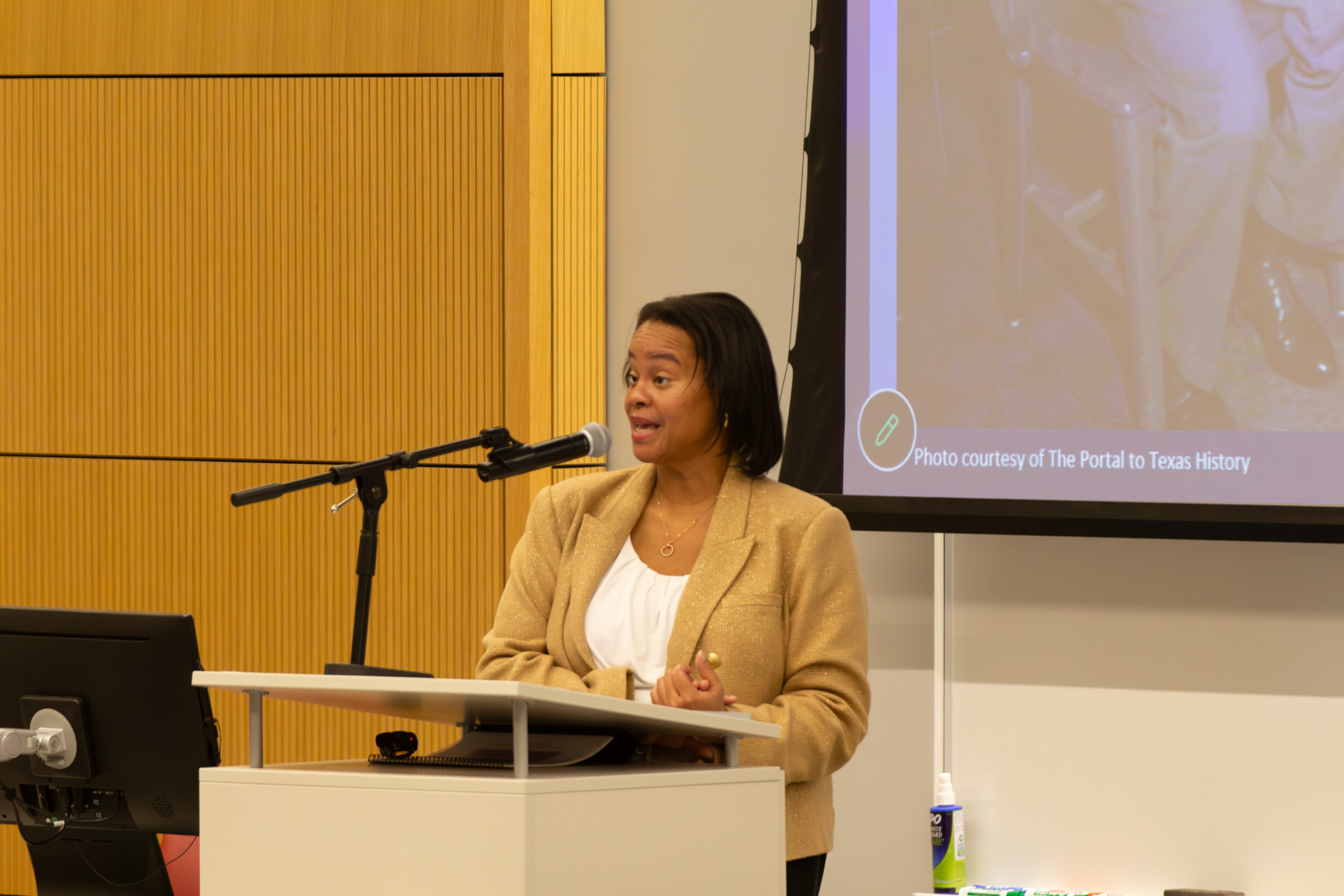
Danielle Holley speaking in the UH Black History Month lecture at the John M. O’Quinn Law Building, Tuesday, February 10, 2026, in Houston, Texas | Luis Diego Gonzalez/The Cougar

On Feb. 10, Dean Leonard Baynes and Mount Holyoke College President Danielle Holley presented their lecture titled “The Past, Present, and Future of Civil Rights Lawyering” at the UH Law Center.

The lecture commemorated Black History Month and informed attendees about the evolution of African American lawyers, both nationally and in Texas. The lecture emphasized the importance of all minorities being involved in public policy and law.

“America is full of different types of races, ethnicities and cultures, so it’s super important that we have laws and policies that cater not to just one group, but to all groups,” said political science freshman Patricia Koloko.

Baynes opened the lecture by retelling the stories of lawyers Macon B. Allen and Charlotte Ray, the first Black male and female lawyers in the U.S.

“What you find about a lot of the early African American lawyers is that they were not able to practice,” Baynes said. “Lawyers like Macon B. Allen probably only became a lawyer because they apprenticed with someone, and during the 1840s, finding someone who would apprentice Black people was incredibly hard, if not impossible.”

Holley highlighted early Black civil rights advocates, including Heman Marion Sweatt and Thurgood Marshall. In 1946, Sweatt applied to the University of Texas School of Law.

Sweatt met every academic requirement and wanted to study law. He wanted to be of benefit to his state, but was denied entry solely because of his race, Holley said.

The university attempted to build a separate law school for Sweatt to attend in Houston. In response, Sweatt, supported by Marshall and other members of the National Association for the Advancement of Colored People legal defense fund, filed a lawsuit against the university’s then-president.

The case was taken to the Supreme Court, where the justices unanimously ruled in favor of Sweatt and ordered that he be able to attend UT’s law school.

“Law school was, and it remains, the gateway to judgeships, policymaking, economic security and the idea of who gets to interpret the Constitution rather than merely live under the Constitution,” Holley said.

Students felt thankful for the work and progress of Black civil rights lawyers.

“I can only be so grateful to the lawyers and activists that came before because I’m a mixed-race person, so I probably wouldn’t even exist if we were in a certain era still,” said computer information systems senior Alisa Akaya.

Attendees agreed that civil rights lawyering is especially important today, considering the current scenarios in the real world.

“Our Constitution is based on liberty and freedom,” Koloko said. “We must fight to make sure that we’re following that pathway our Founding Fathers have for us, no matter where you come from.”

Holley discussed the current challenges aspiring Black lawyers face, including being more likely to carry student debt, be first-generation students, experience isolation and be underrepresented.

“Are Black students and graduates able to form networks, sponsorships or gets sponsors where we work? Are we able to be seen as lawyers who are identified with prestige? Do we have institutional support in the places that we work?” Holley said. “All of that can really impact the ability for us to turn people who are interested in being lawyers into law students and then turning those law students into licensed lawyers.”

Holley explained it is also difficult for Black law students to become civil rights lawyers, since racial inequality in today’s political climate is much more legally sophisticated than it was during the segregation era.

“Discrimination is often reframed as neutrality and sometimes discrimination, as we heard from the Equal Employment Opportunity Commission and the Department of Justice, is reframed as discrimination against white Americans,” Holley said.

Holley said the future of Black civil rights lawyers will require moral clarity, legal imagination, institutional courage, solidarity and stamina.

“Civil rights is not a sprint. This is a really long-term problem that we have to solve,” Holley said. “We have to figure out how the Constitution of the United States, our statutes, our regulations, our state constitutions and state regulations support a world in which we can all believe that it is made for us?”

news@thedailycougar.com

—
“Lecture explores past, future of civil rights law” was originally posted on The Cougar

Posted in UncategorizedComments Off on Lecture explores past, future of civil rights law