Author Archives | Carla Kemtchouang

Georgia Tech Degree Roadmap beta release

One week after the release of Phase II registration, the Tech Student Government Association (SGA) announced the beta release of its new GT Degree Roadmap software. The interactive tool allows students to map out their degree pathways with features unseen in previous tools. 

Students can drag and drop courses from a list of all offered courses into their planned semesters, input any possible Advanced Placement (AP) credits from high school and save detailed plans. 

A key feature of this software is the visualization through course tree maps, which show the sequential flow of all required prerequisites for a course and provide the option to view post-requisites. There is also real-time conflict detection that immediately notifies users of prerequisite conflicts. 

Anson Goo, the Executive Committee Chair of the IT Board’s Internal Tools team initiated the development of the tool. He joined as a member of SGA in October 2023 and was appointed team lead the following semester once he proposed the idea for this project and his peers endorsed it. 

Active development of this project began in the Fall 2024 semester and continued into the following spring and summer semesters under the leadership of Goo, as well as with the help of other computer science students.

Nicholas Stone, SGA’s Joint Vice President of Information Technology, explained the overarching vision for the project as a software that could “scrape the [course catalog] data and get it for [students] so that everybody can see where their prerequisites are and very easily and intuitively scope out their plan.” 

Goo described the software as an extension of the current system of resources students have access to. Rather than replacing tools such as Course Critique and GT Scheduler, GT Degree Roadmap is meant to “…help [students] with the pre-processing part like looking into prerequisites and planning [them] out,” serving as a replacement for Excel spreadsheets that academic departments use to track coursework. Goo made mentions of recent collaborations with Student Life and the Office of Information Technology to enhance its capabilities.

The Technique also discussed the tool with Steven Girardot, Vice Provost for Undergraduate Education and Student Success. Girardot is a Tech alumnus who has held various administrative roles at the Institute, primarily working with undergraduate education and student success initiatives. His current role includes overseeing units such as the Career Center and Academic Success and Advising

When asked about the scope of the project, Girardot stated, “Our students are very innovative and very forward-thinking and very entrepreneurial. So I think that anything our students develop has huge potential to make [an] impact not only at Georgia Tech but beyond Georgia Tech. It’s very important [for students] to take the information from this tool and work closely with their academic advisors … Make sure the advisor contributes to the overall planning of course scheduling and degree planning and in coordination with the other resources that we have at Georgia Tech as well.”

When asked about the future of the software, Girardot said, “As students continue to work on this tool and this resource, other schools will certainly take notice of the potential innovations in this space. So I have a lot of optimism in that.”

Since the beta release, the SGA team has tracked a milestone of 400 users for the platform, a performance metric that Goo states the team uses for measuring the software’s visibility and outreach. The team also constantly checks responses from the feedback form “as a core planning platform” to evaluate and improve the software. As Stone explained, “the purpose of the IT portion of the student government is to take in any student input, and if there’s a solution that we can do, then we will actively work on that. We’re always trying to drive forward new changes that will help the students.”

The first official version of the tool will be released by the end of the upcoming fall break. Its beta release can be found on GT Degree Roadmap where SGA encourages feedback and continues releasing updates to the program, including brand new features that will aim to maintain an intuitive experience for its users.

The post Georgia Tech Degree Roadmap beta release appeared first on Technique.
Posted in UncategorizedComments Off on Georgia Tech Degree Roadmap beta release

Federal Funding Changes to The Stitch Project

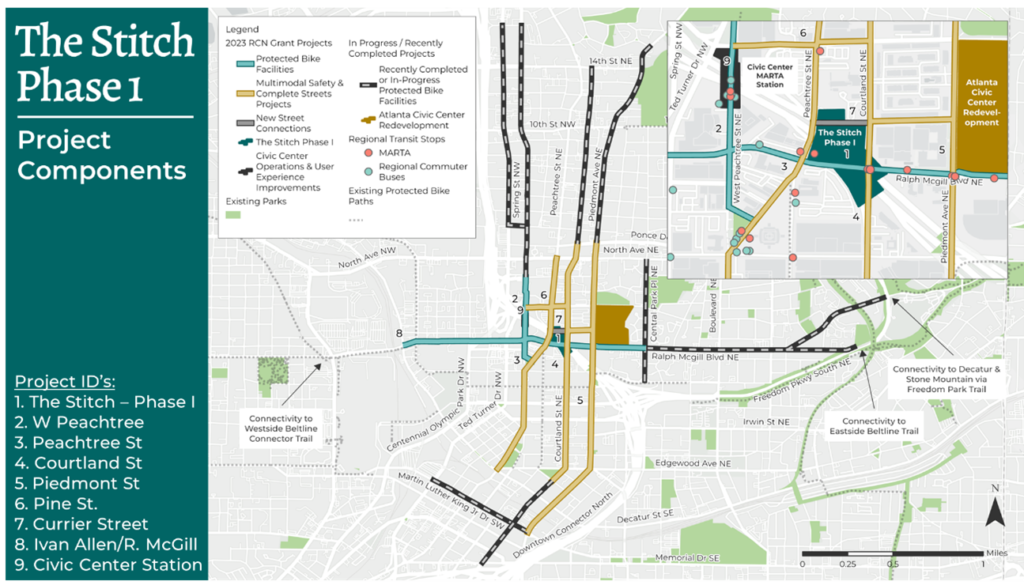
The Stitch, a project determined to connect downtown Atlanta neighborhoods, pushes its construction plans to later dates after the Big Beautiful Bill makes significant cuts to federal funding.

The Stitch project aims to turn parts of the 75 and 85 Interstates Downtown Connector into a community green space. It will span 17 acres of community greenspace upon completion, provide more environmentally friendly modes of transportation along these parts, increase the usage of streets as gathering spaces and show more of Atlanta’s cultural history through a blend of history and arts. 

Planning for the project came to a halt when President Donald Trump signed the Big Beautiful Bill into law on Independence Day. The legislation revoked $151 million in federal grants from the project, removing approximately three-quarters of the project funding for phase one construction. 

The project stems back to the 2000s with talks of extending Mayor’s Park. In 2015, the Atlanta Downtown Improvement District (ADID) authorized a study to revisit the idea and included the Civic Center MARTA Station in the vision. The project then received its official name “The Stitch,” and ADID created a committee overseeing further testing and pre-development plans for the next four years.

Starting in 2020, information about the project and its goals was shared with the public, and the committee pursued funding for ensuing developmental steps. The first of three phases for the project consists of pavilions for events, tree canopies, plazas, lawns, urban gardens and much more. This will be located between Ivan Allen Jr. Boulevard Northeast and Currier Street Northeast and is called the “heart of the Stitch,” as the other phases will extend from these spaces.

The project has received funding from the Department of Housing and Urban Development, Atlanta Regional Commission, ADID and the City of Atlanta. Additionally, the United States Department of Transportation (USDOT) Reconnecting Communities Grant Program awarded the committee $158 million. As of March 2024, it was announced by Congresswoman Nikema Williams that the project had gained a total of $207,645,161 in federal funding.

The recent federal grant cuts will not eliminate the project. In fact, according to the Central Atlanta Progress (CAP) and ADID, “The team will complete shovel-ready engineering, permitting, and approvals for Phase 1 by mid-2026. Meanwhile, Mayor Dickens and GDOT leadership have affirmed their support for advancing this transformative project for Atlanta.”

The post Federal Funding Changes to The Stitch Project appeared first on Technique.

Posted in UncategorizedComments Off on Federal Funding Changes to The Stitch Project

Shriners Children’s facility opening in Atlanta

On July 2nd, Georgia Governor Brian Kemp announced the development of a new Shriners Children’s research facility in Science Square, Tech’s hub for groundbreaking research and development across from Tech’s North Avenue Research Area. The hospital will invest over $153 million into this project and create 470 new jobs. 

Shriners Children’s is currently one of the largest pediatric centers in the world, with its primary facilities located in the United States, Canada and Mexico. The hospital treats a wide range of conditions, including orthopedic, neuromuscular and burn injuries, among others. The hospital is also dedicated to conducting research and this new facility, the Shriners Children’s Research Institute, will be an opportunity to make more breakthroughs. 

The Vice President of Research Programs at Shriners Children’s, Dr. Marc Lalande, tells the governor’s press that the institute will “serve as a multidisciplinary innovation hub to advance the healthcare of children.” 

The hospital will seek professionals in different research fields, such as medical devices, data informatics, cell and gene therapies, robotics, artificial intelligence and biologics to contribute to its efforts.

The location and partnership with Tech strengthen Atlanta’s position as a leading city of innovation and commitment to technological and scientific developments. The research institute aims to advance pediatric research and to open its doors within 18 months of this announcement. 

Shriners Children’s Hospital opened its first hospital in 1922. During the 1910s United States polio outbreaks, members of the Shriners Fraternity saw that there were children without access to proper care for the virus. The Shriners Children’s Hospital in Shreveport, Louisiana served as the first of many to welcome any child needing care. The non-profit organization now runs 19 hospitals in the United States and many clinics around the world. 

The hospital continuously partners with other higher-education institutions to research specific causes. The Genomics Institute was launched in 2017 through a partnership with the University of South Tampa Research Park, focusing on advancing various treatment options through DNA sequencing. The Howard Green Center for Children’s Skin Health & Research at the hospital’s Boston location explores the use of stem cells to treat epidermolysis bullosa, a skin condition that develops mostly in infants and young children. 

This new Research Institute, in collaboration with Tech, aims to create new medical devices to help children have more control of their mobility. This initiative will be led by Scott Kozin, M.D., hand surgeon and chief of staff at the hospital’s Philadelphia location, and Frank L Hammond III, Ph.D., researcher at the Adaptation Robotic Manipulation Laboratory at Tech. 

This one-of-a-kind collaboration between Shriners Children’s and Tech will bring more insight to and strengthen the use of robotics and technology to improve the quality of life for children. It unites science, innovation and care to realize a more advanced future for medicine and research.

The post Shriners Children’s facility opening in Atlanta appeared first on Technique.

Posted in UncategorizedComments Off on Shriners Children’s facility opening in Atlanta

Georgia Tech’s Biltmore Restoration

Over a century after its grand opening, Tech welcomes the Atlanta Biltmore in Tech Square as a center for innovation and business collaboration.

Built in 1924, the Biltmore served as both a hotel and an apartment complex for dwellers of the metropolitan city.

During the 1960s, competition grew between the Biltmore and other hotels in downtown Atlanta. In 1982, operations concluded and the hotel closed. For many years, this hotel has stood as a “Landmark Building Exterior” for the city, standing as proof of the growth and evolution of the city.

The Georgia Tech Foundation acquired the historic building in June 2016. Almost a decade later, the school has announced that the Biltmore will be another addition to Tech Square. 

Tech Square is the Institute’s very own 2.5-million-square-foot innovation and dining district. It is home to over 30 corporate innovation centers, including R&D laboratories and regional technological centers, two upcoming buildings for the Scheller College of Business and the H. Milton Stewart School of Industrial and Systems Engineering and the premier high-performance computing center Coda building. The Biltmore will house the school’s Office of Technology Licensing, aiming to guide companies commercializing the Institute’s research and expediting the international use of the school’s innovations. The VentureLab will also be in this building, home to the Southeast hub for the National Science Foundation I-Corps.

CREATE-X and Quadrant-i, two Tech idea-realizing programs, will be headquartered in the Biltmore. CREATE-X is Tech’s initiative to realize student startups, which has created over $2.4 billion worth of innovation and plans to launch 1,000 startups annually. Similarly, Quadrant-i transforms research into tangible results and real-world startups by supporting inventors and matching their solutions to customers and the market.

The Startup Scaling Platform will bring mentorship, funding and more support to startups in their early stage — helping them welcome their first 100 customers. The Corporate Engagement Office will join industry leaders with compatible startups, while the Venture Investment Hub will host events joining these two groups. There will also be additional strategic partners aimed at supporting organizations and corporate centers for innovation.

This initiative aligns with the growth of Tech Square as a top-five U.S. technological hub, reinforcing the city’s reputation as a center for innovation and business advancement. 

David Tyndall, current CEO of Collaborative Real Estate and an original co-developer of Tech Square, will be overseeing the Biltmore’s redevelopment. *Source* Tyndall calls this reconstruction a “crown jewel of innovation.”

Through integration of academic research, entrepreneurial support and corporate engagement, Tech’s restoration of the Biltmore will not only enhance the school’s position but also Atlanta’s as a national leader in innovation and technology. 

“Atlanta is becoming the startup capital of the South, and this next chapter for The Biltmore strengthens our momentum,” said Atlanta Mayor Andre Dickens. 

This project will ensure that the city remains at the forefront of startup creativity and breakthrough research commercialization, reshaping the future of business and technology as it is known.

The post Georgia Tech’s Biltmore Restoration appeared first on Technique.

Posted in UncategorizedComments Off on Georgia Tech’s Biltmore Restoration

Georgia Tech Comprehensive Campus Plan Developments

Tech released its Comprehensive Campus Plan spanning 2023-2031 in November of 2023. The plan outlined over 20 projects to facilitate the Institute’s 10-year Strategic Plan. These projects are meant to reshape the campus, develop new infrastructure and inspire the campus and surrounding community, and they are already starting to be put in place.

The School of Public Policy building D.M. Smith is receiving major upgrades, with the installation of new electrical and plumbing systems, as well as accommodations for an elevator and wheelchair accessibility. The building will have a virtual lab and space for hoteling for the School. The building once relied on steam for daily operations, but with these new additions, the building will align with the goals of the Georgia Tech Climate Action Plan.

Ferst Drive, a road encircling the campus, is being revitalized to accommodate bicycle and scooter usage. There will be more separation for pedestrians, bikes, buses, and vehicles to provide more safety. This includes a cycle track installation along the interior of the road as well as realignment with other routes to improve traffic circulation.

In July of 2024, many buildings around campus lost air conditioning due to a chilled water pipe leak in Harrison Square. In addition to repairing the pipe, Infrastructure and Sustainability is currently working to increase the resiliency of the overall system. 

The Thomas A. Fanning Student-Athlete Performance Center will be a 100,000-square-foot 4-story student-athlete center. It will provide strength and conditioning space, sports medicine offices, nutrition areas, and much more to support the work of Tech’s athletes. As a result, the southbound lane of Techwood Drive will not reopen until the completion of the center in 2026.

Tech Square Phase 3 will welcome Scheller Tower, a 14-story, 415,000-square-foot academic and office space housing multiple programs for the Scheller College of Business. The H. Milton Stewart School of Industrial and Systems Engineering will occupy the 18-story George tower and include street-level retail.

The new Curran Street Residence Hall, set to be complete in 2026, will be the first new residence hall on campus since 2005. The residence hall will house 860 first-year students across 191,000 square feet of double occupancy rooms. 

The Pathway of Progress; Celebrating Georgia Tech Women is an exterior landscape sculptural and digital experience, commemorating women and historically momentous events that have shaped the Institute. The project will be open to the public by the end of Fall 2024 with an official grand opening in March 2025. There is an interactive tool that allows users to see current and almost-completed projects, found on https://gtfacilities.maps.arcgis.com/apps/instant/slider/index.html?appid=60287828a9b94c63bb5b904612b327dd. 

The Infrastructure and Sustainability (I&S) Analytics team also has a data request form for anyone—students, faculty, researchers, and community members—who is interested in getting more information about specific campus data and encourages students to use the campus as inspiration for class assignments, research projects, or design projects.

When asked about the significance of the changes the Plan will make to the campus, Institute Planner Laurence Brennan notes, “We feel a profound responsibility to inspire and engage students within our built environment.” He hopes “that our work transcends the borders of Georgia Tech by weaving the urban fabric that surrounds us into campus.”

With the increasing numbers of students and campus visitors the Institute receives each year, the campus can face traffic problems with the variety of mobility. Infrastructure and Sustainability is working hard to address this with the reconfiguration of roads around campus, such as the addition of bike lanes on Ferst Drive and Techwood Drive.

“The Techwood project aligns directly with the city’s plans to connect the campus to Centennial Olympic Park, where essentially all bike routes converge and disperse across the greater metro area,” Brennan adds. “These larger scale connections promote more walk-and-bikeability throughout the city and encourage more positive interactions regarding motor vehicles.”

When asked about the impact on day-to-day lives the current projects will have, I&S Communications Officer Cathy Brim emphasized, “All of these projects support our mission of providing a resilient learning environment and the safest campus possible for students, faculty, and staff.” 

Georgia Tech celebrates alumni of diverse backgrounds through inclusion initiatives such as the Pathway of Progress and the Divine Nine Plaza, to “demonstrate the power that diversity of thought has in higher education.” These projects are more than upgrading the physical aspects of campus — they are meant to inspire students and help them feel that they belong at Georgia Tech.

Infrastructure and Sustainability welcomes the Georgia Tech community to be involved. The Student Government Association and Graduate Student Government Association host town hall events, volunteer events, and send out surveys across the campus to receive feedback. Further information about these projects can be found on the I&S website https://facilities.gatech.edu/projects/current, around campus on digital screens in multiple locations, and on Georgia Tech social media accounts.

The post Georgia Tech Comprehensive Campus Plan Developments appeared first on Technique.

Posted in UncategorizedComments Off on Georgia Tech Comprehensive Campus Plan Developments

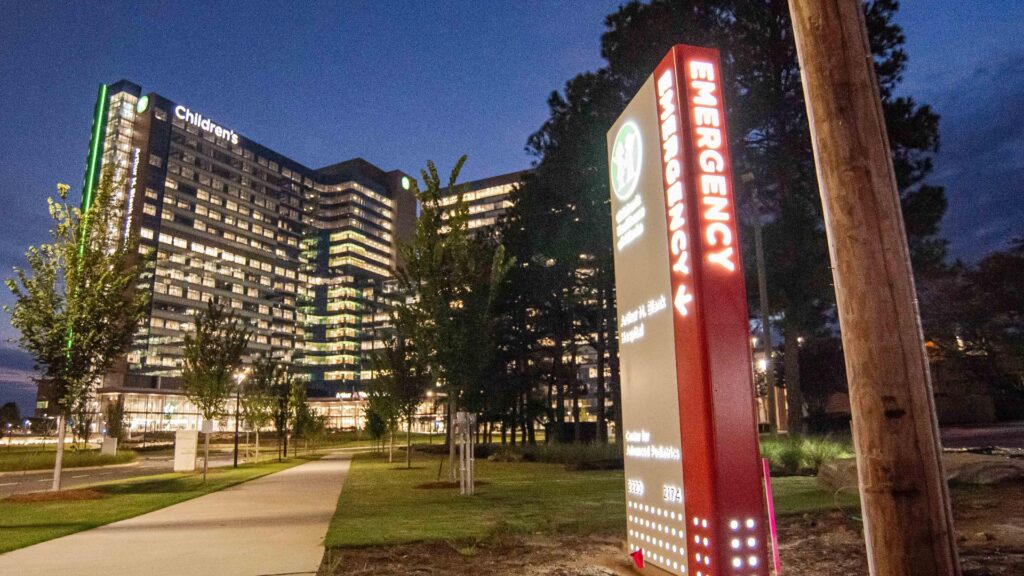
Children’s Healthcare of Atlanta Arthur M. Blank Hospital Opens

The new Children’s Hospital of Atlanta Arthur M. Blank Hospital was opened on Sunday Sept. 29  in Atlanta.

Patients in the now-closed Egleston Hospital were transferred to the newly opened Arthur M. Blank Hospital. 65 ambulances drove 202 patients to the new hospital, and 1,200 team members and 1,000 volunteers helped program this smooth transition for the patients and their families. Hospital officials reported that the move was completed by 7 p.m. that day.

The Arthur M. Blank Family Foundation, named after Home Depot Co-founder and owner of the Atlanta Falcons, Arthur M. Blank donated $200 million in 2020 to help the Children’s Healthcare of Atlanta (CHOA) fund this project.

The project cost $1.5 billion and has provided 116 more beds than Egleston. The new hospital has 19 stories and spans 2 million square feet, allowing more flexibility with Atlanta’s growing population. The removal of an old hotel on that land marked the beginning of the construction in 2020, with its completion in 2024.

Laura Jones is the Children’s Healthcare’s Vice President for Emergency Services, Trauma, Transport, Transfer Center and Special Care Unit. When giving a tour of the facility in May 2024, she said, “It’s been an adventure. We’ve been working on this design and building for the last nine years.”

From 2017 to 2018, CHOA worked on obtaining a Certification of Need to begin planning. In 2018, the organization created the design and construction began two years later. The hospital ended construction this year.

The hospital’s designs were a group effort of not just executives in charge but also therapists, physicians, nurses, and other clinicians. Their input on the design would ensure the best design for taking care of their patients.

Arthur M. Blank Hospital has larger and more private rooms for patients than Egleston to ensure the comfort and privacy of patients and their families. There are family lounges, kitchenettes on every floor, activity rooms for the children and other amenities.

The hospital mentions that “research shows exposure to nature reduces the need for some medications and improves outcomes,” so the facility features more than 20 acres of walking trails and natural space in its design. Over 70% of patient rooms overlook these beautiful views.

In their dedication to testing every aspect of this large project, the organization turned a 114,000-square-foot warehouse into a mock hospital to run simulations. Patient families, operational leaders and clinicians were involved.

Kristen Christensen, a Cardiac Intensive Care Unit (CICU) nurse, was among the 400 who participated. “I’m doing my part to make it the best it can be,” she said. “And that’s exactly what every child deserves.”

CHOA has three hospitals across Georgia, eight urgent care centers and multiple specialty centers ranging from rheumatology centers to technology-dependent intensive care centers.

CHOA’s Heart Center is among the top five pediatric heart facilities in the U.S. regarding the volume of Cardiac Acute Care Units (CACU) and CICU surgeries performed, which is more than 800 cardiac annually. 

“We’ll also transfer patients from the Scottish Rite Aflac Cancer and Blood Disorders Center,” Jones said in an interview with GPB News, “because we’re going to consolidate our inpatient hematology services at Arthur M. Blank.”

Mackenzie Madison, third-year NEURO, is a medical scribe for CHOA outside of school. She has worked at Egleston since June 2024 and began her journey at Arthur M. Blank on the second day of its opening.

Her first day was “chaotic” due to the hospital’s size difference. “The emergency center is three times Egleston’s. There are 75 rooms, each with much more space than the previous center.” Along with patients, equipment and databases had to be transferred. 

Madison has already seen innovative technology being implemented at the new hospital. Alongside its dedicated team of doctors and nurses, the hospital will be run largely with the help of robots. They will transport medication floor to floor, discard medical waste and deliver linens. Some will have the opportunity to meet with patients and care for them directly by delivering food and medication and performing other tasks. The robots are painted with bright colors and drawings to make the children feel more comfortable with the change and to put a smile on their faces. 

Madison finds the new hospital “beautiful,” but it is so big that she often finds herself lost in its halls. She says the community has been one of the biggest supporters of this project, contributing immensely financially and being happy that children can receive the best care possible.

On her first shift, she saw a 4-year-old patient running around the waiting rooms. They were admitted to treat their chronic pain, but in the excitement of the new environment, they were jumping around and giving everyone hugs. This heartwarming sight proves the years of planning to be worth it.

The post Children’s Healthcare of Atlanta Arthur M. Blank Hospital Opens appeared first on Technique.

Posted in UncategorizedComments Off on Children’s Healthcare of Atlanta Arthur M. Blank Hospital Opens

Afrobeats genre keeps evolving

“Jerusalema.”

For African immigrants, no matter the generation, this song title alone brings back memories of people posting dances to this song on the internet, or even memories of family members recording a video of their outfits to this song to be shared with friends. Whatever the case, this song quickly flourished from its popularity in South Africa in 2019 and became well-known worldwide in years to come.

During 2020, Wizkid’s “Essence (ft. Tems)” took the world by storm with its relaxing rhythm and loving lyrics. It became a common background song to cooking, makeup and lifestyle TikToks.

These songs are among recent Afrobeat hits, a musical genre that began in the 1960s as Western African tunes blended with African American music. One major genre pioneer was Africa 70, a Nigerian-Ghanaian band that mixed Western African rhythm with American funk, jazz and soul. Fela Kuti was a Nigerian musician and activist, as well as the creator of Africa 70, and he used his music to bring attention to the corruption of his country’s government.  

In the 2000s, the music genre had evolved into multiple subcategories: Afrobeats, Afro-pop, Afro-fusion and more. Afrobeats is a genre created by West Africans and its worldwide diaspora, with most of its origins consisting of Nigerian “Naija” and Ghanaian “hiplife” music. Famous musician Davido once said in a 2017 interview, “there’s so much going on in Africa, the last thing people want to hear is sad music.” Many other artists of today are straying away from the terms Afrobeat and Afrobeats to preserve the essence that Kuti brought to the original genre.

In the early 2000s, artists such as P-square and Tiwa Savage were staples in every West African’s playlist. No matter the occasion — parties, weddings, birthdays, barbecues, graduations — their music would make people rise to their feet and dance. These artists would sing in a mix of English and their native language. However, with music being a universal language, the barrier did not stop artists from different countries from charting outside of Africa.

In the households of francophone Africans, Makossa is a genre that is not heard often anymore but holds memories to those in their late teens or early twenties. Makossa is a music genre originating from Douala, Cameroon in the 1940s, known for its heavy use of electric guitar accompanying lead vocalists with choirs following them. A leading pioneer is Emmanuel N’Djoké “Manu” Dibango, a Cameroonian musician who became famous with his song “Soul Makossa.”  

Many American pop artists have even taken inspiration from his lyrics, facing legal trouble for not having attributed the inspiration to Dibango. Dibango sings, “Mama ko mama sa maka makosa” in his “Soul Makossa” refrain. In Michael Jackson’s 1982 hit “Wanna Be Startin’ Somethin’,” he sings “Ma-ma-se, ma-ma-sa, ma-ma-coo-sa.” Rihanna sampled Jackson’s song and re-phrasing of Dibango’s lyrics in her song “Don’t Stop the Music,” released in 2008.

Artists such as Petit Pays and Charlotte Mbango, both Cameroonian Makossa singers, are names those born in the 1970s-1990s may recognize. Similar to the evolution of Afrobeats, Makossa now uses more international languages such as French and English. The music genre is slowly losing its popularity, but artists such as Mani Bella and Locko led a new rise in Cameroonian urban music in the 2010s.

When asked what the music genre means to her, Nigerian student Anita Olele, second-year CS, called it the “heartbeat of our current generation,” referring to the current generation of the African Diaspora. 

When asked about her preference between older African music and the newer generation, Olele shared she does not have an opinion. Older Nigerian music is “ageless” as she grew up listening to these tunes, but the modern take on the genre has been exciting for her to discover and watch evolve. For anyone interested in listening to African music, she recommends “Bloody Samaritan” by Arya Starr.

“It is more than just music,” she adds. “The instruments and beats are very distinctive and are usually meant to induce automatic feelings of joy and celebration and bring people together.” She feels “proud and happy” to see different African countries such as Nigeria and South Africa releasing music and seeing their fame reach the rest of the world.

The post Afrobeats genre keeps evolving appeared first on Technique.

Posted in UncategorizedComments Off on Afrobeats genre keeps evolving