
Author Archives | Carla Kemtchouang

Tech’s new Space Research Institute

On Sept. 5, the new Georgia Tech Space Research Institute (SRI) held its inaugural meeting with over 130 researchers from across the campus at the Marcus Nanotechnology building. The event marked a new moment for the Institute, which began operations on July 1, and is yet another sign of Tech’s commitment to becoming a leader in ground-breaking research.

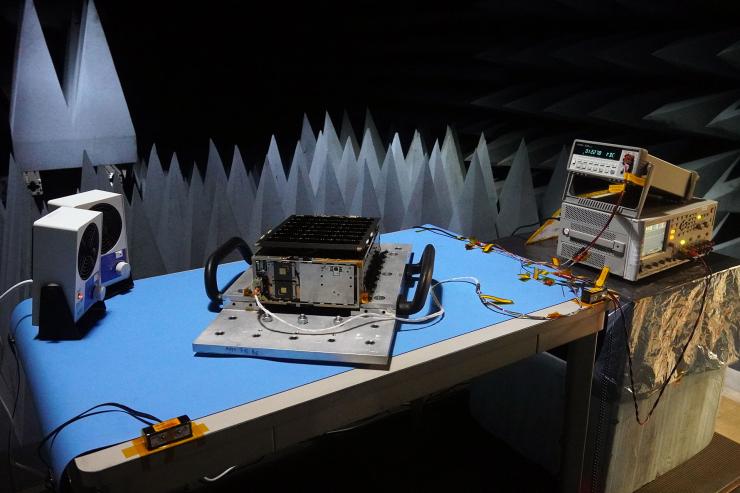
The highlights of the meeting were as follows: the CubeSats satellites launched into Earth’s low orbit by the Space Systems Design Lab in March; physics Ph.D. student J. Cole Faggert received a NASA Future Investigators in NASA Earth and Space Science and Technology (FINESST) award for using multi-wavelength imaging to study supermassive black holes in August; and in September, math Ph.D. and aerospace engineering master’s student Jaden Wang received the NASA Space Technology Graduate Research Opportunity (NSTGRO) grant to support his research on computing mathematically-based solutions for landing spacecraft.

The Center for Space Technology and Research (CSTAR) was a hub that expanded Tech’s aerospace industry research. The Hypersonic Center of Excellence, Georgia Tech Astrobiology, Center for Relativistic Astrophysics and Space Policy and International Relations Center are all groups under CSTAR that now also function under the SRI. Across various colleges, there are students, faculty and other professionals who conduct space research, and the SRI serves as a central support hub for CSTAR centers, labs and individuals. 

“Establishing this really took shape probably 15 years ago or so when Bobby Braun was a professor here,” said SRI Executive Director Jud Ready in an interview with the Technique. “He recognized that we had a lot of individual researchers doing things in space, like I was doing material science-related stuff in space with solar cells, for instance.”

The two came together to form CSTAR, and Braun later on reached out to the College of Engineering, the College of Sciences, the Georgia Tech Research Institute (GTRI) and the Executive Vice President for Research for $25,000 from each entity per year. CSTAR would use these funds to give back to faculty as grants for space-related research, support workshops and externally funded proposals. 

“We’re trying to demonstrate all the clever and innovative science and engineering that goes on at Georgia Tech. We’re continuing that right now with the Space Research Institute,” Ready said. “We’ll continually do that every year. Put on a big event to showcase Georgia Tech research.”

The Institute’s kick-off yearly fiscal event was going to be a Lunar Surface Innovation Consortium meeting. Johns Hopkins University sponsored the gathering using NASA funding as a way for the moon research community across the United States to gather. The Institute scheduled the gathering for November, but due to the federal government shutdown earlier this month, the event will be postponed. 

The second event will be the Symposium on Space Innovations next fall, where hundreds of people will have panels, student poster sessions, networking, social events and field trips to space research labs at Tech, such as the Dedicated Spacecraft Assembly Clean Room and the Georgia Tech Observatory’s telescopes. 

“We like to think our research is great, but our students are even better,” Ready said. The SRI is working on recruiting efforts with companies, national labs, private foundations and individuals. There will be a variety of internship programs for external students, as well as Tech-only opportunities to ensure its students’ applications do not get lost among outside applications. 

The SRI also fosters support for startups and highlights space research at Tech. In September, Arizona-based investment advisor group CreationsVC donated $375,000 to space-related and space-adjacent Quadrant-i startup companies that are based on Tech’s intellectual property. The Institute highlights five faculty members every year for their work and puts self-nomination applications in monthly newsletters. 

“It’s a fairly skinny staff right now in the office, but we are very interested in engaging students. If any student out there is interested in space-related research, I encourage them to join those clubs and contact the leadership of SRI to help connect them,” said Ready. 

Tech’s Astronomy Club is working with the SRI to host a Homecoming Alumni Stargazing on Oct. 23, and SRI wants to grow a deeper connection with clubs and students to increase space-related activity on campus.

“We’re open for business. We are looking to enhance Atlanta and the state of Georgia as a Nexus for space-related research, development and commercialization,” Ready said. Under the SRI, Tech’s space researchers now have a central resource to continue their work, as it promises to elevate space science and its impact.

The post Tech’s new Space Research Institute appeared first on Technique.

Posted in UncategorizedComments Off on Tech’s new Space Research Institute

Georgia Tech student wins 2025 GeoGuessr World Cup

Radu Casapu, a first-year master’s student studying City and Regional Planning (MCRP) at Tech, won the 2025 GeoGuessr World Championship. The two-day competition took place from Aug. 29-30 in Copenhagen, Denmark.

GeoGuessr is an online geography game where players are “dropped” into Google Maps and given images that they must use to deduce the specific location. This was his third appearance at the global competition and his first win. He qualified by winning the DreamHack Dallas tournament, where he competed against others from the U.S., Canada and Latin America.

“Ever since I was really little, I was just hooked on it [geography],” Casapu said. “I used to look at atlases, [my school] had puzzle maps with countries and states as pieces and I would play with them.”

He competed in middle school geography bees and played quiz bowls in high school. Naturally, GeoGuessr became an extension of those interests. He began playing the game in high school, before the game had a competitive scene. 

The first World Cup launched in 2023, where Casapu received an invitation to compete. He returned in 2024 through qualifiers and won a seat at this year’s competition through the regional tournament in Dallas. 

“I came into this competition seated at No. 1 because I won the tournament in Dallas,” Casapu said. “There was a lot of expectation on me.”

To prepare for the World Cup, he spent time doing research, exploring Google Maps and its Street View feature. He would look around and take notes in his journal, writing down things he would notice in various locations. He would also play many head-to-head duels to practice playing under the tournament’s format.

During the matches, Carapu focused on  calm and avoided second-guessing himself. He noted the mental side of the game frequently determinesthe result of the game for a player, even for someone who has practiced and put in a lot of physical work.

“Obviously, I feel like I came in extremely prepared with my knowledge, but I still think the biggest thing that makes a difference of like the winner: it’s like the mental game,”Casapu said.

Outside of GeoGuessr, Casapu engages with geography through traveling, traveling photography and architecture photography. He values looking at things from a spatial perspective, noting where places are and learning the cultural and physical stories behind everywhere he goes. He studied geography in his undergraduate degree and values the opportunity through his master’s program to help shape cities and urban development. 

“We get to go out and meet people, meet developers, community leaders and talk to people in different communities. That’s really cool. And again with the spatial aspect, I just love seeing growth in cities,” Casapu said.

Casapu noted the championship win has raised his profile in the GeoGuessr community and in public, saying that he has even become a household name. He has since appeared on livestreams with other popular social media creators and attended promotional events in Los Angeles. He said the recognition has been surprising but welcome. 

“When you’re in Street View location, notice the architecture, the road, what people are doing,” Casapu recommended to anyone wanting to play the game. “Notice the trees, the cars —everything. Just explore things on your own … I love looking around Google Maps. I know a lot of people love to do that in their free time as well, even though they might not necessarily be playing Geoguesser.”

“This for me was a bucket list thing,” he said when talking about his win. “It’s like I’ve basically completed the game.” 

Casapu plans on continuing to compete and promote the game, though he now has the opportunity to play with less pressure.

The post Georgia Tech student wins 2025 GeoGuessr World Cup appeared first on Technique.

Posted in UncategorizedComments Off on Georgia Tech student wins 2025 GeoGuessr World Cup

Clark Foundation donates $11 million

The College of Engineering announced a $11 million donation on Sept. 15 to Tech’s Clark Scholars Program from the A. James & Alice B. Clark Foundation. This will double the amount of scholarships available to students from low-income backgrounds and expand access to engineering education at the Institute.

The Foundation began its collaboration with Tech in 2018, founding the program with the goal of providing support through need-based scholarships, mentorship and professional development. The program supports 10 students each year for their entire tenure at the Institute, resulting in a cohort of 40 to 50 students at a time. The cohort will double with the donation.

“This support allows our students to have hands-on learning experiences, obtain career development skills, and support for mental health and well-being,” said Raheem Beyah, Dean of the College of Engineering and Southern Company Chair, in an interview with Tech. “I’m grateful for the countless ways the Clark Foundation has changed the lives of our engineers. This investment is a testament to the meaningful partnership between Georgia Tech and the Clark Foundation and perpetuates the Foundation’s lasting impact.”

The Foundation began its philanthropy in 1987 under the name “Clark Charitable Foundation.” Clark and his daughter wanted to give back to their local communities and donated to nearby hospitals, cultural institutions, veterans groups, schools and community organizations. 

Clark passed away in 2015, and as per his wishes, his estate was spent down. The foundation was renamed and expanded the following year. The Clark Foundation has since invested over a billion in continuing to support various communities and organizations, with $591 million spent on engineering education.

In 2018, the Foundation created the Clark Scholars Program and has partnerships with 11 top institutions. Clark Program Scholars at Tech attend regular meetings with Institute leadership and receive tutoring, career planning and alumni mentorship. 

Tech’s “Invest in the Best Scholarship Challenge” initiative aims to reduce financial barriers for students. The Georgia Tech Foundation matched the Clark Foundation’s donation dollar-for-dollar, resulting in the doubling of the number of students who will now receive aid from the program. The scholarship will cover tuition and fees, as well as research opportunities, summer coursework and study abroad programs. 

The Clark Scholars Philanthropy Challenge is a new initiative by the Clark Foundation that aims to educate students about nonprofit organizations and the work they do, as well as the impact of individual giving. Students in this challenge will analyze financial filings, review impact reports and interview nonprofit leaders before selecting one organization to receive a donation from the Philanthropy Challenge Endowment. 

According to a U.S. National Science Foundation case study, 86% of low-income STEM graduates who received scholarship assistance entered the STEM workforce in 2024. On the other hand, less than 60% STEM graduates in 2017 were employed a year after graduating. This demonstrates a bridge that donations such as the Clark Foundation’s provide for students in STEM.

“Georgia Tech demands an enormous amount from its students. In addition to funding their education, a gift like this ensures that our Scholars can focus on their coursework because they know that mental health support and professional development curricula are in place to promote their success,” noted David Torello, Clark Scholars program director at Tech.

The post Clark Foundation donates $11 million appeared first on Technique.

Posted in UncategorizedComments Off on Clark Foundation donates $11 million

John W. Durstine Endowment of $100 million

On Sept. 4, Tech announced that alumnus John W. Durstine, ME ‘57, bequeathed $100 million to the George W. Woodruff School of Mechanical Engineering. This is the largest donation received by the Institute in its history and will completely transform the Woodruff School.

The Woodruff School of Mechanical Engineering was home to almost 2,000 actively enrolled students in the Fall 2024 semester. U.S. News & World Report has ranked the school #2 for the best undergraduate mechanical engineering program and #5 among graduate programs in the nation. 

The Georgia Tech Foundation maintains the endowment and will help maintain the faculty of the Woodruff School by establishing endowed chairs and professorships for both established and early-career professionals. The endowment will support the Institute’s research mission as well, funding more tools and facilities for further innovation. 

The John W. Durstine Endowment will also enhance the Student Competition Center, home to the Institute’s seven student-led engineering competition clubs, Capstone Design, a course that mechanical engineering students take during their last semester to build and showcase their acquired skills, and the Flowers Invention Studio, one of Tech’s makerspaces. 

“This gift provides once-in-a-lifetime resources for the Woodruff School,” said Raheem Beyah, dean of the College of Engineering and Southern Company Chair. “By investing in the people who teach, inspire and mentor our students, Mr. Durstine has strengthened the core of the Woodruff School and put it in a class of its own. His legacy is a testament to the extraordinary loyalty and vision of our alumni.”

Durstine passed away this February, and his legacy extends beyond this generous gift. Originally from Birmingham, Ala., Durstine graduated from Tech in 1957. He then earned a Master of Business Administration from Harvard Business School and worked as a Ford Motor Company executive for decades, focusing on advancing powertrain strategy and systems engineering. 

In 1978, he began his philanthropy by giving a $100 gift to Roll and Call, Tech’s annual fund supported by alumni, and continued over the next four decades. His support extended directly to students, from cheering on students during competitions to staying closely connected to the Woodruff School. He was inducted into the Institute’s College of Engineering Hall of Fame in 2014.

“John Durstine’s historic generosity is deeply inspiring to all of us working to carry out the Institute’s mission,” said Tech President Ángel Cabrera. “John could have left his estate to many good causes, and he chose to invest in Georgia Tech’s faculty because he knew firsthand the transformative impact that our outstanding faculty have in the lives and careers of our students.”

The gift also contributes to Transforming Tomorrow: The Campaign for Georgia Tech, a $2 billion philanthropic initiative that has been in effect since 2018. 

Durstine’s legacy will live on in every student who benefits from the programs and faculties supported by his gift. He made a lasting tribute for the future of Tech, and his generosity will continue shaping the Institute’s vision for innovation and a transformative future.

The post John W. Durstine Endowment of $100 million appeared first on Technique.

Posted in UncategorizedComments Off on John W. Durstine Endowment of $100 million

A pink personality

If you asked the people closest to me what my favorite color is, they would answer pink without needing a second to think.

There is no simple explanation for this personality choice of mine. Pink is a color with many personalities and many embodiments, and besides the shade it provides to the world, it serves many purposes to me. 

After one examines the fictional character Barbie, it comes as no surprise that the color pink is a crucial aspect of her identity. Growing up, my comfort show was “Barbie: Life in the Dreamhouse” because I saw Barbie taking on various occupations and still making room for pink in all of them. She flew a pink plane as a pilot and wore a pink astronaut suit in space — who says she can’t do it all?

Both the doll and color have long been symbols of femininity and softness. Barbie is marketed as a capable woman of many talents, and the color has helped push this vision onto young girls such as myself. The more I watched the show on Netflix, the more I realized that the people who say “pink is for girls” did not fully understand her mission and what she stood for. These groups did have the pleasure of seeing one of the most talented characters in cartoon history practically waving that color as her flag to empower girls and young women.

The Merriam-Webster dictionary defines synesthesia as “a concomitant sensation.” Some examples most commonly seen of this in humans are Grapheme color synesthesia, the association of numbers or letters to a color, or mirror touch synesthesia, where seeing a person hug someone else may give you the feeling that you are the one being hugged. 

I find myself experiencing synesthesia-like symptoms with pink. The color brings me joy in its shade, sadness when I remember that my favorite show is no longer on Netflix and hope for future children who will look at the color and feel empowered instead of belittled for choosing a “girly” color.

Pink was the color I chose when buying my umbrella, engineering calculator, ruler, pencil case and other small yet important objects. Pink is the color I wear and immediately feel confident in, like Barbie. Pink will continue being the color I seek out whenever I buy phone cases. It is more than a color; it is a lifestyle.

It is also the best color out there.

The post A pink personality appeared first on Technique.

Posted in UncategorizedComments Off on A pink personality

New Student Center restaurant openings

Students returning to campus this Fall 2025 semester may have walked into the John Lewis Student Center and noticed additions to the restaurant options. Marrakech Express, Dancing Goats and Noodle Theory have begun their operations and provide new flavors for students and visitors alike.


Marrakech Express

Marrakech Express replaced Slutty Vegan on the first floor of the Student Center, which served its last customers on February 26. Marrakech offers traditional Moroccan and Mediterranean cuisine. Before opening this location, they had a tent in the weekly Community Market along Tech Walkway that was popular with students. 

In an interview with the Technique, Student Government Association (SGA) Dining Committee chair Soumit Guntupalli explained, “Tech Dining looked to fill the spot with a place that they thought that students would really enjoy, and Marrakech Express came to mind.” Tech Dining worked with Marrakech Express throughout their transition from a market vendor to their more permanent home in the Student Center . Menu items include tanjiya, a traditional stewed lamb dish from Marrakech, shawarma and falafel dishes.

Read a review of Marrakech Express’ first brick-and-mortar location in Smyrna, Ga. here.


Dancing Goats

Dancing Goats Coffee replaces Blue Donkey to offer a greater variety of cafes across campus. The company, which already maintains several locations across the Atlanta area, moved into the Student Center after winning the favor of the Jackets in a student coffee-tasting event.

“Tech Dining hosted an event last semester where they had different coffee and beverage vendors at the Exhibition Hall. It was an all-day event. Students could come in and try all the different vendors, rank them and were able to vote at the end of the day. And according to the results, Dancing Goats won the ‘contest,’ so to speak, and they were voted the most popular,” said Guntupalli.

Dancing Goats offers coffee, tea and numerous bakery items.


Noodle Theory

Noodle Theory is also located on the second floor of the Student Center, replacing Bento Sushi. They offer several Japanese comfort cuisine options, including rice bowls, donburi, yaki udon and ramen.

According to Guntupalli, “[Noodle Theory] was more of a Tech Dining thing. They were looking to provide more offerings in the Pan-Asian fusion sector of meals…so Noodle Theory was a concept that they came up with to help meet student needs and provide a little bit more variety.”

SGA works closely with the Tech Dining team throughout the process of adding new vendors. They start by getting student feedback through surveys and tabling.

“We try to come from the students’ perspective and try to provide their input in a way that the new offerings that they’re able to provide really meet student demand,” Guntupalli said.

Results from an SGA Dining Committee tabling event in the Fall 2024 semester showed that students were interested in more coffee and dessert options. When students were asked about which types of new food they would like to see on campus, over a third of responses contained coffee, while dessert yielded the same result. This inspired the pop-up coffee event that led to the addition of Dancing Goats. The committee works closely with Tech Dining, providing a student voice.

If students are interested in being a part of this process, they can apply for the SGA dining committee by filling out the form here. Students can also send an email to campusservices@sga.gatech.edu to voice any questions or concerns they may have.

The post New Student Center restaurant openings appeared first on Technique.

Posted in UncategorizedComments Off on New Student Center restaurant openings