When many people walk into the meat aisle at the grocery store, they often do not think about what goes into getting their steak or chicken on the shelf — and especially not how much water goes into its production.
In a study published earlier this month, University of Minnesota researchers make those connections about where commercialized meat comes from and how much water it takes to bring them from farm to table.
Using 2012 data, the study tracks the supply chains of some of the biggest commercial producers of beef, chicken, pork and ethanol, products that consume nearly half of the global crop production as feed and feedstocks.
This is the first time on a national scale researchers have looked at this supply chain up close, said Kate Brauman, study co-author and lead scientist for the Global Water Initiative at the University’s Institute on the Environment (IonE).
One of their most notable findings is the discovery that it is not necessarily the type of meat that has the largest environmental footprint but where the meat is sourced and how scarce water is in that region, Brauman said.
Although beef production on average is the most water-intensive meat to produce, the water needed to support chickens, pigs and other animals varies, according to the study. In areas where there is more rain, for instance, farmers require less groundwater to grow the crops that will eventually be turned into animal feed. But in areas that experience drought or have less water available, agricultural and livestock production will put a strain on the water available nearby.
“This generalized assessment for a consumer of, like, ‘Don’t eat beef because of water’ actually doesn’t hold true, and [the study] brings nuance to that,” said co-author Jennifer Schmitt, the program director and lead scientist at the NorthStar Initiative for Sustainable Enterprise at the IonE. “You should think more about where the food is coming from and what they’re doing in their supply chain to combat issues of water scarcity than just making blanket decisions.”
Water scarcity not only has negative impacts on the environment but also on residents who live in these areas and companies who have invested in these supply chains.
Farmers who do not have enough water to plant may need to delay their growing season or grow a smaller yield. Overusing aquifers can also cause the ground to sink, and, if a city does not have enough water, they may need to import water from another place, which is extremely expensive, Brauman said.
With commodity crops like corn and soy, which are normally grown in a high volume, it is harder to track where these products came from and which facility they were sold to, she said. This makes it hard to quantify the environmental impacts because, depending on where the commodity crop came from, the amount of water it used varies. Other analysis has been dependent on broad regionalized or county data, which does not give an accurate picture of where water scarcity varies area by area.
“This is a big challenge for environmental work in general. [Because] we can see all this variation, we can quantify it, but we still have a really hard time connecting that through supply chains to
businesses and to consumer products,” Brauman said.
In a collaboration with FoodS³, a food systems supply tool powered by the NorthStar Initiative for Sustainable Enterprise, researchers developed a spatial optimization model using 2012 data from industry reports, the U.S. Department of Agriculture, the U.S. Census of Agriculture and company websites. Researchers tracked how much corn and soy was produced and purchased by county and compared it with which areas have water scarcity in the U.S.
“By keeping track of that movement, we’re actually able to trace where water impacts went,” Brauman said. “And it’s really important to do this for soy and corn, for ethanol and for meat because that’s where the vast, vast majority of the corn and soy that we grow in the U.S. actually goes.”
One of their biggest audiences with this research is larger companies involved in these supply chains, she said. Their work not only highlights sustainable practices they can take but can also help them save money in the future by mitigating the risk of supply chain disruptions due to water scarcity. Schmitt said they also want to include more stakeholders in the process, including policy makers and private companies.
“I think it’s fair to say that we all want clean water, clean air and to recognize the need to slow global warming because of the effects that it’s going to have in the next couple of decades but [also] the effects it’s already having on communities across the world,” said Jacob London, a manager of investor engagement for Ceres, a nonprofit that works with companies in the food industry to improve their agricultural and water sourcing issues and set sustainability goals.
London said this study gives companies the data needed to predict and assess future risks to their supply chains. Depleted water can increase commodity prices and transportation costs and make it more difficult to rely on contracted farmers. In highlighting areas of water scarcity and directly linking feed production to specific companies, it is easier for meat companies to understand where their products are coming from and what steps they can take to become more sustainable.
“Companies in the industry oftentimes use the excuse that because it’s such a complex supply chain, it’s very difficult to get insights into how their beef or pork or chicken is getting to the restaurant … and sort of implying that it’s the suppliers responsibility to account for the sustainability effects,” he said. “And I think this study kind of puts a dent in that excuse.”
Posted in UncategorizedComments Off on University researchers map water scarcity related to meat and ethanol production
Hidden in the industrial sector of St. Paul, a grain bin-shaped building glints in the sun. Inside, a tank fermenting yeast bubbles and sacks of organic malted grain sit on the floor. When operating, Bang Brewing can make about 300 gallons of beer per batch.
Since officially launching in May, the St. Paul brewery is partnering with the University of Minnesota to create the Organic Brewers Alliance, a database that will map out growers, brewers and maltsters around the nation and help foster connections among them. Once finished, the database will map where producers and breweries are located and enable people to search by specific ingredient or location, said Sandy Boss Febbo, co-owner of Bang Brewing. Companies will also be able to find contact information to get in touch with one another.
When Boss Febbo and her husband, Jay, opened Bang Brewing in 2013, she said their mission was to craft their beers and ales using only organic ingredients. One of the challenges they encountered right away was how to source them.
Boss Febbo said there are few farms growing organic grains needed to brew beer, like barley and rye. For the organic farms that do exist, finding them is another hassle.
“We have fewer options, because there are fewer farms that are working with organic practices. Within those, they’re growing fewer varieties [of grains],” she said. “It’s a challenge that we embrace.”
Giving farmers this tool, the Organic Brewers Alliance will help promote sustainable and organic agriculture, Boss Febbo said. Through this, farmers will also be able to find and expand their market, which will in turn give brewers like herself more options.
“Rebuilding regional networks, I do feel at times like we’re reinventing the wheel,” she said. “We need to show that there’s more demand out there and coming together in this network and making this tool available to people is going to enable that to happen.”
Emmery Hartwig, a fourth-year plant science major, has been working on the project since its launch. Hartwig and another undergraduate student, Marena Ekblad, have spent their time calling nearly every organic brewer, farmer and producer in the country and recording a master list of maltsters, millers, brewers and growers.
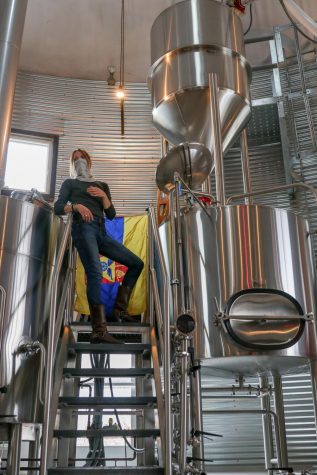
Sandy Boss Febbo, co-owner of Bang Brewing Company in St. Paul, explains the ins and outs of brewing beer on Sunday, Oct. 25. Boss Febbo and her husband Jay started Bang Brewing in 2013, and have recently moved into the custom-built grain bin that now houses their brewery. They are both very involved in the brewing process. (Audrey Rauth)
Hartwig said they have cataloged over 60 breweries and hop farms, 100 grain farms and 14 maltsters so far. Often when they call a brewer, the brewer will refer Hartwig to another organic brewer, and so on. Because of this, Hartwig said it is apparent there is a need for a resource like the Organic Brewers Alliance.
“One of the purposes is just to help people spread information, share information, establish cooperative purchasing for brewers, so that they can access larger markets that they normally wouldn’t be able to access,” Hartwig said. “And then also just to garner support for sustainable and regenerative agriculture because with climate change, it’s never been more important.”
The project is expected to be completed by the end of 2020, they said, and there are plans to make similar projects cataloging organic cider and wine distilleries around the U.S. in the future.
Noreen Thomas, an organic farmer who owns Doubting Thomas Farms in Moorhead, Minnesota, has supplied Bang Brewing with malted and flaked barley, oats and wheat for almost two years. Thomas said the Organic Brewers Alliance would be great for her business.
Already organic producers face challenges with getting certified as organic entities. Organic farms have to be inspected by a third party and cannot use any herbicides or pesticides, she said.
Thomas said the Boss Febbos are already ahead of the curve. Not only will the Alliance promote organic farming, which has environmental and health benefits, it will also help consumers know which local farms they are supporting. With more small breweries opening in recent years and an interest in uniquely crafted flavors, their work is especially relevant, Thomas said.
Competing against larger companies, the Organic Brewers Alliance tool will level the playing field by helping smaller organic farms get put on the map, she said.
“The people interested in organics are very committed. They’ve had to go against the grain, literally,” Thomas said. “The work is a lot harder and this will help alleviate [those challenges].”
Correction: A previous version of this story misstated the type of equipment used in Bang Brewing Company and incorrectly described when the project began. Due to an editor’s addition, Boss Febbos was misspelled. The story has since been updated and corrected.
Posted in UncategorizedComments Off on Going ‘against the grain’: UMN establishing tool to connect organic farmers to brewers
University of Minnesota graduate student of maternal and child health Delilah Robb is trying to destigmatize sex and sexuality in American Indian communities through community listening sessions, video and print campaigns, and virtual education classes in the Twin Cities.
As part of the Indian Health Board’s campaign, “Honor Your Body and Your Culture,” her work incorporates American Indian culture into the discussion about sexual health and seeks to educate and empower American Indian people through the process.
Historically, colonialism and forced assimilation changed how people have thought about sex and gender, said Robb, who is from the Turtle Mountain Band of Chippewa Indians.
“There’s a lot of things that people need to think about [with] sexual health,” Robb said. Topics like sexual orientation, gender roles and identity, love and affection, and body image are related issues that are important to address.
Talking about sexual health is hard for a lot of people, not just for American Indian people, she said. But especially in the context of colonization and the forced integration of American Indian children into Christian boarding schools, American Indian teachings and lessons around sexual health were taken away, Robb said.
Kyle Hill, an enrolled citizen of the Turtle Mountain Band of Chippewa, said sexuality and sexual health are not typical topics American Indian people talk about because of historical trauma as a result of settler-colonialism, which specifically refers to the oppression and violence against American Indians perpetuated by settlers. Hill is a clinical training director at the Indian Health Board with a Ph.D in clinical psychology and a Master’s of Public Health.
When European settlers came to the United States, they instituted several federal policies centered on assimilation with a disturbing motto: “Kill the Indian, save the man,” he said.
Government removal of American Indian people from their land and the forcible integration into boarding schools removed American Indians from their culture and value systems and fundamentally disrupted gendered tasks and societal roles, he said.
Although some may think of boarding schools as occurring a long time ago, Robb said her grandmother was part of that generation. Boarding school practice only stopped with the passage of the Indian Child Welfare Act in 1978, which gave American Indian parents the legal right to deny their child’s placement in schools off reservations.
“What I love about what Delilah is doing is framing sexual health from a cultural perspective — the beauty of culture, the beauty of ceremony and allowing us to describe and conceptualize our own health and sexuality as Indigenous people,” Hill said. “[Robb is] helping us to reclaim our understanding, from our own perspective and from our own culture, about what healthy sexuality means and therefore liberating us from this Western notion, but also being real about what are the real issues in our communities.”
Lenny Hayes, a member of the Sisseton-Wahpeton Oyate tribe who was involved with the project, said colonialism has resulted in the loss of identity and recognition of Two-Spirit people, both within tribes and in the mainstream LGBTQ community. Hayes is the owner and operator of Tate Topa consulting and specializes in marriage and family therapy in American Indian communities.
Although not all American Indian tribes connect with the word “Two-Spirit,” each tribe has a word to describe Two-Spirit identity. The term comes from the Ojibwe language and refers to an American Indian person who has both a masculine and feminine spirit, according to Hayes.
Historically, Two-Spirit people were revered as spiritual beings and served important roles in their communities, Hayes said. After being targeted and murdered by colonists, they were often hidden to avoid detection and persecution. Over time, Two-Spirit people were largely forgotten by their tribes and remain excluded from mainstream LGBTQ communities today, said Hayes, who is a Two-Spirit man.
“When we do work within a community, we really try to stay away from that ‘I’ statement and then use ‘we’ because when we do this work, we do it for our communities and not ourselves,” Hayes said. “That’s why [Robb’s work is] community-based rather than meeting with individuals one-on-one. It’s making it a part of community but also making it very safe and comfortable for individuals to talk about sexuality.”
Nova MartinRogers, a sixth grader at Brimhall Elementary in Roseville from the White Earth Nation, attended one of Robb’s summer youth programs in August over Zoom. Although she said her parents talked with her about sex and sexuality before attending the group, Nova said the four-day virtual series was helpful, especially since she had not learned about topics like sex or puberty at school.
Robb now offers a monthly Youth Circle group for people aged 11 to 17 and started a Parent Circle in the second week of October.
While talking about topics like consent, gender, puberty and safe sex, youth, like Nova, are keeping their hands busy learning traditional crafts like beadwork and how to prepare traditional tobacco. Traditional tobacco is different from commercial tobacco and is made by preparing different plants. The tobacco also has spiritual and cultural significance in many tribes.
Nicole MartinRogers said she enrolled her daughter Nova in these classes because she wanted her to have the experience of learning alongside an American Indian instructor and other American Indian kids.
“I don’t think a lot of kids have access to the information they need at the right age to make good, healthy decisions,” she said. “So, I’m glad that they have that.”
MartinRogers said the class is a way of combatting stigma about sex. She said she knew many people who were not taught about consent, had children at a young age or got sexually transmitted infections.
“Nobody’s talking about this,” Robb said. “If I create a safe place for people to share through the teaching, it’s also a collective healing … where we can openly talk about some of the things that have happened [to us].”
Posted in UncategorizedComments Off on University grad student fosters conversation, education about sexual health in American Indian communities
The Mimbres Collection at the Weisman Art Museum has a long and complicated past.
First excavated by anthropology professors and students in the 1920s, the collection of human remains and burial belongings was housed at the University of Minnesota before being transferred to the Weisman, where it remains today.
Mimbres bowls, characterized for their painted designs and a round hole in the center, were used in burials in 11th century New Mexico among a variety of Pueblo tribes, including the current-day Hopi Tribe, Pueblo of Zuni and the Pueblo of Acoma.
Despite repeated attempts by affiliated tribes to return the collection to New Mexico, the funerary objects remain at the Weisman. Under a 1990 federal law, institutions that receive federal funding must create an inventory of any Native American cultural objects or funerary remains as a part of the repatriation process. The University and the Weisman have come under fire by Native American communities, anthropologists and the Minnesota Indian Affairs Council (MIAC) for their delay of inventory.
Now, about 90 years after the excavation, University anthropologists and archeology students have been working to compile an inventory of the collection to return objects to affiliated tribes who claim descent in New Mexico.
In mid-September, a letter was drafted to the University on behalf of all the graduate students in the anthropology department. Their message was clear: repatriation is not only warranted, but essential to address the “historical extractive and unethical practices of our department.” The letter cites the history of the collection and contextualizes the University’s role in larger structures of oppression against people of color, especially in light of the police killing of George Floyd.
An enrolled member of the Citizen Potawatomi Nation, fifth-year anthropology student Elan Pochedley said his involvement as a co-author of the letter was especially personal.
“Potawatomi people and nations have also been affected by these practices of exhuming, looting, and collecting Indigenous bodily remains and funerary objects for the benefit of institutions of higher education,” he said in an email to the Minnesota Daily.
“In a moment when questions of racial justice and institutional accountability are of the utmost importance to address, we are not interested in erasing the Department of Anthropology’s institutional legacy as it pertains to the Mimbres excavations and the looting of Indigenous graves.”
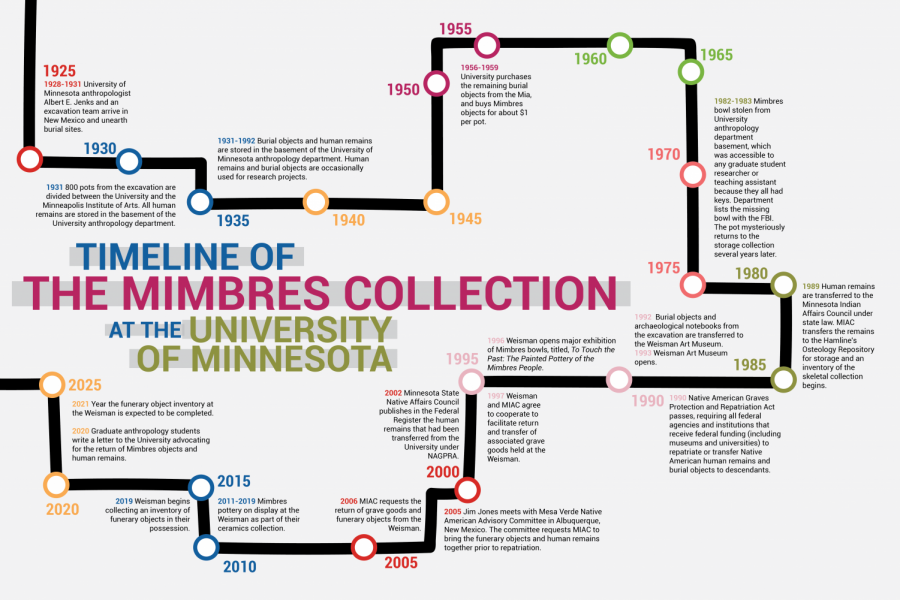
A timeline of the Mimbres Collection at the University
The Mimbres Collection has a long history, stemming from a 1928 archaeological expedition in the Mimbres Valley, New Mexico led by Albert E. Jenks, the founder of the University anthropology department. In a collaboration with the School for American Research and the University of New Mexico, and with a sponsorship from the Minneapolis Institute of Art, Jenks along with several other graduate and undergraduate students unearthed burial sites for over three years.
Jenks returned to Minnesota with the human remains of about 190 people and almost 3,000 painted bowls, ceramics, animal bone tools, jewelry and other objects that were buried with them.
A timeline of the Mimbres Collection, beginning from the 1928 excavation until 2021, when the inventory of funerary objects at the Weisman is expected to be completed. Mary Ellen Ritter
Both the human remains and burial objects were stored in the basement of the anthropology department until 1992. In 1989 under state law, the University anthropology department transferred all the human remains identified as of American Indian descent to MIAC to await repatriation efforts.
The human remains are currently housed at Hamline University, which has an agreement with MIAC to store and take care of the remains until they are returned. As the Weisman Art Museum was being built, the burial objects were relocated there for safekeeping and storage.
Under the Federal Native American Graves Protection and Repatriation Act (NAGPRA), which passed in 1990, all institutions that receive federal funding, including museums and universities, must engage in repatriation efforts with affiliated Native American peoples.
Along with a compiled inventory, each museum and federal agency is required to send a summary with a general description of the sacred or funerary objects in its possession to any Native American tribe or organization who may be affiliated with the items. This summary serves as an invitation for the tribes to consult with the institution, and gives them an opportunity to request the return of these items.
In the summer of 2019, the Weisman, which had initially only submitted a general summary, began collecting an inventory of the funerary objects in their possession.
This work was delayed in part by a miscommunication about whether MIAC was designated a federal entity that needed both a summary submission and a comprehensive inventory, said former Weisman director Lyndel King, who served at the Weisman from 1981 to June 2020. King said to her knowledge, the museum believed they were compliant with NAGPRA, and said their noncompliance was an “honest mistake.”
MIAC has long criticized King’s leadership, and in a resolution in June wrote that the University had intentionally failed to comply with NAGPRA for over 30 years, despite repeated demands of repatriation and action from the Weisman.
In recent years, Native American tribes with cultural affiliation to the Mimbres objects and remains have requested both the human remains and funerary objects be returned together, so as to properly rebury their ancestors.
The process of repatriation
Kat Hayes, an associate anthropology professor and director of the Race, Indigeneity, Gender and Sexuality Studies Initiative at the University, has also been heavily involved with the repatriation efforts by providing research and directing the completion of the Weisman’s inventory. Hayes said in many circumstances it can be challenging to establish cultural affiliations with burial objects from thousands of years ago due to patterns of migration over time.
But based on the evidence they have, she said it is clear to see that many, if not most, of Pueblo communities are descendants of the Mimbres people. Detailed archeological field notes from the 1928 to 1931 expeditions indicate precisely where the burial objects were taken by Jenks, and oral traditions relay migration patterns that have established ancestry in these areas, Hayes said.
Former University graduate student Melissa Cerda has been looking into University compliance with NAGPRA for years.
As a senior cultural resource specialist for MIAC, Cerda said the process has required something similar to detective work, sorting through and digitizing old archeological excavation notebooks and fading collection records to trace where objects came from and how they came to the museum.
While completing the inventory, Hayes, Cerda and a couple other students had to formally request the notebooks and materials from the Weisman be scanned so they could use them, as the Weisman only made the field books available to the researchers for an hour or so at a time, Hayes said. Hayes also said she had to remind the Weisman that it was within their rights to access the information based on an agreement with the anthropology department.
At Hamline’s Osteology Repository, Desiree Haggberg is the supervisor who oversees MIAC’s skeletal repository. As part of the cataloguing required of NAGPRA, Haggberg gathers as much physical evidence about the bones as possible, accessing characteristics like sex, age, height and trauma to the skeleton. Haggberg said some of the human remains taken from the Mimbres Valley are full skeletons, but most are partial, with only one or two bones from a single person.
“The vast majority of the human remains, we don’t know what happened to them,” said Matt Edling, the lab and collections manager of the University anthropology department. “[Jenks’ excavation team said] they excavated them, but they never came back to the University of Minnesota and were never cataloged into our collections … Who knows what happened to them? We don’t know.”
Part of Edling’s role in the repatriation process is tracing what happened to all the funerary objects and human remains collected by Jenks and his team. Some objects have been traded or gifted to other art museums or anthropology departments around the country. Others were rumored to be stolen, taken from the anthropology basement and sold.
Edling said in an email to the Minnesota Daily he believes this issue should have been investigated years ago, when MIAC first contacted the Weisman, and “definitely after the Weisman received an official request for repatriation from the Hopi Tribe in 2014.”
Despite having original field notes from the excavations in their possession that stated most objects were associated with funerary contexts, in a 2004 letter obtained by the Minnesota Daily, King wrote to the Hamline Osteology lab that, “I understand … that the intent is to claim repatriation for bowls to these groups mentioned in the proposal. We are not aware of any basis for such a claim for repatriation under NAGPRA.”
Lasting effects
A former NAGPRA representative for MIAC, Jim Jones was involved with the fight for repatriation of the Mimbres collection at the Weisman for over two decades. He said the work has taken a significant toll on him, and eventually he had to stop doing repatriation work.
“The University of Minnesota and the Weisman and everyone has to get on board and do the right thing,” he said. “These people that are associated with those remains from the Southwest, whether it’s the Pueblo communities, the Zuni, the Hopi — the communities down there deserve their relatives back and anything that’s associated with them.”
Andrea Carlson graduated from the University in 2003, and said she has been fighting against the showing of Mimbres objects since she was an undergraduate student. As an Ojibwe artist, Carlson said working with museums and institutions with ethnographic collections on display puts Native artists in a unique position.
“It feels different to you. It hurts you in a different way,” she said. “There’s part of me that wishes I could just work with a museum. That way, I didn’t have to question whether or not they had my body or the bodies of my people.”
In 2018, Carlson was invited to be on an advisory board for the Art Institute of Chicago. The museum was months away from showing a collection of Mimbres pottery donated from a private collector and wanted to get advice from several Native American people on how to proceed. Despite Carlson and the four other Native people on the board advocating strongly against the showing, the museum continued moving forward before postponing the show indefinitely right before their expected opening.
Many museum curators perceive and display Native American pottery, cultural objects or burial belongings as beautiful works of art that should be accessible and shared through the medium of a museum, but they do not have the authority to make those claims, she said.
“I’m so used to hearing how beautiful our grave objects were,” Carlson said. “Just because they’re beautiful does not give a non-Native person the right to put them on display.”
Serving as a reminder of the damage still unfolding, over the summer the Weisman found a tooth, several bone fragments and two cremation bundles in the museum’s holdings that were previously uncatalogued by the museum. The remains were immediately turned over to MIAC and taken to Hamline, but the Weisman acknowledged the damage it caused.
“This discovery was, of course, particularly disturbing and distressing, and it underscores the importance of completing the full inventory of the Mimbres materials,” wrote the Weisman in an informational FAQ about the collection on their website. “A complete inventory is absolutely crucial to ensuring that these human remains and all the affiliated cultural materials are properly identified and cared for with the respect they deserve.”
The museum said their full inventory of the Mimbres funerary objects should be complete by March 2021, assuming pandemic-related University closures do not delay the process. At the end of August, the University also started an advisory committee composed of Native American scholars and several other University professors. The committee will consult with tribal affiliates and advise University leaders in decisions related to the collection.
As a Korean Native American artist who identifies as a descendent of the Mimbres Valley people, Debra Yepa-Pappan said she gets frustrated working with art museums and institutions who want to make the determination of what objects are culturally significant enough to display. Ignoring the wants and needs of Native American people contributes to a power dynamic where largely white-led institutions then control their history and narrative.
“If it’s ultimately significant to Pueblo people, then let it be ours,” she said. “[Mimbres pottery] are made beautifully for a reason, not for us to look at. These are materials that were supposed to remain with those people they were buried with. And it’s for them, not us.”
Posted in UncategorizedComments Off on Weisman Art Museum faces criticism after delaying repatriation of Native American objects for 30 years
Motivated by a need she saw for LGBTQ-specific health and education in the medical field, fourth-year University of Minnesota medical student Emily June Zolfaghari has been developing a resource guide for middle and high school nurses in the state to help provide more equitable care. Zolfaghari recently received the Minnesota Medical Association’s Student Leadership Award for her idea.
During her undergraduate years, Zolfaghari said some of her LGBTQ friends would talk to her about their frustrations with their healthcare providers who would often not ask the right questions, ignored their concerns related to sexuality and identity and would not make proper referrals, which resulted in them bouncing around looking for proper care.
While the University is a leader in the nation for LGBTQ studies, specialized care for LGBTQ people is not integrated into the core curricula of the Medical School, or in many schools nationally, said Zolfaghari.
Zolfaghari’s toolkit will take the form of an educational pamphlet of frequently asked questions, definitions about terms and tips related to gender and sexuality. It will provide guidance about pronoun usage and lists the contact information for organizations nurses can refer students to.
When doing her research, Zolfaghari said she found gaps in knowledge among school nurses surrounding topics like chest binding for more masculine-presenting students and red flags for suicidal ideation or eating disorders.
“If they have a health issue, a lot of times students’ first point of contact … isn’t just their [primary care physician] doctor, it’s the health nurse at school,” she said. “That’s where I came up with this idea of developing a toolkit, for these public school nurses to have so that they might be able to answer different questions for students that approach them.”
In 2018, Zolfaghari initially started the project as part of her year-long public health fellowship with the Twin Cities Medical Society. She said her hope is to collaborate with local social services organization OutFront Minnesota and distribute the guide to public school nurses around the state to use at their own discretion. She said she plans to complete the toolkit by May.
It is especially important for primary care physicians to build trust and relationships with their patients over time, according to Zolfaghari, because it will allow them to better understand medical problems and address them properly. If a patient lacks trust in their doctor, they are less likely to seek care, which can be detrimental to their health and long-term wellbeing, she said.
“A really big problem is if someone doesn’t feel like they trust the medical community, then they’re not going to go out and seek help when they need it,” Zolfaghari said.
Emily June Zolfaghari poses for a portrait with information from a toolkit she created based on LGBTQ health on Wednesday, Oct. 14 in Minneapolis. Zolfaghari shared her toolkit with high school nurses to help inform them on LGBTQ health and won an award for her work. (Audrey Rauth)
Andrew Kuehne, a 2017 University alum who attended a more conservative high school in St. Cloud, said Zolfaghari’s toolkit would have been beneficial to him growing up.
“Having a non-biased resource, especially for families who aren’t as accepting, would be extremely helpful for establishing a good baseline of mental health for LGBTQ individuals, as well as giving a space where they can meet people who are equipped to talk with issues of identity and struggle that plague every high schooler, but especially plague plenty of LGBTQ youth,” he said.
Although he said he believes people are generally more open about gender and sexuality now, having a resource like this in many people’s formative years when they are coming to terms with their sexuality could foster healthier conversations about self-identity and emotion.
“Those formative years where you’re coming into your sexuality, you’re confused, you’re listening to the responses of people around you,” he said. “I think having a targeted resource where these kids could go to really would help at least waive some of the worries that many kids and kids like [me] struggled with as you’re going through some of the most fragile years of your life.”
Many LGBTQ people experience higher rates of bullying, depression, suicidality and sexually transmitted infections, said B.R. Simon Rosser, a professor at the University School of Public Health who researches LGBTQ sexual health and wellness. They also have an accelerated risk of social isolation and social stigma, which in turn can result in homelessness and family rejection. Marginalization is also compounded for LGBTQ people who are Black, Indigenous and people of color, who experience racism in addition to homophobia.
For some students who may not have a safe home life, “the health provider can be the only person in the child’s system that they can turn to,” Rosser said.
“For all those reasons, it’s super important that health providers be comfortable about talking about sex and talking about sexuality with adolescents,” he said. “But obviously they need to be trained in how to do that, and there needs to be a whole variety of tools. This isn’t just about giving a one-on-one course in how to ask somebody about their sexual orientation, especially at an age when some people may not know or may not have words to describe who they are.”
Correction: A previous version of this article inaccurately stated the organization affiliated with Zolfaghari’s fellowship.
Posted in UncategorizedComments Off on Medical student creates toolkit for school nurses to better serve LGBTQ youth
Newly planted winter camelina seedlings sprout in little green rows at the University of Minnesota field plots on the St. Paul campus. The winter annual plant is one of 15 breeds University researchers are cultivating to help farmers keep nutrients in their soil, reduce erosion and create a commercially viable product for farmers to sell.
The work comes out of a need to develop crops to cover what some researchers call “the brown period,” the gap between when crops are harvested in the fall and new crops are planted in the spring. During this brown period when there are no plants actively growing in the fields, excess fertilizer can leach into nearby rivers and streams. Cover crops like winter camelina can prevent that.
The project comprises a team of researchers working on a variety of different fronts, including food science, genetics, marketing and implementation.
Agronomy professor Don Wyse has been working to develop the next generation of winter-hardy annuals and perennials through the Forever Green Initiative, which he started 30 years ago. One of the only projects of its kind in the world, Wyse said the premise is to produce crops that will survive Minnesota winters, develop the capacity for farmers to use the crops and cultivate a market where farmers will be able to sell these crops.
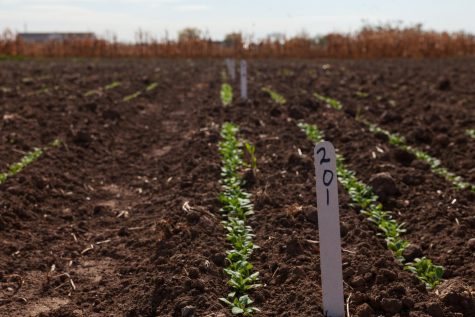
Rows of camelina sprouts, separated into sections containing different lines with varying characteristics, cover a field at the University’s St. Paul campus on Tuesday, Oct. 6. (Kamaan Richards)
Winter camelina is winter hardy, meaning it will survive the winter and keep nutrients in the soil. Its short life cycle also does not disrupt the normal growing season of crops like corn or soybeans.
The winter camelina seed, when cultivated, produces an oil that has a similar composition to canola oil which can be used in cooking or salad dressing, said Pam Ismail, a University professor who specializes in food chemistry and works on the project. After extracting the oil, the remaining meal is high in protein and can be used for human consumption, adding more value to the crop.
Scotty Wells, a University agronomist working on the project, said that only 2% of the Minnesota landscape rotate cover crops into their fields for the winter. Wells said that in the past there has been a lot of research on the benefits of cover crops but without a market or desire for cover crops, their research does not have a practical application.
“We’re not asking farmers to make a huge change to their cropping system. It’s something that a lot [of farmers] will be able to slot into their existing cropping systems,” said Katherine Frels, a research assistant professor in the Department of Agronomy and Plant Genetics. “Winter camelina gives them an option to improve the sustainability of their farm without having it mandated on them.”
Frels said the team’s research has shown that having cover crops in fields over the winter results in a 90% reduction of nutrient loss.
Winter camelina also suppresses weeds, reduces soil erosion and captures fertilizer that would normally be lost to the environment through rain or snow.
Because it is hard to develop a new crop, Frels said many similar projects have failed when they run into roadblocks.
“You have to have a good genetic breeding program, you have to teach farmers how to grow and [manage], you have to continue improving that management and you also have to have a market,” she said. “So that’s why most crop development programs that have tried to start over the last two decades have failed: because they just have one or two of those initiatives.”
Colin Cureton, who works as a supply chain development specialist for the Forever Green Initiative, said he has been laying down the foundation for commercial success for the plant by talking with farmers and potential industry partners interested in camelina.
Cureton said he is confident winter camelina will bring the benefits farmers are looking for in their crops and it is being evaluated as a product for sustainable aviation fuel.
“It’s been really fun to work on the Forever Green project and the camelina projects because we are so interdisciplinary,” Frels said. “I think we have a really high chance of success, especially with a crop like winter camelina.”
Correction: A previous version of this story attributed incorrect information about the winter camelina’s properties and uses to Pam Ismail. The story has been updated with the factual information.
Posted in UncategorizedComments Off on The winter camelina: University researchers developing new cash cover crop
Now in the third year of their research, University of Minnesota soil scientists are experimenting with manure application to help farmers navigate the effects of the climate crisis.
Due to changing weather patterns, farmers have been seeing wetter growing seasons, which has made it difficult to plant and fertilize their crops as normal. If crops are fertilized too early, excessive rain can cause fertilizer to run off the field and enter streams, lakes and waterways and even leach into the groundwater. To give farmers more opportunity to plant, researchers are experimenting with the timing of fertilizer application.
The whole project started because of an important need to use nitrogen efficiently, said Fabián Fernández, a University researcher on the project.
The success of planting is dependent on many different factors, which vary depending on the field, said David Kee, the director of research for the Minnesota Soybean Research and Promotion Council, which funded some of the initial stages of the project.
“We call it ‘the four R’s,’” Kee said. “The right rate, the right place, the right nutrients and the right time.”
Typically, farmers apply nutrients to their crops — in the form of manure or synthetic fertilizer, both of which contain nitrogen — during the fall or spring, he said. But, because the weather has been getting wetter, it has become more challenging to apply manure. Applying it too early could risk the crops not absorbing the nutrients in time and the fertilizer being washed away. Applying it too late could risk a smaller crop yield as the plants will not have enough nutrients to flourish.
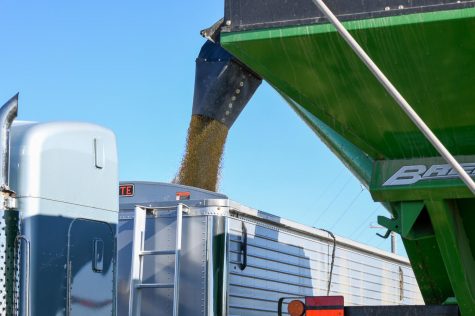
A combine unloads in Madison Lake on Wednesday, Sep. 30. (Emily Urfer)
Kee said loss of nutrients is not only bad for the environment and the health of the crops themselves, it also impacts a farmer’s profitability. Any fertilizer that does not reach the plant’s roots is a lost investment, he said.
Since COVID-19 hit in March, farmers have had fewer vendors and lower demand for their crops, especially with the closure of many restaurants and other normal suppliers. Even before the pandemic, weather disasters, trade wars and low crop commodity prices have plagued the farming industry. With farmers already on a tight budget, using expensive fertilizer efficiently is everything.
Logistics of the research
Melissa Wilson, the principal investigator of the project, said her team is looking to widen the window of opportunity for farmers to apply manure amid wetter growing seasons.
“Especially in a cold climate like Minnesota — you only have so many days that are good growing … and planting late can be really problematic for yields,” Wilson said. “So having one less thing to do in the spring, like if you could wait to apply your manure, could be beneficial.”
Part of the team’s experiments have been looking into dispensing liquid swine manure between rows of corn— which is referred to as “sidedressing.” This tactic is unique because it applies nutrients to crops that are already in their growing stage, which makes them more likely to absorb nutrients and prevent erosion if conditions are wet.
Manure consists primarily of animal feces and urine, whereas synthetic fertilizers contain many of the same nutrients, but they are human-made. Wilson said synthetic fertilizer is most commonly used among farmers, and between 25-40% of farm acreage uses manure.
Wilson said many farmers, especially those who own livestock and need to dispose of livestock waste, could benefit from manure application. Manure contains organic matter not present in chemical fertilizers, which encourages microbial growth in the soil and improves water retention.
“We kind of say that commercial fertilizers are meant to feed the plant. But the manure feeds the soil, which then helps feed the plants,” she said.
Chris Pfarr, a former graduate assistant on the project, said there are two ways to apply manure: either through a dragline hose or a tanker. A dragline hose is attached to a pump filled with manure and is typically dragged behind a tractor. A tanker, on the other hand, is pulled like a wagon behind a tractor and discharges manure from a smaller series of hoses.
Former graduate student researcher Chris Pfarr poses for a portrait in Madison Lake on Wednesday, Sep. 30. University researchers are conducting research on alternative methods for applying fertilizers to crops in response to new challenges presented by climate change. (Emily Urfer)
Dragline hoses often run over the corn, which if run too late in the season can damage crops beyond recovery. Alternatively, tankers run along the spaces between rows of corn, which means they can apply the manure later in the season when crops are taller without damaging them.
Their recent experiments with tankers suggest that with this method farmers can still plant their seeds at the ideal seasonal time and apply fertilizer later when the ground is less wet.
Environmental impacts
Another important aspect of their research is reducing pollution caused by excess nitrogen, the most important nutrient in manure and fertilizer that is absorbed by plants.
If nitrogen is not taken in by the plants, it can be lost to the environment. Under wet conditions, nitrogen can turn into a greenhouse gas. As water moves through the soil, water can also pick up nitrate and carry it away, contributing to runoff that negatively impacts lakes, rivers and streams. Excess nitrogen in water causes algae to grow faster than ecosystems can handle, which depletes oxygen in the water that other fish and plants need to survive.
If nitrate leaches below the roots of plants, it can contaminate groundwater too, which has shown to have effects on human health. Nitrate ingestion can lead to birth defects and increase the risk of specific cancers in adults.
“If we’re going to be sustainable farmers, we want to be able to be environmentally sustainable, but also maximize yields for food production,” said Pfarr, whose family farm was used as the base for the experiments in the study. “It’ll be especially important with the changing weather [to be] more efficient with what we have.”
Posted in UncategorizedComments Off on Making the best of a crappy situation: New manure research looks to help farmers during climate crisis
The University of Minnesota was awarded a $12.5 million grant from the National Science Foundation in September to establish a research institute that will study global changes in biodiversity as environments adapt to climate change.
The first institute of its kind, the Biology Integration Institute (BII) is part of a major initiative that will use spectroscopic sensors to analyze the health and chemical composition of plants based on how they reflect light. Using hyperspectral cameras, which measure the way light interacts with matter, researchers will be able to look at how ecosystems around the globe are influenced by changes in their environments.
Centered at the University’s College of Biological Sciences, a team of 20 biologists, including researchers from the University of Wisconsin-Madison and the University of Maine, will be looking at various plant, fungi and microbe systems. Studying rapid changes in the environment will then help researchers understand the consequences of losing the genetic variation and variability of life in an ecosystem.
“Biodiversity is fundamental to survival of humans on this planet. We depend on the functions of ecosystems and the diversity of organisms within those ecosystems. And they’re changing rapidly,” said BII director Jeannine Cavender-Bares. Having more variation in an ecosystem can help regulate climate and contribute to cleaner air and water, she added.
“The work we’re doing now … is critical for monitoring biodiversity and ecosystem function on planet Earth,” Cavender-Bares said.
The team will be working with data from the National Science Foundation’s National Ecological Observatory Network as well as other sites, including the Cedar Creek Ecosystem Science Reserve north of the Twin Cities. Their results will help interpret spectral data from NASA’s planned Surface Biology and Geology satellite mission, which seeks to monitor Earth’s biodiversity, Cavender-Bares said.
Phil Townsend, a forest ecologist at the University of Wisconsin-Madison and a BII co-director, has been working with spectral technology for years.
In analyzing the solar radiation reflected off plants, scientists can develop models about the genetic evolution of the plant and gain insights about the interactions between the plants and other organisms in ecosystems. Townsend said the technology is not only cost effective but will help them measure biodiversity on a global scale. This will give them new insights into predicting carbon uptake, plant growth and nutrition dynamics as well as how an ecosystem adjusts to change.
“This will help with conservation. And it could also help us in figuring out ways that we can mitigate climate change impacts on our natural ecosystems,” he said. “The more we know about those ecosystems, the better we can adapt to them.”
An important part of the project is bringing biologists with different specialities together. Under the common theme of biodiversity, each researcher brings their own experience and expertise.
Nathan Springer is a University professor interested in understanding the genetic variation of agricultural crops, especially corn. Using hyperspectral technology that shows the wavelengths of light that bounce off corn plants, Springer said his work for BII will help farmers maximize the productivity of their yields and reduce unnecessary environmental impacts.
Another goal is to make their research accessible and do outreach for mentoring and training opportunities. The team will be working with K-12 students to foster an interest in biology and science. It also plans to collaborate with Indigenous communities like the Wisconsin Tribal Conservation Advisory Council to collect data and incorporate their knowledge of the land.
“It’s scary because it’s ambitious,” said Townsend. “Our ultimate goal is nothing short of trying to help save the ecosystem of Earth. We know we’re not going to be able to do it with just this one project, but we sure hope that we will generate information and knowledge that will help us to do that.”
Posted in UncategorizedComments Off on University awarded $12.5 million grant to study Earth’s biodiversity