
Author Archives | Becca Most, Campus Activities Reporter

University of Minnesota archives the oldest Jewish newspaper in Minnesota

In the basement of Elmer L. Andersen Library on the West Bank of the University of Minnesota campus, third-year math and computer science student Nhung Pham carefully places a yellowed sheet of newspaper on the base of a large scanning machine. Pressing down on the crease in the center, she spreads the page open and crops the image on the computer to ensure the scan includes the entire sheet.

Beside her is a stack of other issues from the 1964 editions of the American Jewish World, the oldest Jewish newspaper in Minnesota, which has run from 1912 to the present.

Pham is part of an effort to digitize the entirety of the paper’s print editions by hand, a labor-intensive task undertaken by University librarians and undergraduate students as part of Andersen Library’s Upper Midwest Jewish Archives.

Almost half of the archival work is finished so far, said Jennifer Claybourne, the digital projects specialist at the University and an overseer of the project. The archived issues of the American Jewish World Newspaper are available for view on the library’s website.
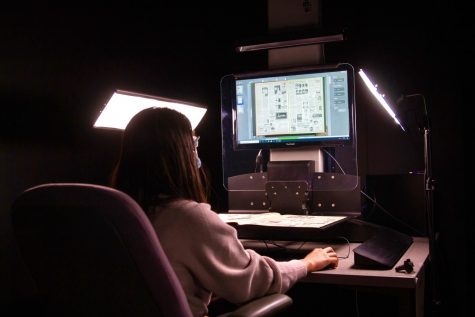
Nhung Pham, a student at the University of Minnesota, scans volume pages from the American Jewish World on Tuesday, March 16 at Elmer L. Andersen Library. Pham says references to her country Vietnam usually catch her eye as she works with the various archive materials. (Audrey Rauth)

Digitizing the collection will not only make the information in these articles more accessible to historians and researchers, but will also help people find information about the Jewish people who lived in Minnesota, said University archivist Kate Dietrick, who is leading the project.

Dietrick said she will often get anywhere from 20 to 40 questions a month about Jewish history in the state. Some are from people who are curious about their family history; others ask her about how people in the Midwest reacted to and perceived events like the Holocaust at the time it happened.

With this information available online, people will no longer have to visit the collection in person, which will give the collection a broader audience, she said.

“When we think of Jewish Americans, we might think of places like New York. We don’t necessarily think of the Jewish community in Duluth,” Dietrick said. “So by digitizing this, we are kind of breaking open this story to anyone, to remind them that Jewish communities do exist in Minnesota and have existed in Minnesota, and here’s their story.”

Housed in these yellowed pages are news stories and editorials, but also extensive personal sections that detail marriages, bar and bat mitzvahs, and births, as well as other personal stories about trips people went on and visitors who came to the Twin Cities. One of Dietrick’s favorite postings was a personal advertisement where a woman implored the public to help her find a cameo pin she had lost at a dance.

Another favorite was a 1933 advertisement for an underground nightclub in the Wabasha Street Caves during Prohibition. In lieu of an address, the directions to the club told the reader to cross the Wabasha Bridge to Fillmore Street, turn right and follow until they got to a skull and crossbones sign, Dietrick said.

“There’s all sorts of really fun personal stories in there. It’s very easy to get lost in those pages,” she said.

Although now many people think of larger papers like the New York Times and the Star Tribune, Dietrick said at this time there were thousands of smaller hyper-local newspapers around the country catering to different communities, especially ethnic and religious minorities.

“You might not get Jewish voices in the Star Tribune in 1912, you might not get Black voices. So, if you aren’t getting those in these larger newspapers, looking at these smaller community papers is even more valuable,” she said. “This is where you’re going to find these stories. And that’s why I think paying attention to smaller publications can be important, because why did these publications pop up in the first place? Probably because they were being ignored.”

In 2018, Dietrick reached out to Mordecai Specktor, the current editor of the American Jewish World, to see if the paper would be interested in donating their collections to be archived at the University. A year later she remembers that it took two trips to fit 70 bound volumes of the newspaper into the back of her car, many sections of which were physically crumbling with age.

“Some of the early volumes [from the early 1900s] were kind of crumbling to pieces. And when people have come in the past to look at those old volumes, they’d leave paper crumbs all over the floor. We had to vacuum up afterward,” Specktor said. “Time wasn’t on our side — we had to get this done before they literally crumbled to dust.”

Dietrick started fundraising for the digitization work in September and raised $25,000 in three weeks, a task she thought would take nearly a year. The team started the digitization process in earnest in October.

Specktor said the history of the Jewish people in the Midwest is incredible and complex, and that many Jewish people settled in cities around the country and landed in farming colonies in North Dakota.

“There’s not much left of that except for the cemeteries,” he said. “Jews made lives for themselves all around Minnesota, all over the North Country. And you find those stories in the Jewish World.”

Posted in UncategorizedComments Off on University of Minnesota archives the oldest Jewish newspaper in Minnesota

University researchers among first to explore aquaculture viability in Minnesota

Hidden in a former tractor garage on the University of Minnesota St. Paul campus, the sound of running water fills the air. In the Minnesota Aquatic Invasive Species Research Center, 20,000 tiny yellow perch swim in circles in two large, blue tubs of water, occasionally bubbling to the surface to nibble on food floating there.

Yellow perch have the potential to be one of the most promising species for fish farming in the state, an industry whose viability has not been explored until now.

A new three-year project led by the University’s Sea Grant program is looking to explore the potential of a sustainable aquaculture industry in Minnesota. Aquaculture includes breeding, rearing and harvesting fish, shellfish, algae and other aquatic organisms in a controlled environment.

Researchers say they can better support farmers interested in this field by conducting a market study that examines the profitability of fish farming, consumer interest in buying local seafood and the initial cost of starting an aquaculture business in the state.

Fish farming in Minnesota

“Aquaculture is becoming more important as capture fisheries globally are declining,” said Dr. Amy Schrank, University professor and co-lead of the project. “There’s still increasing demand by people for fish protein as a food source, but wild fisheries are not able to meet that demand.”

The U.S. imports the majority of all seafood consumed. The Great Lakes region contains over 20% of the world’s fresh water, which could give Minnesota and the Midwest the potential to be a hot spot for aquaculture, she said.

Researcher Dr. Amy Schrank, left, and fish producers Ted Wind and Chad Hebert pose with a tank of yellow perch in the Minnesota Aquatic Invasive Species Research Center on the St. Paul campus on Monday, March 15. Schrank is working on a market study to test the viability of fish farming for commercial purposes in Minnesota. (Shannon Doyle)

Part of the market study will be looking into if Minnesota aquaculture farmers can compete with international market prices, said Don Schreiner, a fisheries specialist and project co-lead.

The food fish industry in the state is small, he said. Minnesota has registered only 25 licensed aquaculture farmers, and most of the fish bred in the state get used as bait or to supplement the populations of fish in ponds and lakes.

Despite the fact there are few farmers actively involved with aquaculture, Schreiner said he often gets two to three inquiries a week from curious Minnesotans who are interested in aquaculture but do not know how or where to start.

Chad Hebert, a local producer of yellow perch, said Minnesota has a robust fishing industry, rich natural resources and a consumer base that has a taste for seafood, which means it has the potential to expand commercial fish farming as a business.

A fish farmer for over a decade, Hebert lost his farm in 2018 when the building housing it was torn down but has been working with the University and other organizations to explore best management practices for early life stage development of perch. Some of the barriers to the aquaculture industry are the initial costs associated with equipment, water filtration systems and an inaccessible stable market, he said.

Because the information on these barriers does not exist, it is almost impossible for farmers to secure a loan for their businesses, Schreiner said.

Knowing this information could help farmers in the future. And if it is proven that the food fish business is not viable in Minnesota, that could dissuade people from investing in a business that is not sustainable.

“We may find that, based on what the consumers tell us and what it costs to raise fish, that Minnesota cannot be competitive and people aren’t willing to pay a premium if that’s what it takes to keep it competitive,” he said. “And maybe we let somebody else raise fish and we just purchase it, but at least people won’t be putting their life savings into businesses that have a really good chance to fail.”

Correction: A previous version of this article misstated the total number of yellow perch located in the Minnesota Aquatic Invasive Species Research Center; the correct amount is 20,000. 

Posted in UncategorizedComments Off on University researchers among first to explore aquaculture viability in Minnesota

Bell Museum opens new environmental justice exhibit

Accordion-style panels fill up one of the gallery exhibition rooms at the Bell Museum near the University of Minnesota campus. Each panel is colored brightly to set them apart and labeled with a place: Providence, Rhode Island; Greensboro and Princeville, North Carolina; Twin Cities, Minnesota.

Opening at the Bell Museum on March 12, “Climates of Inequality: Stories of Environmental Justice” will stay until May 16, when it will be folded up and transported to its next location.

Organized by the Humanities Action Lab, over 500 students, educators and environmental justice advocates around the nation helped map, research and create the information displayed in the exhibit.

A section of the Twin Cities panel examines the Rights of Manoomin, or wild rice. In Anishinaabe culture, wild rice has the right to clean water, freedom from genetic engineering and a healthy, stable climate. Another section looks at environmental racism and insufficient city response following a tornado that ripped through North Minneapolis in 2011.

Others examine equity issues surrounding the Upper Harbor Terminal Project in North Minneapolis, the contamination of land water due to the Ford production plant starting in the 1920s and the pollution of Minneapolis’ East Phillips neighborhood.

Patricia O’Leary, a University graduate student in the Heritage Studies and Public History program, first got involved with the project through a graduate class in the spring of 2020.

O’Leary said she and her family grew up in Fontana, California, home to a regional trucking hub and steel mill factory. She said her father has issues with housing and would often spend his nights sleeping outside and coughing after inhaling exhaust fumes and smoke from nearby forest fires. While living in an area that also dealt with frequent flooding, she remembers her father calling her one day before preparing to stay under a bridge. He was putting down sandbags to keep dry from the rising water.

“[The class] helped me put words to the things that I was feeling and the things that I was seeing around me,” she said.

Because growing up in conditions like these was normalized, O’Leary said she did not even realize that what was happening to her was not happening to others.

Throughout this project, students like O’Leary worked with and interviewed local activists and others in the cities who have been working to rectify and address injustice for decades at the grassroots level.

Putting a name to the injustice and disparities she experienced for years was powerful, she said. Rather than leaving the exhibit feeling disheartened, she hopes viewers leave educated about what environmental justice looks like and motivated to bring about change.

“I see myself as part of it, and I see my family as part of it. I’m not just doing this for myself, you know, I’m doing this for the people that are in my own heart,” O’Leary said.

Dr. Kevin Murphy, a professor at the University, taught the public history classes in 2019 and 2020 where students worked on the exhibit. He said teaching students about history in a comprehensive way helps people walk away with a better insight into the issues at hand.

“It is a multi-sided public memory project,” said Andrea Manolov, a second-year graduate student in the Heritage Studies and Public History Program and digital content creator for the Humanities Action Lab.

Extending beyond the scope and physical confines of the Bell Museum, the Climates of Inequality project will also include a series of virtual events like a March 16 panel featuring Twin Cities community leaders and activists discussing environmental justice in urban planning, pollution remediation and disaster relief.

Other activities include a series of writing workshops related to food justice Manolov is developing with local environmental activist LaDonna Redmond. After the workshops, participants will perform monologues about their history with food in their own lives and within their communities.

Manolov said something she thinks is interesting about this exhibition is that it connects issues of climate injustice, natural disasters, racism and pollution nation-wide.

“I feel like a lot of people do care about climate inequality and climate change, and a lot of people know that we have to take action around it,” Manolov said. “But it’s all connected to these much larger problems that are rooted in dispossession and economic inequality and capitalism … What is interesting about this exhibit is just how much value it places on local activism and how it can connect this to other very specific sites and their work in local activism.”

Posted in UncategorizedComments Off on Bell Museum opens new environmental justice exhibit

University researchers explore potential of microalgae in agriculture

University of Minnesota researcher Adriana Alvarez De la Hoz thinks microalgae could be the fertilizer of the future.

Although many would typically associate algae with seaweed, or other varieties of green aquatic plants on the surface of lakes or ocean shores, microalgae live everywhere — even in the soil.

In a report released online last month, the Ph.D. candidate at the University said microalgae have tremendous potential to revitalize soil, prevent erosion and reduce the use of chemical fertilizers that pollute the environment.

Microalgae have many benefits for the soil as renewable resources, including the storage of carbon and nitrogen. These organisms can also add nutrients to the soil, which contributes to better plant growth.

Historically, microalgae have not been fully explored for their benefits in agriculture, Alvarez De la Hoz said. With changing weather patterns that lead to higher precipitation, algae can help soil stick together and become more resilient to erosion, which keeps nutrients in the environment.

“I think it’s very important that we can at least acknowledge the fundamental role that soil is going to have for our future — for food, for water, for energy, for climate,” Alvarez De la Hoz said. “And we need to protect that soil resource.”

David Ramjohn is the CEO of one of the only companies out there exploring the use of microalgae at a commercial scale. Since 2016, his Texas-based business, AlgEternal, has been working to create a variety of products by extracting the organic materials from algae.

One of the major challenges that has prevented algae from being utilized is related to the ability to grow algae at the scale needed to be profitable, he said. Growing algae in shallow open ponds can risk contamination, which could cause a farmer to lose an entire algae crop. His company has been able to grow algae using a closed photobioreactor system, a device which uses a light source to cultivate algae at any scale they want.

“It is that scale-up factor that has prevented the industry from really taking off,” Ramjohn said. “If you want algae to be the feedstock of the future, you have to be able to grow algae at the same scale that we grow rice and wheat and cotton and corn and all those other crops.”

A self-described “algae farmer,” Ramjohn said the company has been able to produce soil amendments and even a skincare line from algae. A soil amendment improves the structure and condition of the soil, compared to a fertilizer which is focused on improving the nutrients in the soil.

“We view soil as a natural resource, one that isn’t very well understood, or one that people don’t pay attention to,” he said. “Because we are losing soil at an alarming rate, we’ve got to stop it. We’ve got to fix it. And it’s not going to be fixed by pouring more and more chemicals into the ground. It’s got to be fixed with what we call regenerative agricultural practices.”

Posted in UncategorizedComments Off on University researchers explore potential of microalgae in agriculture

Not just ‘point A to point B’: U researchers talk transit equity

One day when Ania McDonnell was taking the light rail to an internship as a student at Hamline University, she said she was followed after she got off the platform.

Throughout college and into graduate school at the University of Minnesota, McDonnell continued having conversations with other women about their experiences on public transit. One woman she talked to was kissed on the cheek by a stranger, and many others had their own stories about times they felt unsafe.

“I actually would be curious if there’s a woman who hasn’t experienced some type of harassment on public transportation,” McDonnell said. “It’s definitely something that I think not everyone understands.”

For her master’s thesis, McDonnell researched how people experience transit differently, and how the design of city transportation plans accommodate their needs — or not.

Last year, she analyzed the 10-year transportation plans of several cities around Minnesota, including Minneapolis, Bloomington, Little Canada and Centerville. Looking for specific keywords related to gender, as well as how each comprehensive plan accounted for inclusivity, she found almost none of these city plans explicitly addressed how people experience or use transportation differently.

Since then, her research has caught the attention of city planners, especially in light of Transit Equity Day on Feb. 4.

Based on her research, and the research of others at the University, McDonnell found that women often have different transportation needs and face additional challenges compared to men. On average, women make more trips than men, have greater security concerns in dark or deserted transit areas and travel during off-peak hours for part-time jobs, like in the caregiving sector. LGBTQ people also are more likely to experience harassment and assault on transit.

A system rooted in racism

Dr. Yingling Fan, a professor of urban and regional planning at the University, said public transportation systems in the United States are rooted in a larger context of systemic racism, which greatly affects how people access and use public transportation today.

Fan said a high-quality, equitable transportation system needs to be accessible, affordable and designed with and for the communities who use it.

In the Twin Cities, the thriving Rondo community was destroyed in order to make way for the construction of the 1-94 highway in the 1950s and ‘60s, for instance, resulting in the displacement of hundreds of Black families and the destruction of hundreds of businesses.

Fan said the cultivation of a society that is reliant on private transportation, like cars, contributes to existing inequalities.

“Whenever you have a kind of default mode for transportation, then you actually expect to create an underclass,” Fan said. “When you have an entire city kind of reconstructed to serve people who use automobiles, then certainly people who don’t use automobiles will be disadvantaged.”

She emphasized the need to properly invest in public transportation, especially as communities of color make up 60% of those who use public transportation to get around.

Navigating lengthy commutes

Fan’s research has also shown that women typically have a shorter commute time than men but make more stops, possibly related to child care, grocery shopping and other errands, whereas men typically use transportation to commute to one location.

McDonnell said public transportation has not been designed to address these needs. Oftentimes, it is challenging to make multiple trips by bus or light rail, and usually results in long wait times and lengthy commutes.

For those who live in suburbs these barriers are even more pronounced.

For someone living in north Minneapolis who works at the Mall of America, for instance, there is no direct public transportation connecting those two sites, Fan said. This means people would have to consider taking multiple modes of transportation, like taking the bus to a light rail station, and factor in wait times, commutes, safety and the reliability of public transportation.

“I think more innovation will be very important,” she said. “We cannot continue to do business as usual.”

‘Redefining’ public transit

Rather than simply investing in more buses, Fan said city planners have to redefine what public transit is and looks like. In the future, this could be like investing in car-pooling or pick up services like Uber that are operated by a public transit service.

In her thesis, McDonnell lists a series of recommendations for city planners moving forward. Some of her suggestions include collecting city-level transportation data by gender and providing transportation vouchers to people receiving Temporary Assistance for Needy Families.

“It is important to include community voices, because while many of us involved in the transportation field bring tremendous technical expertise to the table, the folks who are most immediately impacted by our decisions are the people who live in the neighborhoods,” said Gloria Jeff, an experienced transportation executive and urban planner who heads MnDOT’s Metro District Livability Initiative. “Focusing on transit is important … [it’s] not just how you get from point A to point B, but also how transportation provides you with access to a variety of other opportunities.”

Posted in UncategorizedComments Off on Not just ‘point A to point B’: U researchers talk transit equity

University researchers developing aphid-resistant soybeans

Last year, 90% of Matthew Fitzgerald’s 450 acres of soybeans were infested with soybean aphids. An organic farmer in Hutchinson, Minnesota, Fitzgerald is one of many whose livelihoods have been devastated by this tiny insect in recent years.

Since 2016, University of Minnesota researchers have been looking to develop an aphid-resistant soybean crop that will not only cut down insecticide use in the state, but assist organic farmers who cannot combat the bugs using traditional insecticides.

Soybeans make up 30% of Minnesota’s total agricultural exports and remain the state’s top export commodity. In 2016, soybeans accounted for $2.1 billion in exports from Minnesota, and the state ranked third in the nation for soybean production as of 2019.

This is one of the reasons why University researcher and the principal investigator on the project Dr. Bob Koch said their work is so important.

Aphids suck nutrients from the soybean plant and excrete a sticky brown film onto their leaves. This makes it harder for the plant to get its energy from the sun using photosynthesis; it also limits the plant’s ability to grow and produce a bigger crop yield.

As part of their second phase of the project, Koch and his team are looking to breed plants with a natural resistance to the aphids. He is also exploring the best way to incorporate these aphid-resistant varieties into production, as well as test their effectiveness and impacts on other pests besides the aphid.

“The research from Minnesota and other states shows that these varieties can be very effective at protecting soybean plants — protecting their yield, preventing aphid populations from growing. But the challenge is they’re not very widely available,” Koch said.

Another element of their research is using remote sensing technologies to help farmers visualize where infestations are in their fields. Using satellite data, researchers have been able to detect damaging levels of aphids. Farmers can then use this data to determine which crops would benefit from treatment and which would not.

Koch said this will be an important tool for farmers who are applying insecticide to their fields. Knowing which areas need the insecticide reduces the tendency to blanket a field in insecticides, and helps farmers opt for a more tailored application, which can save them money, too.

Excessive insecticide use has contaminated surface waters like streams, lakes and rivers and is harmful for pollinators like bees. It can even leach into drinking water, said University professor and researcher Dr. Aaron Lorenz, who is also on the project.

Although he said this research is not the only solution, Koch said it is important to have these crops as another option farmers can turn to.

Fitzgerald said because he is an organic farmer, he does not have the same tools to control aphids as other farmers do. In order to keep his organic status, he cannot use many traditional insecticides, and the ones he can use are very expensive and sometimes do not even work.

Because it is so hard to grow organic soybeans in the U.S. — partially due to these aphids — Fitzgerald said this is why more organic soybeans are actually imported into the country than exported. Another factor is accessibility.

“The availability right now with aphid-resistance soybeans, especially in northern Minnesota and central Minnesota is really, really limited,” Lorenz said. “In general, the big seed companies really don’t develop aphid-resistant soybeans … so my philosophy is that the more we can develop, the better off we are in terms of options for farmers.”

Carmen Fernholz, who owns an organic farm with his family in western Minnesota, said although his crops have been impacted by aphids less in recent years, he wishes he could plant soybeans without worrying about losing hundreds of dollars.

“Whenever the aphid first started showing up here, it could impact the crop and yield by at least 50%. And so, any way to develop aphid-resistant varieties would be a tremendous boon to organic producers,” Fernholz said. “We live in fear that it could show up with a vengeance anytime.”

Posted in UncategorizedComments Off on University researchers developing aphid-resistant soybeans

Subterranean fungi could be key to treating devastating bat disease

For the past four years, University of Minnesota researcher Bob Blanchette has examined over 165 varieties of subterranean fungi that have been growing in various caves and iron ore mines around Minnesota.

Of those varieties, 46 of the fungi types do not match any type of fungus scientists have seen before, Blanchette said. One variety stretches over rocks and crevices like cobwebs. Another variety appears as a bright teal patch on the ground, and a third variety takes up enough space to fill an entire room.

Blanchette and several other researchers published some of their initial findings last summer. Part of their research is looking into whether the compounds these fungi produce could be used to combat a deadly disease that has decimated Minnesota’s bat populations in recent years.

White-nose syndrome

Some sites in Minnesota have seen their hibernating bat populations drop 94% due to white-nose syndrome, a disease characterized by a white growth on a bat’s nose, wings and ears. The disease was first documented in the state about five years ago and is caused by a fungus called Pseudogymnoascus destructans (Pd).

Bats with white-nose syndrome wake from hibernation prematurely and begin foraging in the winter. Because food and water sources are scarce, bats die because they use up their limited fat reserves to sustain themselves.

“Every time they wake in the winter, it’s very energetically costly. It takes a lot of energy to warm their bodies back up,” said Minnesota Department of Natural Resources mammal specialist Melissa Boman. “Because their fat reserves are so limited and every wake up is costly, those bats essentially starve.”

Blanchette said studying the subterranean fungi could be key to stopping the spread of Pd.

“We really don’t have a lot of information on the biology and ecology of these organisms. And this is [also] true for the pathogen that causes the white-nose syndrome of bats,” he said. “If we could learn more about that biology and the ecology of them, we can likely have a better opportunity to find controls for them.”

‘Untapped resources’

Christine Salomon, an associate professor at the College of Pharmacy’s Center for Drug Design, has been studying samples taken from these mines and caves in her lab. Examining the compounds in the fungi and bacteria, Salomon is looking for microbial strains that inhibit the growth of the fungal pathogen Pd causing white-nose syndrome in bats.

The approach of using a living organism to combat the growth or spread of another organism is known as “biological control” and has been used successfully in agricultural settings to treat a number of diseases and insect pests, she said.

So far, Salomon said her lab has identified more than 100 different microbial strains that inhibit the growth of Pd in a lab setting.

Because Pd spores remain on cave walls and floors for a long time and the disease has spread to so many bats, it may be impossible to treat bats individually for Pd, Salomon said. Her focus then has largely been on developing treatments for cave surfaces to reduce the amount of infectious white-nose syndrome pathogens.

Associate professor Christine Salomon holds a rock sample found in Soudan Underground Mine in her lab in Nils Hasselmo Hall on Tuesday, Jan 26. Salomon is looking for microbial strains that inhibit the growth of the fungal pathogen Pseudogymnoascus destructans (Pd).
(Emily Urfer)

By isolating the active components in each potential biocontrol strain, her team tests to see if the compounds are toxic to bat cells. Using samples from the cave walls Blanchette’s team explored, they are also testing to see if these living microbes are effective as a biological control agent on the cave’s rock ceilings and walls.

The process is slow and tedious, and researchers must be careful about the implications of introducing foreign microbes into the environment or using treatments that could negatively impact other species besides bats, she said.

Finding natural compounds and biological control agents to address the outbreak rather than using synthetic pesticides or other human-made treatments could not only be less expensive but better for the environment, if they can prove biological control is as effective, Salomon said.

Blanchette said venturing into these caves to explore how these fungi are adapting to extreme environments is exciting, and something the state will hopefully be able to use in the future.

“These [fungi] are untapped resources in Minnesota here that could be very beneficial and very useful in the future,” he said. “And most important is to find out what they are and what they do.”

Posted in UncategorizedComments Off on Subterranean fungi could be key to treating devastating bat disease

Cataloging Minnesota’s native bees

Using the University of Minnesota Insect Collection, a team of bee researchers at the Minnesota Department of Natural Resources (DNR) is tracking and studying native bees in the hope of understanding how the insects have been impacted by the climate crisis.

Because researchers do not have a comprehensive list of which bees are native to Minnesota, they do not know much about these insects.

By collecting and studying native bees, future research will examine deeper questions about migration patterns and changes to bee habitats, said Robin Thomson, the University’s Insect Collection curator. Through this, the Minnesota DNR has been able to put together a historical picture of which bees have lived in the state and when, she said.

This research will also help scientists predict what bee species they would expect to find today, Thomson said.

“There are some species that maybe have shifted ranges. They’re being found in different counties, which might correlate to changes in land use for agricultural reasons,” she said.

Some bee species that the DNR has found in the past are no longer popping up in their recent surveys.

“There’s a question of where did they go? And why did they move?” Thomson said.

Nicole Gerjets, the bee survey specialist for the DNR’s Minnesota Biological Survey, has been leading a survey of native bees since 2017. Part of this project, which has continued in the pandemic, is creating a baseline survey documenting what bees are present around the state.

Gerjets and her team have already covered the western and northeastern areas of Minnesota, with next year being their last field sweep through the state. The project is anticipated to finish in 2023 and is funded by the Minnesota Environment and Natural Resources Trust Fund, as recommended by the Legislative-Citizen Commission on Minnesota Resources.

The commission makes funding recommendations to the Minnesota legislature for environmental and natural resource projects.

The survey work includes physically capturing bees in the spring and summer, sorting through and identifying the bees, then pinning and labeling each one. The information is then entered into a database, and the bees are stored at the University’s Insect Collection.

A case of Borealis Kirby bees, a type of bumble bee, is displayed as part of the Insect Collection for the University of Minnesota’s Department of Entomology on Thursday, Nov. 19. (Audrey Rauth)

So far, the team has collected around 45,000 specimens, tens of thousands of which have been donated to the University Insect Collection, Gerjets said. The University collection has over 65,000 bees in storage, both native and nonnative to Minnesota.

“We can’t know what we need to conserve unless we know what we have,” said Jessica Petersen, a research scientist at the DNR who also is involved with the Minnesota Biological Survey. “Bees are incredibly diverse. So, it’s really important to be able to look into what bees we have here in the state … and be able to see what makes them so diverse.”

With around 450 bee species in Minnesota, she said there are many questions that need answers, such as the long-term impact of the climate crisis on bees.

Typically, surveyed bees are thrown away after they are catalogued, Petersen said. But once the data is collected, these bees will be transferred to the University’s collection, where they will be available to anyone who needs them.

“We hear about pollinator decline in the popular press, but we don’t have any numbers to put to that,” she said. “A lot of the initial pollinator decline interest and worry was with respect to honeybees, which are not native, and it’s just one species.”

Because native bees are different biologically and ecologically from honeybees, Petersen said they are likely being impacted by environmental change in different ways. Without knowing what bees are out there, they will not know the effects.

“People talk about pollinator habitat and pollinator decline as if it’s one species, and it’s really 450,” she said. “If we don’t ask questions about how they’re interacting with the environment, we can’t know how to help save them either.”

Posted in UncategorizedComments Off on Cataloging Minnesota’s native bees

Meet David Remucal, the University’s ‘plant rescuer’

David Remucal is one of the few “plant rescuers” in the state.

Collecting, breeding and salvaging endangered plants around Minnesota and Wisconsin, the University of Minnesota adjunct professor’s role at the Minnesota Landscape Arboretum is multifaceted. A plant ecologist by training, Remucal’s work now is in protecting some of the most endangered plants in the Upper Midwest.

 David Remucal poses for a portrait in the lab where he works to save plants at the University of Minnesota Horticultural Research Center on Monday, Nov. 9. Remucal, with the help of volunteers, aims to collect samples of local plants in order to replant them in the event they become rare or endangered. (Nur B. Adam)

“Rare plant rescues haven’t really been a thing in Minnesota,” he said. “And so we’re trying to change that.”

In 2013, Remucal founded the Plant Conservation Program at the Arboretum. Fielding calls from the Minnesota and Wisconsin Departments of Natural Resources (DNR), as well as concerned citizens and other municipal governments, his team is called to salvage threatened and endangered plants from various sites around the states. They then collect and save seeds or whole plants at the Arboretum to keep their genetic material alive in case the plants go extinct in the wild.

Because most of Minnesota’s natural landscape has been altered by humans, Remucal said he feels a sense of responsibility to conserve species that are now at risk of extinction.

“Whether a species is rare or not, there’s no reason why it isn’t as valuable as anything else out there,” Remucal said. “If it’s going away, we should try to save it if we can. And that is especially true for anything that we had a hand in causing its rareness.”

Each rescue requires paperwork and permits from the state’s DNR before the rescue. After the plants are transplanted to a different location, Remucal’s team monitors them for several years, Remucal said. Many of the plants they rescue come from construction sites where the plants would have been either dug up or destroyed.

By law, when developers encounter threatened or endangered species on the land they are intending to build on, they must either stop or modify their development or offset the impact of their operation. Offsetting their impact can mean hiring biologists to do survey work for the species or paying a mitigation fee to the state’s DNR for conservation work, said Bridget Henning-Randa, the endangered species consultant for the Minnesota DNR.

The mitigation fee is used to offset the impact of destroying threatened or endangered species and can sometimes be more than $100,000.

“We’re aiming to sort of intercept that gap where plants have been allowed to be taken … and then work with the landowner to actually remove the plants before they’re destroyed,” said Amanda Weise, a plant conservation associate who works with Remucal in the program.

In the past, the team, along with a group of volunteers, has successfully salvaged two species, the lance-leaf violet and a rare species of blackberry. When Weise gets a lead about an endangered plant on a parcel of land, she said finding it is like going on a “Pokémon hunt.”

On Nov. 7 and 8, Remucal’s team started a new project with ball cactuses in a quarry on the western side of the state. Rounded with a spherical cluster of long white spines, the ball cactus is more common in the western parts of the country but peeks into a small area of Minnesota, Remucal said.

Mining has threatened this cactus’s habitat, and because the plant is so fragile, it is tricky to move it, Remucal said. Part of this ongoing project will be to survey and transplant the cactuses over the next couple of years, collect and bank their seeds, monitor their growth and grow new plants from those seeds.

Because much of Minnesota’s native flora has yet to be identified, it is hard to study them, said Jason Husveth, a restoration ecologist who sometimes partners with Remucal and his team.

Husveth said their conservation work is essential, especially when the state is losing so many of its ecosystems and endangered species to development and climate change.

“At some point there’s going to be a tipping point, if we haven’t reached that tipping point, where there’s a cascade effect,” he said. “Each one of these organisms or species is an important part of the system. And we can’t afford to lose, really, any of them.”

Remucal said his vision is to have an endangered species garden at the Arboretum so people can see all of the variety of plants the state is about to lose. This will hopefully get people emotionally invested in their conservation efforts and encourage financial and legislative support for this cause, he said.

“When we talk to the general public, they’re less aware or unaware of what’s being lost on a daily basis,” Husveth said. “It’s both somewhat discouraging and then really feels like a great sense of purpose, like, ‘Wow, you know, we are conscious of this, and if we don’t do it nobody will.’”

Posted in UncategorizedComments Off on Meet David Remucal, the University’s ‘plant rescuer’

UMN Forest Resources Department, others in STEM reckon with anti-racism letters from students

Students in several University of Minnesota STEM departments are following up on letters they initially drafted to their departments over the summer in a larger effort to hold them accountable to equity and inclusion efforts and center student input.

Following the police killing of George Floyd in May, graduate students and postdoctoral researchers in Forest Resources, Physics and Ecology, Evolution and Behavior wrote letters to their departments calling for action. Many University students and postdocs also joined the national movement to “#ShutDownSTEM” on June 10, a day for scientists and researchers to address institutional and systemic racism in academia.

In a letter released publicly on Oct. 19, students in Forest Resources called on their department to incorporate environmental justice into the curricula, strengthen the recruitment and retention of diverse faculty and students, and actively engage with and support several efforts of the Minnesota Indian Affairs Council. Students also called for compassionate and indefinite support of the Native American Medicine Garden, on the St. Paul campus. The University came under fire over the summer for not renewing the contract of the garden’s long-term caretaker, Cânté Sütá Francis Bettelyoun.

The letter also noted that when department head Mike Kilgore wrote a letter to the department in June, he did not address Floyd’s death a month earlier nor make a public statement about the department’s own efforts to address systemic racism. According to the letter, the department has historically been predominantly white and male.

“It is time for our department to step back and see the forest for the trees,” the letter said. “We, the students of Forest Resources, are calling on the department to critically look at its own history, to acknowledge the issues of the past, to break its recurrent harmful practices, and to stem the legacy of injury.”

As of Nov. 5, the letter had 320 signatures from students, staff, alumni and community members.

Students respond

“I care a lot about environmental justice and I feel that through this education, I am trying to become a responsible steward of the land,” said first-year natural resources science and management master’s student Emilie Wille, who was involved in the letter’s dissemination. “And in order to do that, we need to be good stewards for the wellbeing of the entire planet. That means for all people, for all places. And that requires an academic culture that emphasizes justice and inclusion.”

With the letter being one of the first emails she received as a University student, Wille said seeing the collective effort of other students in her department was heartening.

“When it comes to diversity, equity and inclusion issues, it can be kind of vulnerable to give testimonials by yourself. It can be vulnerable if you are alone,” Wille said. “So, just knowing that there is this collective community behind this effort is incredibly powerful.”

Sam Reed, a fourth-year Ph.D. candidate in the natural resources science and management program, said he thinks many students feel like they are not consulted in the department’s decision-making process.

“Students have so many ideas and visions as to what the future could look like, so it’s critical that we’re actually engaging with them and creating a stronger community among faculty and students,” he said. “Because someday, we’re all going to be colleagues, and it’s just the only way it can actually solve problems into the future.”

Graduate students and postdoctoral researchers in Ecology, Evolution and Behavior (EEB) wrote a similar letter to their department on June 24 calling out the department for “persistent instances of discriminatory behavior and racism.”

Student and faculty efforts to design inclusive initiatives have gone uncompensated and are sometimes met with “faculty apathy” or “active opposition,” the letter said.

In a companion piece to the letter, EEB Ph.D. student Leno Smith Jr. detailed his experiences with racism as a Black student in the department and included anonymous accounts from other EEB students of color.

“As a person of color in the EEB department, the discourse concerning the existence of racism in academia over the past week has left me incredibly unsettled,” Smith Jr. wrote. “There should be no room for debate on this issue. Academic institutions developed from deeply racist societies, so naturally they will inherit racist values and structures present in these societies.”

Looking to the future

Since June, both departments have set to make changes, but graduate students said there is still plenty to be done.

Forest Resources department head Mike Kilgore said the department scheduled a listening session with students in the first week of November. Faculty are also partnering closely with the diversity and inclusion office at the College of Food, Agricultural and Natural Resource Sciences, the college that oversees Forest Resources, he said.

A faculty retreat in November is also planned “with the sole objective of developing an engagement plan based on conversations and important feedback around anti-racism, diversity, equity and inclusion,” Kilgore said in an email to the Minnesota Daily.

Similar efforts have gone underway in the EEB department, said Mike Travisano, the interim head.

In a town hall with faculty, graduate students and others talked about the EEB letter and aired their frustrations. Over the summer, EEB created a task force composed of several students, postdocs and faculty to plan the department’s next steps. Faculty have also undergone training on bystander interventions.

Travisano said the letter served as a wakeup call for many in the department.

“It’s easy to mistake a list [as a way of] addressing systemic racism,” he said. “It’s not something that’s going to stop problems … it’s going to be something that we’re working on. And we are making progress, but we will need to continue making progress.”

Posted in UncategorizedComments Off on UMN Forest Resources Department, others in STEM reckon with anti-racism letters from students