
Author Archives | Audrey Szeto

Rethinking incarceration in Maria Gaspar’s project “Disappearance Jail Texas”

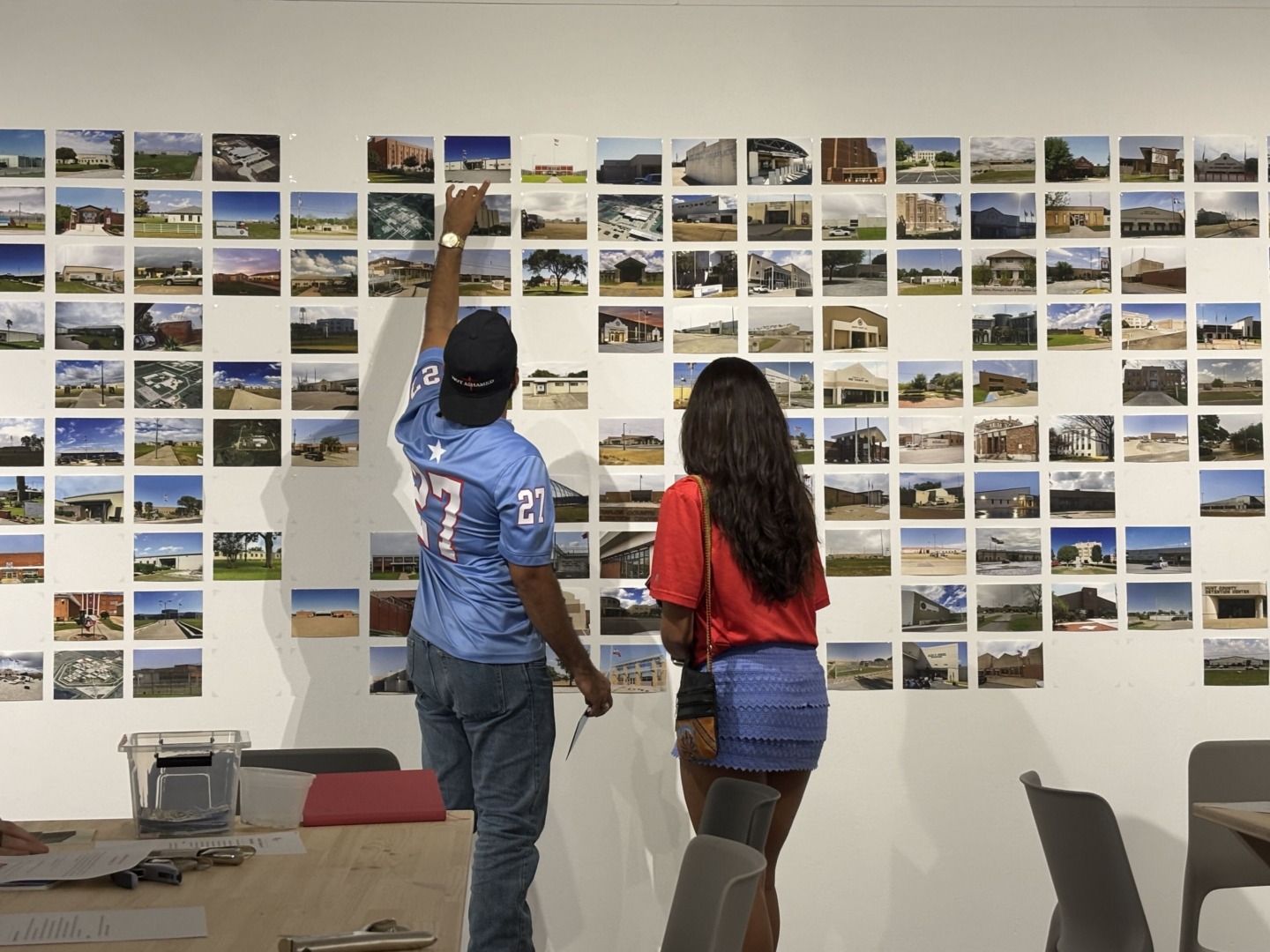
Participants engage with Maria Gaspar’s project “Disappearance Jail Texas” at a punch party at the Blaffer Art Museum on October 3, 2026, in Houston, Texas. | Audrey Szeto/The Cougar

The Blaffer Art Museum hosted a punch party on Oct. 3, which explored themes of incarceration, captivity and freedom in Maria Gaspar’s project “Disappearance Jail Texas.”

The idea behind the workshop, led by Gaspar, was to punch holes into photographs of carceral facilities and imagine what could replace the facility instead.

“Many people that I’ve spoken to say ‘instead of a prison, why can’t we have a school?’” Gaspar said. “Or why can’t we have a beautiful park? That’s what the invitation is, for us to collectively think about how these places impact us and what we might want to see instead.”

Participants can look through a list of different Texas facilities which include jails, prisons and immigrant detention camps, and find the exact facility on the wall of photographs.

“Unlike other artworks, which you cannot touch, these you grab with your hands,” Gaspar said. “They record the history of a community within that state.”

Women’s Caucus for Art member Suzanne Buckland was surprised when she saw what was in the photograph she chose to punch out.

“The detention center has playground equipment in there,” Buckland said. “It’s behind this big fence with barbed wire, and that says a lot. It needs to go.”

One of the photographs prompted participant Nara Lesser to think about mental health in relation to incarceration.

“The first picture I punched was of a prison mental health facility,” Lesser said. “As someone who has a fair number of mental illnesses, I can’t imagine how awful the care, if there even is any care, is.”

As part of the project, Gaspar is interested in how carceral facilities are represented in the political imagination, how the images make people feel and how the images teach people to normalize an idea.

“We know that incarceration in the United States is highly racialized,” Gaspar said. “We know that it targets poor people and trans people. Therefore, I became interested in how, as an artist, I can create the artworks that can speak to the nuances of what it means to incarcerate people, and what it means to live with incarceration in our lives.”

The project is a part of Gaspar’s exhibition, “We Press Our Hands to the Steel Curtain.” Her exhibition is inspired by the demolition of a jail in her childhood neighborhood, which was predominantly a Mexican immigrant community.

“As a first generation immigrant, it resonates because of the recent ice abductions that have skyrocketed,” Gaspar said. “And it begets the question about how we dehumanize and criminalize people.”

Texas is the sixth state where Gaspar has held a punch party. Her goal is to hold punch parties in all 50 states and continue fostering conversations about incarceration.

“When you think of prisons, you only think of how there’s lots of bad people there,” said participant Wayne Rogers. “But, maybe there is a bright side, that they are trying to rehabilitate themselves and make a better life for themselves.”

news@thedailycougar.com

—
“Rethinking incarceration in Maria Gaspar’s project “Disappearance Jail Texas”” was originally posted on The Cougar

Posted in UncategorizedComments Off on Rethinking incarceration in Maria Gaspar’s project “Disappearance Jail Texas”

Rethinking incarceration in Maria Gaspar’s project “Disappearance Jail Texas”

Participants engage with Maria Gaspar’s project “Disappearance Jail Texas” at a punch party at the Blaffer Art Museum on October 3, 2026, in Houston, Texas. | Audrey Szeto/The Cougar

The Blaffer Art Museum hosted a punch party on Oct. 3, which explored themes of incarceration, captivity and freedom in Maria Gaspar’s project “Disappearance Jail Texas.”

The idea behind the workshop, led by Gaspar, was to punch holes into photographs of carceral facilities and imagine what could replace the facility instead.

“Many people that I’ve spoken to say ‘instead of a prison, why can’t we have a school?’” Gaspar said. “Or why can’t we have a beautiful park? That’s what the invitation is, for us to collectively think about how these places impact us and what we might want to see instead.”

Participants can look through a list of different Texas facilities which include jails, prisons and immigrant detention camps, and find the exact facility on the wall of photographs.

“Unlike other artworks, which you cannot touch, these you grab with your hands,” Gaspar said. “They record the history of a community within that state.”

Women’s Caucus for Art member Suzanne Buckland was surprised when she saw what was in the photograph she chose to punch out.

“The detention center has playground equipment in there,” Buckland said. “It’s behind this big fence with barbed wire, and that says a lot. It needs to go.”

One of the photographs prompted participant Nara Lesser to think about mental health in relation to incarceration.

“The first picture I punched was of a prison mental health facility,” Lesser said. “As someone who has a fair number of mental illnesses, I can’t imagine how awful the care, if there even is any care, is.”

As part of the project, Gaspar is interested in how carceral facilities are represented in the political imagination, how the images make people feel and how the images teach people to normalize an idea.

“We know that incarceration in the United States is highly racialized,” Gaspar said. “We know that it targets poor people and trans people. Therefore, I became interested in how, as an artist, I can create the artworks that can speak to the nuances of what it means to incarcerate people, and what it means to live with incarceration in our lives.”

The project is a part of Gaspar’s exhibition, “We Press Our Hands to the Steel Curtain.” Her exhibition is inspired by the demolition of a jail in her childhood neighborhood, which was predominantly a Mexican immigrant community.

“As a first generation immigrant, it resonates because of the recent ice abductions that have skyrocketed,” Gaspar said. “And it begets the question about how we dehumanize and criminalize people.”

Texas is the sixth state where Gaspar has held a punch party. Her goal is to hold punch parties in all 50 states and continue fostering conversations about incarceration.

“When you think of prisons, you only think of how there’s lots of bad people there,” said participant Wayne Rogers. “But, maybe there is a bright side, that they are trying to rehabilitate themselves and make a better life for themselves.”

news@thedailycougar.com

—
“Rethinking incarceration in Maria Gaspar’s project “Disappearance Jail Texas”” was originally posted on The Cougar

Posted in UncategorizedComments Off on Rethinking incarceration in Maria Gaspar’s project “Disappearance Jail Texas”

Opening closed doors: Jacqueline Garcia on the importance of Latinos in medicine

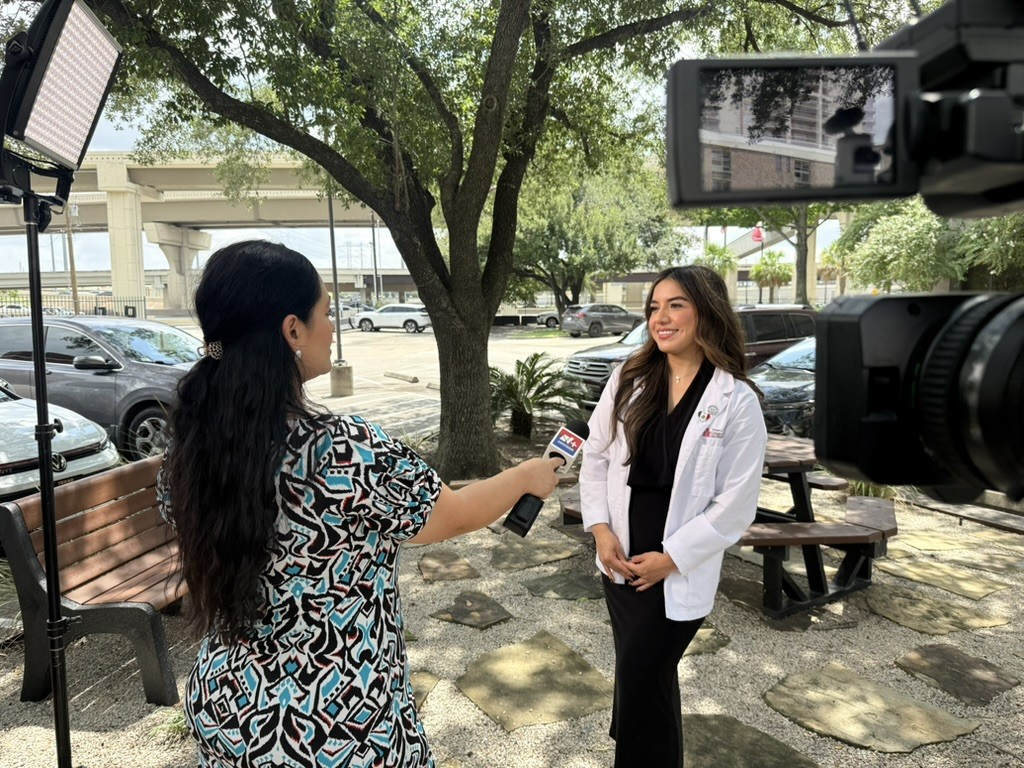
Medical student Jacqueline Garcia participates in an interview for Univision 45 Houston on September 11, 2026, in Houston, Texas. | Photo courtesy of Jacqueline Garcia.

In the small town of Amarillo, Texas, a 15-year-old girl stands in the trauma bay of an emergency room. Following a traumatic accident, her father needs emergency surgery. As the only Spanish-speaker in the trauma bay, the responsibility falls on her to translate this pivotal information to her father.

This 15-year-old girl was Jacqueline Garcia over a decade ago. Now, she is a third-year medical student at the Tilman J. Fertitta Family College of Medicine and vice president of the Latino Medical Student Association.

“I remember standing in the trauma bay that day and promising myself that I never wanted somebody else to feel that way,” Garcia said. “That’s kind of where my passion for medicine started.”

Garcia is a first generation student, and her parents immigrated to the U.S. from Aguascalientes, Mexico. Recent census data show that 20.5% of the U.S. population is Latino, but only around 6 to 7% Latino physicians, according to Statista.

“Being bilingual was something that was very special to me because it gave me the ability to not only communicate with my parents, but to be able to help them navigate a system that wasn’t built for them,” Garcia said.

Healthcare literacy is the ability for individuals to understand health information and make informed decisions about their health. Garcia says that patients who do not have the ability to pursue higher education may not understand the severity of their diagnosis and that this issue is prevalent among Hispanic populations and migrant communities.

“Medicine, on its own, is a foreign language to any person,” said colleague and LMSA president Amanda Hernandez. “Having to understand that in a language you don’t speak – it’s incredibly challenging.” 

In addition to difficulties navigating the healthcare system, low-income communities experience disparities in access to healthy food and medical insurance. 

According to Rice University, 73% of uninsured residents of food-insecure households in Houston and Harris County are Hispanic. 

“It’s a cycle that needs to be broken,” Garcia said. “That’s where healthcare providers can provide those interventions. And a lot of that comes through compassion and through empathy, because you’re able to see the circumstances that these patients live in.”

The language barrier and cultural misunderstandings many experience is why Latino representation in medicine is important to both Garcia and Hernandez.

“I think the voice that we serve to this community, for them to see themselves in their doctor, increases their motivation to keep up with their own health,” Hernandez said. “It increases the trust in medicine in general.”

By serving as vice president of the LMSA, Garcia increases mentorship for Latino students and dedicates time to the health and well-being of Latino communities.

“Thinking about those who are coming behind her and how to make an easier way for other Latinas – for example, those coming from small towns – all of those things are really important for her,” said learning community professor Woods Nash.

Nash has been Garcia’s mentor since her first year of medical school. Throughout Garcia’s time in medical school, he has advocated for her and supported her ideas.

“It’s interesting for me, for someone who’s never been to a place like Amarillo, to know something about what life there is like,” Nash said. “And Jackie is one of those students who’s interested in serving a community like the one she comes from in Amarillo that has limited access to healthcare, due mostly to lower socioeconomic status.”

Along with serving others, members of LMSA gain a sense of community in a field where Latinos are a minority.

“When you go into medicine and you don’t see people like you, you expect the experience to be lonely,” Hernandez said. “It’s nice to have someone who can understand where you come from and that you can just be yourself.”

As a part of the LMSA, Garcia was invited to speak about what it means to be a Latina in medicine in an interview with Univision 45. 

She spoke about her upbringing, hoping to inspire aspiring physicians and anyone who has a dream to pursue higher education.

“My biggest message is: the best gift that you can give your parents is to invest in your own education,” Garcia said. “It’s also the best form of resistance and protest – educating yourself – because no one can ever take your education away from you.”

news@thedailycougar.com

—
“Opening closed doors: Jacqueline Garcia on the importance of Latinos in medicine” was originally posted on The Cougar

Posted in UncategorizedComments Off on Opening closed doors: Jacqueline Garcia on the importance of Latinos in medicine