Author Archives | Amelia Fiore, Arts and Culture Writer

‘Los Dreamers’ explores the borders we can break through

University Theatre’s production of “Los Dreamers,” a 2018 play written by Mónica Sánchez, opened on May 22 in the Robinson Theater. Described by its author as a dramedy (drama and romantic comedy), the story examines love, complex family relationships and the sobering reality that immigrants face in the present-day United States.

After a brief telling of an ancient Mayan creation myth, we are introduced to Scoobi (Monse Quesada Gonzalez), a young adult who was born in Mexico and brought to the States undocumented. Facing the threat of deportation, she marries Dylan (Evan Stalnaker), who receives college tuition and housing assistance from Scoobi’s mother, Petra (Laila Ortega), in return. She must learn to confront her own notions of love and identity, all while being followed by the ghost of her deceased lover, Roko (Manny Rojas Meza).

A key point in the show is the mirroring between Scoobi and the experiences of her parents. They were members of the Zapatista Army of National Liberation, a real political militant group that resides in Chiapas, the southernmost state of Mexico. The parallel between Scoobi and her mother is thoughtfully displayed through flashback scenes from 1994, during the Zapatista uprising. It was a 12-day rebellion that claimed the lives of 153 individuals, including the fictional Scoobi’s father.

Malek Najjar, professor of theater arts at UO and the director of the production, said the show “really straddles multiple worlds, multiple time frames and also asks us to cross that border of empathy for the characters.”

Najjar chose the piece while searching for a show that told a Latinx story with an emphasis on a younger age group of characters. He was also born and raised in Albuquerque, New Mexico, where Sánchez was raised and where “Los Dreamers” takes place. He found inspiration in a story of a young person facing deportation, something he emphasized was important to highlight, as he had often seen it in his own home state.

“I brought the idea of crossing borders as my metaphor for the show,” Najjar said. “Not just international borders, like the one between Mexico and the United States, but also crossing the internal borders that we have. What do we do when we encounter a culture that’s not our own? How do we cross that border linguistically through food and through traditions and through culture?”

Mark Meliason, an attendee, said he was drawn to the production after he attended one of Najjar’s previous shows. He directed “THEM,” a war drama written by Palestinian playwright Samah Sabawi, in Portland and Eugene last summer. As for “Los Dreamers,” Meliason was intrigued to hear a story exploring the political and social tensions shaping the country. “It’s a very powerful play. Very contemporary of what’s happening, but also, it dates back for decades,” Meliason said. “I really wish the theater was packed, because it’s a message that needs to be heard.”

Actors in the University of Oregon Theatre’s production of Los Dreamers, which runs on select dates from May 22 to June 7, 2026, and is free for current UO students with a University ID. (Courtesy of Kaylee Aalbers and Ella Moriarty)

While all are exceptional actors on their own, the show came to life when Scoobi, Petra and Dylan shared the stage. The script is light-hearted in some places, incorporating funny quips and emphasizing the awkwardness of the trio’s dynamic through cultural differences. Then, without notice, the tone shifts to something much heavier. It’s one of many ways the narrative communicates the throes of Scoobi’s experience; she can never get too comfortable because the heartbreak of her past and the uncertainty of her future are always looming.

The set’s design, overseen by Professor Mary Jungels Goodyear, had its own hand in telling the story. From the comfortably basic layout of Scoobi and Petra’s home to the brightly colorful scenery of Chiapas, the stage’s layout was apparent in its intentionality. Najjar explained that the production team spent a significant amount of time researching the environments of the Desert Southwest and Mexico to ensure their production accurately represented the scenery and cultural influences.

The team also hung art in the theater lobby, including a collage of Chicano and Zapatista murals which inspired the “Los Dreamers” poster, created by recent graduate Seberiana Lopez. Tucked inside the program, there was a card describing ways to respond to an “Immigration or Other Officer” in the event you are approached, both in English and Spanish. It was a powerful act of community care, as much as a bold directorial choice.

“Los Dreamers” was published in 2018, and when asked if he made any changes to better suit a 2026 production, Najjar said he didn’t need to. According to him, the story is “timeless, in some unfortunate ways.” He wanted audiences to hear the stories of immigrants themselves, stories that often go overlooked or untold, and ask themselves to examine their own reservations regarding immigration and cultural differences.

“How do we tear down those walls?” Najjar asks. “How do we tear down those barriers and look at ourselves as humans rather than subjects of a country? Why can’t we say that’s a human who is dealing with the same issues that all of us are dealing with? Even though they might not look like us, sound like us, or dress like us, it doesn’t matter. It’s ultimately about the fact that we’re all in this struggle together.”

“Los Dreamers” completed its final performance on June 7. For more information on past University Theatre productions, check out their website.


The post ‘Los Dreamers’ explores the borders we can break through appeared first on Daily Emerald.

Posted in UncategorizedComments Off on ‘Los Dreamers’ explores the borders we can break through

‘Rising Tides. Crashing Waves:’ Uplifting Asian American voices through independent film

“They’re by us, for us or about us.”

That’s the criteria for films screened at the DisOrient Asian American Film Festival, according to Executive Director Pamela Quan. The three-day festival sets the stage for independent Asian American filmmakers from across the country, all in the cozy space of the Art House.

The core of the festival will kick off on Friday, March 13, with a screening of the first film, followed by a reception. The next two days will be jam-packed with screenings — 11 full-length films and several short films —  during the afternoon and evening, and will continue virtually into March 16-22 to reach viewers across the Pacific Northwest.

Jo Fujiwara-Morozumi is DisOrient’s programming director and a UO alumni, who graduated in 2023 with a degree in cinema studies. They have been attending the festival since they were young. In high school, they became an intern before becoming more integrated into the planning process. Last year was their first in this role. 

An essential aspect of Morozumi’s position is creating the catalog. The film selection process can be demanding, as the board receives hundreds of submissions from promising filmmakers from around the country. They have to make sure they curate a list that adheres to DisOrient’s distinct subject matter, and Morozumi often travels to various film festivals in different states to scout for new voices.

The theme this year is “Rising Tides. Crashing Waves,” which was mainly inspired by an influx of uniquely impactful submissions created by Native Hawaiian Pacific Islanders. The message holds deeper meaning, though.

“The rising tides aspect alludes to that rising pressure of sociopolitical injustice that we’re seeing in this country right now, but it also alludes to the response to that injustice, the sort of rising frustration within our community,” Morozumi said. “And the crashing wave is the result of that rising frustration coming out in political action. So a lot of the films that we’re seeing this year are in line with those themes in terms of generations of frustration and struggle, and then coming out in the form of activism.”

Around 50 filmmakers are traveling to Eugene to be a part of DisOrient, including 92-year-old Mitzi Loftus, born in Hood River, Oregon, to immigrant parents from Japan. Her and her family were forced out of their home in 1942, shortly after the attack on Pearl Harbor, and sent to an internment camp in California. At this year’s festival, she will appear as the subject of the short film “Out of Place.”

There will be a handful of other Q&As where attendees can learn from filmmakers directly. Some other featured speakers include Georgina Pazcoguin, who made history in 2013 as the first Asian-American female soloist at New York City Ballet. Her and director Jennifer Rita Lin will be speaking on “About Face.”

Nicole Yamase and Daniel H. Lin will also speak on their centerpiece film, “Remathau: People of the Ocean,” which tells the story of Yamase’s experience being the first Micronesian and Pacific Islander to dive into the “Challenger Deep” of the Marianas Trench.

Benito Bautista, director of “The Road to Sydney,” will also host a Q&A on his film on opening night. The film follows Philippine dancer Sydney Loyola as she navigates job loss following her gender transition.

Courtesy of Alan Zhou

There are dozens of movies to be screened, including seven short film series. Each one, however, tells a story about an individual experience, but also shows how these experiences can transcend cultural boundaries.

“The great thing about independent Asian American film right now is that it is so diverse in terms of subject matter, topics and who is in front and behind the camera. I don’t have to bend over backwards to make sure that every single identity is represented, because we are just naturally seeing them come up,” Morozumi said.

Jason D. Mak, founder of the festival and current board member, explains that the name “DisOrient” is born from this idea; the festival is meant to serve as an antithesis to the concept of Asian America as a monolith.

“The name DisOrient Asian American Film Festival was intentionally chosen to subvert and reclaim the term ‘Oriental,’ which for generations carried stereotypes that painted Asians as exotic, mysterious or foreign. The festival’s name flips that narrative on its head,” Mak said. “DisOrient asserts the right to self-representation, challenging audiences to see Asian Americans not as caricatures, but as fully human storytellers shaping their own identities and experiences.”

Anti-Asian rhetoric in the media and popular culture has served as a call to action for Asian American filmmakers, and as injustices toward other communities rise, Quan emphasizes that the need for communal education and shared creativity is more important now than ever. 

“We just feel really committed because we’re witnessing injustices in the world. Not only in our own Asian American, Native Hawaiian, Pacific Islander community, but also, we saw George Floyd, we saw ICE raids, we saw people being unfairly characterized because they’re an immigrant,” Quan said.

She hopes that by mindfully watching these films, attendees are inspired to stand up against injustice when they witness it. “Maybe in small ways, maybe in big ways, but I hope they feel moved to take action,” she said. “ I hope they get this itch to explore their own stories when they see others and maybe share some of that, because I think through that connection, we can certainly find solutions that are better than the ones we’re seeing right now.”

Morozumi hopes that viewers are most impacted by the educational aspect, especially in the community of Eugene. “Eugene is a pretty predominantly white town, so, naturally, our audiences tend to look like that. We bring out community members of color in large amounts, but I think that it serves as a really great opportunity to show people perspectives they wouldn’t normally see in mass media,” Morozumi said.

“We have a lot of work to do,” Quan said. “And I think over 21 years, we’re coming to see the power of the individual, the power of a small film festival in a town like Eugene.”

DisOrient will begin in-person screenings on March 13 at 6 p.m. Tickets for individual screenings or pass packages are available to purchase on the festival’s website.


The post ‘Rising Tides. Crashing Waves:’ Uplifting Asian American voices through independent film appeared first on Daily Emerald.

Posted in UncategorizedComments Off on ‘Rising Tides. Crashing Waves:’ Uplifting Asian American voices through independent film

Free ASUO x Rose Room thrift pop-up accommodates students with sustainable fashion

Have you ever walked into a thrift store, found something that perfectly fit your style, then checked the price tag to your immediate dismay?

The Rose Room believes that sustainability shouldn’t be so financially risky, which is why they paired up with ASUO to host a free thrifting pop-up. On Feb. 26 from 2 to 5 p.m., the ASUO office opened its doors to those who wanted to donate or thrift for free. An eager crowd showed up and showed out on both fronts. 

According to the SSC Reusables team, an estimated 300 students were in attendance. The room held an ensemble of different styles, colors and designs, composed partially of items already in the Rose Room’s possession alongside student-provided donations.

The event was a unique collaboration between the Student Sustainability Center and ASUO, pairing the two for something entirely fresh. “I think this is the first time in recent memory that the Student Sustainability Center has collaborated with ASUO in this way,” Dori Vaughan, an organizer of the event and a coordinator for the Student Sustainability Center’s Waste Production and Reusables Program, said.

The Rose Room, a component of the SSC, currently functions as a “free thrift store for students on campus,” and is open on Mondays and Wednesdays from 12 to 2 p.m. in PLC 182 all term. The program initially acted as a resource for staff members to secure free office supplies, but the SSC expanded the mission to include clothing to better accommodate the needs of students.

Nathaniel Pratt, an ASUO executive advocacy intern, introduced the concept as part of a larger effort to promote sustainability within the student body. “I had to present to my director and the president something new, and I wanted to do it on circular clothing models. We talked about it, and we kind of both came up with the idea of having a pop-up,” Pratt said.

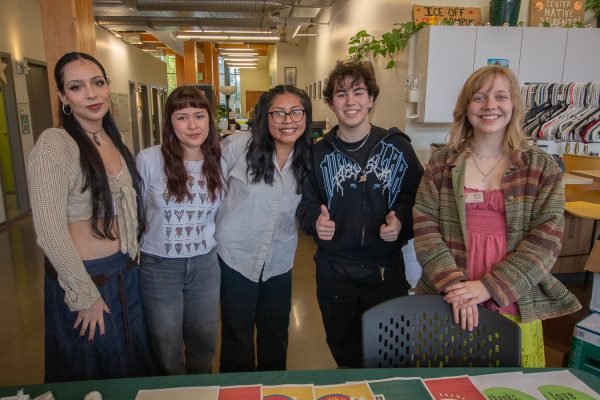
The hosts of the event From left to right: Selah Richards, Aril Lara, Ada Contreras, Nathaniel Pratt, and Dori Vaughan pose for a picture together. On Feb. 26, 2026, The ASUO and Rose Room collaborated to host a clothing pop up at the ASUO Office, at University of Oregon, based in Eugene, Ore. (Fred Hall/Emerald)

According to data from Capital One Shopping Research, approximately 1/3 of clothing and apparel items purchased in the United States over the past year were secondhand. A circular clothing model is one meant to keep clothes in use as long as possible to eliminate waste and fast fashion. Thrifting, an example of this, has resonated vastly with young adults, and the UO campus is no exception.

“We’ve seen a huge rise in thrifting culture in the last 10 years, and there are a lot of resale stores that have popped up,” Vaughan said. “We’re trying to capture an audience with people who would go to those resale stores and convince them to instead give their items back to students under the assumption that they will find things that are of equal or higher quality by engaging in these programs.”

Vaughan emphasized the importance of accessibility in order to properly introduce a circular clothing system on campus, and that the “free” part of the “free thrifting pop-up” was integral in catching the attention of students.

“Being able to just tell people it’s free — that’s really exciting, especially in college when it seems like everything is turning you upside down and shaking your lunch money out of your pockets,” Vaughan said. “(It’s exciting) to have opportunities to engage with movements and programs on campus where you just get stuff, and you don’t have to think about your wallet at all. And so that was something we tried to outline on our posters was this slogan of thrift for free.”

While financially appealing to most, Pratt recognizes the wariness some students may have about engaging in an ASUO-sponsored event. He assures the elected campaign, Student Power, is ready to engage directly with students and prioritize their needs.

“There’s kind of a stigma of ASUO taking over stuff and like not really assessing the right needs of organizations and partners. I think Student Power is doing a really good job of understanding what the needs of the university are, and what the students actually really want to see,” Pratt said. “And I really want to see more collaboration, and I hope that through events like this, we can show that we are trustworthy, and that we can help you and that what we do really does matter.”

Amber Geiger, a junior, attended the event because the Rose Room had previously sparked her interest in recycling on campus. “I appreciate that events like this get put on for community building, but also for people who need resources,” they said. Geiger is hoping to attend an event like this again, “definitely earlier too,” as the racks that initially held hundreds of items had been whittled down to only a few dozen after only an hour into the event.

“I love the way sharing economies work, and I think, especially in college, it’s so valuable to be part of a larger community that shares things instead of outsourcing everything,” Vaughan said. “I think there’s just so much for everyone. Like, we’ve had such a diverse group of people. Anyone can come, and it doesn’t really matter your income bracket.”

As for the future of the Rose Room, Vaughan hopes the mission continues to expand. “There is talk of someday having sort of a basic needs center on campus, which is after both of our times here, but we are trying to legitimize the Rose Room and its services so that if something like that were to happen, we wouldn’t get left out of the conversation,” Vaughan said.

Anyone can donate clothing to the Rose Room, either by handing it to someone working at the SSC, dropping it in the donation bin at the EMU or bringing it directly to the Rose Room. You can find a map of current donation locations on their Instagram.

The post Free ASUO x Rose Room thrift pop-up accommodates students with sustainable fashion appeared first on Daily Emerald.

Posted in UncategorizedComments Off on Free ASUO x Rose Room thrift pop-up accommodates students with sustainable fashion

University Theatre livens up a timeless classic

The lights dim, and a messenger emerges from an unseen entrance, delivering news of the Prince of Arragon’s return from war to the Household of Leonato as he weaves through the audience. The eyes of people in the seats follow him to the stage, captivated. This is a common thread throughout the rest of the show; the viewers are not separate from the story, rather, nameless onlookers to our protagonists.

And so, UO Theatre’s production of “Much Ado About Nothing” begins. The rest of the ensemble gathers on stage, and we are introduced to Leonato (Harvey Parsons), his daughter, Hero (Loralee Van Londen) and his niece, Beatrice (Bleu Jones). They meet Prince Don Pedro (Dylan Podrabsky), his illegitimate brother, Don John (Mason Bruderer) and his companions, Balthasar (Aiden Lopez), Claudio (Gavin Blackwell) and Benedick (Trevor Tarantino). The cast is large, and the stage oftentimes feels crowded, but each plays a substantial role in propelling the layered story forward — or just providing a snappy one-liner.

The chemistry between the sharp-witted Beatrice and staunch bachelor Benedick is immediately recognizable, and it is quickly clear that their story will follow the enemies-to-lovers trope. As for Claudio, his initial affections for Beatrice subside when he meets Hero, and they engage shortly after.

Both Benedick and Beatrice’s companions believe that the two should be together, so they enact a plan to foster a romance by telling each that the other is desperately in love with them. It works fairly quickly. However, Don John’s opposing scheme to break up Hero and Claudio also succeeds, and Claudio accuses her of infidelity before their marriage.

Toward the end, Don John’s henchmen admit to their lie, and Hero and Claudio finally marry. Benedick and Beatrice are still in love, even after learning of their friends’ plan, and the cast shares a lively dance to end the show.

Don John seems to be the least menacing villain out of all Shakespearean stories; his motives simply boil down to his bastardness and satisfaction with the role of antagonist. Despite his flat rationale, Bruderer does a brilliant job of illuminating his wickedness, albeit in a silly cartoon villain sort of way.

Beatrice commands the stage each time she takes it. Jones portrays her with a stubborn, often aloof, attitude, which makes her deeply enjoyable to watch and laugh with. Her budding relationship with Benedick is sometimes awkward and always combative — a romance that keeps the audience on their toes.

Ava Bousquet, a sophomore, hadn’t seen a show produced by UO Theatre before, and she thoroughly enjoyed this one’s liveliness. “I think you have to (be energetic) if you’re doing Shakespeare. I mean, I definitely don’t know the language, but I felt the plot was communicated,” they said.

One standout moment arrived about a quarter into the show, when Benedick eavesdrops on the Prince, Leonardo and Claudio as they enact their plan. His sneaking through the audience had everyone turning their heads back and forth, excited to watch his dramatic reactions up close. His liveliness during his few following monologues acted as a conversation between himself and the audience, as if he were asking our advice one-on-one to resolve his confusing romantic endeavors.

“I really like how witty Shakespeare was, and I think the actors and actresses did very well with their acting, and the lighting was phenomenal,” Kristin Koch, a UO event coordinator, said. “Jordan (Hamlin, lighting designer) did a great job.”

The technical aspect of the production did an excellent job communicating the dim, soft environment of Messina, Italy. The costumes, managed by Heather Bair and designed by Jeanette De Jong, transformed the actors into English Renaissance-era aristocrats. The scenic design, done by Mary Jungels Goodyear, was nothing short of lovely, and the details built into the garden, house of Leonato and surrounding set pieces did not go unappreciated.

The live guitarists (Akash Dhruva and Beau Jungels), who played on opposite sides of the stage whenever a main character sang or during a group dance, were an endearing touch.

“I thought the comedy was really strong in this. I felt like they were able to really get the audience involved and have a lot of really good comedic time with everything,” Bousquet’s friend, Casey, said. “I thought it was a really, really fun show. Tell everybody to stay for the dance number at the end, that was really fun.”

Seeing this show on Valentine’s Day was the ideal cozy remedy to a particularly rainy evening, and the joy emitting from the newly reopened Robinson stage was enough to keep the entire audience warm.

The last three performances will take place in the Robinson Theatre on Feb. 27 and 28 and Mar. 1. See the UO Theatre website for more details and information on upcoming productions.

The post University Theatre livens up a timeless classic appeared first on Daily Emerald.

Posted in UncategorizedComments Off on University Theatre livens up a timeless classic

The brutal reality of job hunting in ‘No Other Choice’

movie review

**Spoilers ahead

It’s a dog-eat-dog world, especially in the job market. Renowned South Korean filmmaker Park Chan-wook’s latest work explores just what that means, and the lengths people will go to get hired.

“No Other Choice,” which premiered in U.S. theaters in December 2025, follows Yoo Man-su, a family man who is fired after 25 years as a manager for a paper-making company. He and his family are optimistic at first, but weeks turn into months, and the job market is looking bleak. While his name gets lost in the sea of applications, he devises a plan to become the sole perfect candidate for a thriving rival company.

Lee Byung-hun, most well-known for his role as the Front Man in “Squid Game,” leads the story with an unshakable grasp. His character is one the audience is meant to both encourage and criticize; a man who consistently makes decisions he knows he shouldn’t, but who can’t be blamed for his circumstances. He is a reflection of you — the working-class person who will do anything for a sense of security in an ever-changing world.

Son Ye-jin plays his wife, Mi-ri, who is both a loyal leader of the family and an accessory in Man-su’s crimes. To support her family during trying times, she quits tennis lessons and takes up a part-time job as a dental assistant to the young, handsome Oh Jin-ho (Yoo Yeon-seok), much to Man-su’s chagrin.

Not to box this film into its place of origin, but stylistically, it is reminiscent of Bong Joon Ho’s 2019 Oscar winner, “Parasite.” Every shot is calculated with precision: carefully structured to make you feel the exact anxiety, joy, fear or anger matching that of the portrayed characters. When Man-su’s plan goes sideways (something that occurs a few times), the sharp editing urges you to look away and just pray that it resolves soon.

Park also utilizes visually intriguing, albeit unorthodox, post-production layering of multiple characters who share the same scene, but are in different places. This is a recurring tactic between Man-su and Mi-ri, connecting the characters despite their physical separation. The colors and lighting techniques are also extremely intentional. Warm tones, greenery and bright clothing at home are contrasted with the sterile white environment at the interview sites.

As his plan progresses, the passion Man-su once carried for his craft morphs into a blinded desire to get ahead. He doesn’t really want to hurt anyone, and it takes a painstakingly long time to get there. But when he does, it is not empowering. I find that in other “good for them” films, such as “Kill Bill” or “Taken,” the filmmaker is begging you to be on the killer protagonist’s side. In this case, the people Man-su targets are not murderers or thieves, but working men like himself who were down on their luck.

There is a lull about three quarters of the way through, in which Man-su is evading both his wife and two policemen from catching on to his crimes. But at this critical point, it feels like the stakes are completely depleted. The detectives aren’t placing responsibility on him for the disappearances of two men searching for paper jobs of their own, and Mi-ri does not let on that she knows about the body in their backyard and doesn’t care (well, she does, but not enough to add to her husband’s distress). It’s more anxiety-inducing to watch him bury graves than sit through an actual police questioning, and I think Park could’ve distributed that feeling better to add to the weight of what occurred.

The lack of satisfaction at the end of the film is entirely telling of what it means to secure a job in a cutthroat world. Man-su is happy when he’s finally hired, even after all he went through to do so, but as he realizes his once-passion has been turned into AI daycare, the harsh reality begins to sink in. To the executives who fired and hired him, Man-su is no more than another machine, and so were the people dying for that same job.

Doomscrolling on LinkedIn, killing your job competitors, comme ci, comme ça. As college prepares young adults for the unknown wild west of the early-career job market, “No Other Choice” is a not-so-welcome reminder that the worst is yet to come.

The post The brutal reality of job hunting in ‘No Other Choice’ appeared first on Daily Emerald.

Posted in UncategorizedComments Off on The brutal reality of job hunting in ‘No Other Choice’

Do you believe in magic?

The room holds only a handful of people, a few joining on Zoom, eagerly waiting to showcase their tricks. It’s inside Merrill Gardens at Sheldon Park, an assisted living facility buried in the outskirts of Eugene. One person tells me to open my right palm and places two squishy, red balls inside before closing it. When I open my hand back up, there are three.

This is a typical meeting for the Mysticians. The Eugene-based magic club was founded in 1962 by Ray Hyman and the late Jerry Andrus, both renowned figures in the magic world. Hyman, who is also a retired professor of psychology at UO, is now 97 years old and still running the show.

Alongside him is Jay Frasier, current club secretary and Lane Community College professor, who is also an award-winning magician. He prides the Mysticians on its unique lack of traditional structure, something Hyman decided on when he first created the group as an incentive for quality discussion over time-consuming agenda explaining.

“We don’t have dues (and) we don’t have membership requirements, except for being interested in magic,” Frasier said. This type of accessibility opened the gates to a diverse range of participants over the group’s 60-year history. They’ve even had a few members make their way to the big leagues, such as Hart Keene (as seen on “America’s Got Talent”) and Greg Moreland (professional comic magician).

As for Frasier, his curiosity for magic piqued when he was about five years old, when a minister at his church showed him a seemingly impossible card trick. “It fooled the pants off of me. I was like, ‘how the heck?’ He wouldn’t tell me how it was done,” Frasier said. “So, I had my mom check out all the grown-up books on magic and read them to me, ’cause I wanted to know how that trick was done. It was driving me insane. It was like this worm in my brain that just would not go away, so … I’ve been hooked ever since.”

Mysticians meetings typically act as a forum for both performing and explaining tricks, but since a “Muggle” would be joining, the group would refrain from openly discussing their secrets. The group performs occasionally, but meets monthly to mull over new illusions (and share a magician joke or two).

According to Hyman, card magic is the “most widespread form of magic,” but many of the group’s members have found a way to utilize their other talents. One created a prop out of a shoebox, which, when stuffed with a handful of handkerchiefs, manifested an entirely new piece of colorful fabric that was pulled out with a satisfied smile.

They’ve also had members in the past who have solely worked with larger props, leaning toward a more “stage magic” style. There is a wide variety of avenues to mystify, big and small.

For some, the Mysticians is an outlet from the stressors of daily life. The most recent meeting coincided with a possible upcoming faculty strike at LCC over budget cuts. Currently, Frasier works as a professional magician on the side, something he has had to lean on for financial security.

“So, my joke — it’s not actually totally a joke — is that I’m in education, so I’ve got to do something to make some money. And there’s some truth in that. Particularly since we’re bargaining right now, the faculty union with the administration, and it’s not going well,” he said.

Unlike Houdini escaping handcuffs after jumping into the Erie Canal, the group acts as a break from real life. Both Frasier and Hyman are self-described skeptics, yet they practice something that is meant to incite both confusion and awe. Although not exactly scientifically supported, the group is one example of how magic acts as a way to both inspire and bring people together.

As for the Mysticians, anyone is free to join; the only prerequisite is an interest in the fantastical. They will continue to meet at Merrill Gardens monthly, whether the group is few or many, as long as the wonder for things like disappearing squishy red balls remains.

The post Do you believe in magic? appeared first on Daily Emerald.

Posted in UncategorizedComments Off on Do you believe in magic?

Filmlandia brings Oregon’s best to campus

Over the course of winter and spring term, the UO Cinema Studies department is hosting a series of screenings, beginning this term with 14 films. Some notable features include “Coraline,” “The Shining” and a series of short films, one of which is the “Portlandia” pilot episode. It will close in June with a silent film, alongside a live musical accompaniment.

Peter Alilunas, an associate professor of cinema studies, co-founded the series with assistant professor Colin Williamson this year. The idea came to mind after the cinema studies program’s recent migration from McKenzie to Villard Hall.

“Partly to celebrate that, we thought, ‘Why don’t we do a screening series that will help us celebrate this new place?’ So, we were thinking about place as a theme, and that’s when we landed on the idea of Oregon,” Alilunas said. “Oregon is not just a literal place; it also has kind of these multiple layers of meaning.”

The big decision was carefully choosing a select group of films to screen. According to Alilunas, movies like “Animal House” have had their time to shine on campus; they wanted to do something fresh, create a space to explore the entire state from one room and share its influence on cinema.

To accomplish this, they constructed a catalog that includes filmmakers of Oregon origin, movies filmed in Oregon and stories that center Pacific Northwest ways of life. They also prioritized representation of the state’s diversity by paying homage to underrepresented communities in film.

“We have pretty solid representation across race, class, gender and sexuality, independent filmmaking, commercial entertainment … Indigenous representation was really important to us, too, thinking about the longer histories of those communities who have been here long before the U of O and the cinema,” Williamson said.

The event is also a celebration of our state’s eccentricity, one which holds a special place in the hearts of cinephiles. Alilunas said, “I think Oregon is a place where filmmakers have come to capture something that is slightly askew or different.”

Along with inspiring Oregon appreciation, the pair hope to revive an art lost on the UO campus. Labeling the series with “University Film Society Presents” on its flyer is a nod to the organization which was present and thriving in the 1960s, that hosted screenings with an abundance of participants.

“One of the things Colin and I have done is we brought that name back as a way of kind of bringing that past into the future and then the present and the future as well,” Alilunas said. The move away from communal filmgoing hasn’t just occurred on campus, but is a cultural shift felt around the world.

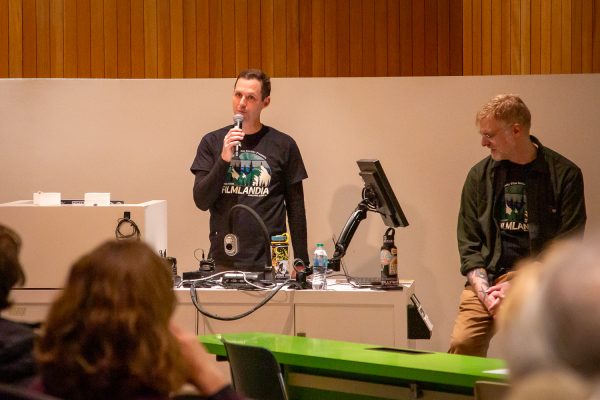
University of Oregon cinema studies professor Colin Williamson (left), along with cinema studies professor Peter Alilunas (right) addressed the audience ahead of the second screening in the Filmlandia Screening Series hosted by the Department of Cinema Studies and the University Film Society on Jan. 21, 2026. (Corey Hoffman/Emerald) (Corey Hoffman)

“I think we all feel that sense that something about the cinema has eroded or disappeared,” Williamson said. “A lot of the students that come through my classes talk about having nostalgia for those kind of communal forms of engagement that are not really readily available to them anymore or are more difficult to access, and with the series, one of our community building approaches was to say, ‘Here’s a designated place in time for us all to come together.’”

Each screening will begin with a short introduction to spark conversation between filmgoers, something Williamson believes is integral to their mission.

“It’s like, when you’re standing in the lobby to a screening and talking about it, or meeting people, (you’re) having ideas that typically you wouldn’t have, you know, sitting in your bed watching a movie or on your couch. Showing up, having time and watching people kind of model behaviors of engaging with the cinema is really important to us,” he said.

In an age of streaming, with tens of thousands of choices over hundreds of platforms, movie-watching can all be a bit overwhelming. Throughout this digital migration, there have been cries warning of the slow, painful death of cinema —- believe it; these professors/film historians have heard it all.

“The cinema has died many, many times before. Before it was a communal event, it was like a solitary, organized event with people looking in little peep show devices, right? And there have been cycles of this throughout film history. We are, I think, in the midst of a cycle,” Williamson said.

Williamson and Alilunas also believe we are still very much in control of cinema’s future. Filmlandia is one iteration of hope for communal moviegoing, a practice that will continue as long as we want it to. As long as we come together, mindfully absorb and discuss the art we consume, the integrity of cinema has nothing to worry about.

The event is free for all students and faculty, and films will be shown on Wednesdays at 6 p.m. in Lawrence or Villard Hall. On select dates, there will be special guests in attendance, including filmmakers, student speakers and community representatives. There will also be cinema studies “swag” that can be won via a punchcard based on screening attendance. Check the schedule for upcoming screenings on the cinema studies website.

The post Filmlandia brings Oregon’s best to campus appeared first on Daily Emerald.

Posted in UncategorizedComments Off on Filmlandia brings Oregon’s best to campus

“Tomorrow is a Latter Day”: ‘The Book of Mormon’ comes to Eugene

Most people have seen them on the street or at their doorstep, but does anyone really know what Mormon missionaries are all about? “The Book of Mormon,” a musical co-written by Trey Parker, Matt Stone (“South Park”) and Robert Lopez (“Avenue Q”), offers a satirical look into the world of the church. Opening on Broadway in 2011, the original cast starred powerhouses Andrew Rannells and Josh Gad, and won nine Tony awards and a Grammy.

It is the tenth-longest-running Broadway show, with more than 5,000 performances, a number that continues to grow as they tour across the country into later this year. From Jan. 2-4, the production made a pit stop at the Hult Center for the Performing Arts in Eugene.

Although a namesake, “The Book of Mormon” isn’t a direct retelling of the religious text, but a story of two Mormon missionaries and their experience trying to proselytize in rural Uganda. It centers Kevin Price (Sam McLellan), a self-important, “great Mormon” who would rather spend his two-year mission in Orlando. He is accompanied by the clumsy Arnold Cunningham (Jacob Aune), a compulsive liar who preferred watching Star Wars over reading the Book of Mormon.

In Uganda, the pair meet the other missionaries, led by Elder McKinley (Craig Franke), who have been unsuccessful in their assignment to baptize any townspeople. We are also introduced to Nabulungi (Charity Arianna), a young woman who dreams of a brighter future for her village amid the threat of a local warlord.

This cast brought both vocal skill and a vibrant acting style to this production. Cunningham was played expertly by Aune, who leaned into the character’s social awkwardness and nerdy obsessions to win laughs from the audience whenever he was on stage. McLellan, though a compelling actor who effectively captured his character’s motivations, seemed to struggle with some of Price’s belted notes, especially in the demanding solo, “I Believe.” Ultimately, it was Arianna’s voice that commanded the theater with Nabulungi’s Act One solo, “Sal Tlay Ka Siti,” where she asserted herself as not a side character, but someone to root for.

The set, brought to life by Scott Pask, features simple props that come together to portray a tattered, simplified representation of a small Ugandan town, which starkly contrasts the bright white attire of the missionaries. The proscenium that framed the stage was inspired by contemporary Mormon temples and features a golden statue of the angel Moroni at its top.

In the number “Spooky Mormon Hell Dream,” where Price is in, you guessed it — hell — the costumes designed by Ann Roth sparkle and captivate the eye while its content shocks the moral conscience.

But the music of “Mormon” is truly what transforms what would have been a silly comedy sketch into a sincere, masterful piece of theater. Parker, Stone and Lopez expertly blend classic showtune-style melodies and “South Park”-esque wit within its lyrics.

“Turn it Off,” for example, is a satirical play on emotionally repressive behaviors, like suppressing one’s own homosexuality, that are often commonplace in Latter-day Saints culture. While contextually depressing, it also features an endearing dance break and a quick change into pink sequin vests.

The show ends with “Tomorrow Is a Latter Day,” a spunky all-cast ending number with the message: People don’t need the rules and restrictions of organized religion, but should simply care for each other and focus on one day at a time.

The content has faced some criticism over the years, mainly on how the Ugandan townspeople were portrayed as unsophisticated and ignorant. After the pandemic, Parker and Stone made several revisions to the script and certain gags. Nabulungi now uses an iPad instead of a typewriter, and there is more of an emphasis on the dangers of online misinformation versus ignorant naivety.

Theater has been in a constant grapple with its future since the 90s, and “The Book of Mormon” serves as a glimmer of hope among the dark uncertainty of the performing arts. With decreased funding and dwindling public interest amid the digital age, theater has taken quite a hit in recent years. Shows like “Mormon” are necessary to keep the heart of performing arts beating — audiences need to see that theater can be funny, moving and even moderately offensive.

The post “Tomorrow is a Latter Day”: ‘The Book of Mormon’ comes to Eugene appeared first on Daily Emerald.

Posted in UncategorizedComments Off on “Tomorrow is a Latter Day”: ‘The Book of Mormon’ comes to Eugene

‘IT: Welcome to Derry’ is proof that prequels can pack a punch

Born as the third installment to Andrés Muschietti’s “IT” universe, “IT: Welcome to Derry” has solidified itself as the eager, rebellious youngest child of the franchise. It’s unlike any other Stephen King product, and “Stranger Things” may have competition for the best ‘group of kids fighting an evil child-hungry alien’ show of the season.

In this HBO Max show, we are taken back to Derry in the 60s and learn a bit more about how the classic clown killer Pennywise made his mark — this time on a whole new, but not random, batch of kids. Muschietti, who directed the 2017 and 2019 “IT” films, created the eight-episode series alongside his sister Barbara Muschietti and writer Jason Fuchs.

This series, although shaped by the same director, takes a staunch turn from the films. The characters are given more time to flesh out over the span of eight hour-long episodes, and the intensity seldom dies down. Having more time to spend with these characters might be what makes some of their brutal demises so… brutal.

The main concept of the series (and entire franchise) boils down to the gruesome murder of children, which isn’t exactly easy to swallow. What makes their distress so poignant, though, is the outstanding acting skills of the cast, especially the child actors.

The show almost entirely follows a group of five kids investigating a classmate’s mysterious disappearance, followed by the disappearances of three other children. Not only do these actors perfectly portray the depths of the horrors they face, like hauntings from deceased parents, but their chemistry doesn’t feel cliché. It’s a ragtag group of kids that don’t seem to go together at first, but as their friendship solidifies, so do the stakes.

The use of both practical and special effects is a key factor in shaping the horror of Pennywise (played by Bill Skarsgård). Several horrifying hallucinations can be attributed to the work of both SFX and VFX teams, which blended CGI and practical effects makeup. In the first climactic scene of the series, artists married prosthetics, fake goo and a digitally-made demon baby into something terrifyingly absurd enough to capture what “IT” is all about. It comes across as eerie and paranormal, but not artificial.

The series takes place in Derry, Maine, in 1962, right in the middle of the Civil Rights Movement. Themes of racism, bigotry, militarization, Cold War paranoia and infringement on Indigenous property amplify the horrors of Derry and anchor the plights of its residents. In one scene, a fire is set at a Black-owned club, which is a reference to real tragedies that shook Black communities during the time period. It’s a necessary addition to the story, and avoiding such would have been a disservice to both history and proper storytelling.

What makes “IT: Welcome to Derry” so special isn’t solely a result of its gruesome nature (although that definitely plays a role), but the characters that spark enough sympathy to have you pace around your living room, praying that they make it out alright. It’s definitely much wilder than the “IT” films, but it also has a bit more heart. The story also serves as a perfect display of how the only thing more horrifying than an alien clown is human beings.

A second season of “IT: Welcome to Derry” has not been officially confirmed by HBO, but the creators have a set three-season timeline in the works. The series definitely isn’t for the faint of heart, but if you’re craving creative horror and underdogs to root for, you’ll feel right at home in Derry.

The post ‘IT: Welcome to Derry’ is proof that prequels can pack a punch appeared first on Daily Emerald.

Posted in UncategorizedComments Off on ‘IT: Welcome to Derry’ is proof that prequels can pack a punch

‘Wicked: For Good’ defied gravity at the box office, but does it defy expectations?

It’s been a year since “Wicked,” and anticipation has been through the roof. How can a multimillion-dollar franchise follow a film that made such a significant cultural and emotional impact? Unfortunately, some things are too good to replicate.

“Wicked: For Good” came to theaters nationwide on Nov. 21, almost exactly a year after the release of its first counterpart, “Wicked.” Having earned $226 million worldwide in its opening weekend, this sequel has made a huge splash already, and Oscar and Grammy nominations seem to be just past the yellow brick road.

The ending of the first film left us with Elphaba (Cynthia Erivo), who had just discovered the Wizard’s (Jeff Goldblum) fraud, causing a ruckus as she denounced Oz in her leaving. This caused a rift in her and Glinda’s (Ariana Grande) friendship, and the future of the Emerald City looked bleak.

In the second film, we are reintroduced to the characters in their new roles: Glinda as a blissful public figure, Elphaba as public enemy number one, Fiyero (Johnathan Bailey) as Captain of the Wizard’s Guard, Nessarose (Marissa Bode) as a cold governor and Boq (Ethan Slater) as her discontented subordinate. The time jump is only one year, yet there is a huge shift from the character personalities and motivations with which we were familiar.

“Wicked: For Good” shined in terms of visuals; popping hues of pink, green and gold wove throughout the fantastical Oz thanks to production designer Nathan Crowley. His use of practical sets, including Elphaba’s lair and the tulip field (made up of 9 million flowers), had mesmerizing intentional detail. Another carefully-crafted aspect was the SFX makeup artistry involved in creating the Tin Man and Scarecrow, both of which took around four hours to complete.

Visual appreciation aside, the story of “Wicked: For Good” dampened in comparison to the narrative soul embedded in its prequel. After a lulling first half, the pacing took a sharp turn, cramming in a random love triangle and rushing through momentous, life-altering events.

In musical theater, first acts serve to introduce a world and its characters, construct a conflict and leave enough of a cliffhanger to incentivize theater-goers to return post-intermission. Second acts are notorious for cramming in cheap thrills to tie everything together, leaving less room for character building and narrative build-up. The two films don’t stray from this structure.

As for acting, Slater’s performance was unexpectedly powerful. Michelle Yeoh, who played the conniving villain behind the Wizard, Madame Morrible, did not leave the same impression. Her acting was incredible, as always, but her singing was simply not Wicked-level. Goldblum’s voice wasn’t ideal either, but it’s understandable that both their namesakes and talent were too perfect to pass on.

This film’s two original songs, “No Place Like Home” and “The Girl in the Bubble,” were both written by Stephen Schwartz and Grande and Erivo, respectively. Although Schwartz is a musical powerhouse, these songs fell flat. The soundtrack overall was far less iconic than the first, although that’s expected of a second act.

On the other hand, “No Good Deed” was a ballad that only Erivo would be able to deliver with such strength. It was the shining star of the entire film, and the songs that followed (aside from “For Good,” which was appropriately moving) paled in comparison.

The symbolism of greed and a fascist political structure in Oz, revealed in the rejection of Elphaba and prejudice against its animals and Munchkins, is about as blandly obvious as it could get. While its blatantness should have been enough to stir an empowering emotional impact, Elphaba didn’t motivate me to stand up to corporate greed and unjust dictatorship. This might be due, in part, to the franchise’s 400+ brand partnerships.

Aside from your typical makeup palettes and water bottles, some brand deals are raising eyebrows. Swiffer’s pink Sweep and Mop Deluxe, Febreze’s “Beautifical Blossom” Air Freshener and Cascade’s “Emerald City” dishwasher pods are all seemingly random collaborations. Why so many cleaning products? And what is the point of slapping pink and green onto any and every purchasable piece of plastic?At the end of the day, the film’s $90 million global marketing budget doesn’t change the inherent musical theater logic that second acts just can’t stand alone as well as a first. Was the essence of “Wicked: For Good” just a well-disguised, fluffy cash grab? Although a sugary and visually pleasing film, this sequel didn’t come close to defying much of anything except expectations.

The post ‘Wicked: For Good’ defied gravity at the box office, but does it defy expectations? appeared first on Daily Emerald.

Posted in UncategorizedComments Off on ‘Wicked: For Good’ defied gravity at the box office, but does it defy expectations?