Author Archives | Alec Grosswald

A firsthand analysis of the 2024 Presidential Debate’s Spin Room

In the hours leading up to the 2024 Presidential Debate, Gov. Brian Kemp visited Tech’s own McCamish Pavilion, which doubled as the spin room for the evening of the debate, to discuss his thoughts on President Joe Biden and former President Donald Trump’s first debate since 2020.

“If this is to play back like it’s been in the past with a knock-down drag-out brawl, and they’re not focused on the future, … it may just be a wash,” said Kemp.

Like many Americans, Kemp hoped for a productive, policy-focused debate that could be genuinely informative, but he maintained low expectations. Thursday’s debate was exactly what he predicted — both candidates’ arguments consisted mainly of personal attacks, leaving voters with nothing substantive to consider about either candidate. Meanwhile, Trump and Biden’s campaign surrogates vied for media support, working to appeal to young voters. 

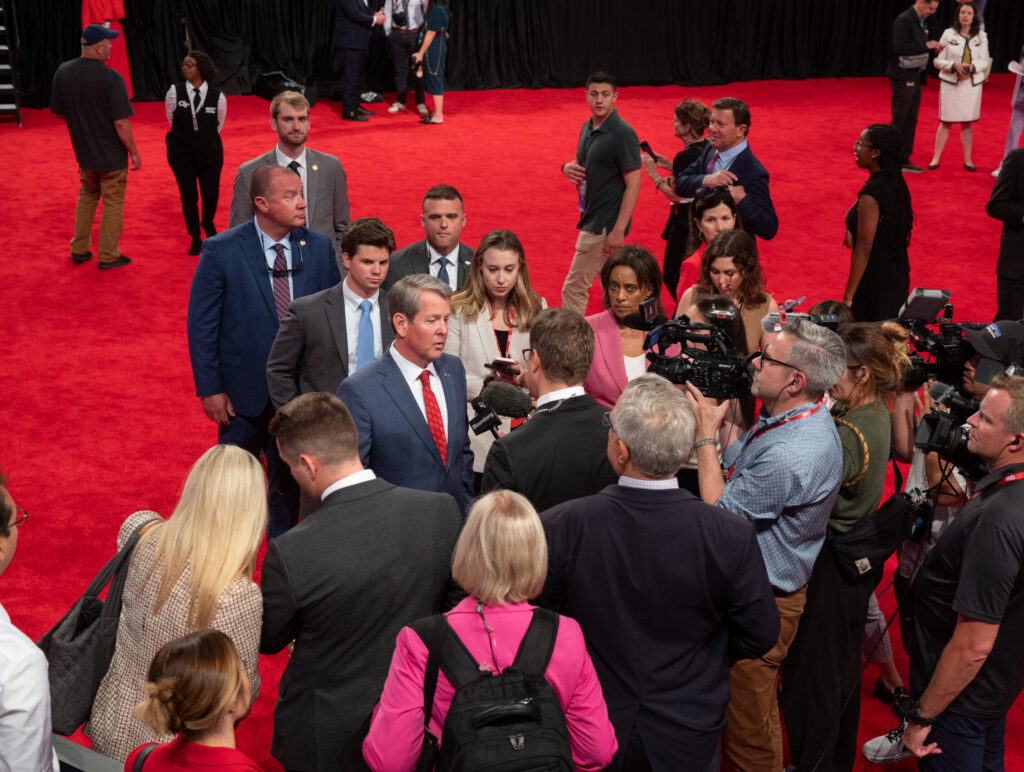
Thanks to CNN, the Technique had the opportunity to represent the Institute in the spin room. Over 800 U.S. and foreign press members representing over 100 countries gathered in McCamish. What is usually a basketball court was transformed into a spin room, complete with a red carpet and press boxes lining the court’s sidelines where news organizations like CNN, MSNBC and Fox News simulcasted the debate and conducted live interviews with campaign surrogates and experts. 

A spin room is the epicenter of media coverage for a debate, providing a designated area where campaign representatives can speak to the press and “spin” the results of the debate in their respective candidate’s favor. There, America’s most prominent politicians answered the student body’s most pressing questions for the two candidates who were preparing just across the street from Tech’s campus. 

Access to reproductive healthcare continues to be a contentious issue among college students, and voters are turning to the candidates for clear stances on the issue. When the Dobbs decision overturned Roe v. Wade in 2022, it sparked protests and counter protests at the Institute, as well as in the greater Atlanta area. Now, states have the right to restrict or ban abortions, and Trump seemed to agree with this decision during the debate. 

“And what I did is I put three great Supreme Court justices on the court, and they happened to vote in favor of killing Roe v. Wade and moving it back to the states. This is something that everybody wanted,” said Trump in response to a question about banning abortion medication. “Now the states are working it out. … But I believe in the exceptions for rape, incest, and the life of the mother. I think it’s very important. Some people don’t. Follow your heart.”

Biden has said on multiple instances that he will override the Roe decision, and that he blames the restrictions on the Trump-influenced Supreme Court. In the spin room, Gov. Gavin Newsom (D-Calif.) delivered a chilling message to young voters about why advocating for reproductive rights should be  important to them.

“In the United States of America, we had 171,000 last year that had to leave their state to access their reproductive freedoms. That’s the world of Donald Trump. That’s 64,000 pregnancies related to rape in states that denied access to reproductive care. … A 12 year-old was raped in Mississippi that was forced to take the kid to term, and now she’s forced to take that kid to seventh grade. That’s the world of Donald Trump. You have a kid in Louisiana who was raped and had a baby clutching her teddy bear as she gave birth. That’s Donald Trump’s America. This is serious stuff, … and I want to applaud Vice President Harris for being a strong, clarifying advocate for women and girls, which is advocacy for all of us,” said Newsom. 

Another topic that has been important to students is concerns about student loans. Biden’s Saving on a Valuable Education (SAVE) plan for student loan forgiveness provides aid to college graduates across the nation, but aspects of the plan are currently on hold due to ongoing lawsuits arguing that the plan is a breach of executive authority. According to Education Data Initiative, the average public university student accrues $32,637 of debt to attain a bachelor’s degree. While Biden argues for SAVE’s validity, Rep. Byron Donalds (R-Fla.) calls for it to be repealed, and he gave Tech students who may incur student loans a different perspective on the issue before the debate. 

“The student loan bailout, in my opinion, is unconstitutional,” said Donalds. “Congress never acted to say ‘yeah we’re gonna forgive student loans that the American taxpayer has backed and subsidized.’ Joe Biden did that with a pen and a phone. That’s not presidential, [and] that’s not the way our system works. You cannot take money from two thirds of the American people to give it to a third of the American people and say that’s working out for everybody. That’s not not a recipe for long term success. … It’s going to lead to more inflation as a result.”

When asked how students are expected to finance their education without this program, Donalds encouraged students to treat their education like an investment, and he mentioned that institutions of higher education should stop “selling the dream” to young students that all degrees are equal. 

“To students who struggle to finance their education, number one, be really cognizant of what you’re majoring in,” Donalds said. “Whether it’s kids here at Georgia Tech, or anywhere in the country, we have to be honest with them that all college degrees are not the same. We like to say that they are, but they’re not when you get into the real world. Debt is not a terrible thing, as long as you’re using it to acquire an asset that has value in the future. … A degree in humanities does not have the same economic value as a degree in finance, or accounting or engineering. We have to be smarter about how young people are going to college, because they have to deal with that debt burden.”

Additionally, Tech students wanted to hear the candidates’ thoughts on what role they might play in curtailing the progression of climate change and developing a more sustainable future. When moderator Dana Bash asked candidates how they would deal with the climate crisis, neither one gave a direct answer. Biden briefly referenced his passing of the Inflation Reduction Act, which is expected to cut greenhouse gas emissions by 42%. Meanwhile, Trump claimed that he had the “best environmental numbers ever.” 

Georgia Sen. Raphael Warnock encouraged Tech students to lead the innovation of a sustainable future, and he said that Georgia has become a leader in green energy development thanks to Biden’s infrastructure developments. 

“Young people need to think about all the issues that they care about. I’m proud of what the Biden administration has done, for example, for creating a sustainable, green-energy future that protects the planet and creates jobs. … Georgia, because of the investments he made with the Inflation Reduction Act, is actually leading the way on that front. I’m proud of the fact that Dalton, Ga., the textile capital of the world, is also now the biggest producer of domestic solar panels in the western hemisphere. The students at Georgia Tech who are majoring in engineering, these smart young people are a part of that future,” said Warnock.

Directly after the debate, the general consensus among the present media was that Biden had lost. The debate was an opportunity to dispel voters’ reservations about his age and viability as a candidate, but his poor performance instead reinforced these doubts from his supporters and opponents alike. In the weeks following the debate, calls within the Democratic Party to replace Biden seem to grow louder each day, yet he remains adamant that he can succeed in another term. 

President Biden’s campaign representatives gathered for a solemn statement in the spin room in which they urged voters to not vote for former President Trump. // Photo by Alec Grosswald, Student Publications.

The Democrats deviated from a normal post-debate strategy. Usually, each candidate’s campaign surrogates will remain on the spin room floor answering individual questions for hours following the debate. This time, they gathered on the floor behind what is usually the free-throw line, and they each gave a solemn statement with one central message: the debate made it clear that despite Biden’s shortcomings, they need the nation’s support in preventing Trump from serving another term in office.

“This election isn’t about all the lies that Trump is selling you,” said Rep. Jasmine Crockett (D-Texas). “What it’s about are the facts. The facts are that he took that right [referring to reproductive healthcare] away from us, and he wants to take more rights away from us, and he did not shy away from it. Every time he did not want to answer a question, he just decided to deflect.”

After about ten minutes, the Democrats concluded their statements and accepted a couple of questions from the media before promptly exiting McCamish. In their wake, they left over a dozen of Trump’s campaign surrogates alone with the press for over an hour, giving them plenty of time to send a ubiquitous message to every news channel — this debate was a complete and utter victory for Trump. 

Rep. Matt Gaetz (R-Fla.) is one of Trump’s top campaign surrogates, and he remained on the spin room floor to discuss the strengths of Trump’s arguments and Biden’s exposed weaknesses. At 42, Gaetz is over 15 years younger than the median age of the House of Representatives, and he had a unique message to share with young voters regarding the upcoming election. 

“Joe Biden is not their president. I can’t imagine how a young American would look at what they saw from Biden tonight and think they wanna ride with that guy. Like something broke with ‘Brandon’ tonight. I’m not entirely sure what it was, but it’s off kilter. President Trump wants to make sure that young people have excellent jobs and can buy homes. Right now, young people are being turned into a generation of serfs who will rent forever and never build wealth the way our parents and grandparents did. Under President Trump’s economic policies, we will have lower interest rates [and] access to capital. Young people will be able to take risks and start businesses and do the things that fulfill the great American promise. Joe Biden has killed the American dream, and frankly, this debate for him was a colossal nightmare,” said Gaetz.

Overall, it is unclear to what extent the debate will affect either candidate’s votes. It served as evidence of their increasing ages and decreasing ability to levy an effective argument against one another. As a result, young voters continue to express their disillusionment towards the election process. According to a poll by the Harvard Political Review, 40% of voters ages 18-29 do not think their vote will make a real difference in the upcoming election. In an interview with the Technique, Warnock and former Atlanta Mayor Keisha Lance-Bottoms expressed the importance of young voters in the presidential election. 

“I think that it is perfectly okay to be disillusioned, but you can’t give up. Think about the Civil Rights Movement. We’re in front of the pastor of Ebenezer Baptist Church, and it was a process; it wasn’t just a one time event. It really was a revolution. That is what you all have before yourselves. You are a part of making lasting change.  It’s not gonna happen overnight. … If you’re not involved, then you’re ensuring [the system’s] failure,” said Bottoms. 

Warnock continued, “Feeling disillusioned is not a reason to become disengaged. In fact, it’s a reason to become more engaged. There have been no great movements in this country, like the Civil Rights Movement, without young people. I think that there are politicians who want to see young people [get out the vote] because they’re counting on you. You have to show up and hold the people that you are voting for accountable.”

The post A firsthand analysis of the 2024 Presidential Debate’s Spin Room appeared first on Technique.

Posted in UncategorizedComments Off on A firsthand analysis of the 2024 Presidential Debate’s Spin Room

Tech hosts Annual Protective Relaying Conference

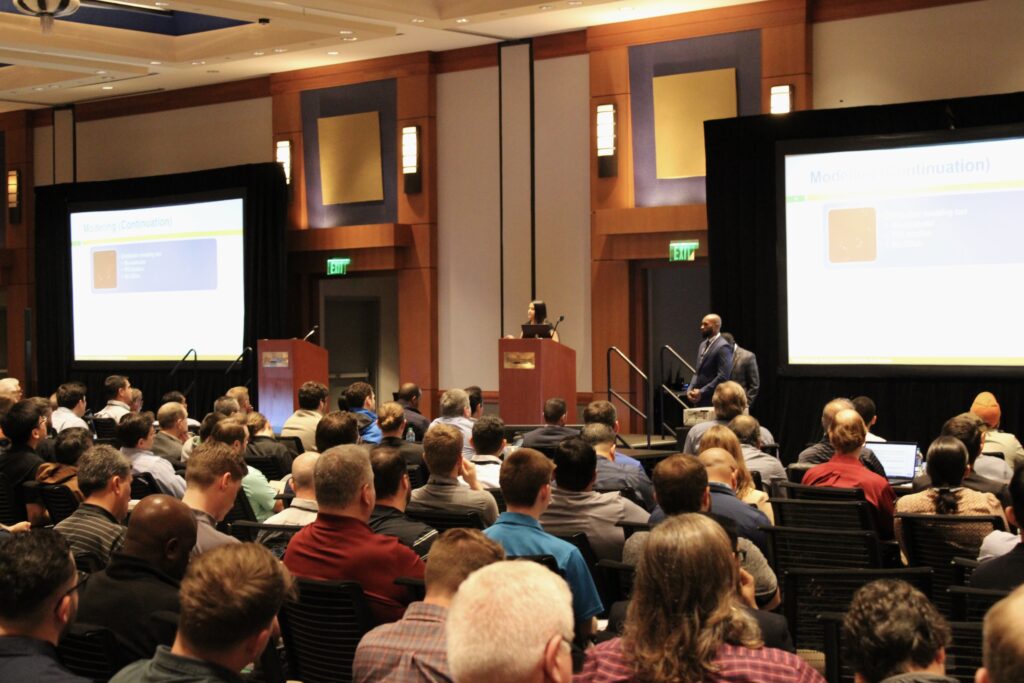
Professor A.P. “Sakis” Meliopolous, PhD, hosted the 2024 Georgia Tech Protective Relaying Conference, from April 24 through 27. The three-day event provided a platform for the leading engineers, technicians, consultants and other stakeholders in the power grid protection industry field to discuss the latest advancements in the field. 

In the power grid, protective relays act as smart circuit breakers, constantly monitoring for dangerous conditions and tripping specific sections to isolate faults. This crucial function within the power grid protection industry ensures the safe and reliable operation of large-scale electric networks.

The conference delved into specific areas of current research and development within protective relaying. During its morning sessions, leading scientists and engineers in this protective relaying field presented the results of their research from the past year regarding a specific problem area followed by a short Q&A session. 

“The planning committee and I review all the research papers that are submitted and decide what to feature in the conference. Last year, we had about 100 paper submissions, but the program only accepted 40 of them. After they present, all the authors of the paper receive a certificate of completion,” said Meliopolous. 

Multiple research papers focused on accommodating the growth of sustainable development in the industry, specifically in the form of distributed generation systems. Distributed generation refers to the use of small-scale power generation sources, often renewable, located closer to points of consumption. As communities develop more sustainable forms of energy generation and consumption, many have adopted this as a solution, producing small-scale solar farms or hydroelectric dams that power their community. These innovations feed power to the grid with different electrical aspects and properties, raising unprecedented challenges for the grid’s engineers.

The Institute’s Power Systems Control and Automation Laboratory (PSCAL), spearheaded by Meliopolous, is one of the nation’s leaders in automated power systems control research, andwhich is finding solutions to this challenge. One of their more significant projects, “Autonomous, Adaptive and Secure Distribution Protection,” aims to better protect power grids that draw energy from distributed generation systems. 

Meliopolous’s master’s students were able to attend the program and facilitate it, seeing firsthand how their research is one of the most prescient topics in the industry. 

“Most of the work we do [at PSCAL] is in protective power systems, and this conference is a hub for that,” said Syed Afroz, second-year M.S. ECE. “We meet a lot of industry professionals, and we get insight into how the industry operates. We get to see how our theoretical knowledge is applied practically. … We get to network with a lot of prominent figures in the industry and share our knowledge and experiences with common industry issues and solution applications.” 

Grid cybersecurity is aAnother significant area where the industry is evolving. is grid cybersecurity. According to the North American Electric Reliability Corporation (NERC), U.S. power grids are increasingly vulnerable to cyberattacks, with the number of susceptible access points in electrical networks increasing by about 60 per day. 

In addition to facilitating the convention, Meliopolous oversees various premier research, academic and professional programs at the Institute related to electrical systems. Last year, he won the Institute of Electrical and Electronics Engineers (IEEE) Power & Energy Society Outstanding Power Engineering Educator Award for his contributions to power system education in protection, control and operation. 

“At Georgia Tech, we have a very strong program in Protection and Controls and Cybersecurity. Everything we do in [this industry] is based on computers. All the relays are embedded in computer systems, so you can realize that when somebody tries to attack the power system, that is where he starts. In fact, we have a center [at the Institute] that monitors cyber attacks on the power system. We’re seeing millions [of attacks] per month. So people are trying continuously. Professional organizations like IEEE are constantly developing new security standards for utility companies. At the same time, the government is developing regulations to meet these standards,” Meliopolous said.

Meliopolous is an administrator, developer and professor for two significant educational programs related to power grid protection and control under the Institute’s Professional Education Department (GTPE), which educates in-industry professionals on the latest standards, strategies and technologies that are prevalent in their respective fields. According to their FY22 Impact report, GTPE enrolled over 100,000 professionals in their programs in 2022. 

“I am the academic administrator of the Power System Certificate program. The program is run in parallel by [GTPE] and the School of Electrical and Computer Engineering, and it is designed for practicing engineers. These courses usually consist of three or four days of intensive classes on the subject. We have a series of courses that are spread throughout the year, … and once they complete these, they receive a certificate of completion for it.”

Along with other professors, Meliopolous is constantly developing the courses to educate professional engineers on developing technologies and their applications in the power grid protection industry. 

“For example, we have one course where we teach what happens in a control center, which is typically what operates and monitors a power system. Since the systems there are updated frequently, engineers come to learn the new industry standards that utilities implement. We also have courses on protection and control, power quality, grounding and power electronics. These courses cover what ECE students learn here, but they are designed to assume that these engineers already know the basics,” Meliopolous said. 

He also leads multiple master’s programs in the field, providing opportunities for engineers to build their expertise in certain subject areas within electrical systems that apply to modern industry standards.

“Additionally, we have an online program where students can earn a M.S. in Cybersecurity for Electric Energy Systems. This is also run by the Professional Education Department, but unlike the certificate program, it operates on a semester system. The program has 10 courses, and I am teaching two of them, which I developed,” said Meliopolous. 

The 2024 Georgia Tech Protective Relaying Conference addressed the critical role protective relays play in ensuring a safe and reliable grid, and it continues to solidify the Institute’s leading position in power systems research and education.

The post Tech hosts Annual Protective Relaying Conference appeared first on Technique.

Posted in UncategorizedComments Off on Tech hosts Annual Protective Relaying Conference

“Inside Out 2” Review: Puberty Hits Hard

Like many sequels, “Inside Out 2” coasted on the emotional waves of its predecessor. The return of beloved characters like Joy (Amy Poehler), Sadness (Phyllis Smith), Anger (Lewis Black), Fear (Tony Hale) and Disgust (Liza Lapira) brings an intense feeling of nostalgia to the feature for many viewers who saw the premiere of “Inside Out” just under nine years ago. Ironically, Nostalgia is a new emotion who only makes a couple of cameos in Riley’s consciousness despite the movie being chock full of it. 

“Inside Out 2” finds Riley (Kaitlyn Dias), now a teenager, facing puberty’s emotional rollercoaster. New emotions like Anxiety (Maya Hawke) take charge, pushing aside her core personality in a bid for success. Joy and the original crew must delve into the recesses of Riley’s mind to retrieve her sense of self, navigating the complexities of adolescence and rediscovering the importance of all emotions in this journey of self-discovery.

The director Kelsey Mann and his team produced a strikingly accurate depiction of puberty in all of its complexity. With the arrival of new emotions and a developing belief system, every decision that Riley faces, like making friends at a new school or earning a spot on the hockey team, becomes infinitely more complex. Anxiety and Envy’s (Ayo Edibiri) actions perfectly emulate what it felt like to become a teenager and suddenly have the urge to fit in with the “cool kids,” coming at the price of one’s vulnerably new sense of self. 

Similar to “Soul,” the feature’s use of more complex emotions and themes make it better suited for a more mature audience. Though it does have its goofy moments, young kids likely cannot relate to Anxiety, or even understand what it is. Parents should beware that unless they have sat down with their child for that dreaded puberty talk, they might have a few questions in the theater.

Joy and the crew’s journey to retrieve Riley’s sense of self was a hilariously random foil to the somewhat tragic plot of Anxiety’s takeover. Reminiscent of Pixar classics like “Monsters Inc.” and “Toy Story,” this part of the film delivered one hilarious gag after another that had audience members of all ages roaring with laughter. 

Overall, the plot was somewhat forgettable, and the emotional moments leveraged the audience’s emotional attachment to the characters that the filmmakers garnered during the first movie. However, along with a predictably wholesome and happy ending, the whole film effectively drives home one central message: at the end of the day, Riley is still a nice, ordinary kid. 

In terms of individual performances, Poehler’s stellar delivery of Joy’s emotional moments really tugged at the audience’s heart strings. On the other hand, Hawke’s performance was unimpressive. She was handed a perfectly-written character, but her delivery failed to add any unique aspects. Also, Ennui’s character was unnecessary and somewhat cringey. Maybe children and parents found the character’s indulgence of the teenage angst cliché funny, but it is unappealing to many teens and young adults.

While “Inside Out 2” might not be a groundbreaking sequel, it offers a charming and relatable return to the world of Riley’s emotions. The animation remains stunning, the new characters are interesting additions and the core message about embracing all of one’s emotions and memories resonates well with the audience. If you grew up on the first movie, definitely return to the theater for this one.

The post “Inside Out 2” Review: Puberty Hits Hard appeared first on Technique.

Posted in UncategorizedComments Off on “Inside Out 2” Review: Puberty Hits Hard

SGA announces election results amongst controversy

This Tuesday at 12 p.m., students gathered at Harrison Square to hear the results of this year’s contested Student Government Association (SGA) Undergraduate Executive Ticket and Undergraduate House of Representatives (UHR) elections. It was announced that Shivani Virani, third-year NEUR and Julia Haley, third-year PUBP, would be next year’s SGA President and Executive Vice President, respectively. They beat out Aditya “AP” Prabhakar, second-year NEUR, and Cole Scott, third-year BA, in a student body vote of 1152 to 836, according to the Undergraduate Elections HQ page of the SGA website.

Anticipation surrounding the elections has boiled over in the past weeks as on Friday, March 15, the original date when results were supposed to be disclosed, SGA announced that they would be delayed until further notice. Rumors on campus began to swirl regarding elections violations, and when a detailed results page appeared on the website Tuesday afternoon, it confirmed them — the SGA Elections Committee deducted 4% of Virani and Haley’s votes and 7% of Prabakhar and Scott’s votes due to violations. 

“I kept checking the SGA Instagram for results, but I didn’t see anything. I heard from my friend that there were election violations, but I have no idea what actually happened,” said Evan Leahy, second-year ISYE. 

Additionally, the Biochemistry Representative vote featured a vote deduction amid a highly contested election. Erin Leal,  third-year BCHM, received a 2% vote deduction for an election violation and lost to her opponent Dhwani Patel, second-year BCHM in a vote of 24-23. Prior to the deduction, the two candidates were tied, so Erin’s count was floor rounded to 23 to represent the deducted value. The deduction essentially acted as a tiebreaker between the two candidates, giving Patel the win. 

All three groups received a 2% deduction for violating Section V Subsection I of the SGA Elections Code, which states that “No campaign materials may display any image of a logo or trademark of the Georgia Institute of Technology, or any division thereof.” 

Virani and Haley received an additional 2% vote reduction, and Prabhakar and Scott received an additional 5% deduction for violating a different statute of the code. The election results page cites Section V A.6, Section V B.1 and Section V H of the Elections Code, which all have to do with standard campaigning practices. 

Section A of the code defines campaigning, which is prohibited outside of the official campaigning period, and Section B outlines certain campaigning protocols which students must follow. The specific code cited says that campaign members cannot solicit two or more students for votes at the same time
outside of the campaign period.

Section V H of the code is also cited under the same deduction, and it states that “the use of any Student Government Association logo, letterhead, office equipment, office supplies, meeting space or personnel is prohibited.”

Since all three statutes were listed for the same deduction, it implies that one action or series of actions incurred them simultaneously. However, due to the sensitive nature of the violations hearing process, SGA cannot release further details related to the specific actions that sparked the violations. Clare Chung, second-year ISYE, is the SGA Elections Committee Chair, and she explains how the process works and what factors play a role in determining the violations
and their associated penalties. 

“Once a violation is first filed, the Elections Committee decides on whether it is considered a major or minor violation as well as the penalty if necessary within 24 hours. General classifications are in the code, but decisions are based on discussions between committee members and are voted upon on a case-to-case basis depending on the exact evidence provided by the violation submitter. Details related to evidence are confidential but that is the general process,” Chung said.

According to the SGA Elections code, penalties can vary depending on the severity of the violation. Minor violations result in penalties like vote deductions, but major offenses, such as tampering with the elections process, permanently disqualify candidates from ever holding an SGA position and could incur disciplinary action from the Office of Student Integrity. 

“Penalties are decided in the process as above, through discussion and voting. Final decisions are by majority vote and the [Undergraduate Judiciary Cabinet] UJC also gives input if necessary. Again, the process depends on each election because unexpected things can always come up. In these cases, like for this election cycle, the timing of results can sometimes be unfortunately affected,” Chung said. 

The deliberations of these penalties depend significantly on the analysis of each individual case, and they include in-depth conversations with the Elections Committee, select members of the UJC and Dean of Students John Stein, who is also SGA’s staff advisor. Similar to previous years, there were multiple election violations that the committee reviewed and either found the parties to be not guilty or found that their actions did not amount to a penalty.

“Our responsibility as a committee is to interpret violations directly against the provided evidence and the words of the Elections Code. So we have very little room to consider broader or personal context while remaining unbiased, but we still have to be reasonable towards all the candidates. Ideally, we wouldn’t penalize anyone because the votes of the student body should hold the most weight in these elections. But when certain positions are contested, the natural competition makes that more difficult,” Chung said. 

Though the aforementioned candidates were penalized for election violations, the election results illustrate that they did not skew the Executive Ticket vote enough to significantly affect its outcome. 

As of Monday, all results are final, and Virani and Haley will be next term’s SGA President and Executive Vice President. At the announcement, Virani and Haley expressed their enthusiasm for the upcoming term. 

“We’re really looking forward to [the next year] and grateful to the Elections Committee for the smooth process, even if it was a little delayed. … There’s been a lot of things that this administration is still working on that we want to pick up and keep momentum on [while] starting our own initiatives in the new semester,” Haley said. 

This year’s SGA ballot also featured expansions in student representation, like an increased number of representatives for larger majors like CS. Amanda Ehrenhalt, second-year ISYE, will fill the previously vacant role of Athletics Representative this term. 

“I’m looking forward to increasing the alliance and connection between the Athletics community and the greater student body. Through close collaboration with the Georgia Tech Athletics Association and the Student Athlete Advisory Board, I hope to focus on events involving the Total Person Program and SGA. As I step into this role, I am eager to receive feedback from students in all spheres of campus with the goal to build our representation and foster an interconnected campus of all students across Tech,” Ehrenhalt said.

Notwithstanding the violations, all of the SGA candidates in this election season exhibited a strong dedication to serve the interests of the student body. Later this month, the new officials will be inaugurated at the SGA banquet, ushering in a suite of students eager to make an impact on student life at the Institute.

The post SGA announces election results amongst controversy appeared first on Technique.

Posted in UncategorizedComments Off on SGA announces election results amongst controversy

YJRD takes down Marble City Mayhem

Coming off a victory in their last bout against Peach State, the Yellow Jacket Roller Derby team (YJRD) faced Knoxville’s Marble City Mayhem in their third home bout of the fall season. Though the Mayhem put up an intense fight, the Jackets maintained their lead through the entire bout with a victorious final score of 189-161. 

Roller derby bouts consist of two thirty-minute halves where two teams of five players face off on a flat, elliptical track. The halves are composed of several two-minute-long jams where players can score. Each team has one jammer as their offense and four blockers as their defense. The jammers’ goal is to lap the opposing blockers, and their team receives a point for each opponent  they pass. In the first pass, the jammers do not score points, but the first jammer to lead the pack achieves lead jammer status, allowing them to stop the jam at any point. 

After some motivation from team captain Primm Reaper, the Jackets were feeling more than ready to face off against the Marble City Mayhem. Monstrous Nightmare made a strong drive as the lead jammer out of the gate, starting YJRD with a lead. Boulder came in as their next jammer during a power jam, which occurs when the opposing jammer is in the penalty box. YJRD took advantage of this, making three passes and scoring big before the opposing jammer had a chance to get back in the game and stop it. 

With GingerSnap and Primm Reaper playing solid defense, Scare Bear slid effortlessly through the pack. Calling upon their figure skating experience, they side-surf past Marble City’s defenders along the inside line of the track. 

Later in the half, Lightning McLynn put up a fierce offense as the jammer. Even after getting recycled two times, she stepped back into the track and pushed past Marble City’s defenders to score a few points. The first period concluded with YJRD up 115-57.

The score crept closer to a tie in the second period, but the Jackets held down the fort with a brick wall of a defense. In more than one instance, three of YJRD’s defenders would lock elbows to form an impenetrable wall that prevented the opposing jammer from scoring a single point on them. 

Veteran player Sweet n’ Sour, nicknamed “Sweetie,” showed her expertise in the second half when they scored a remarkable 19 points in a single two-minute jam, effortlessly dodging the incoming barrage of shoulders and elbows. At one point, Sweetie leaped across a corner of the track, passing three opposing blockers and landing a near-perfect dismount. Unfortunately, the opposition held the lead jammer status and ended the jam just before their skates touched the ground to score points. 

As the second period winded down, the physical intensity of the bout started to wear on the players, but the Jackets did not falter. McLynn fell to the ground after a brutal hit, but she recovered quickly and later overcame the fatigue to score an eight-point jam. 

The bout ended in a win for Tech, with players Tonya Hardass and Boulder winning best blocker and best jammer. Each player on YJRD gave it their all on Sunday and put up an intensely fierce fight until the very end of the bout. Students can watch YJRD’s Exhibition Bout at the Exhibition Hall on Sunday, Nov. 12 at 2 p.m.

YJRD is an all-gender club sport, and interested students can join as “newbies” during the open enrollment period at the beginning of the 2024 spring semester. 

The post YJRD takes down Marble City Mayhem appeared first on Technique.

Posted in UncategorizedComments Off on YJRD takes down Marble City Mayhem

Crush the cringe culture crisis

Everyone who has TikTok is bound to come across a video whose audience has deemed it cringy, whether it be a 13-year-old dressed in their favorite cosplay or a micro celebrity embarrassing themselves in a public interview. Anonymous accounts fill the comments section with backhanded remarks like “Look guys, we found the original” or “cuteness overload,” often gaining more likes than the actual video. Although cringe is an innately human feeling, projecting that feeling onto others is a form of cyberbullying that mainly targets marginalized groups. 

Let it be known that I neither detest cringing, nor do I think that everyone should stop doing it. The feeling of secondhand embarrassment is universal and is an important facet of our social nature as human beings. 

The Cambridge Dictionary defines cringe as feeling “very embarrassed, and often [showing] this by a physical movement or expression.” These movements typically manifest in the form of grimacing, turning one’s head or wrinkling one’s nose. These are physical indicators of “vicarious social pain,” according to a journal published by Social Cognitive and Affective Neuroscience. 

Despite its negative connotation, the act of cringing demonstrates our empathetic nature as humans. In fact, the degree to which we cringe at someone depends on how much we relate to the person directly receiving the embarrassment. 

The more we relate to an individual, the more we are able to visualize ourselves in their shoes and experience their pain or pleasure.  Therefore, cringing at a video online establishes an emotional link between the viewer and the video publisher. This reaction itself is not problematic; it is an involuntary reflex resulting from our brain interacting with established social norms. 

The problem with cringe culture lies within its name — social media users have developed a culture of shaming others for acting in a manner that does not harm or disturb others. 

Though it started in the late 2010s, cringe culture escalated notably during the pandemic. With no other outlet for expression, teens turned to social media to discuss their special interests and join communities with other like-minded individuals. Suddenly, they became victims of intense, unjustified cyberbullying. A notable example of this is the proliferation of cosplay on TikTok. Cosplaying is the act of representing a fictional character by wearing costumes and emulating the character’s personality. Cosplay is considered a performance art, and portraying a character successfully takes time, effort and talent. However, when cosplay artists would display the fruits of their labor on social media, they mostly received comments
calling them cringy. This may not be a universal phenomenon, but I have observed people consistently being shamed for practicing an art form that is known for its inclusive community because others believe it to be cringy. 

Cringe culture perpetuates harmful social norms that do not have a place in modern society and otherizes members of marginalized groups, particularly the neurodivergent and LGBTQ+ communities. According to stopbullying.gov, “more U.S. high school students who self-identify as lesbian, gay, or bisexual (LGB) report having been … cyberbullied (27%) in the past year than their straight peers [13%].”

Cyberbullying, even if users participate in it unknowingly, has serious ramifications for vulnerable youth. Saying something or someone is cringy is simply an indirect form of shaming others. Social media gives users the unique opportunity to freely display their hobbies and interests, and it is imperative that we preserve this privilege by striving to create a tolerant and inclusive online community, even if it means toning down the sarcasm. Cringe culture needs to end. 

Posted in UncategorizedComments Off on Crush the cringe culture crisis

Tech advances free campus speech protections

At the beginning of this month, the Foundation for Individual Rights and Expression (FIRE) released its annual College Free Speech Rankings. Tech rose significantly in the rankings, jumping from 90th place in last year’s report to 27th place. FIRE develops its report based on a survey of 55,102 college students attending 254 accredited colleges. 

According to FIRE’s website, the College Free Speech Rankings are based on a composite score of 13 questions, six of which survey student perceptions of their campus environment. The other seven assess faculty and staff responses to the expression of ideas on campus. Most questions asked students if they felt comfortable expressing a controversial political opinion to a variety of audiences through various media. Higher scores indicate a better campus climate for free speech and expression.

Dr. Luoluo Hong is the Vice President for Student Engagement & Well-Being (SEWB), and her department works alongside others to foster a healthy free speech climate on campus for students and faculty. 

“Under President Cabrera’s leadership, all members of Georgia Tech’s administration are deeply committed to protecting and promoting free speech across campus. After the results came out last year, Georgia Tech reviewed its policies and procedures and made substantive changes to better protect the freedom of expression rights of students, faculty, staff and guests at Georgia Tech. This is a major reason for the leap forward in our ranking,” says Hong. 

The organization deemed the Institute’s speech climate “slightly above average” and assigned it a speech code of “green,” meaning that it is generally safe for students to express their ideas on campus. Hong attributes this in part to the Institute’s commitment to establishing a tolerant campus environment, which is present in a new SEWB division. 

“Student Engagement & Well-Being is really making a concerted effort, along with other cabinet areas and the colleges, to promote a sense of belonging for all students, regardless of their identities, backgrounds or viewpoints. Students who have a sense of being welcomed and included, as well as perceive that they truly matter, are more likely to be actively engaged both in and out of the classroom and as a result experience greater holistic success. The establishment of a new division in August, known as Arts, Belonging & Community, is in part an effort to better emphasize and highlight this effort. This focus also permeates a large number of our departments and offices across SEWB,” Hong says. 

Tech is able to maintain this high standard due to the rights to free speech outlined by the Student Handbook and the University System of Georgia. However, Dr. Hong says that real changes come from enforcing these rights.

“Georgia Tech has advanced as one of its strategic values, ‘we safeguard freedom of inquiry and expression.’ This is the cornerstone of a high-quality education that prepares our graduates to work and lead into the future. We cannot truly live our values if we do not hold members of the community accountable when we don’t live up to this guiding principle.  When we are aware of potential free speech violations, we can also use those as an opportunity to educate and help people develop a better understanding of both their rights and their responsibilities where free speech is concerned,” Hong says. 

Although their review of the Institute was generally positive, Tech’s ranking page featured some testimonials from students who felt uncomfortable expressing their opinions on campus. 

“There are few instances of abortion politics being discussed on campus,” says one anonymous student. “This is a very emotionally-charged issue and it is difficult to navigate in an environment where some people may take offense to [having] a particular stance.”

Furthermore, Tech’s advancements of free speech protections have led them to navigate the discussion of hate speech versus discrimination.

“Georgia Tech administrators understand that combating discrimination and promoting free speech are not mutually exclusive. Based on our campus policy, discrimination is defined as ‘decision-making based on protected categories of race, ethnicity, ancestry, color, religion, sex (including pregnancy), sexual orientation, gender identity, national origin, age, disability, genetics, veteran status or any other category protected by law.’ GT further defines discriminatory harassment as, ‘unwelcome verbal, non-verbal or physical conduct directed against any person or group, based upon [the categories mentioned] that is so severe, pervasive or persistent as to unreasonably interfere with or limit an individual’s employment or educational opportunities,’” Hong says. 

USG policy follows the U.S. Constitution, in that there it does not make an exception for hate speech under students’ first amendment protections. In fact, the policy designates the outdoor areas of campus as “public forums for the campus community.” Therefore, Tech has a limited scope in terms of what speech they can regulate on campus. 

“As part of our commitment to fostering a Yellow Jacket community where all feel a sense of belonging, Georgia Tech strives to combat discrimination through prevention and intervention efforts. In my experience in responding to complaints of alleged discrimination, most speech that is reported ends up being protected speech and does not rise to the level of constituting unlawful discrimination or harassment. However, whenever we believe that reported behavior has potentially violated laws or policies, we will investigate and follow up, as well as provide support to those who have been negatively impacted or harmed,” Hong says.

Instead of censorship, Hong says that Tech strives to develop a community where students feel a sense of belonging, and she concluded her statement by encouraging students to engage in this process. 

“If we wish to live in a community defined by caring and compassion, we can’t just focus on our individual rights to free speech.  We also need honest, courageous conversations about the responsibility we each must uphold to consider the impact and consequences of our speech. When speech is hurtful or harmful, we need to ask ourselves, ‘Just because I have the right to say this, should I be saying this? Is this how I want to show up with others, or how I want to be a part of the GT community,’”  Hong says.

Students can learn more about the Institute’s free speech policies and any recent procedural changes that have been made and could impact them at students.gatech.edu/freedom_of_expression.

Posted in UncategorizedComments Off on Tech advances free campus speech protections

Transportation at Tech

Tech’s campus is entirely walkable, but its sprawling 400 acres can be daunting to navigate on foot. If you get exhausted from the beating Georgia sun or have no time to walk to your class across campus, have no fear! Tech’s bus system may seem unreliable, but if equipped with the necessary information, it will become a convenient tool at your disposal. 

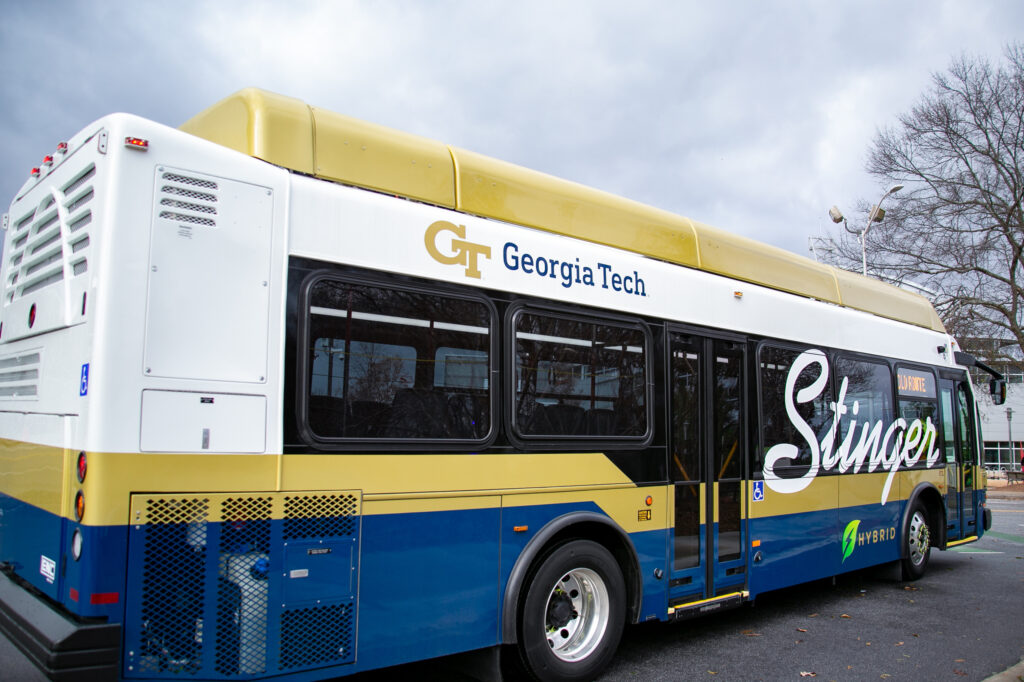
The Institute maintains a fleet of buses called Stingers, which are open to students and the general public — no boarding fee or ID required. Nine routes span the campus, including one that travels to Atlantic Station and another to Emory University. The most important routes for freshmen to know are the Gold, Red and Blue routes, which will transport you between your dorm and your classes. 

All three routes travel around Ferst Drive, but there are some key differences to be aware of for successful travel. The Gold route travels back and forth between Tech Square and the Student Center. East Campus students should catch this bus on the corner of 5th Street and Techwood Drive if they want to travel to buildings on Ferst Drive, such as Kendeda or the Instructional Center. The Red and Blue lines travel around campus with stops at the East and West campus dorms. Notably, the Red line travels from West to East, while the Blue line moves in reverse. 

Keeping these routes in mind, the most important tool in your transportation arsenal will be the TransLoc app. There, users can track the buses in real time and gauge how much time they will have to get to the nearest bus stop. The app will display all the campus bus lines, which show the ETA of the nearest bus to your location when you click on their name. 

Due to frequent stops and high pedestrian traffic, the Stinger travels much slower than expected during peak hours. Sometimes, students can arrive at their destination faster by walking briskly instead of taking the bus. Rather than wasting precious minutes of your commute waiting at the bus stop, use TransLoc to weigh your options. Usually, walking to class is more efficient if the bus takes more than five minutes to arrive. 

Tech offers two modes of nighttime transportation to help students travel safely: the Midnight Rambler and the Stingerette. The Midnight Rambler operates every day from around 9 p.m. -2 a.m., making a circular route through campus. This bus operates less frequently, so be sure to monitor it beforehand on TransLoc. 

The Stingerette is a bit more complicated to use, as it is a demand-based ridesharing system that uses smaller passenger vans instead of buses. Students can order a Stingerette by downloading the Stingerette app and making an account. The Stingerette can pick up or drop off students at almost any car-accessible location on campus, including the Home Park and Centennial Place areas for drop-off only. Its reliability fluctuates, for example, the Stingerette might take around five to ten minutes to arrive on a Monday night, but 30 minutes to an hour on a Saturday night. Be respectful to the Stingerette drivers, because lying about the number of passengers and disorderly conduct will result in denial of entry into the vehicle. 

Though it can be difficult to navigate, Tech transportation might just help you arrive on time to an exam or an important interview. Hopefully, these tips and trips will help you navigate the Stinger with confidence.

Posted in UncategorizedComments Off on Transportation at Tech

Tech Researchers Lead NASA Project

The National Aeronautics and Space Association (NASA) has selected  a team of Tech researchers to pioneer a lunar research project to support their upcoming manned voyage to the Moon.  Dr. Thomas Orlando of the School of Chemistry and Biochemistry at the Institute will lead the Center for Lunar Environment and Volatile Exploration Research (CLEVER), which aims to characterize the lunar environment and its makeup of volatile particles. 

The Center’s research is highly interdisciplinary, including professors from the School of Chemistry and Biochemistry, the Woodruff School of Mechanical Engineering, the School of Physics and the School of Earth and Atmospheric Sciences as central project leaders. Dr. Micah Schaible is the lead for the science outreach and public engagement portion of the grant. 

“Our stake in this [grant] is to characterize the environment of the Moon as thoroughly as possible so that future astronaut or robotic activities on the moon are done efficiently and safely,” says Schaible. 

“The overarching themes are to better understand how radiation from the sun affects the molecular volatile content on the Moon, how they move around the moon, and ultimately, what risks and hazards are associated with harvesting those volatiles for something like a lunar base in the future.”

Their research will aid in preparations for the Artemis Program, which aims to have astronauts on the Moon by 2024. Artemis is the first program to include a manned mission to the Moon since that of Apollo in 1969 and will send the first woman and person of color there on its voyage. CLEVER’s research about lunar volatiles, or dust, will be instrumental to the program, as lunar dust is detrimental to the health of living quarters, research instruments and the astronauts themselves.

According to NASA Science, lunar dust “is extremely fine and abrasive, almost like powdered glass. Astronauts on several Apollo missions found that it clung to everything and was almost impossible to remove; once tracked inside the Lunar Module, some of it easily became airborne, irritating lungs and eyes.”

This grant is a subsection of the Solar System Exploration Research Virtual Institute (SSERVI), a branch of NASA that focuses on  exploration of Near-Earth Asteroids, the Moon and Mars and its celestial bodies. CLEVER and  four other grant recipients under SSERVI will specifically research different aspects of the Moon and its processes. The Research Institute will hold various interdisciplinary research forums and symposiums over the five-year grant period to encourage high-level collaboration amongst the research teams.

“We will be at the NASA Exploration Science Forum each year, with this year’s taking place in mid-July. There, we will present our research to SSERVI and make connections with other groups. Additionally, each principal investigator will present findings at conferences more adjacent to their fields. For example, Dr. Linsey (ME) focuses on instrument development, and she attended the biannual Lunar Surface Innovation Consortia that focuses on tools and instruments that could be used by Artemis astronauts.”

In addition to interdisciplinary involvement at Tech, CLEVER plans to provide opportunities for Tech students to do research within their Center. They will offer most positions to graduate students but plan to open a few positions to undergraduate students as well. The research students will have the opportunity to study under multiple mentors to promote interdisciplinary research skills in their respective fields.

“Over the course of the 5-year research program,” says Shaible, “we have 30 student years of available research funding. Each of the PIs will share a graduate student… which gives the benefit of a more well-rounded student. They are the ones that will really be doing the hard work, and I am really thrilled that we are involving so many university students in this collaboration.”

Dr. Schaible says that, aside from Tech involvement, CLEVER plans to expand its education to Atlanta’s youth. 

“We do have a K-12 outreach program as well,” he says. “NASA really likes the idea of ‘building bridges’, and we really want to accomplish this by educating high school and middle school students. We are developing age-appropriate content that is lunar research-related and showing them what it looks like to be a lunar scientist at a young age.”

This outreach plan aligns with a significant pillar of SSERVI’s mission statement, as they seek to “train the next generation of explorers and encourage global public engagement.” Similarly,  they state that one of the central goals of the Artemis Program is to inspire a new generation of scientists by sending humans to the Moon. 

Tech professors’ research will be integral to NASA’s understanding of the Moon’s natural processes, and their findings will affect the long-term health of the astronauts on Artemis and the equipment they bring to the Moon. Furthermore, research from Artemis and SSERVI is a phase of NASA’s long-term plan to make human contact with Mars. They plan to apply elements of lunar research there,  exploring opportunities like resource extraction and sustained human life on the planet. Dr. Schaible advises interested students to stay alert for possible research opportunities in the coming terms. 

Posted in UncategorizedComments Off on Tech Researchers Lead NASA Project

Lana Del Rey makes waves in new album

“Thank you. I feel like being happy is the ultimate [goal], so I did it,” Lana Del Rey said in her acceptance speech for the Billboard Women in Music Visionary Award. For many longtime Lana Del Rey fans, “Did You Know That There’s a Tunnel Under Ocean Blvd” feels like the light at the end of a metaphorical tunnel, as the singer-songwriter reexamines the heavy themes of her past from a happier, more stable point of view. 

Upon listening to the album, it is clear that Del Rey’s lyrical genius rivals that of “Norman F***ing Rockwell!,” but she seems to undertake a more unfiltered, stream-of-consciousness style with her ambling, wordy verses. She reflects on how and where love appears in her life — in family and spirituality, past lovers and ultimately the self. 

Followers of the singer know that she holds her brother Charlie, sister Chuck and father Rob dear to her heart and reveres family as one of the central pillars of her life. She establishes this in the opening track, “The Grants,” where she yearns to remember her family after death, singing gracefully over the gospel tones of her background singers. She continues this sentiment into the title track, where she wishes for her legacy to not be forgotten like the literal tunnel under Ocean Blvd. 

“My pastor told me, when you leave, all you take is your memories, and I’m gonna take mine of you with me,” she sings on the first track. “I’m doing it for us, for our family line,” she continues in a swelling crescendo. 

She maintains the same creeping tempo over a hypnotic, piano-based backing through the majority of the album, exemplified in “Candy Necklace” and “Sweet.” The epitome of this style arrives halfway through the album, which provides some of the most profound lyrics of her career. She has matured past catering to the masses. Instead, she prioritizes the poetry and lets the melody chase after it.

The epitome of this comes in “Fingertips,” where, according to Genius, producer Drew Erickson assembled her voice note fragments into a coherent song with minimal instrumentals. The song has no consistent rhythm structure or chorus, mimicking the nonlinear manner in which Del Rey processes her traumatic past. She lilts through hard-hitting lyrics, once again discussing death and its impact on her. She ponders her identity in a series of desperate questions, referencing her familial love and past struggles with addiction and self-harm.

“Will I die? Or will I get to that ten-year mark? / Where I beat the extinction of telomeres? / And if I do, will you be there with me, Father, Sister, Brother? // Charlie, stop smoking, / Caroline, will you be with me? / Will the baby be alright? / Will I have one of mine? / Can I handle it even if I do?,” Del Rey sings.

After a seemingly infinite dirge of emotionally taxing lyrics backed by droning piano, Del Rey provides a much-needed release in a happy ending through the latter half of the album. 

“Let The Light In” features a happier tune accompanied by a tranquil acoustic guitar and Father John Misty’s cool rasp. “Margaret” is a beautiful ode to producer and friend Jack Antonoff’s love for his fiance Margaret Qualley. 

She advises the audience that “when you know, you know” that you love someone. The song deepened in significance when Billboard announced her engagement to manager Evan Winiker, which came as a surprise to even the most dedicated fans. In her final three songs, Del Rey returns to the superficial — paying homage to her younger, more gaudy self with trap beats reminiscent of her “Lust for Life” era. She samples “Angelina” by Tommy Genesis on “Peppers”  and remixes her own song “Venice B****” for fans on “Taco Truck x VB.” Del Rey has the unique ability to sing with earth-shattering profundity in one verse and cause listeners to cringe by calling herself “Lanita” in the next one, but this is why she retains such a cult following.

“But it’s also a perfect distillation of the duality that makes Del Rey’s 21st-century siren songs so singular,” the New York Times wrote. “Nine albums into her career, she has become a musical mermaid, capable of breathing as easily on the surface as she can in the ocean’s darkest depths.”

If you were expecting to listen to “Did You Know That There’s a Tunnel Under Ocean Blvd” and find the glamorous melancholy and grungy noir of Lana Del Rey’s older works, you would be terribly mistaken. She has matured boundlessly since her debut album “Born To Die,” and her sound has matured alongside her. 

Although some of the songs grow repetitive behind the constant backdrop of piano, the album retains masterful lyricism, beautiful vocals and a few catchy hits. “Did You Know That There’s a Tunnel Under Ocean Blvd’’ can be found on all streaming platforms and is available for purchase on vinyl in various locations.

Posted in UncategorizedComments Off on Lana Del Rey makes waves in new album