
Author Archives | Alec Grosswald

Energy Club hosts global leaders at the Southeastern Energy Conference

Energy Club @ Georgia Tech collaborated with the Institute to host their annual Southeastern Energy Conference on Feb. 28 and March 1. The theme of this year’s conference was “Going Global — Energy’s Place on the World Stage.” They hosted multiple panels where policy experts, investors and engineers discussed cutting-edge energy topics like grid cybersecurity, the future of hydrogen power, microgrids and global sustainable development. 

The conference also featured a student research symposium and two keynote speakers from the Institute: John Tien, a distinguished fellow at Tech and former deputy secretary of the U.S. Department of Homeland Security (DHS), and Tim Lieuwen, Tech’s recently confirmed Executive Vice President for Research.  

Samuel Woolsey, second-year ME, organized the conference. He told the Technique that chose speakers relevant to the theme of global development because engineering and technology, especially in the energy sector, relies on changing political and financial factors. 

“This is a topic that is very personally important to me because it [combines] the two areas I see myself going into with a career: international affairs and energy. Also, it is really important the way that they’re intertwined, and I feel that at Georgia Tech, often we’re only talking about the technology and not the ways in which the technology … affects the way that things go on in the world,” Woolsey said.

Woolsey chose keynote speakers that educated students on the nuances of emerging issues on the grid, equipping them with industry-relevant knowledge to succeed in energy jobs or research. Analytical models that project ways to achieve net-zero depend on a multitude of economic and political factors, and Lieuwen gave students advice on how to navigate them in their careers. 

“When you’re growing and learning about energy, develop a filter. You have to sort through models that are mostly myth,” Lieuwen said. 

Several conversations on hydrogen and nuclear power also discussed how these greener forms of generation factor into the energy transition. In a panel about global nuclear generation, Seth Grae, Chairman for the American Nuclear Society’s International Council, explained that a green energy portfolio with significant nuclear generation requires large scale, international collaborations on repeatable models. By adopting similar technologies, nuclear plants can work off precedent, which can enhance regulatory processes and develop a supply chain that can accommodate nuclear growth. 

The panels gave students a holistic account of each issue at hand, incorporating engineering, policy and investments experts. Woolsey said this was his intention when seeking out speakers for the conference. One panel featured the Bahamian Minister of Energy, Hon. JoBeth Coleby-Davis, who discussed her strategy to implement new grid technology in developing countries like the Bahamas. 

“I tried to focus on getting someone from academia, someone from industry, and maybe someone with a policy or government perspective  also someone with a technical perspective to draw on the engineers,” Woolsey said.

Woolsey expressed gratitude to the Institute for their support in facilitating the event and finding speakers. Ranking No. 3 in energy and fuels research, many Tech alumni have made significant contributions to the industry. Many of them are involved in Tech’s Strategic Energy Institute, which supports energy research and investments.

“Energy club’s aim has always been to advance discussion about these pressing energy challenges,” said Tejaswi Manoj, second-year ECE and Energy Club president. “That really aligns with what the Strategic Energy Institute aims to do, which is just foster research and education in this industry. They’ve always been extremely supportive of our events, and [this year] they helped us get connected with the speakers.”

Multiple faculty from the Institute also shared their expertise on grid cybersecurity. Juan Villareal, M.S. Cybersecurity ‘24, explained how as technology advanced, digital devices started to protect the grid instead of electromechanical relays, and it left critical infrastructures exposed to cyber attacks from foreign entities. He told students that supplementing their degree with cybersecurity would make them an invaluable asset in industry. 

“As an electrical engineer, you think more about physical cybersecurity, especially when they are producing [circuit] boards. Some companies can put foreign components that are used to track data. Bringing this to a broader scale and learning that there could be more danger than we previously thought was really interesting,” said Lily Alterman, first-year ECE. 

After lunch, Energy Club hosted a student research symposium where graduate students presented energy research to judges for a chance to win $300. Li Zhang (MS MSE) placed first in the symposium for his research about the vapor-phase infiltration of titanium oxide with dyes to create photocatalysts. Energy Club president says that events like these are an important part of the club’s mission to encourage academic research in energy.

Manoj says that this is just one of the ways Energy Club promotes student research. They also encourage students to work on interdisciplinary energy projects using the club’s resources and Tech’s labs and makerspaces on campus. Currently, students are developing a sidewalk that will generate electricity for Tech’s grid just by people walking on it. 

“We are currently working on building a piezoelectric sidewalk project on campus which is going to be built right next to the [Price Gilbert Memorial] Library. We are planning to get at least 50 piezoelectric tiles, ones that are also solar panels. This is an example of just one project that we’re working on with GTRI and SEI,” Manoj said. 

At their conference, Energy Club demonstrated their continued commitment to fostering grid technology development and preparing students for the energy industry. To learn more about them or join the club, visit energyclub.gatech.edu.

The post Energy Club hosts global leaders at the Southeastern Energy Conference appeared first on Technique.

Posted in UncategorizedComments Off on Energy Club hosts global leaders at the Southeastern Energy Conference

A Recap of the 2025 SGA Debate

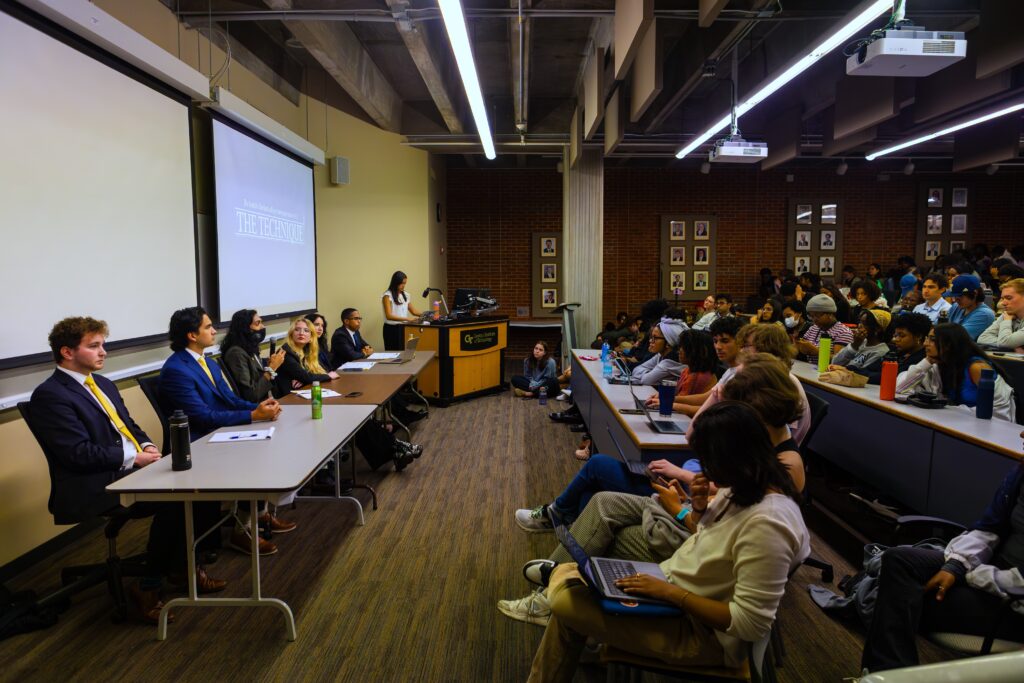
The Technique hosted its annual Undergraduate Student Government Association (SGA) debate this Tuesday, Feb. 25 where three tickets for President and Executive Vice President defended their platforms: Hunter Richardson and Noah Pastula, fourth-year CS/BA and third-year ME, Dhruv Kulkarni and Kyra Stillwagon, fourth-year LMC and fourth-year PUBP, and Sultan Ziyad and Xiomara Salinas, third-year CE and second-year ChemE. 

Sanika Tank, third-year LMC and News Editor of the Technique, moderated the debate. She gave each ticket two minutes to give opening and closing remarks and to respond to each moderator question. Then, each ticket had one minute to answer an audience question. The topics covered the candidates’ plans of action regarding the Institute’s recent Diversity, Equity, and Inclusion (DEI) language changes, enrollment growth, housing and infrastructure. 

Opening Statements

Richardson and Pastula opened by highlighting their extensive SGA experience, a combined seven years. As the current Vice President of Academic Affairs, Richardson highlighted his experience advocating for greater access to student resources and civic engagement. Pastula outlined the ticket’s goal of increasing representation for students in Tech departments that serve them. 

Kulkarni said, “Last week, we didn’t even think we were going to run, but then we realized that we had a lot of things on campus that we cared a whole lot about.” The two emphasized that despite their lack of experience within SGA, their tenure as Registered Student Organization (RSO) leaders has equipped them to lead, and they emphasized their commitment to serving the student body with transparency.

Ziyad began by outlining DRIVE, the center of the ticket’s platform. It stands for “develop SGA to champion change, respond to students swiftly, improve service to student organizations, voice student views to faculty and establish SGA’s standard of excellence.” He encouraged students to judge leaders by their “measurable impact on students” and by their “character and commitment to serving others.”

Biggest problem facing students today

Richardson, along with the other tickets, wanted to start by “addressing the reason why a lot of people are in this room.” Immediately before the debate, Dr. Luoluo Hong, Tech’s Vice President of Student Engagement and Wellbeing, held a town hall with student leaders where she discussed restructuring of resources for minority students due to changing federal and state policy around DEI. 

Richardson affirmed his and Pastula’s commitment to surrounding themselves with a diverse cabinet and to uplifting student voices on the matter. He also acknowledged Tech’s rapid increases in enrollment as a big issue. He says he will work with the administration to enact changes in “incremental steps” that will serve students. Pastula says that to achieve this, they will incorporate more students and RSOs into the SGA framework. 

Stillwagon cited a lack of SGA support for student initiatives and organizations as a larger problem that students face. She wants to make sure that RSOs are “not just part of the conversation, but the main point of the conversation” and that SGA supports students without allowing them to “lose ownership of their organization.”

Ziyad noted that the uncertainty of future administrative changes related to DEI produces uncertainty for students about the future of the Institute’s culture. He says that since SGA receives information from administrators before most students, they can communicate changes more often, in a “digestible but thorough” format. Salinas also emphasized that student needs require more representation, starting with physical needs like better infrastructure, academic needs and a need for belonging and wellbeing. 

Maintaining transparency while navigating DEI policy changes

In circling back to this topic, Richardson promised to meet minority students where they are to get direct feedback from affected communities, and he also wants to bring back SGA town halls during this period of change. 

“Hunter and I have been in some of the most public-facing conversations with students and the most private-facing conversations with administration. We have the connections that we need to advocate for you,” Pastula said.

Kulkarni wants to use the ticket’s platform to highlight and reinforce RSOs that have provided a community for the same student groups who use the resource centers that may see changes. He said that if SGA and the administration supported and communicated with these organizations more, they could better represent them. Stillwagon encouraged students to use their voices to go to the Capitol and share their opinions on the state legislature concerning DEI.

Ziyad brought up his personal experiences with OMED and Black Culture, Innovation and Technology (BCIT). He promised to do everything in his power to preserve these programs. He and Salinas also say they want to continue the open forums for Under-Represented Groups in Education (U.R.G.E) that started last year. 

Helping students navigate on and off-campus housing challenges

Richardson was honest with the crowd, telling students that SGA has already explored subsidizing off-campus student housing, but it is not legally feasible. Pastula says they want to “promise [students] things they can do,” which involves expanding Tech’s housing resources to include residents on and off campus. One specific goal the ticket mentioned was to transform the Resident Assistant (RA) curriculum to help students through the process of finding a place to live on or near campus. 

Kulkarni also acknowledged that “SGA cannot magically solve the housing crisis,” but they can effectively voice issues that residents face with their housing. Stillwagon empathized with students, saying that “what we have right now is insufficient.” She discussed her experience with untreated cockroach infestations and mold in her campus apartment and difficulties securing off-campus housing. 

Xiomara highlighted that new housing and infrastructure developments are in the works, like the Curran St. Residence coming in 2026. Like the other tickets, they highlighted the need to help students transition to off-campus housing and voice their concerns regarding on-campus housing issues to the administration. 

Audience Questions

When asked how they will balance progress with complacency given their extensive SGA experience, Richardson said that no matter what, “[Our cabinet] collectively presents a united front of the student body.” He also said that they will make notes of room for improvement based on past administrations. 

In contrast, students asked Kulkarni’s ticket about obstacles they might face due to their lack of SGA experience, what RSOs they were involved in, and why they currently feel unrepresented by SGA. They have both been a part of DramaTech, and Stillwagon mentioned that she held leadership positions in Clarkston Futures and Students Organized for Sustainability.

“What we can do is trust the people under us to make smart decisions that follow our vision … about sustainability, accessibility and community,” Kulkarni said. 

The last question probed Ziyad and Salinas on their specific plan to fund international students’ healthcare with SGA money. They want to reorganize the SGA funding endowment’s legislative reserves to create a funding pool to subsidize international students’ $1400 healthcare fee.

Closing Statements

All candidates thanked the audience for attending and encouraged them to vote, citing that last year’s election turnout represented only 11% of the student body. Pastula reiterated that his and Hunter’s actions within SGA have reflected their commitment to representing students and have fueled the 100 goals they outlined for their term. Richardson concluded by thanking the audience, saying that “you being here has enabled your peers to better serve you next year.” 

Stillwagon emphasized the need for change, saying “business as usual is not enough,” and she encouraged students to be sure that whoever they vote for is willing to fight for them and their RSO. She and Kulkarni spoke to the power of the student voice and called on the audience to use it by participating in more than just SGA elections. 

Ziyad and Salinas called students to action with a series of questions: “Do you want more of the same, or do you want to ‘DRIVE’ into the future? … Who has been out front serving a variety of communities, … and who has been meeting students where they are?” 

The polls opened on Monday, March 3, and the election results will be announced in Harrison Square on Friday, March 7. Students can vote now on Tech’s Engage homepage at gatech.campuslabs.com/engage. For more information on voting, the candidates and how to report an election violation, see sga.gatech.edu/elections.

The post A Recap of the 2025 SGA Debate appeared first on Technique.

Posted in UncategorizedComments Off on A Recap of the 2025 SGA Debate

Travis Nunnally talks Black Tech excellence

Twin brothers and Tech alumni Travis (M.S. ME ‘09) and Troy Nunnally (M.S. ECE ‘09, Ph.D. ECE ‘14) develop cutting-edge technologies for businesses, all while continuing to serve Atlanta’s Black tech ecosystem that helped them succeed. Travis spoke with the Technique about how their company, Brain Rain Solutions, grew from a startup idea at the Institute into a consulting firm that has impacted over 8,000 businesses. Since graduating, he and Troy have established deep ties between the College of Engineering (COE) and the local community, developing the talents of engineers of minority backgrounds. 

The idea for Brain Rain Solutions arose from a project the pair worked on at Tech when they noticed that the symposium at which the projects were presented lacked the software to organize and present the projects. They saw a hole in the market — they could streamline companies’ operations by integrating them with the newest available technologies. 

“We started the company as a software development agency, so we essentially partner up with small, medium and large-sized enterprise companies to help launch and release products. In 2009, Apple just launched the App Store, and the big strategic objective during those years [was] focusing on iPhone apps. We did that for years, and then in 2014, we started to focus more on augmented reality and virtual reality applications. Then, in 2017, we started to focus more on artificial intelligence (AI) applications,” Nunnally said. 

Travis and Troy are known in the local community as the “Tech Twins” for a reason — with Travis’s engineering expertise and Troy’s expertise in AI and cybersecurity, they have constantly adapted to remain at the forefront of emerging technology. According to the National Bureau of Economic Research, only 6% of U.S. businesses employed AI in some form, but Brain Rain Solutions was already developing ways to implement it in the private sector. Now, Troy says they plan to capitalize on the newest application of AI that is just beginning to grow more prevalent — fully-equipped AI agents.

“The way businesses have been [applying AI] over the past couple of years has been [of a] very narrow scope. For example, it may be a chatbot just for customer support. … We think there is going to be a move to link these narrow applications to achieve a more holistic, complex deliverable or even process. … We think the focus that a lot of companies are moving towards is AI as a process instead of AI as just a narrow deliverable. AI agents are really the big push right now for companies who are ahead of the game, and they have these AI agent swarms (a team of agents) working on complex processes. That’s essentially what we’re currently working on. At our business, we try to stay two to five years ahead of what the current industry is. That way … as customers start to think about it, we’ve already been working in that industry and have the expertise and experience to execute,” Nunnally said. 

As a master’s student in Mechanical Engineering, Nunnally developed a broad technical foundation that equipped him to navigate this emerging field, and the problem-solving skills that he learned helped him navigate the obstacles of entrepreneurship that he may not have explicitly faced in class. 

“As Mechanical Engineers, the courses we take cover the entire spectrum of engineering,” Nunnally said. “When you start a business, and you’re an engineer, you quickly realize that you can be the best talent in the world, have the best problem solving and build the best product, but if nobody knows about that product, it will die. I just had to learn that if you want to survive in a field of entrepreneurship, [marketing is] a prerequisite. At this core essence, it’s asking how to get somebody to purchase a product, and that’s the problem. As engineers, now we reverse engineer how to solve that problem. It’s really an engineering problem at its core — you’re experimenting.”

According to Nunnally, the twins also graduated from the Institute with profound relationships with their peers and the Black tech community in Atlanta, and he attributes his decision to matriculate here to programs that help develop talented engineers from underrepresented minority backgrounds. A couple of alumni he maintains a close relationship with are Atlanta Mayor Andre Dickens (ChemE ‘98), a Kappa Alpha Psi fraternity brother, and Nashlie Sephus (M.S. ECE. ’10, Ph.D. ECE ’14), an AI Scientist and Evangelist at Amazon Web Services with whom they founded their nonprofit KITTLabs. 

“To be transparent and honest, [Troy and I] would not have gone to Tech if we didn’t have some of these resources. I was born and raised in Southwest Atlanta. … When I was making my decisions of where to go to graduate school, it was based off of a fellowship called the GEM Fellowship Program, which was focused on getting minority students into graduate schools at top-tier universities. My choices were MIT, Stanford and [the Institute]. Because I’m Atlanta-born and raised, I decided to come home to Georgia Tech. … I’m a first-generation grad student, so I probably would not have had the resources to [get my degree] without turning a lot of debt,” said Nunnally. 

Now, the pair, along with Sephus and other alumni, give back to the local community through KITTLabs. There, they work to develop the talents of people of color in science, technology, engineering, arts and mathematics (STEAM) by providing a community with resources that can be difficult to find in a white male-dominated field. 

“We’ve been instrumental in linking Georgia Tech with the Black Tech ecosystem, as well as building startups and engineers and tech talent in that ecosystem as well. With KITTLabs, we’ve partnered with quite a bit of organizations in Atlanta, like Microsoft, Amazon and Meta, to help build talent in Atlanta. [KITTLabs] is near and dear to our hearts, but it’s very instrumental to keep our ties, especially in this day and age, to the Black tech ecosystem so we can at least keep it thriving and alive,” Nunnally said. 

Nunnally’s work at Brain Rain Solutions and KITTLabs embodies what it means to be a Jacket in engineering — he is innovative, adaptive and committed to serving his community.

The post Travis Nunnally talks Black Tech excellence appeared first on Technique.

Posted in UncategorizedComments Off on Travis Nunnally talks Black Tech excellence

Thrilling heists return with “Den of Thieves 2: Pantera”

When “Den of Thieves” hit theaters in 2018, it was met with moderate success in the box office and mixed reviews from critics. In the following seven years, the movie has become a cult classic among heist movie fans, leaving the sequel with big shoes to fill. 

“Den of Thieves 2: Pantera” follows “Big Nick” O’Brien (Gerard Butler) as he chases heist mastermind and escapee Donnie Wilson (O’Shea Jackson Jr.) across the Atlantic. An unlikely team-up between the two leads to an epic European diamond heist involving mafia bosses, international car chases and some unexpected twists and turns. Although the plot was bogged down with some unlikely coincidences and convolutions, the two costars deliver compelling performances, which makes the film worth the watch. 

When Donnie and Big Nick are on screen together, their dialogue is always engaging. Their chemistry is palpable, and it was obvious how close the pair had become in an interview with the Technique where Butler and Jackson Jr. discussed their experiences reprising their lead roles in the film and returning to work with director Christian Gudegast (Watch the full interview here).

“I was a little apprehensive about getting back into that role because, for Big Nick,” said Butler, “you have to go somewhere to get into that role. … But the second we started together, our chemistry was so good, and it was so much fun together. I went from ‘How do I get through this scene’ to ‘We’re killing it. What next?’”

A “Den of Thieves” sequel had been in the works since the first movie’s release, but various unfortunate circumstances like the COVID-19 pandemic, cast injuries and the war in Ukraine caused filming plans to be changed and delayed. Jackson Jr. said that despite this, it felt like they had never left, largely due to the work environment that Gudegast fostered. 

“Gudegast really makes you feel involved, like the project is ours — a one band, one sound mentality. It was good to see everyone again. It was a real feeling, like coming back to summer camp and seeing the same people there,” said Jackson Jr.

Another one of Gudegast’s directorial strengths evident in the film were the action scenes, especially car chases. They were suspenseful, well-choreographed and perfectly framed on the twists, turns and cliffs of the Canary Islands. Viewers should not get too engrossed in the chase, or they will miss a small milestone in Hollywood history — the first all-electric car used as the hero car in a chase sequence. According to Porsche, Gudegast and producer Tucker Tooley employed a fleet of five meticulously custom-engineered Taycan Turbos to execute the chase scenes. 

Butler shared that filming these chase scenes was one of the more challenging aspects of the job. 

“There were a lot of hard scenes, between being thrown in the ocean, or these crazy action scenes where [Jackson Jr.] is driving like a mad man, and I’m hanging out with the car swinging towards walls. … That was also what was fun about it, doing something challenging that … gets all the color out of the story.”

Despite this, the plot left much to be desired. After an almost two-and-a-half hour film, Big Nick and Donnie seemed to be the only dynamic characters, leaving the others underdeveloped. Despite playing an integral role in the heist and spending a lot of time on screen, Donnie’s accomplice, Jovanna (Evin Ahmad), was left with untapped potential. 

Overall, the most memorable aspect of “Den of Thieves 2: Pantera” was the joint performance of its two headliners, Jackson Jr. and Butler. Although it does not quite live up to expectations, it is still a fun watch, and watching the film in a theater is sure to accentuate its cinematic action scenes. Fans of the first feature or heist movies in general are sure to enjoy this movie, which is out in theaters now.

The post Thrilling heists return with “Den of Thieves 2: Pantera” appeared first on Technique.

Posted in UncategorizedComments Off on Thrilling heists return with “Den of Thieves 2: Pantera”

Clairo and Alice Phoebe Lou rock Fox Theatre

Last Thursday, Nov. 7, indie icon Clairo brought good vibes to the Fox Theatre, touring her recently Grammy-nominated album “Charm.” Although getting off to a bit of a slow start, Clairo and opener Alice Phoebe Lou more than charmed the audience, bringing earnest vocals and a sense of intimacy to one of the larger concert venues in the city.

Alice Matthews, known professionally as Alice Phoebe Lou, and her band stayed in a small portion of the stage in front of a curtain, but her presence reverberated through the theater the moment she began singing “Angel,” off her 2023 album “Shelter.” She brought a pleasant mix of synth pop and indie rock; the strums of her acoustic guitar were beautifully accompanied by the keyboard and percussion of her band. 


Alice’s yearning and honest voice is a standout. She sings so smoothly and compellingly that it leaves the listener with a pulling feeling in their chest. Her performance of “Lover / / Over the Moon” with its minimal guitar and keys really highlighted her smooth, melodic style. Midway through the set, she remarked that she was feeling emotional reaching the end of her tour with Clairo and how grateful she was to be performing under the crystalline sky of stars in the Fox Theatre. Her positivity and wholesomeness shone through during her set and was undoubtedly infectious.


The excitement was bubbling by the end of her set, and Alice leveraged it by ramping up the tempo with two high-energy songs. She concluded with hit song “Witches” and a new single titled “Better,” which she released later that night. By the end, everyone was on their feet. Alice Phoebe Lou’s live performance felt like an entire night in an opening set and was definitely worth attending.

During the break, hundreds of Clairo fans queued up to buy merchandise that perfectly represented Clairo’s thrifted, artsy vibe. A line of teens and young adults decked out in vintage dresses and ribbon bows complimented by leather jackets and boots wrapped through the lobby and extended down to the stage.

Alice Phoebe Lou at the Fox Theatre | Photo by Alec Grosswald Student Publications

From the second the curtain dropped, every aspect of Clairo’s show complimented her and the image she has developed from “Charm.” The band was set up around a ‘70s era conversation pit with Clairo’s microphone front-and-center, adjacent to an antique mossy-green velvet chair. The background shimmered with cedar-colored hanging beads reminiscent of vintage wood-paneled walls. Clairo’s entrance was met with a deafening applause, but the audience shortly quieted down in anticipation when instead of singing, she and her band made use of the conversation pit to share a pre-show drink of what looked like whiskey. The tone was promptly set for the night — relaxed, intimate, communal — everyone was together to have a good time. 

Clairo opened with “Nomad,” one of the singles off of “Charm” where she delicately sings through melodic bends and swirls of keeping her emotions reserved after a split. Her stage presence reflected these themes: a moonlike spotlight descended upon her mid-song, reflecting on her white silk dress and surrounding her with an angelic aura. She remained reserved, though, and she often turned her back on the audience.

Though her vocals were impeccable, it seemed that Clairo was not expressing the joy that she usually feels when performing. She stepped offstage a few times during the first few songs, and she started crying while singing “Softly.” Clairo, born Claire Cottrill here in Atlanta, is human just like us, and like many, the outcome of the presidential election just two days prior left her with mixed emotions.

She paused the set to address the crowd, visibly upset. “I’m full of so much sadness and rage today,” she said. “It’s just not up for debate. … You’re a f***ing weirdo if you want to make a decision about my body. … It’s really heavy on my heart today, but we have a show to do.”

This statement was immediately received with enthusiastic cheers of support and a standing ovation from the audience that lasted over a minute. Avid concertgoers in the city know what Atlanta concert crowds are like — extremely rowdy but respectful and supportive. The Clairo show was the epitome of that. The love emanating from the audience was palpable, and it definitely was an inflection point in the show. 

Nobody sat down afterward, and the show did indeed go on with growing audience enthusiasm that reflected back upon Clairo. She started to relax, sometimes dancing and taking sips from her drink. The audience belted every word to her jazzy rendition of 2017 indie classic “Flaming Hot Cheetos.” Claps and “woos” came when she hit the high notes in the bridge of “Terrapin.” 

Through most of the concert, Clairo maintained the lush, jazzy and reserved vibe that she established at the start. She did not move much from her microphone stand in the middle of the stage, and when she did, it was to address her band members in the conversation pit. It left the audience captivated less by her singular performance and more by that of the entire band. Hailey Niswanger (on “everything else” according to Clairo) was a definite standout. She was constantly moving around the pit, shifting effortlessly from playful backup vocals to shredding on the keys and even a killer saxophone solo.

Photo by Alec Grosswald Student Publications

The mood definitely picked up when Clairo played the teenage staples that held a lot of emotional weight for the audience. She picked up the guitar to play the opening chords to “North,” in a performance reminiscent of the studio version from her first album “Immunity,” and the energy in the room started to grow. It rose exponentially when Clairo started to perform her last and most popular songs of the night, with the drums starting to beat the rhythm of “4EVER.”

The tempo hastened even more when the band began the arrangement for “Amoeba,” and Clairo told everyone to dance and sing along to the song, lamenting that she could not be out there dancing with us. Next came “Bags” and “Sexy to Someone,” and the Fox began to reverberate with a crescendo of cheers and belts to the lyrics of these old and new classics. Clairo felt the energy, dancing with the crowd and throwing up heart signs, smiling and shouting “love you Atlanta!” on multiple occasions. 

Just when the energy reached the conceivable limit for an indie-rock concert, the newly iconic synth and keys of “Juna” started playing, and cheers almost grew deafening. It will be hard to beat the feeling of euphoria that came from belting the lyrics of that song along with every single attendee at Clairo’s packed out show. Again, in classic Atlanta fashion, a moshpit erupted in the orchestra pit, which might be a first for the Fox. There was no encore, but it did not seem to matter to fans because they had just experienced a special moment that only comes once in a lifetime.

At only 26, Clairo already has three studio albums and a Grammy nomination under her belt for a reason. For over ten years now, her beautifully tender and honest songs on love, loss and everything in between have cemented her as an indie icon, and her live show was truly an emotional experience in which her personality shone through. The “Charm” tour is a testament to her growth as an artist, and although it presented some obstacles, Atlanta’s Nov. 7 show was evidence that she will deliver an incredible performance regardless of the size of her audience.

The post Clairo and Alice Phoebe Lou rock Fox Theatre appeared first on Technique.

Posted in UncategorizedComments Off on Clairo and Alice Phoebe Lou rock Fox Theatre

Tech’s mascot wrecks a long-standing record

Matthew Kistner, fourth-year CS and former Technique sports editor, was driving students in the School of Mathematics around campus in the Ramblin’ Reck when its odometer hit 22,022 miles. Unbeknownst to his passengers, this number was a huge milestone for Kistner. It meant that as of Monday, Nov. 4, he had traveled 3,000 miles in the Ramblin’ Reck as this year’s driver, breaking a record distance that had not been recorded since the mascot’s introduction in 1961.

As the Ramblin’ Reck Club’s driver, Kistner is behind the driver’s seat at every single appearance of the Reck, both on and off campus. He is responsible for its appearance at every single football game (except for the Jackets’ home opener in Ireland) and took it to ten states throughout the Eastern U.S. The Technique sat down with Kistner in the Reck Garage, his de facto “home base,” where he stores and maintains the 1930 Ford Model A Sport Coupe. He gave insight into the work and dedication necessary to uphold the Ramblin’ Reck’s image on campus. 

“So we didn’t know the exact number of the record in mileage,” said Kistner. “We just knew that nobody had ever crossed the 3,000-mile mark. … It was something really cool and neat to get to celebrate on Monday because it was a goal of mine to [surpass] the record as much as possible. I was not really thinking about the specific record or anything like that; I just wanted to do the most I could, you know, getting the Reck out as much as possible, driving it as much as possible and making it as accessible as possible. This really cool achievement just came with that at the same time.”

The record break came at an auspicious time in the fall football season: Homecoming. Instead of resting and celebrating his achievement, Kistener got right back to work, continuing to make the Ramblin’ Reck known on campus.

“A main goal of mine was to capitalize on the opportunity for the Reck to be as visible as possible to students, alumni and really anybody coming around campus this week because the Reck has, in years past, not been the most visible. It’s been a busy week, and the game was actually the end of it all for me. For a lot of people, the game is the beginning [of their Homecoming experience], but for me, it was the end. Getting to engage with so many alumni and students on campus throughout the week was really cool,” Kistner said. 

During Homecoming week, Kistner brought the mascot to every homecoming event he was able to attend during the weekdays and played an important role in the traditional events like the Mini 500, Freshman Cake Race and the Wreck Parade. As a graduating senior and a member of the Reck Club since freshman year, he is the steward of homecoming traditions and events, which was especially gratifying for him. 

“Getting to be a part of those events was really neat, and getting to experience that from the driver’s seat of the Reck was so insane. The Freshman Cake Race was really full circle for me this year because I had been a runner, I had been a member that helped with setup, I had planned it the year before, and now I was setting the pace driving the Reck in it this year. That was something that was really sentimental for me during a homecoming week,” Kistner said. 

Kistner has taken the Ramblin’ Reck to every away game, but for every trip over seven miles, he has to tow the coupe to its destination on a trailer. So, he drove most of that 3,000-mile record here on campus, interacting with students. In order to drive as many students as possible, Kistner spearheaded a new campaign called “Ride Days,” in which RSOs can schedule four-hour blocks to ride with him anywhere on campus. 

“They are hosted out of our Reck Garage if that organization doesn’t have a hub on campus, and [what we do] is completely up to the discretion of the organization. Usually, I send them a spreadsheet where members can sign up for a 30-minute time slot to ride in the Reck. People might think that 30 minutes is a lot, but it goes by really fast. We did six of those this past week, and that put us over 15 total Ride Days this semester. It’s a lot of driving, a lot of time behind the wheel,” Kistner said. 

The abundance of miles driven on campus is a marker of Kistner’s dedication to the student body and the betterment of the Institute overall. Spending hours driving, maintaining and repairing the Ramblin’ Reck on top of his 12-credit-hour schedule requires a unique level of commitment and motivation, which Kistner seems to have plenty of. 

“I always knew I wanted to be a driver since I arrived in 2021. It was something I strived towards, and a large part of what keeps me going is a motivation and a passion and spirit for Tech, as cheesy as that is. There are days, as much as I hate to admit, when I would like to just be a student that goes to class and then goes home and goes to bed. But then I think about the fact of how rare and unique an opportunity I have every single day is. … I think about the fact that I only get 366 days to do this job, and I don’t want to leave any regrets behind.”

This year is breaking records for more than just the Ramblin’ Reck. With admissions reaching record highs and GT Athletics experiencing unprecedented growth in support (Kistner even mentioned that he had to hide the Ramblin’ Reck from rowdy fans that stormed the field last weekend), Kistner and Ramblin’ Reck Club as a whole are leveraging the refreshingly vibrant energy on campus to enrich the student experience. 

“Our president, Simran Patel, [fourth-year ECON], works really hard, and she makes my job way easier. A lot of people get confused and think that I am also the president, which is very much not the case. … My job is the car, not the Club, whereas her job is the Club. Nothing that I have achieved would be possible without her stepping up to the plate and doing everything she’s done this year. It’s not just me setting records this year, it’s also her behind the scenes,” said Kistner. 

With the win against the University of Miami, the Jackets have clinched bowl eligibility, extending Kistner’s term as driver through December, making him the first alumnus to drive the Ramblin’ Reck through the tunnel at a football game. Now a history-maker on campus, Kistner’s love for the Institute was obvious as he expressed his excitement about the Jacket’s growing school spirit. 

“There’s a whole new vibe on campus this year,” he said, “and the only thing that we can do as student leaders on campus is keep raising the bar.”

The post Tech’s mascot wrecks a long-standing record appeared first on Technique.

Posted in UncategorizedComments Off on Tech’s mascot wrecks a long-standing record

Trop-rock band Summer Salt rolls into Atlanta

Last Friday, Sept. 13, was one of the first cold and rainy nights in Atlanta, ushering in the upcoming fall season. However, the fall gloom was forgotten inside of Terminal West where Summer Salt performed an intimate show surrounded by warm lighting and cardboard waves. 

The indie surf-rock band’s Driving Back to Hawaii Fall Tour celebrates the ten-year anniversary of their inaugural EP “Driving to Hawaii.” Founded by lead singer and guitarist Matthew Terry and Eugene Chung, the surf-rock band is touring on a literal journey back to Hawaii with Winston Triolo (bass and backing vocals) and Anthony Barnett (lead guitar and backing vocals).

Before Summer Salt took to the stage, it was obvious that they had garnered a cult following over the last decade and that the vibes were going to be good. Fans filed in donning matching Hawaiian shirts and pastels and enjoyed opening sets from Mini Trees and Will Paquin.  

Opening with “Life Ain’t the Same,” an upbeat hit off of their album “Happy Camper,” Summer Salt quickly set the tone for the night — it would be upbeat yet relaxing, full of catchy tunes and wholesome interactions with the audience. 

They followed up shortly after with “Revvin’ my Cj7,” which Terry describes as an ode to his father. He sings from his point of view. Terry is almost drowned out by the audience belting along, “And I don’t know why / I’m always putting up a fight / When I’m so damn tired / From working overtime.” His almost perfectly smooth voice seemed to glide over Barnett’s jazz melodies, producing a song that has not lost its catchiness or emotional significance in the seven years since its release. 

The band’s jazz and vintage influence is evident in most of their songs, especially the ones with catchy hooks accompanied by what can only be described as beautiful harmonies that satisfy the ear. Before the band played “So Sweet to Me,” they encouraged everyone to sing the hook if they knew it, and unsurprisingly, the entire crowd started “oohing” and “aahing” at the charming hook reminiscent of a tropical beach vacation. 

Summer Salt delivers this niche sound so well that it can be easy to get lost in the music and not realize the intention behind their every move. Chung incorporates hits to the snare in such a way that keeps the crowd nodding, but not jumping. Triolo and Barnett know exactly when to amp up the vocal progressions, or when to play more conservatively to highlight a specific element of the song. The respect and admiration the band members have for each other shine through this way. 

The band incorporated a few songs from their new EP “Electrolytes” throughout the show. Songs like “Deja Vu” and “Poolside” maintain the same general feel and sound of their music but with a more mature and carefree approach. Touring member Triolo’s influence was definitely evident on the more recent projects, with his vocals occasionally coming into the spotlight in some of them.

The feelings of relaxation and warm nostalgia brought at the show so far climaxed midway through their performance of the entire “Driving to Hawaii” EP. Before performing “Tidal Waves,” Terry mentioned that it was funny how ten years later, he could still relate to this song that they do not perform often, and it was obvious that he has held a quiet reverence for it. The band as a whole paused often to share their feelings with the small audience, evoking a sense of community with the audience that added value to the show.

Unlike most of their songs that excel in melody and instrumentation, the lyrics of this song work in tandem with the composition to produce a true work of art. The jazzy guitar and drums gently build up and crash throughout the song as the title insinuates. Over it, Terry sings, “And as I fall from this home as a feather / Into your pocket where I’ll haunt myself forever.” He continues in the chorus, “What’s the day? / What’s the hour? / Sip on dreams I don’t recollect now.”

Summer Salt’s genuine emotions radiated warmth just like the concert lights. Their passion for music came through with every song. The feelings of enlightenment, nostalgia and relaxation that come with summer shine through their music, and Terry’s outstanding vocal performances accentuate them. What really made the show memorable, though, was the strong mutual appreciation between the audience and the band, creating a unique and unforgettable moment of community. Summer Salt’s Driving Back to Hawaii Fall Tour is a must see for all indie surf-rock fans, or just concert lovers in general.

The post Trop-rock band Summer Salt rolls into Atlanta appeared first on Technique.

Posted in UncategorizedComments Off on Trop-rock band Summer Salt rolls into Atlanta

Glass Animals lights up Alpharetta venue

On Aug. 8, Glass Animals landed in Alpharetta’s Ameris Bank Amphitheatre for their second show of their “Tour of Earth.” The band is currently touring their album “I Love You So F***ing Much,” which they released in July 2024. Though David Bayley (vocals), Drew MacFarlane (guitar and keyboard), Edmund Irwin-Singer (bass) and Joe Seaward (drums) started Glass Animals in 2010, they have experienced a meteoric rise since their single “Heat Waves” went viral in 2020. Now, their otherworldly production has put them among the stars.

In the minutes leading up to the concert, crowds started filing into their seats, and the audience swelled with excitement. As the sun set, the stadium lights reflected on hundreds of neon 70s-style outfits, perfectly aligning with the space-synth aesthetic of the new album. 

Glass Animals threw quite a production, and it was evident from before the show even began. Fog overwhelmed the stage, which was covered by a huge curtain displaying the album’s cover. Suddenly, the curtain fell to reveal the band playing “whatthehellishappening?” from their new album in front of a grandiose visual display. Vintage spaceship control panels surrounded the band, and an LED screen that spanned the entire stage illuminated the amphitheatre.  

During the first few songs, Bayley struggled to get comfortable with the crowd. He seemed a bit reserved, singing behind the microphone stand on the elevated back-half of the stage along with the rest of his band. The vocals were a bit shaky, but he maintained a high energy level throughout the first few songs.

The songs themselves did not stand out during the first half of the show, and the production was its most impressive element. The band shifted to a more gothic mood with their third song “Wonderful Nothing,” as the stage dimmed and flashed soft green lights. As Bayley danced across the stage, a plasma ball emerged in the center of the stage that flashed erratic rays of green light. Glass Animals totally nailed the atmosphere and aesthetics of their concert. 

The audience followed each song with roaring cheers for the band, and it was obvious that Bayley fed off of its energy. He gradually became more comfortable with the audience; he descended to the lower stage and started dancing as he performed, all with a smile on his face. By the time he started singing “Space Ghost Coast To Coast,” an upbeat hit off of their 2020 album “Dreamland,” the fans in the pit were dancing almost as
vigorously as him. 

The energy reached a climax with Bayley’s elaborate ten-minute performance of “Gooey,” the band’s first popular hit from 2014. The song blended in with most of the others in terms of sound and lyricism but gave the catchiest chorus of the night when Bayley sang, “You just wanna know those peanut butter vibes” repeatedly. In true Glass Animals fashion, the most memorable part of the night was his performance. After the first verse of the song, Bayley sprinted off stage and emerged a couple minutes later among the crowd in the lawn where he sang the next verse.

It was obvious that connecting with the audience so closely in a venue of this size was Bayley’s true passion. Any sort of reservations that their virality had converted them into one-hit wonders melted away. 

Upon his return, he took a moment to address the crowd: “I was a bit nervous to come on stage, but it’s like a big warm hug seeing all you guys,” said Bayley. 

After that performance, Glass Animals took a victory lap, playing some of their biggest hits. Each song was memorable and unique, and the energy they brought with them was unmatched. “Take A Slice” was the best song instrumentally. McFarlane played its TikTok-famous guitar solo whose suspenseful high notes sounded even better than the record. 

The show concluded with “Heat Waves” as the encore, and hearing it was worth waiting in the post-concert traffic. It is unfathomable that a wall of synthesizers accompanied by a laser light show could incite such raw emotions, but that is what Glass Animals gave in their final performance of the night. The repetition of the song’s chorus makes the melancholy breakup song incredibly catchy, forever imprinting the lyrics “Sometimes all I think about is you, late nights in the middle of June,” on the listeners. 

Most of Glass Animals’ songs were not discernible from each other save for a few hits that knocked it out of the park. Although they sometimes missed the mark on individual performances or lyricism, they nailed the concert’s production, and the visuals alone were enough to light up the entire venue and keep the whole crowd dancing. Overall, they gave Atlanta a thrilling show that the audience is sure to remember.

The post Glass Animals lights up Alpharetta venue appeared first on Technique.

Posted in UncategorizedComments Off on Glass Animals lights up Alpharetta venue

“Deadpool & Wolverine:” an epic Marvel tribute

Shawn Levy’s third film in the “Deadpool” franchise opens with Deadpool (Ryan Reynolds) in a frantic fight, but before the audience can get their bearings, he already lands two jabs on Disney for acquiring 20th Century Fox, one at Reynolds’ wife Blake Lively’s “Gossip Girl” performance and another at the audience for expecting Wolverine (Hugh Jackman) to appear so early in the story. This scene sets the self-referential tone of the rest of the film.

“Deadpool and Wolverine” is exactly what the Marvel Cinematic Universe (MCU) needed — a fast-paced, action-packed feature with an engaging and well-paced plot, unhinged comedy and thrilling fight scenes with compelling special effects. It is a refreshing standout of Marvel’s new era, reminiscent of their golden age classics. 

As expected, the team-up between the two powerhouses, Reynolds and Jackman, produced a superb joint performance. Since their first appearances in 2009’s “X-Men Origins: Wolverine,” the actors have perfected their respective characters. 

Even in a third installment, Reynolds still has not exhausted his comedic artillery. The “meta” jokes were not overused and retained their value, and he definitely made the most of the raunchy comedy in the MCU’s first R-rated movie. Jackman nails every facet of Wolverine, delivering his familiar broodiness, sarcasm and rare hilarious moments.

Both actors had serious scenes, and shockingly, Reynolds was the most compelling. He leverages the empathy fans have grown to feel for Deadpool over the first two movies and looks inward, delivering an emotional performance alongside his onscreen partner Vanessa (Morena Baccarin).  After two movies worth of Deadpool-esque shenanigans, it seems that he is finally ready to find a purpose for his powers. 

The two actors brought their commitment to the stage, giving the audience some of the most exciting fight scenes they have seen in years, with the best ones, ironically, being between each other. Clearly, Jackman’s roles in “The Greatest Showman” and “The Music Man” honed his skills in dance, sharpening his ability to follow battle choreography. The fights were agile, fast-paced and awesomely gory — probably due to “Deadpool’s” fancy new Disney budget. 

Recently, fans have complained that recent Marvel films’ battles are not as engaging because their overused, not-so-convincing CGI overwhelms the audience. But here, thanks in part to its roughly $200 million production budget, the effects were compelling, and the film boasted more action than the average Marvel movie. 

The storytelling overall was above average, but not exceptional. It felt like Levy’s purpose was to pay homage to Marvel’s 20th Century Fox characters rather than focus completely on the plot. Without spoiling the cameos, the film evokes a similar nostalgia that “Spiderman: No Way Home” did when it brought back all of the past Spiderman actors. However, even if a fan does not religiously follow the happenings of the MCU or “X-Men,” the film is still worth the watch. As usual, fans should stay for the end-credits scene to get the most out of the experience.

Levy underlines the many cameos with an unoriginal and somewhat tired “this Marvel character takes on the multiverse” premise. Though the concept is more concise in this feature compared to other newer Marvel productions, fans should watch season one of “Loki” to avoid a lot of unnecessary confusion. 

Though the multiverse contains infinite possibilities, it seems that Marvel confines itself to a similar trope each time — some big bad villain threatens to destroy the “space-time continuum,” and a ragtag group of variants must rise to the challenge and defeat them. Deadpool said it best towards the end of the movie. “Marvel, can we be done with the whole multiverse thing?” 

Marvel’s “Deadpool and Wolverine” is almost perfect. The story is good, but the characters’ performances really stand out. Reynolds and Jackman delivered the perfect mix of action, comedy and drama that would make any Marvel fan shed a tear. It brings the quality that so many have been looking for in the years since Phase 4’s onset. This is a must-watch film in theaters, and experiencing each joke and surprise cameo with an audience makes for an even better watch. 

The post “Deadpool & Wolverine:” an epic Marvel tribute appeared first on Technique.

Posted in UncategorizedComments Off on “Deadpool & Wolverine:” an epic Marvel tribute

“Deadpool and Wolverine”: an epic homage to the classics

Shawn Levy’s third film in the “Deadpool” franchise opens with Deadpool (Ryan Reynolds) in a frantic fight, but before the audience can get their bearings, he already lands two jabs on Disney for acquiring 20th Century Fox, one at Reynolds’ wife Blake Lively’s “Gossip Girl” performance and another at the audience for expecting Wolverine (Hugh Jackman) to appear so early in the story. This scene sets the self-referential tone of the rest of the film. 

“Deadpool and Wolverine” is exactly what the Marvel Cinematic Universe (MCU) needed — a fast-paced, action-packed feature with an engaging and well-paced plot, unhinged comedy and thrilling fight scenes with compelling special effects. It is a refreshing standout of Marvel’s new era, reminiscent of their golden age classics. 

As expected, the team-up between the two powerhouses, Reynolds and Jackman, produced a superb joint performance. Since their first appearances in 2009’s “X-Men Origins: Wolverine,” the actors have perfected their respective characters. 

Even in a third installment, Reynolds still has not exhausted his comedic artillery. The “meta” jokes were not overused and retained their value, and he definitely made the most of the raunchy comedy in the MCU’s first R-rated movie. Jackman nails every facet of Wolverine, delivering his familiar broodiness, sarcasm and rare hilarious moments.

Both actors had serious scenes, and shockingly, Reynolds was the most compelling. He leverages the empathy fans have grown to feel for Deadpool over the first two movies and looks inward, delivering an emotional performance alongside his onscreen partner Vanessa (Morena Baccarin).  After two movies worth of Deadpool-esque shenanigans, it seems that he is finally ready to find a purpose for his powers. 

The two actors brought their commitment to the stage, giving the audience some of the most exciting fight scenes they have seen in years, with the best ones, ironically, being between each other. Clearly, Jackman’s roles in “The Greatest Showman” and “The Music Man” honed his skills in dance, sharpening his ability to follow battle choreography. The fights were agile, fast-paced and awesomely gory — probably due to “Deadpool’s” fancy new Disney budget. 

Recently, fans have complained that recent Marvel films’ battles are not as engaging because their overused, not-so-convincing CGI overwhelms the audience. But here, thanks in part to its roughly $200 million production budget, the effects were compelling, and the film boasted more action than the average Marvel movie. 

The storytelling overall was above average, but not exceptional. It felt like Levy’s purpose was to pay homage to Marvel’s 20th Century Fox characters rather than focus completely on the plot. Without spoiling the cameos, the film evokes a similar nostalgia that “Spiderman: No Way Home” did when it brought back all of the past Spiderman actors. However, even if a fan does not religiously follow the happenings of the MCU or “X-Men,” the film is still worth the watch. As usual, fans should stay for the end-credits scene to get the most out of the experience.

Levy underlines the many cameos with an unoriginal and somewhat tired “this Marvel character takes on the multiverse” premise. Though the concept is more concise in this feature compared to other newer Marvel productions, fans should watch season one of “Loki” to avoid a lot of unnecessary confusion. 

Though the multiverse contains infinite possibilities, it seems that Marvel confines itself to a similar trope each time — some big bad villain threatens to destroy the “space-time continuum,” and a ragtag group of variants must rise to the challenge and defeat them. Deadpool said it best towards the end of the movie. “Marvel, can we be done with the whole multiverse thing?” 

Marvel’s “Deadpool and Wolverine” is almost perfect. The story is good, but the characters’ performances really stand out. Reynolds and Jackman delivered the perfect mix of action, comedy and drama that would make any Marvel fan shed a tear. It brings the quality that so many have been looking for in the years since Phase 4’s onset. This is a must-watch in theaters when it premieres on July 26, and experiencing each joke and surprise cameo with an audience makes for an even better watch. 

Our rating: 4.5/5 stars

The post “Deadpool and Wolverine”: an epic homage to the classics appeared first on Technique.

Posted in UncategorizedComments Off on “Deadpool and Wolverine”: an epic homage to the classics