Author Archives | admin

Duration of Status removal temporarily blocked by US federal court

Jose Gonzalez-Campelo/The Cougar

A US federal district court in Massachusetts has temporarily blocked the implementation of removal of Duration of Status for F-1 and J-1 non-immigrants. As a result, the D/S framework remains in place for now and no immediate action is required by international students.

The UH international community was informed about the same by the International Student and Scholar Services Office as well through an email.

“For now, please continue to follow your usual immigration requirements and maintain your status as you normally would,” ISSSO said. “There is nothing additional you need to do regarding the “Duration of Status” guidance at this time.”

While this is a relief, it is important to understand that the postponement of implementation is temporary and not a finale judgement invalidating the rule.

The new proposed rule by the Department of Homeland Security would restrict visa holders to remain in the US with fixed admission periods of two to four years, making extensions beyond four years challenging.

The court has scheduled an in-person status conference for Oct. 2, 2026.

The ISSSO continues to monitor federal guidance, court proceedings and immigration regulations closely and will keep students informed if there are any new changes impacting the students.

“We understand that changes in immigration policy can be concerning and we appreciate your patience as this situation continues to develop,” ISSSP said. “Please know that we are here to support you and will share information as soon as we have meaningful updates.”

news@thedailycougar.com

—
“Duration of Status removal temporarily blocked by US federal court” was originally posted on The Cougar

Posted in NewsComments Off on Duration of Status removal temporarily blocked by US federal court

Lame Duck

Seeing is believing, so Dan Lanning put his arms on his knees and looked down at the Boone Pickens Stadium turf as his team headed towards an unimaginable, unfathomable defeat. 

“It wasn’t close in a lot of ways,” Lanning said to the media postgame. “We got our ass kicked in a lot of areas.” 

How else to assess what happened Saturday in Stillwater, Oklahoma? 

How else for fans to feel about Oregon getting the green and yellow beat out of it to the tune of 554 total yards compared to 281 from the Ducks, then enraged?

And how else to react to Saturday, Sept. 12, 2026, marking the first time in Football Bowl Subdivision history that a team riding a 10-game losing streak broke its losing streak against a top 10 team, then deflated. 

This season — among other past ones — was supposed to be the year, with a returning Heisman-hyped quarterback, stout defensive line and a whole lot of talent everywhere. But all of that hype — and boy was there a lot of it — seemingly went out the door Saturday like air escaping a Stillwater-sized balloon. 

“I think there’s definitely concerns in general from a performance standpoint,” Lanning said. “It’s not about the players, it’s about what we’re asking them to do as coaches.” 

Last season, The Emerald wrote that “In Eugene, as in most college-football-mad cities, there are 12 one-game seasons.” But rarely does one game dictate a season like Saturday’s will. 

And yes, fans might be viewing the situation with red-colored glasses, and yes, as Lanning was sure to say, everything Oregon wants to accomplish is still in front of it. Solos don’t beat teams. Right?

But does it feel like those things will happen? Does it feel like Oregon is a blowout  — at least it really should be — of Portland State, away from catching a groove before conference play? 

Not right now. At least not to the general consensus.

The most famous cliche in sports is that there’s a whole lot of failure. But no one expected a letdown like this.

Once trailing by a point in the fourth quarter, Oregon had its comeback hopes ended after Dierre Hill Jr. fumbled a pitch from Moore with the Ducks down eight. 

“I mean, look, that’s a play that everyone will look at, and the reality is that this ball game is in no way, shape or form on Dierre,” Lanning said. “All right? We’ve seen him make a million plays here for the Ducks…. There (were) several places that we didn’t play well enough to deserve to win this game.”

It was the sort of loss that makes one reevaluate everything.

Through the season’s first week, Oregon could be characterized as a team enduring early struggles against a quality opponent.

That narrative no longer holds up.

The narrative becomes the new coordinators, the “player-led” moniker the roster has taken on, the new starters along the offensive line and in the secondary — anything that has changed since last season. 

How else can a team with this much returning talent, on the field and on the sidelines, start a season this flat?

This, after all, was the same Oklahoma State that had lost 12 straight games and only managed 10 points a week prior against Tulsa. 

And the Ducks made them look like worldbeaters. Led by Drew Mestemaker, the Pokes had an answer for every Oregon counter and won every moment that mattered. Oregon fumbled away a gimme. Literally. 

There are the football reasons that Oregon lost this game: the dropped passes and missed reads. But what fans will remember is the attitude reasons that Oregon lost this game. Everything the Ducks show you online is their choice. From the missing final score graphic on social media to who is available to speak postgame, few know what actually goes on inside the program’s walls. But there’s no hiding what happened Saturday.

And having watched his team commit the same mistakes in taut games and miss opportunities while running the same schemes that have been routinely outschemed by the sport’s best, Lanning suggested that something needed to change. However, he wouldn’t go on to say what. 

“Ultimately, plays don’t matter unless you execute the play, right?” Lanning said. “ Now, can we call better plays? Absolutely. On both sides of the ball. But that’s not — this isn’t (defensive coordinator Chris Hampton), this isn’t (offensive coordinator Drew Mehringer). ‘Oh, that’s the reason.’ Like, no. No. We have to go execute plays. If we were executing plays, and they weren’t working, that’d be different.”

Lanning’s auditing of what’s gone wrong in 2026 must go beyond what’s new. His three unsuccessful fourth-down attempts, including the head-scratching fourth-and-8, with under seven minutes left, mirrored the unfettered aggression that cost Oregon in its 2023 PAC-12 Championship loss to Washington.

Perhaps the two seasons since, in which the Ducks didn’t take a “bad loss” in the regular season, built a false sense of comfort in a now fifth-year head coach. 

These Ducks have certainly grown and made corrections in that time, but they’ve never soul-searched in the way they now must. For the man at the helm, whose seat remains ice-cold, to his credit, the search can’t overlook the hallmarks of his coaching style.

From the “feed-the-studs” mentality that has seen passes behind the line of scrimmage remain there, to the typically detailed defense that has consistently missed tackles, aspects of Lanning’s style are again being called into question.

The columns of green Ws that have lined the Ducks’ schedules for two years may have obscured flaws in the program, but now they’re unignorable.

No matter where Lanning’s tenure goes from here, his most embarrassing loss to date will be a lynchpin in it, and the Ducks’ 2027 playoff prospects rest in the program-wide soul-searching that lies ahead.

Throughout the upset, Oregon social media echoed a similar sentiment: “c’mon it’s Oklahoma  State,” rang through text chains in the Oregon stratosphere. Indeed it was. Saturday, the Pokes showed what they are all about. For now, so did the Ducks. 


The post Lame Duck appeared first on Daily Emerald.

Posted in NewsComments Off on Lame Duck

Education in America is far from equal

.flex_cell.av-av_cell_one_fourth-07d30e11a6a5b37cb8a80b2906d41ea3{
vertical-align:top;
}

Education in America is far from equal

America needs to fight for equal education as inequality in the country is peaking.

#top .hr.hr-invisible.av-av_hr-3cdc9664f29087702913853352eac422{
height:10px;
}

By JACOB STRAND

#top .hr.hr-invisible.av-av_hr-3cdc9664f29087702913853352eac422{
height:10px;
}

.avia-image-container.av-mu24ev7k-3e4fd6b1fca83295e8fde974b5fa69e0 img.avia_image{
box-shadow:none;
}
.avia-image-container.av-mu24ev7k-3e4fd6b1fca83295e8fde974b5fa69e0 .av-image-caption-overlay-center{
color:#ffffff;
}

Vine Street Elementary School in Hollywood, California has an overwhelmingly Latino student body, over 80% of which qualify for free or reduced-price meals. (Jengod / Wikimedia Commons)

.flex_cell.av-av_cell_one_fourth-07d30e11a6a5b37cb8a80b2906d41ea3{
vertical-align:top;
}

.flex_cell.av-av_cell_one_fourth-07d30e11a6a5b37cb8a80b2906d41ea3{
vertical-align:top;
}

Today, the conversation around equal educational opportunity has shifted largely to its application in higher education. 

Former President Joe Biden’s administration focused significant attention and effort on advancing actions that would apply the mission of diversity, equity and inclusion policy into the strategies and procedures of postsecondary learning institutions. 

The Biden administration’s pursuit of DEI in American universities and colleges has been met with significant resistance and reversals from President Donald Trump’s administration. This has been successfully changing the conversation concerning educational reform to postsecondary education. 


Daily headlines, sent straight to your inbox.

Subscribe to our newsletter to keep up with the latest at and around USC.

Decades of debate and reform across all levels of society and government have defined a historical –– now centuries long –– battle to provide equal opportunity of education in the United States. Despite a long succession of progress, unevenness persists in education across the country –– both in higher academia and precollege institutions.

What is being overlooked is a disparity in the distribution of resources and opportunities at the local and state levels for pre-K-12 public education, resulting in significant inequalities where the adverse consequences have continually and disproportionately affected underprivileged communities and underrepresented students. 

A study published last year revealed that the U.S. maintains the most unequal pre-K-12 public education funding in the industrialized world. Financing imbalances at the local and state levels for public education deprive students of the opportunity to succeed. 

Funding for learning in public schools varies wildly from state to state, where states with the highest funding levels spend, on average, about twice per pupil compared to states that spend the least. 

Schools predominantly in the South and Southwest are severely underfunded when compared to the Northeast. A student in New York receives almost $30,000 in state and local revenue investment into their K-12 education, while a student from Idaho only receives about $11,000.  

The funding disparity corresponds to major differences seen between states in the performance of their schools, with less revenue often correlating to worse test scores, lower graduation rates and worse academic performance in general. 

States such as Vermont, Maine and New York, which are among the top spenders per capita on their students, rank among the top in statistics like high school graduation rates and college readiness. 

In contrast, California, despite being the richest state in the country, ranks among the lowest spenders on K-12 public education per capita. Its schools boast some of the most dismal rankings in high school retention rates, ACT and SAT scoring, and National Assessment of Educational Process scoring.

Public schools’ reliance on local property taxes for revenue further contributes to inequalities in financing learning. In California specifically, school districts in well-endowed areas where property values are high capitalize on their excess revenues in ways that are simply unavailable to areas with lower property values. 

The result is what are called “excess advantage” school districts. These districts have thousands of dollars more to spend per pupil compared to regular districts, meaning more academic resources, more learning options and support, and more competitive faculty salaries for already advantaged districts. 

Despite efforts from the federal government and the states to level the playing field, they have largely failed to diminish the opportunity gap that exists from funding discrepancies. 

For example, federal funds account for about 12% of public schools’ pocketbooks, which, while meaningful, is overshadowed by local and state revenues and hardly makes up for the significant differences in funding across the board. At the same time, California funding formulas have failed to equalize the difference in funding between rich and poor districts. 

A clear example is visible here in Los Angeles County, where the Los Angeles Unified School District is outspent by Beverly Hills Unified by more than $6,000 per pupil. According to data from the 2024-2025 school year, LAUSD spent about $29,000 per pupil, while Beverly Hills Unified funding allowed for more than $35,000 per pupil.

What we’re seeing as a consequence of all these factors is that already disadvantaged districts, where the community is generally poorer and more racially diverse, are deprived of the financial resources that offer more affluent communities a legitimate and continually entrenched academic advantage.

Over the past 250 years, the U.S.’s public education system has expanded to encompass almost 50 million students and 18,000 school districts. LAUSD alone, the largest school district in California and the second largest in the nation, currently enrolls more than half a million students.  

Students and families across the nation rely on public education for their futures, for participation in higher academia and for a chance in the job market. 

Looking forward, public education faces increasing pressures, from a hostile presidential administration to growing impacts from artificial intelligence and social media. By most measures, the country is more unequal than ever. Protecting and improving public education is vital for protecting and preserving opportunity for all and meaningfully bettering the lives of millions of families across the nation.

#top .hr.hr-invisible.av-av_hr-82f5be0ae0af6a64fe3091010b237709{
height:20px;
}

.flex_cell.av-av_cell_one_fourth-158c56ad4987fbee32a30a1d6c306202{
vertical-align:top;
}

ADVERTISEMENTS

Looking to advertise with us? Visit dailytrojan.com/ads.

The post Education in America is far from equal appeared first on Daily Trojan.

Posted in NewsComments Off on Education in America is far from equal

Yes, we’re in hell. Argue with God. | Vivere et Vixisse

“We all died in 2020, and this is hell.” 

I’m sure many of you have heard this phrase in TikTok comment sections over the past several weeks. It’s an interesting phrase that is humorous or witty in conversation, but somber in reality. Hell is an incredibly religious allegory for eternal misery, and outside of that context, it seems jarring to use for comedic effect. 

Haein Shon

I’d argue that this phrase isn’t used  just for laughs, but rather as an accurate depiction of the collective consciousness that hasn’t been seen at this magnitude before. We’re on the precipice of cooperative, yet paradoxical nihilism, and it cannot be stopped unless we appeal to a neglected part of humanity — our worth outside efficiency.

We cannot deny there’s an element of satirical religiousness loaded within this phrase. It describes our current reality as a subset of the underworld — doomed to an everlasting decline of human society. However, Generation Z isn’t the first to think this way. 

German philosopher Oswald Spengler published a book in 1918 called “The Decline of The West” at the end of World War I. The war produced tremendous economic, political and social change the world had never seen before.

With revolutionary methods of warfare being inflicted upon civilians and other sectors of nations, Austrian neurologist Sigmund Freud argued in his own paper, “Thoughts for The Times on War and Death,” that the West believed a rational mind was rooted in intellectual stimulation and mutual benefits of individual men. WWI effectively broke that notion, with the brutality of the violence contradicting every value the West ever established in the modern world through imperialist conquest. 

Spengler emphasises this very argument by explaining that Western society has entered its final stage before collapse, stating “The soul thinks once again, and in Romanticism looks back piteously to its childhood; then finally, weary, reluctant, cold, it loses its desire to be, and, as in Imperial Rome, wishes itself out of the overlong daylight and back in the darkness of protomysticism, in the womb of the mother, in the grave.” 

Simply put, modern society has exhausted its power and will regress back into a primitive state of being. This defeatist and pessimistic view of society has largely to do with Spengler’s person of influence: Friedrich Nietzsche. 

Nietzsche is the original nihilist, for better or for worse — he flat-out stated that “God is dead” in his own work, solidifying our severance of spirituality for modernity. His fundamental claim that the beliefs that life and morals are meaningless only become nihilistic when the believer finds it reasonable to reject their existence. 

I believe that this exact framing of Nietzsche’s idea is being exacerbated by the information age. With the constant overloading of our neurological senses due to social media, the illusion of choice paralyzing our decision-making processes and our world leaders actively pushing essentially anti-human policies, a perfect storm has been created for this so-called “life-negation.” 

We’re losing touch with the most human parts of ourselves, and alienation is one of the biggest common denominators. In a 2024 national survey, 18% of Gen Z reported “never” trusting the government. This figure is stark, as this percentage more than doubles the proportion of millennial respondents. Never trusting your own government is an incredibly extreme mindset, and it gets amplified when the rise of online echo chambers increases civic and political polarization.  

With alienation comes social integration: 85% of Gen Z believes social awkwardness is a widespread problem for their generation, while 56% of Americans use “avoidance” tactics to skip out on human interaction. 

This might not seem like a reason to ring the alarms, but the lack of socialization does cause actual concerns for mental and physical health. We seem to come together to joke online about our defeatist world politics, but we are simultaneously hurting ourselves individually. 

There’s an old saying: Misery loves company. People would rather drown with someone else than by themselves. This is a dark way of framing Gen Z’s mindset, but we should acknowledge nihilism instead of failing to address the elephant in the room. 

The modern system thrives on efficiency and profit, and global powers seem to be in no interest to change anytime soon. We have left behind the individuals and traded their souls for statistics and profit margins. We would rather laugh together through those dreaded TikTok comment sections than stand together, because that takes less effort.

I’ve fallen into this more often than I would like to admit, but one thought I will always share with others is: For every thought of inaction, do an action of compassion. Attending your local protest will always be more helpful than a snarky TikTok comment. 

Why fantasize about the end when you can aid in the present?

Posted in NewsComments Off on Yes, we’re in hell. Argue with God. | Vivere et Vixisse

Students grapple with reduced aid in wake of receding state grant funds

With the fall semester transitions in full swing, college students both locally and statewide have been left to confront reductions to one of the most critical forms of need-based financial aid.

The Minnesota State Grant is the largest statewide financial aid program for undergraduate resident students, assisting thousands of low- and middle-income scholars annually.

In the 2026-27 fiscal year, however, recipients of the award have been faced with grievously reduced or entirely lost awards due to the unexplained $131 million shortfall in funding by state legislatures.

Minnesota Legislatures wrapped up their session and voted in approval of a higher education package back in May. While the package aims to include several advancements to financial aid programs and fraud-prevention measures, it is also actively failing to address the gaping multi-million-dollar monetary deficit.

University of Minnesota students are among many institutions facing the aftermath of this failure.

William Luther, Executive Director of Government and Legislative Affairs of the Undergraduate Student Government, said the aid helps those most in need who cannot attend the University without it. He said the USG appealed to the state legislature and higher education committees with a message of urgency.

“We need this bill,” Luther said. “It is incredibly important. Otherwise, students are going to lose needed aid.”

Hannah Tinega, a fourth-year student at the University, discussed her concern and alarm upon hearing about the projected grant cut. Now that the semester has started, she has been feeling the impacts as a result of the grant reductions, forced to fall back on family for financial support.

“I know personally, it’s going to be harder on me because I have my parents paying for it, and they have a lot to take care of back home with my siblings as well,” Tinega said.

As an incoming fourth-year, she voiced her distress because of the cuts and the high stakes they hold for many students, herself included.

“Having it be my final year, that’s not something you want to hear– being on the bridge of not being able to complete your school year due to financial cuts,” Tinega said. 

Nate Peterson, the University’s executive director of the Office of Student Finance, wrote that the University had to implement cuts to student aid in accordance with updated state and federal parameters for the program in a statement.

“When the state of Minnesota changed parameters for the Minnesota State Grant program, the University implemented those parameters,” Peterson wrote. “Which resulted in the reduction of the Minnesota State Grant for all students.”

Peterson said that, if remaining aid programs were available to supplement the reduction, students would have been offered that funding. He also added that there are various resources that are open to students to support their financial needs and wellness.

“One Stop Student Services and the Office of Student Finance have been working directly with students regarding their 2026-2027 financial aid packages. Counselors work with students on specific questions and offer resources,” Peterson wrote. “If students have questions about their Minnesota State Grant or financial aid package, we encourage them to contact One Stop Student Services.”

Luther said the USG is working to restore need-based aid for students in the state. The USG released a petition Aug. 28 addressed to state leaders that calls for bringing back the state grant.

As of Sept. 5, the petition had more than 1,600 signatures. Of the current signees, 600 said they had seen decreases in their aid. Luther said the median loss reported was $4,000. 

Luther said that if students want to take action beyond the petition, they need to be vocal to their state legislators. He said that student voices at last year’s session helped ensure funding for the North Star Promise, another state need-based aid program.

“How we passed our minimum wage on campus? Students showed up. How did we get a universal transit pass? Students showed up,” Luther said. “If students show up for the state grant program… there are limitless opportunities for students to gain back what is theirs for the state grant.”

In a statement, Sen. Omar Fateh said the state cannot turn its back on the low- and middle-income students who rely on the grant. Fateh, chair of the Senate Higher Education Committee, said he is optimistic about the chances to restore the state grant in the next legislative session.

“Students should continue to make themselves heard,” Fateh said. “Students did their part this year, showing up to committee, showing up to offices, making the case for the State Grant program’s importance.” 

Tinega voiced the importance of student advocacy and outreach, encouraging them to take action to draw attention to the issue, regardless of whether they have been affected by the grant or not.

“Raising that awareness – sending out emails or pushing [information] towards other students to let them know this is happening [is important] because they might not know entirely what’s going on financial-wise,” Tinega said. “Just overall awareness towards the students and then trying to come together as a group to see what can be done.”

The post Students grapple with reduced aid in wake of receding state grant funds appeared first on The Minnesota Daily.

Posted in NewsComments Off on Students grapple with reduced aid in wake of receding state grant funds

College Democrats accuse College Republicans of “doxxing” over viral X post; College Republicans resurface Democrat’s past comments


One year after Charlie Kirk’s death, University of Utah College Republicans were tabling on campus when U student Sara Larsen approached them holding a cake that read “Happy Kirkiversary.” Rylie Barnes, vice president of the campus organization, posted a photo of the cake on her personal X account. Published on Sept. 10, the post — captioned “What is wrong with students in Utah??” — received 6.3 million views in three days. 

In response to Barnes’ post, the College Democrats of the University and Utah (CDUU) posted an official statement on Instagram that called the cake “distasteful,” but that Barnes’ image of Larsen had the “intention of public shaming.” “Despite her request to delete it, College Republicans leadership doubled down, even after acknowledging the extreme doxxing and harassment that was taking place,” the statement said. 

Utah Federation of College Republicans Chair Riley Beesley told The Chronicle that “to [his] knowledge, there have been zero requests to delete our post.” He also stated the College Republicans were “never involved in any doxxing nor harassment.” Barnes did not include any identifying information about Larsen in the post. 

College Republicans and Democrats comment

In a statement to The Chronicle, College Republicans President Daylan Alzamora responded to CDUU’s Instagram statement on Larsen. “Conservative students seeking to attend the University of Utah must understand their viewpoints will not be tolerated by much of the student body,” Alzamora wrote. “They will be threatened, mocked and in this instance, baked a cake.” 

In response to Alzamora’s statement, Guymon told The Chronicle that conservative students “have a right to express their point of view on campus.” “We welcome open and honest dialogue with them, and hope to have productive dialogue in the future,” he said in a text statement. “Their recent actions have not only been unproductive, but harmful.”

President of CDUU Tyson Guymon commented on the public reaction to College Republicans’ post. “Although the student’s message was reprehensible, no student deserves to be doxxed and face the level of harassment they are facing,” he wrote.

Alzamora demanded the College Democrats “disavow” online threats towards members of the College Republicans. “We also demand they make a statement condemning the acts of Dean Stewart earlier in the year who was arrested for saying he would ‘Kirk’ our members and officers at an outdoor debate,” the statement said. Beesley sent The Chronicle screenshots of recent threats on social media site Yik Yak, although the commenters could not be identified. 

Resurfacing X posts

On Sept. 12, Beesley released a series of posts resurfacing College Democrat Mason McCann’s past comments about Charlie Kirk. One of Beesley’s posts ended with the line “MAKE HIM FAMOUS.” Beesley said the thread was a response to McCann’s “hypocrisy” in his support of CDUU’s Instagram statement.

“We have a large cache of instances in which he made these demeaning comments… towards the death of Charlie Kirk, and it’s unfair to come defame us for doing something when he’s done it himself,” Beesley said. “Now the truth is to be known, and I think that’s a good thing. We’ll put it in the public sphere and let people decide what they feel about it.”

Later in the interview, Beesley said McCann’s comments reflect a larger pattern. “If it takes us maybe calling out people for some of these awful and disgusting remarks, so be it,” he said. “It might be the only way that people realize the grotesqueness of the situation because it’s disgusting.”

In a statement to The Chronicle, McCann said that Riley’s post was retweeted by the national College Republicans account “within minutes.” He believes the post was a “coordinated effort” to make him a “target on a wide, national level.” “Whatever I may have said or retweeted last September, even if I may disagree with them now, does not remotely warrant a widespread hate campaign,” McCann wrote. 

University of Utah comment

On Sept. 14, the university made a statement regarding reports of threats and harassment. Encouraging students to “seek opportunities to extend understanding and move toward resolution,” the U renounced students using disagreement as an “invitation to target, intimidate or threaten another person.”

“The university strongly supports freedom of expression, including speech that may be controversial, offensive or deeply upsetting,” the statement said. “That freedom must coexist with our shared responsibility to protect the safety and well-being of others.”

The university stated that they will not publicly discuss “specific student matters.” “The university is working with those directly affected and is reviewing the circumstances surrounding this matter consistent with university policy and applicable law,” the statement said.

Current status

According to McCann, even after locking his personal accounts, people are still calling him slurs and sending him death threats — many of which are “prevalent” in Beesley’s comment section. He said X users are reposting images of his and his family’s LinkedIn accounts and spreading their personal information. “[Beesley] is bringing down a mass-harassment campaign upon me because of petty disagreements in the past. This is not at all okay, and I have had a report filed to campus safety,” McCann said. “This kind of behavior is unacceptable in all forms, and the university needs to take swift action.”

In response, Beesley said there was “no prior coordination with College Republicans of America” before the post’s release.

Larsen publicly apologized on X on Sept. 11, and College Republicans forgave her for the cake. However, according to CDUU’s Instagram statement, “the posts are still up and the hate campaign continues.” As of Sept. 13, Barnes’ post is still public. 

The Chronicle was unable to receive comment from Larsen, as her X account does not allow for direct messages.

[09/14/2026] Editor’s Note: This article has been updated to reflect the University of Utah’s comment on the situation that was released after the original publication of the article.


a.cowley@dailyutahchronicle.com

@abcowleychrony.bsky.social

The post College Democrats accuse College Republicans of “doxxing” over viral X post; College Republicans resurface Democrat’s past comments appeared first on The Daily Utah Chronicle.

Posted in NewsComments Off on College Democrats accuse College Republicans of “doxxing” over viral X post; College Republicans resurface Democrat’s past comments

Classifieds – September 14, 2026

The Daily Trojan features Classified advertising in each day’s edition.  Here you can read, search, and even print out each day’s edition of the Classifieds.

Click the Classifieds icon to download the PDF of today’s Classifieds:

Click to Download the Classifieds as a PDF

To place an ad, please contact an ad representative:

(213) 740-2707

USC Student Publications Student Union – Room 402

Los Angeles, CA 90089-0895

https://dailytrojan.com/ads

The post Classifieds – September 14, 2026 appeared first on Daily Trojan.

Posted in NewsComments Off on Classifieds – September 14, 2026

Law school is becoming a luxury good. BU Law must do more to support students.

Op-Eds do not reflect the editorial opinion of The Daily Free Press. They are solely the opinion of the author.

Kamir Kothari is a co-founder of Juris Education, a leading law school admissions consulting firm.

Law school is becoming a luxury good. BU Law must do more to support students.

The rising costs of law school coupled with the limits on graduate student loan borrowing in the One Big Beautiful Bill Act have caused massive anxiety among students. According to a recent survey of prospective law students conducted by Juris Education, a law school admissions consulting firm, a staggering 97% said they are concerned about the cost of law school to some degree. Nearly 27% said they expect to graduate with $100,000 or more in debt.

The question isn’t only whether students can afford law school. It’s whether the debt changes what kind of lawyers they become. At Boston University School of Law, annual tuition alone runs $73,024. Over three years, a student who doesn’t receive a full scholarship can graduate owing well over $219,072. That kind of debt drives talented graduates away from meaningful but lower-paying legal work in public interest law, legal aid and advocacy because they need to finance their loans.

When cost dictates career choices, the legal profession loses the people it needs most.

Boston University Law invests in public service more than some other law schools. Public Interest Scholarships range from $40,000 to full tuition for all three years, and recipients receive additional funds to cover required fees, plus stipends of up to $6,000 for 1L and 2L summers spent in unpaid public-interest internships. The school’s Loan Repayment Assistance Program provides generous loans to JD graduates within 10 years of graduation who work full-time in public interest or government positions. Clinics and practicums offer real-world experience in settings ranging from criminal defense to immigration advocacy and human trafficking. Further, more than 90% of applicants receive some form of grant or scholarship. But they only range from $1,000 to $10,000 per year, which is barely enough to cover the full year of tuition.

BU Law can also rethink the duration of its legal education. According to the survey by Juris Education, 65% of prospective students said they would consider a two-year law program if given the choice. Accelerated JD programs or hybrid pathways can lower the total cost of a degree. Challenges around bar exam preparation, academic rigor and training quality are real, but few such programs exist just because institutions haven’t designed them. BU Law can take on the leadership to be one of the pioneering two-year law school programs.

BU Law should also increase its transparency around how financial aid is distributed. Merit scholarships carry no GPA or class rank requirements for renewal, which is a stronger commitment than many peer schools make. BU Law should build on that reputation. Expand need-based grants, remove unnecessary conditions from existing scholarships and offer financial incentives for students pursuing public service law, legal clinics or advocacy work so they can commit to those careers without six-figure debt hanging over every decision.

Finally, BU Law’s Career Development Office should play a more active role in helping students understand the financial consequences of their career path before they graduate. If students will carry six-figure debt into the legal profession, they need to understand earning projections by specialty, loan repayment timelines and realistic best and worst-case financial scenarios. Many students enter graduate education without a clear idea of these costs. That lack of knowledge only adds to their anxiety and pushes them toward higher-paying roles by default rather than by choice.

The increasing cost of a law degree isn’t just about whether it’s worth it. It’s a question of access, affordability and who gets to shape the future of the legal profession. BU Law already demonstrates more commitment to public interest law than most of its peers. The next step is guaranteeing that commitment reaches students early enough and broadly enough to keep cost from being the deciding factor in a talented student’s career.

Posted in NewsComments Off on Law school is becoming a luxury good. BU Law must do more to support students.

Ducks Shutout Terrapins 1-0 in cold and wet battle at Papé

The rain blasted Papé Field on Sunday, but Lauren Hunter didn’t care. After 70 minutes of full-pitch play, a game where the University of Maryland and University of Oregon battled to keep each other off the board, Hunter zipped a shot through the raindrops and shook the collected rain off the back of the net, a joy for the cold and wet Ducks crowd.

Oregon soccer (6-1-1) looked to bounce back in Big Ten play after surrendering its first loss to Rutgers University on Thursday in game one of conference play. The Ducks turned their attention to the University of Maryland Terrapins (3-4-1), who made the journey to Papé Field for a Sunday matinee game.

Freshman Shiloh Baird had a nice opportunity early on as she got into the top of the Maryland box after a misplayed pass. Baird tried to keep the ball in Ducks possession, but she was called for a trip in the box on Dani Gichner, setting up a Terrapins free kick.  

The physicality from Baird continued with another foul and another free kick was given to the Terrapins, this time to Lisa McIntyre, though the Oregon defense kept them from doing much with it.

“I think any time that there’s weather and balls are skipping and maybe people’s first touches are off, it’s going to be a physical battle,” Head coach Tracy Joyner said. “That’s just the nature of it, because no one’s taking anything super clean.”

In the first fifteen minutes of the game, the Ducks were unable to get much offense going. They were awarded a corner kick around the ten minute mark, but were unable to settle it in the box and lost the ball to the Terrapins without getting a shot off. 

Oregon freshman Gisselle Fuentes Gonzalez went airborne on a hit from Ella Bulava on the far side of the pitch on the Maryland side. The free kick rocketed toward the Terrapins’ net and keeper Faith Luckey leaped for the ball, but after hitting the ground she lost control, and it rolled into the net. After video review, it was confirmed to be a foul on the Ducks, and the goal was rescinded. 

With the rain reaching torrential levels, the Ducks found themselves battling away in their box as the Terrapins booted the ball on net. The levee that was the Oregon defense didn’t break, and the Ducks regained control to keep the game 0-0.

As the first half waned away, the Ducks started to have better passing up the middle of the pitch and set up stronger chances. Most of the work was done by Carly Cormack in the center of the pitch, setting up runs down the side lines and crosses into the box. But, like all half, the issue for the Ducks was getting the finishing touch.

Two great chances for the Ducks concluded the first half. First, a cross came into the top of the box, and Elise Picard smashed the ball off one touch, but it curled just above the crossbar, and the cold and wet crowd reacted with a groan. Then, Logan Russo smashed one on net in the last 20 seconds, but Luckey got her hands on the ball and set it to the crossbar, where it careened off and up out of play. 

“At halftime we talked about just being more opportunistic in front of goal,” Joyner said. “Especially taking advantage of the weather, running through balls, just being a little bit more athletic and anticipatory.”

The second half started with a strong offensive push from the Ducks. Russo belted a corner kick into the box, but again Luckey got her hands on it and kept it out of the net. 

McIntyre went streaking to the Ducks’ 18-yard box and was tripped up by Taylor Dever, who saw a yellow card for the offense. The Terrapins, on a phenomenal scoring opportunity, sent the ball above the crossbar again.

The Ducks and Terrapins traded strong opportunities, but neither side could get the job done. It seemed that each chance to finally get on the board ended in a shot off target, or a cross that was just too far in front of the intended target, a testament to the Terrapins and Oregon defenses

Oregon broke the scoreless tie in the 70th minute, when Lauren Hunter laced a laser shot from way outside the 18-yard box as rain slammed the pitch. The ball had no sideways movement, just up and past the outstretched hands of Luckey.

“It was a matter of time,” Hunter said. “We’ve been knocking at their door the entire game.”

In the last ten minutes, the Ducks did not let up the physicality. Cailin Bloom, who came on for Cloe Chase, slammed into Ava Paolini and was given Oregon’s second card.

Hunter found herself on the ground just over ten minutes after her goal and was able to walk herself off the field and to the sideline.

The Ducks’ defense never faltered after the goal. They squandered any opportunity the Terrapins looked to set up and kept them off the board, helping Oregon goalkeeper Kailey Kimball keep a clean sheet and securing the first conference win for the Ducks.

“(Kimball) is experienced, she’s a grad student, and just has a really good maturity and understanding of how the game works,” Joyner said. “We were really happy for her.”

Oregon soccer heads south to USC to kick off a three-game road trip on Friday, Sept. 18. The game is set to start at 6:00 p.m. and can be watched via Big Ten Plus.

The post Ducks Shutout Terrapins 1-0 in cold and wet battle at Papé appeared first on Daily Emerald.

Posted in NewsComments Off on Ducks Shutout Terrapins 1-0 in cold and wet battle at Papé

Houston blows out Southern Jaguars 77-6, advance to 2-0 record in the season

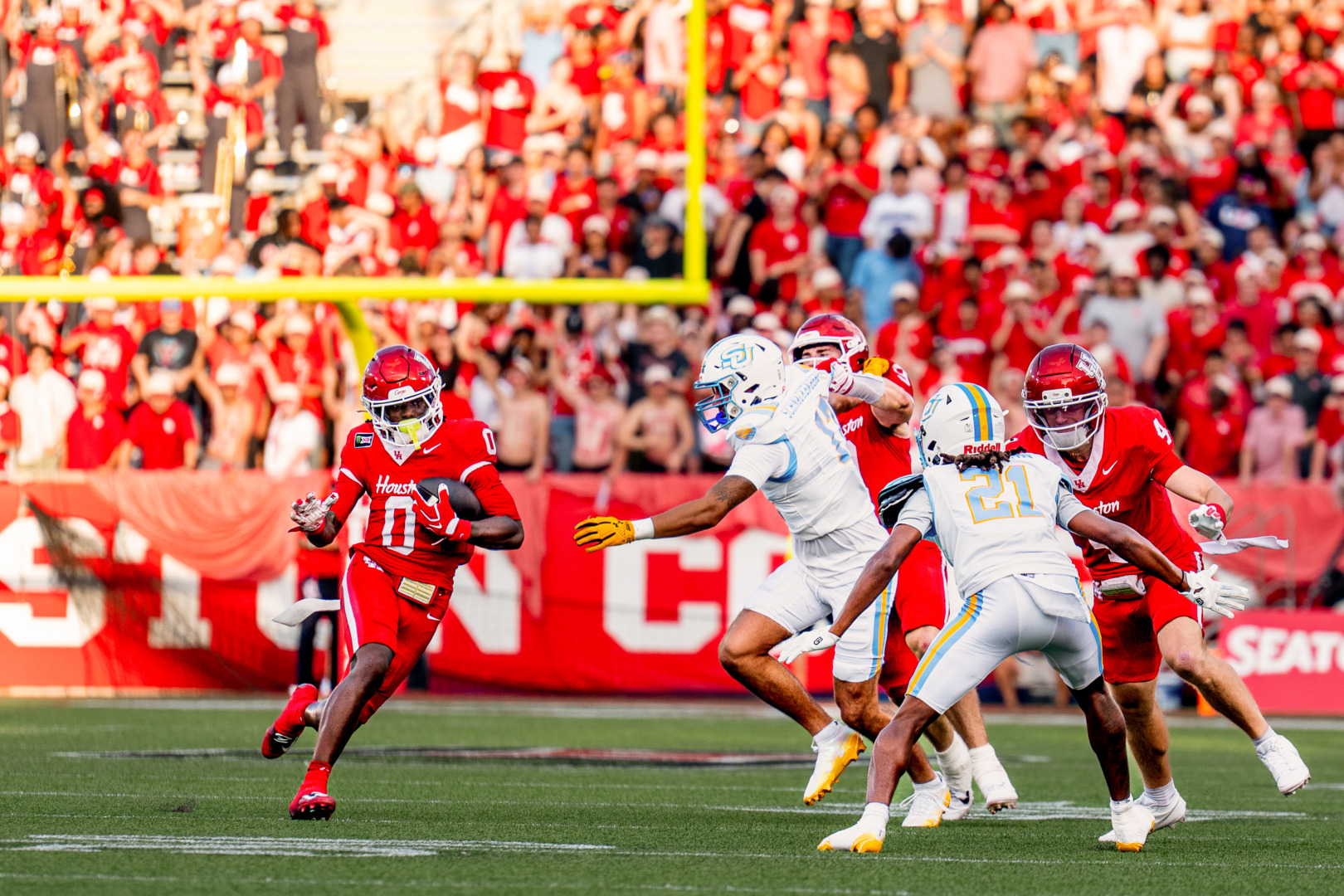
Houston running back Makhi Hughes protects the ball while running toward the end zone during the football game against Southern University on Saturday, Sept. 12, 2026, at TDECU Stadium. | Payton Gaskill/The Cougar

No. 22 Houston Cougars beat the Southern Jaguars in TDECU Stadium 77-6, improving their record to 2-0. Houston’s defense only allowed Southern to get 121 total yards and intercepted the ball once. 

The Cougars had a total of 691 yards, 203 in the air and 388 on the ground. Fifth-year quarterback Conner Weigman had 120 yards and three touchdowns.

Additionally, freshman quarterback Keisean Henderson made his debut in the third quarter and had 137 total yards and three touchdowns. 

“(Keisean) is a very good athlete,” said Head Coach Willie Fritz. “He did a good job of running the offense for us and being in control.”

The first quarter started off with Southern punting the ball to Houston on the 37-yard line. The first drive for the Cougars in the game saw them march down the field and ended with Weigman throwing a nine-yard pass to senior tight end Patrick Overmyer. 

After touchdown, the Jaguars tried to answer but fifth-year defensive back Jalen Mayo strip-sacked junior quarterback Christian Johnson, giving the ball back to the Cougars at the 22-yard line. 

The drive ended in a nine-yard rushing touchdown from junior running back Re’Shaun Sanford II, putting Houston up 14-0. 

Johnson tried to throw a lateral pass to redshirt junior running back Trey Holly, but it was out of reach. Houston scooped up that lateral pass and positioned the Cougars at the 21-yard line. With four minutes left, senior running back Makhi Hughes got a rushing touchdown at the one-yard line, making the score 21-0. 

The Cougars got the ball again after a three-and-out for Southern. After a 27-yard catch-and-run from Sanford, Weigman threw an eight-yard touchdown pass to senior wide receiver Amare Thomas a couple of plays later. 

The second quarter started with Southern putting together a drive but failed to convert on 4th  down, which gave Houston the ball back. Weigman threw a 43-yard touchdown pass to junior wide receiver Koby Young, putting Houston up 35-0. 

Southern senior quarterback Ashton Strother threw an interception and put the Cougars on the 25-yard line. Henderson completed a seven-yard touchdown pass to Young, giving Houston 42 unanswered points. 

Houston went into halftime with one more touchdown from freshman running back John Hebert, making it 49-0. 

The third quarter started with Henderson fumbling the ball but quickly recovering it and running for a 54-yard touchdown. Houston quickly got the football back after a punt from Southern and scored another rushing touchdown by junior running back DJ Butler. 

At the five-minute mark in the third quarter, Hebert got another touchdown, putting Houston up 70 points. After the touchdown, Southern was able to score a touchdown, with sophomore quarterback Wyatt McCauley throwing a 70-yard pass to redshirt sophomore wide receiver Jayden Cook, making the score 70-6. 

The fourth quarter was limited to eight minutes and saw one last Cougar touchdown, which sophomore quarterback Luke Carney ran in for Houston, with the final score 77-6. 

“I was so happy we got to play so many guys and these guys worked their tails off,” Fritz said. “That’s very important to me.”

The Cougars look to keep their winning streak alive next week as they travel to Lubbock, Texas, to face the reigning Big 12 Champions, No. 12 Texas Tech on Sept. 18. 

sports@thedailycougar.com

—
“Houston blows out Southern Jaguars 77-6, advance to 2-0 record in the season” was originally posted on The Cougar

Posted in NewsComments Off on Houston blows out Southern Jaguars 77-6, advance to 2-0 record in the season