Author Archives | admin

Rock music, designer clothes and oblivion: Charli XCX’s ‘Music, Fashion, Film’ tour takes TD Garden by storm

As the lights went dark at TD Garden last Thursday night, a sold out crowd of Charli XCX fans sporting ripped-up old shirts and dark sunglasses erupted in screams. The UK-born electropop singer arrived in peak rock-star swagger, cloaked in a leather jacket-dress and accompanied by a full band and mic stand. 

As the beginning notes of “Rock Music” played, XCX kept her hands in her pockets, throwing her hair back and forth and stomping her foot to the beat. Her air of casual apathy transmitted through the black-and-white screens as she transitioned smoothly into “Yeah” — another song off of her 2026 album “Music, Fashion, Film” — which is comically dry until the chorus hits and the drums crescendo.

“The last time I was here, I was having a breakdown,” XCX recounted to the packed arena — one of the only times she took a breather during a 90-minute set. “But now, I’m really good. Okay, thanks.” Boston hasn’t seen XCX since her joint tour with Troye Sivan in 2024, creating extra buzz around this concert.

This vulnerable, wry humor appears throughout XCX’s music and public persona, one she’s since leaned into with the rock-star motif in “Music, Fashion, Film”. She says something vulnerable, then plays it off like it doesn’t matter. The album and its consequent tour showcase her unique ability to switch between a curated persona and genuine vulnerability at a whim.

Poking fun at her public persona of a party girl, XCX broke into a genuine giggle as she sang the opening lines of “Wink Wink” — another track filled with self-aware jabs. XCX promised she’s “not a bad girl anymore” before characteristically winking to the audience. 

Pushing further into the apathetic pop star persona, XCX and a group of backup dancers performed “Card Declined” — a spoken-word track about hyperconsumerism and retail therapy — as the long stage turned into a makeshift runway and towering spotlights fit for New York Fashion Week emerged from the floor. 

The dancers then left the stage to XCX for a deep-cutting performance of “I’m Afraid,” a deeply emotional track about insecurity in marriage and work. 

“All this pain makes me believe I’m a better artist now,” sang XCX, standing at the very edge of the stage, accompanied only by a small line of fire. 

XCX has explored these themes before, but her expertise in mixing and sound production make the track even more vulnerable, especially as the drums boom and lights flash in sync with the crescendoing chorus.

From there, XCX returned to some earlier hits, including the fan favorite “Track 10” off of “Pop 2” and 2024’s “Girl, so confusing.” The track features pop singer Lorde — and says the two stars look alike because they’ve “got the same hair” — which many concert goers seemed to address by sporting Lorde T-shirts.

Turning back to her dance-pop roots, the stage flashed with neon lights as the track to “Pink Diamond” started up. One of the most energetic songs off of 2020’s “how i’m feeling now,” XCX demonstrated her versatility with fast-paced verses and striking choreography marking the end of the second set. 

Returning to the stage with a new bejeweled outfit, XCX gave a captivating rendition of “Dying for You,” one of the tracks from the 2026 “Wuthering Heights” soundtrack she composed. XCX bounced around to the intense bass, demonstrating her excellent stage presence. 

The majority of the third set consisted of  tracks from the 2024 album “brat,” which catapulted XCX to mainstream fame after over a decade of success in the electro-pop periphery of the music industry. She performed “Club Classics,” “365 remix,” “360,” “Sympathy is a knife”  — another vulnerable track, which XCX performed alone — “Von Dutch” and finally “Guess,” before disappearing backstage again.

XCX reemerged with “2007” and “Camera” off of “Music, Fashion, Film,” before traveling to the top of the tiered stage for a chill-inducing performance of “party 4 u” — accompanied, of course, by a series of excited screams from the audience. 

A hard-hitting dance performance of “Vroom Vroom” and a catwalk-inspired rendition of “SS26” closed out the final set before the appropriately chosen final performance of “No One Lasts Forever,” featuring a recording of a spoken interlude by Canadian absurdist-film legend David Cronenberg. 

As Cronenberg declared “Oblivion is freedom,” XCX and her backup dancers gathered at center stage, breaking the fourth wall and staring directly into the camera lens. 

For an album that begins with tracks about insecurity and finding comfort in performance, the ending monologue by Cronenberg is a resounding acceptance of mortality and a superfluous yet loving attitude toward art. 

XCX manages to weave her past hits into the 30-minute runtime of “Music, Fashion, Film,” creating a spectacle of life, love and art. She wants the audience to remember: art is a lot, but it’s not everything — because after all, “nothing’s gonna last forever.”
Posted in NewsComments Off on Rock music, designer clothes and oblivion: Charli XCX’s ‘Music, Fashion, Film’ tour takes TD Garden by storm

Ehly: UO needs to do more for out-of-state students

With the number of friends I have made at UO who are from California, it wasn’t a surprise for me to find out that a large portion of UO’s tuition revenue comes from out-of-state students. 

When UO’s $65 million budget cut was announced on May 14, President Karl Scholz wrote that about 80% of UO’s general education fund comes from tuition revenue, and “the biggest contributor is tuition paid by out-of-state students…a gap in our out-of-state enrollment has a disproportionate effect on our operations.”

For the last decade, UO has enrolled about 2,400 out-of-state undergraduates each fall, according to President Scholz. In May, it was anticipated that fewer than 1,900 out-of-state students would enroll this fall. 

“One year can be an aberration,” Scholz said. “With a second year of evidence, I believe we need to treat this as our new reality.”

Scholz cited declining birth rates as a factor in his May 20 letter, and expects out-of-state enrollment to keep declining over the next decade as the pool of college-age students shrinks. 

This demographic trend is real, but is not something the university should hide behind. It does not excuse two decades of tuition hikes that have priced out the out-of-state students that UO is trying to attract. 

UO sophomore Addy Keenan is from California and knows the effect that UO’s high out-of-state tuition can have on prospective students. 

“I think it’s really high, and I don’t think it should be,” Keenan said. 

However, Keenan doesn’t think UO is isolated from most public universities, in that a majority of public schools in the U.S. have significantly higher out-of-state tuition. 

“I also personally know a lot of people that didn’t come here because…there’s no guarantee that you get financial aid,” Keenan said. 

Jennifer Smith, president of UO’s classified employees union, has argued the crisis says more about priorities for UO than demographics. 

“We’ve seen decades of disinvestment from our schools by the state, poor management and administrative bloat, wishful thinking that private donors will give enough to keep us whole and untenable tuition increases,” Smith said to Lookout Eugene-Springfield in May. 

Smith argued that the university is slashing the budget, cutting programs and laying off faculty while building brand new dorms and paying upper administration generously, while also raising tuition for new students. 

Keenan noted that UO joining a program like the Western Undergraduate Exchange—a program that works to cap participating out-of-state students’ tuition at no more than 150% of in-state rates for students who meet a minimum GPA—could possibly draw in more non-resident students without slashing the sticker price across the board. 

Many public universities in Oregon, such as Oregon State, Portland State, Southern Oregon and more, all participate in the WUE program, while UO left the program in 2012.  

If UO wants to remedy its out-of-state enrollment rates to supplement its general education fund, it needs to cater to financial programs that bring these students in and give them an incentive to choose UO.

The post Ehly: UO needs to do more for out-of-state students appeared first on Daily Emerald.

Posted in NewsComments Off on Ehly: UO needs to do more for out-of-state students

GTFF calls for impasse in negotiations with UO

The Graduate Teacher Fellows Federation has called for an impasse in negotiations with the University of Oregon after a hold up, according to an Instagram post from on Oct. 1.

“GTFF does not believe that UO will agree to a fair contract without escalation,” the post said. 

This comes after the union filed an unfair labor practice complaint against the university on Sep. 15 for “failing to engage in the bargaining process in good faith,” and alleging the university was engaging in “superficial surface bargaining,” according to documents filed with the Oregon Employment Relations Board.

An impasse can happen when both parties in a bargaining contract don’t reach an agreement in the first 15 days of mediation, according to the Oregon Employment Relations Board. The negotiations can also enter another stage of mediation if they wish.

According to the union’s Instagram post, there are two options if the 30-day impasse period ends with no progress between the two parties in bargaining, “an employer may impose a contract, without the consent of employees,” or “the union can declare intent to strike.” 

GTFF has come to a tentative agreement on ten articles, with 24 still being in negotiation at the bargaining table. 

“We want a fair contract that works for our GEs. As I said, the university is in a difficult position, but that should not come at the expense of cutting our health insurance.” Carver Goldstein, president of GTFF, said in a statement to The Daily Emerald on Sept. 29 at the Board of Trustees meeting, before the impasse was declared. 

UO Spokesperson Angela Seydel said the university did not have a statement at this time.

This is a developing story and will be updated.

The post GTFF calls for impasse in negotiations with UO appeared first on Daily Emerald.

Posted in NewsComments Off on GTFF calls for impasse in negotiations with UO

U places 179th in the country in new college rankings report


In US News’ Best Colleges for 2027, the University of Utah was ranked 179th of the 428 universities on the ‘Best National University’ list.

The U was ranked 75th for ‘Most Innovative School,’ 38th in financial resources and 9th in entrepreneurship. It was also ranked 91st in the ‘Best Public Schools’ and ‘Best Value for In-State Students’ categories. Many other Utah schools were ranked in different categories. BYU ranked ahead of the U by 63 spots in overall national rankings. Utah State University ranked 288th.

Methodology

LaMont Jones is the managing editor for US News’ education. In an interview with The Daily Utah Chronicle, he explained how schools are categorized and subsequently ranked. “We don’t claim to be the end all be all. We just say we’re a great starting point to get you all this information to help you decide,” he said.

Jones said the data is collected from federal reports, government data and occasionally third-party sources. They use Carnegie standards to categorize schools. Other ranking categories include Liberal Arts colleges, Historically black colleges and universities, ivy league universities, community colleges and more.

To evaluate an overall score, schools are evaluated on 17 different factors, each weighted differently to add up to 100. The top factor is earnings after graduation, which is calculated four years after a student graduates. Jones said this helps minimize ‘family influence’ effects right after graduation. “If you did one year out, it would really be so skewed. Even two years out would be skewed,” he said.

Entrepreneurship

The U consistently ranks high across lists in entrepreneurship and business. In a research analysis conducted by a Stanford professor this last summer, Utah was ranked first in the country as ‘most likely to start a unicorn,’ which is a billion-dollar startup. Bloomberg recently ranked Utah 18th in best business and MBA programs for public schools. Overall, it placed 44th in business programs and fourth in entrepreneurship.

Kurt Dirks, dean of the David Eccles School of Business, addressed the Bloomberg ratings in a press release. “We are a business school on the rise, and this recognition is another indication of the progress we are making,” he said.

Across the U.S Best Colleges lists, the U’s highest ranking was in entrepreneurship, out of around 40 schools. The data was based on the Association to Advance Collegiate Schools of Business.

Significance of rankings

Jones said the rankings are a ‘public good’ that keeps prospective students and their families informed. “People need as much information as they can to make one of the most important and costly decisions they will ever make,” he said.

In a statement to The Chronicle, The U’s Associate Director of PR and Communications, Heather King, said these rankings can provide useful information to the university. “Rankings can be a valuable measure of university performance and provide useful insights into areas of strength and opportunities for improvement. At the same time, rankings represent just one indicator and are based on specific methodologies that may not capture the full scope of the university’s mission, quality or impact,” King wrote “We take rankings seriously and use them as one source of information to guide our work and consider them alongside the many other measures that reflect student success, academic excellence, research and the value we provide to our students and the broader community.”

The university also provides its own statistics about various programs, resources and opportunities available to students. 


e.howell@ustudentmedia.com

Bryelle_howell

The post U places 179th in the country in new college rankings report appeared first on The Daily Utah Chronicle.

Posted in NewsComments Off on U places 179th in the country in new college rankings report

UH unveils Statue of Four Lies time capsule

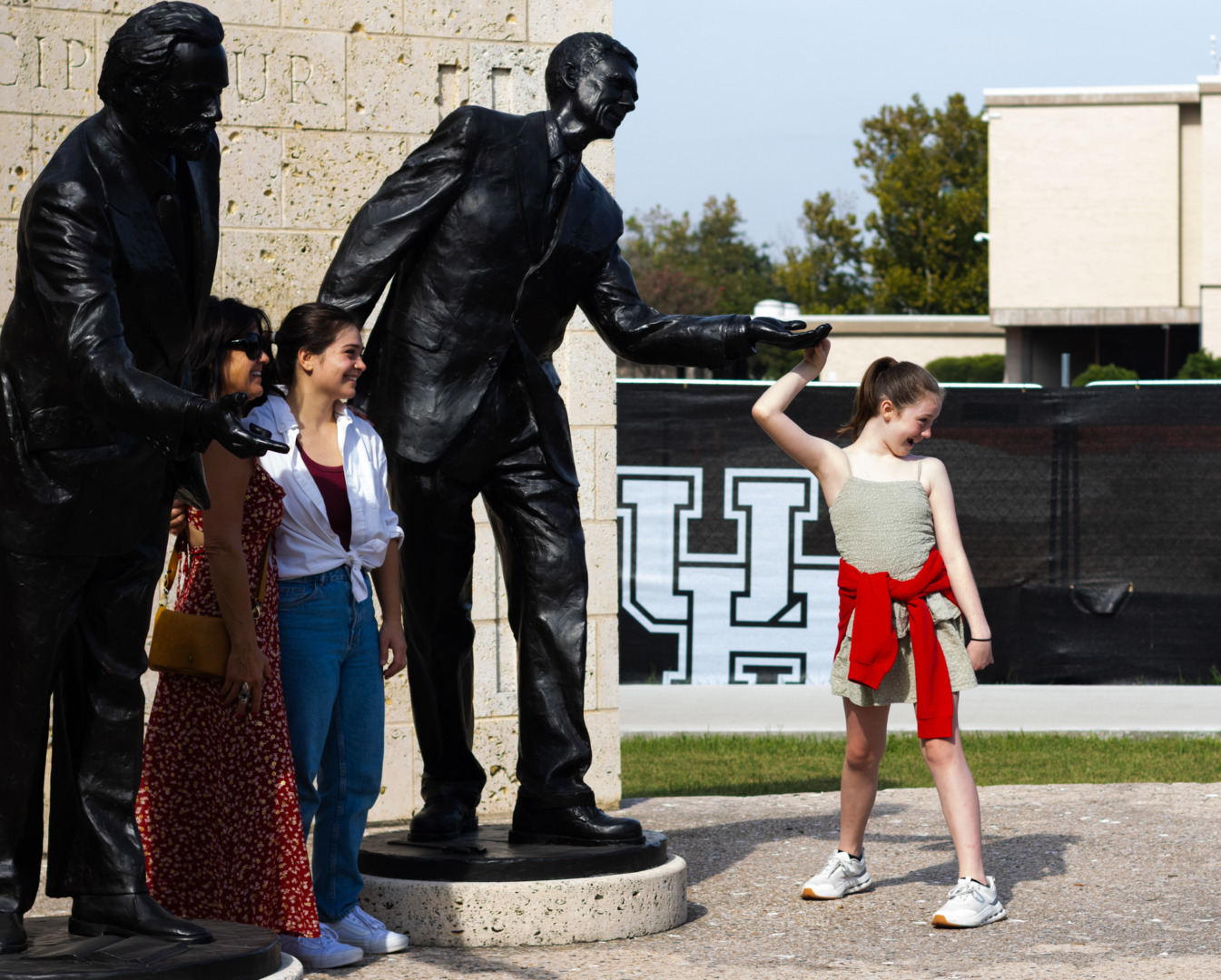
Visitors enjoy taking photos with the Statue of 4 Lies. This occurred during the Statue of Four Lies Time Capsule Reveal at Houston, Texas on September 26, 2026. | Mikele Rodriguez/The Cougar

UH, along with artist Jack Massing, unveiled the time capsule at the Statue of Four Lies during a two-day event on Sept. 25 and 26.

The event marked the 16th anniversary of the Statue of Four Lies’ installation by the Art Guys and with it, the reveal of a long-awaited time capsule sealed in the wall behind the statue. 

“We are revealing what the Art Guys left us in this capsule here that was installed in 2010,” said UH President Renu Khator. “I wasn’t too happy that I didn’t know what was in the capsule, but today I feel like it is so exciting that we get to reveal it and see what is inside.”

The unveiling was hosted by UH and put together by the Public Art University of Houston System, with live music, free food for guests, a petting zoo and two inflatable slides named after the Houston art team, the Art Guys.

The Art Guys, made up of the late Michael Galbreth and Jack Massing, both of whom are alumni and former educators at UH, were commissioned to create the statue.

“It was conceived in 2009 and installed in 2010,” Massing said. “Today, we’re honoring the 100th anniversary of the University of Houston, which is next year.”

The statue’s lies are not to harm the viewer, but to open up different interpretations, according to Massing.

“We like to use wit and humor to animate our work and then open it up for more questions,” Massing said. “Questions make people think, answers typically do not. They give you a final resolution when you get an answer.”

The statue has gained a reputation for students accessorizing it, much like a bronze statue or bronze painted man in the city inviting tourists.

“That’s what was intended,” Massing said. “We took it off the pedestal and put it on the ground so that the students here could interact with us, and we can continue to perform for however long these are here.”

Fittingly, the ceremony and time capsule reveal contained plenty of wit and humor.

Within the time capsule was a suitcase containing two pairs of underwear, one with the Tasmanian devil from “Looney Tunes”, the other a Krispy Kreme-themed pair of underwear. Also inside were some old socks and a combination of numbers with an unknown meaning as of now. 


While the crowd laughed at the reveal of the suitcase, they became shocked to find that there is, in fact, another time capsule inside of the time capsule, which will be revealed April 1, 2083.

Although the Statue of Four Lies does lie about its original date’s significance and it even bends the truth on its full reveal, UH still sees this as the kick-off for centennial celebrations to come.

“What better way to start your centennial than to come here,” Khator said. “We know we are going to have a birthday party in March, we know we are going to have our finale sometime in October and we know that there will be at least a dozen curated events to mark the centennial.”

For now, the mystique of the statue remains. With a whole new mystery to the reveal set for 2083, the statue stands in Lynn Eusan Park, waiting for its next show.

news@thedailycougar.com

—
“UH unveils Statue of Four Lies time capsule” was originally posted on The Cougar

Posted in NewsComments Off on UH unveils Statue of Four Lies time capsule

Gophers women’s golf looks to finish fall season on a high note

The Gophers women’s golf team is looking to finish the fall strong after several shaky tournament performances this season.

Despite a last-place finish at the ANNIKA Foundation Intercollegiate, senior Luisamariana Mesones said the team has stayed positive and continued to work hard despite the results.

“We’re still grinding, and we’re still hopeful that we’re going to have a good performance,” Mesones said. “Our attitudes never change.”

Mesones is coming off a top-20 finish at the Lady Paladin Invitational, where she managed 1-under par. 

“Another great journey for Mar,” said Head Coach Matt Higgins. “We had a young lineup this week, and I know they’ll learn from the good things that went well and work on the things we can do better for our next tournament.”

Even though she performed well, Mesones said she expected more from herself.

“I feel like I went with higher expectations for that event,” Mesones said. “I didn’t really meet them.”

Mesones said she does not like to focus on specific aspects of her swing. Instead, she has been working on playing more freely and trusting herself.

Mesones will also face a new course in her next tournament. She has never played at the Blessings Golf Club before, but has talked to friends on the University of Arkansas team who offered her their advice.

But Mesones is not worried about knowing the course, or about who else will be playing.

“I’m going into these two tournaments without knowing and just playing myself, my golf and ultimately beating the course, not the other girls,” Mesones said.

Mesones said her mindset toward new courses has changed during her time at Minnesota.

She used to worry more about knowing the course and the field before a tournament. Now, she tries to focus on playing her own game.

“I learned that I need to be grateful for just the time that I can be in that moment, playing a new course or a course I played before,” Mesones said.

The team will also look at its chemistry as it finishes the fall season.

Minnesota has nine players on its roster this season. Mesones said the bigger team has not changed the camaraderie of its players. The team spends time together outside of golf, and Mesones said the players support each other on and off the course.

Mesones said being a senior has also changed how she looks at leadership. Instead of feeling like she has to be the person everyone looks up to, her new outlook acknowledges that everyone on the team brings something different to the table.

“I feel like that distribution of leadership is with all our team,” Mesones said. “Not only seniors or juniors, but also the underclassmen.”

For Mesones, the team comes before her individual goals.

“I want to succeed as a team first and then as an individual,” Mesones said.

As she heads into the final part of her college career, Mesones hopes Minnesota can make it to the NCAA regionals and advance to the national championships.

She also wants to finish her Minnesota career knowing she gave everything she could.

“I’m just looking forward to having a great time and grinding and giving it my best,” Mesones said. “So when I graduate, I can be at peace with everything I could do.”

The post Gophers women’s golf looks to finish fall season on a high note appeared first on The Minnesota Daily.

Posted in NewsComments Off on Gophers women’s golf looks to finish fall season on a high note

Nobody Tells You That Leaving Home Makes You the Only Person Who Knows Your Medical History

Your pediatrician had everything. Every ear infection, the time you broke your wrist, the allergy nobody can quite remember the details of, all of it in one file in one office your parents drove you to for eighteen years.

Then you moved here, and that stopped being true.

Now you use the campus health center. Maybe urgent care that one time. You saw someone at home over winter break. If you have a chronic condition you might still see a specialist three states away. Nobody is assembling those into one picture, and the person best placed to do it is you, which nobody mentions during orientation.

Why this bites later rather than now

At twenty, a scattered medical record costs you very little. You are healthy, visits are rare, and when something happens it is usually self-contained.

The problem is that records do not reset. The file you are building right now follows you into your thirties and beyond, and the gaps you leave in it stay there. When a doctor eventually needs your history, they get what was written down, not what actually happened.

And what gets written down is thinner than most people assume. Appointments run short. A note gets typed in the last two minutes or afterwards between patients. “Stable” is accurate and says almost nothing. Six months later, another clinician reads it and has to guess what stable meant.

The scale of the documentation problem

This is measurable, and the numbers are worse than you would expect.

The US Department of Health and Human Services Office of Inspector General audits how well medical records support the diagnoses submitted for payment. Across the diagnosis codes it considers high risk, it reports that roughly 70 percent were not supported by the associated medical records, with some categories above 90 percent.

One audit looked at 97 records where an acute stroke had been submitted. None were supported as acute strokes by the underlying documentation. In 68 of those cases the patient genuinely had had a stroke. It had happened earlier, and the record described it as current.

Nobody fabricated anything. The records just stopped keeping up, and the systems reading them afterwards could not tell the difference between a stroke happening now and one from 2019.

The fix the industry landed on, and what it means for you

Healthcare spent years trying to solve this backwards: software that reads charts months later and reconstructs what should have been written. That works only when the note contains enough to go on, which is exactly the situation where it usually does not.

So the approach shifted to supporting the clinician during the appointment instead, showing what the record already contains and prompting for the specificity that gets lost under time pressure. In the industry it is called prospective risk adjustment, and the logic is simple enough: the most accurate moment to describe a patient is while you are looking at them.

Which is also the moment you are in the room. That is your opening.

Four things worth doing while you are young enough for it to be easy

  • Get your records from your pediatrician before that office loses track of you. Practices close, merge and purge old files. This gets harder every year you wait.
  • Ask for the after-visit summary and actually read it. If something is described wrongly or vaguely, say so at the next visit. It takes one sentence.
  • Keep your own one-page list: conditions, medications, allergies, surgeries, dates. Unglamorous and worth more than any app when you are in urgent care at 2am in a city you do not live in.
  • When a clinician mentions something from your history, ask whether it is still current or now history. Five seconds, and it targets the exact distinction records keep getting wrong.

The part that actually matters

If you are pre-med, nursing, public health or anything adjacent, you will be on the other side of this within a few years, typing those notes yourself under the same time pressure. Worth knowing now what a thin note costs the next person who reads it.

And if you are not, you still have one advantage no clinician has. You are the only person who sees your whole record, across every system, for your entire life. Right now that record is short and easy to manage. That will not be true forever.

The post Nobody Tells You That Leaving Home Makes You the Only Person Who Knows Your Medical History appeared first on The Rocky Mountain Collegian.

Posted in NewsComments Off on Nobody Tells You That Leaving Home Makes You the Only Person Who Knows Your Medical History

The thirst trap is dead, long live the long game

Since “Heated Rivalry” debuted on Crave and HBO Max, fans have posted hundreds of video edits of the show, some amassing millions of views, according to NBC News. The show led to fan club nights in Los Angeles — where crowds came together to watch projected TikTok edits — and even a lookalike contest in Washington D.C. that drew thousands of RSVPs. 


That’s an alarming amount of cultural energy for a show whose runtime is primarily a slow burn rather than a definitive resolution — and it’s evidence of a broader pattern echoed throughout three unrelated new releases this year.


“Heated Rivalry,” adapted from Rachel Reid’s “Game Changers” book series, revolves around two closeted ice hockey players carrying on a secret years-long relationship. It is widely regarded as one of the breakout TV hits of 2025. Since its success, Prime Video’s “Off Campus,” adapted from Elle Kennedy’s sports romance novels, has followed a similar trajectory, earning a whopping score of 92% on Rotten Tomatoes. 


They might not seem like they would have the same fanbase. However, the shows have drawn similar audience behavior — fan-edits, in-person meetups, prolonged online obsession — built less around plot twists and more around slow-building emotional tension. This pattern aligns with what researchers have been documenting about Gen Z viewing habits on a broader scale.


A widely cited study from UCLA’s Center for Scholars and Storytellers surveyed roughly 1,500 people ages 10 to 24 about their media preferences. More than half of those surveyed — 59.7% — said they wanted to see more content centered on friendships and platonic relationships. 


Yalda Uhls, the senior author of this study and CEO of CSS, argues that “relatable stories are the currency of connection” for Gen Z. 


This interpretation fits with what audience research firm YPulse has found looking specifically at shows like “Heated Rivalry.” Gen Z viewers are, in fact, spending significant time with romantically charged storylines. What draws them in, according to YPulse, is less the explicit content itself and more the emotional connection and yearning behind it — unresolved desire, complex characters and dynamics that feel authentic. 


I think part of this phenomenon stems from fatigue. Gen Z grew up on decades of shows that leaned on sex scenes to say “this is real cinema,” — think “Gossip Girl” or “The Vampire Diaries” — and that move doesn’t really hit the same anymore. If a show wants its emotional climax to actually click, it has to really sell it to the audience. 


There’s also — thankfully — a generational understanding going around regarding consent and communication. Gen Z has grown up with far more conversations about boundaries than any generation before it, so relationships built on people actually talking to each other read as more compelling and digestible than ones built purely on tension. 


Then there’s the explanation that’s a little harder to accept. Matt Puretz, a senior researcher at CSS and co-author of the UCLA study, stated that “ultimately, teens want to feel connected to their friends.” I think this speaks to a larger sentiment. A lot of people turn to fiction to feel a certain kind of connection — romantic, platonic, you name it — that can feel genuinely hard to find in life. That’s a lot to put on a hockey show, I agree. But it does explain why the shows that hit the hardest aren’t the ones that rush through the romantic storyline. 


Both “Heated Rivalry” and “Off-Campus” spend a large chunk of their runtime in the in-between, everyday aspects of romance — flirty banter, coffee runs, late-night study sessions, crying in each other’s arms, the slow chipping-away of someone’s emotional guard — instead of sprinting to what we all already know is going to happen. If you’re someone who wants to watch a romance show to feel that warmth, you’d want to sit through the whole thing instead of being teleported to the inevitable outcome.


“Heated Rivalry” and “Off Campus” are still very much steamy shows. What’s actually shifting is narrower than “Gen Z hates sex scenes” — it’s that breaking through to a mainstream audience right now requires emotional vulnerability as a focal point, not a blurry factor in the periphery. Think about it — two shows, two completely different worlds, landing the same kind of obsessive, slightly unhinged but wholly passionate fan responses can’t be a coincidence. That’s a genre figuring out what people want from it in the moment, and adapting accordingly. 

Posted in NewsComments Off on The thirst trap is dead, long live the long game

Ben McAdams and Riley Owen meet for CD1 debate


Rep. Ben McAdams, D-Utah and Rep. Riley Owen, R-Utah met at the Salt Lake Community College (SLCC) to debate as the Democratic and Republican candidates for the newly redrawn Congressional District 1. 

McAdams and Owen, the only two candidates who met the 10% polling threshold set by the Utah Debate Commission, debated several topics, including the economy, education, data centers and the Great Salt Lake. Owen ended the debate by promising voters to make their voices heard as a young, new face in Washington and make change happen. McAdams ended with an appeal to Republican voters, asking them to ask themselves if their party still represented them.

Education

In response to a question on whether or not Congress should increase benefits to maintain the current benefits provided by Pell Grants, Owen said that while he believes “education is the future.” He also emphasized that there are alternatives to degrees, especially given AI “changing the economy.” “There are a lot of ways where you can get educated and you can be prepared to enter society without having to go into debt,” he said. 

Owen also said that he believes that “everyone who wants to pursue an education should.”

McAdams said that he “strongly” supports Pell Grants, saying that “we have to bring down the cost of college.” McAdams also said that people should look at “alternatives” to college, saying it’s not the only path students should consider. 

AI and data centers

Owen said that AI has “everything to do with our national security, with our national health as an economy.” He said he doesn’t want to fall behind China in the AI race, saying the federal government needs to make sure the U.S. stays “competitive.”

McAdams said that conversations about AI are crucial. “Anytime the makers of AI are talking about a 10% risk of annihilation of humanity, I think that’s something we should take pretty seriously,” he said. There needs to be strong guardrails to protect American citizens from the “harms of AI,” and that any economic “disruption” doesn’t harm everyday Americans, he added.

On data centers, McAdams said that he doesn’t believe they need “massive government handouts” to be built. As mayor, he opposed a data center in West Jordan because of the impacts on water and the $200 million tax incentive that the city gave Facebook, he said.

McAdams said that as data centers should be built cautiously. “[Data centers should be] done in a way that minimizes reliance on fossil fuels, relies on clean and renewable energy, doesn’t use water in the Great Salt Lake watershed and is done in a responsible way,” he said. 

Owen said that his message to data center developers is simple. “Pay your taxes,” he said. “Be water positive. Be carbon negative. Don’t ruin the grid and don’t ruin our lands.” He said he was “heartened” to see Utahns voice their concerns over the Stratos Data Center, and that he wants Utahns to make their voices heard.

While he’s “optimistic” that data canters can be built more efficiently, Owen added, he wants to “fight for individuals and families.” “They shouldn’t be burdened with the cost of businesses coming in and making a buck in their backyard,” Owen said. 

Great Salt Lake

Owen said he doesn’t believe that Utah’s legislative leaders have done enough to restore the Great Salt Lake.

McAdams agreed. “There’s no issue more important to the future of Utah than the air we breathe, the place we call home, than saving this lake,” he said. 

Owen says that he would “rely on the scientists and researchers who have been dealing with this for decades” for guidance on how to save the GSL.

He said “infrastructure investments” are important to him to remove invasive species from the lake. Owen also supports creating “water markets, not regulated forced buybacks, but leases from willing users who are willing to sell that back into the lake.”

McAdams said Utah must “make hard choices” to save the GSL. While restoration is possible, it requires Utahns to “make a commitment.” “But this is not like putting a man on Mars,” McAdams said. “We can save this lake.”

McAdams said the federal government faces water issues across the Western U.S. and that more funding needs to be diverted to help the problem. While climate change plays a role, it is not the only threat to the lake. “80% of the problem at the GSL is just simply that we are growing and diverting water that used to flow into the lake and is getting diverted to other purposes,” he said. 

Economy

When asked about what he would do to improve the economy, Owen said Utah needs to tackle affordable housing, and that politicians need to make raising families more affordable.

Owen said the answer is more supply to aid with affordable housing, saying he wants to expand low-income housing tax credits to build more affordable homes.

McAdams said that the high price of gas and the price of food is the result of “this ill-gotten war” in Iran. He said that the cost of gas would “come down immediately” if the war were stopped. He also said that tariffs were to blame, calling them a “tax on American households.”

Owen said that Congress needs to “get our spending under control.” “[Congress is] spending into oblivion, and ordinary people like you and I are left footing the bill,” he said.

On the national debt, which now exceeds $40 trillion, Owen said that he wants a balanced-budget amendment, citing countries like Germany and Singapore. He also said he wants to use AI to deliver governmental services more efficiently.

McAdams said that he also supports a balanced-budget amendment, and finds it “sad that when we talk about balancing the budget, the first place we go is trying to balance it on the backs of hardworking people.” He said that he wants to roll back tax cuts for billionaires and corporations to do this.


l.digregorio@dailyutahchronicle.com

@luca__dig/x.com

The post Ben McAdams and Riley Owen meet for CD1 debate appeared first on The Daily Utah Chronicle.

Posted in NewsComments Off on Ben McAdams and Riley Owen meet for CD1 debate

Stampa: Sydney Sweeney is a disgrace to feminism, women’s sports

Editor’s Note: All opinion section content reflects the views of the individual author only and does not represent a stance taken by The Collegian or its editorial board.

Women are represented in all aspects of collegiate and professional athletics. They have fought for hundreds of years to be seen as strong, independent individuals who can hit a home run as well as create life.

Views for women’s sports in the U.S. have increased 18% in the first half of 2026 compared to the previous year, a report published by Nielsen found report. Women are strong and capable, and they continue to bend and break records every day.

On Sept. 9, Sydney Sweeney was depicted in an advertisement for Novig — a sports prediction market — wearing nothing but sports equipment, like footballs and hockey shoulder pads. The advertisement had her use sports gear to cover herself to emphasize that Novig is strictly for sports rather than politics, wars or death. 

The advertisement received mixed messages. Some — mostly men — praised her body in the comments, while others shamed her for objectifying women in sports and sexualizing women’s athletics for profit. There has been immense backlash from women Olympians and athletes across the globe, specifically from British Olympic gold medallist Sophie Capewell, who released a statement on social media that reads, “Imagine a world where sexualized representation isn’t the most popular way of seeing women in sport.” 

People all over social media made posts in support of athletes like Capewell, showing clips of women in their elements, playing their sports, winning Olympic medals, pushing limits and breaking records. Gracie Kramer, an American gymnast, posted clips of herself on Instagram with the caption “This is SO much more than sports,” which started a viral trend of women across social media showing themselves competing and participating in their respective sports. 

Sydney Sweeney’s advertisement isn’t just a stab at women’s sports, it is also an insult to those who have fought to further women’s representation in an otherwise male-dominant field.

It is an insult to women change-makers throughout history like Babe Didrikson Zaharias, an American athlete known for her success in basketball, golf, volleyball, baseball and track and field. She is widely recognized as one of the first truly dominant figures in women’s sports history. It is also insulting to those who have transcended the popularity of women’s sports — athletes like tennis star Serena Williams, basketball record-breaker Lisa Leslie and hockey legend Hayley Wickenheiser. More and more Olympians and professionals are stepping forward and sharing their journeys as a minority in the sports industry. 

Sweeney’s ad reinforces how women are typically seen by men and how they are perceived in male-dominated fields. Sports shouldn’t be catered toward the male lens, as Sweeney has done; women’s sports are strictly for women to compete, empower, chase big dreams and conquer them.

Reach Ava Stampa at letters@collegian.com or on social media @RMCollegian.

The post Stampa: Sydney Sweeney is a disgrace to feminism, women’s sports appeared first on The Rocky Mountain Collegian.

Posted in NewsComments Off on Stampa: Sydney Sweeney is a disgrace to feminism, women’s sports