
Boston University students are no longer allowed to use “laptops, cellphones, and other similar devices” during COM CO 101, “The World of Communication: The Human Storyteller,” in a new policy aimed at curbing distractions.
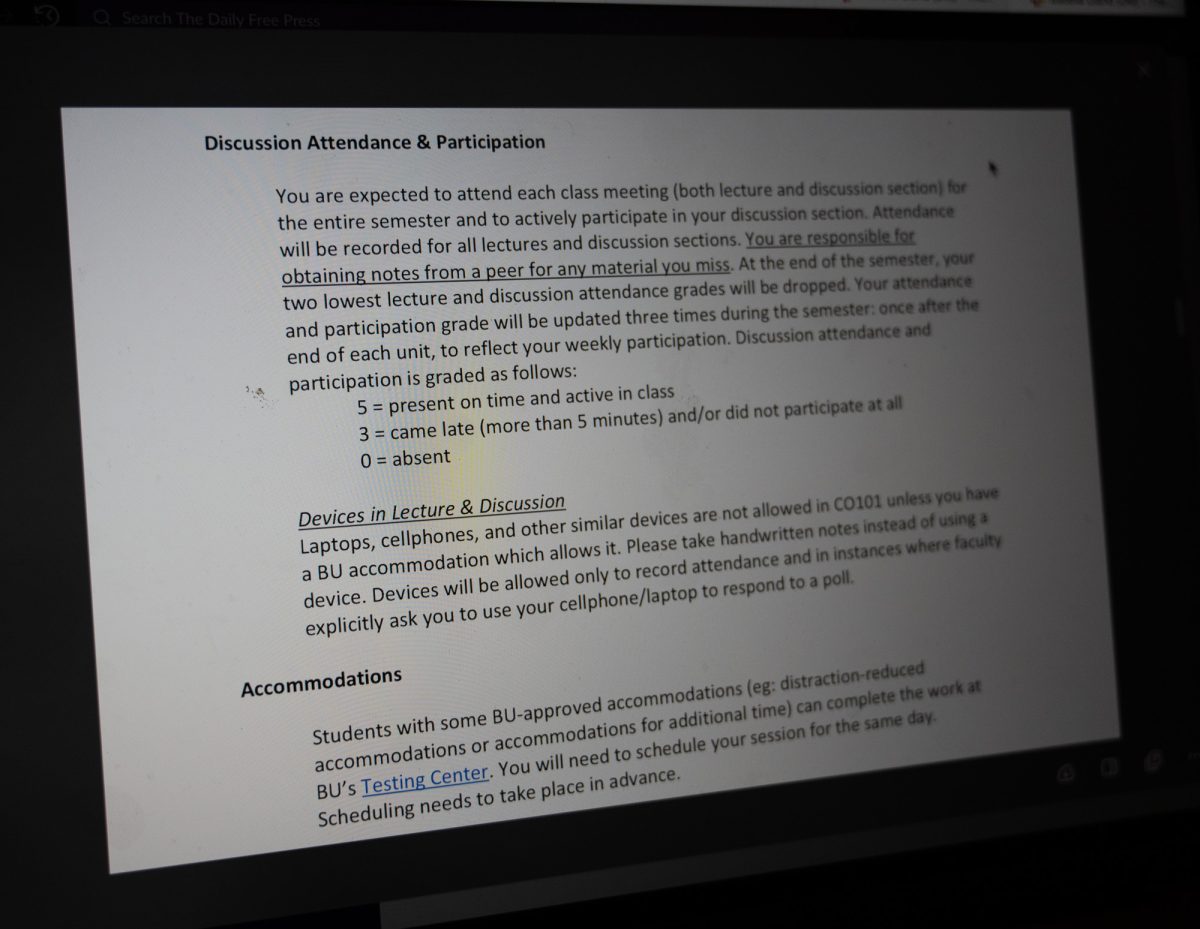
This semester, about 175 students, according to Student Link, in COM 101 — the introductory course required by all students in the College of Communication — are required to put away devices during lecture and discussion. However, there are exceptions for online class activities and disability accommodations, according to the course syllabus.
John Hall, master lecturer of film and television who teaches the film and TV section of COM 101, said the faculty teaching the course made the decision after noticing students were increasingly distracted by devices.
“They’re just checked out,” Hall said. “It’s hard to get people participating when they’re not listening to you.”
Dana Janbek, master lecturer of mass communication, advertising and public relations who teaches that section of the course, said she’s executed similar policies in her smaller classes, but she initially resisted implementing a device ban in a big class like COM 101.
The impacts of the policy have been beneficial, Janbek said.
“Students are more focused, [are] paying attention and are more engaged with the content,” she said.
David Abel, professor of practice of journalism and teaches that section of the course, initially proposed the phone ban, said Janbek.
Abel wrote in an email to The Daily Free Press the new device rules have made “a significant difference” in student engagement.
Abel wrote prior to the ban he had seen students FaceTiming friends, shopping, playing video games and watching videos unrelated to class.
“The amount of distraction has become absurd, making this policy of requiring students to put away their digital devices during lectures the next logical step,” he wrote.
While the COM 101 professors find the policies generally a success, students are not always adhering to the rules in their discussion sections.
Chloe Chau, a freshman taking COM 101, said most people in her discussion section keep their computers open during class to take notes and complete assignments.
Despite the syllabus asking students to take handwritten notes, the teaching assistant doesn’t usually tell students to close laptops, Chau said. The discussion largely relies on online activities.
Giselle Valentine, a TA for COM 101, said some students have ignored her when she has asked them to put away their devices — but otherwise, there hasn’t been much resistance.
“They’ve been pretty understanding. I do have to remind them every week though,” Valentine said.
Hall realized policy for discussion sections has been “less clear” after he sat in on discussions and saw students with computers out.
“We’re going to make a push to make that clear,” Hall said.
For some students, making the switch to handwritten notes has been difficult.
Kieran Snow, a freshman in COM 101, said the device policy hasn’t bothered her, but it has been an adjustment that has made studying for weekly quizzes more challenging. During a lecture, she missed writing down a quote, which appeared on her last quiz.
Chau said her written notes are messier than using a laptop because of the fast pace of the class.
“I also type a lot quicker. So I know that I’m getting all the information written down [with a computer],” Chau said.
Chau said COM 101 students should have a choice between digital and paper note-taking.
Hall said he has not received “significant negative feedback” about the policy, and Janbek said returning TAs have reported students being more attentive in discussion.
Hall and Janbek both said they “definitely” intend to continue the policy going forward.
“We’re always changing up [COM] 101 to keep up with the times,” Janbek said.