
Daily Trojan Magazine
AI’s positive impacts
#top .hr.hr-invisible.av-lji381f8-0e8a1b80d610e5d72fdb84ad89bedcd3{
height:20px;
}
Amid a flurry of revelations around artificial intelligence and mounting concerns about its ethics, one student organization is working to show that the technology can do some good.
.avia-image-container.av-ljqidwhf-9255edb94a5babd8434ab502233ebd43 img.avia_image{
box-shadow:none;
}
.avia-image-container.av-ljqidwhf-9255edb94a5babd8434ab502233ebd43 .av-image-caption-overlay-center{
color:#ffffff;
}

By DANIELLE JONES
.flex_cell.av-qnasc7q-685873f36e8b14a01dfadae35d2e3df2{
vertical-align:top;
}
.avia-image-container.av-lji2z9n1-92be7cee4ef076ecc31d45ac36dc6dd0 img.avia_image{
box-shadow:none;
}
.avia-image-container.av-lji2z9n1-92be7cee4ef076ecc31d45ac36dc6dd0 .av-image-caption-overlay-center{
color:#ffffff;
}

(Lyndzi Ramos | Daily Trojan)
In the heart of Colombia, artificial intelligence is reviving an extinct indigenous language.
In October last year, Leslie Moreno, a rising junior majoring in computer science, stumbled upon a competition where applicants develop speech-to-text translation models for indigenous languages in the Americas. As her family is from Boyacá — a mountainous department in Colombia home to upwards of one million people — the now-extinct Muisca language that is indigenous to that region came to mind.
.flex_cell.av-8gkioba-51b88f64ee84e1722a6ce460b34401b4{
vertical-align:top;
}
.avia-image-container.av-ljmctljk-c66d8b7d5b2989ee872c4ac39ff2474b img.avia_image{
box-shadow:none;
}
.avia-image-container.av-ljmctljk-c66d8b7d5b2989ee872c4ac39ff2474b .av-image-caption-overlay-center{
color:#ffffff;
}

Houses line the street in Duitama, a city in the department of Boyacá, Colombia. (Omar Jair Cabezas)
.flex_cell.av-3rwvxv6e-d7d26baa4ba9f8988eaa54115e0c7a12{
vertical-align:top;
}
“I always knew, growing up, how [Muisca] culture was super important to informing how we speak Spanish every day in Colombia,” Moreno told me recently in a Zoom call. “A lot of our everyday lingo — which I originally thought, as a kid, that it was just normal slang — it’s actually words that are straight from this language. Those are ways that this language has still existed.”
Moreno and Aryan Gulati, a rising junior majoring in computer science, contacted a research group in Colombia that was working to revitalize the language — who then provided them with manuscripts from which they could get data to train their model.
“The feedback we’ve gotten has been really encouraging,” Moreno told me. “The linguistics group is honestly — they’re also excited … since, for the most part, [the revitalization effort has] just been contained to Boyacá, Colombia. And it’s also, like, as a student, it’s been really great to dive into projects that [have] some connection to the region of where my family’s from.”
These are powerful life and death decisions … not mundane, everyday my-life’s-a-little-more-convenient decisions.”
Eric Rice, co-founder of CAIS and professor of social work
Linguistics is just one of the social areas the USC Center for AI in Society (CAIS) is developing machine-learning approaches towards. A collaboration between the Viterbi School of Engineering and the Dworak-Peck School of Social Work, CAIS has conducted projects researching solutions to issues such as homelessness, disaster planning, substance abuse prevention and treatment and conservation since 2016.
In the coming years, CAIS will likely see more funding for their work, as part of President Carol Folt’s new AI-hyperfocused initiative announced in May. The $1 billion-plus, 10-year Frontiers of Computing initiative will, among other things, establish a new School of Advanced Computing within Viterbi, expand the University’s presence in Silicon Beach — a Big Tech hub in Los Angeles’ Westside area — as well as educational outreach and involvement.
“Our unifying goal with this initiative is to create a digital backbone that embeds computational power, digital literacy, and evolving technologies into all disciplines,” Folt wrote in her announcement. “By enhancing pedagogy and programs in all 22 diverse schools and institutes at USC, we will prepare leaders to be digitally fluent, technologically adept, and, above all, ethically sound.”
Also announced earlier, in March, was a $10 million Center for Generative AI and Society, aiming to serve as a home for research on innovative and ethical use cases of AI.
.flex_cell.av-btuzqxi-e3e74ecb5cdc457aef82e548bc8c7e55{
vertical-align:top;
}
.flex_cell.av-2uen4tsm-90bcfcf791b6ec5e0063a2563bddda78{
vertical-align:top;
}
.avia-image-container.av-ljmdah1x-c53506c3bf5a2ccc784a45ea837d3656 img.avia_image{
box-shadow:none;
}
.avia-image-container.av-ljmdah1x-c53506c3bf5a2ccc784a45ea837d3656 .av-image-caption-overlay-center{
color:#ffffff;
}
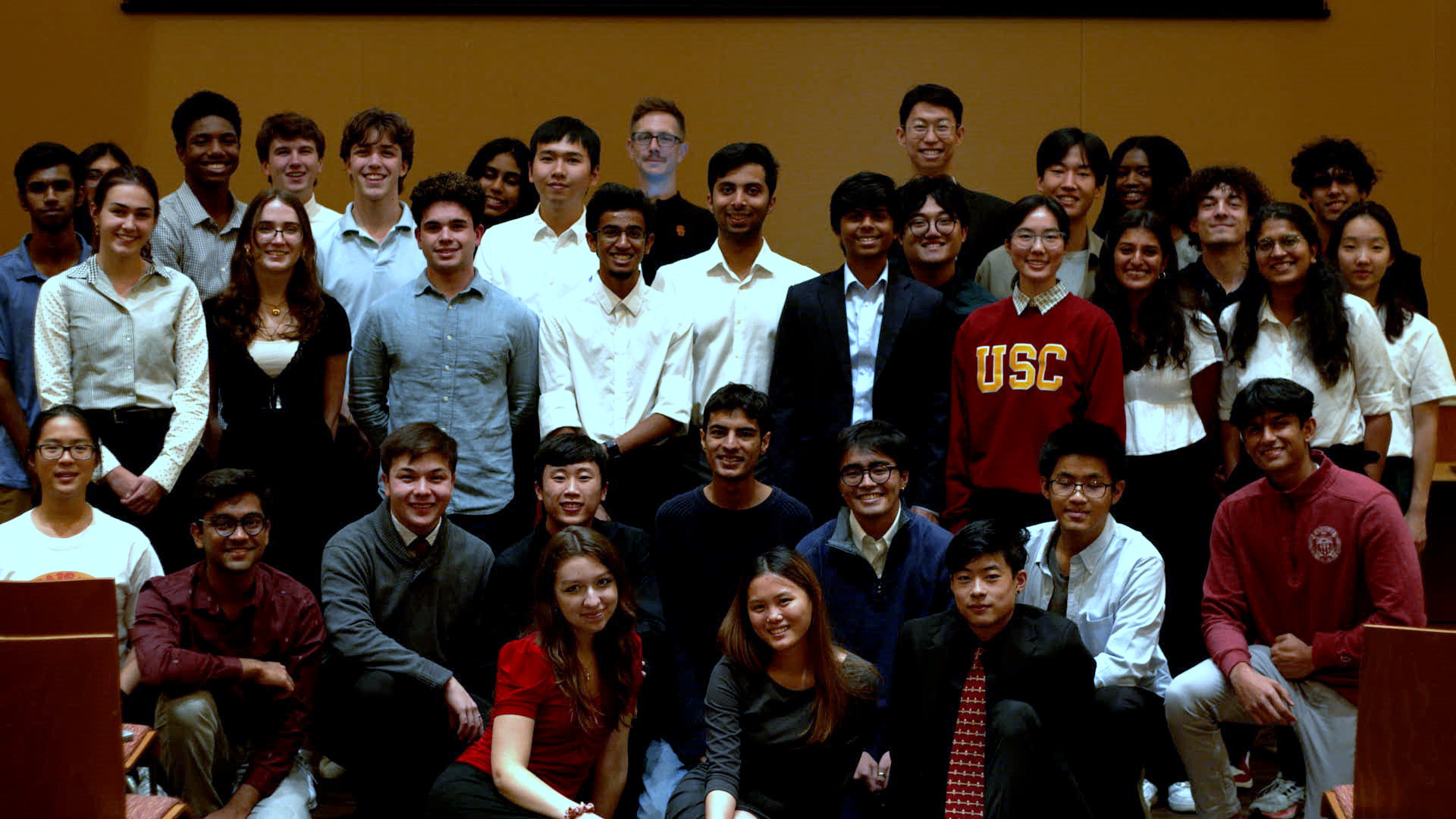
Members of CAIS++, the undergraduate student branch of the USC Center for AI in Society, in April. (CAIS++)
.flex_cell.av-2pjp9kra-6ad75a9bea0a3c9a8c60572660ffb260{
vertical-align:top;
}
Eric Rice, co-founder of CAIS and professor of social work, told me that he hopes the Frontiers of Computing initiative “will inspire even more people in social work to get involved in this kind of work,” as well as inspire those in engineering to be interested in “things that have an application to society and for social good — which is what we really are focused on.”
Such applications, Rice speculated, could include planning for natural disasters, allocating resources to the unhoused and early intervention for substance abuse and mental health issues.
“These are powerful life and death decisions,” Rice said, “not mundane, everyday my-life’s-a-little-more-convenient decisions.”
Moreno and Gulati are the co-presidents of CAIS++, the undergraduate student branch of the USC Center for AI in Society. (The “++” is the increment operator for several different programming languages; in other words, the name could be taken to mean “add one to CAIS.”) Saying that they appreciate the University’s commitment to increased investments in AI-related research, both hope it will prioritize the growth of existing programs.
“All of this, together, will unlock many possibilities for projects that maybe we don’t have the resources to do right now as students,” Gulati told me. “Hopefully, additional funding will make our research more impactful and meaningful.”
CAIS++ recruits members from a wide range of academic backgrounds and skill levels, considering primarily a strong interest in researching the positive impacts of AI. For individuals with little to no experience in computer science, CAIS++ provides a student-developed curriculum that prepares students to join a research project by the spring semester.
“One of the main components that is different about our curriculum … is that we emphasize a combination of theory and the skills actually needed to build these systems,” Gulati told me.
.flex_cell.av-26w8h8nq-7cd277a74036d2c2ce41bd9c2fb93336{
vertical-align:top;
}
.avia-image-container.av-ljmdfsz5-f5081d0a9375fbebf0f1e040e9f0ed07 img.avia_image{
box-shadow:none;
}
.avia-image-container.av-ljmdfsz5-f5081d0a9375fbebf0f1e040e9f0ed07 .av-image-caption-overlay-center{
color:#ffffff;
}
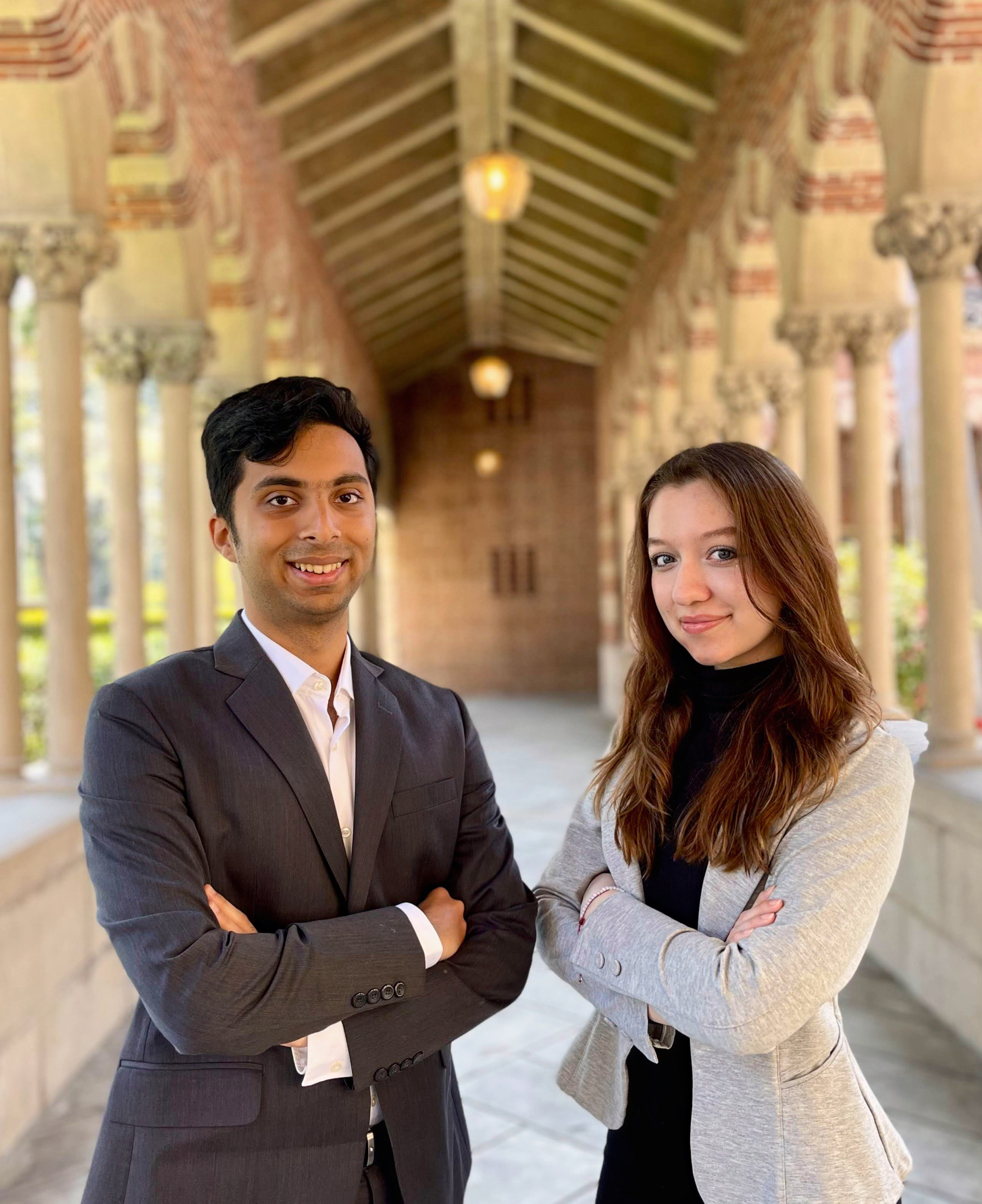
Gulati (left) and Moreno (right). (Michelle Pugh)
.flex_cell.av-1qvkyzo6-d71dbcbdfd2b8862be36f3eec0be1bbe{
vertical-align:top;
}
Based on open-source curriculums and data from other university machine learning student organizations, the flexible and collaborative nature of CAIS++’s student-led curriculum also allows for members to consult CAIS faculty and propose what they want to see and study. It’s an experience Moreno considers unlike any other class offered at USC.
“In a sense, you have an organization where it’s not just one type of student,” Moreno told me. “Let’s say [there’s] a specific AI model. There are different issues that this AI model can tackle, [so] we could cater it more to things that different students have seen or ideas that really have only come to specific students.”
An opportunity to present research comes at the end of the school year. In April, CAIS invited CAIS++ members to the ShowCAIS symposium, where students and faculty from seven USC schools presented on topics such as equity, healthcare, conservation and LGBTQ+ marginalization. CAIS++ also puts on a presentation event, OpenShowCAIS++, to give student researchers an opportunity to present their work to their fellow club members and the public.
.flex_cell.av-163rxr6e-f1d38c4d351b7b769c0b872af05ae8e7{
vertical-align:top;
}
.avia-image-container.av-ljmdmzjo-206b6d445621bb6e83773565e2b57ddd img.avia_image{
box-shadow:none;
}
.avia-image-container.av-ljmdmzjo-206b6d445621bb6e83773565e2b57ddd .av-image-caption-overlay-center{
color:#ffffff;
}

A poster at the most recent ShowCAIS symposium, in April. (CAIS++)
.flex_cell.av-945q3a-930f54ed09cc9ec19d2780069805726c{
vertical-align:top;
}
“We provide a platform for people of all backgrounds [and] all interests to come, learn more [and] see if this is something they’d like and then use CAIS as a resource to really get involved in the space,” Gulati told me.
In a rapidly evolving technological landscape, CAIS and CAIS++ are paving opportunities for students and faculty alike to learn and research with AI, growing in digital literacy while building a community that is “engaged and passionate” about their ideas for a greater cause.
“We care very much about students, student education and inspiring students to get involved in work that uses AI for the benefit of society,” Rice told me. “Having a club that is a place where students get together, essentially, to work on these kinds of things because they think it’s fun and cool and exciting, is really a great way of doing things.” ❋
.flex_cell.av-86ohgk6-bcae067ddf295043a2130284acd3d797{
vertical-align:top;
}
The post AI’s positive impacts appeared first on Daily Trojan.