Author Archives | Zoie Konneker

Martin sticks to strengths in ‘The Overthinker’

Comedian Demetri Martin has not ventured too far into the public consciousness since the release of his 2015 Netflix special “Live (At the Time).” His voice has graced Cartoon Network’s “We Bare Bears” since 2014 and his directorial debut hit the festival circuit in 2016, but fans of Martin’s unique comic style have had very little content to whet their appetites in recent years. 

Thanks to Netflix’s recent focus on standup content, Martin released his second special on the platform, “The Overthinker”, in early August.

If fans expected any change in Martin’s comedic style since his last special, they’ll end up sorely disappointed by the time the credits roll on his newest hour. 

Martin’s scatterbrained machine-gun one-liners once again dominate the show, which is to be expected; the man built his career off of a quirky, fast-paced and quick-witted style. That being said, the “observations” made in his bits seem to echo those from his previous special almost verbatim, making the performance less interesting and impressive.

At times Martin even seems to directly rehash old content, giving his newest special the feeling of a Mad-Lib variation rather than a brand-new hour of comedy.

When it doesn’t feel like a rerun, “The Overthinker” does a lot of things right. Martin is in top form, more confident on stage than in his previous outings but not enough to compromise his “awkward” persona. When he strays from the one-liner format to tell a more traditional long form joke, he manages his economy of words perfectly and keeps the pace engaging throughout. 

In fact, one of the special’s highlights comes during an uncharacteristically long story about gluten-free toast.

Martin’s guitar makes an appearance as well during a bit that carries over from his previous specials. Although his “songs” simply consist of jokes told over a repeating chord progression, it manages to break up his sometimes frustrating lack of cohesion. 

He also introduces an older bit that was missing from his first Netflix special: a large drawing pad simply labeled “drawings.” Martin provides a commentary over a series of poorly drawn figures and charts, allowing the whip-smart standup to fully flex his complex comedic mind. Some of the special’s best moments come from the interplay between his poor quality art and his formidable wit, though the bit was short and the drawings were unfortunately in short supply.

Martin has never been a political comic, and nothing has changed despite comedy’s current obsession with Donald Trump. In recent times, joking about the state and actions of the current administration has become the “tee ball” of the comedy world; virtually every Netflix special released this year has touched on the subject in one way or another. 

In this massive cloud of criticism, few comedians have been able to contribute anything new to the conversation on the administration and its actions, making much of the political comedy scene dull and repetitive. 

Rather than simply offering the same stale diatribe that audiences have suffered through over and over again since 2016, Martin shows with “The Overthinker” that he will always put the cerebral quality of his jokes over the cheap laughs that easy political content affords. 

For better or worse, Martin’s new special is exactly what audiences would expect. His drawing bits make a welcome return from his 2007 special, “Person,” his usual guitar-backed portions are just as clever as they’ve always been and his pun-heavy style has aged wonderfully. Still, no matter how well his tried-and-true formula works, it is hard to get through the special without asking “Is that all?”

Posted in UncategorizedComments Off on Martin sticks to strengths in ‘The Overthinker’

Inaugural Graduate Student Convocation welcomes students new and old

On Wednesday, Aug. 29, first-year and returning graduate students alike streamed into the spacious McCamish Pavilion, seated for the first ever Graduate Student Convocation.

The idea of hosting a Graduate Student Convocation was developed based on the recommendations from last year’s Path Forward Campus Culture action team, which found that graduate students desired a better sense of a community.

The action team found that one of the largest items that diminished the community aspect of the graduate student experience compared to the undergraduate student experience was the lack of a proper celebratory event to welcome students to the school: hence, the creation of the inaugural Graduate Student Convocation.

Finding ways for graduate students to connect to the holistic aspects of student life was a persistent theme in the programming of the event.

“I hope that all of you will explore student life and community engagement opportunities as you begin your graduate degree here at the Georgia Institute of Technology,” said President G.P. “Bud” Peterson to the many rows of graduate students filling the stands of McCamish,

Peterson praised the diversity and creativity of the graduate student population and encouraged them to take advantage of the vibrant community around them. 

“Our graduate students overall hail from 127 different countries around the globe,” Peterson said.

Peterson was followed by a student welcome from Shane Jacobeen, a doctoral candidate in the School of Physics.

Jacobeen likewise encouraged graduate students to make friends and get involved.

““My first recommendation I would like to share is to surround yourself with the right people,”  Jacobeen said.“This is especially significant for those of you will be choosing advisors and researchers, but I advise it to everyone in some way because it is so important to have people around you who can support each other.”

Jacobeen also stressed that a healthy social life leads not only to a more pleasurable graduate student experience, but also a healthier mind.

“Growing research suggests that a strong social network is key component of mental health.” Jacobeen said.

Other speakers from administration included Rafael L Bras, the provost and executive vice president for Academic Affairs, Bonnie Ferri, the vice provost for Graduate Education and Faculty Development.

In a nice touch alluding to the importance of research communication skills, computer science graduate student Tesca Fitzgerald  shared a light-hearted Three-Minute Thesis detailing her research in teaching robots by example.

After the Graduate Student Convocation, graduate students attendees were invited to the graduate student picnic.

Posted in UncategorizedComments Off on Inaugural Graduate Student Convocation welcomes students new and old

100 percent renewable? Not really.

On Aug. 28, Facebook announced on its blog that it plans to reduce greenhouse gas emissions by 75 percent and will completely power its global operations with renewable energy by the end of 2020.

In this goal, Facebook follows the 140 companies of the RE100 group, which includes big names such as IKEA and Google who have pledged to become “100 percent renewable” in the near future. (Google, which had a head start, achieved 100 percent renewable energy in 2017.)

These 100 percent renewable projects are a step up from carbon neutral programs where companies can claim they are “carbon neutral” by paying other companies to produce less waste — in what’s known as a carbon offset.

While the carbon offset approach has become less popular among companies trying to promote themselves as green, companies like Google and others that now claim to be 100 percent renewable take advantage of another loophole in terminology: financing renewable energy projects in places far away in order to somehow makeup for carbon produced onsite.

On the RE100 group’s website, they list two ways of becoming “100 percent renewable.” The first method is what the lay person — and what I — would consider being truly 100 percent renewable: where all on-site operations are run using renewable energy sources such as solar and wind.

The second, while a noble approach, is what ends up being mostly a loophole, where they allow companies to claim being completely renewable through “[purchasing] renewable electricity sourced from generators and suppliers in the market … [including] specific generators (e.g. power purchase agreements), which can be located onsite or offsite. 

It also includes retail purchases from suppliers and utilities and the purchase of stand-alone (“unbundled”) energy attribute certificates.”

However, any solution where companies are allowed to compensate for pumping out carbon by compensating elsewhere is an incomplete solution — although there is a net benefit, it doesn’t end the hot potato game of dodging responsibility for increasing carbon usage over time. Since energy consumption on the whole continues to rise, even companies with rapidly growing carbon usage could claim to be 100 percent renewable simply by paying for renewable energy projects commensurate to their increasing carbon production.

Despite these caveats on how good these 100 percent initiatives are, these companies are moving faster on green initiatives compared to almost every other sector imaginable, a fact which says more about the extreme sluggishness of American society to embrace strong climate-change-preventing initiatives than it says about the speed of these companies.

For example, take universities: Georgia Tech has only pledged to become carbon neutral by 2050, a leisurely goal once you realize that by that date ,the effects of climate change will internally displace more than 143 million people across the globe, according to the World Bank.

And since it’s clear that federal government administration isn’t going to push hard to reduce carbon emissions, it’s up to companies, universities, and nonprofit organizations to really get serious on reducing their carbon usage dramatically — before people are displaced and lives are lost.

To summarize: while it’s great that companies are working toward a more renewable future for green initiatives, in the end, shuffling around definitions and carbon production here and there will not suffice, and companies that want to be green need to actually become so by lowering their carbon productions to an absolute zero — or at least as possibly close as they can get.

Posted in UncategorizedComments Off on 100 percent renewable? Not really.

Hard Truths & Hot dogs

Two measly naked hot dogs lay in front of me, accompanied by grease-drenched french fries and a solitary, sweating red paper cup. 

Across the cheap grey table sits my boyfriend, happily digging into an overpriced low-grade burger. 

It is 8 p.m. Wednesday. I am at the Varsity. 

My boyfriend dragged me here after he saw an ad for the Varsity in an issue of the Technique from the 1950s. I’m not really sure why I let him do that.

“Excuse me. Are y’all college students?”

A voice breaks the silence.

“Are y’all college students?”

A short woman, clad in Varsity red and armed with a broom, stands at the edge of our table, expectantly waiting for a response. We reply with a bemused yes.

“I just want to tell y’all how to be safe out there. I came up with this mix to use instead of pepper spray – jalapeno sauce, honey and pepper flakes. It burns like hell and doesn’t come out of their eyes. Just whenever someone tries something, just go ‘spssst’ and they’ll be rolling on the ground in pain,” she says, stuttering through her two missing front teeth. 

We thank her for the advice. 

She departs. 

Two more bites into our food and we hear, “I just want all y’all to be safe. Don’t understand why people go after college kids when you out there trying to get an education.” 

As college students, we both selfishly agree with her statement. She leaves again, only to return later. 

She continues this dance of silent sweeping and avid talking for the next hour.

“I live down the street. It’s tough there. People don’t have running water or food in their homes. We just can’t afford it. I make less than $500 a week. All that goes towards putting a roof over my babies’ heads. We can’t go anywhere better because we have no money. Sometimes, we don’t have enough to eat everyday. I learned to live off a slice of bread for three days.”

Quiet sweeping.

“We need clothes. I know a girl down the street who’s been wearing the same shirt for 30 days. She stinks! But she doesn’t have anything else to wear. And all that stuff that gets donated never makes it to us. The lady in charge of one of them gives all the best clothes to her kids first.”

Silence.

“We can’t trust the government. They make all these promises to us that they’re going to fix our neighborhoods and then they don’t do anything. If anyone else tries to help, we just scare them off. We are taught to act tough so no one f*cks with us. We don’t know how to ask for help because that’s a sign of weakness. Being weak will get you killed.”

She empties some trays into the trash.

“Some mamas out there get their kids addicted to heroin just so they have someone to sell to. We don’t have good role models out there. Growing up, all they see are drug dealers so they become dealers. Big brothers are out there telling their little brothers, ‘f*ck them b*tches. F*ck them hoes. If she ain’t going to have sex with you, go to her sister.’ No one’s learning respect.”

 “We need role models like you guys. We need respectable kids like you taking our kids out to places like the Varsity or the movies or something.”

We ended up listening to her for over an hour. Never before were we as grounded as we were in that grease-coated booth. 

Sure, Tech is hard but at least we have running water and clean clothes. 

When we finished eating, she insisted that she would take care of our trash. 

In return for her insight into life in Atlanta, I’m sharing her story in hopes that someone turn her suggestions into action.

Posted in UncategorizedComments Off on Hard Truths & Hot dogs

36 questions: a pathway to meaningful relationships

The list begins with a simple question: given the choice of anyone in the world, whom would you want as a dinner guest?

It’s the first of 36 questions that, theoretically, will generate extreme closeness between the pair of individuals who answer them. A couple trying to get to know each other on a first date, for example, might be one step closer to falling in love. The questions are organized into three categories, getting more and more intimate and personal as they continue.

The final prompt instructs participants to ask for advice from their partner on a personal problem and marks the end of what is meant to be an intense 45-minute experience.

The list comes from a study led by psychologist Arthur Aron called “The Experimental Generation of Personal Closeness: A Procedure and Some Preliminary Findings.” Years after the study, which showed a positive correlation between individuals who answered the questions and increased interpersonal closeness, the internet took hold of the paper and ran with it.

People tried the list on their romantic partners, taking turns exchanging questions. They tried it on people they had never met, hoping to find true love. They had varying degrees of success.

I heard about the list a few months ago and decided to try it with my romantic partner at the time. We didn’t seem to fall more in love, but I recognize that we were already significantly close   and weren’t performing the experiment under strict experimental conditions.

However, I found the experience far more gratifying when I tried it with a relatively new friend about whom I didn’t know a great deal of personal details. Beyond just the questions, which were interesting enough, we found ourselves getting pulled into other conversations and emotional stories. 

I felt that I came out of the experience knowing her far better than I had before and now we can relate to each other on a deeper level. 

I look back at that moment as a significant milestone in my relationship with her.

It strikes me that we are often so wrapped up in looking for a “hack” to find love, or a way to lock down someone we’re interested in. We don’t invest nearly as much time or effort into cultivating closeness in our platonic friendships.

I am certainly guilty of this. I worry about making sure a crush or boyfriend knows how important he is to me, but I find myself thinking less about whether one of my best friends might feel neglected. 

It’s not too hard, either. Many of the same things we do to show appreciation for a significant other, we can do for our friends. 

If someone is on your mind, let them know you’re thinking of them. 

If a friend is having a rough day, see if there is anything you can do to help or just pick them up a coffee or snack.

In my opinion, life is more fulfilling if I can have deeper-than-surface-level relationships with people that are important to me. 

My friends are there for me through thick and thin. I want to invest time into relationships with them, instead of ignoring them in favor of  a potential partner whose long term presence in my life isn’t guaranteed.

I took the whole experience as a wake up call, that I should create a space for love in all of my relationships. 

So I urge you to try it. Show people in your life that you want to know more about them by asking them these 36 questions. You might be surprised with what you find out.

It’s so hard to resist the pull of popular culture, which tells us that the only place for intimacy is in romantic partnerships. 

Investing into getting to know someone more deeply is a sign of love, whether that affection is platonic or romantic.  

Posted in UncategorizedComments Off on 36 questions: a pathway to meaningful relationships

Swant documents reveal details of summer events

A look into ethics discussions among the Tech administration leading up to the dismissal of Steve Swant shows his involvement with ethics efforts on campus and his actions leading up to the day he was let go.

On April 13, 2018, Swant sent an updated conflict of interest management form to President G.P. “Bud” Peterson detailing his continued service on the board of RIB.

The plan mentions a discussion between Peterson and Swant it which they agreed that Swant should continue to serve on the board “as it has strategic value to Georgia Tech and falls within the Institute’s guidelines.”

The form also includes potential conflicts that were raised by Peterson. These were that Swant’s participation on the board serves the relationship between Tech and RIB, a concern about remuneration for his services and an offset of losses for not taking payment for serving the board. The biggest change was that Swant would no longer have a “Significant Financial Interest” in the company since he would no longer be paid as a member of the board.

The main point of conflict that would develop surrounds the last part of form when Swant states he would disclose his membership of the board in any discussions regarding the hiring of RIB for services at Tech.

As the report that was released by the Board of Regents (BOR) later in the summer showed, Swant did not follow this practice when speaking with his subordinates in the past. Specifically shown is an email  from May 2017, in which Swant is angered that someone suggests that RIB should not be used on a project.

“His definition of ‘best in class’ is flawed,” Swant’s email reads, “his vision is short sighted, and his  bias is even more pronounced than mine.”

On June 4, Swant sent an email to President Peterson saying that he would discuss a decreased role on the RIB board with the CEO to avoid an appearance of a conflict of interest. The next mention of his work with RIB comes on July 12 when he forwards his resignation from the board of RIB to President Peterson.

Five days later, President Peterson received an email from John Fuchko, Vice Chancellor for Organizational Effectiveness, with a draft of the report from the BOR detailing the conflict of interest review for Swant. The same report would later be released by Tech officially on July 26. The day after receiving the report, President Peterson received drafts for the termination of Swant which he would send out on July 19, effectively ending Swant’s employment at Tech.

Following the dismissal of Swant, President Peterson made sweeping changes regarding ethics and reporting on campus. One of those changes was the creation of an interim Vice President for Ethics, Compliance and Risk Management (VPECRM).

In an email to the Tech community on Tuesday Aug. 21, Aisha Oliver-Staley announced that she would be filling the role of interim VPECRM.

The email tells everyone the avenues for reporting ethics violations through EthicsPoint and emphasizes the ability to stay anonymous. At the end of the email, she discusses her role and the fact that she reports directly to President Peterson and asks that everyone share all thoughts and suggestions with her.

Following the ethics reviews of GTRI and Campus Services, the list of people that now directly report to President Peterson has grown in order to increase the President’s awareness of possible ethical issues when they arise in the future.

Posted in UncategorizedComments Off on Swant documents reveal details of summer events

Tech’s LGBTQIA Center comes out of the closet

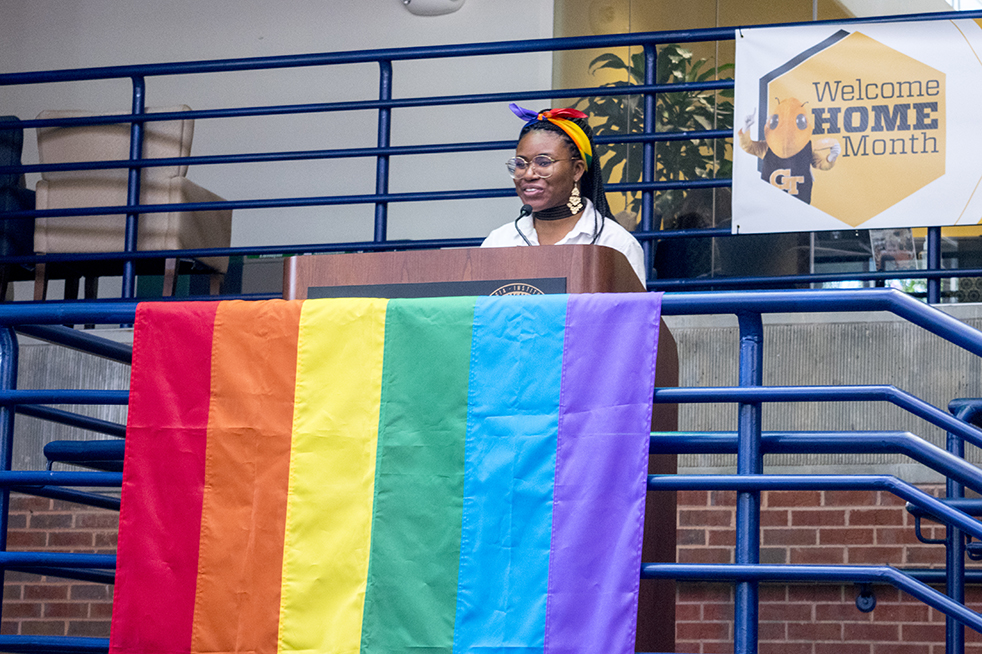
In Smithgall on Thursday, Aug. 23, three flags — the trans flag, the gay pride flag and the bisexual pride flag — stood out in the morning light among the rest, welcoming a new era for students on Tech’s campus.

Over one hundred students, staff, faculty and alumni congregated for the grand opening of the new LGBTQIA Resource Center, which began with an introduction from Aby Parsons, the director of the LGBTQIA Resource Center, who described the center’s many achievements since opening four years ago.

Since its start, the small resource center staff has trained over 1,700 students and staff in inclusion, raised over $50,000 in alumni and employee donations, celebrated over 70 Lavender Graduates and started over 20 new initiatives for fostering a more inclusive environment. This year, the center will double their staff with the addition of a full-time coordinator, Camilla Brewer.

The expanded center now includes a meeting space for discussions and study, a lounge for viewing presentations, films and hosting events, two professional staff offices, a reception area and “the Oasis,” a space meant for relaxation and supporting positive mental health measures.

President G. P. “Bud” Peterson, Dean John Stein from the Office of Student Life, Director of Diversity and Inclusion Archie Ervin and President of Pride Alliance Genny Kennedy all spoke at the ceremony, each with different  insights into the importance and impact of the expanded center.

Peterson explained the need for a center like this, where people, both Tech students on campus and LGBT community members across the greater Atlanta area,  can feel safe, included and heard.

Peterson reaffirmed Tech’s mission to “create the type of environment and culture that we can be proud of,” and assured his audience he would provide an update on the Path Forward action teams’ progress in his institute address next month.

Kennedy described her immense pride and excitement for the grand opening not only as a member of the Pride Alliance, but also as a student at Tech. Kennedy joked the LGBT community’s previous office put members “in the closet,” but the audience could see now that the members of the community were finally out of the closet and in the spotlight — right where they belonged.

Multiple speakers mentioned how the tragic death of Scout Schultz galvanized much needed change on Tech’s campus, and that we should all hold a space in our hearts for their family, friends and passions that caused them to advocate for this type of expansion and celebration of diversity to occur.

After Parsons cut the ribbon to the center, she lead a group inside to show them the realized result of the center expansion.

In her speech, Parsons said she hopes the center and the ideals it stands for will not be going away anytime soon.

The LGBTQIA+ Resource Center in the Flag building can be visited weekdays from Monday through Friday, 8:30 a.m. to 5 p.m. and will welcome visitors of any kind, any time.

Posted in UncategorizedComments Off on Tech’s LGBTQIA Center comes out of the closet

‘Ordeal by Innocence’ reinvents detective genre

Amazon recently released an adaptation of Agatha Christie’s 1958 whodunnit “Ordeal by Innocence.” The novel follows the struggle of the Argyles, an upper-class British family, to determine who among them is responsible for the murder of the family’s late matriarch Rachel. After an abundance of twists, the true nature of and motivation for the murder are revealed to be rather ordinary.

In director Sandra Goldbacher’s take on the classic novel, the setting is moved to an appropriately gloomy Scottish manor. While the premise and characters remain largely unchanged (though “Argyle” is changed to “Argyll”), the Amazon miniseries is a completely new beast, something much darker and much more cynical than anything Christie ever wrote.

When the three-part miniseries opens, the audience is introduced to the Argyll family and the horrible crime of which Rachel Argyll has been the victim through a series of fast-moving non-chronological clips which set an exceptionally dark tone and disorient the viewer.

While these clips do an excellent job of controlling the flow of information to the viewer and set them up for a strange tale, the sequence is one of the weakest of the miniseries. It draws on a bit too long and does too little to advance the story.

Still, as soon as the viewer escapes this sequence, they are immersed in the gorgeously vibrant world which is perhaps the best feature of Goldbacher’s adaptation. Every set is immaculate. Every shot perfectly set up. The series is a joy to watch if only for the beauty of its universe, and even viewers who are skeptical of such things will begin to take notice of Goldbacher’s meticulous use of symmetry and powerful imagery to create a haunting effect.

The viewer must be careful not to let the overwhelming beauty of the miniseries distract from the complexity lurking beneath the surface. Goldbacher’s work is far from a simple adaptation of Agatha Christie’s novel. She makes deliberate changes to the plot and characters which enhance the story and change the tale from a traditional piece of detective fiction into a postmodern thriller rife with flawed characters, substance abuse and moral ambiguity.

Every character in Amazon’s “Ordeal by Innocence” is either deeply flawed or struggles with serious personal troubles, from drug addiction to alcoholism to mental illness. Few of the characters are likable, but at some point the viewer feels sympathy for each of them. The cast deserves the credit for portraying the characters convincingly.

Perhaps the least likable character in the series is the one most masterfully acted. The character of Phillip Durrant, a former war pilot who is paralyzed from the waist down by a car accident, is the Argyll family’s resident provocateur. Portrayed by Matthew Goode (“The Imitation Game”), he airs out each character’s doubts about who has committed the crime with detachment and brutal honesty, as though he approaches the consequential issue as a mere intellectual exercise.

In the hands of a lesser actor, Durrant would come across as a villain, but Goode’s performance highlights the character’s brokenness and demonstrates that his cruelty is simply a method by which he copes with his
own disability.

Ella Purnell (“Churchill,” “Miss Peregrine’s Home for Peculiar Children”) turns in an equally superb performance as Hester Argyll. Purnell does an excellent job of portraying her character’s internal struggle over the possibility that she may have murdered her mother in a fit of rage. Hester is also quite possibly the most likable character in the entire miniseries. She labors under the imposed burden of her mother’s perfectionism, trying desperately to please her until she can simply no longer stand to be at home. Just before her death, Rachel’s excessive control over Hester’s life becomes so unbearable that Hester later believes that she may have killed her mother without realizing it.

Thematically, the most compelling feature of “Ordeal by Innocence” is the nuance with which it treats the central murder. One of the recurring motifs in the miniseries is the idea that “it could’ve happened to anyone.” The characters can sympathize with their mother’s murderer; they understand that their mother placed enormous pressure on everyone in her life and that any one of them could have just as easily been the one to snap.

This is what makes the series so refreshing. Stylistically, it is very similar to a traditional whodunnit crime story, but it lacks the central moral voice which typically defines that genre. Whereas traditional detective fiction features a clear cut villain who is typically motivated by money or self-gain, the flawed characters in “Ordeal by Innocence” are simply the product of their environment. The series poses questions about what makes a person evil and what that means for the idea of justice.

Since the midpoint of the 20th century, the detective fiction genre has declined and largely died out in western culture, in part because its moral framework is too black and white for the world of contemporary literature. Goldbacher’s greatest accomplishment with this miniseries is reconciling the genre with the morally ambiguous values of modern thought.

She treads the fine line of contemporary morality with plenty of nuance. While the viewer and the characters sympathize with the circumstances which led to Rachel Argyll’s murder, justice is still ultimately delivered; even if the crime is a product of the perpetrator’s circumstances, the criminal is responsible for his individual actions and deserves punishment.

“Ordeal by Innocence” is positively fantastic to watch, and the miniseries has the potential to revolutionize the crime fiction genre. If the impact of the series is that viewers get to see more shows like this one, the future of television is certainly bright.

Posted in UncategorizedComments Off on ‘Ordeal by Innocence’ reinvents detective genre

New Death Cab for Cutie album is alternative perfection

On Aug. 17, Death Cab for Cutie released its ninth studio album since the group first formed in 1997, titled “Thank You for Today.”

The album contains ten tracks and comes in at a runtime of 38 minutes, and perhaps its greatest strength is its consistent quality.

Alternative bands often struggle to find the appropriate balance between material which is varied and non-repetitive but also stylistically and thematically connected enough to form a coherent and listenable album. The result is that bands often release albums with either too much stylistic variation from song to song, resulting in a fractured listening experience, or so little variation that the listening experience is boring
and repetitive.

On “Thank You for Today,” Death Cab for Cutie strike up a perfect balance between the two. No song sounds too much like the last to be interesting and fresh-sounding, but the transitions between tracks remain smooth and natural, never leaving the listener wondering if Spotify has automatically switched him to an entirely different artist.

A great example of this is the dramatic yet smooth transition from the third track on the album, “Gold Rush,” to the fourth, “Your Hurricane,” two songs which feel very different from each other. The texture of the first is dominated by percussion, with the rhythm driven by drums, tambourines and a piano. The latter is much more melodic, with guitar taking center stage and drawn-out vocals replacing the staccato lyrics of the previous track.

The tracks have very different sounds, but the effect is created primarily through mixing; the same instruments are there, they are just weighted differently.

As a result, the listener feels as though he is hearing the same band as before, now with a different member taking up the dominant role. The transition is not jarring, and yet the album gains a sense of variety.

Another demonstration of the album’s consistency is the fact that none of the songs stand head-and-shoulders above the rest. The first track, “I Dreamt We Spoke Again,” is clearly meant to be the most radio-friendly song on the album with its to-the-point tempo and brevity, but it is still not a significant departure from the rest of the album in style or quality.

Every song on “Thank You for Today” feels as though it was produced with the intention of being a single without compromising its sense of artistic honesty.

“Autumn Love,” for instance, has the polished feel of a commercial track and even features a catchy chorus and a radio-friendly tempo.

Still, the song occupies the thoroughly uncommercial sixth slot on the album and feels like a private conversation between the artist and the listener in the way deep cuts typically do.

Virtually every song on the album manages this superb balance between the polished production quality of an early-release single and the sense of uncompromised artistic honesty and freedom typically only found tracks from deeper in the album.

Lead songwriter Ben Gibbard somehow manages to write songs which feel to each listener as though they are written for him without feeling as though they are written for everybody else as well. It is an intangible quality which few songwriters can achieve in their music and it is the defining feature which makes this album so enjoyable to listen to.

The only shortcoming with “Thank You for Today” is that it does not contribute anything truly new to the alternative rock genre. It is an excellent album, but Gibbard clearly was not    looking to innovate with it. This record will not set a new trend for the alternative music industry, nor will it mark a turning point in Death Cab for Cutie’s long existence.

Still, it is apparent that Gibbard is not trying to reinvent himself on the album, and he has no reason to. Death Cab for Cutie are not growing old, they are reaching the peak of their quality as a band.

The lack of innovation in “Thank You for Today” means that the album will never achieve legendary status, but it also reinforces the idea that this is an album which is meant to be listened to. The album is not intended to change music, and the listener will not find himself feeling changed after listening to it.

Still, it is clearly an attempt to perfect alternative rock, and the listener will certainly find himself enjoying music more than he has in a long time.

Posted in UncategorizedComments Off on New Death Cab for Cutie album is alternative perfection

Tech-UCF game rescheduled for 2022 season

School is back in session, and with it comes a brand new season of college football. While last season’s defensive woes and ultimately bowl-less season are blocked off in most Tech fans’ minds, one storyline from last season remains relevant: the cancelled University of Central Florida game.

Last September, the Jackets were scheduled to travel down to Orlando, Florida to take on the UCF Knights in what was then a highly anticipated matchup. Unfortunately, Hurricane Irma hit the Caribbean and southeastern United States the week the Jackets were scheduled to play, affecting the UCF campus. As a result, after much deliberation about potential alternatives to playing in Orlando such as moving the game to Bobby Dodd Stadium or postponing the game to later in the season, the match was indefinitely postponed.

On August 17, Tech Football announced on Twitter that the game has been officially rescheduled for September 24, 2022. While the scheduled game is four years away and  feature new rosters on both sides, UCF still poses an interesting matchup for the Jackets, especially considering the circumstances surrounding last year’s postponed game.

Although at first glance the cancelled match does not seem to have had a significant bearing on last season as a whole, if the game had been played, it could have been a season-changer for either team that won. The Jackets finished 5-6 last season, which left them one win shy of bowl eligibility. But had Tech faced off against the Knights and brought home a win, the resulting 6-6 record would have qualified Tech for a bowl game — a hallmark of a successful season for many programs.

On the other side of the field, UCF finished the season undefeated with a perfect 13-0 record after their Peach Bowl win over Auburn. They finished 6th in the AP rankings as the only undefeated team in the top 25. Despite their perfect record, however, they did not qualify for the College Football Playoffs due to a weak strength of schedule. Could a win over Tech have pushed them over the edge into the elite four teams that qualify to compete for a national title? No one can say for sure how the scenario where Tech and UCF did play last season would have affected the fate of either team, but it’s undeniable that the game could’ve had major implications for the winning team.

Despite what could have been, fans still have something to look forward to in the 2022 game. Even though the Knights aren’t in a “Power 5” division to which most successful D1 teams  (the Power 5 divisions are the SEC, ACC, Big Ten, Big Twelve, and Pac 12), UCF boasts a high-scoring, pass-first offense that can give any defense in the country a run for their money. Their offensive playstyle is a direct contrast to Tech’s, as the Jackets feature a run-first style offense through the triple option – in that sense, the matchup should at least be an entertaining one.

Even though UCF is coming off a historically successful season, they are undergoing coaching changes in both the head coach and defensive coordinator positions. Scott Frost, who led the team to their perfect record in 2017, left the organization to coach at Nebraska this offseason, replaced by  Josh Heupel, ex Heisman runner-up and former Missouri offensive coordinator. As a part of this coaching transition, Heupel is hiring Randy Shannon (Florida’s defensive coordinator/interim head coach) as UCF’s new defensive coordinator. With the success that UCF enjoyed last year as an undefeated team, it is hard to imagine that these coaching changes will bring about major changes in the team’s playstyle. However, after four years of personnel changes and the coaches grooming the team dynamic to their liking, the Jackets will be facing off against a new and, if they continue on their trend, exciting opponent.

Posted in UncategorizedComments Off on Tech-UCF game rescheduled for 2022 season