
Author Archives | Wil Kotnik, Blogger

Repeal and Replace

There has always been a clamorous resistance from the GOP against the health care plan Obama introduced when in office. This plan, the Affordable Care Act (ACA)—or ObamaCare as it’s widely known—makes it so that the wealthy who can afford to pay for private providers have to pay more money in order to aid those who don’t have such financial liberties (see previous blog Locking Horns With The Past for more details). From the start, the republican party has sought to dismantle ObamaCare. They tried getting it repealed, and when that didn’t work they attempted bringing down the outside structure by means of filing federal lawsuits, disrupting provisionals, and creating bulwarks for funding.

This week the GOP found their first success in a republican reformation of health care. Their plan passed in the House with a vote of 217 to 213. The blueprint of the plan accepted by the House makes a few major alterations. First of all it cuts the taxes on the wealthy, which was a major contribution to funding ObamaCare. Another major change is that it gives states the power to choose whether or not “essential health benefits” such as maternity care, emergency services, and mental illnesses, are covered by health care. And perhaps the other most notable change is the legalization for insurance companies to charge higher prices for those with preexisting conditions.

The reformation of health care made it through the House, but Senate has yet to vote on it. There’s some skepticism on whether or not the GOP will find the same success there; they’ve apparently been constructing their own blueprint of a health-care reformation. However, President Trump is so sure certain of their victory that he’s already signed the bill preemptively, without the Senate having spoken their mind yet. Whether or not his bold move was arrogance or foresight is yet to be determined.


What Will Whitman Feel

The Whitman Community is largely built up from relatively wealthy or high-income families (median income of parents being $156,000 per year). As such, the possibility of the GOP’s health care plan might benefit a large majority of the student body and their families given the proposed tax cuts for the wealthy. However students of the FGWC (First Generation/Working Class) body might experience a less pleasant dimension of the plan, should it pass through congress as is. The toll on the working class community would be self explanatory, in that they wouldn’t have the funds of the wealthy redirected towards their own health care. This indirectly affects at least some of the parents of first generation students as well—on average, the salary of college graduates are more than those who don’t get a higher education degree.

The other matter of relevance to our Whitman community is the power of states to determine which essential health benefits are covered by insurance. Washington is secure in its democratic majority, so the essential benefits such as maternal health would likely still be covered. States that have voted more red lately might be less inclined to provide assistance to abortion and other critical matters.
Posted in UncategorizedComments Off on Repeal and Replace

Repeal and Replace

There has always been a clamorous resistance from the GOP against the health care plan Obama introduced when in office. This plan, the Affordable Care Act (ACA)—or ObamaCare as it’s widely known—makes it so that the wealthy who can afford to pay for private providers have to pay more money in order to aid those who don’t have such financial liberties (see previous blog Locking Horns With The Past for more details). From the start, the republican party has sought to dismantle ObamaCare. They tried getting it repealed, and when that didn’t work they attempted bringing down the outside structure by means of filing federal lawsuits, disrupting provisionals, and creating bulwarks for funding.

This week the GOP found their first success in a republican reformation of health care. Their plan passed in the House with a vote of 217 to 213. The blueprint of the plan accepted by the House makes a few major alterations. First of all it cuts the taxes on the wealthy, which was a major contribution to funding ObamaCare. Another major change is that it gives states the power to choose whether or not “essential health benefits” such as maternity care, emergency services, and mental illnesses, are covered by health care. And perhaps the other most notable change is the legalization for insurance companies to charge higher prices for those with preexisting conditions.

The reformation of health care made it through the House, but Senate has yet to vote on it. There’s some skepticism on whether or not the GOP will find the same success there; they’ve apparently been constructing their own blueprint of a health-care reformation. However, President Trump is so sure certain of their victory that he’s already signed the bill preemptively, without the Senate having spoken their mind yet. Whether or not his bold move was arrogance or foresight is yet to be determined.


What Will Whitman Feel

The Whitman Community is largely built up from relatively wealthy or high-income families (median income of parents being $156,000 per year). As such, the possibility of the GOP’s health care plan might benefit a large majority of the student body and their families given the proposed tax cuts for the wealthy. However students of the FGWC (First Generation/Working Class) body might experience a less pleasant dimension of the plan, should it pass through congress as is. The toll on the working class community would be self explanatory, in that they wouldn’t have the funds of the wealthy redirected towards their own health care. This indirectly affects at least some of the parents of first generation students as well—on average, the salary of college graduates are more than those who don’t get a higher education degree.

The other matter of relevance to our Whitman community is the power of states to determine which essential health benefits are covered by insurance. Washington is secure in its democratic majority, so the essential benefits such as maternal health would likely still be covered. States that have voted more red lately might be less inclined to provide assistance to abortion and other critical matters.

Posted in UncategorizedComments Off on Repeal and Replace

Frexit

The 2016 United States election result was the catalyst of two very different reactions: either euphoric delight and hope from Trump supporters, or utter dismay and fear from, well, everyone else.

The French may go through a very similar clash of emotion. The campaign for their next president is underway and so far they have whittled the candidates down from eleven to two. By all accounts, the remaining competitors are polar opposites on the political spectrum. The young Emmanuel Macron used to be an economy minister and has a noticeably centrist regime. The alternate candidate, Marine Le Pen, is vastly different. She has a far-right political view, and, following in the footsteps of her father, has served competently as president of the National Front (a right-wing nationalist party). So, why is the French election relevant? Le Pen, like Trump, is yet another populist candidate who appeals to the ordinary civilians who make up the bulk of the population. She was even verbally endorsed by Trump. Le Pen is running her campaign on a France First ideology (does that echo ‘Make America Great Again?’), depicting Macron as unpatriotic. Her populist promise of putting France at the forefront of her efforts indicates some severe alterations. Among her objectives are an expulsion of illegal immigrants, while cutting the allowance of incoming immigrants to accepting 10,000 people per year. In addition, she hopes to shut down “extremist mosques.” Evidently, not the most racially accepting of people. However, the most controversial goal of Le Pen’s is to follow in the footsteps of Britain’s withdrawal of the European Union (Brexit). Critics have labeled this goal “Frexit,” a twist on Brexit. The following clamor of this announcement splashed all across Europe, goading political leaders from other countries to pine in on the French election in the first example of outside countries voicing their opinions on another country’s politics in years. Endorsements have been flying at Macron from all over the continent in hopes that he’ll keep the EU from becoming even more fragmented.


What Will Whitman Feel?

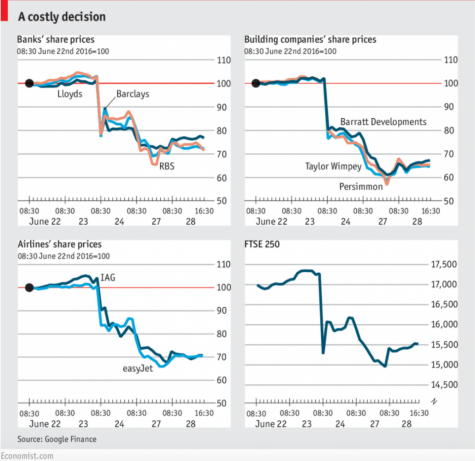
Although the election is taking place in a country across the sea and the EU is a union from across the Atlantic, the potential impact of Frexit (and the election of a populist president in Europe) would be felt globally, including at Whitman. Based on Brexit, the most widespread impact would be on the global market (as indicated by the graph). Stocks across the globe crashed like a landslide as investors pulled out of risky exchanges and played it safe. By taking out yet another pivotal piece of the EU market, the structural integrity of the EU will be put in question. Thus the exit of France would catalyze the fearful reactions exhibited during Brexit but on a whole new level.

In addition, the possibility of Le Pen being elected would be a statement as to the success of racist/nationalistic populism. With her and President Trump both standing in opposition to immigrants, the illegal immigrants everywhere must fear for their well-being. Whitman is home to undocumented students, and the populist revolution would go against the sanctuary-campus environment that is so carefully fostered here. A victory of Le Pen, as well as Trump’s recent (and as of yet unsuccessful) battle against sanctuary cities, would not help the mental health and security of undocumented students, nor those on campus with family members who have an illegal immigrant status.

Posted in UncategorizedComments Off on Frexit

Put a ($54 billion) Ring on It

Once elected, one of the duties of the President is to come forth with a budget proposal: their opinion on where governmental funds are directed, and how much money goes towards those objectives. President Trump released his financial vision for the next year on May 16th, 2017. By now, there’s been quite a bit of expert scrutinization. There’s an obvious inclination of importance towards United States martial defense and security. It’s “obvious” because he’s proposing $54 billion dollars of cuts from other federal governmental areas in order to redirect it to defense purposes. The Environmental Protection Agency (EPA) is threatened with taking one of the most critical hits: a proposed 31% budget cut. That’s the difference from $8.1 billion down to $5.7 billion. The schematic would at the same time rid the EPA of 25% of its 15,000 jobs. The nationwide consequences if such a proposal were to be accepted are by no means obscure. Experts have named some of the more pressing concerns. Among the top was the 90% cut for the Great Lakes Restoration Initiative, which cares for the damaged areas of the largest source of fresh water in the world. In addition, regional clean-up operations for oil-spills and other damaging accidents would be deprioritized, including brownfields—the redevelopment of industrial areas to more sustainable initiatives. There would be more straightforward liabilities as well, things that could damage people without traveling through the circuitous reliance of the environment’s well-being. These things include the 80% budget to the radon gas cleaning initiative, which strives to get rid of the dangerous gas that’s present in an estimated 1 in 15 homes and indirectly causes 21,000 deaths a year through cancer and contaminated drinking water. Speaking of drinking water, public water monitoring stations would also lose attention. That means even less resources would go to places like Flint, Michigan, which has dangerously high levels of lead in the city’s drinking water.

However, the thing to remember is that this is merely the first of Trump’s proposals, before he’d even consulted the cabinet. Environmental Politics Professor Phil Brick thinks there’s no reason to panic yet, while there’s still opportunity for other political authorities to shut the proposal down: “Lots of the things Trump says, he’s not going to do. He said NATO was bad and needs fixing, now it’s his best friend.” Instead what worries Brick in regards to the environment is that at the moment, the Republican platform has numbers where they need numbers; many important governmental branches have a majority of Republican republican representatives. Already their endeavor to privatize federal state land is showing promise in the success of the Dakota Access Pipeline. According to Brick, this is what should concern the environment and those who love it—the stress on the Department of Interior, which is responsible for all Federal public land such as national parks, national monuments, wildlife refuges, and the likes. The Republican platform calls for changes in regards to which land is private versus that which is public. Were more land private, resources could be extracted and the economy can flourish. Many liberals and environmentalists disagree, voicing concern for the devastating environmental impacts of such a mentality. There has already been pressure on the Department of Interior, as the Trump administration tried to undo the Bears Ears National Monument. This is despite the fact that  71% of the population of Utah, where it’s located, supports its representation of Native American strength and unity as well as its aesthetic and environmental value.


What Will Whitman Feel

As Phil Brick pointed out, the blueprint of Trump’s budget proposal is nothing but that—a proposal. There have already been many influential voices of abnegation, which suggests that whatever schematic goes through likely won’t be as extreme as Trump’s original proposal. The importance of this topic, I think, is the insight into what Trump envisions for this country and it’s values. There’s an undoubted dismissal of environmental protection and care, and a prominent rigor in the exploitation of earth’s resources. Trump’s plan, were he to have it his way, would benefit almost explicitly national security and the United States military. Although he may think it’s in the best interest for citizens of the U.S, he’s overlooking the threats that aren’t across borders, such as lead poisoned drinking water, radon gas pipes, pollution, water intoxication through pesticides, and extraction of natural resources such as fracking: essentially, the things that the EPA and Department of Interior are responsible to protect. These are the threats that aren’t attempting to develop nuclear weapons (like North Korea) but reside in our own basements and backyards, and the air we breathe and water we drink. However, they still endanger the health and well-being of United States citizens whom Trump promises to protect.

Posted in UncategorizedComments Off on Put a ($54 billion) Ring on It

“Syri-us” Stuff

Many have had to crawl through the week anxiously awaiting some concrete answers in regards to the open Supreme Court position. It’s a place that needs to be filled, and the Trump administration successfully advocated for Judge Neil Gorsuch to assume the seat of honor. But back up…the position opened during Obama’s last term, when Judge Antonin Scalia passed away 14 months ago. A lot of people were of the opinion that Obama ought to decide who would fill the suddenly gaping hole in the branch that has the final word on all necessary matters concerning laws of Congress and the Constitution itself. Given such crucial functions, the deciding of a new Judge is clearly a big deal. But more than that, such a nominee will serve as a pivotal weight on the Supreme Court’s scale of it’s members ideological loyalties. Well, the GOP motioned to postpone a nomination until Trump assumed presidency. And now, still feeling the sting of having the nominee that Obama supported brushed aside, each of the 48 democratic member of the senate is fighting tooth and nail to keep Trump’s nominee, Neil Gorsuch, from ascending from his original place in Denver, Colorado to the Supreme Court. However, even Senator Merkley’s 15 hour-long filibuster got swept away by the 52 republican members as they altered the voting system so that instead of requiring 60 votes cast in their favor, all nominees for Executive Branch positions and federal courts (which includes Gorsuch) will find victory in a simple majority. Why is this such a big deal? Mostly because the imbalance Gorsuch will bring to the fulcrum of Supreme Court ideologies; he has a noticeably conservative track record based on his Denver court of appeals. His election will return the Supreme Court to five knowingly conservative-voting justices, and four who lean where a more liberal wind blows. This could make all the difference as the Supreme Court meets next week to decide which cases to take on for next term. Among these potential cases are petitions to extend the Second Amendment to carrying firearms beyond the interior of a home and pleas from business owners to deny their services to same-sex married couples.

Other big news this week takes us international. Syria, wrenched by a six-year civil war, is coping with its second encounter with chemical weaponry. The last time, President Assad of Syria took responsibility for the 1000 lives lost to toxic gases and President Obama threatened with U.S military intervention unless all chemical weapons were destroyed. The recent April 4th attack resulted in around 80 deaths. This tragedy is no less forgivable than the last, but nobody is sure where to direct the blame. Assad is rejecting responsibility and nobody else has stepped forward to do so either. Despite the uncertainty, President Trump ordered a missile strike on a Syrian military airfield in a severe response to the use of chemical weaponry. Although the Russian forces allied to Syria were warned in advance, the 59 tomahawk missiles killed five soldiers and eight civilians. This heat-of-the-moment act could very well be an indication that the distrust towards Trump controlling the nuclear missile button isn’t completely unjustified. Both Russian President Vladimir Putin and Assad called the response an “arrogant act of aggression,” according to the Washington Post. The missile strike was the first act of U.S military interference and has many political implications in regards to our already shaky relationship with Russia and the safety of U.S troops stationed in Syria. Deputy Ambassador Vladimir Safronkov noted the difference between the U.S diction of fighting terrorism and the bombing of a Syrian government-owned military institute. Safronkov voiced a concern that the strike has lead the conflict into a more diplomatically treacherous plane.

What Will Whitman Feel?

We’ve discussed two serious culminations of this week. What then do these happenings mean for our very own Whitman community?

Gorsuch’s elevation to the Supreme Court has the potential to impact a lot of people from our pool of students and faculty. The possible upcoming Supreme Court cases have serious implications for setting the tone on LGBTQ rights, abortion, gun laws, environmental protection, and in some states the influence of minority voters. Being a widely liberal bodied college, the conservative tilt in the Supreme Court may have a negative impact on a sizable portion of our community. With the election of Trump, LGBTQ and minority students had explicitly expressed fear for what his presidency might bring. Gorsuch’s seat at the highest court in the country seems to be moving us one step closer to the reasons those students harbor fear. But only time will tell how Gorsuch will really affect our community and the many others in the U.S: he is, after all, a highly qualified judge who claims to make decisions based only on facts and written law.

The adversities in Syria might seem more remote, but that makes it no less real–even the less tangible aspects such as the blow dealt to United States International Relations with Russia. It’s yet to be determined whether or not the repercussions of these dealings will reach the United States, let alone Whitman College, but the lives of those affected are being mourned by many.

Posted in UncategorizedComments Off on “Syri-us” Stuff

Locking Horns with the Past

This has been a busy few weeks, and Trump has been attempting to assert his competence in the oval office by making true the commitments he made during his campaign. As promised, he immediately went about trying to repeal the Affordable Care Act (ACA), more commonly known as Obamacare. The ACA has, since conception, been widely unpopular among the republican party. This is largely due to an ideological and economic conflict over the fact that Obamacare mandates that those who can afford to pay for a private provider have to pay more, redirecting the excess to help those who require the aid of governmental provision.  During the presidential campaign of last year, Trump claimed that dismantling the ACA would not only happen right away, but would be easy. Last week those words were put to the test. Trump offered up his own revised health care proposal, which was oriented towards privatizing health insurance. Neither the democrats nor prominent republican factions such as the Freedom Caucus found the proposal appealing. The GOP found it largely unsatisfactory, Kentucky Senator Rand Paul calling it “Obamacare Lite.” This reception of repugnancy was only reinforced when those in the Congressional Budget Office crunched some numbers, estimating that in the first year alone, 14 million Americans would lose health insurance. That number would rise to 24 million, they said, by 2026. The reactions of the republicans and the open verbal rejection from GOP organizations like the Freedom Caucus offers a clear implication that republicans desire a more extreme rendition of healthcare;one that diminishes social-cost responsibility among the wealthy. Democrats, on the other hand, have voiced fears for those who will now find healthcare out of their financial reach.

After the shaking political defeat, Trump needs to take scrupulously well thought-out action to prove his capacity as not just a businessman but a political leader. Evidently President Trump thought he needed to take action too. The manifestation of this realization took shape as the new executive order he signed on Tuesday that took a swing at Obama’s towering environmental protection legacy, threatening to turn it into rubble. The order revoked some of the policies Obama had put in place, such as limitations on coal mining that inhibited fossil fuel production. It was legal barriers like those limitations on fossil fuel usage and production which were pivotal for keeping the U.S on track for the Paris Climate Agreement’s goal of cutting back on CO2 emissions by a third between 2005 and 2030. Trump’s reasoning for signing the reformative executive order is that it will revitalize the coal mining industry, ultimately benefiting the United States economy. There has been some controversy over that claim. Professors from Harvard and Wyoming University are arguing that jobs won’t increase because the coal operations that have remained functional to this day have relied on mechanized work rather than human employees. This being true, Trump’s executive order may only result in an increase in production and use of coal for energy, but actually decrease or have a negative impact on jobs in the field. We’ll find out the truth of this dispute in the coming years.

Trump has continued to throw around some lofty allegations even now that he’s secured his place in the Oval Office. Throughout the last few weeks, he’s been accusing President Obama of wiretapping his phone during the electoral campaigns in the hopes of catching him in communication with Russian authorities. If this were true, the repercussions of such an act would be obvious. However, FBI director James Comey announced that there was no evidence to support these claims. Since then, accusations have taken another 180 degree spin to face back at Trump. Former attorney general Sally Yates, fired earlier this year by President Trump, was prepared to speak on the investigation of illegal communications between Trump and Russia in a hearing. Her testimony is as of yet unheard, due to interference by the Trump administration. According to the Washington Post, Yates was notified by the Justice Department that the content of her testimony was off-limits as decreed by the presidential communication privilege—a plea similar to that heard long ago from the White House when they were trying to hide President Nixon’s scandalous Watergate tapes that resulted in his resignation from office. Evidently, they don’t want her to publicize any information she might have attained on the matter as attorney general. This recent event has prompted even more suspicion on where Trump stands with personal friendliness towards Russia.

Posted in UncategorizedComments Off on Locking Horns with the Past

Introduction

There’s always a lot of excitement after the election of a new president. I think there’s bound to be even more turmoil given the drastically differing morals, values, and political orientations between our former president Obama and the newly acceded Trump. It will be an interesting transition to witness and, I believe, an interesting four years to come. The purpose of this blog is to offer accounts of current political happenings, with hopes that through logic and reasoning readers of any political background might be able to form fresh opinions.

Posted in UncategorizedComments Off on Introduction