Author Archives | Wendolee T. Garcia Martinez

Faculty raises concerns over proposed UH course review policy

Greg Abbott is overstepping his authority

Greg Abbott is overstepping his authority

Juana Garcia/The Cougar

A proposed course review policy at UH is being met with criticism from faculty advocates who believe it could increase political interference with academics and censorship. 

According to a press release from the American Association of University Professors – University of Houston chapter, the proposed policy could reduce faculty control over course content and curriculum and could potentially cause professors to “shy away” from challenging topics. 

“Instead of ensuring a robust conversation in the classroom, these guidelines introduce uncertainty and fear. Professors may shy away from challenging subject matters and topics that students have chosen to learn and have a right to confront in their education,” said instructional associate professor of mechanical and aerospace engineering Hilary Reed in the press release. 

The concerns come from a broader debate in Texas on Senate Bill 37, which has affected Texas A&M and the University of Texas at Austin. 

Texas A&M canceled six undergraduate courses: Introduction to Race and Ethnicity, Religions of the World, Ethics in Public Policy, Diversity in Sport Organizations, Cultural Leadership and Exploration for Society and Diversity, Equity and Inclusion in Youth Development Organizations. 380 courses were flagged and require revisions to comply with curricular standards. 

UT System Regents adopted a new set of rules to change how controversial topics must be taught.

The Daily Texan reported that out of 434 faculty members who answered their survey on SB 37, 40% agreed or somewhat agreed to changing their syllabi or teaching approach to avoid violating the law. 

The press release stated that the language used in the self-assessment is vague and questioned who would be reviewing the course syllabi, citing the review process of Texas A&M using AI. 

Faculty leaders say that curriculum-based decisions usually fall under faculty expertise through shared governance structures and warn that fear over political backlash can influence what instructors feel comfortable teaching, especially in topics such as race, gender, politics and public policy. 

Faculty members believe the course review policy undermines students’ ability to think critically and harms the quality of the students’ education. 

“Along with curtailing academic freedom, this appears to be an attempt to infantilize our students by not trusting their ability to engage in critical thinking and to label everyday expectations of learning as potential acts of ‘indoctrination,’” said English professor Nick Flynn.

news@thedailycougar.com

—
“Faculty raises concerns over proposed UH course review policy” was originally posted on The Cougar

Posted in UncategorizedComments Off on Faculty raises concerns over proposed UH course review policy

Candidates emphasize transparency, safety in SGA debate

UH SGA presidential candidates attend the 2026 SGA Debate on Tuesday, Feb. 17, 2026, in Houston, Texas. | Raphael Fernandez/The Cougar

Presidential and vice presidential candidates faced off at Tuesday’s Student Government Association debate, where they detailed their campaign platforms and responded to questions about transparency, campus safety and student finances.

Vice presidential debate 

The debate featured management information systems PhD student Raj Kabir, economics junior Lundan Sherrod, public policy and political science junior Ian Kariuki and environmental design sophomore Sukaina Rizvi.

The debate began with vice presidential candidates answering why students should vote for them and their running mates.

Kabir emphasised his experience working with university systems, his background in leadership and his policy and negotiation skills. Kabir focused on gathering data from students to identify issues they are experiencing.

Kabir also pointed out the needs of international students, claiming that adapting to a new campus and culture can be difficult.

Sherrod stressed the need for clearer communication between SGA and the student body, arguing that many students feel disconnected from decisions that directly impact them. They proposed more consistent updates about campus incidents and clearer messaging regarding university policies.

Kariuki highlighted their experience as a student safety security committee member and said their priority would be to ensure student voices are meaningfully represented in administrative discussions.

Rizvi also spoke on the need for student voices to be heard. She strives to involve herself directly with the students through public forums or anonymous platforms. 

Candidates agreed that SGA must improve outreach efforts and create stronger feedback systems so students’ voices are heard and students can better understand how University decisions are made.
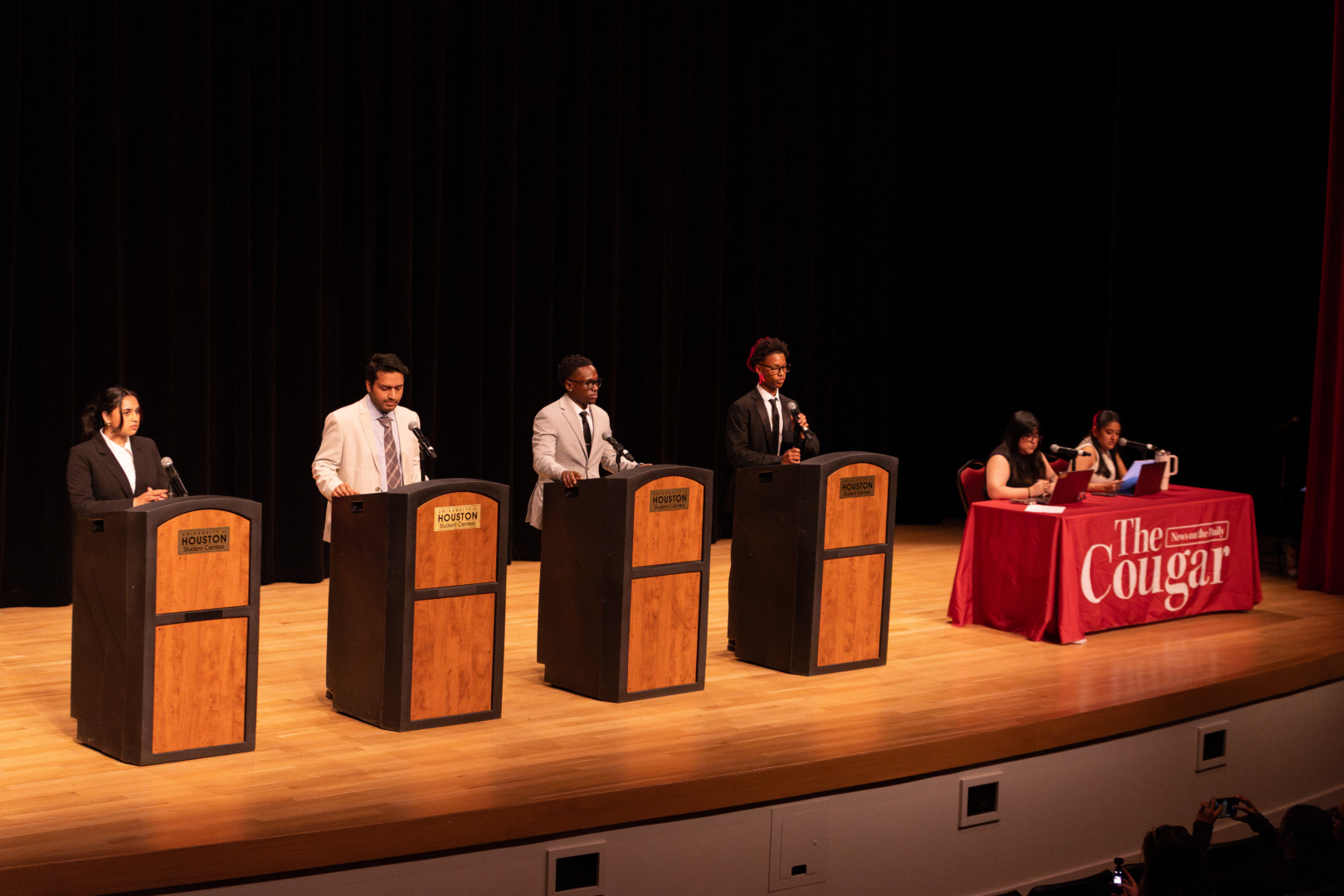
UH SGA vice presidential candidates attend the 2026 SGA Debate on Tuesday, Feb. 17, 2026, in Houston, Texas. | Raphael Fernandez/The Cougar

Presidential debate 

When presidential candidates took the floor, the discussion turned to broader challenges, including tuition costs, student fees and campus safety.

The debate featured political science freshman Kyra Williams, public policy junior Joshua Sambrano, architecture and psychology senior Tav Cockrell and information systems PhD student Biswajit Sarkar. Each candidate presented their stance and responded to questions about student safety, tuition costs and trust in SGA. 

Kyra Williams 

Williams focused on student voice and communication with administration.

“One of the priorities that we have seen from many people on campus is the lack of student voice in the administration,” Williams said. “We want to bridge the gap from SGA to the students.”

Williams proposed monthly Zoom or in-person meetings to make SGA more accessible. She said transparency is especially important regarding campus services students already pay for. 

“If tuition and all of our money are going to that, then we should be able to know exactly what we’re paying for and be able to use it,” Williams said.

When asked about student safety, Williams advocated for more emergency call boxes, particularly in areas between Cougar Village and Cougar Woods.

“There should be emergency boxes at every corner,” she said.

Joshua Sambrano

Sambrano emphasized transparency and public safety as his top priorities.

“I think the biggest priority is going to be a mix between transparency and public safety,” Sambrano said. “Students who are paying thousands of dollars are afforded the right to know the progress of safety initiatives as it’s happening.”

Sambrano criticised the lack of updates following campus safety alerts and pointed out the lack of a policy for U.S. Immigration and Customs Enforcement’s presence on campus.

“These are things that are non-negotiable,” Sambrano said. “These are things that we need to fight for, fight tooth and nail to make sure that we get accomplished.”

Sambrano said the university needs clearer communication and policy-based solutions regarding ICE. While the University is not legally allowed to call itself a “sanctuary campus,” Sambrano said there are other legal ways the University can protect its immigrant population. 

“With this new administration that we will be ushering in, I have a lot of faith that we can put a dent in that by changing the opinion of what we actually can do legally,” said Sambrano. “We can go ahead and secure our rights on campus. We can go ahead and secure all of the pros of a sanctuary campus without being red-flagged by the state of Texas.”

Williams raised a rebuttal of Sambrano’s statement by claiming other student groups have tried to make the University a sanctuary campus but failed. Williams also stated SGA is restricted from making these kinds of decisions, as is the University. 

Tav Cockrell

Cockrell centred his speech on financial transparency and proposing a “Where’s My Tuition Going?” campaign.

“We all care about where our money goes,” Cockrell said. “We want you to know what you’re paying, where it’s going to and we want you to have an active voice in that process.”

Cockrell said tuition breakdowns should include optional fees and college-specific charges, due to different colleges paying different lab and program fees. He described current committee processes as “extremely bureaucratic” and said students deserve clearer explanations.

During closing remarks, Cockrell defended his record in a previous SGA administration, stating he “fought tooth and nail” to ensure structural reform. He also addressed claims about his involvement in constitutional changes, saying the failed constitution was “a result of the direct student representation voted into office.”

“I stand by my ethics,” Cockrell said. “Wrong is wrong, right is right.”

Biswajit Sarkar

Sarkar prioritized dining affordability and campus safety.

He said many students have complained about limited food options and costly meal plans.

“I have spoken with students in the dining hall,” Sarkar said. “They are very upset by eating the same kind of food, and I feel like the food plans are very costly.”

Sarkar proposed negotiating for more affordable dining plans, possible free meal options and additional microwaves and food resources in the library during late study hours.

When asked about safety on campus, he suggested increasing cameras, alarm systems and monitoring in areas between residence halls and dining facilities.

“We should increase the security stuff, the cameras or the buzzers so we can track or monitor the student movement at nighttime,” he said.

Rebuilding trust

When asked how they would restore trust in SGA, candidates repeatedly stated transparency and communication.

“Trust has to be earned,” Williams said. “The only way for us to gain your trust is for us to show you that we can be trusted.”

Sambrano argued that SGA must apply more pressure on administration and set “a new standard” for student governance.

Cockrell said rebuilding trust requires acknowledging past mistakes and engaging directly with students.

Sarkar emphasised “action rather than words,” saying he believes in “tangible outcomes.”

Students will be able to vote for their new representatives on March 3-5. Voting will be available online on Get Involved. 

news@thedailycougar.com

—
“Candidates emphasize transparency, safety in SGA debate” was originally posted on The Cougar

Posted in UncategorizedComments Off on Candidates emphasize transparency, safety in SGA debate

Candidates emphasize transparency, safety in SGA debate

UH SGA presidential candidates attend the 2026 SGA Debate on Tuesday, Feb. 17, 2026, in Houston, Texas. | Raphael Fernandez/The Cougar

Presidential and vice presidential candidates faced off at Tuesday’s Student Government Association debate, where they detailed their campaign platforms and responded to questions about transparency, campus safety and student finances.

Vice presidential debate 

The debate featured management information systems PhD student Raj Kabir, economics junior Lundan Sherrod, public policy and political science junior Ian Kariuki and environmental design sophomore Sukaina Rizvi.

The debate began with vice presidential candidates answering why students should vote for them and their running mates.

Kabir emphasised his experience working with university systems, his background in leadership and his policy and negotiation skills. Kabir focused on gathering data from students to identify issues they are experiencing.

Kabir also pointed out the needs of international students, claiming that adapting to a new campus and culture can be difficult.

Sherrod stressed the need for clearer communication between SGA and the student body, arguing that many students feel disconnected from decisions that directly impact them. They proposed more consistent updates about campus incidents and clearer messaging regarding university policies.

Kariuki highlighted their experience as a student safety security committee member and said their priority would be to ensure student voices are meaningfully represented in administrative discussions.

Rizvi also spoke on the need for student voices to be heard. She strives to involve herself directly with the students through public forums or anonymous platforms. 

Candidates agreed that SGA must improve outreach efforts and create stronger feedback systems so students’ voices are heard and students can better understand how University decisions are made.

UH SGA vice presidential candidates attend the 2026 SGA Debate on Tuesday, Feb. 17, 2026, in Houston, Texas. | Raphael Fernandez/The Cougar

Presidential debate 

When presidential candidates took the floor, the discussion turned to broader challenges, including tuition costs, student fees and campus safety.

The debate featured political science freshman Kyra Williams, public policy junior Joshua Sambrano, architecture and psychology senior Tav Cockrell and information systems PhD student Biswajit Sarkar. Each candidate presented their stance and responded to questions about student safety, tuition costs and trust in SGA. 

Kyra Williams 

Williams focused on student voice and communication with administration.

“One of the priorities that we have seen from many people on campus is the lack of student voice in the administration,” Williams said. “We want to bridge the gap from SGA to the students.”

Williams proposed monthly Zoom or in-person meetings to make SGA more accessible. She said transparency is especially important regarding campus services students already pay for. 

“If tuition and all of our money are going to that, then we should be able to know exactly what we’re paying for and be able to use it,” Williams said.

When asked about student safety, Williams advocated for more emergency call boxes, particularly in areas between Cougar Village and Cougar Woods.

“There should be emergency boxes at every corner,” she said.

Joshua Sambrano

Sambrano emphasized transparency and public safety as his top priorities.

“I think the biggest priority is going to be a mix between transparency and public safety,” Sambrano said. “Students who are paying thousands of dollars are afforded the right to know the progress of safety initiatives as it’s happening.”

Sambrano criticised the lack of updates following campus safety alerts and pointed out the lack of a policy for U.S. Immigration and Customs Enforcement’s presence on campus.

“These are things that are non-negotiable,” Sambrano said. “These are things that we need to fight for, fight tooth and nail to make sure that we get accomplished.”

Sambrano said the university needs clearer communication and policy-based solutions regarding ICE. While the University is not legally allowed to call itself a “sanctuary campus,” Sambrano said there are other legal ways the University can protect its immigrant population. 

“With this new administration that we will be ushering in, I have a lot of faith that we can put a dent in that by changing the opinion of what we actually can do legally,” said Sambrano. “We can go ahead and secure our rights on campus. We can go ahead and secure all of the pros of a sanctuary campus without being red-flagged by the state of Texas.”

Williams raised a rebuttal of Sambrano’s statement by claiming other student groups have tried to make the University a sanctuary campus but failed. Williams also stated SGA is restricted from making these kinds of decisions, as is the University. 

Tav Cockrell

Cockrell centred his speech on financial transparency and proposing a “Where’s My Tuition Going?” campaign.

“We all care about where our money goes,” Cockrell said. “We want you to know what you’re paying, where it’s going to and we want you to have an active voice in that process.”

Cockrell said tuition breakdowns should include optional fees and college-specific charges, due to different colleges paying different lab and program fees. He described current committee processes as “extremely bureaucratic” and said students deserve clearer explanations.

During closing remarks, Cockrell defended his record in a previous SGA administration, stating he “fought tooth and nail” to ensure structural reform. He also addressed claims about his involvement in constitutional changes, saying the failed constitution was “a result of the direct student representation voted into office.”

“I stand by my ethics,” Cockrell said. “Wrong is wrong, right is right.”

Biswajit Sarkar

Sarkar prioritized dining affordability and campus safety.

He said many students have complained about limited food options and costly meal plans.

“I have spoken with students in the dining hall,” Sarkar said. “They are very upset by eating the same kind of food, and I feel like the food plans are very costly.”

Sarkar proposed negotiating for more affordable dining plans, possible free meal options and additional microwaves and food resources in the library during late study hours.

When asked about safety on campus, he suggested increasing cameras, alarm systems and monitoring in areas between residence halls and dining facilities.

“We should increase the security stuff, the cameras or the buzzers so we can track or monitor the student movement at nighttime,” he said.

Rebuilding trust

When asked how they would restore trust in SGA, candidates repeatedly stated transparency and communication.

“Trust has to be earned,” Williams said. “The only way for us to gain your trust is for us to show you that we can be trusted.”

Sambrano argued that SGA must apply more pressure on administration and set “a new standard” for student governance.

Cockrell said rebuilding trust requires acknowledging past mistakes and engaging directly with students.

Sarkar emphasised “action rather than words,” saying he believes in “tangible outcomes.”

Students will be able to vote for their new representatives on March 3-5. Voting will be available online on Get Involved. 

news@thedailycougar.com

—
“Candidates emphasize transparency, safety in SGA debate” was originally posted on The Cougar

Posted in UncategorizedComments Off on Candidates emphasize transparency, safety in SGA debate

UH removes gender-neutral restrooms in compliance with Senate Bill 8

Lily Huynh / The Cougar

The University has removed gender-neutral restrooms in the Graduate College of Social Work to comply with a new Texas law regulating bathroom access in public buildings.

According to the Houston Chronicle, restrooms that were labeled as all-gender in the social work building have been redesignated as men’s or women’s only facilities. The changes are due to the implementation of Senate Bill 8, also known as the Texas Women’s Privacy Act, which requires restrooms in public buildings to be designated based on biological sex.

“Following passage of the Texas Women’s Privacy Act, the University undertook a comprehensive review of campus facilities, including bathrooms, and implemented updates to ensure compliance,” a university spokesperson said in a statement to the Houston Chronicle. “The changes made in the Graduate College of Social Work were part of this process.”

Students in the social work college described the change as discouraging and said it sends a conflicting message about social justice.

“It 100% feels like erasure,” social work student Red Clemly said to the Houston Chronicle. “This is the Graduate College of Social Work … Social work is supposed to be tied to social justice, and social justice is supposed to be standing up for human beings’ rights.”

Clemly said other single-stall gender-neutral restrooms exist throughout campus, but aren’t practical for students in the social work building.

Gender-neutral restrooms are ADA-compliant and also used by individuals with disabilities. The University states that there are other ADA-compliant restrooms nearby.

The Chronicle reported that paper signs were taped over the restroom symbols to show the new designations. 

news@thedailycougar.com

—
“UH removes gender-neutral restrooms in compliance with Senate Bill 8” was originally posted on The Cougar

Posted in UncategorizedComments Off on UH removes gender-neutral restrooms in compliance with Senate Bill 8

UH removes gender-neutral restrooms in compliance with Senate Bill 8

Lily Huynh / The Cougar

The University has removed gender-neutral restrooms in the Graduate College of Social Work to comply with a new Texas law regulating bathroom access in public buildings.

According to the Houston Chronicle, restrooms that were labeled as all-gender in the social work building have been redesignated as men’s or women’s only facilities. The changes are due to the implementation of Senate Bill 8, also known as the Texas Women’s Privacy Act, which requires restrooms in public buildings to be designated based on biological sex.

“Following passage of the Texas Women’s Privacy Act, the University undertook a comprehensive review of campus facilities, including bathrooms, and implemented updates to ensure compliance,” a university spokesperson said in a statement to the Houston Chronicle. “The changes made in the Graduate College of Social Work were part of this process.”

Students in the social work college described the change as discouraging and said it sends a conflicting message about social justice.

“It 100% feels like erasure,” social work student Red Clemly said to the Houston Chronicle. “This is the Graduate College of Social Work … Social work is supposed to be tied to social justice, and social justice is supposed to be standing up for human beings’ rights.”

Clemly said other single-stall gender-neutral restrooms exist throughout campus, but aren’t practical for students in the social work building.

Gender-neutral restrooms are ADA-compliant and also used by individuals with disabilities. The University states that there are other ADA-compliant restrooms nearby.

The Chronicle reported that paper signs were taped over the restroom symbols to show the new designations. 

news@thedailycougar.com

—
“UH removes gender-neutral restrooms in compliance with Senate Bill 8” was originally posted on The Cougar

Posted in UncategorizedComments Off on UH removes gender-neutral restrooms in compliance with Senate Bill 8

A coin flip that led to helping change lives- UH project help young children with mobility disabilities

Graduate student Jesus Rodriguez poses for a photo with The Cougar on Thursday Jan. 12, 2026, in Houston, Texas. | Raphael Fernandez/The Cougar

For computer and systems engineering Ph.D. student Jesus Rodriguez, engineering isn’t just about software and code, it’s about giving back to the community and helping those around him.

Rodriguez works on a project called P-LEGS, the Pediatric Lower Extremity Gait System initiated by Jose Luis Contreras-Vidal, the principal investigator of the project. He works specifically on a robotic exoskeleton designed to rehabilitate young children with mobility disabilities.

Originally from Mexico, Rodriguez moved to the U.S. during middle school, returned to Mexico to complete his bachelor’s degree and later decided to come back to the States to pursue graduate study.

After his mother told him about a new scholarship offered by Mexico’s Federal Electricity Commission at UH, Rodriguez began researching the University and came across the P-LEGS project. Right at this moment, he knew he wanted to work alongside Contreras-Vidal.

“Helping people is something I want to do the rest of my life, and so I applied to the University specifically to work on this project and to work with Dr. Contreras,” Rodriguez said.

The coin flip

Rodriguez originally studied neuroscience but realized he did not see himself spending the rest of his life doing laboratory work.

Despite having various interests, he narrowed his choices to computer science and engineering. The decision, however, was not meticulously planned.

“I knew I liked coding, so I thought, what can I do with coding? Either computer science or engineering,” Rodriguez said. “So I flipped a coin, and well, engineering won.”

A calling rooted in community service

Acts of service have been embedded in Rodriguez for as long as he can remember, from helping strangers and family members to volunteering in his community.

In Mexico, he volunteered at a children’s museum, where he taught kids about science, history and culture.

From demonstrating electrical experiments to giving lessons on climate change, he saw firsthand how education and engagement could light up a child’s eyes, Rodriguez said.

He describes himself as an introvert, but Rodriguez pushes himself to connect with others when it means making an impact or bringing a smile to someone’s face.

“When it’s for somebody else, when it’s for making people smile, I put my energy into it,” Rodriguez said. “Even if I drain all my social battery.”

The P-LEGS project

The P-LEGS exoskeleton is built to assist children with conditions such as cerebral palsy, spina bifida or spinal cord injuries.

Traditional physical therapy focuses on one aspect of movement at a time, such as knee motion or balance. Rodriguez explained that the exoskeleton is designed to imitate movement at the hips, knees and ankles, allowing children to practice full gait movements simultaneously.

A goal of the exoskeleton project is to create a more accessible and affordable alternative to existing systems that can be used both in clinics and at home, helping families who struggle to transport their children to hospitals.

The device will be first used in the clinics and then at home, so kids can benefit from both.

“One of the things that we learned from those enrolled in the study is that some children’s families find it really hard to get to the hospital,” Rodriguez said. “But those children deserve the right to be able to move. We want the price to be affordable. We want it to be as accessible as possible.”

The team is currently conducting a pilot study to test the device with both neurotypical children and children with mobility impairments. The data collected will help the team work toward FDA clearance.

Wherever his career leads, Rodriguez said one notion will remain unchanged: the work must matter.

“My core idea is that wherever I go in life, I want to do work that advances something, a technology that helps people,” Rodriguez said.

Many children with mobility disabilities reside in Houston, and through this project Rodriguez hopes to improve not only a child’s life but also the community that surrounds them.

For children learning to walk with the help of robotics, that advancement could mean more than the success of a project, it could mean independence.

“What I really want to see is the same thing that I saw back when I used to volunteer at the museum in Mexico, children’s faces lighting up, seeing their own self-improvement, endurance and improving the things that they couldn’t do alone before,” Rodriguez said. “That will not only impact the kids, but also the parents, the sisters, brothers and their extended family. It’s an improvement that fuels the soul.”

news@thedailycougar.com

—
“A coin flip that led to helping change lives- UH project help young children with mobility disabilities” was originally posted on The Cougar

Posted in UncategorizedComments Off on A coin flip that led to helping change lives- UH project help young children with mobility disabilities

A coin flip that led to helping change lives- UH project helps young children with mobility disabilities

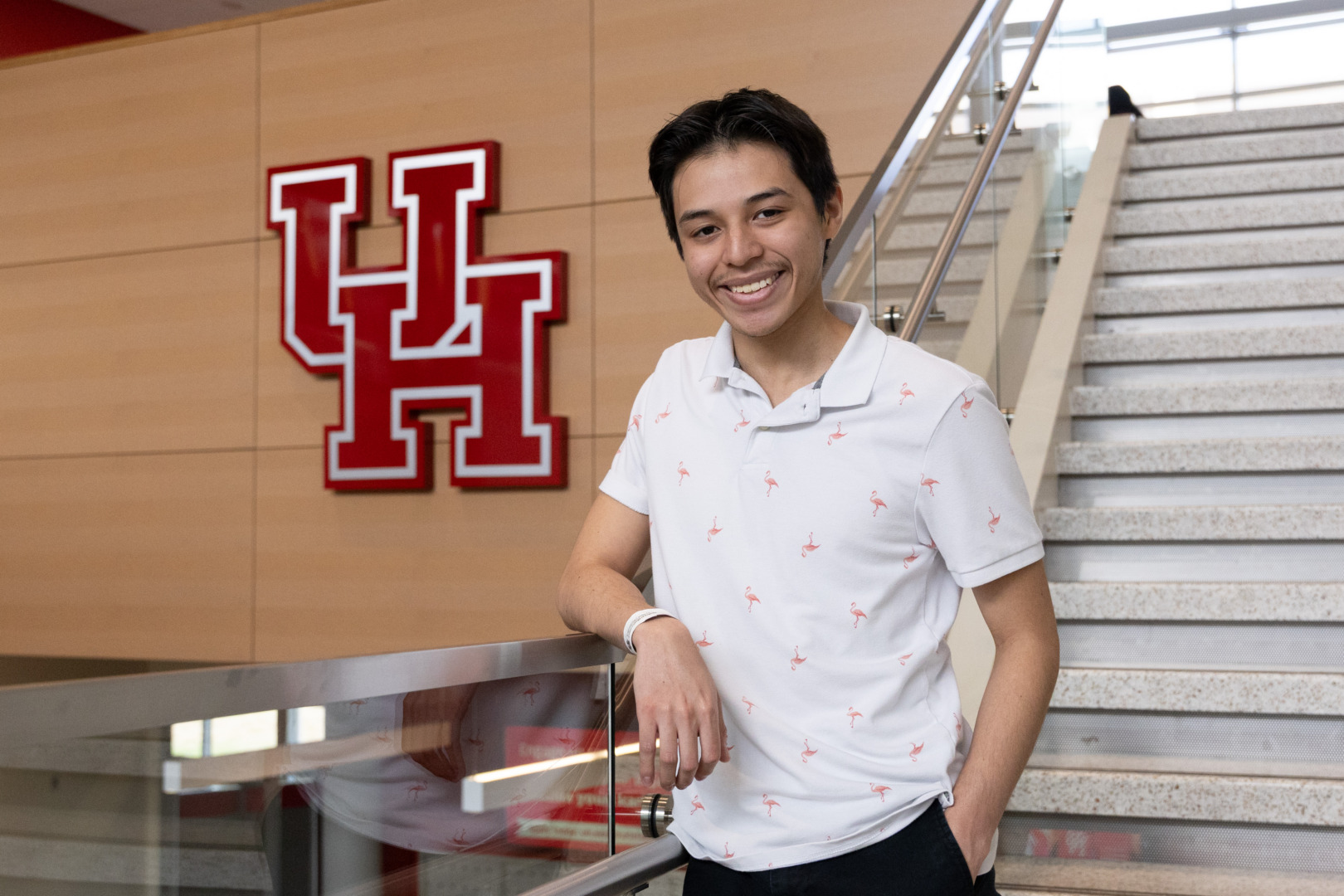
Graduate student Jesus Rodriguez poses for a photo with The Cougar on Thursday Jan. 12, 2026, in Houston, Texas. | Raphael Fernandez/The Cougar

For computer and systems engineering Ph.D. student Jesus Rodriguez, engineering isn’t just about software and code, it’s about giving back to the community and helping those around him.

Rodriguez works on a project called P-LEGS, the Pediatric Lower Extremity Gait System initiated by Jose Luis Contreras-Vidal, the principal investigator of the project. He works specifically on a robotic exoskeleton designed to rehabilitate young children with mobility disabilities.

Originally from Mexico, Rodriguez moved to the U.S. during middle school, returned to Mexico to complete his bachelor’s degree and later decided to come back to the States to pursue graduate study.

After his mother told him about a new scholarship offered by Mexico’s Federal Electricity Commission at UH, Rodriguez began researching the University and came across the P-LEGS project. Right at this moment, he knew he wanted to work alongside Contreras-Vidal.

“Helping people is something I want to do the rest of my life, and so I applied to the University specifically to work on this project and to work with Dr. Contreras,” Rodriguez said.

The coin flip

Rodriguez originally studied neuroscience but realized he did not see himself spending the rest of his life doing laboratory work.

Despite having various interests, he narrowed his choices to computer science and engineering. The decision, however, was not meticulously planned.

“I knew I liked coding, so I thought, what can I do with coding? Either computer science or engineering,” Rodriguez said. “So I flipped a coin, and well, engineering won.”

A calling rooted in community service

Acts of service have been embedded in Rodriguez for as long as he can remember, from helping strangers and family members to volunteering in his community.

In Mexico, he volunteered at a children’s museum, where he taught kids about science, history and culture.

From demonstrating electrical experiments to giving lessons on climate change, he saw firsthand how education and engagement could light up a child’s eyes, Rodriguez said.

He describes himself as an introvert, but Rodriguez pushes himself to connect with others when it means making an impact or bringing a smile to someone’s face.

“When it’s for somebody else, when it’s for making people smile, I put my energy into it,” Rodriguez said. “Even if I drain all my social battery.”

The P-LEGS project

The P-LEGS exoskeleton is built to assist children with conditions such as cerebral palsy, spina bifida or spinal cord injuries.

Traditional physical therapy focuses on one aspect of movement at a time, such as knee motion or balance. Rodriguez explained that the exoskeleton is designed to imitate movement at the hips, knees and ankles, allowing children to practice full gait movements simultaneously.

A goal of the exoskeleton project is to create a more accessible and affordable alternative to existing systems that can be used both in clinics and at home, helping families who struggle to transport their children to hospitals.

The device will be first used in the clinics and then at home, so kids can benefit from both.

“One of the things that we learned from those enrolled in the study is that some children’s families find it really hard to get to the hospital,” Rodriguez said. “But those children deserve the right to be able to move. We want the price to be affordable. We want it to be as accessible as possible.”

The team is currently conducting a pilot study to test the device with both neurotypical children and children with mobility impairments. The data collected will help the team work toward FDA clearance.

Wherever his career leads, Rodriguez said one notion will remain unchanged: the work must matter.

“My core idea is that wherever I go in life, I want to do work that advances something, a technology that helps people,” Rodriguez said.

Many children with mobility disabilities reside in Houston, and through this project Rodriguez hopes to improve not only a child’s life but also the community that surrounds them.

For children learning to walk with the help of robotics, that advancement could mean more than the success of a project, it could mean independence.

“What I really want to see is the same thing that I saw back when I used to volunteer at the museum in Mexico, children’s faces lighting up, seeing their own self-improvement, endurance and improving the things that they couldn’t do alone before,” Rodriguez said. “That will not only impact the kids, but also the parents, the sisters, brothers and their extended family. It’s an improvement that fuels the soul.”

news@thedailycougar.com

—
“A coin flip that led to helping change lives- UH project helps young children with mobility disabilities” was originally posted on The Cougar
Posted in UncategorizedComments Off on A coin flip that led to helping change lives- UH project helps young children with mobility disabilities

UH instructors asked to sign memo rejecting “indoctrination”

Lily Huynh / The Cougar

UH instructors were asked to sign a memo declaring that they teach critical thinking rather than “indoctrinate” students at the order of President Renu Khator.

The message was sent to faculty in the College of Liberal Arts and Social Sciences by Dean Dan O’Connor following a directive from President Khator in November 2025.

“Our responsibility is to give students the ability to form their own opinions, not to force a particular one on them. Our guiding principle is to teach them, not to indoctrinate them,” Khator said.

According to The Chron, O’Connor told associate professor of English María C. Gonzalez that those who refused to sign the memo would not be punished; however, he said he would potentially have to review the syllabi of those who did not sign the acknowledgment.

O’Connor also told Gonzalez that every dean has been instructed to send this memo, because Khator wants to confirm to the Universitys Board of Regents that instructors are “teaching critical theory and not ideology.”

Five key statements

In the memo sent by  CLASS, professors were asked to acknowledge five statements:

  • “A primary purpose of higher education is to enhance critical thinking.”
  • “Our responsibility is to give students the ability to form their own opinions, not to indoctrinate them.”
  • “I understand the definition and attributes of critical thinking.”
  • “I design my courses and course materials to be consistent with the definition and attributes of critical thinking.”
  • “I use methods of instruction that are intended to enhance students’ critical thinking.” 

Political climate in Texas higher education

Texas public universities have faced scrutiny from lawmakers and governing boards over what is taught in classrooms. In November, the Texas A&M System Board of Regents approved a ban on lectures on “race and gender ideology.” This action sparked controversy and protests across campuses over censorship in higher education institutions.

While UH’s action does not ban these topics, faculty members say it reflects compliance with Senate Bill 37, a law that increases state oversight of curriculum taught in higher education. The law went into effect Jan. 1, 2026.

“We see what’s happening at the other universities in Texas and across the nation, so we know that in many ways admin is working for us,” said chair of the English department Lauren Zentz to The Houston Chronicle. “But it’s still such a dangerous climate that any moment of overcompliance kind of puts us at risk for sliding down the slippery slope of the denigration of education in a democratic society.”

This is a developing story and The Cougar will continue to report on it.

news@thedailycougar.com

—
“UH instructors asked to sign memo rejecting “indoctrination”” was originally posted on The Cougar

Posted in UncategorizedComments Off on UH instructors asked to sign memo rejecting “indoctrination”