Author Archives | Truitt Clark

Singer/songwriter makes his way in the industry

cole - online

Cole Thannisch is a new, up-and-coming artist who continues to blow away audiences, whether performing in a bar or in front of 10,000 people. He is currently a student at Belmont University in Nashville, Tennessee, but comes back to perform in his hometown, Alpharetta, Georgia, and around the Atlanta area.

The Technique had the privilege of interviewing him and learning more about his musical career and being a musician in the industry today.

Technique: What inspired you to get into music? Did you sing or play piano first? When?

Thannisch: I first started playing piano at four years old. Both my parents had been singers at one point in their life, in church, musical theater, and in an a cappella group. I stuck with the weekly practice/memorize/lesson/recital routine with my piano lessons but around the age of nine or ten, I started composing my own music for nation-wide contests. Once that happened, I kind of jumped into a new world of making music. That led me to want to take up electric guitar when I was 11. My dad raised me on Eric Clapton, Led Zeppelin and Pink Floyd, so I suppose I naturally wanted to be able to rock out like the guys I had seen on TV and concert DVDs time and time again.

I actually didn’t start singing until I was 14. I had only done choir in school until then but once I got into doing high school theater, I started to like using my voice for music rather than just talking or screaming at the TV while playing video games. Ever since then, I’ve just loved performing in any and all formats.

Technique: What is it like to be an up-and-coming artist in today’s music industry? What challenges have you had to face?

Thannisch: Today’s music industry is quite a challenging one. It’s certainly nothing like it was back during the days of my rock idols. Even in the late 90s and early 2000s, record labels were actively searching for new talent that they could exploit and make into the next rock or pop super star. Today, it’s more like “Hey kid, you’re good, but come talk to me when you’re already famous.” Being in Nashville, especially, has really proven to me that it’s all about acquiring new songs and the rights to those songs for the major publishers. Nashville is much more of a songwriting town than it is an artistry town in my opinion. And your way into the business as someone who wants to make music will have to be through writing and co-writing with the people who really know their way around town (in more ways than one).

My biggest challenge has probably been staying motivated and keeping my eyes on whatever my goals are. At Belmont University, I’m surrounded by the most talented people I’ve ever known. I was lucky enough to get a spot as a singer in the School of Music’s most exclusive ensemble, Phoenix, as an auditioning freshman. Because of that, I’ve had the immense pleasure of working with other world-class musicians and vocalists. Being around those kinds of creative people keeps me going.

Technique: Can you tell us about your first public appearance or your favorite musical moment?

Thannisch: My first public appearance … does a talent show count? I’m honestly not sure. I’ve done recitals since the age of five and bar gigs since the age of 15. However, my favorite musical moment, my biggest on-stage rush, would probably be a tie between two instances.

The first would be last spring, April 2014, when a piece I composed/arranged for a 150 person, 6-8 part choir and a full string orchestra was performed at the University Singers concert. The piece was called “Apocalyptica,” and it was a mashup of the theme from “The Walking Dead,” “Pompeii” by Bastille, “Sound of Silence” by Simon and Garfunkel, “Mad World” by Tears for Fears and “The Second Law: Unsustainable” by Muse, along with some excerpts from ancient Gregorian chants and “Night on Bald Mountain,” a famous classical piece. So, that was pretty amazing to see all come together. There’s actually a video of it (mediocre quality) from an audience member’s cell phone on YouTube on my channel.

The next would probably be when I opened up for Styx, Ted Nugent and REO Speedwagon in May 2012 as an 18 year old who just graduated high school. I won an open mic contest hosted by 97.1 The River to find an opener for the show, and amongst 30 other solo acts, I won. Playing in front of 10,000 people at only 18 was pretty amazing.

Honestly, any time I know that I gave my best on stage and that it was received and enjoyed by the crowd, I feel incredible. Whether it be because of one lyric, or hitting a ridiculously high note, or a certain song that a couple at the back of the bar had played at their wedding, I know that I’m doing what I’m on earth to do.

Technique: Tell us about your first single. What inspired you to write it? How was that experience?

Thannisch: My first real single wasn’t actually my first single. I had released a couple songs on iTunes back before I went off to college at Belmont, but “Won’t Leave You Behind” is what I consider my most professional single to date, after my first EP, “Love,” released in 2013. The inspiration from that song came from what most would expect, a woman, with whom I have only shared a handful of intimate moments.

Nonetheless, my feelings towards her proved to be plenty enough for a fun song to perform. I actually wrote it way back in spring of 2013 but hadn’t recorded it until summer 2014. I wrote it with the intention of being able to be performed as an electronic pop song and as more of a pop/singer-songwriter tune, hence why I released the raw studio version of me and my guitar just playing the song straight through in one take along with my friend Alex Ehler’s (aka THOUGHTSEIZE) dubstep remix of the song.

Technique: How much of your music/lyrics do you write and what type of subjects do you like to cover?

Thannisch: Up until recently, I have written every bit of music and lyrics I release. I’ve finally begun to branch into the world of co-writing and writing for other artists. The subjects I kind of touched on earlier, but they can range from women (hell, they mostly come from my experiences with women, both good and bad), my life goals, someone else’s romantic fantasy or tragedy, a personal experience or a friend’s experience.

Although, the most intriguing songs for me to write are ones like my song “The Cold,” which will be released on my EP come August or September. It isn’t about me. It isn’t about a friend. It’s completely centered around an idea of an unorthodox time signature and what winter could mean for someone. I drew images from things I’ve seen around Nashville in the lyrics of the song but it still describes a person’s own narrative. That narrative is just one that was created/envisioned separately from anything I’ve done or experienced.

Technique: You currently live in Nashville. How often are you able to get back to Atlanta to perform? Do you have any scheduled appearances in Atlanta?

Thannisch: I go back to Atlanta a few times a semester, more so in the spring than the fall. I actually have several dates scheduled in Atlanta for the rest of the spring. I’m playing at Ray’s at Killer Creek off Mansell Road in Alpharetta on Apr. 3 and 4, and then I perform at the Alpharetta Arts Streetfest on Apr. 19. Come May, I’ll be playing all over the place in Metro Atlanta, mostly in Fulton, Cherokee and Forsyth counties.

Technique: What are your plans for the future?

Thannisch: My plans for the future boil down to this: never stop creating. No matter what I have to do to make a living, whether it be a music teacher, a private voice coach, a bar musician, a songwriter on music row who only makes 10 percent of the total revenue his songs earn or a background singer on tour with some other act, I will never stop creating music. It’s so cheap and easy to make music by yourself nowadays that you don’t need 100 grand and a massive studio. You can literally do everything in your computer and make fantastic music that someone will want to listen to.

As a professional, I hope to stay in Nashville after I graduate, or possibly after a couple months of being back in Atlanta. I know I can always find work in Atlanta, but Nashville doesn’t pay local entertainment nearly as well. I’m working on a few connections in Atlanta, Nashville and Los Angeles as far as an artist career goes. I try and keep my feet in a lot of doors, and whichever one opens up first will probably be the one I sprint through.

Posted in UncategorizedComments Off on Singer/songwriter makes his way in the industry

Students Speak: Student Center dining options

food court - online

A tasty lunch or snack can change the mood of someone’s entire day or make or break a week. For college students who have little time and resources to spend on meals, campus dining options are important determinants in their quality of life.

The Student Center acts as a hub in the center of campus for purchasing quick breakfasts and lunches in between classes. Students often dine at places within the Student Center multiple times a week since all options accept Dining Dollars and BuzzFunds.

The recent introduction of increased variety in Student Center food venues, most notably through the opening of Twisted Taco and Ray’s New York Pizza, seems to excite most Tech students. Both new additions to campus are locally founded, trendy staples of Atlanta.

Twisted Taco brings the first opportunity for students to get Tex-Mex food on campus. With a diverse collection of cheaply priced tacos and vegetarian nachos on the menu, Twisted Taco appeals to students with all kinds of preferences.

“Twisted Taco is so delicious. I like the different options,” Erica Bush, second-year CE major, said.

Fresh to the Student Center Food Court, Ray’s New York Pizza has a well-known reputation at Tech due to its presence in Tech Square. Their ready-made single-slice selection consists of an assortment of pizza choices with a range of toppings. Ray’s option to purchase by the slice allows students to pay for the right amount of food without worrying about bringing leftovers to class.

No complaints have been made from those who miss walking to Tech Square to get to Ray’s or going off-campus to search for a Twisted Taco.

“I had a Twisted Taco back at home and always liked Rays in Tech Square, so being able to eat there by just going to the Student Center makes things really convenient, having all those options in one place. The more food options the better, ” Joseph Hooper, second-year CS, major.

The universal reaction from the opening of a Ray’s and Twisted Taco in the food court among students has been positive all around. Hopefully, the options continue to impress students.

Posted in UncategorizedComments Off on Students Speak: Student Center dining options

Cinderella dances once more

cinder_Online

“Cinderella” is the live action 2015 remake of the classic  fairy tale that Disney first animated in 1950. Starring Lily James (“Downton Abbey”) as the titular character, the film shares many aspects of its characters and story with its animated counterpart, but like any remake worth seeing, it does provide the story with a few welcome updates.

The first noticeable change in this version of “Cinderella” is the film’s large amount of focus on its  heroine’s early childhood years, before the evil stepmother (Cate Blanchett, The Lord of the Rings) comes into the picture. The audience is able to see how Cinderella grew up, see more of her as a person and how she ends up in her infamous situation with her stepmother.

Speaking of which, the movie does a good job of giving the stepmother some extra character. She is not initially mean to Cinderella, but there is a gradual, but realistic, increase in her cruelty toward her step-daughter, which is refreshing especially when compared to most interpretations of the story. The prince (Richard Madden, Game of Thrones) is also given a decent amount of character development throughout the movie, which is a far cry from the original.

The visual effects of the film are given a good treatment as well. With vibrantly colored scenes and equally lively characters, the effects manage to capture the essence of the story of Cinderella while still remaining somewhat realistic. That being said, the movie is not afraid to be flashy and magical when it needs to be, which is good since it gives the movie that childlike sense of wonder that has become such a timeless tradition of the Disney name.

Despite these pros though, there is a minor problem with the movie, and it is the fact that the prince and Cinderella practically fall in love at first sight. They only have three interactions throughout the entire movie, which is two more than the original story, but the characters know that they are meant to be after the first meeting. While it can be argued that the point of the film is Cinderella’s rise out of a place of great cruelty and a romance is only a small part, it is still hard to accept the couple’s instant, lovestruck chemistry, especially by today’s standards. But it is only a minor problem.

Overall, “Cinderella” is a decent adaptation of the classic tale that may surprise viewers with its emotional range. While it does not deviate too much from the general plot from the original, it adds plenty of refreshing scenes and ideas that breath some new life into this story.

Posted in UncategorizedComments Off on Cinderella dances once more

Dr. Clough speaks on ethics in engineering

Dr. Clough-3310 - online

On March 24, Tech students and faculty had the distinguished honor of having Dr. Wayne Clough, the former President of Tech and namesake of the CULC, speak about climate change’s impact on habitats and mankind. Dr. Clough was chosen to speak by a new selection committee established by the school of Environmental Engineering.

This new speaker series brings a distinguished leader to Tech every fall and spring to share his or her thoughts with Tech students and faculty. After asking 1200 students and Tech alumni and 100 faculty and staff members, the committee came to an unanimous vote for the selected speaker: Dr. Clough.

During the lecture, Dr. Clough emphasized how engineers, not just Washington bureaucrats, need to focus on solving the major problem of climate change. Citing the rising sea level as evidence of climate change’s major repercussions, Dr. Clough illustrated climate change’s vast effects.

He then raised a valid point: With the government not even spending money on our highways, why would the government spend money on a future event that some still doubt? He believes engineers have a moral responsibility to address this mounting problem.

“The most important thing for an engineer to keep in mind when designing is public safety and welfare; we engineers have a code of ethic,” Clough said.

Recently, President Obama and President Xi Jinping of China met and decided to mitigate the effects of climate change, which Dr. Clough believes to be historic since the two countries are tackling a serious issue.

Every four years, the U.S. performs a climate assessment where different U.S. agencies, such as NASA and the Smithsonian Institution, must answer questions specific to climate change. Certain agencies took serious action after these assessments, such as NASA which sent out a satellite named Tempo which monitors U.S. pollution.

Dr. Clough also spoke on the Earth’s temperature that has been increasing since 1880. The latest measurement was in 2013, which showed that the temperature has increased by 0.16 degrees Celsius. At this rate, the sea level would rise by 10 feet by year 2200. We would need a boat to see the Smithsonian by 2200.

Dr. Clough then poses an intriguing question: “How do we fix this sea level rise rate of about 0.13 inches per year?”

With the growing population, carbon dioxide continues to be an issue according to Dr. Clough. In 2150, there will be 3 billion more people and another 2 billion more by the end of the century. Dr. Clough feels we cannot add that many more people. Although some carbon has resulted from natural causes, he feels we still have a responsibility to help combat the man-made sources of carbon dioxide.

His solution to this is mitigating the severity of the problem. He cites the New York’s $25 billion spending budget on floodwalls post-Hurricane Sandy as a strong example of mitigation. This is a good step to take according to Dr. Clough, but he suggests combining the money put into protecting the citizens on the coast with mitigation.

According to Dr. Clough, if humans do not slow down the level of carbon dioxide released into the air, mankind will enter the Anthropocene age, a proposed time period that will occur when human activities prominently impact Earth. During the Anthropocene age, there will be a black layer of carbon left by humans along with an excess of plastic located in the ocean. In fact, even the sand is predicted to be mostly plastic.

Connecting climate change back to Tech, Dr. Clough spoke about Tech’s prestige in mitigation. Tech has a Carbon-Neutral Energy Solution Lab and leads the carbon-free environment campus effort domestically.

“Doing nothing is simply not an option, and I took an oath as a civil engineer that public welfare is the most important thing,” Clough said.

When Dr. Clough first came to Tech as an administrator, students complained about the lack of recycling on campus and demanded change. Now, Tech is one of the best campuses in the world when it comes to recycling. Dr. Clough gave a shout out to everyone on campus and proclaimed that he is proud.

Posted in UncategorizedComments Off on Dr. Clough speaks on ethics in engineering

SCPC Fine Wine course: nothing to whine about

winecourse_online

See. Sniff. Sip. Summarize. That is the philosophy Dr. Blake Cherrington, Certified Wine Educator, employs  when appreciating the art of fine wine. Through Student Center Programs Council’s (SCPC) Options courses offered each semester, Dr. Cherrington and his wife, Meryl Cherrington, have been teaching the Exploring Fine Wine class since 2009.

Dr. Cherrington is one of seven Certified Wine Educators in Georgia, and one of four hundred worldwide. He also holds a Ph.D. in EE and formerly taught at Tech.

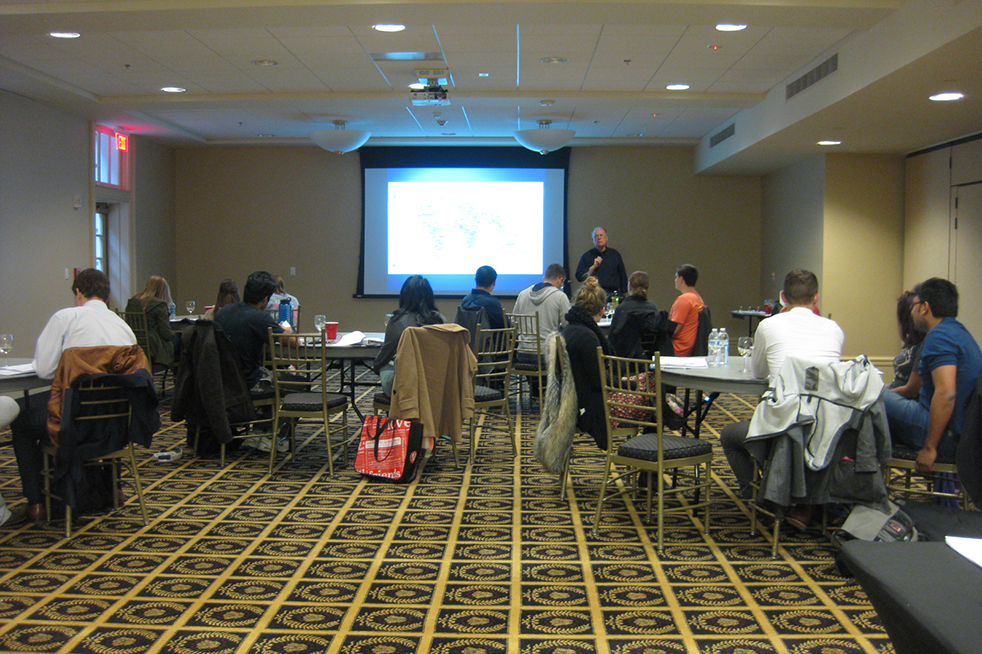
The class is held in Tech’s Historic Academy of Medicine—a fitting venue for a course on fine wine. Cherrington teaches his class using a PowerPoint and a few selected bottles of wine from the region of interest.

Students dressed in sweatpants and blazers alike sit around small circular tables with a “dump cup” in the center. Each student has his or her own wine glass and a binder containing the course material. Wine, paired with the dimly lit venue and ornately patterned carpeting, gives the class a debonair feel.

Cherrington begins the course by jumping right into wine tasting. During the first week he focuses on white wines, the second week on red wines, and then he introduces his students to the wines of the world. The global wines range from California to New Zealand to France.

“Last week, we did representative wines from California, Oregon and Washington State—well over 90 percent of the wines in this country. Tonight we’re going to do Chile and Argentina,” Dr. Cherrington said. “[Next week], Australia and New Zealand.”

After each wine sampling, Dr. Cherrington always asks for student input on the wine sampled. Students generally take the course either out of curiosity or for professional reasons.

“We have got a lot of people who are young professionals going out into the business world. Others take the course just for the sheer enjoyment of learning about wine. I think most of them enjoy it because after they leave here, they now have a foundation and can go to a restaurant or wine store and either pick out a wine or at least have an intelligent conversation with the wine steward,” Cherrington said. “My students are quite curious about the subject. And what other classes assign drinking wine? Can you beat that?”

Garrett Mallory, a fourth-year CS major attending the class this semester, has just such motivations for attending Exploring Fine Wine.

“I really like to cook, and I think understanding how the choice of drink complements a fine meal is the next step for me in understanding how to create a well-balanced dining experience,” Mallory said. “That, and I figured if I were ever at a formal event such as an invitation or professional dinner, knowing how to read the menu and choose a wine is a big plus.”

Exploring Fine Wine has been a popular offering  for seven years now, and the class aims to target anyone affiliated with Tech. The class is proving successful in educating students on the finer points of wine.

“There has never been a negative review. It’s always sold out,” said Matt Pack, Options Chair of SCPC.

“You learn a ton, have a great chance to connect with people and get to enjoy a wide variety of unique wines,” Mallory added. “I feel a lot more confident on the subject after attending a few classes, and look forward to the rest of the wine tasting classes.”

“The great thing about wine is that it’s not something you drink by yourself,” Cherrington said. “Wine means food and friends as well. It’s a social thing, and it has a lot of culture built into it.”

Cherrington feels that appreciating wine is like appreciating any art; there is a certain class and elegance associated with the art of wine and a certain skill needed to fully understand it.

Posted in UncategorizedComments Off on SCPC Fine Wine course: nothing to whine about

Best shares thoughts on new UN position

Architectural Macau_AI

With his recent appointment as director of the newly formed United Nations University Institute on Computing and Society (UNU-CS), Dr. Michael Best, associate professor in the School of International Affairs and School of Interactive Computing at Tech, will be taking a leave of absence from the university. Although Best will be accepting the four-year position based in Macau, China, he will always “remember [his] home at Tech.” The Technique talked to Best to gauge his feelings towards his recent appointment.

Technique: What was your reaction when you found out you were selected as the director for the UNU-CS based in Macau, China?

Best: I was excited. It was a combination of excitement and intimidation because it really is a fascinating and marvelous new opportunity, but it is a little daunting.

Technique: Is there anything that you are particularly intimated by?

Best: One challenge is that it really is a start-up. There is no staff. I am essentially the first staff member for the Institute, so one of the unique opportunities and challenges is to build a core set of researchers from nothing. Sometimes I wake up in the morning thinking that is the most amazing thing I have ever had the chance to do, and other times I wake up thinking that is the most insane, impossible thing I have ever had the chance to do.

Technique: What specifically will you do in your role? Are there any particular initiatives that you plan on prioritizing?

Best: My role is essentially the CEO of the Institute. I am responsible for setting the vision, the overall hiring strategy, and day-to-day management. I must keep the place running. In terms of initiatives I plan on undertaking that is something I plan on answering the first few months while I’m on the job. What is the intellectual space that we really want to focus on? The mandate for the institution is rather broad. It is anything that has to do with computing and communication technologies and the developing world. Our purpose is to perform world-class research while also being policy impactful on the United Nations. So, that’s quite a large space.

Technique: I understand that you have been involved with monitoring elections in Africa; do you plan on using those skills in your new position?

Best: I certainly intend to continue my own research agenda at least part-time while I’m directing the Institute. One piece of the Institute’s work will focus on civil engagement and political development. In addition, I do a lot of work in peace building and computing in conflict-stress environments, and I suspect I will continue on with some of those initiatives. I have to be realistic about how much time I will have to devote to research compared to when I was just working as a faculty member here at Tech. Realistically, I will have to slow down on some of my research activities.

Technique: How do you feel your time at Tech has prepared you for this role?

Best: As part of Tech’s strategic goals, I have been very supported in my interest to have international reach and policy impact. I think this job will add to my skill-set in that I will have more direct management experience. Here at Tech I manage my research lab of students and collaborators but that is different than running a research center of scholars and support staff.

Technique: What is the thing you will miss the most about Tech?

Best: I know I will miss the students here at Tech. Of course, I hope to bring some with me. We are looking at opportunities to have Tech students come for a summer, a week, or a term. I will miss a lot of my friends and colleagues here on campus but also in the general Atlanta area.

Technique: What are you most looking forward to in China?

Best: Well besides just the exciting opportunity for building this new research institute, it is an amazing part of the world to have a chance to live in. The Pearl River Delta is exploding in entrepreneurship, innovation, and creativity. Just to be able to be there and participate some in this amazing dynamic will be exciting.

Technique: For students that might want to go down on this United Nations career path, what steps do you recommend they take now in preparation?

Best: The United Nations is a strange organization in terms of hiring. Some parts have early professional career positions for young people. Many parts expect advanced degrees—Masters and PhDs specifically. So it is a very diverse organization with frankly unusual hiring practices. That said the UN is global. I think any Tech student who has an interest in pursuing an United Nations career should have international experience that should start now.

Posted in UncategorizedComments Off on Best shares thoughts on new UN position

So, who the heck is Beck?

beck_online

In the most recent installment of the Grammy’s, Beck’s newest album, “Morning Phase,” won Album of the Year among other awards, beating other more well-known artists, including Beyonce and Sam Smith. Aside from the memorable moment when Kanye West once again felt the need to interrupt someone’s acceptance speech — because, heaven forbid, someone win an award that Beyonce was nominated for — Beck winning this award invites the question: who is Beck?

Beck is not new to the music industry. He started performing on buses in Los Angeles in his teens. In 1989, he left for New York, where he started to write new types of songs — turning mundane thoughts about things like pizza into lyrics. In 1993, he released the song “Loser” at his record label’s insistence. While he believed the song was mediocre, it was actually his most popular song for years, peaking at number 10 on the Billboard Hot 100 singles chart as well as topping the Modern Rock Tracks chart.

Because of this song, Beck was labeled the “King of Slackers” and considered the center of the “slacker” movement, a title he strongly contested. He then released the album “Odelay” in 1996, which contained hits such as “Where It’s At” and “Devil’s Haircut.” This album was nominated at the 1997 Grammy’s for Album of the Year, though it did not win. He did, however, receive a Grammy for Best Alternative Music Performance for the song “Where It’s At” as well as a Grammy for Best Male Rock Vocalist.

Since then, Beck has released several more albums, reinventing his sound in 2002 and leaving behind break beats for a more folk-like sound. One of his more recent albums was entirely comprised of sheet music — ”Song Reader,” released in 2012 — assuming fans would record their own versions and interpretations of it.  The most recent album, “Morning Phase,” is his twelfth studio album. It was released in early 2014, following his signing with Capitol Records at the end of 2013. This year at the Grammy’s, Beck’s album won 3 awards: Best Engineered album, non-classical, Best Rock Album and, of course, Album of the Year. In general, Beck mostly produces alternative music, though his style often includes a fusion of rock, folk, hip-hop and rap.

Music production aside, Beck is married to actress Marissa Rabisi, sister of Scientology actor Giovani Rabisi, and is also a scientologist himself. In fact, his parents, David Campbell, a musician, and Bibbe Hansen, a visual artist, are also scientologists. His upbringing likey had a huge impact on his creativity. Unlike some other artists, Beck relies on himself to write lyrics for his songs. He also plays a multitude of instruments, including guitar, keyboard and drums. However, despite this self-reliance and phenomenal musical capability, Beck is, and has always been, a humble artist.

Posted in UncategorizedComments Off on So, who the heck is Beck?

Global Vibes: Spanish sleuth novel compels

gun_online

El juego de Caín by César Mallorquí is an enthralling Spanish detective novel centering on Carmen Hidalgo’s most recent case. The book opens with a case proposal from Ignacio Vazquez, the president of Deportivo de Chamartín: he wishes Hidalgo and her detective agency to investigate the unusual spending habits of his star player, Rubén Mochedano. There is never a dull moment in Carmen Hidalgo’s quest for answers that leads her all through Madrid and even to Colombia and back.

Accompanied by various uncouth allies including Ángel (a murderer for hire), El Gato (the leader of a biker gang), Hermes (an ex-con), Gabriel (the pretty face) and her cousin, Hidalgo quickly uncovers that Mochedano is being blackmailed, but that reveal is only the tip of the
deadly iceberg.

Although her past is dismal and rather depressing and Hidalgo has no more reason to be joyous than any other hardened detective, with her affinity for brand name shoes, Hidalgo pushes the boundaries of the stereotypical somber sleuth. Of course, with a woman as the main character, the obligatory love story is present, but Mallorquí puts his own spin on the stereotype, transforming the usual sad attempt at giving a female protagonist depth into a mockery of other novels in the detective genre. Hidalgo goes so far as to have a handsome young man, Gabriel, as her secretary in place of the beautiful yet normally clueless girl found at the front desks of many a detective.

Hidalgo’s dark sense of humor paired with Mallorquí’s levity in a serious genre make for a unique novel with a compelling story that will leave the reader guessing until the last pages. While some major plot points are quite easy to predict, Mallorquí sets the reader on a mental journey with varying depths of guesswork, and few, if any, readers would be able to divine the entire story before the end of the novel, especially because Mallorquí sees fit to leave the ending open to interpretation. The murder and intrigue of El juego de Cain make for a page-turning quick read.

Sadly, the book has one major drawback for many Tech students. It has never been translated into English, so in order to enjoy the twists and turn of Mallorquí’s novel, one must also enjoy the Spanish language. For those just learning Spanish, though, this is a rather good read, because it does not use extraordinarily complicated language, but is not a children’s book in any
sense either.

For those not daunted by this potential language barrier, El juego de Caín is a great novel for leisurely reading. There are many references to modern culture and, unlike many stories in this age of technology, the main characters do not create plot holes all over the place by ignoring their cell phones and other technology. On the contrary, Hidalgo and her friends use technology to their advantage, at one point even “invocando a san Google, escribí…” (“invoking Saint Google, I typed…”), which is the response a good majority of the modern world would have when faced with a question to which they do not know the answer. This refreshing acceptance of technology makes for a more believable story.

El juego de Caín’s enjoyable story and humor leaves the reader looking forward to reading El juego de los herejes, the second documented case of Carmen Hidalgo, which takes place quite some time after the events of El juego de Caín. If the first book is anything to judge by, Mallorquí will not fail to please and entice with his return to the dark humor of Hidalgo.

Posted in UncategorizedComments Off on Global Vibes: Spanish sleuth novel compels

Fresh comedy redefines stereotypes

fob_online

It’s 1995, and the Huangs are moving from Washington D.C.’s thriving and highly populated Chinatown to an almost all-white and humid town in Orlando, Florida. Hip-hop obsessed, 12-year-old Eddie Huang (Hudson Yang) is thrown for a loop as he tries to fit in with the popular kids at school. “Fresh off the Boat,”  ABC’s new comedy, follows the Huangs after their move as they try to navigate the uncharted territory of owning a Western-themed restaurant and living in a practically foreign suburban neighborhood.

The Huangs move to Orlando after Eddie’s father, Louis (Randall Park, “Veep”), buys Cattleman’s Ranch, a Western restaurant. Louis believes unconditionally in the American Dream, much to his wife Jessica’s (Constance Wu) chagrin. Eddie’s two younger brothers, Emery (Forrest Wheeler) and Evan (Evan Chan) are sweet boys who accept their Asian culture wholeheartedly and fit in quite well at their new school. Emery even becomes popular on his first day at school, getting a girlfriend with his happy-go-lucky attitude — much to Eddie’s surprise, disbelief and
irritation.

Jessica’s displeasure at having to leave D.C. can be seen in the first few minutes of the pilot episode. She is unhappy as she has no friends, family or a Taiwanese market, and her hair does not bode well in the Florida humidity. She, much like Eddie, is separated by her Asian culture when trying to mingle with the more popular wives of the neighborhood. However, after a couple episodes, she and her neighbor’s outcast second wife bond over their shared love of Stephen King movies.

“Fresh off the Boat” is the only Asian-American centered show on primetime American channels.  The show rehearses old Asian stereotypes while quickly and empathetically demolishing them. For example, in the pilot, Louis tries to make Cattleman’s Ranch successful by hiring a white host, so customers won’t be put off by an Asian face greeting them. Similarly, Jessica and Eddie embark on an expedition for Lunchables at a giant grocery store, which initiates a nostalgic flashback of Jessica fighting and “negotiating” for prices when buying groceries at the Taiwanese market in D.C.

The first episode is steeped in such stereotypes, suggesting that the rest of the season would be much the same, chock full of stereotypical Asian behavior mixed with comedy to lessen the awkwardness. However, the second episode is a little bit of a game-changer, and insinuates a much better direction for the show.

The second episode opens with the principal of Eddie’s school warning all the parents of a dangerous drug dealer tricking kids into taking drugs. Jessica stands up and asks about something that she fears even more: when report cards come out. The implication that Jessica holds grades above all else is slowly chipped away throughout the episode, resolving the episode with her understanding that there is much more to life.

While the show may still be finding its rhythm, it is an important pop cultural moment; it lays down both common and uncommon Asian stereotypes and either dismantles, undermines or pokes fun at them. Major themes are alluded to in the narration at the outset of the show and then dealt with somewhat gracefully during the length of the episode.

“Fresh off the Boat” might be the first of many shows and may be part and parcel of recent trends in Asian American representation, joining Cristina Yang (Sandra Oh) in “Grey’s Anatomy,” Joan Watson (Lucy Liu) in “Elementary,” Dr. Lawrence Kutner (Kal Penn)  in “House” and Mindy Lahiri (Mindy Kaling) in “The Mindy Project”.

Seven episodes have aired so far, and there has been major character development, be it Jessica sticking up for Louis’s belief in the good of all people even though she regards most people in the opposite way or Louis realizing that sometimes happiness is worth more than success. The show is doing well and has a lot to be hopeful for, coming up with 6.4 million viewers last week. Although “Fresh off the Boat” still needs more refinement material-wise, what it stands for and what it is trying to do make it more than worthy of at least a second season.

Posted in UncategorizedComments Off on Fresh comedy redefines stereotypes

Cultural club “cares” for Chinese orphans

Photo courtesy of Calvin Su

On March 3, despite the gloomy weather, China Care held their Carnival with Street Market in Skiles Courtyard. This event featured Chinese street food for sale like bahn mi, bubble tea, lotus chips and egg tarts along with a free moon bounce and the opportunity to play corn hole.

The event drew many people who wanted to learn more about Asian culture and appreciate its food.

“I love Asian food,” first-year EE student Lian Randle said. “It was great to have it right there. Besides bubble tea, I hadn’t heard of any of these before today.”

“The goal is making diversity a part of everyday life by fusing Asian and American aspects, all on a regular school day,” Kathy Cheng, President of China Care, said. “It’s so awesome that even though we are a smaller club, … we are able to put our name out there and host multiple events every semester that each cater to hundreds of students.”

China Care has been on Tech’s campus for more than five years as a philanthropy group. Their mission, in addition to promoting  diversity on campus, is to help adopted Chinese children and fundraise for orphans in China.

Each month, the group members have play-groups with local children, originally from China, who have been adopted by American families. The children are brought on campus to play games and participate in traditional Chinese activities like a mini–Chinese New Year.

“[The children] learn a little bit more about their culture, and also they can play with the other kids and learn how to identify themselves because they’re in an interesting situation,” said Cheng, referring to the play-groups.

The organization has also been able to fundraise for orphans in China. The money goes towards orphans in China who have special needs and are medically fragile. Last year, China Care raised approximately $5,000 to fund a surgery for XingYu, who was born with Hirschsprung’s disease, a condition affecting the lower abdomen.

Last semester, China Care put on “Cure Your Cravings,” a cultural event that featured restaurant-catered Chinese food along with performances from a lion dance group, comedian and more. China Care ended up raising $900 which was then donated to help Chinese orphans.

China Care will be hosting a charity dinner fundraising event on April 4. This event will be held at a restaurant on Buford Highway and includes Chinese performances along with raffles for Chinese artifacts. One of the biggest attractions for the event, however, remains the authentic cuisine.

Ultimately, China Care aims to bring more Chinese awareness to Tech, and they welcome everyone to their events.

Posted in UncategorizedComments Off on Cultural club “cares” for Chinese orphans