Author Archives | Truitt Clark

Researchers find bugs in common browsers

Photo courtesy of Mozilla

Recently,  researchers from the College of Computing at Tech who published a paper including information on a certain technique which can be used to detect security flaws were awarded the Internet Defense Award from Facebook along with a $100,000 prize from the social networking site.

The research team, consisting of Ph.D. students Byoungyoung Lee and Chengyu Song, as well as professors Taesoo Kim and Wenke Lee, discovered eleven previously unknown internet browser security flaws. Among these were two flaws in “Firefox” and nine in “libstdc++”.

The researchers’ paper, “Type Casting Verification: Stopping an Emerging Attack Vectory”, identifies an emerging class of security vulnerabilities in C++ programs. Programs written in this code typically use both static and dynamic casts when one data type is changed a different one.

The team of researchers from Tech discovered that certain bad casts can actually create corrupt pointers that can be accessed by hackers and, in turn, be used to corrupt memory processes. The researchers’ paper proposes a novel technique that can be used to detect these types of casting issues.

In fact, the prototype that the researchers have developed already is showing results, having proven capable of locating and recognizing the previously undetected security vulnerabilities in Firefox and libstdc++. Those particular security issues of the browsers that were discovered by the Tech researchers have since been remedied, theoretically making Firefox and libstdc++ safer pieces of software for users.

“It is time for the Internet community to start addressing the more difficult, deeper security problems,” said Wenke Lee. “The security research community has been working on various ways to detect and fix memory safety bugs for decades, and has made progress. Our work studied the much harder and deeper bugs and our tools discovered serious security bugs in widely used software.”

Due to the Tech researchers’ contribution to increasing the safety of browsers used by many, Facebook selected the team from a pool of applicants from all over the world to receive the prize. Additionally, Facebook chose to award the team of researchers a total of $100,000, double the prize money the previous year’s winner received. The social media company felt strongly that this research (and the information gleaned through it) could potentially have far-reaching and very important effects and impacts in the cyber security world.

Facebook first initiated the Internet Defense Prize in 2014 in close partnership with the USENIX Association (officially The Advanced Computing Systems Association) in order to effectively “celebrate contributions to the protection and defense of the internet.” The USENIX Security Awards Committee works in conjunction with certain representatives from Facebook for the purpose of deciding the ultimate winner of the Internet Defense Award prize.

Posted in UncategorizedComments Off on Researchers find bugs in common browsers

Solar Racing fires up the track

Photo courtesy of Meera Nathan

In temperatures surpassing 100 degrees, Georgia Tech’s Solar Racing team braved the heat to compete against fourteen other teams in the annual Formula Sun Grand Prix (FSGP) track race in Austin, Texas at the Circuit of the Americas racetrack, consisting of road style closed courses. In this worldwide competition, teams’ solar vehicles are pushed to the limit in handling braking, curves, and accelerating. The FSGP track race is a three day event in which strategy, driver training, teamwork and, of course, a well-built vehicle are crucial for success.

FSGP originated from a larger event: the American Solar Challenge (ASC). The ASC is a 1200 to 1800 mile cross country road race across North America, and is held every other year during the summer. During the years that include an ASC race the FSGP only serves as a qualifier, yet still is considered quite an accomplishment to complete. After passing their “Scrutineering” inspections in order to satisfy the vehicle design regulations, which took about three days, the team was able to move on to the FSGP.

This year’s outcome for the GT Solar Racing team proved to be a significant improvement from their previous competition during the ASC year in 2014. “Teams need to complete 90 laps in one day or 60 laps each on two days in order to make the cut,” said Bharat Kathpalia, fourth year ME. “We did not make the cut due to logistical issues — the truck and trailer broke down on the way to Austin, so we had to leave all our spare parts behind.” Needless to say, this year the GT Solar Racing team came back with unwavering fervor.

Georgia Tech’s solar racing vehicle, the Endeavour, finished about 100 miles around the Circuit of the Americas racetrack, completing ten laps on day one, five on day two and thirteen on day three. “We shattered all of Georgia Tech’s records with our twenty-seven laps,” Kathpalia said.

However, with most successes there are hurdles to overcome. Despite surpassing their personal goals, the Solar Racing team faced numerous challenges along the way. “We were working with a car made out of older parts.  In addition, Austin is very hot this time of year, which caused a lot of the car’s parts to overheat,” Kathpalia said. “It was a challenge to keep our drivers safe while also making sure the car was running as efficiently as possible.”

Some of their struggles, however, resulted in improved performance. “On the first day of racing, we had to remove one of the battery modules as it was leaking,” Kathpalia said. We ended up discharging it later in the day; however, removing that module ended up improving our car’s performance.”

GT Solar Racing is now working on a new car, SR-2, whose frame is already welded in the shop. “The ‘SR2’ will be two-thirds the weight of the Endeavour, will have a third of the drag, and almost 50% more torque,” Kathpalia said. The team will be competing at the FSGP track race next year, and hopes to move onto the American Solar Challenge soon after. “We’re in a much better place logistically and mentally. Endeavour is a 4 year old car that we inherited, so we’ve had to spend 4 years fixing all the issues and learning its systems,” Kathpalia said. “With SR-2 we are aiming for at least a top 5 spot in the FSGP and qualifying for ASC next year.”

After getting 10% of the incoming freshman class to sign up for the team during FASET, Georgia Tech Solar Racing has high hopes for the team’s future. Training and introductory projects for new members begin this weekend.

More information on Tech’s solar racing team can be found at www.gtsolarracing.com.

Posted in UncategorizedComments Off on Solar Racing fires up the track

Sharing embarrassing first year stories

Photo by Jamie Howell

As a Freshman, nothing makes you feel more comfortable and reassured at FASET or other orientation meetings than asking upperclassmen about their first-year and how they lived it. I’m not talking about how well they did in their classes, how many friends they made their first day or how cool their fraternity’s initiation process was. The truly good stories are those that were lived with uneasiness and embarrassment. While successes and achievements can be inspiring, the tales of mistakes are often more instructive and always provide a good laugh. Here are some embarrassing first year experiences that sophomores, juniors and seniors agreed to share, though anonymously.

A fourth-year ME major from India had an incredibly uncomfortable first day in Atlanta.

He put it very mildly: “I came a little unprepared: I landed at the airport by myself with three pieces of luggage, no map or mobile internet and little or no information about check-in.”

He then proceeded to ask around for directions to the campus, and luckily for him, local Atlantans’ cordiality helped him out. But after getting off the MARTA at North Avenue, he realized his misfortunes had just begun.

“Loaded like a mule, I came out to the scorching sunlight. It was mid-August, around two o’clock and there wasn’t a cloud in the sky. Needless to say I started sweating within a minute.”

Oblivious of the check-in instructions, he didn’t get his keys at the ECHO office and couldn’t settle down. Instead, he dragged his luggage half across campus all the way to Clough Undergraduate Center, where International check-in takes place the week before classes.

“I climbed Freshman Hill under the burning sun and I finally showed up in front of the OIE staff exhausted and dripping with sweat: it was a pretty embarrassing scene.”

Fortunately during move-in week campus swarms of helpful assistants, and he was taken care of without hesitation.

Something a lot of us have experienced as Freshmen is locking ourselves out of our dorm room, but this second-year EE major has definitely had it worse than all of us.

“It was my fourth day on campus and I was living in Smith. That morning I woke up early and went for a shower: I left my clothes in the room, I wrapped up in my towel and locked the door behind me.”

Worried about his shower (in Smith, fighting for a shower can be a real challenge), he forgot his keys. He had just finished showering when the realization hit him. He ran back to the room, but his roommate had already left for classes.

“I had no phone to contact Maintenance, no clothes to wear and, most importantly, I had class in an hour! I felt so embarrassed as I started knocking on every door of the hall to find help, even more so when somebody finally answered and I had to explain the whole thing.”

After a good laugh, he was given some clothes and walked to ECHO where he could sort it all out.

A fourth-year EE major had a similarly drenching experience. He lived in Smith and like every honest East Campus freshman he used to climb his way up Freshman Hill to get to class.

“It was a morning of my second week of class and it was raining cats and dogs.”

Knowledgeable about Atlantan Summer rainstorms which give rapidly way to a hot sun, he dressed lightly.

“I put on a shirt and flip flops. Big mistake! Bobby Dodd Way was flooded with streaming water! But it was too late to turn back and change — I would have missed class! Although I loathed the freezing sensation that tormented my feet in the cold water, I kept going up.”

Around him were other students who struggled with the water flow, but they all had closed shoes.

“Every now and then I got puzzled looks which meant something like ‘What is that weirdo doing in flip flops?’. I was already glad that the hill was coming to an end, when all of a sudden I slipped on the wet asphalt and I fell butt to the ground, while my flip flops jumped up in the air and fell a few feet downhill. It was all so fast I couldn’t do anything about it, but as soon as I realized what had happened my face reddened, as I felt twenty-plus eyes looking at me and people snickering. Forcefully trying to keep a straight face, I stood up barefoot, picked up my flip flops and headed to class, with my head low and my butt wet and hurting — quite an embarrassing experience.”

For CS students Summer internships are a big opportunity to get some hands-on experience and to start building a rich resume. Some, the ‘brave and bold’, apply as soon as their Freshman year to big companies like Google, Uber, Facebook and Microsoft. There’s only one scary thing that makes those names seem far away from our reach: interviews.

“I applied for as many as 6 programs in a very short period of time — the applications were fairly straight-forward. Then came the interviews.”

He prepared properly for the big companies he was truly interested in, such as Uber, looking up the company’s history and reviewing certain programming languages beforehand.  Smaller businesses, though, his plan B’s, received much less attention. The result was that a couple of interviews were ridiculous, almost comical.

“There was this one time I had an interview with a software engineering company. Literally, all I knew about it was the name (barely) and that they needed programmers. He met with the two interviewers and everything was cool as they went through his resume and his skills. Then they switched to particular questions about the job.

“When I was asked: ‘So what are you looking for in our company?’ and ‘What is it about our business that interests you?’, I had no reasonable response to give them: I didn’t know what they did!”

With a guilty smile he said, “Well I know you’re looking for programmers, and I like programming”. An embarrassing silence followed. Then one of the interviewers caught the hint and with a knowing smile said, “You haven’t looked at the company at all, have you?” to which he answered honestly. After that, the conversation was moved on to different topics.

He likes to point out: “Funny thing, I still got the job offer I wanted from them, but ended up refusing it for an internship in a bigger company.”

Whether you’ve been ambushed by Atlanta’s unpredictable weather (lesson learned, always carry an umbrella), caught in an unfortunate interview or experiencing the dreaded sensation of realizing that you’ve locked yourself out of your room after a shower, most of us can bring to mind some sort of embarrassing memory from our earliest years of college life.

Posted in UncategorizedComments Off on Sharing embarrassing first year stories

Jen and Jeff discuss plans for new year

Photo courtesy of Megna Saha

As the 2015-2016 school year kicks into motion, the Undergraduate President and Vice President prepare to create a new executive board to faithfully represent the student body. Jennifer Abrams, fourth-year Public Policy major and current president, and Jefferson Losse, fourth-year Mechanical Engineering major and current vice president, sat down with the Technique to talk about plans and preparations for the new school year.

Technique: What new initiative are you most excited for the new year?

Jeff: Two things that we’ve already done so far that I’m already really excited for are the campus safety app and a new mental health portal.  The app is rolling out the first of September and is now fully functional, so students can go and download that right now if they would like to. It’s just LiveSafe, if you’re familiar with it, but that will replace JacketGuardian. We’ve also been working with the counseling center. I know in our platform we discussed the new mental health portal for the website through the counseling center. That is now live at united.gatech.edu and has been in progress for the past year now.

Technique: What’s new with the mobile app?

Jeff: This kind of runs with our platform in the campaign — that we want to make things that you can use as a student as user friendly as possible. When you pull up this app, it takes two seconds to boot. It’s a very simple UI that you can use. One of the big strong points of this is there are anonymous tips and reporting. Through surveys we’ve found that people don’t want to put their name down whenever they report a crime or anything that might not necessitate as a crime. It might just be something minimal, that they don’t think is necessary to call the police for. So with this app, you can report any number of items, and it’ll go right to GTPD, not to the Atlanta Police Department, because when you call 911 it’ll go to the Atlanta Police Department, and then they’ll go to the GTPD, so there’s a lag in communications.

Technique: What exactly has the Health and Wellness Task Force been up to? (The Health and Wellness Task Force was one of the proposals of Jen and Jeff’s campaign platform.)

Jen: That committee falls under the vice president of student life. In the first semester their biggest role is going to be to helping to usher in the director for the Center for Community Health and Well Being. That person will be chosen in the next two or three weeks; there’s been a national search going on since last spring. And that committee, [under] that person, will really be working with this new center that we have. What are our students like, what do they need, what do we see as the needs of our students in the area of wellness? They have been meeting with the directing staff over at the CRC, health promotions and STAMPS, and identifying the ways that they have wanted to reach out to students in the past and maybe didn’t have the best ideas or ways to do that. Basically, how can SGA really be helping more in that area of campus, to reach out more to our students.

Technique: What can SGA do for students that students aren’t aware of?

Jeff: We cover such a broad expanse on campus. I would really recommend, if I could recommend a student do anything, is to invest a little bit of their time in SGA, and just kind of figure out what we could do for them, because we hit just about every facet of campus. We work a lot with parking and transportation, academics, athletics. I don’t think people understand the scope of what SGA does, what they can do. One of the big things that we’re trying to address right now is that there’s 14,000 undergrads that we’re trying to help, and if they have an issue, they don’t necessarily know to reach out to SGA. It’s kind of a two sided thing –we’re wholly invested in the students, but we also need them to be invested in us, so we can turn around and help them.

Jen: One of the biggest things that students can always do is that if something comes up, if there’s an issue, even if it’s just a question, always to let us know, or just to ask. If you have a question and we don’t have an answer, we’ll at least know who to go to and ask the question. That’s just what we need from students, for them to let them know what they need from us.

Technique: What communication channels are open for students? How can they let you know?

Jen: Both of us are always open by email, in that case if you just go to sga.gatech.edu, if the website gives you nothing else, you’re going to at least know who Jeff and I are and if you want to contact us. Our email is always there, you can always email us. We have a facebook page at Georgia Tech Student Government Association, and also we monitor reddit a lot. So usually if there’s something going on there, and we can help answer a question, we’ll try to give our two cents. So those are three pretty big ways. And the SGA office is also in the Student Center. It’s across from Subway. We have an administrative secretary who’s awesome and is always there to answer questions, and nine times out of ten there’s an SGA person in the office. If someone has a question, they can walk in and ask them. Georgia, our secretary, can answer that question, and if she can’t answer that question, then one of the students in the back can usually give the answer or point them in the right direction.

Technique: What plans do you have to improve campus’s awareness and appreciation of diversity?

Jen: We have a Cultural and Diversity Affairs Committee. We call them CDAC. Last year they did a lot of really great outreach with our students working with the leadership of the student organization, doing some diversity round tables, getting some conversations started amongst our student leader and our student relations. So right now, they’re in the beginning, and they say, what does it look like the institute needs this year as we have a conversation about diversity?

Jeff: It kind of goes on a per case basis, so, as issues become relevant, we’re going to hold discussions throughout the year that address those. We’re going to actively search for that student feedback by holding those discussions and hosting them, but that’s not necessarily something you can plan for. It’s more of an event that happens and you address it at that point.

Jen: The great thing I think about SGA is when these things come up, our affiliation is the students. We’re not affiliated with one group or the other, so when we need to talk about something, we have a broad range of people in student government to give lots of ideas and opinions and thoughts as we’re trying the program about discussion.

Jeff: Like we said, there’s hundreds of us in SGA, so we cover all sorts of facets.

Technique: Is there anything else you to tell us about?

Jeff: Just wanted to stress live safe, and committee applications are coming soon.

Jen: Biggest thing. Whether someone joins a committee or doesn’t is always like outreach to us. Us reaching out, we’re going to be doing that all year. That’s what we’re here for, so just stressing how much, if they need either of us, if they need someone in our exec cabinet, always let us know, because we are definitely here to help.

Jeff: We have a lot of capacity to affect student life, so if someone’s interested, they should definitely join student government if they have the chance. Committees are a really easy way to break through and get into SGA, so I encourage anyone that has an issue, or thinks they can do something that can promote student life, they should join.


Posted in UncategorizedComments Off on Jen and Jeff discuss plans for new year

New spy thriller is uninspired spin on classic

Photo courtesy of Warner Bros. Pictures

Deep in the drama of the Cold War, American CIA agent Napoleon Solo (Henry Cavill, Man of Steel) finds unlikely company in rival Soviet KGB specialist Illya Kuryakin (Armie Hammer, The Lone Ranger) and hardened German mechanic Gaby Teller (Alicia Vikander, Ex Machina) as they join forces to hunt down Gaby’s missing scientist father, Udo (Christian Berkel, Valkyrie). The mission is by no means a creative one—the wonderful band of misfits is tasked with extracting Dr. Teller to prevent the stereotypical world-wide nuclear crisis at the hands of a sinister couple, the Vinciguerras (Elizabeth Debicki, The Great Gatsby, and Luca Calvani).

In many ways, Guy Ritchie’s The Man from U.N.C.L.E. is a standard, unimaginative, albeit humorous and fun spy film. The main nuclear conflict is not at all an interesting one though. Rather, the only truly intriguing dynamic of the nearly nonexistent plot is its protagonist foils. This recreation of the cult 1960s TV show of the same name surprised audiences with its superb character development.

Even from one of the first scenes (a car chase scene that rivals The Bourne Identity in creativity), Ritchie clearly establishes Solo’s calm, quirky demeanor contrasted to Kuryakin’s intense, short-tempered mentality. Chuckles ensue as the two ridiculously attractive protagonists exchange witty banter as they grow as characters and learn more about each other to the point where they are close to what “normal people” call friends.

On the negative end of the spectrum, the other characters are weak. The lead female role — a mechanic dolled up for fancy parties — does account for some humorous quips, but does not provide the stunning sharpness apparent in a Bond girl or the like. The antagonists are even worse. Victoria Vinciguerra, accompanied by her very unimportant spouse Alexander, is an extremely stereotypical, sinister femme fatal lacking any innovation.

Blockbuster directors with enormous budgets often spend the vast majority of their funds on elaborate pyrotechnics, but Ritchie is a special filmmaker. He allocates much of the budget to the details of the film and to the sets, seen in this spy thriller as well as his 2009 creation, Sherlock Holmes, which all but shoves a theater audience into a DeLorean to present them with the wonderful surroundings and elements of 19th century England.

The Man from U.N.C.L.E. engenders a similar effect, depicting the ridiculous and dramatic environments and characters of the 1960s bourgeoisie scene. Ritchie beautifully portrays an ostentatious, sleek and accurate representation and recreation of 1960s fashion with seersucker suits, popping orange dresses, pillbox hats and shiny oxfords. Other seemingly small design details make all the difference in the film and give it an authentic feel, from Solo romping about Rome on a bright yellow Vespa to the models of the Formula One cars used at the Grand Prix event.

Ritchie also incorporates fantastic cinematography, giving a modern edge to the classic spy story. Innovative split screen action montages and well-executed mood juxtaposition scenes bridge the gap between plot developments, taking the place of disposable karate chop scenes and drawn-out foot chases so common in spy thrillers. In one instance, Ritchie conveys both humor and peril, as Solo lounges in a parked carrier truck, flipping through Italian radio channels, sipping prosecco and eating a picnic sandwich from a wicker basket while his partner is in a lethal boat race.

With this somewhat underwhelming recreation, Ritchie establishes a reputation as a technically sound and creative filmmaker, and with a few solid projects under his feet, he has the ability and the potential to make a true masterpiece of cinema. As for the film itself, The Man from U.N.C.L.E. is by and large an entertaining movie created to make money. It is by no means a great movie, and will not be in contention for awards, but it is worth the trip to the theater for an undeniably fun time.

Posted in UncategorizedComments Off on New spy thriller is uninspired spin on classic

Affordable picnic food hit or miss

Photo by Brenda Lin

While Tech’s dining might be stellar every once and a while, eating the same thing again and again tends to become rather dull and bland. As the semester continues, many students find themselves disenchanted with the on campus options and willing to venture farther into Atlanta to find sustenance.

Last year, a restaurant, Zesto, closed on Ponce de Leon Avenue. Perhaps not wanting to miss such a real estate opportunity, Cook Out, a growing North Carolina based food chain, opened another branch there in December. This chain has been steadily growing since the 1980s and offers many fast food staples such as hamburgers and fries but also a wider range of food than other restaurants of its kind.

Cook Out chose a theme and ran with it: the menu provides foods one would find at its namesake the decorations are reminiscent of the outdoors, tables are made of heavily shellacked wood (or plastic made to appear as wood) which remind diners of picnic tables, and the food itself is served in disposable polystyrene foam boxes for easy
transportation.

The atmosphere is completed with Christian music playing in the background, occasionally broken up by a loudspeaker at full volume announcing that someone’s food is ready at the counter emulating the hectic atmosphere of a large picnic where everyone is attempting to get their food at the same time even though there are few cooks.

This is not to say that the service is slow, it is a reasonably small wait time after ordering, but while eating, the announcements are quite distracting and interrupt conversations.

Another detail that unintentionally pays tribute to Cook Out’s namesake it the scarcity of napkins. It is a rare picnic indeed where everything can be easily located without asking. The restaurant’s customers are given few napkins and must ask an employee for more (of course, there is always the option which some more resigned picnickers choose: suffer with dirty hands).

Atmosphere aside, Cook Out is a restaurant rather like most, but  it touts one specialty, a great variety of milkshakes. Some flavors are seasonal such as Eggnog in December, while many are year round treats. With more than 30 different flavors, including oddities such as Pineapple, Heath Toffee, and Banana Fudge, Cook Out’s plethora of milkshakes rivals that of Steak ‘n Shake.

Even with this vast number of milkshakes to choose from, the menu displayed at the counter emphasizes something else. The most prominently placed information is the restaurant’s Cook Out Tray, a combo meal. For $4.99, customers may choose a drink, a meal, and two side items. This is quite a luck of the draw deal due to the fact that some sides are miniscule (for instance, if someone orders onion rings, he or she might end up with only four small rings) while other “sides” are entire meals on their own (such as being able to order chicken nuggets or a corn dog).

The quality of the food is not a down side to Cook Out. On the contrary, this restaurant’s hamburgers have a decent amount of meat. Unlike other fast food chains who emphasize the toppings one might add to a hamburger, thus degrading the thickness of the actual meat patty to make room, Cook Out lets customers decide exactly what goes on the hamburger but keeps the meat thick — looking like an actual slice of meat. The corn dog, however, is predictably made of mystery meat. Fortunately though, it is smothered in fried breading and tastes perfectly fine.

Posted in UncategorizedComments Off on Affordable picnic food hit or miss

Lasers galvanize students

Photo by Tyler Meuter

For the third and final installment of Welcome Week, the Residence Hall Association (RHA) hosted Dino Dash Laser Tag on top of the Curran Parking Deck on Aug. 20.

Tech residents were invited for a night of free laser tag, basketball and volleyball. More importantly, barbecue (which was quickly demolished), hot dogs and Monster were provided.

The laser tag activity, being the main focus, was set up with inflatable barriers for competitors to take cover behind along with a canopy for each team. Opponents began each match on separate sides of the arena in small teams, all equipped with a laser rifle and a sensor on their gun.

Each competitor had four lives that, when depleted, could be recharged with a medic gun located in the two separate base tents. As a result, one team member would be designated as the medic who fired healing rays at teammates. Some medics decided to not give up on dealing damage to the enemy, dual-wielding both the healing gun and the regular blaster.

The general “strategy” evolved into running with the sensor behind your back and taking the opposing team on firing squad style. Rounds passed by quickly, but they were later extended by the dual-wielding method, a more organized approach to the game.

After a few matches and a change of teams, participants could enjoy free food. Ongoing pickup basketball and volleyball were played on the courts throughout the event. Students mingled amongst themselves as the rain passed by overhead into the night.

The Welcome Week concluding event followed Monday’s “Dinosaur Exhibit” petting zoo on Skiles Walkway and Tuesday’s “Pterodactyl Time” inflatable in front of Brittain Dining Hall. The petting zoo allowed students to engage in some quality time with a variety of creatures ranging from camels to monkeys and turtles.

All of the RHA events were a nice way for freshmen to become acclimated to their new surroundings and for returning residents to get back into the groove of college life.

Posted in UncategorizedComments Off on Lasers galvanize students

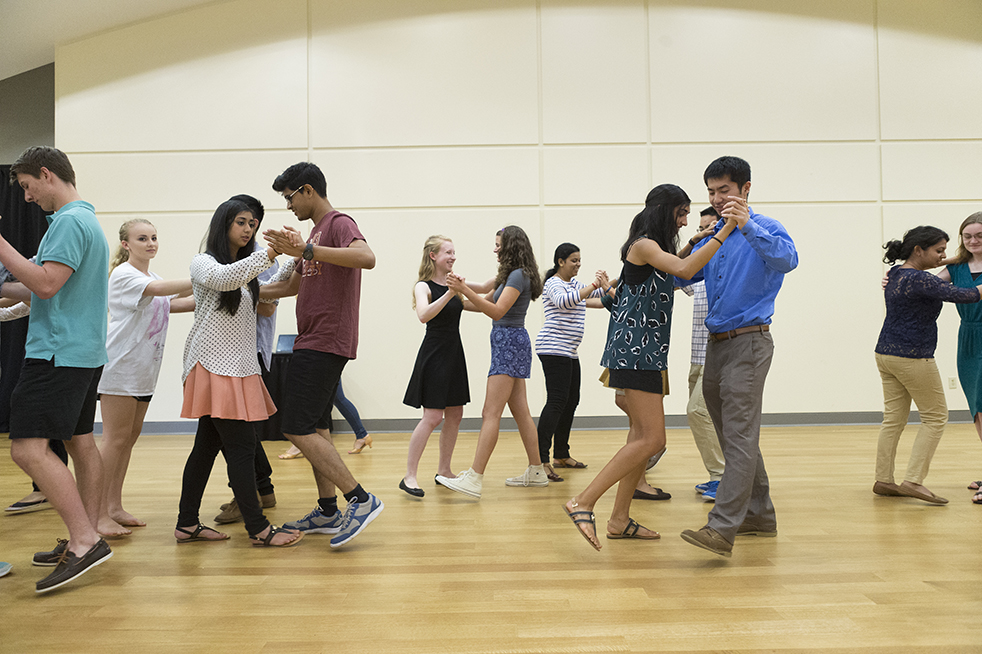
Club helps curious students Fall into Dance

Photo by John Nakano

Colleges are usually noted as extraordinary places to find one’s true passions. Not one to disappoint, Tech happily embraces a stunning variety of clubs, teams, and organizations. No matter what a student’s interests, there is sure to be at least one group that fits his or her desires. The main problem with this plethora is that students need to be able to browse and explore the different organizations in order to find the perfect match.

To accommodate this growing need, many clubs host info sessions or post fliers and sidewalk chalk messages to get the news of their existence to potential members at the beginning of each semester.

One such advertising group was Tech’s Ballroom Dance Club, or the slightly shorter GTBDC, but they were not content to merely invite students to an info session or their first meeting. Nothing so droll was suitable. Instead, GTBDC opted for their first event to be a kind of welcoming party to prospective new members where they gave dance lessons to all comers.

At seven in the evening of Aug. 22, the Student Center’s third floor Ballroom was positively packed with individuals, couples and groups of friends who were interested in dancing. The graceful exertion did not begin immediately, however.

Tables were setup outside the ballroom filled with trays of chicken nuggets, candy, water bottles and chips. Another table held several laptops for attendees to add their names to GTBDC’s mailing list, thus signing up for future dance opportunities throughout the semester. Once refreshments were served, the dance lessons commenced.

The very first thing that attendees were taught is that ballroom dances progress in a counterclockwise direction, which is called the line of dance. From here, instruction became a little more difficult, but it was still enjoyed by all. Daniel Boman, a graduate student, and Kelsey Johnson, the club’s president, taught the Foxtrot in fabulous red outfits.

The second dance, taught by another couple, was the Rumba (not the vacuum) which, in a room as packed as that ballroom,  seemed to be a dance specifically designed for clothes-lining everyone in the general vicinity. Once most (though sadly not all) people noticed that certain flourishes were detrimental to the health of their neighbors, this dance went along smoothly.

The third and final dance taught was presided over by Boman and Johnson again, this time in blue outfits. Through this lesson, many of these new dance students realized the hard way that the Hustle, when performed improperly, is little more than holding hands and spinning very quickly in a circle—activities unkind to one’s sense of equilibrium.

Sprinkled throughout the lessons were various dancing games, and after teaching the Hustle, the club played music to which attendees could practice their newly learned abilities. Throughout the four hour long event, attendees slowly trickled out the doors. Many stayed for all three lessons, but few stayed for the entire event. One could easily tell that those who stayed had truly enjoyed themselves (rather than staying for lack of something better to do or through a sense of dedication  once the dancing had started). As the crowd thinned and inhibitions diminished, it became easier for dancers to find a partner.

The entire evening was designed to encourage attendees to switch partners between dances and throughout the lessons—a fitting concept since most were just learning to dance. Switching partners encouraged people to help one another instead of settling into a certain flow with a single partner.

With a successful night of lessons and dancing, the attendees were given quite a few compelling reasons to join Tech’s Ballroom Dance Club. Most of those in attendance were freshmen, and new Tech students are always particularly eager to explore their options before dedicating themselves to any one group on campus. GTBDC hopes the excitement of their lessons gave their attendees a good enough reason to stick  with ballroom dancing for the semester.

Posted in UncategorizedComments Off on Club helps curious students Fall into Dance

Preview of Women’s Volleyball Season

Photo by John Nanako

Michelle Collier heads into her second season as head volleyball coach of the Jackets at Tech after leading a successful program in 2014. Collier aided the team in improvements in almost every statistical category during her introductory year as the eighth head coach at Tech.

These improvements were crucial to the team’s 13-18 cumulative season record in 2014. Volleyball fans are looking forward to another year of improvement with Collier paving the road to future success.

Early April, Collier was pleased to announce that three new student athletes would be signed to compete for the Jackets.  The team welcomed Anna Kavalchuk (Minsk, Belarus), Hellen Lacava (Sao Paulo, Brazil) and Gabrielle Benda (Raleigh, North Carolina).

Coach Collier is confident that these three student athletes will mesh well with the team and be great assets to an outstanding season in 2015.

In addition to signing three new student athletes, Tech volleyball welcomes freshman Lauren Frerkling of Johns Creek, GA, to the team and welcomes back eight returning athletes.

Returning Jackets look forward to being more competitive on the court this season. The team’s hitters — junior Teegan Van Gunst and sophomores Ashley Askin, Gabriela Stavnetchei, and Anna Kavalchuk — hope to move up this season from 12th in the ACC for kills (12.75 kills per match) and hitting percentage (0.216) after their 2014 season.

After an exemplary season in 2014 and being named to the All-ACC Academic Team, Teegan Van Gunst returns this season and is expected to lead the team in kills as she did in 2014 with 3.32 kills per set.

Teegan’s twin sister Annika, also named All-ACC Academic Team last season, returns this season as a middle blocker. Annika holds the record for the second most kills in the 2014 season with 326 kills. The Van Gunst twins, a formidable pair on the court and invaluable assets to the team, make up one of the many crucial links in Tech’s Women’s Volleyball team.

With matches against six 2014 NCAA Tournament participants and a record high of 14 matches broadcast on the ACC regional network or on ESPN3  this year, every link is going to be important in maintaining a level of high competitive performance in this year’s season.

The Jackets enter the season with four talented middle blockers.  Returning sophomore Sydney Wilson led the team last season with a total of 104 blocks. Junior Lauren Pitz returns with a record of 73 blocks and an impressive 105 kills. Annika Van Gunst and Lauren Frerkling complete the Jacket’s four player powerhouse of middle blockers.

Returning junior London Ackermann and senior Wimberly Wilson complete the team as the defensive specialists. Ackermann reached a career high of 27 digs in last season’s match against North Carolina State (Oct. 10) and tallied six matches with over 20 digs.  Wilson returns after playing 64 sets last season and matching her career high in aces — three aces — against Gardner-Webb last August.

With experience on their side, Ackermann and Wilson will continue to the aid the Jackets in bringing in many victories this season.

The Jackets will open this season with the Gold/White Scrimmage held in O’Keefe Gym on Saturday Aug. 22 at 3 p.m. The scrimmage will be a great chance for the jackets to hone their team skills and cohesiveness on the court before the GT Courtyard by Mariott Atlanta Midtown Invite next weekend. Tech will welcome Siena, Coastal Carolina, Tennessee-Martin and the Citadel to the invite.

Posted in UncategorizedComments Off on Preview of Women’s Volleyball Season

Schniederjans joins PGA Tour

Golf - online

This summer, Tech standout Ollie Schniederjans began his career on the PGA Tour. He is entering the pros with an impressive record behind him: a phenomenal college career, professional-level play in a huge tournament and the title of best amateur golfer in the world.

At Tech, Schniederjans was one of the most talked-about players in the ACC, being named conference Player of the Year twice and finishing runner-up in the 2014 NCAA Division I Championship as a junior. He was also named a first-team All-American in both his junior and senior seasons.

On June 18th, 2014, Schniederjans advanced to the number one spot on the World Amateur Golf Rankings, maintaining the top position for 41 weeks and winning the Mark H. McCormack Medal in the process.

After his college career, Schniederjans competed in his first PGA Tour event at the 2015 Valspar Championship, where he missed the cut. Later, he was exempted into the 2015 U.S. Open and the 2015 Open Championship due to his status as a McCormack recipient.

In an interview with Golfweek before his U.S. Open appearance,  Schneiderjans spoke of his excitement to play in his first major.

“It’s surreal, really,” he said. “You’ve wanted to do this for so long, and now you’re right there in the middle of the scene. I’m here. It’s really special. I have family here, and it’s really cool. I feel very comfortable, like I belong here.”

He had a pedestrian performance in the tournament, finishing 42nd in a pool of 287 players with a score of 7 over par.

The Open Championship, his final tournament as an amateur, proved to be one of his best. In his final round, he managed seven birdies in the first ten holes to put him ten under par. He ultimately finished in a tie for 12th.

“I’ll remember all of [the Open experience]. I’ll definitely remember Monday because I kind of pushed myself to another level, finally, that day,” Schniederjans said in an interview with the PGA Tour. “I was playing well earlier in the week, but I’d get to 2 or 3 under and I’d fall back. It was frustrating. But that last day I pushed it past that, found my name up on the board and felt completely calm and confident on the back nine. That was probably the biggest nine holes I’ve ever played, and I felt like I was totally OK with whatever happened.”

Although his amateur status prevented him to keeping his $160,000 winnings, he can look forward to making much more than that in his professional career. With sponsorships from Callaway and Oddyssey, Schniederjans is exempted into numerous tournaments in the coming months.

His future beyond that depends what he does with these opportunities, but for now the Yellow Jacket has left the entire golf world with few doubts of his ability.

Posted in UncategorizedComments Off on Schniederjans joins PGA Tour