Author Archives | Truitt Clark

Dystopian novels could reflect our future

Kara Pendley

Please note: I ask that you do not take this editorial at face-value. If you have a differing opinion, please share it. I want to hear those opinions in order to research them further. Once I have done that, I will graciously reassess my conclusions. I ask that you do the same.

We all want to know what the future holds. Many think that it is shrouded in mystery and that there is no way to know what is to come. But what if I told you that it was not so mysterious? Let me pose a question: what would it take for our society to become a dystopian novel?

I say it is only a matter of time. Dystopic novels are derived from reality, and that is what makes them intriguing but also makes them terrifying. Societies do not treat them as the warnings they should be. Instead, many times, we play right into them.

Many students are required to read “Fahrenheit 451” in high school. In “Fahrenheit 451,” books have been outlawed, and “firemen” are charged with burning down the homes of people who possess books.

The author originally stated that he wrote the novel out of fear of America potentially “burning books,” and I do not believe that his fears were unwarranted. Books are constantly being challenged, which means there is a formal, written complaint to have the book removed from public libraries, school libraries, classrooms or even college class material. These challenges, of which there are thousands each year, can lead to the books being banned.

This is a real threat to our freedom of speech. We allow people to ban books that they do not deem appropriate, many times because of one word that somehow invalidates thousands.

Many times, they are banned for containing authentic history. No piece of our history should be blocked from us. History is, by definition, a sensitive subject. Publish our mistakes, or future generations are bound to make them again. This path of censorship will lead to a fire burning at 451 degrees Fahrenheit.

Another book that has exploded into popularity in the past couple years is “The Hunger Games.” The novel is a lesson in socialism, telling a story about a girl who lives in Panem, a post-apocalyptic society in North America. There are 12 districts ruled by the Capitol, and each district has a certain job to contribute to society. Everything is redistributed among the populace.

Panem does not represent a capitalist system but a tyrannical government bred from socialism. In history, we have seen that the government (the Capitol) becomes a super-powered group showered in wealth while the rest of the country becomes equal and impoverished. Socialism is the first step to this extreme.

While at first, closing the gap between the rich and poor seems like a wonderful idea; that thinking is exactly what will be our downfall. Yes, we can make the gap smaller, but in doing so, you make the rich poorer and the poor poorer. At first that seems somewhat counterintuitive, but I challenge you to look up some of the studies that have been done.
When so much is taken from the rich, they lose their incentive to grow wealth for society. Once these people cease to create new businesses —which inherently create new jobs that get people off the streets — where does the money come from? We, as a society, stop growing and slowly deteriorate into poverty until complete government control begins to seem like a decent idea.

“Uglies” is another dystopic novel that describes the degradation of our society. In the book, everyone is required to undergo an operation when they turn 16 that transforms them into “pretties.” Individuals are given cosmetic improvements to make them pretty, but the general populace does not know that the surgery also creates lesions in the brain to make them placid, making the pretties seem happy all the time.

This book reflects on free-speech, individual thought and their ties to the idea of physical perfection. The focus of our society should not be on physical beauty; instead, we should focus on cultivating thoughts. We should also not strive to be placidly happy all the time. You cannot know true happiness without experiencing true sadness.

Our thoughts and ideas are what make us individuals. Every time we are told what to think, or more often now, what not to say, the government is slowly turning us into placid “pretties.” We are encouraged to focus on sameness. Differing opinions are discouraged to avoid hurting someone. Great minds are willing to break the mold and create a world better than what exists now.

In the span of 500–700 words, I cannot hope to grasp all these books have to offer. I encourage all of you to go out and read dystopian novels with a new mindset. Think about how we can work to prevent these things from happening. Realize the impact of your current decisions and what they are taking away from future generations.

Posted in UncategorizedComments Off on Dystopian novels could reflect our future

Mellon awards Ivan Allen College $1 million grant

Photo by Basheer Tome

Tech was recently given a $1 million grant by the Mellon Foundation towards the creation of a new learning center within the Ivan Allen College of
Liberal Arts (IAC).

The learning center, called the Digital Interdisciplinary Liberal Arts Center, will offer resources for group and project based learning within liberal arts curricula.

The center will also expand the digital areas of current programs within IAC and within the IAC’s School of Literature, Media and Communication (LMC).

The Mellon Foundation is a group that promotes higher education, the liberal arts and the contributions of the humanities and higher education to society.

They regularly give money to institutes of higher education in order to promote these goals.

The foundation has an endowment of approximately $6 billion.The Mellon Foundation has previously awarded grants to Tech, in the years 1998, 1999 and 2006 in amounts of $183,000, $240,000 and $282,000, respectively.

The Foundation has given a total of 64 grants in the Atlanta area to various organizations, totaling $25.5 million. These grants have been given to Emory, Agnes Scott, Oglethorpe, Morehouse and numerous others.

The grant to Tech is the largest the Mellon Foundation has given in the Atlanta area since 2013, when $1.5 million was given to LYRASIS in support of an open source collections management system for museums.

The Digital Interdisciplinary Liberal Arts Center will include a number of offices within the
center itself.

Dean Jacqueline J. Royster of the IAC and Professors Lauren Klein and Carl DiSalvo will create a Digital Humanities Studio to allow for practice-based research.

They will also develop a Civic Engagement Laboratory in order to allow outreach and application-based learning in the humanities.

This new project hopes to create more opportunities for IAC students and will allow them to engage in more project-based learning experiences.

Royster also thanked the Mellon Foundation in an official statement released through Communications.

“Mellon has our deepest gratitude for believing in our capacities to achieve, to produce and to make a meaningful difference  both in facing global challenges.”

IAC also provides over 55 courses capable of fulfilling Tech’s global perspectives requirements for all Tech students.

Posted in UncategorizedComments Off on Mellon awards Ivan Allen College $1 million grant

New Technology & Business minor launched

Photo by Elliott Brockelbank

The Denning Technology and Management (T&M) Program is adding a Technology and Business minor in fall 2016, and will take applications from students in the Colleges of Architecture, the Sciences and Ivan Allen College.

With this addition, one of Tech’s most well-known academic programs will be open to all Tech students, fulfilling one of Stephen Denning’s goals for the program.

The T&M Program is currently renowned for its engineering and computing cross-disciplinary coursework, as well as its corporate involvement and professional networking opportunities.

The administrators of the program hope that the addition of Tech students from more diverse fields of study will benefit all the students involved.

One of the program’s goals is to teach its participants to see problems and projects from novel points of view.

The program will remain the same size (between sixty and seventy students per class) to preserve the tight-knit community and close working relationships that students develop amongst themselves and their instructors.

The Capstone project is one of the opportunities of participating as a T&M student. In the second year of enrollment, students work in teams of three to five to address a problem within one of the corporate partner companies, for a period of six to eight months.

During this time they can collaborate between teams, grow their professional contacts, and solve a real problem for a major company that they can talk about in their search for other jobs or endeavors in the future.

The Program’s namesake, Stephen A. Denning, made a name for himself in international business, and this is something that the program is striving to continue cultivating in its new students.

All T&M students can attend faculty-led trips abroad focused on relevant coursework.

This spring break, some T&M students will be traveling to Central and Eastern Europe to learn about the transition of the region from communistic to capitalistic economies.

Anne Lynch, the Communications Program manager for T&M, summed up what she sees as the beauty of the program.

“What [engineering students] have said to me is that with engineering you build it or you don’t,” Lynch said. “With business problems there isn’t one right answer and that excites them.

“They get excited about the unknown. They are coming in from high level engineering courses and finding an appreciation for a different kind of challenge, finding a project-based approach instead of a correct answer. After all, you can have the best idea ever, but if you don’t know how to market it and sell it, or know someone who can market it, it might not go anywhere.”

The Technology and Business minor is composed of 22 hours of cross-disciplinary work based in the Scheller College of Business. One of the program’s goals is to be a part of campus that everyone wants to participate in — and this new minor option goes a long way towards making that a distinct possibility.

The first application cycle for students in the College of Architecture, College of Sciences and Ivan Allen College is next fall.

Anyone with at least 30 credit hours to be completed by the time of starting the program  is eligible to apply.

Interested students are encouraged to visit the Technology and Management sections of the Scheller College of Business’ website for further information on how and when to apply.

Posted in UncategorizedComments Off on New Technology & Business minor launched

Peterson holds town halls with BSO students and allies

Town Hall (Online)

Amid concerns following the recent lifting of sanctions on Phi Delta Theta, President G.P. “Bud” Peterson held two informal town halls with members of Black Student Organizations (BSOs)
and allies.

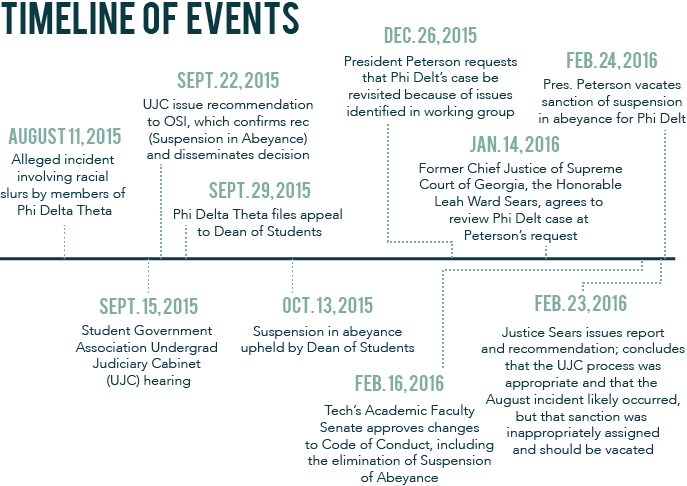
Peterson began both events by outlining the sequence of events which occurred between the August racial incident and his decision to vacate the fraternity’s suspension. The Office of Student Integrity (OSI)’s process was initiated and the Undergraduate Judiciary Cabinet (UJC) found that the incident likely occurred but that Phi Delta Theta’s leadership was not complicit.

The UJC then proceeded to recommend a sanction of Suspension in Abeyance, which per Tech’s policies is to be levied on an organization only if its leaders are fostering environments of
misconduct.

The dissonance between this recommendation and Tech’s policies was not detected until former chief justice of the Georgia Supreme Court Leah Ward-Sears reviewed the case at Pres.
Peterson’s request.

Sears concluded in her assessment that the UJC process is fair and came to the correct conclusions about the Phi Delta Theta case but that the sanction was incorrect and should be vacated.

Pres. Peterson vacated the sanctions, and thereby lifted all sanctions on Phi Delta
Theta, on Feb. 24.

Students are now concerned about the future of the August complaint against the Phi Delta Theta Fraternity, as well as the adequacy of the current Code of Conduct in handling issues of racism and intolerance.

A consistent concern among students in attendance was regarding the message sent by lifting sanctions when the incident was determined to have occurred.

“All of Tech’s leadership are committed to creating an environment that is safe, inclusive and welcoming of every student on campus, and we’ll continue to do that,” Peterson said. “We met with a number of Muslim students a few weeks ago to check in on their experiences.

“We had seven different ‘listening sessions’ to try to understand what the environment is like for women on this campus.

“We’ll continue with those activities, and this [town hall] is a part of that effort.

“[The racial incident] is not alright. We did not lift the sanctions because we believed it was alright. We lifted the sanctions because our policies preclude us from imposing sanctions in this
particular case.”

Peterson, as well as Dr. Archie Ervin, Vice President of Institute Diversity, stressed the importance of the Black Student Experience Task Force, which was created in August and whose final recommendations will be issued soon.

In addition, steps were taken during Greek Advance events to ensure that Greek leadership are aware of diversity issues and how best to prevent and address them.

One student inquired as to Peterson’s personal opinions on the Phi Delta Theta incident and
its resolution.

“I vacated the ruling and lifted the sanctions because that’s what our policy says,” Peterson said. “Are there things we could have done differently? Yes, I could think of a whole bunch of things … I wish this had never happened. It’s created a lot of angst for a lot of people, but we are a community, and that’s an important word.”

“We and the entire leadership at Tech are committed to creating not a tolerating environment, but an inclusive and welcoming environment for all students
here at Tech.”

Posted in UncategorizedComments Off on Peterson holds town halls with BSO students and allies

Phi Delta Theta case reexamined by state judge

Photo by Monica Jamison

More than six months after an alleged racial incident at the Phi Delta Theta house, a former Chief Justice of the Georgia Supreme Court has released a third-party review and recommendation on the fraternity’s case.

Tech released an official statement Feb. 24 upon President G.P. “Bud” Peterson’s decision to permanently lift the sanction of suspension in abeyance which had been previously imposed.

“The Honorable Leah Ward Sears, former chief justice of the Georgia Supreme Court, has completed her review of the Phi Delta Theta case process, findings and sanctions,” said Lance Wallace, Director of Media Relations and Issues Management.

“The Institute retained Sears to review the appeal of the case, after the Undergraduate Judicial Cabinet (UJC) found the fraternity responsible for two separate incidents of racial slurs directed at Georgia Tech students. The UJC’s recommendations were upheld.

“As part of the review, Sears determined Phi Delta Theta was granted due process in the investigation as well as in the student judicial proceedings and the associated appeals. 

“In addition, she found that there was sufficient evidence for the UJC to conclude that the Aug. 11, 2015, incident had occurred as the victim described in her complaint against the fraternity. Sears also noted, however, that Tech policy requires that in order for an entire organization to be held collectively responsible, those involved must have received the consent or encouragement of the organization, its leaders or its officers.

“Because the UJC found that the Phi Delta Theta leadership was not complicit, Sears recommended the sanction of Suspension Held in Abeyance be lifted.”

The announcement came with the release of a number of relevant documents from Justice Sears’ third-party investigation.

The thirty-page report detailing Sears’ review process as well as her findings is available on Tech’s News Center.

In short, the report reiterates the details of the case against Phi Delta Theta, as well as the Office of Student Integrity’s involvement and Tech’s policies as outlined in the Code of Conduct.

It concludes that, while there was sufficient evidence that the Aug. 11 incident was more likely to have occurred than not — in line with the preponderance of evidence standard set by the state — the sanction of Suspension in Abeyance was utilized inappropriately.

Per Tech’s policies, Suspension in Abeyance was to be placed on organizations only if a culture of misconduct had been fostered by leadership.

There is no evidence suggesting that Phi Delta Theta leaders were aware of the alleged racist incident, nor was there any encouragement of such an environment within the fraternity.

The UJC recognized this finding but recommended Suspension in Abeyance in error, and thus Justice Sears suggested the removal of the suspension.

Given the lack of specific offenders to attribute to the incident, there are no further OSI investigations in process with regards to Phi Delta Theta.

Also released with the announcement were a letter from Justice Sears with an overview of the investigation’s findings, as well as a letter to Phi Delta Theta from President Peterson.

The latter document is dated Feb. 24 and addresses Peterson’s decision to entertain an “extraordinary appeal” to the Dean of Students’ decision in light of concerns raised by a working group convened to assess the OSI process.

“I have adopted the Recommendation of Justice Sears that the sanctions against Phi Delta Theta be lifted and the previously imposed sanction … be vacated immediately,” Peterson wrote. “The Georgia Tech Office of Student Integrity is so directed.”

Student groups had varying reactions to the decision.

“After reading the report, the most important thing to notice is that the Incident on Aug. 11 did, in fact, occur,” said Henderson Johnson II, fourth-year aerospace engineering student and leader with the Black Student Experience Taskforce.

“Although I am ultimately disappointed with the decision, I understand that within the context of our Code of Conduct the sanction can’t stand.

“Furthermore, the Black Student Experience Taskforce will continue to work tirelessly to bring forth quality recommendations to help Georgia Tech reach greater levels of inclusivity so that no student’s experience is in any inhibited due to their race [or] religion.”

Numerous members of Black Student Organizations will be joining President Peterson on Monday for a town hall discussing the results of the investigation and what they mean for different communities on Tech’s campus.

“Bud is clearing the air regarding what was mentioned in the [Feb. 24] Daily Digest article … and the resolution of the Phi Delta Theta incident,” Johnson said. “For a lot of the Black community the article is scary because it comes off as though all of our hard work was for nothing, when it really wasn’t.”

“We’re pleased that this unjust decision has been reversed,” said Jonathan Hawkins, legal counsel for Phi Delta Theta. “Yet we remain disappointed that there were sanctions in the first place. The appeal decision supports what we have said all along: Phi Delta Theta is innocent of the charges against it. Unfortunately, Georgia Tech leadership ignored evidence from the beginning that would have avoided this unwarranted eight-month sanction.”

“We hope Tech’s leadership has learned something from this process,” Hawkins said.

The UJC was not able to be reached for comment.

Design by Brighton Kamen

Design by Brighton Kamen

Posted in UncategorizedComments Off on Phi Delta Theta case reexamined by state judge

Early tests provide cautious hope for swimming

Photo by Brenda Lin

If there is one thing to be taken away from Tech swimming and diving this season it is this: records are meant to be broken. Having competed in Greensboro, N.C., last weekend, the Jackets broke 12 school marks.

After being defeated by Duke, Indiana and Michigan, the Jackets went at the ACC Women’s Championship in North Carolina looking for redemption. Though the meet took Tech swimming to a new level, the Jackets closed the meet at a slightly disappointing 11th place.

Last weekend, the Jackets put on a master class in consistency. Each of the four days of the championship new school records were broken. Tech’s women’s swimmers recorded best times in three events on the first, third and fourth days of the meet and two records on the second day.

Brad Homza set a school record in the platform finals on Tech’s last day in Greensboro. Homza’s 436.25 swept the men’s platform dive.  He was named the ACC’s Most Valuable Diver, a prestigious honor for the junior.

Homza is not the only Jacket who has illustrated a capacity to consistently perform at the top of the roster. Freshman Iris Wang, Tech’s resident Olympian, contributed to three of the eleven records broken during the championship weekend. Wang consistently improved in her 100 free performance, breaking the school record three times over the span of the weekend.

Consistently skimming time from her 50 freestyle, Wang set a personal best of 22.90 on the fourth day of the championship. An international student, a remarkable sprinter and an irreplaceable relay member, Wang represents the caliber of Tech swimming and diving.

Over the course of the women’s championship weekend and the season, the Jackets did not merely succeed in individual events but also illustrated a phenomenal team dynamic. Close to half of the record breaking efforts throughout the weekend ­— five of eleven — were relay events.

These contests require more than just fast swimmers. Each relay swimmer is not only responsible for swimming their leg of the relay with significant speed but also for making up time that might have been lost during a teammate’s leg of the race.

Team members work together and must gauge the progression of the relay. Not only must they have faith in their own ability to post a satisfactory time, they must know the abilities of the other relay swimmers to swim swiftly. The historic success in relay racing times posted this weekend by the Jackets depicts a commendable team dynamic and impressive cohesiveness on Tech’s roster.    

As the Jackets prepare not only to finish the Men’s ACC Championship strong this weekend but also for Zone Qualifiers and the NCAA Championships, continuing to perform with consistency will be more valuable to Tech’s standing than ever, particularly as the level of competition increases.

Last weekend’s women’s championships revealed that Tech’s female swimmers seem more comfortable performing in shorter events. Eight out of eleven of the school records broken by women’s swimmers throughout the championship weekend were 200-yard or fewer events.  The 800-free relay was the only event over 400 yards in which Tech broke a record, leaving room for improvement.

There is not much necessity for every team member to specialize in long distance events; however, there is nothing lost in training to improve endurance levels in the water.  A team of consistently fast swimmers with high stamina would be a formidable one.

Tech did not come close to winning the ACC Women’s Championship, but it set a new bar for the team. It is a measure for which the team will no doubt aim.

Posted in UncategorizedComments Off on Early tests provide cautious hope for swimming

Five Things: Baseball Opening Weekend

Photo by John Nakano

Back in early September,  Tech football looked promising. Ranked in the top 25 to start the season, the Jackets rolled through the first few games.  Not to dwell on the past, but the preseason rankings were short lived, the dark horse dreams quickly became comical, and Tech students were promptly reminded that they certainly didn’t come here for the chance to celebrate a National Championship.  Five and a half months later, it’s finally baseball season. Just as they did in the fall, Tech fans are looking on with hope. This time around, the Jackets just might come through.

The Jackets took the field this weekend for their opening series defeating Purdue 5-2, Western Michigan 13-0 and VCU 9-1. Let’s go beyond the box score and take a look at five things we learned this weekend about the Tech baseball squad.

Dominance on the Mound

Pitching was huge for the Jackets last season and looks as though it will be again this year. The pitching staff gave up just three runs all weekend and only one of them was earned. In his first career start, freshman Jonathan Hughes gave up just three hits and no earned runs, notching his first win Sunday against VCU. The other two Tech starters from the weekend, Brandon Gold and Jonathan King, also had solid performances, racking up five innings apiece.

It is worth noting that Gold and King both walked three batters, but Gold managed to strike out eight. The bullpen followed suit, despite the absence of one of the best closers in college baseball, Zac Ryan. While Matthew Gorst pitched well and picked up the only save of the weekend, it seems highly unlikely that Ryan got beat out of his role. Ryan will play a crucial role in a Jackets bullpen that will be a key factor in whether Tech can do any serious damage in the ACC this year.

Offensive Promise

A.J. Murray was the power behind Tech’s offense last year, leading the team in home runs and RBI’s. Unfortunately, the Jackets no longer have the luxury of Murray’s services; the stalwart catcher now finds himself in the Minnesota Twins’ minor league system.

The loss of Murray would seem to leave a considerable void; only two other Tech players hit home runs last season. This weekend, however, the offense showed it could produce. Three individuals managed to clear the fence, and of the seven players with at least ten at bats, four of them are hitting over .400.

Kel Johnson and Matt Gonzales both had solid years in 2015 and will be looked upon to support the offense all year. Johnson went 5-for-12 with a home run and four RBIs while Gonzales went 5-for-15 with two doubles and six RBIs.

Obviously, with only a fraction of a season in the books, there is good reason to throw caution to the wind; this is a small sample size against mostly mediocre pitching, Nevertheless, 27 runs over the course of 3 games is an impressive figure and offers optimism regarding the Jackets’ ability to move on from last season’s offensive centerpiece without a significant drop-off.

Baserunning is the key

This weekend, the heart of the lineup showed they can drive in runs.  Between the two of them, Gonzales and Johnson knocked in 10 runs. Those two will bring in runners all season, but the key will be getting those runners in scoring position.

Wade Bailey’s OBP was an impressive .600, and he scored 6 runs, doing his job as the leadoff and then some. Ryan Peurifoy didn’t play poorly by any means out of the two hole but wasn’t on base quite as much. As long as those two can consistently get into scoring position, Tech will likely have no problem scoring runs this year, even against a typically difficult ACC slate.

The Young Guns Can Play

Coming into the season, Tech boasted one of the best recruiting classes in the country. Throw in a couple stud sophomores including Kel Johnson, and Tech baseball figures to be a force for the next few years.

From a pitching perspective, Jonathan Hughes dominated his first start. From the relief side, Burton Dulaney pitched three good innings, giving up neither a walk nor a run. Dulaney should see a lot of innings this season and hopefully for years to come, if his stellar start is any indication.

Tristin English is another freshman who could do some damage with the bat. He started slowly, a result that is to be expected; he is only 18 years old and undoubtedly talented, given the Major League Baseball offer he spurned to play on The Flats. With more plate appearances, he could soon prove himself a real asset to a lineup that already presents plenty of concerns for opposing pitching staffs.

This Team is Scary

Tech has a lot of winnable games on the schedule but also has to play at FSU and at UVA. If the offense can continue to produce, Tech will win a lot of games, including those tough ACC matchups. Armed with a solid core of starting pitching and one of the best closers in college baseball, the pitching staff should keep the Jackets close in almost every game this year.

This weekend was a small sample size, and if the 2015 Georgia Tech football team taught us anything, a few games against mediocre competition can give some very false implications for the rest of the season.

In a fanbase where hope is in short supply, though, a strong start could provide the oxygen needed to continue. The season has been unkind to Tech in a variety of sports. Perhaps the Jackets will find relief in American national pastime.

Posted in UncategorizedComments Off on Five Things: Baseball Opening Weekend

Timeout: Harsha Sridhar

Photo by John Nakano

Tech men’s basketball has, I believe, an unparalleled ability to inspire frustration in even the most jaded of sports fans.

At least football made it easy. After a quick start against opposing quarterbacks who feared their own shadows and defensive schemes ripped from high school playbooks, Paul Johnson’s Jackets started sliding. And when they started, they didn’t stop, save for one glorious homecoming night at Bobby Dodd.

Tech football put its fans out of their misery gently. The injuries piled up, Justin Thomas had to conjure wine from water to avoid getting sacked within three seconds of his occasional dropback, and by the time the team managed to blow a significant lead over a surprisingly good North Carolina team, the season was, for all intents and purposes, finished.   

There were no false pretenses, no hope for a miraculous resolution to a litany of problems that quickly accumulated. Depressing as it may have been, fans could rest assured that they would miss little if they spent their Saturday afternoons in a more productive manner, anything but watching a trainwreck.

Where football was polite to a fault, Jackets men’s basketball has been everything but. It has led fans to believe it is on the brink of serious contention, then dragged the hopeful back into the cold reality of ACC cellar-dweller status, and, at least for a few days, back again. And you know what? I’m hanging on.

The last time we wrote about men’s basketball in this section, Brian Gregory’s squad was reeling from a 52-66 beating at the hands of the Clemson Tigers. That wasn’t anomalous, either; Tech had lost four of its last five, eight of its last ten and had scraped together a meager three wins in the new year. They were losing on the boards and squandering opportunities when they arose, leaving fans to greet late-game situations with the enthusiasm generally reserved for Congress, tax collectors and CS 2110. The only positive seemed to be the impending termination of woefully mediocre head coach Brian Gregory.

In 2011, Gregory arrived at Tech with real promise;  under his watch, Dayton made the NCAA Tournament twice and the National Invitational Tournament (NIT) once, falling under the .500 mark only once and peaking at No. 18 in the Associated Press rankings during his final year with the Flyers.

Coach Paul Hewitt had worn out his welcome in Atlanta; the Jackets had lost more than they had won in three of the previous four seasons, and despite a national championship appearance in 2004, the team lagged a step or two behind its ACC rivals. Gregory represented new blood, a chance for a fresh start and an end to the middling ways of the Hewitt era.

As it so often does, hindsight has looked unkindly upon this naive hope. Tech has failed to make the perennial consolation prize NIT even once, let alone the Big Dance.

And yet, this could well be Gregory’s best season as Tech’s coach. One more win will break his regular-season record with the Jackets, and per sports-reference.com, Tech’s Simple Rating System score, a measure of a team’s quality, is poised to be its highest in Gregory’s tenure. While the defense has taken a significant step back, the Jackets are scoring nearly ten points more per game than their previous high under Gregory, and they even have a signature win to their name, a 68-64 home victory over then No. 4 Virginia.

As for the last two games? The Jackets have taken the clutch situations they so often disappoint in and made them assets. Coach Gregory drew up a play for star guard Marcus Georges-Hunt against No. 19 Notre Dame that was executed to perfection in a 63-62 win, and Georges-Hunt provided the difference in a win over Clemson with clutch free throws.

Which Jackets team will we get the rest of the way? I have no idea.

Posted in UncategorizedComments Off on Timeout: Harsha Sridhar

Old town classic provides top quality sandwiches

Photo by Tyler Meuter

Looking at 14th Street in Atlanta, west of I-75, most newcomers would not expect much food-wise. The street mostly consists of houses and storage facilities with an occasional gas station or convenience store thrown into the mix.

However, the street is also littered with one-of-a-kind restaurants in addition to a chain or two. The Silver Skillet, for example, is an Atlanta classic and Moe’s BBQ is a college staple.  A lesser known restaurant, however, is Crazy Cuban, which is a small Cuban sandwich joint tucked into a strip mall next to a convenience store.

Legend has it that Crazy Cuban started years ago from a family recipe. Over time, this recipe passed to different owners, but it has remained just as special. The Cuban sandwiches at Crazy Cuban are comparable to the quality of sandwich one could get at a world-famous Miami restaurant, but are still affordable for a college student. Arguably the best sandwich in the restaurant is a classic Cuban, but they also offer several other selections.

The sandwiches at Crazy Cuban have such juicy, top quality meat that the aroma alone will make the customer almost taste the sandwich. This is combined with just the right amount of mustard and perfectly complimented with a pickle.

One of the best parts of Crazy Cuban is the atmosphere. The restaurant itself feels great, with deck or bar seating. The deck is a great place to relax with friends.

What makes Crazy Cuban so unique, however, is the extremely friendly and skilled staff. Not only do they make superior sandwiches, but they also make customers feel welcome to the point that they feel like a regular on their first visit.

The man at the counter lives up to the name of the store, being crazy in the best kind of way. He jokes with customers and pokes fun at people while they order. If not for the food, restaurant connoisseurs should check Crazy Cuban out just for the restaurant’s amazing staff.

Overall, this is the kind of place every student should visit at some point during their time  at Tech because it is the kind of place people remember long after their college years have ended.

Posted in UncategorizedComments Off on Old town classic provides top quality sandwiches

Hands Like Houses releases astounding new album

Photo courtesy of Rise

Australia’s Hands Like Houses has truly found an amazing and progressive sound that is sure to attract fans of the hard rock scene in their new album “Dissonants.”

This is the post-hardcore band’s third full-length album, and it is a tribute to their unique and progressive sound. The band has seen widespread success, participating in Warped Tour in 2013 and 2015 where they played with bands such as All That Remains, Sleeping With Sirens, The Amity Affliction and Beartooth.

Hands Like Houses takes inspiration from many forms of modern rock, including post-hardcore, hard rock, metalcore and alt-rock.

Lead singer Trenton Woodley has a powerful voice with a great range. He is able to adapt seamlessly between lower, soft tunes and higher, more vigorous notes, and he is even able to keep pitch while screaming at the top of his lungs. Guitarists Matt “Coops” Cooper and Alexander Pearson weave a fascinating texture of melody and harmony, while bassist Joel Tyrrell and drummer Matt Parkitney drive a grooving beat.

The album starts with “I Am,” a powerful rock anthem with an engaging melody and upbeat tempo. “I Am” is about being different and standing above the rest. It is a charge to actually make a difference by what is said and done rather than feeding on the fame without making any difference.

Hands Like Houses certainly has the potential to make a difference as they gain popularity from their thrilling talent. This song balances perfectly the interplay between soft melody notes backed with heavy tones and a captivating chorus. This song is not the only gem in their album.

“Perspectives” opens with an etheric electronic riff, which is then drowned by a heavy distorted guitar riff. “Perspectives” builds from softer verses into a brooding and heavy chorus.

It is full of anger, frustration and a longing to be understood as the voice behind the song opens up about failing to get someone to see from their perspective. The voice is tired of being put down as crazy but realizes it is futile to get their audience to see the truth. This song definitely dips into the hard rock/metalcore scene to express the emotion of the subject matter, and it is very befitting of the band’s sound.

Next on the album is “Colourblind” which opens in a mix of hard rock and electronic very similar to the sound of Bring Me the Horizon. This song is a challenge to live life in all of its colorful experiences instead of being stuck in the “black and white.”

True to the bands method of sampling different sounds, “Colourblind” says to see and sample many different ways of thinking and living. The song itself features a fantastic, head-nod inducing beat.

The bridge transitions seamlessly from the introspective verses to the lively chorus, conveying the transition from seeing the narrowness of ones view to opening the mind to new ideas.

“New Romantics” speeds up the tempo and energizes the verses. Bassist Joel Tyrrell really shines through in this song, giving the melody a snapping, grooving rhythm. The song focuses on finding a way to express oneself in a new way.

The man remains the same, but the energy reflects on the release of trying to re-center and find the words that show true emotion in light of what has already been said. It is about “digging deeper” to reveal the true self inside.

In this light, the song may also reflect the band finding a truly amazing sound as they explore different inspirations and emotions. “New Romantics” has a bright harmony and a bold melody with an inspiring tone.

“Dissonants” is filled with both heavy and lighter songs, and all are enjoyable and engaging to listen to for hours on end. It explores both human emotions and interaction, and different mixes of many rock genres.

Posted in UncategorizedComments Off on Hands Like Houses releases astounding new album