Author Archives | Tom Petri

Business: too big to prosecute?

How much is $1.8 billion? That all depends on how you look at it. If you’re Steve Cohen, the director and sole owner of SAC Capital, a group of hedge funds, it’s about 20 percent of your personal net worth. Agreeing to pay the government 20 percent of your net worth isn’t usually ideal, but it could end up being great for Cohen if it avoids further legal action against himself and SAC.

If you believe the indictment from the Department of Justice, SAC Capital was basically an insider-trading shop masquerading as a hedge fund. Traders were implicitly expected to find and exploit inside information, and the firm is responsible for what the DOJ calls “the most lucrative insider trading scheme ever charged,” trading shares of pharmaceutical makers Elan and Wyeth with advance knowledge of clinical trial data. The trades netted SAC some $275 million. The settlement that was announced this week only holds SAC Capital liable, not Steve Cohen, which is sort of a contradiction. If you believe the logic of the DOJ, Cohen founded, owns and runs a criminal organization, but he hasn’t personally done anything criminally wrong.

This settlement by SAC is part of a larger shift in the way the government prosecutes wrongdoing. Remember when Martha Stewart went to prison for insider trading for avoiding $45,000 in losses? These days you can defraud or steal from basically whomever you like as long as you remember to be well connected and have a slush fund set aside from which you can write a check to the DOJ, Securities and Exchange Commission, or Office of the Comptroller of the Currency.

My personal favorite is the settlement that the government reached with HSBC for pervasive, long-lived money laundering for organizations such as Mexican and Colombian drug cartels, terrorists, and the Iranian government. In exchange for no criminal prosecution, HSBC agreed to pay $1.9 billion, about five weeks’ worth of its average revenue.

The U.S. has essentially decided that the big banks are too big to prosecute, which is an interesting way of regulating the financial system, but SAC certainly isn’t a systemically important institution. Neither is Johnson & Johnson, which agreed Nov. 4 to pay $2.2 billion for marketing several drugs off label, including paying kickbacks to doctors and Omnicare Inc., the nation’s largest pharmacy for elder care. J&J “recklessly put at risk the health of some of the most vulnerable members of our society — including young children, the elderly and the disabled,” Attorney General Eric Holder said in a news conference announcing the settlement.

This J&J fine is the latest in a string of DOJ settlements with pharmaceutical companies for various wrongdoings. Essentially, the world’s drug makers market their drugs however they want, dangerously or not, and then eventually get caught and agree to pay a fine. It’s a pattern that’s become a cost of doing business, and it’s spreading. Banks and financial institutions basically act with impunity, pharmaceutical manufacturers can get away with whatever they want, and other industries are going to start noticing. Do whatever you want, as long as you have some money stashed away to give the government if you get caught.

As long as the DOJ continues not to prosecute individuals, the deterrent effect of having laws is diminished. U.S. regulatory agencies have become collection agencies, no longer concerned with preventing illegal activity or inspiring confidence in markets but instead concerned with extracting token fines from companies when they break the law.

Tom Petri is a junior majoring in management information systems, finance and legal studies. He can be contacted at
op-ed@thetriangle.org.

The post Business: too big to prosecute? appeared first on The Triangle.

Posted in UncategorizedComments Off on Business: too big to prosecute?

Fix the election system

It’s not often that you find a group of people who purposely and seriously harm their own country’s economy and who have the power to do it. But the U.S. finds itself with a caucus in the House of Representatives that is ostensibly willing to breach the debt ceiling and possibly default on sovereign debt (which the U.S. has never done) in order to win concessions from the White House and congressional Democrats. This isn’t any way to run a government, but the real problem is that these people have any power at all. How did they get elected in the first place, and why is anyone taking them seriously?

The answer comes to us in two parts: the process of redistricting, which occurs once per decade, and the recent erosion of campaign finance restrictions.

After every census, seats in the House of Representatives are shuffled to more equally reflect the nation’s population. And because there are only 435 seats, when one state gains a seat, it comes at the expense of another. Whenever a seat is added or removed, at least some of the other districts in the state must be redrawn. In most states, the legislature appoints a committee made up of members of the majority party to redraw the map. So if you’re the majority party, you get to pick your voters for at least the next 10 years. That has recently allowed Republicans to lock in House seats with unassailable demographic advantages. The Democrats are in no way innocent of gerrymandering districts, but they aren’t the ones acting ridiculously, so we’ll leave them out for now.

Having a House seat that is almost certain to go to your political party leaves an incumbent in a strange position. There is no incentive to compromise, no reason to be moderate and work across the aisle when you don’t have a diverse and moderate constituency. The only challenge that Republican representatives in gerrymandered districts face is from those further on the right. They have to avoid being seen as nonbelievers, lest they face a challenger in the next primary. And those primary challengers are a real threat. The basic way that political ideology works is that the further from the center you are, the more passionate you have to be. There’s just no way to get people fired up for mutually agreeable, sensible budget cuts. And when you’re running a primary campaign, you can use the passion and support of your base to beat the whoever is closer to the center and by definition has a harder time finding vocal and passionate supporters. And these Tea Party challengers are well funded. In a district that is essentially guaranteed to vote Republican, big donors can pick their candidate and bankroll the whole campaign. Best of all, thanks to changing election laws, donors either don’t have to disclose their contributions or don’t have to file paperwork in time for disclosure to matter. It also turns out that the Tea Party utopia of no taxes or regulation would be good for big business, so it’s not hard to see where the funding comes from.

The threat of having to run against a well-funded Tea Party candidate has caused once-sensible Republicans to trip over themselves to support the extreme positions being put forward. The only reason that Tea Party ideas are being taken seriously is that Republicans don’t want to lose their seats. Many of their districts are going to vote Republican no matter what, and they want to be the Republican that gets picked. The only way to do that is to move further and further right of center. And so we’re left with a Tea Party caucus of 49 people who have scared the other 183 members of the Republican Party in the House into following them down the rabbit hole.

We don’t have to live like this, and it wouldn’t even be that hard to fix. There should be hard-and-fast contribution limits and disclosure requirements for money used for political speech, including issue advocacy. We also need to take redistricting out of the hands of politicians. Districts should be based on geography, not on getting the most favorable demographics for your party. These aren’t new ideas, but they are notoriously tough to get politicians behind. Getting them to give up power isn’t easy. But when you have politicians picking voters and not vice versa, democracy has gone backward. It’s time to set it straight.

Tom Petri is a junior majoring in management information systems, finance and legal studies. He can be contacted at op-ed@thetriangle.org.

The post Fix the election system appeared first on The Triangle.

Posted in UncategorizedComments Off on Fix the election system

LeBow names ArchiTECH winners

Drexel’s LeBow College of Business selected winners May 16 in its ArchiTECH classroom innovation competition, naming finance professors Daniel Dorn and Ed Neeling and a junior business administration student David Hunt the first-prize recipients out of 10 teams.

The competition was designed to gather ideas for how the college can best use the resources of the Gerri C. LeBow building, which is on track to open in the fall. Teams were required to include two full-time faculty members and one student, and propose innovations for at least two business classes that take advantage of the technology and classroom layouts of the new building. The winning submission integrated videoconferencing into the two-course series of applied portfolio management classes, Finance 341 and 342.

FrontLeBow.Courtesy.Web

“Dr. Neeling and I created the two courses over the past five years, and one key component from the get-go was to get the students exposed to senior investment advisers and managers. And we’ve been fortunate to get people to come visit and attend the presentations and give feedback,” Dorn said.

Videoconferencing will allow the students who manage the Dragon Fund, a $1 million equity portfolio and piece of Drexel’s endowment, to receive advice and feedback from investment professionals who would never be able to make it to the classroom.

“There is a range of options that we want to give people from the outside that want to participate,” Dorn said. “They can still come to campus and meet face to face. The ideal version [of the proposal] is to conference-in people and have them participate live in these presentations. And it will be interactive. The students will present; they will field questions from the audience and go back and forth. But we also want the option of just taping these and make (sic) them available through the website, either privately to a preselected audience [or] also to have things that went particularly well on the public website for the Dragon Fund.”

He continued, “There is an analyst with Franklin Templeton [Investments], a mutual fund company in Florida, who contacted the dean’s office and said, ‘I’m an [alumnus]; I’d like to give back. How can I help?’ and he’s a guy in Florida, so he’s not going to be able to come up on a quarterly basis to these things. And he also has about 15-16 years of experience in fund management, so we’d be able to have him give a presentation from his office in Florida. That’s another application of the technology.”

Students in the class are split up into teams and pitch stock ideas to the other members of the class, who then vote on the recommendations.

“Basically we would like to re-create an atmosphere of real stock pitches,” Dorn said. “Students give their best ideas; they get scrutinized by people and have to defend themselves, and the best way this really works is if it’s live.”

LeBow2.Courtesy.Web

Two other teams were also recognized, with second place going to the team of marketing professor Daniel Korschun, economics professor Stephen Joyce and undergraduate business administration student Ryan Bertoldi. Third place was awarded to marketing professors Trina Larsen Andras and Larry Duke along with marketing doctoral student Brooke Reavey.

Korschun, Joyce and Bertoldi submitted a proposal to use examples from film, TV and other media to showcase and explain business concepts. Andras, Duke and Reavey proposed using the behavioral lab in the new LeBow building to teach students how to oversee focus groups and to provide opportunities for students to practice their negotiating skills.

Images courtesy of LeBow College of Business

The post LeBow names ArchiTECH winners appeared first on The Triangle.

Posted in UncategorizedComments Off on LeBow names ArchiTECH winners

Service honors Drexel military

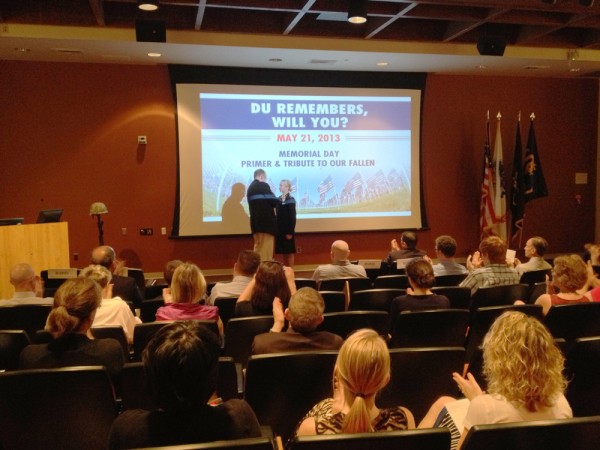
Drexel University’s Office of Student Affairs, in conjunction with the Office of Veteran Student Services, held the annual Memorial Day primer May 21, hosted by the College of Nursing and Health Professions. The event is to honor Drexel’s military community and especially to remember and pay tribute to America’s service members who have died in the line of duty.

According to Army Lt. Col. Richard Zygadlo, director of Drexel’s ROTC program, more than 1.1 million Americans have died in our nation’s wars. Since Sept. 11, 2001, 286 Pennsylvanians have been killed in the war on terror, including members of the Drexel community.

Memorial_Courtesy_WEB

“Our hearts are filled with gratitude as we pause on this day to remember those who have served our country,” Patience Ajoff-Foster, an adviser with the School of Education who gave the invocation, said. “On this day the Drexel University community remembers. As a gesture to show our gratitude for the men and women who have served and continue to serve our country, we remember all of the men and women who have served in our nation’s wars. While we haven’t always shown our appreciation, we remain forever grateful for their courageous service. We especially remember our fallen heroes, as we gather here freely because of their bravery and selflessness.”

Chris Diaz, a veteran of the U.S. Navy and vice president of the Drexel Veterans Association, paid tribute to Brian Lundy, a fellow Navy Corpsman who was killed in Helmand Province, Afghanistan, in September 2011. Diaz arrived in the country with Lundy and volunteered to take over Lundy’s post when he was killed in action.

“Brian was loved by everyone, from the Marines that he served with to the Afghan National Army forces he served with to the villagers that he served in the surrounding areas of Afghanistan. Brian’s sacrifice inspires me — or better yet, the life he lived inspires me,” Diaz said.

The ceremony included the presentation of the Chuck E. Sabin Award, given to a Drexel ROTC senior every year. This year’s honoree was Cadet Katherine Grous, a Philadelphia-area native and current nursing student. She will be commissioned Sept. 20.

The award is named after Drexel alumnus Chuck Sabin, who died in the Sept. 11, 2001, attack on the Pentagon, and was given to Grous by Sabin’s Drexel ROTC classmate, retired Army Col. James Hartz.

“Chuck’s legacy is one of professionalism, dedication and commitment to our nation’s freedom, security and well-being. He loved Drexel, and he loved his country. The Chuck Sabin memorial medal is awarded to a Drexel ROTC cadet who has exhibited the dedication to service and professionalism which marked Chuck’s amazing life,” Hartz said.

Special recognition was also given to Sgt. 1st Class Justo Rivera, who will be deploying to Afghanistan as a flight medic in December. This will be Rivera’s third deployment since 9/11; he previously served in both Iraq and Afghanistan. Rivera is currently stationed at Drexel’s Armory.

In addition to the event on campus, the College of Nursing and Health Professions sent faculty and students to the City Council Veterans Resource Fair May 22 to provide free health screenings to veterans.

“I think Drexel has really earned its title as a military-friendly school, five years in a row,” Rebecca Weidensaul, director of the Office of Veteran Student Services, said. “What I’ve learned is that student veterans, like Matt [Oles] and Chris [Diaz], have so much to offer and the capacity to make Drexel a better place. I think of them as leaders, difference-makers, risk-takers, the perfect match for what [President John A. Fry] calls our ‘creative, diverse, entrepreneurial, impatient, unpretentious and fearless University.’”

Memorial Day is Monday, May 27, and all Americans are encouraged to pause at 3 p.m. local time to participate in a national moment of silence.

Image courtesy of College of Nursing and Health Professions

The post Service honors Drexel military appeared first on The Triangle.

Posted in UncategorizedComments Off on Service honors Drexel military

Fry updates faculty on strategic plan

Drexel President John A. Fry hosted a town hall May 13 for professional staff of the University, where he gave an update on the strategic plan for Drexel through 2017. He discussed the six strategic priorities for the University as well as the transformational themes from the 30-year master plan.

The two overarching goals of the administration are to redefine Drexel’s physical presence in University City and its interaction with the surrounding areas, and to enhance the overall student experience through better retention efforts, an expanded co-op program and a lower student financial burden.

The strategic plan is less than a year old at this point but is already being implemented across the University. The medical school is in the process of being integrated with the rest of Drexel, removing the legal firewall between the institutions. Each college has also been tasked with creating its own strategic plan, a process that is well underway.

FryTownHall_Papaioannou_WEB

“We’re moving at a very accelerated pace, but we’re all adjusting to it,” Teisa Brown, a staff member of the College of Engineering, said. “The whole process is moving very fast, but it’s not reckless.”

The most visible part of the strategic plan involves the physical building out of the campus and shifting the new growth east toward 30th Street Station instead of north into residential neighborhoods. The expansion of the University has had a profound impact on the neighborhoods north and west of the University, to the point where only 16 percent of houses in Powelton Village are owner-occupied.

By shifting the new developments to the area around 30th Street, along with community outreach through the Dornsife Center, the University hopes to re-establish real neighborhoods and move away from having students overtake residential areas. This involves new University-sponsored housing at Chestnut Square and Lancaster Avenue, as well as development programs like mortgage support for employees and investing in the local K-12 schools.

The University has also started pouring resources into improving its student retention rate, which currently sits well below Drexel’s peer group of universities.

Drexel hired Huron, a management consulting company, to perform a complete evaluation of the University.

“The No. 1 challenge, far and away, that was identified by Huron is improving retention and graduation rates,” Fry said. “This is critical to our competitiveness in the future and is critical also to our students’ impressions of us because we do lag significantly behind our peers in both the yield rate of accepted students who enroll and the persistence and graduation rate of our students.”

Drexel is starting a pilot program with 60 freshmen in the fall to try to address some of the retention issues facing the school. It will be a learning community with better advising, peer tutoring and much more faculty interaction. Drexel’s retention rate lags behind competitors by 12 points, according to Fry. If the program is successful, it will be expanded to include more freshmen in upcoming years.

“The philosophy needs to be ‘recruit to retain’ as opposed to ‘recruit to enroll.’ We’re really interested in bringing in students who are a better fit with our institution and keeping them here for their four or five years so they graduate. And our retention rates need to have an eight in front of them instead of a six,” Fry said.

Along with these retention measures, the administration is focusing on making Drexel more affordable to students. Drexel is consistently ranked among the most expensive colleges in the nation, which threatens the enrollment targets of the strategic plan.

“I think you’ll see Drexel gradually dialing down the percentage increase in tuition and room and board. We’re at about 3.9 percent combined, and that’s down from about 4.5 percent last year. We are very sensitive to this, and we’re going to try and think about ways we can constrain that growth over time,” Fry said.

In addition to partnering with community colleges so that students can transfer into Drexel after two years, the University is also planning a round of endowment fundraising to support undergraduate student aid.

More information about the campus strategic plan and the 30-year master plan can be found online at drexel.edu/strategicplan.

Image courtesy of Magda Papaioannou

The post Fry updates faculty on strategic plan appeared first on The Triangle.

Posted in UncategorizedComments Off on Fry updates faculty on strategic plan

UN shifts from traditional model

As part of the College of Arts and Sciences Dean’s Seminar series, Erin Graham, an assistant professor of political science and new member of the Department of History and Politics, discussed her research into the structure of international organizations and the changing nature of the United Nations May 8.

“The purpose of these seminars is for the college to understand the research of the new faculty who have joined us,” Donna Murasko, dean of the College of Arts and Sciences, said. “What’s interesting today about the topic is that I think we all think about the U.N. in a kind of idealized form. And Dr. Graham gives us a different perspective on how the U.N. may be looked at today.”

The seminar was titled “The Bilateralization of the United Nations” and challenged the conventional wisdom about the governance structure of the U.N., the notion that it is primarily a multilateral organization that makes collaborative decisions among the member states.

UNSeminar_Wisniewski_WEB

“U.N. activity is becoming detached from these multilateral governing bodies that we so often associate with the United Nations,” Graham said. “And I follow a couple other people in referring to this process as a bilateralization, where multilateral bodies like the general assembly or the executive board of the United Nations Development Programme are ceding control to donors that contract individually with a U.N. agency.”

The original funding source for the U.N. and its agencies was mandatory contributions from the member states, based on their ability to pay. This system is still in place but is now dwarfed by voluntary contributions. These voluntary funds from states and nonstate organizations can be earmarked for, or away from, specific projects. This financing scheme, cooked up at the beginning of the Cold War, allowed countries to support or avoid programs depending on their national interests.

This type of restricted funding has become extremely common, to the point where the two largest contributors to U.N. funding, the United States and the European Commission, restrict 83 percent and 92 percent of their contributions, respectively.

This method of funding programs poses real risks to the legitimacy of the U.N. as an international body. With voluntary funding comes the implicit pressure for U.N. agencies to do what is popular or risk losing their funding.

The World Health Organization, for example, gets lots of restricted funding to fight malaria and AIDS, but those aren’t the only public-health crises facing the world. Restricted funding only makes agencies accountable to individual donors, not to the broader international community.

“A great way to hold a U.N. agency accountable is by virtue of providing or denying them resources. This is a resource-scarce environment. In a bilateral governance structure, it’s going to be a lot easier to exert influence commensurate with your financial contribution. You’re not one among 193 U.N. states. Suddenly if you provide 25 percent of the budget, [the U.N. agency] is going to be listening to what you say,” Graham said.

While restricted voluntary funding has drawbacks, it has been the lifeblood of the U.N. for years and helped overcome what would have been a very serious financing problem otherwise.

“One of the really positive things about this system is it means more money for the U.N. Had they not come up with the idea of voluntary resources at the U.N., the developed nations would have stopped giving money a long time ago,” Graham said. “The innovation of voluntary funding really allows the United Nations to thrive.”

Graham joined Drexel’s faculty in the fall of 2012 after spending time as a postdoctoral fellow at Princeton University’s Niehaus Center for Globalization and Governance. Graham earned her doctorate from The Ohio State University.

The College of Arts and Sciences hosts the Dean’s Seminar series every other Wednesday. The next topic will be “From Repairing the Brain to Connecting the Brain: Astrocytes are Bystanders No More,” presented May 22 by A. Denise Garcia, an associate professor of biology.

Image courtesy of Rachel Wisniewski

The post UN shifts from traditional model appeared first on The Triangle.

Posted in UncategorizedComments Off on UN shifts from traditional model

Neiman Marcus leader receives Westphal Award

Ken Downing, senior vice president and fashion director for Neiman Marcus, was honored May 1 as the second annual recipient of the Westphal Award from the Antoinette Westphal College of Media Arts & Design.

The award recognizes not only the recipient’s leadership and creative success but also the recipient’s ability to inspire and nurture the next generation of leaders.

“Ken is an American tastemaker,” CoMAD Dean Allen Sabinson said. “He is the public face and the voice for Neiman Marcus, who brings cutting-edge fashion to the store’s most discerning clientele. Ken has transformed, and continues to direct, the overall creative look and public image of Neiman Marcus stores and products. Today he is one of the most influential voices in the fashion world and an outstanding and inspiring role model for the emerging designers we educate here.”

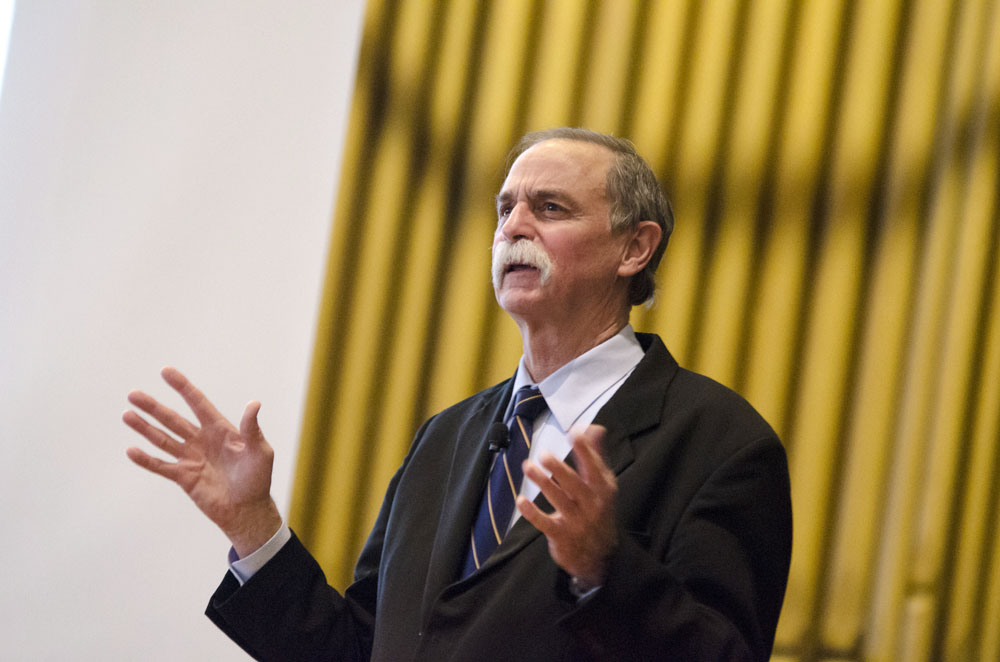
NeimanMarcus_Shah_WEB

Downing spent much of the evening discussing style trends for the upcoming fall and winter seasons and giving advice to the fashion and design students in attendance. He discussed his humble beginnings in Seattle and stressed that any one of the aspiring designers in attendance could make their dreams come true as long as they’re willing to put in the work.

“If you want something really bad enough, … you will have it, because fashion is not just for a rarefied few. Our industry is looking for the talent and creative spirit of all of you,” Downing said.

One of his biggest pieces of advice was to remember the everyday lives of the people who will be wearing the clothes that students design. Downing said it’s easy to get caught up in the highbrow world of designing the most artful piece possible, but designers have to ask themselves whether their creation is practical for an ordinary person to wear because ultimately, it’s ordinary people who determine a designer’s success or failure.

“You have to say to yourself, ‘Here’s my dream, but will it translate into the reality of what a woman puts into her closet and on her back?’ Because you can make the most fanciful clothes in the world, but if they don’t sell, the buyers won’t come back and visit you,” he said.

When asked what drives him in the industry, Downing replied, “I want women to have confidence. … When I can make women look better, look more beautiful and like themselves more, it’s the biggest excitement I get. That’s how you know you’ve succeeded.”

He also warned the audience about getting caught up in the cacophony of fashion media and becoming too dependent on other designers for inspiration. “You have to develop your own voice. What white space in the industry will you fill? I’m not looking for someone who can create another Lanvin dress, because Alber Elbaz already does that perfectly. What is your space in fashion that you’re going to fill that will make my eyes open wide and say, ‘No one is doing that’?”

Downing has been involved in the fashion industry since high school, when he was briefly a model, before deciding he was more comfortable on the other side of the camera. He joined Neiman Marcus in 1989 and has been the company’s fashion director since 2006.

Downing gives credit to his mother, a model in her younger years, for being a source of inspiration.

“I credit my mother with a lot of my good design savvy,” he said.

Earlier in the day, the Neiman Marcus store in King of Prussia held a fashion presentation and reception in honor of Downing’s award, which benefited Drexel’s fashion scholarship program. Downing was taken on a tour of the new URBN Center, where he critiqued and discussed student designs for the upcoming Drexel Fashion Show.

Image courtesy of Sheena Shah

The post Neiman Marcus leader receives Westphal Award appeared first on The Triangle.
Posted in UncategorizedComments Off on Neiman Marcus leader receives Westphal Award

Physicist explains ‘the impossible’

David Wineland, recipient of the 2012 Nobel Prize in physics, visited Drexel University April 15 as the 18th Kaczmarczik Lecturer. He is the second consecutive Nobel laureate to speak in the lecture series.

Wineland, who has been with the National Institute of Standards of Technology since 1975, was cited in his Nobel award for “groundbreaking experimental methods that enable measuring and manipulation of individual quantum systems.” His work in quantum optics has allowed for the measurement of superposition states, which are the occurrence of two distinctly different states simultaneously. Observations of this kind were long thought to be impossible, dating back to the early days of quantum physics. The implications of such an observation were most famously described by Erwin Schroedinger in a thought experiment now known as Schroedinger’s Cat.

In the thought experiment, “you have a situation where there is a single radioactive particle, and also in this box there’s a cat. And there’s some mechanism where if the particle decays it will release poison and kill the cat,” Wineland said. While we could in theory write out the equations to represent the situation, in effect, “all we can say is that the cat exists in a situation where it’s simultaneously dead and alive. It’s not dead or alive, it’s dead and alive,” he explained. Generally, measuring these superpositions causes them to collapse into one state or the other, but the reason Wineland’s research is so innovative is that it enabled the team at NIST to measure and manipulate superposition states without collapsing them.

NobelPrize_Courtesy_WEB copy

The foreseeable implications of this work are in atomic clocks and quantum computing, but it is impossible to say where it will be most important. “More often than not, when a field is developed, you don’t know what the applications are when you’re doing it. Very likely the useful applications will maybe be things we’re not thinking about. A good example of that would be the laser. When it was first developed, people didn’t really have an idea what it would be good for. Maybe they had some simple ideas, but now it’s ubiquitous in our lives. I’d like to believe that the same stuff will happen with this stuff that we’re doing,” Wineland said.

Already, the time and frequency group at NIST has built an atomic clock using aluminum ions that is accurate to one part in 1017, meaning that if the clock had been started 13.7 billion years ago, right at the Big Bang, it would be accurate to within five seconds today.

Quantum computing is in its infancy, but it could be a revolution on a scale not seen since the microprocessor. The smallest unit of information on a regular computer is called a bit and can be either a one or a zero. In a quantum computer, quantum bits, or qubits, are in a superposition of both one and zero simultaneously. This means that two qubits could simultaneously take on four values, and a computer with 300 qubits could hold 2300 values concurrently, more than the number of atoms in the universe.

Wineland’s talk focused on his career trajectory and the research he has performed over the years. He completed his undergraduate studies at the University of California, Berkeley; went on to graduate work at Harvard University under Norman Ramsey, where his thesis was titled “The Atomic Deuterium Maser”; and then to postdoctoral research at the University of Washington in Hans Dehmelt’s lab, where he worked on electron and ion traps. Both Ramsey and Dehmelt were awarded the Nobel Prize in physics in 1989 for separate research.

Promoting physics as a field is one goal of Wineland’s, and he acknowledges that basic science might be losing out to the many distractions available to students. But, he said, “One of the things that’s been nice about this job is that it really is more like a hobby. I’ve been able to determine what I work on, and there’s this wonderful freedom to work on interesting problems. I think if you can get that message across to young people, it might attract more of them.”

NobelPrize2_Courtesy_WEB

“One of the biggest takeaways from things like this, even if you don’t understand all of the details, is the work it took to get where the scientist is,” Michael Schlenker, a first-year physics graduate student, said. The people who win these awards are “people with a passion for what they do, and that passion comes out in this kind of talk.”

The lecture series was established to honor Paul Kaczmarczik, a physics professor who started teaching at Drexel in 1953 and retired in 1989. “Dr. Kaczmarczik was known for being the professor that got all students to understand some of the basic principles of physics, regardless of their major. He made physics real and tangible to everybody,” Donna Murasko, dean of the College of Arts and Sciences, said. “The fact that we have almost 500 high school students with us today is a part of this program that makes this so much what Dr. Kaczmarczik would have liked.”

Images courtesy of and Amy Weaver

The post Physicist explains ‘the impossible’ appeared first on The Triangle.

Posted in UncategorizedComments Off on Physicist explains ‘the impossible’

Project aims to simplify city parking

Four Drexel engineering seniors who are turning their senior design project into a business were selected to be one of 10 university startups participating in the Angel Venture Fair, taking place April 30 in Houston Hall at the University of Pennsylvania.

The four cofounders — Dakota Davis, Jonathan Davis (no relation), Diego Pinate and Niteesh Prasad — are trying to turn street parking into a 21st century affair with Hot Spot Parking.

Their product is like E-ZPass for parking, with “one post per parking spot. The post detects the car is there, it reads the RFID tag in your car, and charges your account for the exact amount of time that you were in the spot,” Prasad said. “You can just park and live your life. Everything else will come to you. You won’t have to interpret any crazy signs, and you’ll get the exact information you need for your spot.” They also plan to use the parking information to create a real-time map of available parking, saving drivers the headache of driving in circles looking for a spot.

HotSpot_Courtesy_WEB

The team thinks the time has come for street parking to move into the digital age and will target smaller cities first, ones that still use coin-fed meters, which Jonathan Davis called “20th century technology.” They hope to generate enough public interest in the new technology that municipalities will start calling them, but until that day comes, Hot Spot plans to go the old-fashioned route, offering a better product at a lower price. “With our system, we don’t take a cut [of the parking revenue]; we’re just there as a helping hand.”

“All the management goes through us. [The cities] only have to pay for the installation and any credit card fees. We handle the management, the maintenance, and it’s basically autonomous. If anything breaks, we fix it. They just sit back, collect the money, and everything is automatically deposited. We make money through analytics and advertising sales.” Jonathan Davis said. “So it’s a better business model than traditional parking companies, which gives us the advantage of helping the city out more. They receive 100 percent of the parking and enforcement revenue.”

Hot Spot is looking to raise enough seed funding to get the company off the ground and into a position where it could approach a city-level project.

“The Angel Venture Fair has a pretty good track record; something like 80 percent of participants will get meetings with investors to further talk about their project,” Pinate said. “As long as we can get the first meeting after the AVF, I think we can take it from there,” Jonathan Davis added. The AVF will be Hot Spot’s first real experience with investors.

Working out of a cramped apartment with a TV, an Xbox and some laptops, the four founders are the spitting image of a typical startup. They disregard formal titles, opting instead for monikers like “The Doctor” and “The Blacksmith.” The last few weeks have been spent finalizing the engineering for their senior design competition, and in typical Drexel fashion, taking exams right in the middle of everything. They have also been applying to incubators, entering the Baiada Institute for Entrepreneurship business plan competition and participating in events during Philly Tech Week.

Jonathan Davis is majoring in general engineering with a minor in business administration. Dakota Davis is dual majoring in computer and electrical engineering. Prasad is majoring in electrical engineering, and Pinate is majoring in computer engineering. Hot Spot Parking can be found on Facebook, Twitter and at www.hotspotparking.com.

Image courtesy of Jonathan Davis

The post Project aims to simplify city parking appeared first on The Triangle.

Posted in UncategorizedComments Off on Project aims to simplify city parking