Netflix’s “Never Have I Ever,” starring newcomer Meitreyi Ramakrishnan as a high school sophomore looking to reinvent herself after her father’s death. The show, created by Mindy Kaling and Lang Fisher, is heavily influenced by Kaling’s own life.
Over the course of ten episodes, “Never Have I Ever” follows a cast of mainly high-school characters tackling real-life issues in a refreshing way. The struggles of grief, coming out, applying to college, healing, unrequited love, single parenthood, and familial ties are all delicately and fairly covered in this show.
The cheesy high-school-drama moments are incredibly cheesy, but almost make you nostalgic for the good ole days, when competing with your academic enemy was the sole driver of your motivation.
“Never Have I Ever” dropped at the end of April and provides a simple distraction from the craziness of the world right now. It is an easily bingeable show lacking depth in many ways, from the shallow actions of the main character to the complicated half-lives of the supporting characters.
Many things are unique to this show, the characters are diverse and real, unlike almost any other high-school-based sitcom.
The real star of this show is Poorna Jagannathan as Nalini Vishwakumar, the mother of the main character. Jagannathan plays Nalini with such weight and reality that I felt she deserved to be the star of this show – there’s too many high school dramas out there already anyway.
Jagannathan’s portrayal of a grieving widow doing her best to raise her daughter is incredibly moving; she is funny with a fantastic sense of humor, an intelligent dermatologist running her own practice, and easily the best character from the show.
Overall, If you can get past the overwhelming selfishness of Ramakrishnan’s Devi Vishwakumar episode after episode, it’s worth watching.
Posted in UncategorizedComments Off on ‘Never Have I Ever’ is worth a watch
At the end of last quarter, I wrote an article about what awaited us in the uncertain future of spring quarter. The entirety of March was quite the rollercoaster ride, as the COVID-19 virus has continued to have more and more of an impact on people’s day to day lives, and with spring quarter now being underway, we’re going to have to see how things play out.
One thing that I would like to commend Drexel on is the amount of effort that is being put into keeping students up to date with what is going on. The university has no doubt had to adjust much of their normal operations in a fairly short frame of time and that is not an easy feat by any means. On top of that, keeping the people that are going to be most impacted by those changes in the loop is arguably more difficult. But they have managed to convey much of the changes in well-written and concise emails that I’ve found very easily digestible.
Congratulations aside, the more pressing matter that I want to focus on in this article is how we can approach this very odd situation that we are now faced with as Drexel students. I think it’s easy to get so caught up in the trials and tribulations of our predicament that we forget to actually come up with ways to make the most out of the situation.
I will admit that I too am fairly weirded out by the fact that I’m currently at home in the comfort of my own room writing this article and not at Stiles Hall. It’s been very strange and sad to not be able to go to the Drexel Writing Center each day and see all of my friends. And it has been hard to swallow the fact that I will very likely never set foot in a Drexel classroom as an undergraduate ever again. I think that freshman, sophomores, juniors and seniors all have vastly different perspectives on the current state of things, as we are all obviously at different points in our college careers. However, a universal thing we all share is that we are all students, and now is a time where we can have our education affected in a very unique way, which is the home environment.
You may not notice it initially, but there are probably many things that were made considerably easier by being on Drexel’s campus, and these things can be both small and large. For example, I never set my alarm when I am at home because I rarely have to get up at a time that requires me to set an alarm. But on Monday, I was scheduled to be available for online writing tutoring sessions around noon, so I set my alarm to go off around 11 in the morning and ended up sleeping through it. Thankfully, I did wake up at around 11:30, but the point remains that my body and mind were so unaccustomed to waking up to an alarm while in my home environment that they completely disregarded it. I am so used to waking up naturally that it is extremely difficult for me to wake up to an alarm, and that could be a problem when I start sleeping through my alarms and missing my class.
Obviously not everyone will have this problem, but it is one small example that other people most definitely have similar versions of. During these first few weeks of classes, you should be paying attention to certain areas related to school that you find yourself struggling with.
A more major problem for me is my inability to do homework. Yes, something as simple as doing the work that is assigned by a professor for a class is incredibly difficult for me to do at home. I’m still not entirely certain why this is the case, but it most definitely has to do with the mindset that I have when I’m at home as opposed to at college. Whenever I would make a trip home for a weekend, I would make it a point to get all of my immediate homework completed so that I could enjoy my time at home with my family, as the whole point of going home was to get a break from the college atmosphere. College equals work and home equals relaxation. That has been my mindset ever since freshman year and having to now change it on the spot is a task that I, and no doubt many other people are finding varying degrees of difficulty with.
At the moment, I’m still trying to find different ways to deal with this problem, but I think that when you’re doing homework, the best thing you can do is make yourself feel as though you are still at college. There’s no way to fully replicate the college atmosphere while you’re at home, but there are small things you can still do that can have the same effect. Is there a certain type of food that you like to snack on while you work? Have that snack. Is there a type of genre of music, or even a specific artist, album or song that you always listen to whenever you do your homework? Put it on. You might be surprised by how much of a difference it can make for you. It doesn’t solve the problem, but it certainly lessens the issue in my opinion.
With all the media out there talking about COVID-19, I think it’s still too early to truly predict when this thing will blow over, so the best thing we can do is just live in the present moment and make whatever changes we can to our approach to education as students. I wish that I could offer more concrete advice on how to navigate the effects of this pandemic, but because everyone’s situation is different, I can only really speak in a general sense. The most any of us can do is take each day for what it is and practice social distancing so that this virus will pass us by in what will hopefully be a reasonable amount of time.
Posted in UncategorizedComments Off on Adapting to college at home
This is an article that I have been both dreading and itching to write. Mulling over each sentence, figuring out how to follow it up, ensuring each word is perfect. It has become not only a habit for me over the last three years but also a necessity.
However, instead of waxing poetic (as I am prone to do), I’ll give it straight: This is my last article for The Triangle as a Drexel University student.
That’s right. I’m leaving. This is my last article as a student at Drexel, but not my last for The Triangle. Not by a longshot.
My run began over three years ago with my first article on Oct. 7, 2016, published under the supervision of Opinion Editor Maggie Fedorocsko and Editor-in-Chief Alexandra Jones. I end it now, on Mar. 13, 2020, as my own editor under the direction of our current chief Nick Camarata. This road has had the ups and downs of a roller coaster. However, unlike a roller coaster, there has been a plethora of emotions.
Aside from these emotions, there have been lessons, laughs, tears, fights and everything you can think of. In each, I have interacted with some of the best people I’ve ever met, working together on bringing this great publication to you, the Drexel University family.
When I first came to the paper, I had no journalism experience. Seriously, I had none. My middle and high school didn’t have a publication, and journalism wasn’t a teaching option — more like a one- or two-month unit in English class. I didn’t even know I wanted to be a member of the media. All I knew was one thing: I wanted to write and open myself up to new experiences.
After the first few weeks here, I knew that I had found my calling. More importantly, I had found my home. I went from being undeclared to a communication major halfway through my first quarter, and I haven’t looked back since.
The more I learned in my studies from all my professors, the more I succeeded, the more I failed — I was able to put it all into practice at The Triangle. There were lessons that became highly valuable to me. I learned how to better myself and better the relationships I make, knowing that we are all on the same team.
I’m proud to say I’ve become a stronger leader by not only learning to follow but also teaching myself to create my path, even if it conflicted with the one everyone else wanted to take.
Even when I knew that people weren’t reading The Triangle (which, believe me, was very frustrating), it was the staff at The Triangle who taught me not to take it personally. They made me realize the point was not to appease people or give them what they wanted, but rather, tell them the truth, no matter how ugly it would be.
However, the one thing that I was determined to explain, as best I could, is that decency is something that has no political status. It comes from how we treat others, treat the world and treat ourselves.
If anything, the biggest lesson I hope that you learned from me is that you can not only dream, but also put the work in to make the dream come true. However, once it’s been accomplished, take that dream and put it to good use so it can benefit as many people as it can.
Before this article concludes, I want to thank everyone who got me to this point.
To my family, my mother Azita in particular, for always believing in me. Dooset daram.
To Anne Haftl, the former head of personnel for The Triangle, thank you for taking the time to email me back in 2016 and bring me in. I’ll be forever grateful.
To Alexandra Jones, Billy Bauer, Gina Vitale, Mike Avena and Nick Camarata: Thank you for being the leaders who pushed me to be the best. Even a simple “no” without explanation was enough to motivate me to become stronger. I would not be here without you.
To Maggie Fedorocsko, Alex Nagy, Matt Brooks and Michaela Graf: Opinion was, and has always been, my home. Thank you for everything you have taught and given me, even if I annoyed you. You guys are truly tough and made of something else for dealing with my trying ways these last few years.
To every editor and staff member I have worked with, particularly Matt Coakley, Tash Hajo, Walker Alexander, Calvin Kiniale, Kim Post, Virginia Tanner, Jason Sobieski, Tosh Farrell, Michael Duffin, Ethan Hermann, Ben Ahrens, Mikayla Butz-Weidner, Maeve Hennessey, Sanju Ramanathan, Mark Budd, Jahnavi Kalyan, Ryan Bosch, Gina Fitzpatrick, Emma Dietz, Sarah Miller, Virginia Wardell, Zoe Sucato, Utkarsh Panchal, Alex Pachkowski and Stefan Kusmirek: you guys are a major part of the reason I am here, and even if you knew this already, I deeply appreciate everything you have taught me. I’m sure it’ll take me far.
To the Triangle writers — not just in Opinion, but in every section I have written in — you are all too numerous to name, but you each have an extraordinary place in my heart. I will miss you all deeply.
I hope that, from these, you’ve learned a lot about me. I know that I’ve learned a lot from you.
Armon out.
Posted in UncategorizedComments Off on Three years, five months, and seven days later…
Autonomous shuttles could make transportation around campus easier for students
It’s no secret that parking seems to be a pain point for college students on several campuses across the United States. According to the New York Times, the University of Wisconsin-Madison has one parking space to every five people, and approximately 65,000 students. The campus plans to add an additional 2,200 parking spaces over the next 20 to 40 years, which seems like a long time for a campus and student body that is continuously growing. In fact, the application rate at the University of Wisconsin-Madison increased by 20 percent between 2017 to 2018.
Transportation and parking remain an ongoing issue for campuses everywhere. A college student at Florida Atlantic University recently highlighted her frustrations with campus parking. “I was rushing to class for a Monday morning lecture that began at 8 a.m. At 7:59, I was nowhere near the building for my course because I had to park so far away. I awkwardly walked in at 8:17 and interrupted the professor’s lecture. On top of that, I needed to arrive early to put finishing touches on a paper that was due at the beginning of class. If I had access to better, more reliable modes of transportation, I would take it.”
Of the many public state universities, most are thousands of acres wide. The University of Florida, for example, sprawls over 2,000 acres of land. With bus systems unable to service the demand and a shortage of parking space for students, students need an alternate transportation solution that is timely and efficient.
Autonomous vehicles have become a de facto mode of transportation for the future. While we’re still in the early stages of this technology’s evolution, fixed-course autonomous shuttle vehicles could be a true transportation solution for college campuses. The use of controlled-speed timed shuttles that would allow students to travel between campus destinations will be revolutionary for universities that experience crowding or issues with parking.
Autonomous shuttles can be a more efficient and eco-friendly method of transportation for students while providing a more relaxing mobility environment. Rather than students parking their vehicles and then traveling by foot to class, they can relax and work on schoolwork while the shuttle takes them to their destination. In fact, autonomous shuttle technology has already been introduced to several universities. The University of Michigan and California State University have both recently incorporated autonomous shuttles (also known as “people-movers”) onto their campuses.
Furthermore, autonomous shuttles will help students with physical disabilities, for whom walking large distances — sometimes up to a mile — to get from one class to another is difficult. While most universities have disability services available, very few of them include efficient, timely transportation. Providing an easier way to get around campus will greatly improve the overall college experience for disabled students and faculty.
Another benefit of autonomous shuttles is safety. Autonomous Vehicle technologies are advancing and improving every day. As of today, an AV cannot see and interpret its surroundings exactly as a human would and therefore lacks a certain level of intuition. On the other hand, autonomous vehicles react to motion and events two to three times faster than a human can, and the use of artificial intelligence will continually improve the need for interpretive logic, which will ultimately create a much safer transportation mode than human-driven vehicles.
Most importantly, autonomous vehicles don’t get distracted by their surroundings or mobile devices like students and other drivers can. According to the 2016 Fatal Motor Vehicle Crashes report by NHTSA, human error and poor judgement are the leading causes of traffic accidents and deaths on our roadways. Federal and local governments, insurance companies, the medical community and other groups are pushing for the introduction of autonomous vehicles to reduce this alarming statistic. There is plenty of research to validate that autonomous vehicles and equipment will dramatically improve safety in all applications, which means campuses will be safer if autonomous transportation is deployed.
In conclusion, with parking continuing to be an increasingly difficult (and expensive) problem on college campuses, providing students with an alternate mode of transportation could solve many campus transportation issues while providing other benefits. Bringing autonomous shuttles to college campuses would greatly improve the overall safety and productivity of the students, teachers and staff, and having innovative, eco-friendly and convenient options increases the attractiveness of campus life — an important consideration in the college selection process.
Posted in UncategorizedComments Off on How autonomous technology could transform the college experience
My mom and I always joke that Las Vegas residencies are where pop music careers go to die. They are almost exclusively pop divas that have lost their relevance in the mainstream. Their new albums see diminishing returns, and the residency is an easy steady check for them to bank on. Yet over the past few years, Celine Dion has consistently been proving us wrong.
Dion rose to worldwide prominence in the ’90s. She had been a successful teen star in Canada, releasing French-language albums throughout the ’80s. After gradually learning to speak English, she released her debut English-language album in 1990. Once Dion got her foot in the door, she took command of Adult Contemporary radio with her soaring emotional ballads and never looked back. She has earned diamond certification on two albums, a rare feat.
Dion began her second Las Vegas residency in 2011 at The Colosseum at Caesar’s Palace. She continued to perform there through this past June, completing a total of 427 shows. In that time she released two albums (2013’s “Loved Me Back to Life” and 2016’s “Encore un soir”), went on multiple European tours and won Billboard’s Icon Award.
Most importantly though, Dion lost her husband of 22 years and longtime manager, Rene Angelil, to throat cancer in 2016. Despite the devastating loss, Dion has continued to forge ahead.
Her new album “Courage,” released Nov. 15, is an exploration of this loss and how far she has come in the healing process. It is her first English-language album in six years, and the 12th in her career.
Much like on “Loved Me Back to Life,” “Courage” sees Dion collaborate with several modern forerunners of pop music to update her sounds. Smash hit songwriter Sia penned two tracks on the album and another on the deluxe edition. Sam Smith, Skylar Grey and Lauv also made writing contributions. On the production side, she gets assistance from David Guetta, Stargate, The Stereotypes, DallasK and Greg Kurstin.
Celine Dion finds the perfect balance of catering to current trends and knowing her voice, her audience and her age. Many mature pop stars often feel like they are playing young to connect with the target demographic, and it just comes off kitschy and cringe-worthy. But Dion hits the sweet spot and the level of camp and theatrics built into her brand helps her flourish.
The opening track, “Flying On My Own,” really sets the tone for the album. It took me quite by surprise on first listen. It starts out quite mellow, feeling like a typical ballad. But as Dion soars vocally in the pre-chorus, the classic dance break, piano stabs and hand claps come in. As she goes for the hook line a full house EDM drop hits. This song is Pride playlist ready.
For Dion, this song is about coming back into herself after her major loss. She had gone her whole career with Angelil by her side, but now she is quite literally “flying on her own.”
The album is centered around this loss but is not a sad album. It is an album about rebuilding yourself and discovering new parts of yourself late in the game. It is an empowering and hopeful listen.
Sometimes there is an odd sonic clash between the EDM influenced tracks and the more stripped and earnest ballads. Still, Dion never relinquishes the spotlight to the track. She is always front and center with a stunning vocal performance.
The album drags on a little long for the casual fan — it clocks in at 57 minutes, with the deluxe edition reaching an hour and 11 minutes. I would say check out the highlights first — “Flying On My Own,” “Lovers Never Die,” “Imperfections,” “Nobody’s Watching,” “The Chase,” “For The Lover That I Lost” and “Perfect Goodbye.”
Overall, it is immensely impressive to reach a point in your career where you are releasing your 27th album. Celine Dion has managed to stay fresh and stay true to herself over four decades and continues to be one of the most beautiful voices of our times.
Posted in UncategorizedComments Off on Celine Dion’s ‘Courage’ album is a triumphant return for the legend
I guess the best way to sum up “Zombieland: Double Tap” is that you will probably get what you expect from it. If you have seen the original “Zombieland,” you will likely have just about the same response to this sequel as you had to its predecessor. I’m not sure if that’s a good or bad thing from a creative standpoint, but that’s my evaluation of it. I moderately enjoyed the original and was adequately entertained by the sequel. It got some genuine laughs out of me, and seeing it in theaters probably helped with that.
However, as I’ve thought about it in passing over the last few days, I have started to see some issues with it. Not plot holes or anything that really alters my impression of it, but just areas where it could improve. I found the story to be somewhat predictable, although that didn’t necessarily hinder the movie. At the end of the day, it works.
One thing I can definitely say in praise of it is that it embraces its identity as a sequel in the right ways. The end of the first “Zombieland” didn’t give the impression that the story would continue, so its sequel didn’t really have anything to deliver on. There is a ten-year gap between the two movies, which is addressed naturally. I think where it excels is in how it deals with the iconic aspects of the original. Columbus’ (Jesse Eisenberg) rules and omniscient knowledge of all zombie fighting activities around the country makes a return in just the right way with a few welcome twists and developments. Tallahassee’s (Woody Harrelson) intense “‘Murica” personality is played up a lot. Where the movie really has fun is with the increasingly inventive ways that humans fight the zombies and deal with the post-apocalyptic state of the country.
I will warn that it is definitely harder to enjoy this sequel if you haven’t seen the original. I guess that’s true of all sequels, but I think it’s especially noticable for “Double Tap.” You won’t exactly be lost, but there will be a lot that will be harder to appreciate.
If an all-star cast is a draw for you, I can safely say that this movie delivers. Nobody has a career-defining performance by any means, but they all play their roles well and are very entertaining to watch. To be fair, the characters aren’t really developed much, so the actors are all essentially hitting the same note the whole time. On the upside, they are well cast, so everyone’s performance and chemistry is moderately entertaining.
I’m not going to recommend that you rush out to see this. A movie like “Joker” might be a more fulfilling experience for you. But if “Joker” looks a little too deep or emotionally intense for you, this is a good alternative. Not to throw shade at any of this week’s releases, but it looks like it’s going to be a pretty underwhelming weekend, so I’d recommend “Zombieland: Double Tap” over anything else opening on Friday. Despite the zombie element, it is not even remotely in the horror genre. Unless you’re averse to somewhat gory action, this should be worth your money in terms of entertainment. Just don’t go in with huge expectations, and you should be satisfied.
Posted in UncategorizedComments Off on ‘Zombieland’ sequel gives audience exactly what’s expected
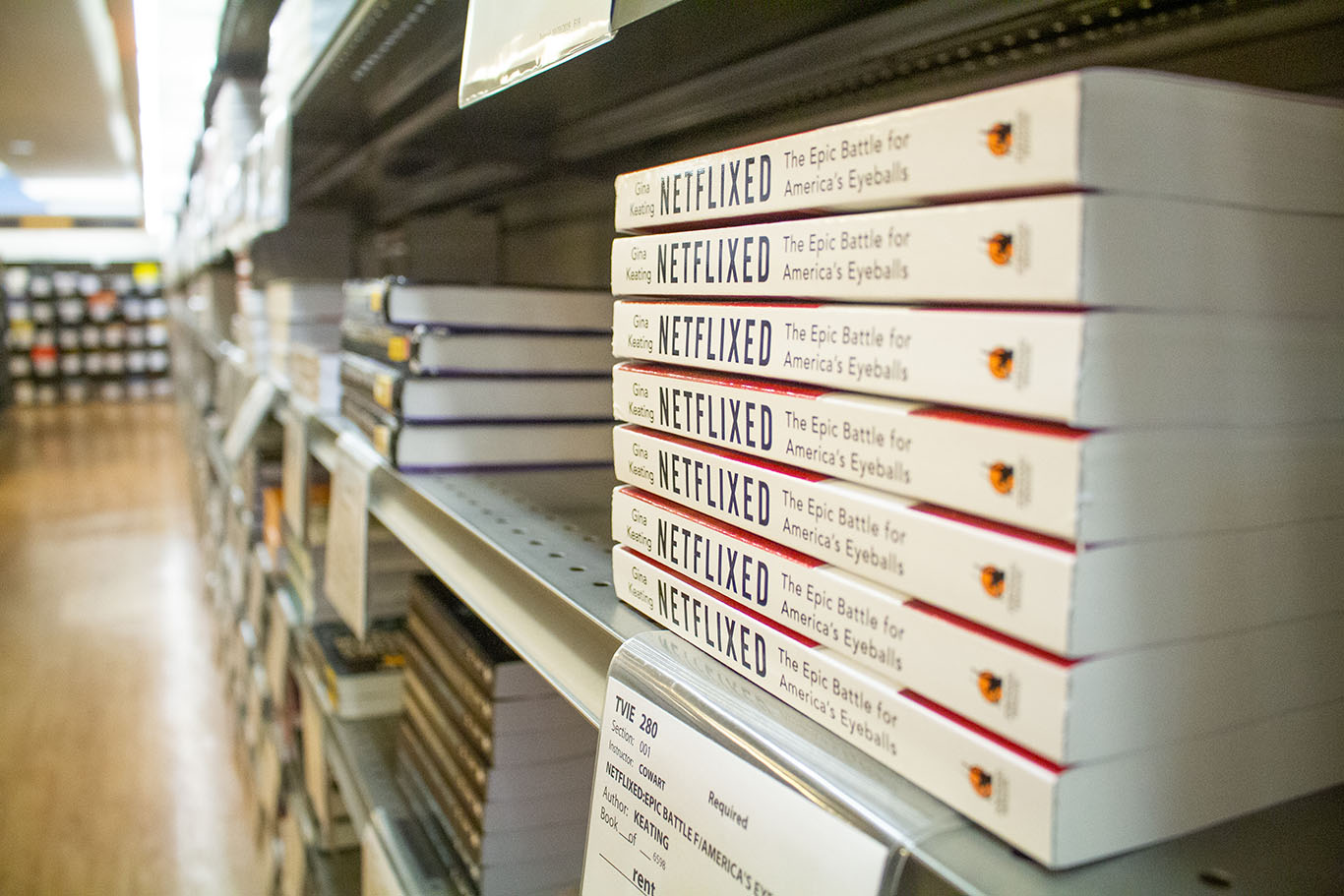
The cost of purchasing books for classes from the Barnes & Noble bookstore is something that I think every college student has been nearly floored by at least once.
Thankfully, I am at the point in my college career where I am taking only the last few English courses to finish up my English major, so I don’t have to worry about some of the really expensive and, quite frankly, annoying stuff from past years. But I still remember my first trip to the bookstore very well in my freshman year. The math text book I bought was well over $100, and the access key that was packaged with it was nearly half the price of the book itself.
Now, I’m not trying to say that the books at the bookstore are overpriced, because I don’t know enough about the process of how the people involved in the selling of the books come to determine the prices that they do. For all I know, they could be setting prices that are completely fair based on their calculations and research. However, being that I am still a college student who has to buy these books, I will say that I find the prices to be a bit steep when you consider the consumers to which the books are being sold.
Obviously money has to be made from selling these books — significant money — and I can’t say that I don’t at least understand why the prices are so much higher at the bookstore; we essentially get instant access to whatever book it is that we need. We can inspect the book before we buy or rent it if it’s used, check for any damages, see if there are too many notes in it already and most importantly, make sure that all the pages are in it. However, I start to question if these benefits are really worth the price when my friend tells me that he found the same anthology book on Amazon for $5; meanwhile, at the bookstore it’s $42 to rent a used copy, $75 to rent a new one and $100 to buy a new one just to push the point home.
Thankfully, we as students don’t have to rely solely on the bookstore. A large portion of us get our books either online as e-books or shipped to where we live, but the problem with this is of course the wait time. Sometimes a book can take a whole week to arrive, even though the shipment information said it would only take two or three business days. That may not seem all that major, but what happens when you need the book in two days so you can do the assigned reading material before you have to go to class? Obviously it’s not the end of the world, but it’s an inconvenience — one that could have been avoided by a simple trip to the bookstore to get the book immediately.
Another thing that can be very hit or miss is price matching. In the details section of price matching for the Barnes & Noble bookstore, there’s a small bit of fine print at the bottom that contains what I find to be a rather important piece of information.
“Titles listed on Amazon that are not ‘rented by’ or ‘sold by’ Amazon are excluded, as are publisher websites and select local competitors.” Essentially, this narrows the potential number of books that can be price matched to just ones that are sold by Amazon. And often times, the cheaper books are listed on Amazon but not sold by it.
And again, I’m not knowledgeable enough about how such a rule is created. I highly doubt that the people coming up with things like this are doing it without a good reason. And while I would love to have the logic behind it explained to me, currently, it just seems like an unnecessary restriction. I can understand wanting to make as much money as possible off selling these textbooks to students, but I don’t think allowing more options for price matching would lead to a significant loss financially.
The bookstore is a fantastic resource, that much I cannot deny as it has been pivotal for acquiring the books that I need for my classes these past three years. That said, I think it can still improve, and everything I’ve brought up in this article hasn’t been to attack the bookstore. I believe that the relationship between students and the bookstore is acceptable for the most part, there are simply some aspects of the transaction that aren’t desirable, but they can be fixed with some communication and understanding from both sides.
Posted in UncategorizedComments Off on The Drexel Bookstore: A costly convenience for students