
Author Archives | Skyler Frazer

NH Listens and City/College Commission come to consider decisions impacting all

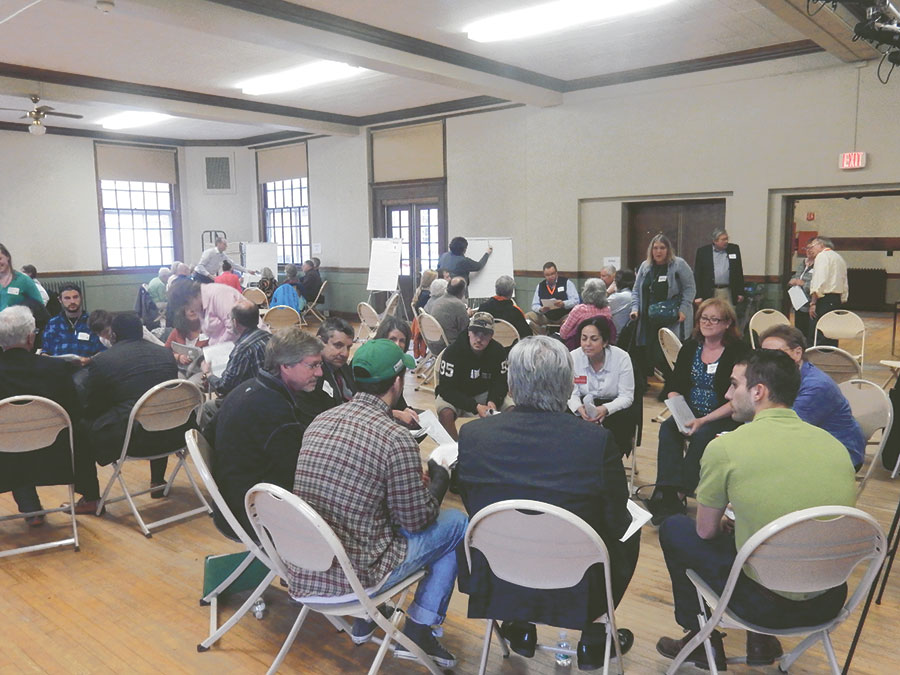
The Keene State College community crossed paths with citizens from the City of Keene in last week’s event hosted by NH Listens and the City/College Commission. “Good Neighbors: A Community Conversation to Strengthen City-College Connections and Relationships” took place Tuesday, April 14, in Heberton Hall, at Keene Public Library.

According to a post on the Keene State College website, the goal of the meeting was to “Get informed, hear important priorities and consider the decisions that impact, represent and affect us all.” Many representatives from KSC were present at the discussion, including Vice President for Student Affairs and Enrollment Management Kemal Atkins, Provost Walter Zahaki and President Anne Huot.

Numerous other professors, students, city councilmen and city commissioners who were also present were split into six groups, 10 or so people in each group. Each group had a trained facilitator from NH Listens who asked questions and kept the conversations moving.
Jordan Crowley / Equinox Staff

Jordan Crowley / Equinox Staff

NH Listens is a group that aims to solve real world problems with community-based organizing and discussion. According to their website, “Our vision is to create a network of engaged communities in New Hampshire that can share their experiences and resources for getting ‘unstuck’ and solving public problems.” The organization was established in 2011.

After a few opening remarks from Zahaki and Huot, the groups began their discussions. These are the findings and discussions from the members of Group B.

Group B had 11 people ranging from students to Keene citizens, with a plethora of professions and stories in between. Everyone was on a first-name basis, though some people in the group were willing to use their last names.

After introductions, Cara, Group B’s facilitator, began asking questions. The first question for the group regarded the values of the KSC-Keene relationship.

The members of the group listed many reasons the college was important to the city, and vice versa. Andy Bohannon, director of Parks and Recreation for Keene, commented on how the students bring a different sense of diversity and culture to the city.

Randy L. Filiault, a 17-year member of the Keene City Council, agreed in this sentiment and also commented on the mutual relationship students and businesses have in the city. Local businesses provide students with jobs and students provide businesses with money and labor.

Debbie, a local who also works with adult education at the college, spoke about the array of programs on campus that are available to the community, such as the many events that are open to the public every week.

One member of the group mentioned that he and his wife eat at Zorn Dining Commons on occasion. Most members of the group agreed that, as a whole, the college is good for the City of Keene, save for a small portion of the KSC community.

“The only thing I don’t like about it is a small percent of out of control students,” Filiault said.

After this discussion, Cara asked the group about what they felt were the greatest threats to these values.

Dick, a member of the City/College Commission, commented on the perceived lack of policy enforcement by the school. Other members of the group questioned how the college reprimands its students that violate rules or break the law.

“Violations should result in community service,” Tim Zinn proposed to the group. Zinn has been a resident of Keene since the 1990s and is now raising his two daughters in the city.

One member of Group B said that college students may be too immersed in college life, neglecting the community around them. The group compiled its most important findings into a list to share with the other five groups. Overall, the other groups had similar ideas and findings to Group B. A major idea brought up by all groups was the idea of communication.

Proper communication between members of the college and members of the Keene community can prevent situations like last year’s Pumpkin Fest riots from happening.

Skyler Frazer can be contacted at sfrazer@kscequinox.com

Posted in UncategorizedComments Off on NH Listens and City/College Commission come to consider decisions impacting all

Campus group hopes to make KSC tobacco free

Administrators at Keene State College are pondering the idea of becoming a tobacco-free school

The leader of this movement is Tiffany Matthews, the coordinator of Wellness Education at the Center for Health and Wellness.

Matthews and the tobacco-free campus task force, which formed in the fall of 2012, have been pursuing this goal for three years.

Last Friday, April 10, Matthews and other supporters of the movement held an open forum in the Madison Street Lounge.

The idea was to get campus talking about the anti-tobacco movement on campus and gather opinions from students as well as faculty.

To Matthews’ disappointment, there weren’t any admitted smokers in the room to express their viewpoints on the proposed changes.

“Seventy-five percent prefer not to deal with the residual effects of tobacco products,” Matthews said, reflecting on surveys the school did in 2012 asking students, faculty and staff about tobacco.

Current KSC rules prohibit smoking within 25 feet of a building on campus.

Many people don’t know what 25 feet looks like off the top of their heads, Matthews argued, and many buildings are so close together there is no way to smoke “legally” between them.

This leads to people violating current rules and putting non-smokers at risk from residual effects.

Even though these results are three years old, Matthews is confident those numbers also mirror how current students feel.

Last Tuesday, March 7, Matthews and the anti-tobacco movement received a re-endorsement from Student Assembly to continue their work.

Kate McNally was also present at the event.

McNally is the program coordinator for Cheshire Coalition for Tobacco-Free Communities at Cheshire Medical Center

Tim Smith / Photo Editor

Tim Smith / Photo Editor

and has been working closely with the movement to make KSC tobacco free. McNally’s goal has been to “break down barriers” preventing people from getting the help they need. “It’s not a constitutional right to smoke. It is a constitutional right for me to have clean air,” McNally said. McNally said that there is a 17 percent youth rate in tobacco use in the Monadnock region and she wants to see that number dip to 10 percent by 2020.

“We can expect that about thirty-five percent, somewhere in that vicinity, of college age people in the Monadnock region use tobacco, compared to a much smaller percentage of people over the age of thirty-five.” McNally said.

William Stroup, an English professor at KSC, supported the idea of making KSC a tobacco-free campus. “As a person whose office is above an area where people smoke a lot, yeah, there have been a number of times where its been impossible to avoid the smoke,” Stroup said. Stroup said he thinks it is crucial for KSC to continue the movement to become tobacco free, as it aligns with the school’s commitment to the health and safety of its students.

Matthews said that while there are still other things the group must look into, the biggest obstacle of the anti-tobacco movement is getting the cabinet and president’s official approval for the change. “Our goal is to go all the way,” Matthews said.

For more on smoking on campus, see our Student Life section on A8.

Skyler Frazer can be contacted at sfrazer@kscequinox.com

Posted in UncategorizedComments Off on Campus group hopes to make KSC tobacco free

KSC may pursue becoming tobacco free

Keene State College is exploring the idea of becoming a tobacco free campus. Tiffany Matthews, coordinator of wellness education at the Center for Health and Wellness, made an appearance at Student Assembly to discuss the idea.

Between April, 9 and April 20 of 2012 the school conducted a two surveys, one for faculty and staff and one for students. The data from the survey showed that 54 percent of KSC students, staff and faculty are affected by tobacco products. Seventy-five percent of these members of the KSC community that were surveyed said they did not want to face these effects of tobacco on campus.

Matthews became part of the Tobacco Free Campus Task Force in fall of 2012 and is hoping to move forward with the groups plans.

Responding to a concern one member of student assembly had, Matthews said that other tobacco free campuses said the move to becoming tobacco free “helped them market their institution,” she said. In other words, tuition didn’t decrease with their move to a tobacco free campus, but it strengthened the institution’s mission.

Student Assembly voted to endorse the continued research of KSC becoming a tobacco free campus.

President Anne Huot also came to Student Assembly to comment on the Title IX reports that were made public on March 27. Huot said there hasn’t been a public outcry since the reports were released, not like some of the outcry last year when the story of misconduct on campus broke. Huot also said that while the school won’t know final enrollment numbers until after May 1, there are no indications that enrollment will decrease in 2015.

Shaun Filiault, one member of Student Assembly, raised a point of privilege in the assembly regarding how the Finance Committee and Student Assembly dealt with budget requests this year. The Finance Committee approved of 74 budget requests in recent weeks and sent emails to the groups they approved informing them what they received for next year. The problem, though, is that the Finance Committee doesn’t have the power to authorize any requests, only make recommendations.

“The Finance Committee recommends and the Student Assembly approves,” Filiault said, “That process wasn’t followed and it needs to be followed.”

In other news, Student Assembly approved of a transfer of funds for Habitat for Humanity.

Student Assembly also approved $857 for The Group Theatre to put on their own production. “It’s a great chance for students to take a hands on role,” one member of the group said. The future production will be completely run by students.

The assembly also approved $272.90 for the group Chock Full of Notes to aid the recording of their cd.

Skyler Frazer can be contacted at sfrazer@kscequinox.com

Posted in UncategorizedComments Off on KSC may pursue becoming tobacco free

Student Assembly March 31st

Student Assembly discussed funding requests and constitution approvals this week on Tuesday, March 31.

The funding request for $7,000 was brought to attention by Campus Ecology. The money requested is for their upcoming event called Solar Power Music Festival. This event is open to the campus and the public.

Campus Ecology is teaming up with WKNH and the Fair Trade Club.

Before the Student Assembly meeting, Campus Ecology met with the Finance Committee and $2,000 had be recommended for their event. They thought instead of granting the larger sum of money that the smaller sum would allow Campus Ecology to request two local bands as an alternative.

The $7,000 would allow Campus Ecology to request a band called Rebel Bucket, who they believe would attract a wide range of people to attend the event.

General Manager of WKNH Kerrianne Thomas said that they’re trying to expand the festival and make it more popular. They welcome other people that are not from keene state to come and help create a bigger crowd.

In favor of granting the money, representative Jessica French said that she loves to see Campus Ecology and Solar Fest expand because it brings people from Keene State and the community. French is also a member of the Fair Trade Club.

French made the motion to grant the $7,000 to Campus Ecology for Solar Power Music Festival. The motion was carried and passed by one vote. This is the first time that Student Assembly has funded the Solar Power Music Festival.

Along with budget requests, the Finance Committee wanted the Student Assembly’s approval of fiscal year 2016s allocated budgets. The total of these budgets is $766,930.44 for 74 groups at KSC.

In other news, KSC Pride made changes to their constitution regarding limiting voting to only active members, officer requirements, qualifications when running for an officer, and their recall article.

The number of meetings that each officer can miss has been lowered. The first missed meeting can be excused. Their goal is to make sure the E-Board stays present.

Their number of Honorary members has been growing and KSC Pride didn’t think it was appropriate for those members to be voting on the E-Board if they are not students. They also added responsibilities for PR. A section has been added for Recall; if any members are disrespectful towards the group then the E-Board deserves the right to tell that member that they cannot attend another meeting. This was added because of problems from previous semesters.

Posted in UncategorizedComments Off on Student Assembly March 31st

Investigation reports clarify employee misconduct

Keene State College President Anne Huot held a press conference Friday, March 27 to open a discussion regarding last year’s investigation of Gino Vallante and two other KSC coaches.


`“These are difficult conversations,” Huot said, referring to the official reports done by the firm McLane, Graf, Raulerson & Middleton. The reviews were led by former N.H. Attorney General Michael Delaney who now works with the firm.

Keene State College Marketing and Communications

Keene State College Marketing and Communications

Huot said that in late January of last year serious allegations regarding Vallante were brought to her attention. A former KSC student and basketball player came forward with information regarding Vallante’s misconduct.


As Huot looked more into the matter, though, it was clear that these weren’t the first problems that were reported about Vallante. Some problems people have had with him (at KSC and other institutions) trace back over ten years according to President Huot.


“There had been a number of occasions, over the course of that time, where we had an obligation to dig a little deeper,” Huot said.


While all three coaches were either fired or let go by the college, no criminal charges have been filed against anyone.


The initial failure to prevent these conduct violations from continuing stems from, “A combination of individual and collective shortcomings when it comes to properly investigating allegations of misconduct,” she said.


Over the course of the investigation it became more and more clear that the college didn’t have enough people to manage situations like this, so Huot said the school has hired an additional position in Human Resources and is looking to hire a full-time Title IX Coordinator.


Title IX of the Education Amendments of 1972 is a Federal civil rights law that prohibits discrimination on the basis of sex in education programs and activities. According to the Title IX informational site, “The Supreme Court has confirmed that schools have an obligation under Title IX to prevent and address harassment against students, regardless of whether the harassment is perpetrated by peers, teachers, or other school officials.” According to the law, any recipient of federal funding (schools, school districts, colleges and universities) “must designate at least one employee to serve as its Title IX coordinator.”


President Huot said that she has scheduled three more “conversations” on campus in two weeks, April sixth seventh and ninth to allow people time to look at the reports before expressing their feelings.


The Equinox is reviewing all the reports done by McLane,Graf, Raulerson & Middleton regarding this case and will produce more information as it comes out.

Posted in UncategorizedComments Off on Investigation reports clarify employee misconduct

Debate sparked at meeting regarding funds

Student Assembly discussed funding requests and constitution approvals in this week’s meeting on Tuesday, March 10.

One funding request for $1,000 from the Barbell Club sparked debate among the assembly.

The money requested is for a two day weekend course to get a Crossfit Level One Certification.

The president of the club said there always needs to be one Level One certified member in the club.

She is graduating so another member will have to step into the role.

The student that would receive the training is a sophomore, but the certification lasts for five years.

Many members of student assembly felt the full $1,000 should not be contributed, but instead paid for by the student who was receiving the training since he would benefit from the certification years after his graduation.

One representative, Shaun Filiault expressed his belief that the student receiving the training contribute some of the money for the course.

Another representative Tyler King shared this sentiment and said that $400 should be contributed rather the full amount.

He said this since the student who would receive training would contribute to the school the two following years rather than the five years the certification offers.

Student assembly representative Ryan Scrivano disagreed with his peers and said these points were “nitpicky” and that they should allocate the whole amount to the club.

Student Assembly eventually reached a conclusion and voted to allocate $400 to the Barbell Club.

Society of Architecture Students also had a funding request.

The president and vice president of the group asked for $3,000 to send their students to a regional conference in Philadelphia, Pennsylvania.

They want all their students to go, as an event like this is crucial for the students studies and future career opportunities.

King said that the assembly should approve of this request of funds because these types of events are extremely important and rewarding.

Spending money on an event that actually benefits students and their future is very positive, he said.

In other news, Student Assembly approved the constitution for KSC Flux Dance Company, officially making it a club on campus.

Representatives from the club met last week with assembly but didn’t have an advisor at the time.

Assembly also approved edits to the constitution for Women’s Rugby that changes how captains are voted for.

The previous constitution was eight years old according to the clubs current treasurer.

Skyler Frazer can be contacted at sfrazer@kscequinox.com
Posted in UncategorizedComments Off on Debate sparked at meeting regarding funds

Alumni, faculty & students in the field of education gather in the Mabel Brown Room before breaking into individualized sessions

Over 30 alumni visited Keene State College last weekend to talk to students about their transitions from college to careers.

On Saturday, March 7, the college held its second annual Inspiring Conversations in Education (ICE) Conference. The conference was put on by ICE Conference Coordinator Maria Franciosa, president emeritus of KSC’s Kappa Delta Pi.

Kappa Delta Pi is the International Honor Society in Education, that’s goal is, “to foster excellence in education and promote fellowship among those dedicated to teaching,” according to its website. Kappa Delta Pi was founded in 1911.

Last year’s conference was such a success that it is turning into an annual event.

Tim Smith / Senior Photographer

Tim Smith / Senior Photographer

“The conference was met with high praise and was recognized by Kappa Delta Pi International with a Professional Development Chapter Programing Award…” Franciosa wrote in the conference’s agenda.

KSC Professor of Education, Prudence Cuper, was the keynote speaker for this year’s event. Cuper, who spoke at convocation in August, noted that writing this speech came more naturally. In her opening remarks Cuper referenced Lois Lowry’s “The Giver” and compared teachers to gardeners, helping nurture students to grow and develop throughout their years of schooling.

Wayne Hartz, interim dean of the School of Professional and Graduate Studies at Keene State College, also kicked off the conference with some remarks for students and faculty.Hartz quoted Nelson Mandela as he said, “Education is the most powerful weapon you can use to change the world.”

After remarks from these folks and a few others, including Provost Walter Zahaki, the event broke off into different sections.

Alumni hosted individual sessions, each focused on a particular topic in education, ranging from “Surviving the First Years of Teaching” to “Urban Learning” to “The Why’s and How’s of Character Education.”

“I love the fact that they’re all graduates from here at all different levels,” Cuper said.

After the conference Cuper said her favorite session of the day was “Flipped Classrooms.”

According to flippedlearning.org, “Flipped Learning is a pedagogical approach in which direct instruction moves from the group learning space to the individual learning space, and the resulting group space is transformed into a dynamic, interactive learning environment where the educator guides students as they apply concepts and engage creatively in the subject matter.”

Education in a flipped classroom usually involves an emphasis on hands-on learning and interactivity with students.

These sessions went on until 2:30 p.m., when students met back in the Mabel Brown Room for an open panel with the alumni.One piece of advice from alumni was related to finding work after graduation.

“Don’t get discouraged if you don’t get your first teaching job after college,” Ashlee Carr said. Carr graduated from Keene State College in 2011 and is currently teaching third grade at Dr. Norman W. Crisp Elementary School.

In the meantime, though, alumni said to stay involved at KSC and try and get experience working in schools, even before their Methods I and II courses.

Kyle Virgin of the KSC Curriculum and Instruction Graduate Program encouraged students to get involved with the honor society, as the group holds many events throughout the year for teachers.

After the event Cuper spoke of the importance of such events to students and other professionals.

“This is a cool idea to bring graduates and undergraduates on campus to talk about their field. I think it’s a great idea and I love the energy in it,” Cuper said.

Skyler Frazer can be contacted at sfrazer@kscequinox.com
Posted in UncategorizedComments Off on Alumni, faculty & students in the field of education gather in the Mabel Brown Room before breaking into individualized sessions

Representatives from The Conway School visit KSC

Professor Paul Cawood Hellmund visited Keene State College last Tuesday, March 3 to speak to students about ecological design.

The lecture “Headwaters thinking: The role of ecological design in uncertain times” focused on problems that many cities and urban areas face today.

Hellmund is the president of The Conway School and the director of the school’s graduate program in sustainable landscape planning and design.

He opened with a few remarks about the school. “You get to learn on the fly, and it is powerful and amazing,” he said.

Hellmund said The Conway School has its graduate students doing hands-on projects in their fields.

All the projects are real and solve real problems. The Conway School is the only school in the country to offer a Master’s of Science in Ecological Design.

Tim Smith / Senior Photographer

Tim Smith / Senior Photographer

Urban stormwater is the first problem facing cities and urban areas that Hellmund spoke of. The combined sewers, featuring sewage and rainwater in the same area, can cause problems related to water quality and flooding.

The goal in cities should be to create a “green in restructure,” Hellmund said. If the waste and water were separated into different drains and tunnels, “It could have a tremendous impact on water quality and the overall . . . the city.”

The second problem Hellmund spoke of is food in urban areas. Often the food in cities is not as affordable elsewhere, especially when figuring travel costs — as many people live over a mile from a supermarket in the city.

Cheaper food nearby is less nutritious, so some people might not be eating what they should be.

“The population of the planet now is primarily urban, so we’re going to have to find out a way to make livable, because that’s where people are,” Hellmund said.

Hellmund introduced some of the projects his students have done in the recent years that have immediately impacted communities.

Some of these ideas were presented to officials in Holyoke last year: a “Green Streets Guidebook” infrastructure project for Holyoke, a “Placemaking Ideabook” for the Holyoke Innovation District and an urban agriculture plan looking at vacant lots in Springfield.

“Our seminar projects for geography are kind of like a small scale version of the projects he was talking about, so it was interesting to see it at a larger scale and look at it directly from the ecological design process,” KSC Senior Hannah Elliot said.

Another senior shared similar sentiments, saying that Hellmund’s talk about using the land you have is important.

“You can green up Keene and you can also clean it up and make things nicer,” Bree Flynn-Kasuba said.

All of these projects are real and, for real clients, not just planning.

Often students and professors see their projects take off years after they work on it. Most of the projects include long term goals, Hellmund said.

Hellmund explained that the whole point of ecological design education is to put practice over theory, to get students out there working how they will in the future.

Hellmund encouraged students to continue to pursue their goals and try and make the world a better, more sustainable place.

“There are thousands of opportunities out there to affect change, all of which are meaningful,” Hellmund said.

Skyler Frazer can be contacted at sfrazer@kscequinox.com

Posted in UncategorizedComments Off on Representatives from The Conway School visit KSC

Selma, Ala. native remembers departure from her hometown & decision to fight injustice

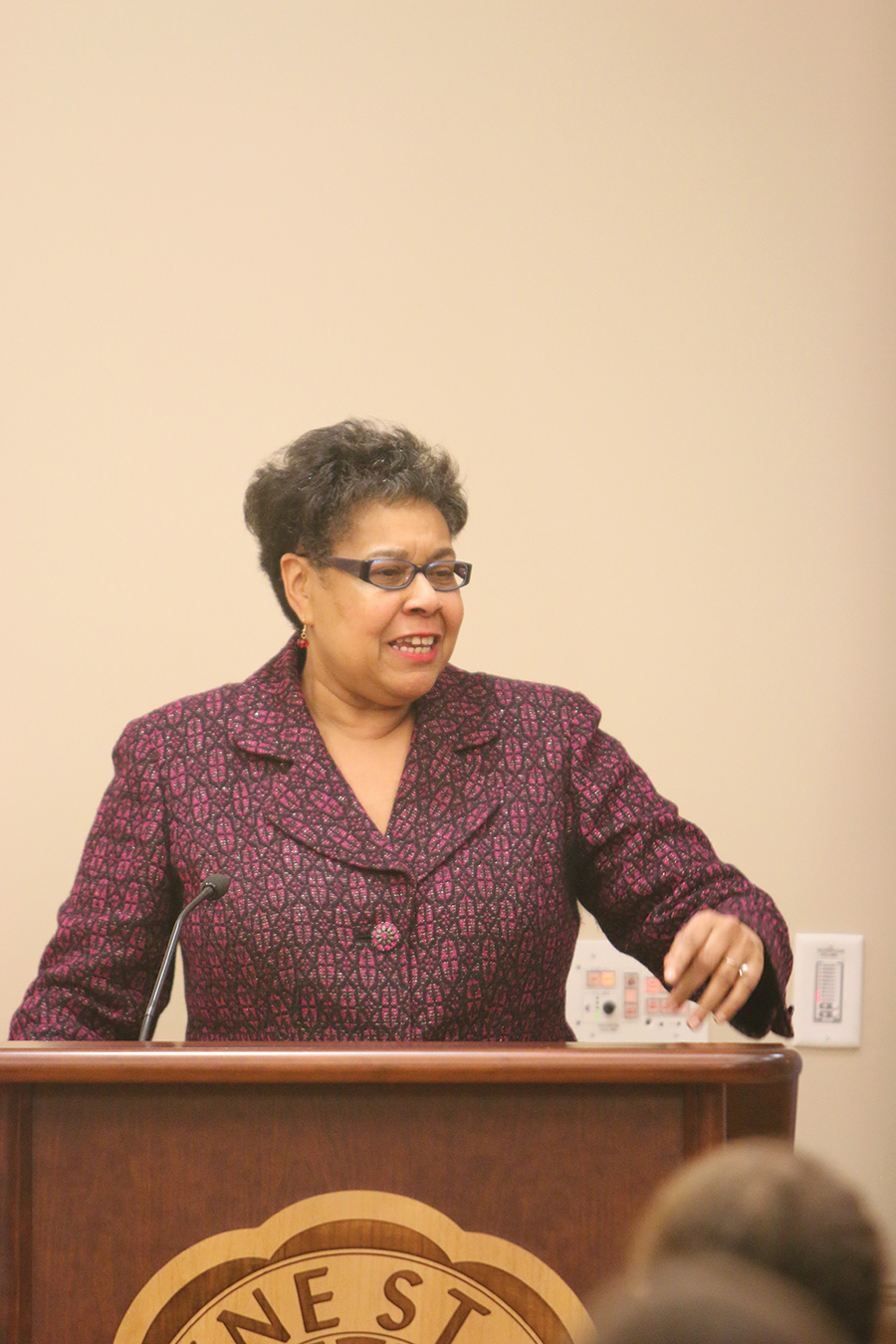
People in the City of Keene got a first-hand look at what life was like in 1965 Selma, Alabama, when Shirley Jefferson visited to talk about her experiences.

Jefferson was just 12 years old when the Selma to Montgomery March for Voting Rights began in her hometown.

“I just happened to grow up in Selma, Alabama in a time that wasn’t so beautiful,” Jefferson said to a room full of citizens and Keene State College students in Centennial Hall of the KSC Alumni Center.

Jefferson said race relations where she lived were much different than they are now.

In fact, she could recall the first time she knew her skin color made a difference in her life.

“I saw a white girl with some ice cream, and I asked my father if I could have some ice cream, and he said ‘No.’ I asked ‘Why?’ He said, ‘Because we can’t go in and get it, because we’re black. We can’t go in those places, we can’t do the same things white people can do,’” Jefferson said, “From that very moment, I think I learned the difference between black and white,” she continued.

Kyle Bailey / Photo Editor

Kyle Bailey / Photo Editor

Experiences like this pushed Jefferson toward her career in law. “At an early age I decided I wanted to fight injustice,” she said.

Jefferson soon moved to Vermont and began studying law at Vermont Law School, much to the confusion of her father.

“I knew if I could just get out of Selma, it would be okay,” Jefferson said.

She said her father couldn’t believe she wanted to go somewhere so far north and actually feared for her life. “My father had never been to Vermont,” she explained.

“He lived in Selma — he lived in segregation all his life. All he had ever encountered was, ‘White people are bad for black people,’” she said.

Eventually though, her father was bragging about her success at college. Jefferson said that she thinks her father started to learn that compassion and love exist in the world because of how well she was treated in school. Jefferson graduated from Vermont Law in 1996.

Jefferson later recalled the first time she met Dr. Martin Luther King Jr. at a church in Alabama.

“Dr. King was up talking, and he had that booming voice and everyone was getting excited . . . ‘We want our freedom, we’ll fight for our freedom, we’ll die for our freedom.’ And I just remember that, when I really started getting involved,” she recalled.

KSC student Hersch Chaim brought up some of the black youth movements that are currently active in the country.

Chaim said he thinks that some of these movements surrounding Trayvon Martin and Michael Brown aren’t getting the same publicity from mainstream media as they did in the 1960s.

When asked her opinion on some of the more modern black youth movements, Jefferson expressed concern that they aren’t as prominent as they should or could be.

“I didn’t know black youth were doing this,” she said.

Professor Dottie Morris gave Jefferson some ideas as far as current youth movements.

“For example, the idea around the organization of Black Lives Matter, I think that’s more of a youth-motivated movement,” she said.

Morris went on to talk about what has happened in Ferguson, Missouri in regards to protests and even what happened years ago in New Orleans. In both those cases, the black community bonded together to try and fix something.

The theme to Jefferson’s discussion last Monday, March 2 eventually centered around making positive change in the world and speaking out against injustice.

“If you don’t like something that’s happening or you feel that something is not right, you might want to speak out and you might want to investigate it a little more,” Jefferson said.

Skyler Frazer can be contacted at sfrazer@kscequinox.com

Posted in UncategorizedComments Off on Selma, Ala. native remembers departure from her hometown & decision to fight injustice

Anne Huot clarifies where Pumpkin Fest money comes from

KSC President Anne Huot visited student assembly Tuesday, March 3 to dispel any rumors about the where the money for the remaining Pumpkin Fest bill will come from.

“I want to start by saying not a penny of your tuition is going toward that, and it has absolutely nothing to do with what may or may not happen with next years tuition rates,” Huot said.

Jake Coughlin / Administrative Executive Editor

Jake Coughlin / Administrative Executive Editor

Since the announcement that the college would pay the remaining Pumpkin Fest bill there have been swirling rumors on social media correlating the rise of tuition and the Pumpkin Fest bill. “There’s nothing like an unsubstantiated rumor to get people exercising,” Huot said, referring to the rumors.

According to Huot, the money to pay for this bill will come directly from a reserve account the college has. This reserve is from the fines that are collected from student misconduct.

In other words, alcohol fines, parking tickets and other money collected from disciplinary action may be going towards the outstanding Pumpkin Fest bill.

The president continued, saying that hopefully this gesture will help mend the relationship between Keene State College and the Keene community. “Sometimes in life, taking the high road is the best course of action,” Huot said, “This community needs this college,” she continued.

Student Body President Bobby Graham expressed one concern with Huot’s quick decision, “I’m not sure that any students were consulted,” Graham said.

Huot acknowledged that her decision was made quickly without student consent and a more thoughtful decision consulting students would happen in another instance.

Huot made one thing clear in her discussion with Student Assembly, “I don’t expect to ever do this again,” she said.

Huot went on to express her distaste for Let it Shine’s proposed plan to split up the bill in the future. Let it Shine is the organization that hosts Keene Pumpkin Festival every year.

Skyler Frazer can be contacted at sfrazer@kscequinox.com

Posted in UncategorizedComments Off on Anne Huot clarifies where Pumpkin Fest money comes from