
Author Archives | Savanna Balkun

Students get help with repaying college debt

Keene State College seniors come to the realization of just how much they will be paying back in student loans as graduation quickly approaches.

Dan Kelly, Financial Aid Specialist said, “This event is for loan repayment and consolidation. Kids can come and sit down, if they registered they can get a printout of their loan history and then we would provide that for them her if they didn’t register they can just sign in and we can provide that for them later.”

“We’re just going to talk about defaulting on your loans, how not to default, payment methods and consolidation,” Kelly said.    

KSC senior, Kirsten Licht said, “I don’t know if I’m more stressed [after the presentation], but it’s not helping, it doesn’t help anything.”

KSC student, Jake Allen said, “It was definitely more overwhelming.  I think just because it seems very skimmed surfaced, which I guess is the point, but at the same time it left me with more questions than answers.”

Allen said that most of his loans are private and that he expected more coverage of those private loans opposed to so much information on just federal.          

The student loan presentation for students took place in the Mountain View Room in the L.P. Young Student Center on April 21 and 22.

Deborah Nichols, the associate director of Financial Aid, presented to KSC students different ways to pay their student loans after they graduate.

Nichols opened up the presentation by explaining what NSLDS is, which she said was the National Student Loan Data System.

She said she advises students to go to the NSLDS website and enter their personal pins to view their personal loan information because it is important to know your balance.

She also added that studentaid.gov is a website that has a repayment calculator for students to figure out how much they are going to owe in loans.

Nichols then went on to explain what a Loan Servicer is — who students pay their loans to.

Nichols made it a point that the customer service representatives at Loan Servicers are often difficult over the phone.

“Sometimes you can get a cranky one, so if you get a cranky customer service rep, you just say ‘Yeah? Okay,’ hang up and redial. They really have a bank of about a hundred sitting there so hopefully you won’t get a cranky one again,” Nichols said.

She made it clear in that case, students can contact her to receive help dealing with the Loan Servicers because she receives school servicers instead of student services.

Nichols went on to explain the difference between subsidized loans and unsubsidized loans.

Subsidized loans are loans that the government pays interest on while students are in school and unsubsidized loans are loans where the borrower is responsible for interest, Nichols said.

She also added that most of the students who attended the presentation had subsidized loans.

Nichols presented a slide that showed that students pay minimally 9,000 dollars in interest overall.

Nichols went through the many different payment plans that undergraduate students can pick to being repaying their loans after their grace period.

A grace period is usually six months or nine months, depending on the type of payment plan you have, that allows graduated students to find a job to begin paying back their loans Nichols said.

“The school reports that you graduated on a certain date and six months afterwards, you start repaying,” Nichols said.

Nichols explained if you fail to pay your loans it is called default. She said default results in delinquency.

“After six months, if you fail to make payments, you’re a delinquent for two-hundred-and-seventy days,” Nichols said.

Nichols added that the number one reason for default is people failing to inform their loan servicers about changed addresses.

Savanna Balkun can be contacted at sbalkun@kscequinox.com

Posted in UncategorizedComments Off on Students get help with repaying college debt

Speaker claims US spends too much money on military and warfare

The pentagon receives half a trillion dollars in taxpayers’ money each year, but it’s still not enough according to William Hartung, the Director of Arms and Security Project at the Center for International Policy.

Hartung presented Profits of War: The Military Industrial Complex and the High Price of Defense on Keene State College campus Thursday, April 9, in Morrison Hall. He stated that he believes the pentagon spends too much money on military purposes and not enough on diplomatic issues.

He presented information about the military budget and how, in 2010, the budget was the highest it’s been since World War II and how the budget has grown each year for ten years.        

The United States spends seven times as much money as Russia on its military and three and half times what China spends, according to Hartung.     

Hartung said, “We might as well just write them [the pentagon] a check” because of how much of taxpayers’ money goes to military use.

He continued to bring up the issue of this over-spending and how it undermines America’s defense.

Hartung claimed that only a small piece of the military spending goes to current conflicts

Colton McCracken / Equinox Staff

Colton McCracken / Equinox Staff

such as ISIS and, instead, covers the globe in creating military strategies for each country.

He said that only about five billion dollars is spent on ISIS and that’s only about one percent of the money the pentagon receives as a whole.

Hartung explained how the pentagon is also wasting money on bureaucracy.

There are about a million soldiers in uniform and an enormous bureaucracy behind them that aren’t contributing to supporting soldiers in the field, he said.

Hartung referred to President Eisenhower’s farewell address in 1961 that bumped up against military industrial complex.

“For Eisenhower, it wasn’t just about the money. He believed there was a corrosive effect that was pervasive throughout the society and really his concern was that the vibrancy of our democracy was at stake,” Hartung said.

He said he finds this speech important because Eisenhower was very concentrated on democracy, which Hartung believed was much more important than military weapons, and the best way to defend the country.

To fix this problem, Hartung said he believes there should be financial penalties and a rebalance of the foreign policy budget.

Hartung ended his hour-long lecture with a flood of questions, comments and mixed opinions from the audience.

Eric Zulaski, who is part of the campaign Governing Under The Influence, also spoke in the presentation by explaining what the campaign is.

“We train residents in the craft of what we call bird dogging. So when a presidential candidate is going to be a town hall meet and people assemble to ask questions we have someone in the audience who’s ready to ask a question like, ‘What are you going to do about this?’” Zulaski said.

Zulaski passed out leaflets to the audience which read, “Lawmakers say they’re trying to keep us safe. In reality it’s just politics as usual with a few wealthy corporations using their profits to influence government decisions that feed their bottom line- and waste billions of your tax dollars.”

Richard Hersom, who said he was over 65 and student at KSC, attended the event for his class, Building a Better Society.

Hersom said he was receiving extra credit from his professor for attending the event and writing a one page paper about it.

He said that in addition to the extra credit, he finds the topic of discussion interesting, which is why he really attended the event.

Zulaski said to become a bird dog for democracy and make your voice heard, visit GUI.afsc.org.

Savanna Balkun can be contacted at sbalkun@kscequinox.com
Posted in UncategorizedComments Off on Speaker claims US spends too much money on military and warfare

Representative from the Restaurant Opportunities Center makes case for equal wages

Keene State College students eyes were opened to the hardships of a restaurant worker. Kim Schmidl-Gagne, KSC’s program organizer, hosted the event, Restaurant Opportunities Center: United Tipped Workers on Tuesday, March 31, in the Mabel Brown Room.

Schmidl-Gagne said there were three classes that had already gotten the presentation earlier that day and three different classes that were required to be at the presentation. Even with the classes required in attendance, the small audience was asked by Schmidl-Gagne to move up to the front of the room. She explained, “ROC United is the only national, non-profit dedicated to improving wages and working conditions for the country’s more than ten million restaurant workers. ROC United represents thirteen thousand restaurant workers.” Schmidl-Gagne then introduced ROC United representative Ariel Jacobson. Jacobson began her presentation by showing the audience a YouTube video called, “Behind the Kitchen Door,” which was acted out and created by people from ROC United.

She explained different ways restaurant workers are treated poorly, including sexual harassment, underpayment and lack of certain benefits. ROC United was formed around the same time the attacks of 9/11 occurred. It was created to replace the union of the restaurant that was on the rooftop of Tower One.    

ROC United supported the Tower One workers as well as many other restaurant workers throughout New York City after the tragic occurrence, according to Jacobson. She explained how the center began in New York City and grew to a national center in 2008. Jacobson presented several relevant facts: restaurant businesses are the second largest private sector employers; there are approximately 11 million workers, six million of those workers are women; restaurant jobs are the lowest paying jobs and only 20 percent of those jobs are livable wages. The federal sub minimum wage for a tipped restaurant worker is two dollars and 13 cents and that number has not changed since 1991, Jacobson said.

She also explained how, in Europe, tipping is not a professional concept and was only used for slaves, making it a racial tradition. Americans came back from Europe and mimicked the tipping of slaves on waiters and waitresses here, she said.

Two in three tipped workers are women, half of them are older than 30 and one in three of them are parents, according to Jacobson. There is also a large amount of sexual harassment in the restaurant business from customers, managers and other employees, Jacobson said. She said ROC United’s overall strategy is to highlight women’s issues. Jacobson presented a list of many other organizations that back their center and what they are fighting for.

ROC United has many ways people can support them including a mobile app named the ROC National Dining Guide that allows users to view policies of different restaurants across the country to only choose restaurants that treat their workers appropriately, Jacobson said.

She also showed the audience a website called livingofftips.com that allows restaurant workers to share their stories and pictures. KSC Junior Jordann Cardinal attended the event for two of her classes, Ethics and Intercultural Communications.

Cardinal said, “I guess I learned a lot about how restaurant businesses affect the lives of servers, specifically women, and I guess I knew because I worked in a restaurant before. She talked specifically how women have been harassed because that’s the way they can make money. It opened my eyes up to how women are treated and why they’re treated that way.”

She also added, “I didn’t know all of the facts that she was telling us either and I wrote a lot of them down such as the sub minimum wage for tipped workers and that waiters are eligible for food stamps because they are feeding us and they can’t even feed their own families.”

Cardinal said overall Jacobson’s presentation was very helpful.

Savanna Balkun can be contacted at sbalkun@kscequinox.com

Posted in UncategorizedComments Off on Representative from the Restaurant Opportunities Center makes case for equal wages

KSC student misconduct fines will be used to cover police overtime

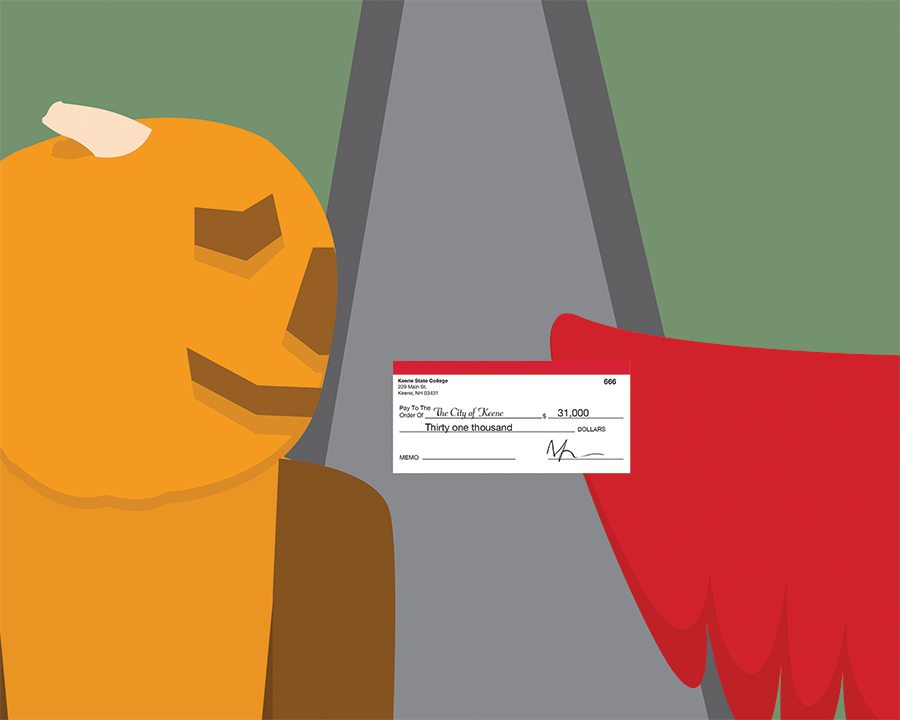
The community of Keene State College has mixed feelings about the college’s decision to pay the remainder of the Pumpkin Fest bill.

Sophomore Courtney Bethel said, “I think it makes sense as to why it’s happening, but I don’t know if it should be for every single student, because most students weren’t even on campus when it happened. Why do people who were off campus, that had to work, that went home — why do they have to pay that extra money?”

Andrea Cuzzupe, also a sophomore, said she thinks it’s a good idea but is wondering how the school is going to pay for it. She also added that if Keene didn’t hold Pumpkin Fest 2015 it would be more harmful than beneficial. Bethel and Cuzzupe both said they will be attending Pumpkin Fest 2015 if there is one.

Philip Bergeron / Graphic design Editor

Philip Bergeron / Graphic design Editor

President Anne Huot also addressed the decision in her letter sent out campus-wide Friday, March 13, which explained how she would take money out of reserve funds to pay the remainder of the bill.  She said that KSC is a leader in the community and the events surrounding 2014s Pumpkin Fest were not allowing the college to move forward and focus on more important work. Huot added that the reaction she has been getting from the KSC community on her decision is very positive. In addition, Huot thanked KSC students in her announcement to pay the remainder of the bill, as she wrote, “Thank you for your commitment to your academic experience, your dedication to Keene State College, and your role as a citizen of the great City of Keene.” She explained that, as stated in the letter sent out, the money being used will be reimbursed by the Student Conduct System fines, which will also reinforce expectations from students to follow the system. Huot added at the end of her interview that she did not want any rumors promoted and that was the purpose of her clarification message sent out on Tuesday, March 17. The clarification letter stated, “The tuition that our students pay, whether in-state or out-of-state is not being used to pay the residual of the bill. As I [Huot] described in my letter, the payment to the City of Keene will be made from reserve funds. Those funds will be repaid from fines collected from violations of the Student Code of Conduct ensuring that the burden is not distributed across the entire student body.”

Huot made it very clear that the raise in tuition next year for out-of-state students was not because of the Pumpkin Fest bill, only for educational purposes. As far as next year’s Pumpkin Fest, Huot does not know if there will be one, because it is the City of Keene’s decision. Student Body President Bobby Graham said, “I think in the end it was the right decision. It seemed like it was us [KSC students] that got the shortest end of the stick with the bill but it was the shortest end of the stick possible.”

“In the long run I think it’s going to do a lot of good things. I think it’s going to do a lot of good things for community and college relationships — that was the main thinking behind President Huot’s decision, I believe. She had make sure we’re safe in our own community too and things like that and in the end I think it was a great decision,” Graham said.

Graham said that although he thought it was a good decision Huot made to pay the bill, next time she decides to use student money in this way, students should definitely be consulted about the matter first.

Pumpkin Fest organizer Ruth Sterling was reached for a comment on KSC’s decision to pay the bill, but did not respond by press time.

Savanna Balkun can be contacted at kscequinox.com

Posted in UncategorizedComments Off on KSC student misconduct fines will be used to cover police overtime

ACT for Social Justice hosts workshop based on disability

The definition of oppression is a group that’s in power keeping another group down, according to ACT for Social Justice.

Oppression was discussed frequently at the Advocacy, Consulting, and Training for Social Justice Workshop: Focus on ability on Feb. 27.

The workshop was led by Mel Motel and Angela Berkfield, both from Brattleboro, Vermont.

Berkfield opened the workshop by explaining the goals the group has to a mix of students, faculty and staff, most of whom said they were there for learning opportunities.

He said their goals are to raise awareness/consciousness about oppression and privilege, to name a common language, to connect awareness to what is happening at Keene State College, to get people talking and to inspire action.

Jordan Crowley / Equinox Staff

Jordan Crowley / Equinox Staff

The participants also had a set of agreements that Berkfield explained to ensure a safe, secure and respectful environment for all.

Berkfield had a student explain a system for conversation.

The student said that green stands for a topic that’s comfortable to talk about, yellow stands for conflicted discussion but not unsafe for the individual and red stands for a place in the conversation where the individual is at an uncomfortable, shutting-down point.

Motel then went on to discuss “ableism” with the participants.

Ableism, she explained, is prejudice or discrimination against people with disabilities in favor of those who are able-bodied or have a set of beliefs that are viewed as “normal.” Motel and Berkfield presented a Youtube video about ableism that made connections about people with disabilities and how they are not always visible.

The participants discussed how people make assumptions that everyone has the same ability to do things.

Alyssa Marinaccio, who works for disabilities services here at KSC, said instead of teaching disabled people how to communicate with the rest of the world, why don’t we teach the rest of the world how to communicate with them?

The group then discussed how people’s perspectives need to change and also how everyday language can reflect oppression.

Berkfield gave an example of something as simple as someone bragging about how well they are doing at work as a comment that reflects ableism.

The participants said they agreed as a whole that there is a long way to go for people with disabilities and their acceptance. Berkfield and Motel then had the group split up into smaller groups to discuss how ableism shows up at KSC.

The group came up with many solutions, some of which included a universal architectural design that is disability-friendly, plans that get people talking, education (especially for faculty) and discussing a strategic plan.

Resident Director Megan Barbato said that an online forum should be created for people to brainstorm ideas and something specific to talk about and address and receive feedback. She said that more disability friendliness should be highlighted by the college so it is more welcoming.

Berkfield said that many of the things that were discussed in the workshop overlap with other workshops discussing racism.

Motel emphasized how the workshop turned out awesome and how the group’s hour-and-a-half discussion could have gone on much longer.

She explained that she learned a lot by participating in the discussion, like how she also makes ableism assumptions. For example, she said she just assumed everyone here could hear what she was going to speak about and could see the video she presented.

This workshop was part of a series. The next sessions are on March 11 and 24, according to Motel. The Campus Commission of Diversity, Equity and Inclusiveness sponsored the event in the Student Center Atrium Conference room.

Savanna Balkun can be contacted at sbalkun@kscequinox.com

Posted in UncategorizedComments Off on ACT for Social Justice hosts workshop based on disability

LEAP fights against drug prohibition

People aged 21 and under make up less than one-third of marijuana users but account for half of all possession arrests, according to the Law Enforcement Against Prohibition organization.

Superintendent of Cheshire County prison, adjunct faculty instructor in criminal justice studies for Keene State College and LEAP spokesman, Richard N. Van Wickler, spoke on Feb. 25 in the Mountain View Room of the student center about the LEAP organization.

Wickler said he joined LEAP in 2007 and is now on the Board of Directors of the organization, after being in the United States Army for 26 years.

He said the only solution for the war on drugs is to remove the motive of drug dealers.     

Philip Bergeron / Graphic Design Editor

Philip Bergeron / Graphic Design Editor

First-year Shannon Wall, of the standing-room only crowd, said that she was only attending the event because she would be awarded bonus points on a test for her Introduction to Criminal Justice Studies class.

She said that she had no idea what LEAP was prior to the event. There were three different classes that attended the event, including one of Wickler’s classes.

The LEAP organization was created in 2003 by undercover drug detectives and today consists of 80 thousand members in 90 different countries, Wickler said.

LEAP’s mission is, “to prevent the multitude of unintended harmful consequences resulting from fighting the war on drugs, and to reduce incidence of death, disease, crime and addiction by ending drug prohibition,” according to the LEAP brochure. 

Wickler said that LEAP is working to legalize drugs but does not advocate the usage of drugs.       

He explained how when a drug dealer is arrested and put in jail, a new job opening is created for other dealers.

Wickler went on to explain how in 1914 no drug was illegal and some drugs, such as heroin, could be bought in a grocery store until 1.3 percent of the population was found addicted, which caused drugs to become illegal.  

Wickler said that people who use drugs are trying to alter their consciousness, which is usually related to their own pain.

He said users don’t intend any sort of violence but the violence comes with protecting themselves, which is directly related to prohibition, according to Wickler.

Wickler went on to explain how in the late 60s President Nixon declared a “War on Drugs,” that’s mission was to reduce the production, supply and use of drugs.  

Wickler then asked the audience a question — “Is a drug-free society achievable?”

He presented facts to the audience, like the fact that over a trillion U.S. tax dollars have been spent on drug wars.

Therefore, the government would save billions by legalizing drugs and the majority of gang violence, which is drug related, would decline.

He also said that tobacco usage and poor diet and exercise has killed more people than drugs have and that there have never been any deaths directly resulting from marijuana use.

Wickler said he believes drug usage is a health issue rather than a crime, which is why he believes prohibition should not exist.

Wickler gave an example of how Switzerland got rid of prohibition, choosing instead to treat the issue as a health problem, and has not seen one drug-related death since 1996. 

If the government would end prohibition and put a regulation on drugs, more people would be safe. Additionally, the government could mandate the production and distribution of cleaner drugs, Wickler continued.

There are 18.9 million marijuana users and 8.9 million users of other illicit drugs, Wickler said.

He informed the audience that at midnight that night, Feb. 26, Washington D.C. would be legalizing marijuana, making it the fourth state in America.

Wickler said that he is interested in taking care of bad guys, not people altering consciousness and to restore the respect for law enforcement.   

First-year Jessyca Derby was also there for her Introduction to Criminal Justice Studies class. She said that Wickler made really great points and brought support and that she enjoyed the presentation a lot.     

Derby said she wasn’t sure about signing up to support the event because of the time consumption, but eventually did end up signing up in support for LEAP.

Savanna Balkun can be contacted at sbalkun@kscequinox.com

Posted in UncategorizedComments Off on LEAP fights against drug prohibition

KSC asked to help pay remainder of 2014 Pumpkin Festival bill

Keene Pumpkin Festival is in jeopardy of no longer existing without the help of the student body.

The annual festival, a tradition of 24 years held in Downtown Keene, is being jeopardized for the 2015 year.

A bill was issued from the 2014 festival that became out of hand in the neighborhoods surrounding the college .

The $90,000 bill is made up of the overtime fees from the police forces and
safety services from the city, neighboring towns and even state troopers. Let it Shine, the volunteer organization that puts together the Pumpkin Festival, covered and took responsibility for $59,000 of the expenses.

This still leaves just under $32,000 to be paid.

Kyle Bailey / Photo Editor

Kyle Bailey / Photo Editor

Ruth Sterling, the festival’s organizer, said, “The volunteers and donations were given in good faith and those people are upset that we would come back to them and ask
them for more money to solve what they see as someone else’s responsibility.”

Sterling said she’s been waiting for a leader, mainly someone from the Keene State College student body or city leadership, to step up to take responsibility. She said she wants a leader to begin a fundraiser or simply donate.

“We’re all responsible when things go wrong in this community and I want to help fix it. And if we came together like that we could raise thirty-two-thousand dollars and we could show that we’re all in this together,” Sterling said. The rest of the Let it Shine board is also waiting for a leader to step up.

Sterling said, “It’s not fair,” in regard to letting the organization pay the leftover expenses. Sterling said the organization should only be responsible for what goes on in the footprint of the festival and not in the surrounding neighborhoods.

Sterling explained if the $32,000 bill is not paid, there will be no Pumpkin Fest 2015.  The cancelling of that will devastate many in the Keene community.

KSC sophomore Alison Gilleran said, “The students should be responsible I guess, but not all the students were in it. So to fine everyone would be annoying.”  Gilleran continued, “Next year we should not be so crazy and try and help that.” Another sophomore at KSC, Seanna Flynn, said the people who were involved with the riots should definitely be the ones to help pay for the bill. “It’s definitely an opportunity to learn, so we should all learn from it and do whatever it takes to help out in the town next year and be a good part of it — to give ourselves a good name back,” Flynn said.

The Pumpkin Festival is a traditional virtue to the City of Keene, as well as the students at KSC.

Sterling said there are ways to keep the next Pumpkin Festival safe and also ways to raise enough money, but only if the community steps up as a whole.

“We need to prove that we want this festival to go on,” Sterling said.

There are two Facebook pages dedicated to “saving” Pumpkin Festival. Sterling said she would be happy to have a donate button on the pages if students wanted to donate. Vice President for Student Affairs, Kemal Atkins, was contacted for a comment on the issue, but did not respond for press time.

Savanna Balkun can be contacted at sbalkun@keene-equinox.com

Posted in UncategorizedComments Off on KSC asked to help pay remainder of 2014 Pumpkin Festival bill