The College of Arts and Sciences natural sciences commencement ceremony was rescheduled to 7:30 p.m. due to heat, combining it with the CAS graduate commencement ceremony.
The ceremonies were scheduled to take place in Autzen Stadium but have been rescheduled to Matthew Knight Arena.
University of Oregon spokesperson Angela Seydel said the covering for the turf caused extreme heat on the field, with temperatures reaching 155 degrees by midafternoon.
“That (temperature) is not safe for anyone, so we had to find an alternative,” Seydel said.
Temperatures this afternoon were forecast to hit 97 degrees. The National Oceanic and Atmospheric Administration Portland office issued a heat advisory for Eugene and the surrounding region at 7:40 a.m. today. The heat advisory expires at midnight tonight. Temperatures are expected to cool through the rest of the week.
Seydel was not aware of any severe heat-related illness that took place as commencement preparation began.
“We had extra paramedics, and there have been some people who reported feeling overheated, but they have all been cared for by paramedics on site,” Seydel said.
Subbu Nagarajan, a graduating UO student, was supposed to have his ceremony at 2:30 p.m., but Nagarajan said at that point ceremonies were already being postponed.
Nagarajan said he was glad the university was paying attention to the heat index and “looking out for us,” but was also hesitant about going to a rescheduled graduation any time soon.
“If it’s postponed till later today, I’m not going. I’m too tired for that sh*t,” Nagarajan said.
Mostly, Nagarajan was regretting paying for his graduation garb.
“I feel like it’s just annoying because I paid $135 for the stole, the cap. That’s pretty much $135 for nothing,” Nagarajan said.
“We appreciate everyone’s patience, and we will get everyone safely graduated,” Seydel said.
Eugene Weekly’s former bookkeeper, who was arrested for embezzling more than $100,000 from the local paper, was sentenced to three years in prison on two counts of first-degree theft and three counts of first-degree aggravated theft by a judge in Lane County Circuit Court.
Elisha Young, 38, embezzled $138,000 from July 2021 to December 2023 by writing checks to herself, changing her pay without authorization and making over-the-counter withdrawals. All of EW’s employees were laid off in December 2023 because of the financial losses caused by Young’s actions.
After the judge read the counts of theft, Camilla Mortensen, the current editor of EW, stood before the courtroom to offer victim testimony.
“Embezzlement, by its nature, is an unthinkable crime to its victims. After all, they trust someone they believed would never betray them. It wasn’t unthinkable to you,” Mortensen said. “You knew that your actions were basically destroying the newspaper that employed you.”
At one point, Young reportedly secretly gave herself a $30,000 raise amid pay cuts for most other publication employees. Young further more cancelled the company’s insurance, stopped paying bills, did not pay the paper’s printer and stopped paying on loans.
“You left the newspaper bleeding with debt. The newspaper is still rebuilding the trust you sought to destroy, still dealing with the aftermath of what you did.”
Mortensen then shared the story of an employee who had been laid off shortly before Christmas 2023.
“One day our copy editor had a job. The next he was accepting a food box at his church,” Mortensen said.
Young fled to Ohio and was extradited in 2025 by Gov. Tina Kotek after the extradition was initially denied.
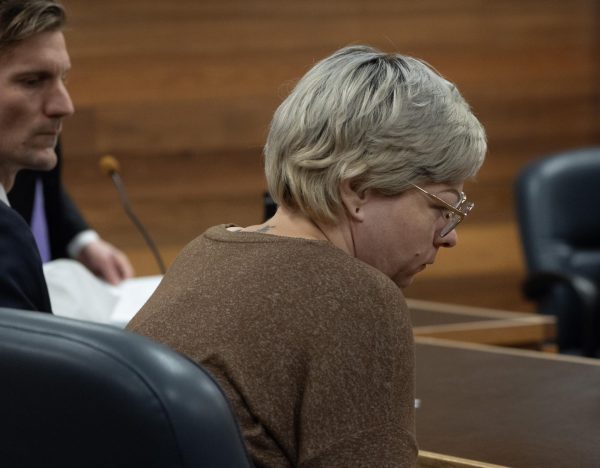
Former Eugene Weekly bookkeeper Elisha Joe Young sits at the defense table during sentencing after being found guilty of embezzling $138,000 from the publication on May 27, 2026. (Chris Pietsch/The Register-Guard) (Chris Pietsch/The Register-Guard)
Young’s court-appointed lawyer, Brian Walker, said Young was sorry for her actions and detailed what he claimed was the root of her addiction. Walker said Young did not receive psychological support after a surgery, which he said caused a drug addiction to “spiral out of control.”
Walker had initially asked the judge to delay sentencing because of custody concerns involving Young’s child, which the judge denied.
The courtroom was packed with Mortensen’s journalism students, Eugene Weekly staff and community members, who celebrated with Mortensen in the hallway after the sentencing.
Mortensen and the Weekly are next expected to pursue a civil case against Young in an effort to recoup some of the stolen funds.
At 9 a.m. in the Rosetta Place Park, community leaders and Eugene residents mourned lives lost to recent traffic collisions and discussed how to build and fund safer streets. Earlier this month, David Winston Morris had been killed in a crash that shut down River Road just one block from the park.
“Today, I wanted to bring our community together to focus our collective attention on proclamations but also on our partnerships and the work that we could do to make the important progress that we need in our community,” Eugene Mayor Kaarin Knudson said.
Daniel Appiah Gyekye, a University of Oregon student and co-organizer of the gathering, described the broad effect of investing in safe and accessible transportation.
“Our streets are more than pathways, they are spaces where families connect and where everyday life happens,” Appiah Gyekye said. “The way we design the streets and use these spaces reflect how much we value one another.”
Appiah Gyekye said that residents cannot “fully participate in community life” without safe streets.
Logan Telles, a transportation planner with the city, discussed the importance of the city’s goal toward fewer injuries and deaths on the road.
“We are also community members that have compassion for our neighbors and we also feel concerned for the safety of ourselves and our families,” Telles said. “The City of Eugene remains committed to the goal of zero traffic deaths on our roadway network.”
Telles said that city staff “understands the sense of grief” rising from recent crashes and fatalities and pointed to improvement projects for bicycling on River Road, sidewalk and lighting improvements on Highway 99 and intersection evaluations.
Eugene Police Department Chief Chris Skinner said EPD would increase enforcement of distracted drivers and drivers under the influence because of a recent grant funding overtime work.
Skinner also encouraged residents to submit reports to the police department when they feel unsafe on a roadway.
“We do really want to hear from you. So much of what we do is predicated on hearing from our community members on where they are having the issues. We can’t just rely on data alone,” Skinner said.
Telles said that money for improvements of River Road came from bond funding, but the city has not had the same funding opportunities to improve Hillyard Road and Patterson Road, where safety concerns came to a head earlier this year when Erick Njue, a UO Ph.D. student, was killed while bicycling.
This winter, Knudson said the city was expecting a grant from the Oregon Department of Transportation through the Safe Routes to School program, but ODOT recently cut Safe Routes to School by $17 million and will not approve new construction projects for the time being, citing a budget gap.
“The grant funding program that we were looking at for that is no longer available and so we’re trying to reorganize and think about how we would realistically fund something,” Telles said.
Sarah Mazze, the coordinator for Eugene 4J’s Safe Routes to School program, also spoke at the event, opening with a story of a family friend who had been killed crossing River Road several years ago.
Now, Mazze is an advocate for safe transportation planning and design and encourages schoolchildren to use active transportation along safe routes.
Mazze said that accessible active transportation can “be the difference between making it to school or not” for vulnerable students.
“We have plenty of data for particular streets, particular types of streets where we can expect more serious crashes, and we know what contributes to this and what helps and we don’t have to wait for the crashes to happen in order to act,” Mazze said. “Let’s do this for each other. Let’s do this for the kids.”
During the May 20 University of Oregon Senate meeting, President John Karl Scholz discussed the recent announcement of $65 million in additional budget cuts to the university, and senators approved the formation of a committee to formally give input when significant academic changes are proposed.
In a campuswide email sent last May 14, Scholz said a main reason for the budget cuts was lower than projected levels of non-resident student enrollment.
At the senate meeting, Scholz explained that enrollment had dropped by 500 students, lower than the university’s predicted numbers. Scholz said these 500 students would have contributed about $20 million dollars to the university each year for four years.
Going forward, Scholz said UO would be “lowering assumptions about out-of-state enrollment.”
Scholz said that there would be more details on “the changes that need to be made” at the December 2026 UO Board of Trustees meeting.
One aspect of change Scholz touched on was narrowing the university’s focus, which he said in the initial announcement would see the school shift to investing further in research and making UO known for specific areas of research.
“We cannot do everything but by focusing thoughtfully we can focus on doing some things exceptionally well,” Scholz said, and went on to say that UO would “double down” on what makes the university “special” and “distinguished.”
Budget cuts have to be made quickly so costs do not continue to build on each other every year, according to Scholz.
“The longer we wait the larger the problem becomes and the deeper those cuts need to be,” Scholz said.
Several senators and faculty members raised questions about the specifics of the university budgets and expressed concern about slashes to specific departments.
“You are projecting cutting our mission,” Pedro García-Caro, a senator and professor of romance languages, said.
The Academic Modification Advisory Committee, created by the faculty senate, aims to act as a body that will provide input if and when significant changes within academic departments are proposed.
The committee will comprise of six faculty across departments, one student, one classified staff member and one member of administration.
Edward Davis, vice president of the senate and earth sciences professor, described the creation of the AMAC as a “process of creating trust.”
“The party that has the power has to become vulnerable and I think President Scholz and Long have been vulnerable though this process. I appreciate the collaborative work we’ve engaged in,” Davis said.
The AMAC will consider a number of factors when giving feedback on significant changes, including “academic quality” of a program, the program’s interdisciplinary value, the program’s effect on diversity and operational costs.
“We want to make sure we are thinking about that inherent interconnectedness when we are making changes,” Davis said. “Our disciplines are so different it is really hard to measure music against chemistry or the business school against architecture.”
Instructure Canvas is experiencing an outage that started this afternoon at the University of Oregon. This outage follows numerous reports of Canvas outages from schools and universities across the country.
Currently, Canvas’ home page displays the following message: “Canvas is currently undergoing scheduled maintenance. Check back soon.”
The university sent an email to students linking to a status page stating “The vendor (Instructure) is engaged in restoring services.”
Another UO service page for Canvas status says the displayed home page message is “unexpected.”
The University of Oregon will start using the existing UO Alert system to notify all students and employees if there is ICE presence on campus on May 5.
According to a university-wide email from Associate Vice President for Student Life and Dean of Students Jimmy Howard, UO will implement an emergency policy which allows it to use the UO Alert system for an ICE alert system.
The presence of immigration officials will be confirmed by a team of representatives from the Office of the General Counsel, University of Oregon Police Department and the Office of Safety and Risk Services who will meet on a call to verify reports “within minutes,” according to university spokesperson Angela Seydel.
Oregon House Bill 4079, the Safeguarding Students and Families Act, requires all K-12 schools and public higher education institutions in the state to develop an ICE alert system. The bill was signed by Governor Tina Kotek on March 31 and takes effect Sept. 30, though schools can opt to develop alerts before the deadline.
The student-led Anti-ICE Coalition formed in March and is made up of 11 student organizations that have been pushing administration to adopt an alert system. On April 12, the coalition delivered over 2,000 signatures to Johnson Hall to demand action on an alert system.
“(The Sept. deadline) leaves a pretty big gap in protection for students. People are going to be here for the next couple weeks and even over the summer so there is obviously a big gap in security,” Cooper Burke, a member of the Anti-ICE Coalition, said.
An anti-ICE walk out and rally is scheduled for tomorrow at Johnson Hall as part of larger May Day action. May Day is a holiday that honors labor movements and advocates for workers’ rights.
“Admin is very disconnected from student life and student safety as a whole. There’s not enough work being done to make students, students that have been minoritized, feel truly safe on campus,” Burke said.
Members of the Anti-ICE Coalition have also said they want students to be able to give input on the alert system, and they want student workers to be trained for interactions with ICE agents.
“The university likes to do the bare minimum and that’s what we’re working towards them not doing,” Burke said.
The university said in the announcement there will be a chance for public comment on the alerts through UO’s Policy Advisory Council during the policy review period ahead of the formal adoption before the September deadline.
The University of Oregon’s Museum of Natural and Cultural History has opened a new exhibit focused on Indigenous cultures.
The exhibit, “America at 250 — Before, Between, Beyond,” hosts mainly Indigenous items from the past two and a half centuries, covering the land that is now called America.
“There is a national movement to commemorate the 250th anniversary of the signing of the Declaration of Independence, so we wanted to also do that,” Lexie Briggs, the museum’s marketing and communications specialist, said. “But then also culturally, we’re talking about cultures that sort of transcend boundaries and transcend time. So we talk about Indigenous cultures that have been in this area since time immemorial.”
A large chunk of the exhibit displays Indigenous Alaskan people’s connection with arctic wildlife. A walrus skull is polished to perfection as ivory figurines climb upon each crevice, and ink on seal skin tells the stories of hunting in the north.
Other items include an intricately beaded breastplate for a horse, moccasins with eagles and a rain coat made from the intestines of a large animal.
These wide-ranging items are just a small part of the museum’s ethnographic collections.
An ethnographic collection is a curated assembly of cultural artifacts, tools and other materials that document the daily lives, technologies or beliefs of specific societies.
“Our director and our collection staff worked together to look into what we never highlighted before or what we wanted to make sure that we brought out. So we kind of tried to do some representative things and then also things that are just so cool and astonishing and beautiful that we really wanted people to get to see them,” Briggs said.
According to Liz White, the museum’s exhibitions designer, the exhibit has been in progress for a year, as museum directors consulted Indigenous communities and created accurate and accessible plaques that describe each exhibit.
“It does take a while, especially when you are doing anything that revolves around consultation and collaboration with outside communities; that can definitely add to the timeline, just because you want to make sure you are appropriately talking to people and talking to the right people,” White said.
The museum plaques are in three languages: English, Spanish and Chinuk Wawa — a trade language of the Pacific Northwest.
The trilingual exhibit design was a suggestion by David Lewis, one of the Indigenous members on the museum’s advisory council. According to Briggs, Felix Furby, a member of the Chinook Nation and the Confederated Tribes of Grand Ronde, worked on the translations.
Briggs said creating the labels in the Indigenous trade language was a part of a broader effort to revitalize the Chinuk Wawa language.
“We wanted it to be highlighted that the Indigenous cultures of this area are incredibly important and vital to what we think of as America, and what better way to do that than just highlighting a language,” Briggs said.
The exhibit is advertised as a reflection of what America is, has been and also “what America might yet become.” Briggs wants visitors to think about the stories behind the objects on display and the objects they value in their own lives and how they relate to place and identity.
“I hope that people think about what the future holds, and what America means to them, and what it can mean and how they can bring that out into the world,” Briggs said.
Data published in the city of Eugene’s latest fatal crash report shows a 55% decrease in traffic fatalities in 2025 when compared to 2024, according to information from the Oregon Department of Transportation.
City officials point to the decrease as a sign that Eugene roadway safety is improving.
“It is encouraging to see the decrease, though we continue to remain committed to zero as the only acceptable goal and we are going to keep pushing towards that,” Logan Telles, a transportation planner for the city, said at an April 15 city council work session.
Telles said it is “hard to call out one specific thing” that contributed to the decrease in deaths, but he concluded increases in spending on city infrastructure and changes in substance use during and after the pandemic might have played a role.
In 2025, 10 people died on the city’s roadways. In 2024, there were 22 deaths. In 2023 and 2022, that number was 14.
Similarly to data from 2022-2024, most fatal crashes occurred on higher volume roadways called “arterial roadways.” Arterial roadways include Franklin Boulevard, Hillyard Street and Sixth Avenue.
In 2022-2024, 88% of fatal crashes happened on arterial roadways. In 2025, all 10 crashes were on arterial streets.
Arterial roadways make up 20% of Eugene’s roadways.
Rob Zako, executive director of Better Eugene Springfield Transportation, said he would like to see the city continue to look at potentially dangerous roadways in the city so that preventative work can be done to stop fatalities before they happen.
“If someone runs a red light and you are seconds off from dying but you didn’t die, we don’t have a record of that,” Zako said. “We want data on things that might happen.”
During the city work session, Telles pointed out that the city already works on some preventive measures, such as handing out reflective gear to cyclists during darker times of the year and posting signage around the city to help cyclists navigate to more bike-friendly paths.
“We do a lot to promote what the safest and most comfortable routes are and we do a lot of wayfinding signage in the community to help folks find those safer routes,” Telles said
As the work session concluded, several councilors still had questions for the city’s traffic engineers, planners and police force, so the city council unanimously agreed to reconvene to discuss transportation safety at another work session.
Regina Lawrence, the current interim dean of the University of Oregon’s School of Journalism and Communication, was announced as the next Edwin L. Artzt Dean on Friday, April 3.
The SOJC dean search began in July after former Dean Juan-Carlos Molleda resigned following public scrutiny over his travel expenses during his time as dean.
In the announcement, UO Provost Christopher P. Long, wrote Lawrence “brings the depth and vision needed to navigate this important moment of transformative change.”
Lawrence previously was the associate dean of SOJC Portland and directed the Agora Journalism Project, a center that researches the impact of local news and highlights gaps in accessing news. She became the interim dean in July.
In August in an interview with The Daily Emerald, Lawrence addressed concerns such as the budget deficit, drawing on her experience as associate dean at the Portland campus as an asset as she enters her position of dean.
“Regina is a nationally recognized expert on political communication, gender and politics, local news ecosystems, community-centered journalism, and the role of media in democracy,” the announcement read.
Lawrence has a Ph.D. in political science from the University of Washington and has written several books covering journalism and politics.
Lawrence was chosen for the job by the SOJC’s Dean Search Committee who met potential candidates, and allowed students in the SOJC to attend the March interviews with the three finalists.
By the middle of March, the search had been narrowed down to three finalists including Lawrence, Emily Metzgar, the director of the School of Media and Journalism at Kent State University and Temple Northup, the director of the School of Journalism and Media Studies at San Diego State University.
Rob Zako, executive director of Better Eugene-Springfield Transportation, walks down the road where bicyclist and University of Oregon Ph.D. student Erick Njue was hit and killed less than a month ago while crossing Patterson Street to the Spencer View Apartments.
“How many traffic deaths are acceptable?” Zako asks. “What if it was your family or your best friend, how many would be acceptable?”
In 2015, the city of Eugene asked the same question, leading to its Vision Zero resolution.
Vision Zero, a goal shared by communities across the country, was adopted by the city with the intent to end traffic collisions that result in death while also encouraging sustainable transportation to meet climate goals.
But 10 years in, fatal crashes have steadily increased. From 2022-2024, 132% more people died on Eugene roads compared to the previous three years.
For the UO community and beyond, the recent deaths of Njue and fellow student Elizabeth Cardenas Figueroa, in August 2025, turned these statistics into human grief and calls to action.
“Today it happened at Patterson Street, tomorrow it will happen at another street — we don’t know where,” Daniel Appiah Gyekye, an international graduate student and friend of Njue, said.
A “Ghost Bike” commemorating the loss of cyclist Elizabeth Cardenas Figueroa sits on the corner of 8th Avenue and Hilyard Street in Eugene, Ore., on Feb. 16, 2026 (Tyler Graham/Emerald) (Tyler Graham)
Appiah Gyekye and fellow community members stressed the “urgency” of safer street design during a packed Feb. 12 community forum on transportation co-supported by BEST. During the forum, held at Roosevelt Middle School, several residents expressed that their lives as a bicyclist or pedestrian feel constantly at risk.
“We need to do more because I don’t know how many people are going to be injured or die before we change things,” Ericka Thessen said.
Thessen is a physical therapist at PeaceHealth RiverBend Hospital and her job partly consists of helping patients recover after collisions.
There is no crosswalk at the entrance to Spencer View Apartments, where Njue lived, and residents of the apartments coming from Alder Street must cross what Zako described as a two lane, one-way “racetrack” without any signage and a potentially blocked sightline because of parked cars.
“If I’m biking, I cross where Erick was crossing because there is not a safe option,” UO graduate student Adrienne Pinsoneault said. Pinsoneault lives in the same apartment complex as Njue, and takes the same route to campus.
Moving forward
One of the city’s key recommendations in its Vision Zero plan is to slow traffic. The most recent Eugene fatal crash report found that speeding was a factor in more than one-third of fatal collisions. According to a search warrant filed in Lane County Circuit Court, the driver who hit Njue was traveling on Patterson Street at an estimated 50 mph, while the street is posted at 25 mph.
A graph depicts fatal road crashes by road class, showing 88% of all crashes occur on arterial classified streets. (Data: City of Eugene; Design: Adaleah Carman/Emerald)
Despite Vision Zero’s speed reduction recommendation, in an interview with The Daily Emerald about two weeks after the crash, the city’s Public Works Department questioned whether speed reduction on Patterson Street is “appropriate” on the high-capacity arterial street.
Streets are generally designated as “arterial” if they have higher traffic volume and higher speed limits. These arterial roads, which include Patterson Street, were responsible for 88% of fatal crashes from 2022-2024.
Speaking about speeding on Patterson Street, Marion Barnes, public affairs manager for the city’s Public Works Department, cited a small study conducted over three days in late January. The study found that 449 of 14,816 vehicles — about 3% — traveling through the intersection of Patterson Street and 22nd Avenue were going more than 35 mph, 10 mph over the posted limit.
Many residents expressed fear of crossing the street, and two employees of the Co-op Family Center at Spencer View Apartments said their cars have been damaged while parking along Patterson Street.
“My mirror has been broken a couple times because both it is narrow but also not visible and it’s straight so you can just go fast,” Heida Sigurdardottir interim co-director of the center, said.
Flowers to remember the loss sit around the bike. A “Ghost Bike” commemorating the recent loss of cyclist Erick Njue sits on the corner of 22nd Avenue and Patterson Street in Eugene, Ore., on Feb. 17, 2026 (Tyler Graham/Emerald) (Tyler Graham)
Attendees of the transportation forum also made slowing down traffic a major focus. They suggested signs, paint and posts as “quick and easy” ways the city could reduce traffic deaths and injuries on Patterson Street, but longer-term solutions like street re-design were also discussed.
UO Professor of City and Regional Planning Marc Schlossberg was a key presenter at the transportation forum and focused on these street re-design solutions.
A graphic shows fatal crashes in Eugene from 2014-2024 show an varying yet increasing number of fatal crashes. (Data: City of Eugene; Design: Adaleah Carman/Emerald)
Schlossberg became a city planner after he was hit by a car while biking his children to preschool over two decades ago. Since then, he has been advocating for safer and more sustainable transportation and writing a book series titled “Rethinking Streets.”
His goal is to increase sustainable transportation safety, with a strong focus on bikes. Schlossberg uses examples of biking infrastructure in cities across the United States — from two-way protected bike lanes in Tampa, Fla. to raised bike lanes in Jackson, Wyo. — as a “recipe book” for Eugene’s layout.
“There’s a lot of experiments happening in the U.S. that we can learn from. A lot of communities have taken risks to try something new,” Schlossberg said. “Regular examples, normal cities, the world didn’t end and hopefully other communities can look like that.”
The examples in Schlossberg’s book, which he said could be applied to Patterson Street and Eugene at large, focus on road design principles that increase visual cues for drivers to slow down, such as narrowing the street and adding protected bike lanes that drivers cannot ignore as easily as posted speed limit signs.
“If the street design forces us to go the desired speed for the context, then we will go the desired speed for the context because we feel like that’s appropriate,” Schlossberg said.
Adding protected bike lanes on East 13th Avenue was a project UO students took on in the early 2010s. From 2007 until the project’s completion, there were six reported bike and pedestrian crashes each year on the street. David Minor, a 27-year-old man, and Vaclav Hajek, a 10-year-old boy, were both killed on the road regularly used by student commuters.
A sign reading “share the road” hangs off the ghost bike. A “Ghost Bike” commemorating the loss of cyclist David Minor sits on the corner of 13th Avenue and Willamette Street in Eugene, Ore., on Feb. 16, 2026 (Tyler Graham/Emerald)
The same group who completed the project on East 13th Avenue, LiveMove, is also currently working to make Patterson Street safer, and developing proactive measures to determine which Eugene streets are unsafe.
Cat Colson and Hannah Norris, members of LiveMove, are starting a “risk and preventative mapping project” to allow pedestrians and cyclists to report roads, bike lanes and walkways where they feel unsafe, uncomfortable or have experienced minor traffic collisions they don’t want to report to the police. The group hopes the study will highlight roads that are high-risk but are not well-tracked.
“It’s a bit of pedestrian equity because cyclists will get representation because the thing is if you’re in an auto collision, because of insurance and all of that, you report it because there is so much money tied up in the car,” Norris said. “So it (the project) is bringing awareness to the reality of what cyclists are facing in terms of unsafe conditions.”
Currently, in its Vision Zero reports, the city uses post-crash data to determine whether a road needs to be fixed. The data only designates intersections as “high crash” after three fatalities, six minor injuries or a combined weighted total have been reported.
LiveMove hopes the city can use this data to form more proactive plans on which streets to improve.
“We shouldn’t be injured or die to be taken seriously,” Colson said.
Schlossberg said the city often gets “stuck in the trap” that things can only change if there is crash data to support the changes.
“There is so much of the community where there is no data because no one’s biking. Does that mean it’s safe? No, it means people are too afraid to go there,” Schlossberg said. “Lack of crash data does not mean a street is safe.”
In response, the city’s Public Works Department said that while it appreciates hearing from the community, data will remain the primary driver in re-design.
“We have to look at data to drive our decisions,” Barnes said. “We will always be data-driven because that is how government works.”
Eugene Mayor Kaarin Knudson also presented at the transportation forum.
“Crash data is going to influence some decisions about where investments go because if you know that something is unsafe and you could stop it by redesigning something in that area, of course you would want to do that,” Knudson said.
Knudson said the city is applying for an emergency grant through Eugene Springfield Safe Routes to School to improve safety on Patterson Street between East 19th Avenue and East 24th Avenue, possibly by reducing traffic flow to one lane, as Schlossberg suggested.
“My goal is that we will see significant change by the summer,” Knudson said. “The goal,” Knudson said, “is significant change by the summer.”
Several community members at the forum, including Appiah Gyekye, said they would not wait for grants to prioritize “human-centered road construction.”
“If we have students coming on board we believe we can make a change as soon as possible,” Appiah Gyekye said. “We need a collective action to make sure this happens as soon as possible and voice out what we want for the betterment of the community.”
Community members at the forum also considered more education surrounding traffic laws.
Students voiced their concerns about freshman traveling to Eugene from across the world to UO with limited background knowledge on the transportation network and laws.
“If UO Transportation Services could re-educate students coming to Eugene, some of these drivers in town would know to take care on certain roads,” Appiah Gyekye said.
Students also mentioned confusion for both cyclists and drivers when bike lanes change or abruptly end.
“I want to know what the rules are everywhere but it changes from street to street,” UO graduate student Michelle Fieser said.
The planners at the meeting said ordinary residents should not have to be involved with city planning in order to feel safe on their streets.
“It is enough to simply demand and then support the change that happens,” Schlossberg said.
Students in LiveMove rely on community input to know what to focus on and talk to the city about, but said that ordinary residents should only have to be involved with city planning as much as they want to be.
“People shouldn’t have to worry about whether they’re going to make it home from campus or not,” Colson said. “People shouldn’t have to care that much to just be safe.”