
Author Archives | Ryan McKinley

Why we love ‘50 Shades’

“50 Shades of Grey” …Have you read the book? Have you seen the movie? Have you analyzed and juxtaposed the two to see if character Christian Grey is more abusive or Anastasia Steele more of a sexual agent in the movie than they are in the book?

I hope you have, because I haven’t. I was told in 2012 that “50 Shades of Grey” was a published version of a fan-fiction piece derived ultimately from the “Twilight” series. That fact didn’t dissuade me from picking up the book; I actually enjoyed the “Twilight” series.

What ultimately dissuaded me from reading the book was the promise of an abusive relationship and a complete fabrication of BDSM, which is short for Bondage, Dominance, Sadism and Masochism (I know you were wondering). BDSM is prefaced with consent, and the people disparaging the book apparently didn’t believe that Steele was always enthusiastically providing that.

So, believing that the book was regressive and abusive, without reading it of course, I was surprised to see so many people fall in love with the book. The book has sold over 100 million copies since its release and will likely sell even more as the movie adaptations bring in new readers.

“50 Shades of Grey” broke the President’s Day Weekend box office records with a $94.4 million four-day debut. This debut could only be possible with the fandom of women. Many older women, middle-aged women and fellow SLU students all seemed stoked to see the film.

Feminist critiques have again proliferated with the film’s release. One major point they all seem to raise is that Christian Grey’s wealth and influence overshadow the fact that he is abusive and a stalker, and the movie in turn glorifies domestic violence. Their critiques are important; they provide a basis from which people can create their own criticisms of the film and book.

Other critiques, paradoxically coming from men, have derided what they call another example of “mommy porn” for “bored housewives,” to quote Arthur Chu of “The Daily Beast.”

Like Arthur Chu, I’m not about that. I’m not going to critique women – and everyone else – for wanting to read a book or watch a movie that addresses the taboo subject of non-traditional sex. (I read and watched “Twilight”; who am I to judge?) Women should not be critiqued for their individual choices, and it is just as misogynistic to lambast them for making that choice as it is to act like Christian Grey.

I am interested, though, in why these books and films are so wildly popular. Maya Dusenbery of Feministing.com argues: “I am in no way surprised that many women, who have been socialized in a culture in which male sexuality is linked to domination and in which women are taught their sexual power comes from being wanted, have fantasies of submission.” Whether we like to believe it or not, our culture – media, politics and social norms – influences are decisions.

In this culture, men and women are taught to interact with each other in different ways; from the subway to the bedroom, our culture influences men and women’s motions, posture and speech. In the next day or two, think about your actions throughout the day through the lens of dominance or submissiveness; you will be surprised how programmed your normal interactions are, based on your gender identity. “50 Shades” did not create this cultural attitude, though it may help to perpetuate it.

Dakota Johnson, the actress who plays Anastasia Steele, argues: “I know that a lot of people, before seeing the movie, were thinking that it’s promoting abuse and violence, but I think it’s actually doing the opposite … I think she’s a strong woman who is fearlessly exploring herself emotionally and sexually.” If that is truly the case, then this movie can provide a representation of confidence, sexual agency and enthusiastic consent that may be lacking in the book. The movie can also cause people to critically analyze their own lives and how they perhaps unknowingly recreate or deviate from the actions of Grey and Steele.

What I ultimately hope this book and movie can do is promote discussions. While I won’t critique people who watch the film or read the book, I don’t believe that “50 Shades,” or anything else, is mindless fantasy.

This book and film are both derivatives of popular cultural values and contribute to it and therefore must be discussed and critiqued.


Posted in UncategorizedComments Off on Why we love ‘50 Shades’

We’re ‘anti-police?’

Last week, SLU student and UNews contributor Nathan Rubbelke wrote an article on collegefix.com about the monument to be erected that commemorates the “Occupy SLU” protests and the “Clock Tower Accords.” In the headline of that piece he writes, “Saint Louis University to Erect Monument Honoring Anti-Police Protest.”
Reading the headline of this shared article on social-media , I couldn’t help but let out a groan. I’m not groaning about the commemoration of the statue; in 40 years this protest is going to be lauded by SLU in the same way that racial integration and the first “Occupy SLU” in 1968 is now. No, I groaned because a college-educated student at SLU called this movement “anti-police.”
Our movement can and should be called many things: disruptive, powerful, emotional, fractured, budding, often inclusive, centered on black lives, intersectional, sustainable, varied, exhaustive and beautiful are but a few of the many ways to describe this movement.
“Anti-police” is one way to describe this movement, but it is largely inaccurate at best, and just plain dangerous at worst.
There are some activists and allies that are “anti-police.” They have advocated for the dissolution of police organizations, offering up several solutions in its stead such as decriminalizing most crimes and unarmed mediation and intervention teams. These ideas should be given more consideration as an alternative to a police force; just because many of us have never experienced an alternative to police, doesn’t mean that the “paradigm is inescapable” (Jose Martin, Rolling Stone, Dec. 16, 2014).
However, I consider the majority of us to understand the realities that reforming the police is much more politically viable than the institution’s removal. I think if we are to be labeled “anti-police”, we should at least get an addendum. Many of us are not “anti-police”: we are against a police force that is not representative of the populace; we are against a police force that resorts to violence to maintain “order”; we are against a police force that disproportionally stops, arrests and kills people of color; we are against a police force that doesn’t discipline its most aggressive and violent officers; we are against a police force that is above the law and the citizens they’re supposed to protect and serve.
Because we advocate, testify and demonstrate for a better police force doesn’t make us “anti-police”. In a talk during last year’s Black History Month by acclaimed sociologist and race theorist, Michael Eric Dyson criticized the work of President Barack Obama. He stated that his criticism did not come out of disdain or hate, but out of love. “I criticize [Obama] because I love him.”
Now, for many of the activists in this movement- themselves victimized by police violence and harassment- that same level of love I just described simply does not apply. As a benefit of my whiteness, I have never feared the police. I loved and admired my police officers growing up. Retired St. Peters police officer Tom Forgue and I call each other “buddy ‘ole pal.” SLU DPSS officer Andy Messina and I exchange Colbert jokes. They are good people, as are most police officers. But even good people have biases. When a person with biases is given a gun or tear-gas cannon, placed in high-pressure situations and always has the “law” to protect them when mistakes are made, there is an opportunity for excess at best and state-complicit violence at worst. When you combine such excess with American law enforcement, an institution historically steeped in the oppression and violence against people of color, the opportunity is realized far too often.
For black and brown people to stare at past and present injustices, to see clearly their ancestors, sisters and brothers’ blood staining the institution of law enforcement and say, “I want to help make you better,” is an act of love. From such a historical context, that statement can derive from nowhere else but love.
To call us “anti-police” is also dangerous. It is dangerous because such a statement paints us in a diametric struggle against the police. It accounts for none of the ambiguity I just described. It also allows people to hold “pro-police” rallies. I hate to break it to them, but they’re not “pro-police,” they’re pro-status quo, and we should know by now how dangerous the status quo is for people of color.
It is disappointing to see students from a Jesuit university do so little to try to understand us. To call us “anti-police” is lazy.
To label us as “anti-police” reduces us. Labeling us “anti-police” solidifies, from the casual onlooker’s perspective, a position of opposition and conflict between our selves and the police.
People should not be against us for demanding the police to treat all people with respect and professionalism, regardless of their identity. People should not be against us for demanding the police to be subject to the same laws as other citizens are subject to. People should not be against us for demanding justice.

Posted in UncategorizedComments Off on We’re ‘anti-police?’

Controversial Chi Alpha

On Jan. 5, members of Rainbow Alliance and other allies were alerted to the on-campus presence of the Lutheran Church Missouri Synod’s conference that planned to discuss outreach among those living the “homosexual lifestyle.” This conference was largely criticized by the LGBTQ community at SLU for making comments against marriage equality and adoption for non-heterosexual couples.

This issue has largely been addressed, with President Pestello agreeing to review the terms under which SLU will allow outside organizations to rent out campus space.

However, another issue has surfaced regarding a different organization at SLU. Pastor Matt Herman leads the Chi Alpha organization at SLU, which discusses faith and Christ and has many other chapters across the U.S. What makes this chapter unique is the controversy surrounding the man that heads it.

In 2009, Herman was the subject of a dispute at Cornell University when he removed Cornell student Chris Donohoe from the leadership of their Chi Alpha chapter for “living an openly gay life.” Donohoe stated in 2009 that he opened up to Herman about embracing his sexuality because he “thought it would be an awesome opportunity to be an openly gay male in a Christian organization.” He ultimately decided to remain in the Chi Alpha chapter, albeit no longer in a leadership position, for the sake of greater dialogue regarding Christianity and sexuality.

In a commentary penned during the midst of the controversy in 2009, Herman stated that, “the issue is not that [Donohoe] feels same-sex attraction. The issue is that he now celebrates what the Bible calls sin. This is inappropriate for a Christian leader.” He further stated the two remained friends throughout this process and that he never asked Donohoe to leave the organization.

The Chi Alpha chapter at Cornell was subject to a one-year suspension of funds ($750) while the university investigated the suspected violation of university policy. Because the Chi Alpha branch was chartered by Cornell’s board of trustees and received funding from the governing student body of the university, the resolution stated that the chapter fell under the university’s guidelines.

At SLU, Chi Alpha doesn’t have any formal connection to SGA. It is not considered a chartered student organization (CSO), nor did they receive any funds from SGA for annual funding. The only connection that this Chi Alpha chapter has to the University is that the organization includes 15-30 SLU students and meets on SLU’s campus. Whether the organization pays for this space is unbeknownst to me. Because of this, Chi Alpha seemingly resides in a gray area in the University. Because they are not a CSO, they do not have to adhere to the SGA’s guidelines for organizations that include a non-discrimination policy based on sexuality.

So the questions become what can we do and what should we do? After hearing firsthand the ignorance and arrogance spouted by pastors at the ‘Taboo’ conference earlier this month, I admittedly have no more tolerance for people suspected of willful discrimination. I think someone who so openly espouses ideas that openly gay individuals should not hold leadership positions within their organization has no business on our campus.

However, this chapter at SLU has not (to my knowledge) committed any wrongdoing or discriminated against anyone. From conversations I’ve had with members of the organizations, the mission of this organization seems worthwhile and useful to students who wish to have greater depth in their conversations regarding faith and Christ. It is entirely possible that what had happened at Cornell College under the leadership of Herman will not occur at SLU. That is obviously the hope. Nonetheless, it is important that this University feels confident that such a breach of University policy would not occur on campus, that would be to the detriment of SLU students.

SLU could conceivably deny this organization from meeting on its campus and charging fines if they do. To allow an exclusionary group on a campus that so frequently espouses its commitment to diversity and inclusion is disingenuous. I believe we should hold SLU accountable to that standard.


Posted in UncategorizedComments Off on Controversial Chi Alpha

Thanksgiving needs a rewrite

Thanksgiving is only about two weeks away, and I know you all are as excited as I am to go home to family and good food. When we inevitably give thanks during this holiday, I’d like you to consider a few extra folks you should be thankful for and how to appropriately celebrate them.

For students, Thanksgiving serves as a deep breath before the plunge into finals. We need this time to recollect and re-center ourselves. We’re thankful that this deep breath also occurs on arguably the best food day in the United States. Thanksgiving is many people’s favorite holiday due to the roasted turkey, stuffing and sweet potato casserole at family gatherings.

Unlike Flag Day or Labor Day, people actually celebrate Thanksgiving with quite a bit of gusto.

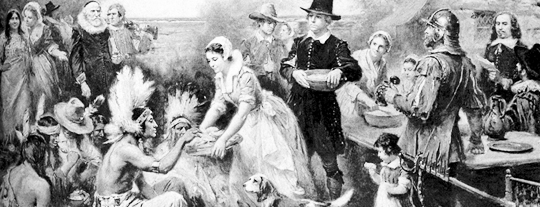
Celebrations, like Thanksgiving, come with a history and a script. As children, we were all taught about the first Thanksgiving, when in 1621 a starving group of pilgrims were saved by the bountiful harvests and generosity of the Wampanoag people. In Kindergarten, my class and I recreated this story, wearing either assumedly Native American headgear or a Puritan cap and eating some dry turkey breast.

Despite insistence in grade school to understand this history, to call this previously described story the first Thanksgiving is a complete fabrication; one conjured up in the late 19th century and propagated following World War I.

The first celebrated “Thanksgiving” came 16 years after the one we learn about in 1621.  In 1637, John Winthrop, the Colony Governor of Massachusetts, proclaimed a “thanksgiving” to celebrate the safe return of several hundred heavily armed volunteers from their slaughter of Native Americans from the neighboring Pequot tribe in present-day Connecticut. These armed volunteers massacred 700 Pequot Indians and they were celebrated for their actions.

Only in the 19th century did the story get spun to tell the happy story of cooperation among the indigenous and white settlers (as white settlers continued to displace the indigenous from their homes across the United States during that time).

This is a history that is repressed because it interferes with our conception of entitlement to the American continents. Native Americans are hardly ever seen in media and public discourse because their existence contradicts our own justifications for being in this country. White settlers and Americans did not come here peacefully or move about peacefully; they killed the people that were here first to do it.

I’m aware that it’s not typical or comfortable table conversation among many people and their families, and people may decide to ditch the origin story altogether. However, this is equally problematic as it denies a historical wrong ever occurred. As Americans, we must remember the triumphs as well as the failures. We cannot and must not erase the history that is unpalatable; otherwise we risk repeating it.

The second aspect of Thanksgiving celebrations is the script. I can only speak from my own experiences, but I expect certain aspects are common for many people.

After a Thanksgiving lunch at my Grandpa’s, family heads to my Aunt’s   house for a smorgasbord, giving thanks to the great food and great people throughout. After eating, we chat about our lives, watch the various football games, pass a football around and perhaps play a board game before eventually returning home.

This script is common; it isn’t broken in any way, so there isn’t much need to fix it. However, I would like to offer ideas to augment such plans.

The first thing you could do is repudiate the incorrect history you have been told your entire life, that your comfort in the United States was ensured through the destruction of the indigenous communities already here. You can acknowledge and address this uncomfortable history by learning more about these communities and seeking to support our indigenous peoples through numerous ways. Give thanks to a family member by giving gifts that were bought directly from indigenous artisans or artists. Support community movements in the 500 plus tribes in the U.S. through monetary donations.

You could even support the Catholic schools on reservations that are always in need of resources to serve their communities.

I contend that ignorance on Thanksgiving is not bliss- not for everyone. The lie of Thanksgiving must be broken and a new script written. I’m asking for your help to make Thanksgiving as uplifting and reflective as it can possibly be.  Thank you.

Our first Thanksgiving in America was not as festive as our history, and this photo, imply.

Our first Thanksgiving in America was not as festive as our history, and this photo, imply.

Posted in UncategorizedComments Off on Thanksgiving needs a rewrite

How easily we all forget

“What did you have for breakfast this morning?” “You know, I honestly I can’t remember.”

This is a short conversation I often had with friends during my elementary school years. The answer was often the same “I don’t know,” no matter the question: What were you for Halloween? or What’d you get for Christmas?  There was also the infamous question from parents, “What did you learn at school today?”

Of course, the implications to not remembering the answers were miniscule at that point. At worst, your parents would chide you, or your friends would ask someone else who happened to get an Xbox 360 for Christmas.

Now these fits of forgetfulness might mean a little more: What did that philosophy reading say again? How long ago did I buy that milk? or What the hell is that cute guy’s name? The risks now are getting a bad grade, getting sick or having McDreamy get away.

Again though, the dangers of not knowing are not truly dangerous. Although these situations affect you, you can still probably laugh them off and move on. What happens though, when you start forgetting about lives?

What happens to you when you forget the 2,100 plus people who lost their lives during the Israeli military’s latest rocket attacks and incursion into the Gaza Strip this past summer, or the 167 deaths in 2012 or even the 1,391 before that in 2008-2009?

Tell me, what happens when you forget about the thousands of undocumented children awaiting trial, who came to the U.S. seeking safety and reunification with their families?

What happens when you forget the names of Ezell Ford, Eric Garner, John Crawford, Michael Brown or Vonderrit Myers; the names of victims from police brutality over the past few months?

What happens when you forget the dialogues on topics such as privilege, police brutality and freedom of expression that were held at the clock tower in the midst of occupy SLU?

You know that answer, as well as I do. The answer is nothing. Literally, nothing will happen to you. I’m going to try to tell you why.

It is because these things do not really matter to us under most occasions. The deaths of the people of Gaza, or those at the hands of police are in some ways no different than those that died at Gettysburg 151 years ago. They are numerical figures of lives lost; they are important, but ultimately forgettable.

I’m not condemning your inability to remember. We all forget. I can’t remember how many lives were lost during the Cultural Revolution, and I study Chinese history.

I will remember the name Mike Brown, however. Through protests, impassioned debates and the occupation of our campus, I will not be forgetting his name and I will not forget why I participated and continue to participate in dialogues, protests and demonstrations. Action precipitated remembrance. I will remember because I connected with and befriended the people there. I must tell you, it is much more difficult to forget the people you care about than those that you do not.

It is a privilege to forget about topics that matter in the world. It is not an accident when philosopher Noam Chomsky says that more white men are concerned with sports statistics than anything else, other than their families and work. If a country cares more about the World Series or fantasy football than U.S. military involvement in Latin America, or about police brutality, it makes sense that people can rattle off the RBI of Stan Musial, but not remember Rodney King or history lessons on U.S. involvement in Central America.

Perhaps I’m expecting too much of SLU students when I tell them to stop putting so much of their time into the operations of organizations whose primary purpose is serving others, when I tell them to stop watching the Cardinal’s game or Netflix and come to a protest with me, when I tell them to wake up from fantasies and sedatives and to learn why people in Ferguson and St. Louis are still protesting, why violence in Central America will continue if we as Americans continue to ignore it and why Israel’s government will again choose rockets rather than reconciliation. My hope is that I’m not. My hope is that being Billikens makes us more empathetic.

So go out there with me. Try to see how I see. More importantly, try to see as they see. Their actions on the street are not fantasy. They occupy these spaces at great risk to themselves; the least we could do is listen.

It’s time to wake up, to get up, to breathe struggle, maybe for the first time, and to not forget why we are fighting.

Posted in UncategorizedComments Off on How easily we all forget

Black lives matter

In August, Ferguson, and by extension St. Louis, was caught in a racial uprising so large that one commentator stated it was this community’s reclamation of its lost “1960s moment.”

After the shooting of Michael Brown on Aug. 9 by Ferguson Police Officer Darren Wilson, hundreds surrounded the spot where he died, left lifeless on the street for hours after his death. Permeating the crowd were feelings of loss and anger. Brown’s stepfather, held a sign: “Ferguson police just executed my unarmed son.”

This anger exploded into a conflagration over the following weeks. Some would describe the events as riots. Others would describe them as uprisings. While the word choice matters (one is mindless and the other a concerted challenge to a system or government), that is not the focus of this article. This article will not be talking about how Ferguson police violated protester’s constitutional right to assembly by not allowing to protesters to stand still and protest. This article will not discuss the fact that more money has been raised for the police officer who (however unjustly) shot a boy six times, to his death, than for Organization for Black Struggle, a leading organization in Ferguson and St. Louis designed to end all forms of oppression and exploitation. This article will not discuss a government’s apparent inability to indict Darren Wilson, which only means he might have committed a crime in killing Michael Brown.

No, this article will discuss a rallying cry that is not heard or repeated enough in American discourse: “Black lives matter.”

Black lives matter. The life of a black boy matters more than the destruction of a QuikTrip. His life, and the matter of his death, deserves more attention from onlookers and media than the destruction of a QuikTrip. His life is worth more than a building.

Black lives matter. No matter how justified you think Darren Wilson was in killing Michael Brown, there’s something terribly wrong with the ease in which the lives of black men and boys can be ended by a gun. John Crawford, a young man walking around a Walmart with an unloaded air rifle was shot by police officers in Ohio (a state, ironically enough, that allows individuals to carry guns openly). His father described the killing as “an execution. No doubt about it.”

Black lives matter. I go to Walbridge elementary for an after-school literacy program, and I work with the young kids and affirm them as often as I can. Despite this, I can’t help but see those boys reflected in those protesting in Ferguson (only a few miles from Walbridge), defying police partly because that’s how one can express their manhood. Their lives matter more than what they’ve been given by a negligent society. I don’t want more boys in pitched battle with the police (them with Molotov cocktails and police with assault rifles). I want a collective society to actively show they believe in these boys and young men. I don’t want this generation of boys forgotten by the larger populace. I don’t want the first time for you to see these young men is when they are choking on tear gas. As Ferguson filled our news feeds, some began to learn about “the talk” that black parents have with their boys: don’t mess with the police, because as an officer said to Sylvester Brown Jr., a former St. Louis Post Dispatch columnist: “We are the police; we can do any damn thing we want to you.” I want parents to eventually not need to give that as anything more than a history lesson.

Black lives matter. The responses this campus had to Black Student Alliance’s (BSA) protest and demands were despicable. Yes, the Yik Yak posts were racist, but at least they were honest. I saw too many good people go silent and cold when black students (and allies) on this campus cry out: “Listen to us! We want more!” Silence still ensues.

Black lives matter. If you agree with this statement, which you all should, then hear me now. Here are ways to show you agree. First, go to the rally downtown this Saturday for Ferguson October, a national mobilization to seek justice for the death of Mike Brown and to protest police violence. Second, get out of SLU for more than Ted Drewes. I know you love frozen custard, but it’s time you started showing love towards impoverished communities on this University’s doorstep. Third, start giving an earnest ear to the folks in BSA that are demanding more from this University. Read their statutes for change, and talk with your friends about them.

Black lives matter.

Posted in UncategorizedComments Off on Black lives matter

Greek Organizations at SLU: Introduction and Influence

Fraternities and sororities on Saint Louis University’s campus do not have a recent history of being checked or called out. Individuals that are not Greek may have bias against these organizations, but it is not often that fraternities or sororities are publicly called out for the actions of individuals within the community or the community at large. Last year, a member of Kappa Delta Sorority was called out publicly for cultural appropriation (by me). I believe the subsequent response from Kappa Delta was universally positive. Many members came closer to the organizations that seek to combat bias in all of its forms, which, in my experience, has not happened before. These articles are intended to provoke a larger, but nonetheless similar response from Greek organizations at SLU.

This piece will come in two parts: the first will be to track the unequal influence of fraternities and sororities (in this case limited to IFC and Panhellenic Council) in comparison to the actual number of members for fraternities and sororities. The second part will be a criticism of sororities and fraternities, as they exist at SLU today, and how these organizations can and should change. This paper is open to debate and encourages those with differing opinions to submit letters to the editor (300 word max) or articles (600-800 words) to the UNews via opinion@unewsonline.com.

Coming into SLU, I think most of us are unaware of how many students are in a fraternity or sorority, and how many leadership positions members of these organizations hold. I was personally told that Greek life “was not that big here.” I tend to disagree.

About 20% of undergraduate SLU students are in Greek organizations, constituting a large minority in the student population. In fact, there are more students in Greek organizations than the Hispanic, Asian American, and African American undergraduate student population combined. This population of fraternity and sorority members is made even bigger on SLU’s campus through a couple of ways.

The first way that fraternities and sororities exert considerable influence over SLU is through their over-representation as SLU Ambassadors. As an Ambassador, one is effectively a salesperson for the University. They are obviously selling the University to the people on their tours, but what aspects of the University? Despite their training, I doubt any know all, or most of the cultural organizations on campus and the wonderful things they do. I doubt they know much about the curriculums of African American Studies, Women and Gender Studies, or numerous other programs. That isn’t the ambassadors’ faults. I know very little about the Business school or Medical school. This is all fine. What’s problematic is when 50% of the ambassadors have similar SLU experiences, coming from fraternities and sororities. SLU is different to all of us based upon our own experiences, but the SLU being sold to prospective students is alarmingly monolithic.

The second way that fraternities and sororities exercise their influence is through rush. This is in no way unique to SLU. The narrative is very similar for every school: all the fraternities and sororities recruit members and ostensibly all of the campus gets in a frenzy of who’s joining which fraternity or sorority and who got denied.

Unless you have some sort of bias or are perceived as an obvious oddball, it’s likely most have at least considered joining a fraternity or sorority. Around 30% of SLU students will rush and about 20% will join a fraternity or sorority. Whether one joins or not, they have ties to these organizations. This is not at all insidious. Fraternities and sororities across the country have proven to be excellent marketers of their organizations. It’s just important to know how important fraternities and sororities are on SLU’s campus.

This influence isn’t an accident either; higher-ups in SLU so avidly supporting and defending Greek organizations, students to fill the Greek organizations year after year, and a stream of wealthy alums from Greek organizations have allowed these organizations to thrive and grow within this University. That’s what worries me; these organizations are becoming too large and influential to seriously challenge.

To be clear, fraternity or sorority member, this is not an attack against you personally. I don’t have grievances against individuals, but institutions. This is also my own perspective and I do not represent the ideas of the University News or any other organization I am a part.  I, and The University News, want discussion.

The second part of this article will be published next week. Stay tuned.

Posted in UncategorizedComments Off on Greek Organizations at SLU: Introduction and Influence

The Oriflamme revolution: Unionizing the orange shirts

As I look across this fine campus and see patches of folks donned in orange, characteristic of Oriflammers, I can’t help but think about the following interview scenario: the interviewer is sitting across from you, perusing your hopefully impressive resume when they stop at the word, “Oriflamme.”

They ask, “What the hell is Oriflamme?” To which you respond, “Ma’am/sir, Oriflamme is a group at Saint Louis University that helps accommodate first-year students’ college transition. We help with the move-in process and attempt to build relationships with freshman. The process lasts about a week, during which we guide the new students to fun events and get them excited about being a Billiken.” “Pithily put,” they respond, “so you were effectively a mover, babysitter and cheerleader, right?”

“…. Yeah,” you say. What else is there to say? That basically sums up exactly what you did for three consecutive years.

The interviewer poses another question: “What were your wages while working for Oriflamme?” “Oh,” you start to falter, “It is actually a volunteer position In fact, we pay $75 to do so.”

At this point, I imagine said interviewer to transform into John Oliver or Stephen Colbert and point out the absurdity of that statement. “So what you’re saying, is that you paid money to move people in, chauffeur them around and cheer them on to each activity? You must be joking.” The prospective employee gets defensive, “But it’s fun!” you cry out a bit too loudly.

Obviously this is not a desirable position to be in. In order to prevent said unfortunate event, I have a modest proposal for you.

This is where I come in, to save you from your blissfully pitiful situation. I’m here to organize you so you can effectively bargain with SLU’s overlords to receive what you are owed.

Oriflammers, your work is extremely important to this University. You are some of the first faces that first year students see. Since Oriflammers are seemingly forced to smile during the duration of their time on duty, you give new students the idea that SLU is either a happy place or a place with no freedom to frown. You help move in these students, wading through the over-protective, the ‘too-many-question’ and unnecessarily angry parents. That’s a minefield. Your bravery deserves recognition. After all, you’re ambassadors to SLU. Ambassadors of the US live in luxurious homes across the world; the least you could get is minimum wage and maybe a $25 gift card to Jimmy John’s.

I’m also not talking about swag. Visors and t-shirts are not difficult to find. I’m sure if you asked nicely you’d get to talk to Mary Bruemmer or Dr. Fred Pestello. If you’re really into orange, perhaps this is the place for you. Regardless, all of this could be done for you as well as getting that green.

I must admit to you all that organizing against your employer is never easy. Countless examples show how local and state governments and companies will depict you as socialist radicals. Your every move will be carefully watched and brutally critiqued. They may attempt to buy off the leaders of the movement or suspend them for a trumped up charge. No, change is never easy, but it is absolutely worth it. I believe in you.

However, if you’d like to avoid the pressure of organizing against a well-funded foe, if you’d like to avoid losing friendships for what you think is right you can remain a happy and unpaid servant to this wonderful University.

Or perhaps I just wished all my friends had come hung out with Dusty and I all of these years. We missed you.

Posted in UncategorizedComments Off on The Oriflamme revolution: Unionizing the orange shirts

Michael Eric Dyson delivers BSA keynote

Wolf Howard / News Editor Keynote: Michael Eric Dyson blended pop culture and history in his treatment of the status of Black people in modern America.

Wolf Howard / News Editor
Keynote: Dyson blended pop culture and history in his treatment of the status of the Black community in modern America.

On Tuesday night in the Center for Global Citizenship’s auditorium, Michael Eric Dyson brought the house down with his brutal honesty, quick wit, popular rap lyrics and a professor’s knowledge of contemporary black America.

Dyson was the keynote speaker for the Black Student Alliance’s month of events dedicated to Black History Month.

Dyson is the author of a number of accessible, yet hard-hitting books on the status of black Americans. His most recent book, which he briefly promoted at the lecture, is “Can you Hear me Now?” As well as authoring books, Dyson is a professor at Georgetown University and the host of a radio show on NPR.

Dyson is hailed as one of the most inspirational African-Americans in the U.S. According to SLU’s Black History Month page, what makes Dyson so influential is that he infuses “intellectual thought with popular culture, Dyson focuses on topics of interest to the public. He eloquently melds scholarly insight with the phenomena of contemporary culture, emphasizing their interconnectedness and force in shaping society.”

He used that trademark style on Tuesday when giving his lecture on the dichotomy of black America. He told the audience that he wants the “opportunity to chat about the state of the black community as it is today.” He said that this period of time has seen growth and progress for the middle class black Americans in this country, which he said culminated in the election of the nation’s first black president. However, he also painted a grim picture for black Americans in the lowest rungs of the economic ladder.

He talked extensively on how President Barack Obama is depicted by popular media sources and how his victory shouldn’t mean the world to the black American community. He stated, “[President Obama] will be out in a minute, we’ll still be black.” Dyson acknowledged the expectation from white Americans that the country is post-racial because a black president was elected, and the statement that would surely follow: “You got a black president, be quiet.” He also criticized members of the black community for blindly supporting Obama, even if the president is not properly representing the black community. He told the audience to be critical of Obama. He stipulated that, “being critical ain’t being a hater.”

On the other hand, he talked about the marginalized black American community that is suffering from spending cuts that don’t adequately emphasize the humanity of poverty. He stated, “We’ve got people who are drastically and desperately poor.” He cited the lyrics of rappers who talked about police brutality and the lack of opportunity, lauding their honesty. “Somebody’s got to tell the truth, I’m glad rappers do.”

Posted in UncategorizedComments Off on Michael Eric Dyson delivers BSA keynote

The power of (useful) petitions

As we hope you’ve all heard, Justin Bieber was arrested a couple of weeks ago for driving in a rented Lamborghini (not really important to the story, but an interesting factoid nonetheless) while intoxicated. The collective reaction from the event has been nothing short of a conflagration.

Bieber has been criticized (or praised) for his mug shot: he flashed a picture-perfect smile and a stylish up-do. He’s been criticized for his apparent failure as a role model for children and teens and he’s been blasted for his utter recklessness.

Most interesting, a petition on the White House website popped up after the arrest and has, as of Monday, Feb. 3, been signed over 240,000 times! This many people acting together for the common cause of seeing “the dangerous, reckless, destructive and drug- abusing Justin Bieber deported and his green card revoked.”

We’re not going to lie, while some of us are more supportive of the Biebz than others, we’re pretty impressed that 240,000 people can do anything construed as political activity together over so short a time.

Of course it’s not important that Justin Bieber will not be deported or denied reentry to the United States, based on two reasons. For one, his privilege as an international pop sensation, and that he generates revenue for days at American venues across the country means he ought not be so quickly kicked out.

Second, court precedent dictates that only under extremely rare cases does the criminal offense of driving under the influence warrant a deportation.

Despite our admiration for the folks who decided that America would be better Bieber-less, we can’t help but wish that Americans would put their political capacity to more useful ends. In fact, in five minutes, we thought of five better things that Americans could write petitions about.

1. Coming to a conclusion on immigration reform and the minimum wage talks this year.

2. Having an annual pool party for Congress and the President (taken out of their own pay) to increase bi-partisanship between these too polarized folks.

3. Make the NSA and other spy agencies’ actions more transparent to Americans.

4. Have American athletes make a stand for LGBT rights in Sochi this winter.

The sad part of this saga is that history tells us that when a big enough group comes together with a common cause, they can create positive change. In 2012, after unpopular budget cuts on Wisconsin state employees, Governor Scott Walker was forced to run in a recall election. While Walker eventually won the recall election, the collective action of enough Wisconsinites made a state Governor really sweat.

We the people have power, but it remains untapped when we use our political capital on Bieber’s deportation.

Posted in UncategorizedComments Off on The power of (useful) petitions