The Handschumacher Dining Center is to be closed for a refresh beginning this fall, Drexel University has confirmed to the Triangle. The Urban Eatery and other dining locations will continue to operate as normal. A university-wide email is expected this week.
“The decision to temporarily close was informed by several factors, including location popularity, proximity to residence halls and renovation needs. Future plans for Handschumacher will be shared with the campus community,” Britt Faulstick, executive director of media relations, told the Triangle.
Drexel Campus Dining is managed by Philadelphia-based food service giant Aramark through its Collegiate Hospitality division.
The dining hall had been absent from the Campus Dining website going into fall term, prompting speculation.
It is not immediately clear whether first-year enrollment has played a role in the decision; the university did not address enrollment in its comment.
“Drexel Campus Dining remains committed to delivering an exceptional dining experience. Even with Handschumacher being temporarily closed this year, our dining program has the capacity to serve all students and provide a wide variety of options. Urban Eatery – our primary dining location – situated near residence halls and the campus center, will serve as the central hub for meals,” Faulstick told the Triangle.
Hans has already undergone a service transformation in recent years. Previously an “all-you-care-to-eat” dining center like Urban Eatery, and also featuring rotating menu stations, its dinner service pivoted to a Grubhub-based mobile ordering point called “the Drop” in recent years. However, the dimly-lit decor is undoubtedly deserving of its own refresh.
Posted in UncategorizedComments Off on Dining hall to be closed for refresh
Philadelphia has an abundance of sights and sounds to experience off-campus, and for those in the know, Drexel’s campus is one of the most convenient starting points to reach them using public transportation.
What is SEPTA?
The Southeastern Pennsylvania Transportation Authority is the region’s public transit agency. To help riders navigate its broad and multimodal network, SEPTA has streamlined its many modes into three divisions: Metro, Bus and Regional Rail.
Metro covers the lettered routes, which are SEPTA’s subways, trolleys and light rail. Metro offers the most convenient way to get to Center City (downtown), far-flung neighborhoods, the stadiums and much in between.
Buses are the numbered routes operating throughout southeastern Pennsylvania in both the city and suburbs. Its routes include regular buses and “trackless trolleys,” or trolleybuses, that fill in the gaps not served by Metro lines.
Finally, fourteen Regional Rail lines — each named by destination — ferry commuters between Center City, the outlying suburbs and Philadelphia International Airport. These heavy rail trains make few stops within the city.
With all these modes, SEPTA provides one of the most robust transit networks in the country. However, there is a major caveat.
Budget crisis
After losing a major stream of state funding in recent years, SEPTA began implementing service cuts in phases over the summer.
For the fall, a 20 percent service reduction for buses and Metro took effect, and trimmed or eliminated routes entirely. A base fare increase to $2.90 is planned for this fall, as well as cuts to Regional Rail, but these are being litigated at time of writing.
Worse is in store without state funding commitments. By January, SEPTA will have enacted a 45 percent total reduction in service. Five Regional Rail lines will be eliminated, including two of the four busiest, as will more bus lines. The agency has warned these cuts could be permanent.
So, where is state funding? Transit funding has long been a political football in the state capital, and negotiations over transit and other issues have delayed the passage of the 2026 state budget, which is now three months overdue. Progress toward a compromise has been halting.
For the latest on the evolving situation, visit SEPTA’s website for the most up-to-date information on service. Schedules and maps for all routes are available online. With those in hand, here is a rundown of the essential services and destinations.
Metro
SEPTA operates two subway routes: the L (also known as the Market-Frankford Line) and the B (formerly Broad Street Line). They run east-west and north-south, respectively.
The L has two stations on campus on Market Street: 34th Street and Drexel Station at 30th Street Destinations include West Philly, Center City and Fishtown to the northeast. It is the quickest way to Center City from Drexel. A free transfer is available to the B and T lines at City Hall.
The B runs on Broad Street from NRG Station in South Philly to Fern Rock in North Philly. Destinations include Temple University, the Kimmel Center, South Street and the Sports Complex. Be mindful of the express trains that skip stops.
Lines T1 through T5 travel underground from City Hall and fan out onto surface streets in West Philly. It stops on campus at 33rd Street and 30th Street. If traveling between 33rd Street Station and Center City, all routes serve all stops by request. However, west of 33rd Street Station, the lines diverge.
When nearing your stop, request it by pulling the yellow cord or pressing the button at the rear doors. When disembarking by the rear doors, be sure to step down: the top step is a pressure plate.
Regional Rail
Regional Rail is the best way to reach destinations outside Philly. Consequently, schedules are oriented towards weekday suburban commuter travel, and off-peak service can be limited.
Regional Rail has its own fare structure, with pricier tickets to travel to further fare zones and during rush hours. Train fares can be purchased at kiosks or on the train. If you are issued a paper ticket, be sure to take it with you.
The Airport Line offers 24/7 service to Philadelphia International Airport, half-hourly on weekdays and hourly on weekends. You can view the schedules for all lines online. Be aware of express trains, and that some stations are served by multiple lines.
Bus
Buses are the workhorse of SEPTA’s network, with over 100 routes. They make up the most local form of transportation, with stops as frequent as every city block. Drexel’s campus is well-served by buses.
How do I use it?
SEPTA bus and Metro fares are $2.50, but this is expected to increase to $2.90 if state funding is not approved.
Fares can be paid contactlessly by credit or debit card, Apple or Samsung Pay or the SEPTA Key. The Key functions like a debit card. Users can load money onto the card at a kiosk, online or through the app.
There are no current advantages to using the Key over other cashless methods, but it does come with perks: showing your Key at businesses across the region can get you discounts.
The SEPTA app is available for smartphones, and contains all the schedules, maps, live vehicle tracking and fare information you should need. An alternative for route planning is the Transit app, which uses crowdsourced information to track vehicles.
Drexel offers a ComPass program to purchase a SEPTA TransPass or TrailPass at a 15 percent discount. This option is worthwhile for daily riders.
Alternatives
Amtrak and NJ Transit services stop at William H. Gray III 30th Street Station. NJ Transit buses and private bus operators depart from 30th Street and Schuylkill Avenue.
Drexel also operates campus shuttles. The Dragon Route runs weekdays from Nesbitt Hall to limited stops in Center City. While not the most direct route, it is free to students with a DragonCard. For information on the Dragon Route and other routes, download the TripShot app.
IndeGo is a bikeshare service available throughout Center City and University City.
Or, if you’re not in a hurry, Philadelphia consistently ranks among the most walkable cities in America.
Public Transportation is the Way To Go
Access to public transportation is one of the biggest upsides to living in a city, and with Drexel beside a transit hub, there are an abundance of options. With service from SEPTA, Amtrak, NJ Transit and more, there is no shortage of ways to get to local and regional destinations without access to a car.
While there is a learning curve to using public transit, remember that there are many resources to help you plan a trip, and that the drivers, conductors and transit ambassadors you’ll encounter will be happy to answer any polite questions. SEPTA is “the way to go,” and with some experience, it will become second nature.
Posted in UncategorizedComments Off on Getting around Philly using SEPTA
SEPTA is set to begin drastic service cuts effective Sunday, Aug. 24, as state lawmakers remain deadlocked on the passage of long-term transportation funding.
With no progress in sight, the transit agency will begin implementing its long-foretold “doomsday budget” with 20 percent service reductions affecting its bus, trolley, subway and light rail (Metro) operations, which are sure to be felt on campus next week. Service will be cut by a further 25 percent effective January 2026.
The impacts of the funding shortfall extend beyond SEPTA: this week, Amtrak warned that its Keystone Service from New York to Harrisburg will be in jeopardy without the annual operating subsidy it receives from SEPTA. Agency-operated school bus routes serving the School District of Philadelphia also stand to be eliminated, complicating commutes for public school students. ADA-accessible transit services will also be discontinued to any riders who no longer live within ¾ of a mile of transit routes.
Here’s what to know about transportation to and from campus beginning Sunday.
Fares
There will be no change in bus or Metro fares until Monday, Sept. 2, when a 21.5 percent fare increase will go into effect. This will bring the standard fare to $2.90 — matching New York City public transit. Regional Rail fares will increase for each zone.
Fare pass prices are also expected to increase: see SEPTA’s website for further details. For those who use Drexel’s ComPass program to purchase a SEPTA TransPass or TrailPass, the discount is rising to 15 percent. The 5 percent difference is being funded by the university.
Buses
In total, 32 bus lines will be cut entirely beginning Sunday and Monday.
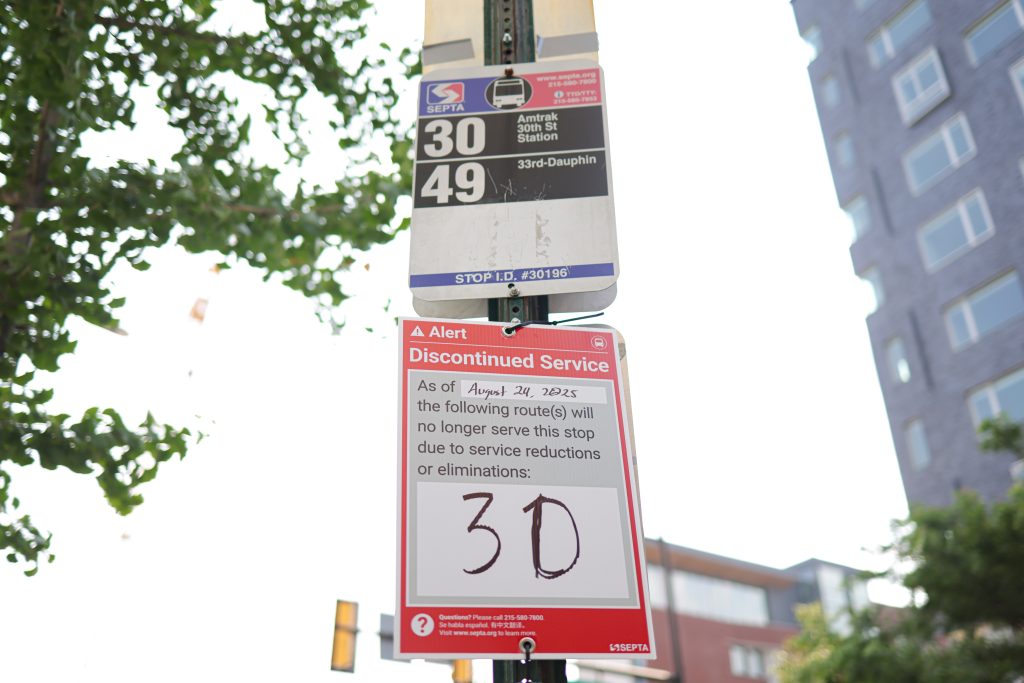
Route 30 will be discontinued entirely from University City to 69th Street.
Route 31 will be discontinued entirely from City Hall to 76th Street and City Avenue.
Overnight bus shuttles for the Market-Frankford and Broad Street Lines — the Owl services — will be discontinued entirely.
Remaining routes will see significant changes, either in route or frequency. Peak (rush-hour) frequencies will increase for most.
Route 38 will maintain its start and end, but will be rerouted to Market Street via 34th Street, bypassing Spring Garden Street and the Ben Franklin Parkway. Off-peak headways will increase from 20 to 30 minutes.
Route 43 will be shortened, travelling from Parkside Loop to the MFL at Spring Garden Station. Peak headways will increase from 16 to 20 minutes.
Route 44 service to Narberth and Gladwyne will be discontinued, leaving only service to Ardmore. Peak headways will increase from 15 to 20 minutes.
Routes 124 and 125 will be significantly altered, with neither serving Center City. Route 124 will be shortened into a circulator service between Gulph Mills Station, the King of Prussia Mall and Chesterbrook. Route 125 will provide service between 30th Street Station and the King of Prussia Business Center via Wissahickon Transit Center and Gulph Mills Station.
Routes 21, 42 and 49 will see peak and midday headways increase.
Metro (trolleys, subways and light rail)
Trolley and subway services will be reduced by 20 percent, translating into slight headway increases at peak times and moderate increases off-peak. See SEPTA’s website for more detailed information per route.
The Sports Express service — the trains available after matches in the Stadium District — will be discontinued beginning Aug. 24.
Regional Rail
No routes will be eliminated before Sept. 2. First, all will face service reductions: the Airport Line will run hourly, all express services will be eliminated and weekend service will be reduced to every two hours.
If funding is not guaranteed by Aug. 24, ten days before rail schedules are set to take effect, expect five routes to be eliminated: the Trenton Line, Chestnut Hill West Line, Cynwyd Line, Paoli-Thorndale Line and Newark Line.
SEPTA is already running service with delays and cancellations due to an equipment shortage. With investigations into two onboard fires this year ongoing, the agency is withdrawing much of its older rail equipment for maintenance. Some of the affected rail cars entered service in 1974 during the Nixon administration.
Alternatives
PATCO, Amtrak and NJ Transit service will be unaffected by the cuts this year.
For students needing to get around the city, biking could be the move: IndeGo bike rentals are available at multiple locations on campus and throughout the city. IndeGo offers monthly rates.
However, there are few alternatives for transportation throughout the region beyond driving, be that a personal vehicle, carpooling or rideshare.
A funding solution?
Last week, state Republican leadership proposed dipping into the Public Transportation Trust Fund to partially fund SEPTA operations. The PTTF was established for capital projects like construction and vehicle purchases, and currently has a balance of $2.4 billion.
Approximately $1.3 billion is already earmarked, according to PennDOT, which Republicans argue leaves the remainder available for use. SEPTA management refuted this, pointing to a $10 billion maintenance backlog, and PennDOT urged caution in spending capital funds for operating expenses.
Another point of contention has been placing a tax on so-called skill games, the slots-like consoles found in many of the state’s bars. Lobbying efforts for and against the tax this past year have been contentious and downright strange at times.
Above all, legislators from Pennsylvania’s rural counties — including Senate President Pro Tempore Kim Ward — have expressed skepticism about the seriousness of the service cuts.
However, the Delaware Valley Regional Planning Commission has made an effort to quantify the effects in real terms. If the 45 percent total service reduction planned for January is enacted, traffic planners suggest as many as 275,000 vehicles per day will be added to the region’s roads — roughly equivalent to the entire population of Pittsburgh.
Posted in UncategorizedComments Off on Drastic SEPTA cuts to take effect Sunday
On Tuesday, Aug. 19, a new Starbucks opened within the sprawling Schuylkill Yards district at 3151 Market Street. Within the same building, a new Fine Wine and Good Spirits has also recently opened its doors to University City.
The geography of this specific Starbucks is strategically significant, being across from the Bossone Center and LeBow Engineering Center, and other buildings of Drexel’s University City campus while also in close proximity to 30th Street Station. Inside, sprawling couches and study spaces offer comfortable areas for students and professionals working or studying.
Photo by Kasey Shamis | The Triangle
The ambiance of the space sets the establishment up to be a prime study spot for Drexel students — more so than Starbucks’ previous location in the LeBow College of Business, which is currently under construction to be transformed into a new Saxby’s.
Yozabed Emaunel Seynos, a Starbucks barista and second-year engineering student at Drexel, spoke about the makeup of the staff at the Starbucks.
“I’d say a good amount of us are students. I know me and two others are from Drexel and another two from UPenn. Everyone else is a Philly native,” Seyno said of the 14 current employees of Starbucks.
“For me personally, since it’s right outside of the engineering building it’s so quick and easy to get here. I think it’s gonna do pretty well,” said Seynos.
While he alluded to customer influx being slow at opening, Seynos was optimistic about the influx of students from September’s Welcome Week and beginning of the fall quarter being good for business.
When asked about his thoughts on the closing of the Starbucks in LeBow, which served as a popular pick-me-up location for many students between classes, fourth-year Sports Business and Legal Studies major Paulie Loscalzo expressed his ambivalence.
“While I’m sad there’ll be no more Starbucks in LeBow, I’m pretty juiced to see the new Starbucks open up right across the street,” said Loscalzo.
With Welcome Week and the fall quarter approaching, the new Starbucks may quickly become a staple for Drexel students.
Posted in UncategorizedComments Off on New Starbucks debuts on Market
On Aug. 1, 2025, a federal jury empaneled by the Eastern District Court of Pennsylvania found Drexel University and the Drexel University College of Medicine not liable in a lawsuit brought by emergency medicine attending physician Sharon Griswold, MD, a former Hahnemann University Hospital and Drexel faculty member.
Griswold had accused Drexel of sex discrimination, retaliation and hostile work environment in violation of Title VII of the Civil Rights Act of 1964, the Pennsylvania Human Relations Act, and the Philadelphia Fair Practices Ordinance. A federal judge summarily dismissed the sex discrimination claim before trial, arguing that she did not have enough evidence for a viable case, but allowed the retaliation and hostile work environment claims to move forward.
During the trial, Griswold described a boys’ club in the department that made women uncomfortable, along with a department chair and human resources department who did nothing about it. She claimed that two staff members would continuously and openly support Trump during the 2016 campaign and display hostility towards women. When she tried to talk to her supervisor, he told her to go talk to them about it. HR merely offered to mediate a dispute.
In one dispute, she was forced to get the ombuds involved, which affected her relationship with her department chair and mentor. She was passed over for a promotion to vice chair of academics, a significant stepping stone for advancing to higher-level positions in academic medicine, because she “sues chairs,” a reference to her time at Jefferson when she sued her department chair.
When Hahnemann eventually closed, she was put on administrative leave, rendering her unable to renegotiate her contract to remain a Drexel faculty member. The leave restricted her from communicating with other students, staff and faculty.
According to Griswold, being placed on leave was a pretense for retaliation because other male doctors who had served concurrent Drexel positions were retained as faculty, but despite serving as director of the MS program in medical simulation, she was unable to advocate for herself.
Griswold refused to comment for this article.
Drexel contended that it had continuously supported Griswold throughout her time at Drexel. She was the first full-time female professor of emergency medicine. Her department chair wrote glowing letters of recommendation for her and supported her career at Drexel. She was nominated and selected for a prestigious women’s leadership conference in academic medicine and became associate dean of education at the College of Medicine.
Drexel said that she was instructed to discuss her issues with her colleagues, some of which were routine business decisions like whether to list a position as part-time or full-time, because they were interpersonal conflicts. Other witnesses described her as difficult to work with because she would have “temper tantrums” when she did not get her way.
In court, Griswold claimed that Drexel’s emergency medicine residency program was put on probation because of another male attending physician who would verbally abuse residents, and that he was not expected to change his behavior.
When tensions were high due to Hahnemann’s abruptly announced closure, Drexel presented evidence that Griswold, in an argument, had threatened to burn down the building — which triggered the paid administrative leave and required her to avoid contact with others and barred her from campus. Drexel framed the administrative leave as a matter of public safety, not retaliation.
In a separate lawsuit, Griswold claimed that Drexel violated her copyright rights. After being placed on administrative leave and subsequently losing her job, she had gotten other faculty members to assign their copyright rights to her, allowing her to own the copyright to the course material developed for her MS in medical simulation program.
Intellectual property law typically gives copyrights produced in the line of employment to the employer, but Drexel’s Intellectual Property Policy gives faculty members the right to their course materials except in certain circumstances, such as when it “is intended to maintain instructional continuity in special, exigent circumstances.” The outcome of this lawsuit is unclear.
Ultimately, the federal jury found Drexel not liable for the claims of retaliation and hostile work environment. Drexel will have additional legal challenges next month as it deals with a lawsuit from former Vice President and University Chief Compliance and Privacy Officer Kim P. Gunter, set to go on bench trial the week of Sept. 8, and another lawsuit from Dr. Piety Foley, set to go to a settlement conference on Sept. 15.
Posted in UncategorizedComments Off on Drexel professor’s discrimination lawsuit dismissed