Pegasus Pizza’s UO campus location on 14th avenue has closed along with the connected Fathoms Bar, according to an announcement made on the company’s social media page.
The campus Pegasus was the first location and opened in 1989. Fathoms Bar was added as an attachment in 2001. The pizza company’s other two locations, in Oakway Center and Woodfield Station, will remain open.
According to the announcement, the closure is attributed to “ongoing changes in the area and the economic challenges that have followed the pandemic.”
Pegasus Pizza has been family owned and operated since its opening in the 1980s.
During the University of Oregon’s commencement ceremonies on Monday temperatures reached upward of 95 degrees, resulting in one speaker passing out during a ceremony and the rescheduling of a different ceremony.
In a campus-wide announcement as the university moves into summer, UO President John Karl Scholz apologized and recognized that graduates “may not have had the experience they expected.”
“As with all events, health and safety are our priority. We will identify lessons and improvements that can make future commencements as safe and enjoyable as possible,” Scholz wrote.
The university president said he was grateful for adaptability and understanding for students participating in graduation ceremonies, as well as thanked volunteers, team members and faculty for their roles in preparing students for ceremonies.
During the College of Design’s commencement in Hayward Field, Dean Adrian Parr Zaretsky passed out during her speech at the ceremony, which began at 4:00 p.m. at Hayward Field.
While the design school’s commencement continued, with shortened speeches, any ceremonies taking place in Autzen Stadium after heat soared were rescheduled indoors to Matthew Knight Arena. According to UO spokesperson Angela Seydel, field temperatures in Autzen were reaching above 150 degrees due to the turf covering used for the events.
The College of Arts and Sciences natural sciences ceremony was moved to 7:30 p.m. at Matthew Knight, combining with the CAS graduate student commencement.
In preparation emails to graduates, the university advised that students should prepare to hydrate and wear sunscreen because extreme temperatures were expected. Water bottles are not permitted on the field, but water bottles were provided to students.
Students were encouraged to remain on the field for the entirety of commencement ceremonies, but a speaker at the CAS humanities and social sciences ceremonies acknowledged it was “a hot day” and directed students to the stadium’s east gate if they wished to exit.
Departments within the university will be able to apply for an exemption to hire new student workers despite a hiring freeze to meet operational needs, according to a communication from the University of Oregon Student Workers union.
UOSW met with UO’s Employee Labor Relations on May 27 to request more information about the hiring freeze’s impact on student workers. In a previous statement, UO confirmed that the hiring freeze would not impact reappointment of student workers who held positions before the summer break, but provided no details about new workers.
According to the communication to union members, UOSW said that ELR confirmed that students would still receive pay increases per the union’s collective bargaining agreement. Hourly wages for student workers will increase by 2.5% on July 1, and all levels of student workers will receive a 3% pay increase. Levels of student workers refer to the classification made depending on the type of employment.
The university informed the student union that departments can apply for an exemption to hire new student workers, different from reappointment, to be able to meet operational needs. According to UOSW, several departments have already utilized these applications for summer and fall term positions.
ELR declined to give the union a timeline of the duration of the hiring freeze or plans for identifying sources of funding to decrease the deficit. It also declined to say what departments would be most impacted by the cuts, stating it is “too early to be able to provide a specific answer,” according to UOSW’s communication.
UOSW’s executive board said in the communication that it will continue to seek more information from UO through labor management meetings. The union will continue to organize throughout the summer and fall, preceding when plans for cuts are anticipated to roll out in December.
A judge in Lane County Circuit Court dismissed a lawsuit filed by the University of Oregon against former defensive back Dakoda Fields over an unpaid balance tied to a settlement agreement.
The university sued Fields in May after he failed to pay an agreed-upon $29,882 in exchange for a release from liability related to an “underlying dispute.” According to court documents, the amount represented a discounted settlement that Fields failed to pay by the April 20 deadline.
After Fields did not make the payment, the university sued for the full amount of $39,882, plus attorney fees.
According to a dismissal notice filed May 27, Fields paid the remaining outstanding balance as well as estimated attorney fees incurred by the university.
A circuit court judge signed the dismissal June 1, and the case was officially closed June 3.
Fields, a former four-star recruit, redshirted with the Ducks in September 2024 as a true freshman before appearing in Oregon’s first three games of the 2025 season. He later transferred to the University of Oklahoma.
Fields’ intent to enter the transfer portal became public Nov. 5, 2025, and he committed to Oklahoma on Jan. 5.
“He didn’t come to work today,” Oregon head coach Dan Lanning said during a Nov. 5 press conference regarding Fields’ transfer. “We haven’t talked to Dakoda. So I guess that’s just the way it goes nowadays.”
The public dispute appears to be a first for the university in the NIL era, though several high-profile cases involving transfer portal movement have emerged in recent months. Those include disputes involving Brendan Sorsby and the University of Cincinnati, Darian Mensah and Duke University, and Demond Williams Jr., after the University of Washington reportedly threatened legal action when Williams announced plans to enter the transfer portal days after signing a deal reportedly worth about $4 million.
Unlike several recent NIL disputes involving transfer portal movement and multimillion-dollar agreements, Oregon’s complaint centered on enforcement of an alleged settlement agreement rather than an attempt to block Fields’ transfer.
Students and faculty members packed seats in the Ford Alumni Center’s Giustina Ballroom for the second day of the University of Oregon Board of Trustees meeting, preparing to speak during public comment or support those who did.
Public comment made up the majority of the June 2 meeting’s agenda and began at 9 a.m. Following Monday’s financial updates and discussion of the recently announced budget cuts, many speakers raised concerns about the looming effects these cuts will have on students and faculty.
Members of labor unions including United Academics, UO’s faculty union; Service Employees International Union, which represents classified staff at the university; UO Student Workers; and the Graduate Teaching Fellows Federation were among those who spoke during public comment.
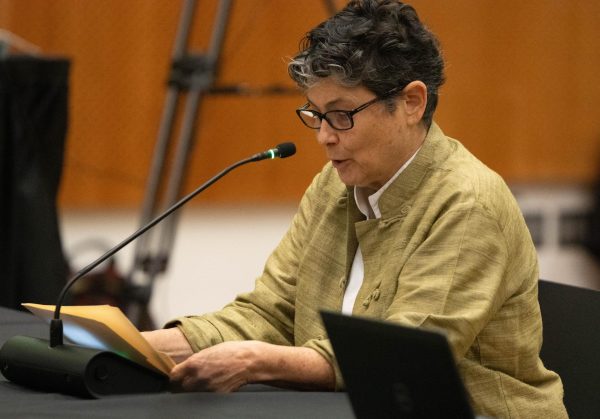
Maram Epstein, vice president of UA, said the announcement of new budget cuts only “heightened distress” after last year’s cuts were “devastating for morale, liberal arts, value of tenure and upholding the principles of shared governance.”
Vice President of United Academics Maram Epstein delivers remarks to the University of Oregon Board of Trustees regarding the university’s budget reductions ahead of public comment at the Ford Alumni Center on June 2, 2026, in Eugene, Ore. Public comment topics included budget cuts, climate goals, support for the Latinx Student Cultural Center and the Israel-Hamas war. (Tarek Anthony/Emerald) (Tarek Anthony)
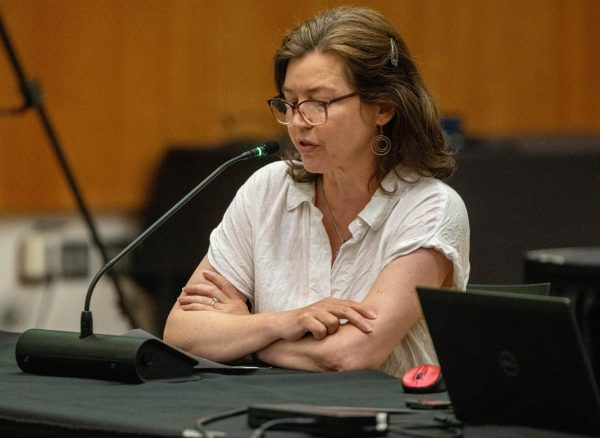
Jennifer Smith, president of SEIU and recently elected Eugene Ward 3 city councilor, questioned budget planning and said it was coming at the cost of workers at the university.
“(Trustees and presidents) are supposed to plan for the future we all knew was coming. They’re supposed to protect the mission of higher education and not undermine it,” Smith said. “Instead of leading, I see doubling down on strategies that are not working, and workers are paying the price.”
SEIU 503 President and incoming Eugene Ward 3 City Councilor Jennifer Smith delivers public comment during a University of Oregon Board of Trustees meeting at the Ford Alumni Center on June 2, 2026, in Eugene, Ore. Public comment topics included budget cuts, climate goals, support for the Latinx Student Cultural Center and the Israel-Hamas war. (Tarek Anthony/Emerald) (Tarek Anthony)
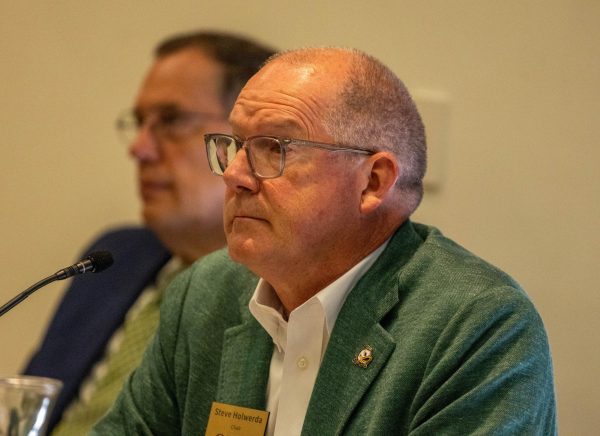
Between comments, Board Chair Steve Holwerda noted that the reason for the “more significant” cuts this year was the university’s decision not to adjust projected enrollment numbers last year.
“Had we made that change, we would have had to have made more significant cuts last year. We felt it was the right thing to do because we were hoping the decline was temporary,” Holwerda said.
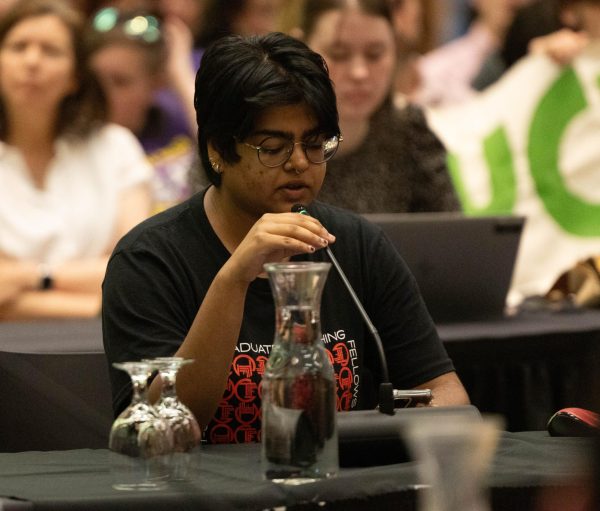
GTFF Co-President and Vice President for Equity and Inclusion Sanjula Rajat and Vice President for External Relations Jacob Schmidt advocated against the burden of cuts falling on educators and workers, pointing to how staff reductions will increase workloads for graduate employees and faculty due to larger class sizes.
Graduate Teaching Fellows Federation Co-President and Vice President for Equity and Inclusion Sanjula Rajat delivers remarks alongside University of Oregon graduate student Jacob Schmidt before public comment at a University of Oregon Board of Trustees meeting at the Ford Alumni Center on June 2, 2026, in Eugene, Ore. (Tarek Anthony/Emerald)
“We need to reconsider how we should organize our fiscal structure to prioritize the heart and blood of this university, its students and workers,” Schmidt said.
Schmidt also urged administrators to anticipate increased costs and staffing needs over time in the same way they “anticipate increased costs in the salaries of administrators and others over time,” rather than “pushing faculty and classified staff to the brink of strike” every bargaining cycle.
Several students also used public comment to advocate for a transition to cleaner energy on campus. Jack Dodson, a member of Climate Justice League, urged administrators to transition to an electric boiler system on campus.
Former ASUO President Prisilla Moreno, alongside Skyla Bird and Morgan Clemmer, members of the Student Planning and Construction Committee, presented a recommendation that the university use SPCC building fee funds to pay for the installation of an electric boiler system, which SPCC estimates will cost approximately $15 million.
Clemmer said SPCC funds could also be used to offset annual electric costs, which are estimated at $10.2 million annually. If immediate installation is not feasible, the money from the building fee would be placed in a separate account until installation can occur, effectively earmarking the funds specifically for the project.
The motion to use building fee funds was not approved by the board, but the resolution will move to a special meeting with administrators to further amend the proposal and revisit the issue at a later date. Holwerda said the administration will “try” to hold the special meeting before June 30.
Board Chair Steve Holwerda listens during public comment at a University of Oregon Board of Trustees meeting at the Ford Alumni Center on June 2, 2026, in Eugene, Ore. (Tarek Anthony/Emerald) (Tarek Anthony )
The 2027 operating and capital budget expenditure authorization, first presented during Monday’s meeting, requested approval of the university’s anticipated business expenses.
The fiscal year 2027 capital budget is projected at $211 million and includes several major projects across campus, from residence halls to academic buildings. Most of the funding for these projects comes from state bonds, grants and gifts.
Currently, expected revenue for 2027 is not projected to fully cover operating expenses. Moffitt said the financial office expects to adjust spending, subject to board approval, once actions such as budget cuts are taken to address the deficit in December.
An amendment was made to the expenditure authorization requiring UO leadership to develop a budget reduction plan, report that plan to the board and bring a revised 2027 operating expenditure authorization for a vote by Dec. 15, the second day of December’s board meeting. The amendment passed unanimously.
The motion for the capital budget expenditure authorization, including the new amendment, also passed unanimously.
The University of Oregon’s spring Board of Trustees meeting is being held June 1 and 2, in addition to meetings of the executive, audit and governance, and finance and facilities committees.
President John Karl Scholz and Senior Vice President for Finance and Administration Jamie Moffitt fielded questions about uncertainty surrounding the recently announced $65 million in budget cuts that will occur at the university over the next several years, noteable not ruling out potential cuts to tenured faculty.
The meeting began at 9 a.m. with updates on internal audit projects and treasury reports before the primary Board of Trustees meeting started at 11 a.m.
Administration remarks
In his opening remarks, Scholz discussed low nonresident enrollment and the reality of consistently decreasing out-of-state tuition revenue.
“We truly want to avoid having to cut budgets, and in light of the factors I mentioned earlier, there’s no reason we can assume that the environment next year will jump back to prior levels. We need to assume the recruiting environment for nonresident students has changed,” Scholz said.
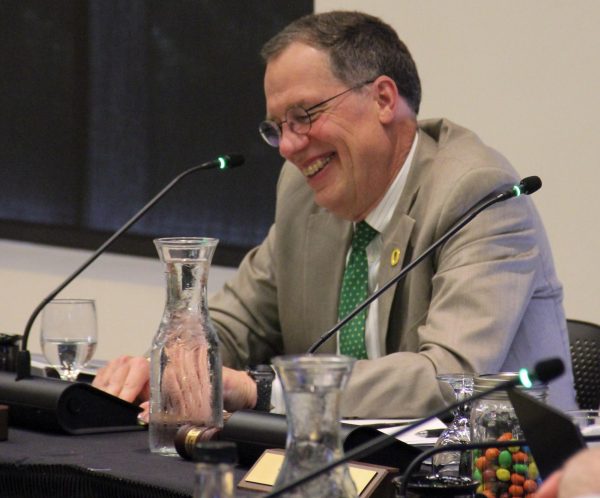
University of Oregon President John Karl Scholz laughs while transitioning between topics during a Board of Trustees meeting at the Ford Alumni Center on June 1, 2026, in Eugene, Ore. Trustees discussed the university’s ongoing budget reductions and their impact on campus operations. (Tarek Anthony/Emerald)
When asked whether tenure-track positions are at risk during this round of cuts, Scholz said it would be “premature to rule out anything off the table.” He said the public phase of the Academic Modification Advisory Committee process will occur in the fall and provide enough time for collaboration and consultation across campus before final decisions are made in December.
Provost Christopher P. Long urged “real and enduring solidarity” among campus leaders as decisions about cuts are made and commented on the AMAC process.
“However imperfect, the AMAC process builds on the formative efforts we made last summer to create the conditions for the senate to provide meaningful feedback on the difficult decisions we need to make,” Long said. “New habits, especially those that depend on trust, take time to develop.”
Long also spoke about the essential nature of universities and why changes must be made to further advance the institution and create a more compelling undergraduate experience.
Executive, Audit and Governance Committee update
Chief Auditor Anta Coulibaly provided an update on the activities of the Office of Internal Audit from March 1 through May 31. The report included an overview of completed and ongoing projects, as well as the status of corrective action plans being implemented across academic units.
One completed audit engagement involved the School of Journalism and Communication, where OIA identified two key areas for improvement. One finding was that travel expenses were not consistently documented, approved or compliant with university policy.
The SOJC audit came amid public controversy in spring 2025 over then-Dean Juan-Carlos Molleda’s travel spending and other issues. Molleda resigned in July 2025 following the controversy.
Additionally, Coulibaly said OIA identified gaps in authentication controls. OIA provided recommendations to SOJC management and is currently monitoring implementation of corrective action plans, though she did not elaborate on specific details.
In a completed audit of the College of Design, OIA identified three primary areas for improvement: financial oversight gaps, administrative control inconsistencies and compliance monitoring.
Because travel expenses were identified as an area of concern, Long noted during the meeting that all dean-level travel requests now go through the provost’s office.
The proposed 2027 audit plan prioritizes departments based on strategic alignment, time since the last audit, management concerns and risk level. Priorities will be identified through meetings with stakeholders across campus and discussions with the board.
Finance and Facilities Committee update
Moffitt, Brian Fox and Jeff Schumacher presented the quarterly financial report, treasury report and a budget and expenditure authorization that will require board approval.
Fox highlighted a projected $3 million reduction in net tuition and fee revenue and a $7.5 million reduction in personnel services costs due to decreased payroll expenses.
Moffitt noted that the budget had already incorporated approximately $17 million of last year’s $30 million in budget cuts. She said the additional decrease in spending reflects further reductions across departments. Service and supply expenditures are also expected to decline because of reduced departmental spending.
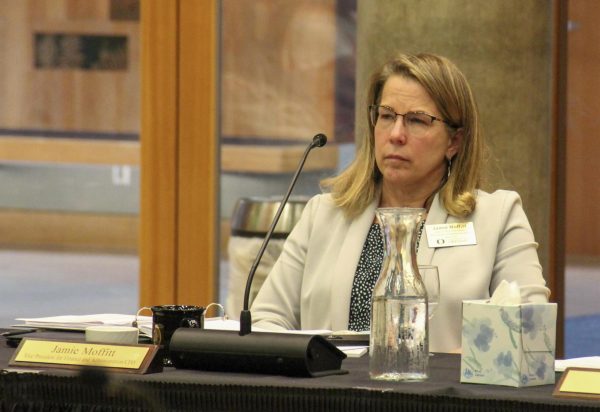
University of Oregon Senior Vice President for Finance and Administration and Chief Financial Officer Jamie Moffitt listens during the University of Oregon Board of Trustees meeting at the Ford Alumni Center on June 1, 2026, in Eugene, Ore. Trustees discussed the university’s ongoing budget reductions and their impact on campus operations. (Tarek Anthony/Emerald) (Tarek Anthony)
The third-quarter projection currently forecasts a year-end gain of $4.5 million, compared with the second-quarter projection of $500,000.
The finance and facilities department projects the university’s fiscal year 2027 operating budget at approximately $1.55 billion. The projected capital budget is approximately $200 million.
Currently, expected operating revenue for UO’s education and general fund — the university’s primary operating fund — is not expected to fully cover expenses. Fox said that as actions are taken to address the budget deficit, including anticipated cuts, the finance office has the authority to adjust spending within the budget approved by the board.
Salary expenditures are expected to increase, primarily because of pay raises required under union contracts. Fox said reductions implemented last year that will fully annualize this year are expected to offset those increases. Spending on supplies and services is also expected to increase by 2.9%.
State appropriations are expected to increase by 5.5%, while tuition revenue is projected to decrease by 1.7%. Indirect cost recovery revenue generated through sponsored grants is expected to decrease by 6.1%.
The fiscal year 2027 capital budget is projected at $211 million and includes several major projects across campus, including next-generation residence halls, continued construction on Friendly Hall and the UO Portland Child Behavioral Health Building. Most of the funding for these projects comes from state bonds, grants and gifts.
Approval of the fiscal year 2027 budget will be brought before the full board during Tuesday’s continuation of the meeting.
The UO Board of Trustees will reconvene Tuesday at 9 a.m. in the Giustina Ballroom at the Ford Alumni Center.
A truck going east on E. 15th Avenue hit a cyclist going south on High Street on Wednesday at approximately 1:30 p.m., fleeing the scene after injuring the cyclist.
The cyclist was transported to PeaceHealth Sacred Heart Medical Center RiverBend hospital with unknown injuries. After fleeing the scene, the driver abandoned the truck which law enforcement located in an unoccupied parking lot on 17th Avenue and Alder Street. The truck was determined to have been stolen.
Eugene Police are currently searching for the driver and at least one other occupant who was in the vehicle. Both were reportedly wearing black hoodies and face masks.
Anyone with information regarding the crash is asked to call 541-682-5111.
This story will be updated as further details develop.
A University of Oregon graduate student and employee was arrested Tuesday at the Frohnmayer Music Building and is currently in custody at the Lane County Jail on charges related to alleged immoral communication with a minor in Washington state.
Jerdil Liosony Castillo was charged in Benton County, Washington, in March with communicating with a minor for immoral purposes. He was also charged with failure to appear for arraignment in Washington.
Castillo’s arraignment in Benton County was scheduled for April 2. After he failed to appear, a bench warrant was issued the same day.
Castillo is a graduate student in the School of Music and Dance and has worked for the UO marching band since August 2025. According to his LinkedIn, Castillo worked previously as a substitute teacher and a music educator at school districts in Washington.
According to the U.S. Marshals Office in Eugene, the U.S. Marshals Service in Eastern Washington requested assistance Tuesday in locating and apprehending Castillo. The Eastern Washington office provided information regarding Castillo’s employment at UO and the location of his office.
Castillo was arrested Tuesday by Eugene marshals in his office after authorities confirmed his date of birth matched the warrant information provided by Washington marshals.
Under Oregon law, Eugene marshals had probable cause to arrest Castillo as a fugitive from justice, defined as an individual who flees from one state to another to avoid prosecution or conviction.
Castillo is being held at the Lane County Jail pending an extradition hearing.
Details regarding the allegations in Washington were not immediately available.
Castillo has been placed on paid administrative leave, according to UO spokesperson Angela Seydel.
This story has been updated to reflect comment from the university. This is a breaking story and will be updated.
The Eugene Water & Electric Board and the Upper McKenzie Rural Fire Protection District deployed spill response measures after a semi-truck carrying 275 gallons of diesel and thousands of gallons of milk crashed near a creek that flows into the upper McKenzie River.
At around 4:30 a.m., a tanker truck crashed near Belknap Springs, about an hour and a half east of Eugene. It was estimated to be carrying between 5,000 and 7,000 gallons of milk, which spilled into the water. McKenzie Watershed Emergency Response partners mobilized to contain the spill and do not expect drinking water to be impacted. The total volume of material that entered the water is still being assessed, according to a press release from EWEB.
Mitigation measures have been implemented, including a boom across Trail Bridge Reservoir, where milk is visible after the spill. EWEB Water Resources and Quality Assurance Supervisor Susan Fricke said in the press release that it would take a “significant amount of time” before the milk and diesel would reach EWEB’s Hayden Bridge Drinking Water Treatment Plant.
Additional responding agencies included Upper McKenzie Fire & Rescue, the Springfield Utility Board, the Oregon Department of Environmental Quality, Region 2 HazMat and the Oregon Department of Fish and Wildlife.
EWEB and its McKenzie River partners conducted a spill response drill at this location last fall, which the release said helped prepare response teams for an incident of this nature.
According to Oregon State Police, the 30-year-old truck driver fell asleep behind the wheel and crashed down an embankment along Highway 126. The driver did not require medical transport, and the vehicle has since been towed.
Editor’s note: This story contains descriptions of domestic violence and racist remarks that readers may find disturbing
A Eugene Police Department officer resigned Saturday after body camera footage showed the officer using “racist and deeply offensive” language against Black people, according to a statement from EPD Police Chief Chris Skinner.
In a four-minute clip of the body camera footage obtained and published by a community member, the officer was driving around the Eugene Federal Building during a protest that occurred on Jan. 30 and was on the phone with another individual. According to a timestamp on the footage, the call occurred around 7:30 p.m..
The protest had escalated and chemical munitions were being deployed on protesters in order to disperse the crowd. EPD had declared the protest a riot around an hour earlier.
Discussing the protest, the officer — whose name has not yet been released — can be heard saying “Oh, there’s gas everywhere” and laughing, and then goes on to say “And none of (the protesters) give a shit about illegal aliens. You know what I mean? They don’t know any,” to the individual they were on the phone with.
Later in the footage the officer, after talking about a cruise, asked “Which (company) do Black people go on?” followed by “they can’t swim. You’ve got to be able to swim if you go.”
The individual on the phone then named several foods associated with racist stereotypes.
Additionally, the officer and the individual on the phone call discussed two coworkers who had allegedly been physically violent toward their family members. According to the individual on the call, the coworker admitted to him that he would “grab” and belittle his wife.
The individual on the call then said another coworker was “doing the same shit,” and described how he “chucked” his daughter up against a wall and slapped her face. The officer then responded, asking “Isn’t that why he got fired?”
Skinner said in the statement that what was said in the video was “unacceptable” and did not reflect the values of EPD.
“There is no excuse for racist remarks from anyone who wears this badge,” the statement said.
The statement went on to say that “accountability must be real,” and that EPD will review its policies, trainings, supervision and culture to ensure this conduct is not tolerated within the department.
Independent Police Auditor Craig Renetzky said in a press release that the video contained comments that were “highly offensive, racist in their nature and simply put, disgusting.” Renetzky was made aware of the video Saturday at around 11:30 a.m., and immediately launched a preliminary investigation.
Renetzky said that he planned to immediately start the process of initiating a complaint and allegation of misconduct, but then heard that the officer had resigned. After the resignation, the auditor could no longer bring allegations of misconduct against the officer as they are only authorized to bring allegations to EPD employees.
However, Renetzky said that the preliminary investigation will continue to “ensure none of the other voices heard on the video are EPD employees,” and bring allegations against any employees if they are identified as being in the footage.