
Author Archives | Published From FLOW

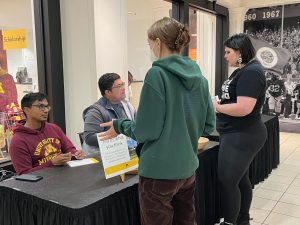
Maroon and Gold Network aims to give students path to success

The University of Minnesota’s Maroon and Gold Network offers help to University students and alumni with career-related connections and advice. 

The network is a free online networking tool from the University’s Alumni Association (UMAA) available for students and alumni to search for job opportunities by location, company and industry. 

Lisa Lewis, the president and CEO of UMAA, said the network was started to make it easy for students and alumni to connect digitally in a “non-intimidating way.” 

Marissa Smith, the associate vice president of engagement of the UMAA, said the platform makes it easier for students and alumni who are seeking career advice, networking and mentorship to engage with one another. 

“Students can join and find alumni to connect with for informational interviews, job shadowing opportunities and for the kind of conversations that open career doors,” Smith said.

Alumni can join the platform to give advice and share their experiences with current students or they can leverage it to find fellow alumni to connect with to advance their own careers, according to Smith.

Smith said there are more than 12,000 alumni across more than 70 countries who are currently active on the network.

“It’s just a really powerful and accessible way for our alumni around the world to stay connected to the institution and share their experiences,” Smith said.

Jessi Beyer, a 2019 graduate of the University, said she has used the platform to connect with other alumni which has been helpful. 

“Just having that connection of being alumni of the University of Minnesota was really great to get that door open, and people have just been so generous with their time,” Beyer said.

The network also provides students with the opportunity to work on projects, which are micro-internships supported by alumni, according to Smith.

“They are short-term professional assignments that can be completed in five to 40 hours,” Smith said. “Students can gain career experience, add a line to their resume and get a new connection with an alum.”

Muna Al Zubaydi, a 2023 graduate of the University, said she participated in a project through the network which allowed her to gain experience in marketing with a music composer as a student.

“For both of us, it was this learning experience,” Al Zubaydi said. “There was not a lot of pressure, and we gave each other room to experiment and be creative, which I really enjoyed.”

According to Al Zubaydi, she is still working with her project mentor on different projects and is grateful for the opportunities the network has given her. 

“This is an experience that you can use further,” Al Zubaydi said. “Even post-college, you can use it to secure a full-time job.”

All project experiences are either paid or unpaid, but Smith added the unpaid opportunities are supported through the Mooty Internship Scholarship.

According to Lewis, Bruce Mooty, who sponsors this scholarship, has a passion for helping students find their path, particularly if they have an economic obstacle in the way.

“Once a student has been selected for an unpaid project, they can apply for the Mooty Internship Scholarship,” Smith said. “We want to make it as easy as possible.” 

Beyer said the project she offered to students was unpaid, but the scholarship helped bridge a privilege gap between students who can afford to do unpaid work versus those who cannot. 

“Having the scholarship available really levels out the playing field for students, which is a good job that the University of Minnesota did with this program,” Beyer said. 

Richard Hinkie, who graduated from the University in 1968, said he wished the network existed when he was a student. 

“The closest thing I had to this network was a bulletin board in the journalism school,” Hinkie said. 

Hinkie has been involved as an alumni through the network, and he said he is happy to do anything to be of service to students.

Hinkie said he felt “paid back” by being a part of the network and felt inspired by the questions students asked and the depth of their curiosity about how the world works. 

Smith said community connections and networking make a difference for students as they navigate the transition from college to career, and having a tool that facilitates that transition is valuable.

“The Maroon and Gold Network is really about building social capital amongst all of our students,” Smith said. “The alumni network that University of Minnesota students are connected to is one of the biggest career assets that they have.” 
Posted in UncategorizedComments Off on Maroon and Gold Network aims to give students path to success

Jordan Nubin carries Minnesota to a 27-12 win over Michigan State

Minnesota Gophers football beat Michigan State 27-12 on Saturday, their first win against the program at home since 2009.

The Gophers were without their star freshmen running backs Darius Taylor and Zach Evans. In addition, Minnesota ruled out guard Tyler Cooper, giving freshman Greg Johnson his first career start.

Michigan State started redshirt freshman quarterback Katin Houser for the third time this season. Houser went 12-for-22 on pass attempts for 101 yards and an interception in last week’s 49-0 loss to Michigan.

A late October chill visited Minneapolis on Saturday just before kickoff with temperatures failing to breach anything more than 35 degrees. However, this did not stop Gophers linebacker Cody Lindenberg from warming up with the rest of the position group shirtless, preparing for his first game of the season.

Minnesota head coach P.J. Fleck headed into Saturday with a 1-3 record against Michigan State, the lone win coming last season in a 34-7 drubbing in East Lansing.

Gophers starting quarterback Athan Kaliakmanis started the game by evading the Spartans’ rush while hitting tight end Nick Kallerup in his hands, but the pass then dropped and fell incomplete. Running back Sean Tyler fumbled on the next play, handing Michigan State great field position.

Lindenberg, on his first drive back as a starter, made a crucial open field tackle to force a field goal on third down. Spartans kicker Jonathan Kim hit the 38-yard field goal, making it 3-0 Spartans.

Immediately, Fleck pivoted to walk-on running back Jordan Nubin on the next drive and picked up five yards. Tyler received the next touch on a backside screen. However, his knee was touching the ground upon making the catch, making it an eight-yard loss. Two plays later, the Gophers fumbled again, this time by Kaliakmanis.

Minnesota’s defense was bailed out on the following drive from a drop on third down by Spartan Tre Mosley. The drop forced Michigan State to settle for another field goal, putting them up 6-0.

Heading into the second quarter, the Gophers defense came up with their fourth stop. They continued to trail while the offense picked up possession inside their 20-yard line.

Receiver Daniel Jackson caught back-to-back first downs, one being a jump ball in double coverage that totaled 44 yards. Michigan State’s defensive back Dillon Tatum was called for defensive pass interference, giving Minnesota a first down in the Spartans’ red zone.

The Gophers failed to pick up a yard in three plays, leading Gophers kicker Dragan Kesich to kick a 35-yard field goal. The kick was blocked, keeping it 6-0 Spartans.

On the following Gophers offensive drive, Kaliakmanis was sacked for a loss of nine yards on first down. Tight end Brevyn Spann-Ford then made an incredible contested catch for 30 yards and tacked on an additional 14 due to a facemask penalty by the Spartans.

During the post-game press conference, Kaliakmanis said Spann-Ford showed who he is as a player against Michigan State, especially on the 30-yard completion.

“Things haven’t gone Brev’s way, and Brev would tell you that, but today he showed he’s Brevyn Spann-Ford, he makes huge plays in big games,” Kaliakmanis said. “That is what he does. There’s never a doubt in my mind with him, there never has been since I started playing with him.”

After the catch, Minnesota did not punch it in for six, so Fleck opted to call out Kesich to drill a 25-yard field goal, making it 6-3 Michigan State with 4:54 left in the half.

The Spartans started the next drive picking up 34 yards from a deep pass from Houser to receiver Montorie Foster Jr. Minnesota then stood tall on the next set of downs, forcing a punt from their 40-yard line with just over three minutes left in the half.

Kaliakmanis continued to feed Jackson, picking up 32 yards on back-to-back plays. While set at the Spartans’ 20-yard line, Jackson sprinted free across the middle on his route, beating the coverage and catching Kaliakmanis’ pass for a 22-yard touchdown. The Gophers star wideout put up six catches for 110 yards and a touchdown in the first half.

Jackson said during the postgame press conference Minnesota had been waiting to use the touchdown play the whole first half.

“We were actually trying to get a certain look for it all game, lining up in that formation, but we never got it, so we were like, ‘At this point, screw it,’” Jackson said.

Kaliakmanis impressed in the first half, going 13-for-18 for 190 yards, including the touchdown pass to Jackson.

After both teams went three-and-out, Michigan State moved it to Minnesota’s 36-yard line before attempting a 53-yard field goal, which went wide left, keeping the score in the Gophers’ favor at 10-6.

Kaliakmanis, under heavy pressure, hit Jackson again over the middle of the field for a first down on third-and-eight. Nubin picked up 13 yards on the next play, moving the offense further into Spartans territory.

Kaliakmanis underthrew receiver Corey Crooms Jr. and was intercepted by Spartans Jaden Mangham who returned it to his 14-yard line. Despite the promising drive that was cut short, the Gophers’ defense got off the field, forcing the sixth Spartans punt of the game.

Nubin’s 24th carry gave him his first career 100-yard game as a Gopher. Minnesota fed Nubin two more times in which he gained 17 yards while they drove downfield with under a minute left in the third quarter.

Nubin sprung his following rush outside and, with a legal crack block from receiver Christian Autman-Bell, scampered into the endzone, making it 17-6 Minnesota.

Michigan State replaced Houser with freshman quarterback Sam Leavitt and picked up back-to-back first downs, one being a 29-yard pass to receiver Jaron Glover to get inside Minnesota territory.

A few plays later, Leavitt found his receiver, Tyrell Henry, over the middle in the endzone for a touchdown. Michigan State went for two but Minnesota made the tackle short of the goal line and held the score at 17-12.

Minnesota recovered Michigan State’s onside kick attempt with 8:36 left in the fourth quarter.

Kaliakmanis escaped the pocket on third-and-five and ran for seven yards. A defensive holding call added on five more, moving the Gophers to the 24-yard line.

Nubin was handed three straight touches, combining for 22 yards to the Michigan State two-yard line. Nubin took one more carry and fell into the endzone for the score, pushing the score to 24-12.

The Gophers reclaimed possession soon after with defensive lineman Jah Joyner knocking the ball out of Leavitt’s hands. Nubin got two straight carries, the second going for three yards and putting him over 200 yards on the day. His 40 total carries made him the second player to reach 35 or more carries during Fleck’s time at Minnesota.

During the postgame press conference, Fleck said that Nubin took advantage of his opportunity and spoke to his work ethic.

“Everybody wants their opportunity, then it is there, you don’t get to pick when that opportunity comes,” Fleck said. “He’s always been ready for his opportunity, always … he just works harder.”

Kesich drilled a 31-yard field goal, putting the Gophers up 27-12 with 3:25 left in the game.

Minnesota went back to their ground-and-pound identity with 26 rushing attempts and only one completed pass in the second half.

The last play of the game concluded just after the Spartans marched down the field. Leavitt launched it toward the endzone in a desperate attempt to score but was intercepted by Gophers defensive back Tre’Von Jones, sealing a Minnesota victory.

Minnesota will remain in Stadium Village next week as they host the Illinois Fighting Illini on Saturday Nov. 4 with kickoff scheduled for 2:30 p.m.

Posted in UncategorizedComments Off on Jordan Nubin carries Minnesota to a 27-12 win over Michigan State

UMN honors program students reflect on changes made to academic advising program

Honors students received new academic advisers this semester following a revamp of the honors advising program last spring which caused students’ advisers to frequently change. 

The honors advising program shifted to a supplemental advising model, allowing students to work with an honors program-specific adviser in addition to supplemental advisers often related to students’ majors. At times, students may have up to three advisers who each serve a different purpose. 

Jenna Elbers, a third-year kinesiology honors student, said she now has three advisers after dealing with the changes occurring last spring. Elbers changed her major last year as the advising program started the transition to the supplemental advising model, which made it difficult for her to communicate questions. 

Elbers has one adviser from the College of Education and Human Development who deals with general student services issues, another adviser from the kinesiology department who deals with major-specific questions and an honors adviser who deals with questions about the honors program. 

“Now that I’ve met with all three advisers, I feel like I have more of an idea of who I should go to for what issues,” Elbers said. “Starting off, I didn’t know who to meet with first, so I would meet with one person and have questions and they couldn’t answer any of my questions and would refer me to one of my other advisers.” 

Elbers said it has been difficult having three advisers as opposed to one adviser who could answer every question. 

“I never had any issues communicating with my old adviser because she almost always answers my questions or gave me direct contacts of people I should reach out to with my questions,” Elbers said. “Now it’s a little more work for me to go to one adviser for certain questions and another for different questions.” 

Jordan Voigt, a third-year architecture student who is also in the honors program, said she got a new adviser last spring as part of the changes to the advising program. According to Voigt, her adviser last year gave her incorrect information about recommended classes as she is attending a study abroad program in Denmark next semester. 

“She advised me to take a specific studio (a 6-credit architecture class) and another specific class that supposedly are made to fill our requirements for graduation,” Voigt said. “After getting my new adviser from the College of Design, I met with him to talk about those classes and emailed him about it and he said, ‘Actually, those are wrong.’” 

After she brought up these issues with both her new honors adviser and design school adviser, Voigt said her honors adviser had no idea what she was talking about. 

“She was pretty much like, ‘Who told you that?’ and kind of gaslighted me. I said, ‘You told me that,’” Voigt said. “It was stressful because it was the beginning of the semester and I was trying to figure out study abroad stuff.” 

Voigt has not talked to her honors adviser since their last interaction and said she now relies mainly on her design school adviser for questions. Having three different advisers is unnecessary as a lot of her questions deal with class requirements for both the honors program and her major, according to Voigt. 

“You’re busy and stressed out with classes, so you don’t want to be stressed out with trying to figure out how your advising works to figure out your classes,” Voigt said. 

Some students say having one adviser made getting assistance easier and less complicated. 

Helen Atkins is a second-year cellular and organismal physiology student in the honors program and has not yet met with her new advisers. Like Elbers, Atkins said she has an honors program-specific adviser, a College of Biological Sciences adviser and a School of Music adviser for her music minor.

“I have about five questions I need to ask an adviser, but due to the new structure of advising, I will need to make appointments with three separate advisers to get these questions answered,” Atkins said in an email to the Minnesota Daily. “As a full-time student with a rigorous course load and part-time job, it can be overwhelming to fit multiple advising appointments in.” 

Atkins understands why the advising changes had to be made but said she feels the situation surrounding the advising program has not been resolved. 

“During the first semester of last year, I had a few meetings and conversations with my adviser and I had reached a point where I felt like we were both familiar with each other,” Atkins said. “This personal connection has been lost this year with the addition of multiple advisers and will be time-consuming to rebuild.”

Posted in UncategorizedComments Off on UMN honors program students reflect on changes made to academic advising program

Review: Killers of the Flower Moon

“Killers of the Flower Moon,” directed by the renowned Martin Scorsese, delves into a somber period of American history full of greed, corruption and bloodshed.

The film is an adaptation of David Grann’s book of the same name. The story revolves around the Osage Nation, an indigenous group relocated to Osage County, Oklahoma, in the late 1800s. Their land happened to be above enormous oil deposits, which led to an extreme wealth in the community. It also made them a target of a dark conspiracy to steal their fortunes.

Leonardo DiCaprio plays Ernest Burkhart, a soldier who has just returned home from World War I. He is housed by his uncle, William King Hale (played by Robert De Niro), a wealthy man who has befriended the Osage people.

Burkhart is an extremely unlikeable character. He will do whatever it takes to get more money — even at the expense of his own wife and mother of his children. However, DiCaprio’s quest for greed does not have the bold determination seen in his portrayal of Jordan Belfort in “The Wolf of Wall Street.” Instead it is more comparable to his role as Rick Dalton in “Once Upon a Time in Hollywood,” in that they both have a weak, compliant nature.

It’s hard to imagine the head of organized crime in a Scorsese movie being played by anyone other than De Niro (see “Goodfellas,” “Casino”), and this performance proves why. Through his charisma and steadiness, he is able to mislead the Osage people into befriending him, despite his heinous maneuvers out of their sight.

The standout performance, however, does not come from the big-name actors. Instead it comes from Lily Gladstone who plays Mollie Burkhart, Ernest’s wife. There is a sadness and fear in her acting as if she witnessed the Osage murders first-hand. This is Gladstone’s breakout performance and surely one to solidify her as a renowned actress.

Jesse Plemons was a great choice as a force of good in the movie. He plays Tom White, a former Texas Ranger who is sent by the Bureau of Investigation (what will eventually become the FBI) to investigate the murders. He is calm and level-headed as he pieces together the evidence of the murders despite push-back.

One surprisingly excellent performance was Brendan Fraser as Hale’s lawyer. It is a small role, but Fraser used what he had. This role along with his commitment to his role in “The Whale” could be the start of the actor’s comeback.

Despite the movie being almost three and a half hours long, there is no overkill. Every scene progresses the story in an important way as the horrors get more ugly and vile.

Scorsese’s love of film is seen in every shot, which makes this picture an immersive experience that grips audiences and offers a moving reflection on the injustices indigenous tribes have endured throughout history.

There is a certain darkness throughout the film that lingers even after the credits are rolling, but it is a story that needed to be told. It will increase awareness of these incidents as well as the larger problems with racism, inequality and greed that characterized the time.

“Killers of the Flower Moon” explores the horrific background of the Osage Indian killings and has all the makings of a memorable cinematic experience: a strong cast, a brilliant director and a story based on actual historical events. It’s a must-see for movie lovers and history buffs alike.

Posted in UncategorizedComments Off on Review: Killers of the Flower Moon

UMN welcomes a new director of the School of Music

The College of Liberal Arts (CLA) welcomed Patrick Warfield, the recently appointed director of the School of Music (SoM), to the University of Minnesota at an event on Thursday. 

The event, hosted at the residence of CLA alumni Anders Folk on Lake Harriet, brought together faculty, students and members of the broader arts community in the Twin Cities.

Warfield said he views music not just as an art form but as a powerful cultural force intertwined with economics, class, race and gender, with the unique ability to bring people together.

Ann Waltner, interim dean of CLA, said Warfield is an exciting and dynamic individual who she hopes will make the “already wonderful” SoM better.

“The music department is particularly important as a way of connecting the University with the community,” Waltner said. “He understands the potential for doing that.”

Warfield’s journey into music began in his early years, when he was drawn to the sense of community it fostered. He received his undergraduate degree in music education from Lawrence University and a graduate degree in musicology from Indiana University.

Throughout his career, Warfield said he sought to bridge the gap between audiences and complex compositions. From providing talks for the Chicago Symphony to demystifying operas, he has worked to make classical music more accessible and engaging.

Before coming to the University, he served as the associate director of the University of Maryland’s School of Music.

His move to the University of Minnesota was not only a professional shift but also a personal one, as he said it allowed him and his wife to return to the Midwest where they both are originally from. Warfield said he is inspired by the local arts scene in the Twin Cities.

Warfield added the arts are especially important during this extremely divisive time.

“The arts bring people together and allow us to talk to each other even when we come from very different places,” Warfield said.

He said the arts also have an incredible power to create and inspire change.

“I believe in the STEM fields, I think they’re hugely important,” Warfield said. “But if the sciences were going to fix our world, they would have done so by now.”

Warfield added he envisions a transformation in music education, aiming to broaden the curriculum beyond Western European classical music and expand to music throughout the rest of the world.

Maja Radovanlija, a teaching specialist in guitar at the SoM, said Warfield is already working to support the SoM’s community.

“He will be very supportive of what we already do,” Radovanlija said. “We have a very diverse community, but he will probably be diversifying more and supporting collaborative ideas that are happening.”

Warfield said the impact of the COVID-19 pandemic on arts is evident, and he is determined to innovate to help students rebuild their arts knowledge. 

“We have to rethink everything we’re doing, to think about how to build up again the skills, the talent, the approaches that were lost during the pandemic,” Warfield said. “I see that as an opportunity. It means we can rethink in basic ways about accessibility and inclusivity.”

Warfield’s approach to music education extends beyond the stage. He said students should recognize the diverse career paths available within the field, from performers to educators, sound engineers to composers. Warfield added he and his faculty are actively working to engage students who may not have initially considered majoring in the arts. 

Warfield plans to offer programs that allow students to explore their musical potential through combining different interests.

“I like to think of my role as wanting to be a dream maker,” Warfield said. “I want to know what people want to do and help them get there.”

Warfield added he wants to see a University where the arts are not just a supplement but an integral part of the institution’s identity.

“When it comes to whatever it is we’re caring about as a university, they should remember that the arts play a role in all of those questions,” Warfield said.

Warfield said, as an administrator, he wants to build a community where students can speak with him about their problems or music.

“I want you to be excited by all the sounds there are in the world and imagine what they mean, how they’ve been used, sometimes how they’ve been misused,” Warfield said. “And remember the beauty of just opening your ears and hearing the world.”

Posted in UncategorizedComments Off on UMN welcomes a new director of the School of Music

The return of Dinkytown McDonald’s

Nearly three years after the iconic golden arches left the neighborhood, McDonald’s is preparing to make its return to Dinkytown.

The popular fast-food chain was a staple for students along Fourth Street Southeast and 15th Avenue Southeast for 57 years before its closure in Dec. 2020. Now, a new McDonald’s is tentatively scheduled to open next week in the same place as its predecessor under the newly constructed Identity apartment building. 

The restaurant will be updated to be fully digital with kiosks where people can order and will have no drive-thru, unlike the previous location, according to Melissa Smith-Kennedy, owner of the new McDonald’s. Smith-Kennedy said she is excited to open in Dinkytown because of students and the decades-long legacy the previous McDonald’s built in the neighborhood. 

“You never really need to go backwards in time,” Smith-Kennedy said. “All you can do is take what you have in front of you and you go forward.” 

Smith-Kennedy added she is looking forward to working in a student-based environment because of the long history McDonald’s has with Dinkytown and its residents and the unique sense of community students bring. Although she appreciates the legacy of the previous building, Smith-Kennedy said the new restaurant will change to better serve students. 

“For us to treat it as anything different from that would be not fair to the University or that area,” Smith-Kennedy said. “You have to go into it with an open mind and be open to learning, being open to listening, and we’ll adjust accordingly.”

Susan LoRusso graduated from the University of Minnesota in 2017 and said McDonald’s was a major part of the student culture in Dinkytown. The restaurant, endearingly referred to as “Drunk Don’s” by many students, was a popular hangout spot for people near campus, according to LoRusso. 

“I don’t think we thought much about the legacy just because it just was part of the fabric of Dinkytown at the time,” LoRusso said. 

Between the condensed student housing and small businesses, the spacious restaurant stood out for its bright red and yellow exterior and instantly recognizable architecture, LoRusso said. As people stepped into the building’s interior, the restaurant was reminiscent of the 1970s, when the restaurant was in its youth, and was a step backward in time against a neighborhood that began to change, according to LoRusso. 

However, LoRusso added that Dinkytown’s gentrification in recent years, with new restaurants and high-rise apartments, has made McDonald’s absence more impactful for those who remember the history and nostalgic charm it resembled in the neighborhood.

“There was a quaintness to [Dinkytown] that doesn’t really exist too much anymore,” LoRusso said. 

Current University student Rachel Gerszewski said she is happy to see McDonald’s back in Dinkytown because of its affordability combined with the opportunity to be a part of a culture students before her have gotten to experience.

Gerszewski added that the history of the previous McDonald’s has added to the anticipation for the new one with people raving about this restaurant before it even opens. 

“It’s not like, ‘Oh, they’re just adding a McDonald’s,’” Gerszewski said. “It’s like, ‘Oh my God it’s coming back.’”

Posted in UncategorizedComments Off on The return of Dinkytown McDonald’s

New USG committee aims to resolve technology-related student issues

The Undergraduate Student Government’s (USG) new Technology Ad-Hoc Committee, adopted this fall, aims to tackle technology-related issues across University of Minnesota-sponsored platforms. 

The committee will work on projects that directly affect students, such as digitizing U-Cards and improving transportation apps like Gopher Chauffeur and Gopher Trip.

USG members Peter Nguyen and Daniel Tobias will serve as the committee’s co-chairs and talked about what they are looking forward to while serving.

“I was really excited to work on this committee just because so many of these issues with transportation and with facilities have technological solutions that are going to be really good to tackle,” Tobias said. 

The idea of a Technology Ad-Hoc Committee was first introduced last spring and was passed down to Nguyen. In searching for a co-chair, Nguyen said he was looking for someone with experience chairing a USG committee and Tobias seemed like the best fit. 

“Daniel has experience,” Nguyen said. “There’s a ton of expertise. He’s just someone you can kind of lean on and rely on in terms of the projects and things like that.”

Nguyen added many of the issues the Technology Ad-Hoc Committee will deal with have considerable overlap with advocacy projects, such as improving the University’s transportation apps, within the Infrastructure Committee that Tobias chairs. So, it made sense to include Tobias on the team.

Technology Ad-Hoc differs from most USG committees because it will include fewer members, is less process-based and aims to change technology students use rather than policies that affect students, according to Nguyen and Tobias. 

Tobias said the unique structure and process of the Technology Ad-Hoc Committee will allow the committee to focus its work on technology-related issues. 

Also differing from tradition, Nguyen said he hopes to get more of the general student population involved with the Technology Ad-Hoc Committee since student input is particularly important when dealing with technology issues. According to Nguyen, the general student population is welcome to serve on any USG committee, though most members are typically USG voting members. 

“For this committee where there’s just a lot of expertise that could go into it in terms of technology, it would be really cool to have a lot of people from outside USG with that kind of expertise get involved,” Nguyen said. 

Tobias said collaboration between the Technology Ad-Hoc Committee and other committees, like its partnership with Infrastructure, will be central to the committee’s function. 

“They’re gonna be big projects that require efforts from a lot of people,” Tobias said. “Really just having more people that work on those projects is going to be really good where we can have people from this committee, who obviously are going to be focused on that, but then also people from the Infrastructure Committee that want to help out.”

Cora Goodwin, a second-year student and member of the Technology Ad-Hoc Committee, said she joined due to interest in the committee’s initial projects but had ideas of her own she wanted to work through the committee. 

Also a member of the Academic Affairs Committee, Goodwin said she joined USG with the goal of creating a standardized Canvas template. Since this combines Goodwin’s interest in both technology and academics, she said she was excited to collaborate on a change that she would have appreciated as a new student. 

Since arriving at the University, Goodwin said she wanted to improve issues with Canvas and make the bus app more accurate.

“Those were things I cared a lot about and made me want to join USG and then I hear, ‘Oh, there’s gonna be a tech committee,’” Goodwin said. “Everything I want to do fits perfectly into that committee.” 

Like other USG committees, much of the proposed changes that pass through the Technology Ad-Hoc Committee will be born from student input, Goodwin added. 

Nguyen said he feels it is important for the Technology Ad-Hoc Committee to harness student efforts in its work because it will deal with many technology-related issues students combat daily.

Nguyen added he hopes a collaboration between the committee and University administrators or stakeholders will prove the University’s recognition and prioritization of student issues, further incentivizing students to give their input.

“Sometimes it feels like the best you can hope for is a co-sign,” Nguyen said. “But I hope they are willing to help us and we go into directly collaborative work, or a worker who directly works on an app gets involved, I think [that] would be cool.”

Posted in UncategorizedComments Off on New USG committee aims to resolve technology-related student issues

UMN students and faculty share thoughts on next University president

The Presidential Search Advisory Committee (PSAC) held seven listening sessions over the past two weeks to encourage students and faculty to speak on what they would like to see from the next University of Minnesota president.

The Board of Regents tasked PSAC at the October meeting to listen to student, faculty, staff and other University voices, generate a profile for potential presidential candidates and present the board with two to four finalists.

Regent Mary Davenport, chair of PSAC, said it is important to have a search committee made up of diverse voices and viewpoints. The goal of the search committee is to find the person who would be the best fit for the University.

“This position is the position in academia that’s out there,” Davenport said. “There are a lot of opportunities to take this University to the next level and excel.”

At the Oct. 20 listening session, Davenport was absent from the first half because she had broken off with the student representatives from the committee to talk to students directly at Coffman Memorial Union.

Davenport was originally supposed to sit in on the listening session, but the trip to Coffman was a last-minute change. She said it was a way of gathering more student input due to a lack of student presence at the meeting on Oct. 17.

One of the most common themes Davenport said she heard from students was how they wanted a president who would connect with their students.

“Students want to know who their president is,” Davenport said. “They want a president that’s visible and that listens to the students.”

Davenport added that speakers from listening sessions at other University campuses systemwide had praised Interim President Jeff Ettinger for his frequent visits to non-Twin Cities campuses.

According to Davenport, the people who spoke wanted to see a similar level of engagement from the next president.

Gurasis Singh, a member of the University’s Undergraduate Student Government, went to the Oct. 17 listening session. He said the next president should have a greater presence on campus and engage more with the community.

Singh added he would like to see the next president make the University’s administration more accessible and understandable to students and staff.

According to Singh, understanding how the University operates would make it easier for students to navigate the University’s systems and advocate for change.

UMN students stop by an impromptu listening session held on Friday, Oct. 20 in the basement of the Coffman Memorial Union. Some members of the PSAC broke off from the main listening session on the West Bank to gather more student comments. (Image by Office of the Board of Regents (courtesy))

Singh said he tried to connect with the Office of Student Affairs (OSA) to talk about some problems he was having with the dining system but later found out OSA did not manage university dining. His experience inspired him to push for change.

“It sounds little, but when you’re trying to make changes and direct up the stream of policymakers, it doesn’t make sense,” Singh said.

Cal Mergendahl, a graduate student at the University, said at the Oct. 17 session they believe the next president should not just focus on the Twin Cities campus.

Mergendahl, who spent their time as an undergraduate student on the Morris campus, said there was a disconnect between the rural campuses and the Twin Cities.

According to Mergendahl, making room for the president to listen to graduate students and students from other campuses outside of the Twin Cities would foster a sense of community systemwide.

“Too often people have gotten into a sense of, ‘It doesn’t matter, they won’t listen anyways,’ and fighting that apathy has been a challenge,” Mergendahl said.

The Oct. 20 listening session heard opinions from faculty members, ranging from ones who started recently to tenured ones.

Eva von Dassow, a professor of classic and Near Eastern religions, said she wanted the next president to have recent experience in fulfilling the University’s mission of teaching, research and engaging with the community.

Von Dassow said fostering relationships in the community would help with the state legislature. State legislators look at the University and do not see an institution where funds are well-allocated.

The way legislators view the University affects state funding and causes the University to raise tuition, von Dassow said.

Von Dassow added students either choose a cheaper university or a major they may not want to study that guarantees a high-paying job to pay back student loans. The next president needs to change the funding system to stop this “feedback loop.”

“We can’t treat the students as ATMs,” von Dassow said. “The funding structure has got to be different than what it is now so that our students are not so constrained when they come here.”

The public listening sessions have concluded, but Davenport and Chris Uggen, vice chair of PSAC, are holding individual listening sessions with other groups like alumni and state legislators.

The committee will review applicants and submit their recommendations to the Board of Regents by late January. The Board will discuss their choices of finalists during the February meeting, and open forums with the finalists will be held systemwide for the rest of the month.

PSAC will select the next president by late February or early March.

Students and faculty who still want to voice their opinions can submit comments through the Board of Regents’ public virtual forum.

“I want to say to you, ‘Just trust us,’ but test us,” Davenport said at the first listening session. “I hope you’re feeling, we’re listening because we want to hear you.”

Posted in UncategorizedComments Off on UMN students and faculty share thoughts on next University president

New financial aid changes frustrate undergraduate students

University of Minnesota students are adapting to changes in their financial aid situations as student loan repayments resume this month. 

Student loan repayments were temporarily stopped due to the COVID-19 pandemic but returned after the Supreme Court struck down President Joe Biden’s plan to eliminate $400 billion in student debt.

Students will receive their first bill at least 21 days before the payment’s due date. Payment plans and other resources are available for students who require additional assistance for federal student loans. 

Changes to the Free Application for Federal Student Aid (FAFSA) were announced this month by the U.S. Department of Education following the passage of a new federal spending bill passed this year. 

Some of the changes include a new Student Aid Index replacing the Expected Family Contribution index on the form and requiring consent for student tax information from the Internal Revenue Service (IRS) to be transferred into the FAFSA application. The FAFSA application, which normally opens Oct. 1, is expected to open Dec. 1. 

Simon Hill is a third-year social work student who transferred to the University of Minnesota from Century College and took out loans to attend both institutions. Hill said he is stressed about having to repay his loans once he is finished with school, so he has a job that allows him to pay off his loans and afford everyday goods. 

“I’ve always known that I’ve had to take loans, that’s what my parents have said and that’s what everyone in my family has done, so it was expected of me,” Hill said. 

Hill added he plans to attend graduate school as a mandatory requirement for his major and hopes graduate employers will pay for his graduate school expenses to ease the burden.

Hill said he wishes the federal student loan forgiveness program was not struck down by the Supreme Court, as it would have made his situation easier. Hill added he has scholarships and the Pell Grant as additional financial aid. 

“I was really happy to hear about the SAVE repayment plan, so that gives me hope about future stuff regarding student loans, but I’m waiting for it to come through,” Hill said. 

The Saving on a Valuable Education (SAVE) repayment plan calculates a student’s monthly loan payment based on income and family size, according to the U.S. Department of Education.

According to the National Center for Education Statistics, 32% of undergraduate students at the University received aid in the form of federal student loans during the 2020-21 school year. 

The data also shows that 82% of full-time students received some form of financial aid, such as scholarships and grants. 

Carter Yost, director of government and legislative affairs for the Undergraduate Student Government (USG), said he wants students to receive an education at a higher-level institution with no barriers to their learning. 

“In talking to students on campus and across the state, there’s a mix of dread and disappointment,” Yost said. “I know there are students who are committed to doing the best they absolutely can to untether themselves from a career of debt.” 

For the past year, USG has been working on lobbying for programs that would eliminate some financial barriers students face when paying for student loans and going into debt. Last spring, USG lobbied for the passage of the North Star Promise Scholarship Program that passed as part of the state’s higher education omnibus bill. 

The North Star Promise Scholarship Program, created by the state of Minnesota’s Office of Higher Education, serves to make college affordable for students by covering the full cost of tuition and other fees. 

Eligible students must be Minnesota residents attending a public higher education institution or tribal college and report a family-adjusted gross income below $80,000 on their FAFSA application. They must also be a degree-seeking student who has not yet received their degree and maintain good academic standing. 

“With repayments starting this month, we’re going to see students and former students continue to struggle with a really economically devastating system,” Yost said. “We’re continuing to try and explore and support ways that the federal government and the state government can reduce that burden on students and ensure that anyone who wants to be able to attend college can do so affordably and feasibly.” 

One Stop Student Services and the Office of Student Finance are ensuring students have plenty of accessible resources for financial aid needs and that the changes to the FAFSA will not affect student loans. 

In an email sent to the Minnesota Daily, the offices said students should reach out to their loan servicers to determine any impacts to their financial aid. 

“Most students will not be required to start making payments on their student loans if they are currently enrolled at least half-time,” One Stop said in the statement. 

One Stop is working closely with various University departments and local school districts to provide presentations about student loans to students, which will begin in late winter and early spring. 

“In a typical year, One Stop staff begin to hear more questions about FAFSA and financial aid for the next academic year beginning in October,” One Stop said. “However, with the delayed launch of the FAFSA, we anticipate those questions delaying until December.” 

Posted in UncategorizedComments Off on New financial aid changes frustrate undergraduate students

Minnesota football’s joyous reaction over the return of Floyd of Rosedale

For the first time in 30 years, Minnesota football holds possession of both the Floyd of Rosedale and Paul Bunyan’s Ax. 

Minnesota, fresh off an embarrassing loss at home against Michigan, made a nine-point comeback, beating the rival Iowa Hawkeyes and reclaiming Floyd for the first time since 2015.

The Gophers have preached complimentary football and achieved it in all regards after the win. Their defense held Iowa’s strong rushing attack to just 11 yards on 28 carries while the offense responded when called upon, setting Dragan Kesich up to make three field goals and seal the victory.

Minnesota head coach P.J. Fleck said during a press conference Monday morning the team had planned to hoist the pig in pairs.

“Coach [Dan] Nichol, who’s our strength coach, told me it’s definitely heavier than 98 pounds,” Fleck said. “I did tell [the players] ‘when you go over there, run to go get it. We had a buddy system because it is really heavy.” 

Raising Floyd of Rosedale meant the world to some of the players who had never beaten Iowa during their time at Minnesota.

Gophers Brevyn Spann-Ford, Nathan Boe and Chris Autman-Bell have totaled 19 years of college football with Minnesota but had never beaten Iowa before last Saturday afternoon. Minnesota’s Offensive Coordinator Greg Harbaugh Jr. told the media on Wednesday those three players were prominent vocal leaders leading up to the game.

“All three of them really took a huge hand in talking to the offense every day,” Harbaugh said. “Brevyn had struggled, but at that moment when we beat Iowa, all that went away.”

The recent struggles against Iowa were a burden on coaches and players. Fleck and defensive coordinator Joe Rossi had not beaten the Hawkeyes until this season.

During the postgame press conference on Oct. 21, fifth-year safety Tyler Nubin said the Iowa game factored into his decision to return to Minnesota.

“After that Iowa game last year, going into my decision, I wanted one more shot at it,” Nubin said. “I wanted to go one more shot with my brothers this season, at this game especially, playing here at Kinnick Stadium.”

The weight has seemingly lifted off the shoulders of Gopher players and their fans after conquering a challenge that seemed insurmountable heading into the season.

However, Minnesota has to keep looking ahead as they face Michigan State on Saturday. Gophers quarterback Athan Kaliakmanis seconded this during a Wednesday afternoon press conference.

“That was a great win, meant a lot for sure, tons of emotion, but it’s time to go 1-0 in the Michigan State season,” Kaliakmanis said.

The terms “1-0” and “Iowa season” are used frequently by the team to show their supreme focus on the game in front of them. Fleck preaches preparing for every week like a season, so the players take on that burden of putting in the extra effort to prepare.

Michigan State will arrive at Huntington Bank Stadium on Saturday as losers of their last five games. The Gophers will seek their fifth win of the season and improve to 3-2 in Big Ten play.

Posted in UncategorizedComments Off on Minnesota football’s joyous reaction over the return of Floyd of Rosedale