Author Archives | Published From FLOW

Gophers men’s hockey at the one-third mark of Big Ten season

After splitting their series versus the Michigan State Spartans this past weekend, the Gophers are one-third of the way through their Big Ten season.

Minnesota has a 3-3-2 record through eight games in conference play. Eight more series, or 16 more games, remain on the Gophers’ Big Ten schedule.

Jimmy Clark, a first-year forward, helped Minnesota move from sixth to fourth place in the conference with his game-winning goal in overtime against Michigan State on Sunday.

The Gophers lost the first game of the Michigan State series in a shootout on Friday night after holding the lead on three separate occasions.

After winning the second game, head coach Bob Motzko said the series was a microcosm of Minnesota’s season.

“It was the good, bad and ugly at times,” Motzko said.

The Gophers traded goals with the Spartans all weekend. Michigan State had a total of six game-tying goals throughout the series.

Although they struggled with maintaining leads, Minnesota’s power play was successful against Michigan State, scoring four power-play goals over the weekend.

Motzko said the eight conference games the team has played have been tough. He added these games, especially games where a smaller lead needs to be protected, are learning opportunities for young players.

“They have to understand that it’s a long year and these games are hard,” Motzko said.

In their last four series, Minnesota has won one game and lost or tied in the other. The Notre Dame series was the only series involving a regulation loss.

“We’re probably the most under-the-radar team there is,” Motzko said. “We’ve only lost one game in the last month and nobody knows it, even our guys don’t know it.”

Gophers co-captain Jaxon Nelson said the team is as good as last year despite losing Logan Cooley, Brock Faber and Matthew Knies to the NHL.

“I think we’re just as good as last year’s team and I think some people overlook that,” Nelson said. “We just have to learn how to play differently than last year’s team. We’re not going to win every game in the parking lot and we have to win the games within the 60 minutes.”

Alternate captain Bryce Brodzinski said the team cannot take any nights off through one-third of the Big Ten season.

“We want to give ourselves the best chance of making the playoffs at the end of the year,” Brodzinski said.

Through all 14 conference and non-conference games, Brodzinski leads the team in scoring with eight goals and eight assists. He had five points in the series against Michigan State.

Brodzinski has been on a line with Nelson, who is second on the team in points, and Mason Nevers.

Motzko said that line, consisting of a senior and two graduates, has been helping younger players mature due to their experience.

“That line is just kind of putting the weight of our team on them,” Motzko said.

The Gophers continue their streak of playing against ranked opponents as they head into their next matchup against No. 18 Penn State. Minnesota has played a ranked opponent ever since their second series of the season.

Nelson said playing on the Gophers means facing top teams like North Dakota, Minnesota State-Mankato, Minnesota-Duluth and the Big Ten conference.

“We know we’re going to have a tough schedule, that’s why we came here,” Nelson said.

All but one team in the Big Ten, Ohio State, is ranked on U.S. College Hockey Online’s most recent national poll. However, Ohio State started the season ranked No. 13 and fluctuated in rankings, eventually falling out of the poll on Nov. 13.

After this weekend’s series against Penn State, Minnesota will travel to Columbus, Ohio to play Ohio State for their final series of 2023.

Posted in UncategorizedComments Off on Gophers men’s hockey at the one-third mark of Big Ten season

UMN students address class registration dilemma

Many University of Minnesota students are facing challenges this fall while registering for spring classes.

Some problems students face include securing course slots, making appointments with academic advisors and using the University’s provided software such as MyU and Schedule Builder.

Sarah Campbell, the associate director of advising at the College of Liberal Arts (CLA), encourages students to view their Academic Progress Audit System (APAS) before registering for classes each semester.

The APAS report lists students’ degree requirements, summarizes their progress and explains what they will need to do to complete their undergraduate degree program, according to Campbell.

“Students can pull up their APAS as often as they want and take a look at what they still need, which is a great guide for registration,” Campbell said.

Some students are having issues meeting with advisors, such as Brian Alberg, a fourth-year data science student who said it was “pretty hard” to get guidance on registration after his first year.

“Academic advisors are really hard to get a hold of sometimes, especially in the middle of the semester,” Alberg said. “So students are kind of left to figure it out on their own when it comes to registration, which I’ve noticed in my four years here.”

When making appointments with advisors, Campbell suggested getting ahead of the rush of registration by making appointments with them farther in advance.

“For spring semester, a lot of students have their schedules firmed up by October, so you can have that conversation then if you want,” Campbell said.

Arya Lucht, a second-year ecology student, explained how hard it was to find the right time to meet with an advisor to address her needs.

“It’s really hard to balance my own class schedule and work schedule with my advisor’s schedule,” Lucht said. “They usually don’t have availability for one or two weeks from when I try to make my appointment, and by that time, I already have figured it out on my own.”

Making appointments during registration is especially difficult and oftentimes there is nothing available until the registration period is over, Lucht added.

According to Campbell, many colleges offer drop-in advising, both virtually and in-person, to help students with questions they may have.

“I think drop-in advising is a great place if you have that quick question and can’t get in to see your advisor,” Campbell said. “It’s another really convenient option for students to get those in-the-moment questions answered.”

Alberg switched his major from computer science to data science in the middle of fall semester last year and found difficulty getting into classes.

“It was hard to get classes for data science because they filled up so quickly, and there’s just not that many of them,” Alberg said.

Jay Radke, a third-year anthropology student, said those with less credits than other students can have more trouble getting into the classes they desire due to their late registration dates.

According to the One Stop Student Services’ website, students are “randomly assigned a specific date and time within a registration stage based on your student type (e.g., graduate student) or by your total number of cumulative credits.”

“There have been a few times where I have wanted to get into really small classes, and I’ve gotten people who have more credits than me to register for those classes for me early,” Radke said. “They then drop the class right before I register in order to ensure I have a spot.”

Zoe Rutledge, a third-year classical civilizations student, said Schedule Builder, the software used for creating class schedules at the University, caused her difficulty and confusion when she signed up for classes.

“There have been multiple times where a class title has shown up on Schedule Builder, and I add it to my schedule to keep track of it, and then later, it will get taken away,” Rutledge said. “There’s just a lot of moving pieces that aren’t really finalized for students.”

Rutledge said during spring semester class registration this year, she faced issues with the MyU portal which provides access to official class registration.

“My entire MyU page in the academic section is not populated with anything,” Rutledge added. “I do not have access to my classes I need to register for.”

Rutledge said she contacted One Stop for support but did not find the help she needed.

Campbell said the departments for students with declared majors are a great place to get more information about registration.

“My best tip is to think about your registration early, so when your registration time opens up, you are ready to go ahead and register,” Campbell said.

Posted in UncategorizedComments Off on UMN students address class registration dilemma

Athletes’ superstitions and the psychology behind performance

In the competitive realm of sports where every move can make a difference, athletes often turn to rituals and superstitions as a means of finding comfort and boosting performance.

Dr. Carly Anderson, sports psychologist with the University of Minnesota’s athletic department, works with athletes who have superstitions, more commonly referred to as rituals.

More often than not, these rituals are a sign of anxiety management before games or can be signs of obsessive-compulsive disorder.

“I do also help athletes on the mental health side of things and I have to say, I probably see more stuff that would fall into the category of OCD ” Anderson said. “[Some athletes have] got to take a certain number of showers or put their water bottle in a certain place to feel at peace or to control some of the anxiety.”

Frequently, athletes in sports characterized by more uncertainty or chance look to superstitions as a way to control what they can and to give themselves reassurance.

“We know that they don’t work as well unless you believe in it,” Anderson said. “[Superstitions] work kind of like the placebo effect.”

Gophers softball sophomore infielder Addison Leschber presumes the reason the softball team has so many superstitions is to lighten the mood.

“It takes all of our negative thoughts and attention away from the game,” Leschber said. “We just focus on something relaxing or something funny. We’re not just hammering ourselves in the box on the field about what’s going wrong. We can look at something and think ‘Oh, that’s happy, that’s fun, let’s keep that positive mindset going.’”

As a team, there are rituals done before each softball game. According to junior infielder Nani Valencia, one of them involves a player getting picked to be a “conductor” and conduct a performance of the National Anthem in the locker room. They inherited this tradition from years past and have sung before every game.

“It always gets us in a good mood and ready to go out there and compete,” said Valencia.

Last year, pitcher Autumn Pease brought in her childhood stuffed animal, Larry the Lizard, to a game. After winning that game, the team decided Larry was their good luck charm. Larry then attended the team’s remaining games while players would pat or kiss him on the head to receive good luck.

Individually, Valencia starts the morning off with a “devotion of the day.” After she gets ready for the game, Valencia puts on her headphones, which do not come off until she steps on the field. She claims to be a superstitious person and thrives in routine.

“Music is a big thing for me,” Valencia said. “Just getting in the right headspace with some Drake or whatever it looks like for that day.”

Additionally, Valencia experiments with her habits at the plate. She will rotate through an order of adjusting her gear before an at-bat. If she adjusts her right glove first and does not get a hit, she will switch it up during her next at-bat. However, if she does get a hit, she will continue to adjust her right glove.

She does this process with her gloves, helmet, bat and the way she steps up to the plate.

“For me, if I find something that works, then I’m superstitious about it. But if I find something that’s not working, I’m okay to switch it up too,” Valencia said. “I’m kind of superstitious about changing it up if it’s not working or just keeping it if it is working.”

Jess Oakland, sophomore infielder for the Gophers, has a similar belief. If something is working for her, she continues the same process. One game, she could not find one of her batting gloves and ended up on a hitting streak.

In addition to that, Oakland always puts her gear on from left to right.

“I don’t know why I do it,” Oakland said. “I’ve always just done it since high school.”

This is a common trend seen in athletes, as Mason Nevers, forward on the Gophers men’s hockey team has a similar approach in that he never puts his right gear on before his left gear. In addition, Nevers also rotates through his game-day suits.

If the Gophers are on a winning streak, Nevers will continue to wear the same suit. However, as soon as they have their first loss, he switches up what he wears.

“For me, a lot of my game days are super routine based,” Nevers said. “Usually, I have the same breakfast and I try to get a similar amount of sleep.”

On the other hand, hockey defenseman Carl Fish puts his left gear on before his right gear. He also will not let his left shin pad touch the ground, otherwise, he claims that he will have a bad game or practice.

“I don’t know why,” Fish said. “It’s just in my head.”

Anderson hypothesizes that these similar routines make athletes feel comfortable. There is not much research done on athlete superstitions but Anderson assumes that putting on gear from one side to the other is due to a feeling of familiarity.

“I’m not sure but I know athletes when they’re competing, comfort is really important,” Anderson said. “Eating a lot of the same foods that they’re used to, getting the same kind of sleep, doing the same rhythm and routine. Routines are significant, so it can probably get down to the nitty gritty.”

The athletes Anderson treats who have intense rituals sometimes struggle if their routine is disrupted. Though superstitions or rituals are not inherently bad, people can lose focus if the environment changes.

To help overcome some of these behaviors, Anderson works on exposure and response prevention, where she intentionally exposes athletes to a different routine to make sure they are comfortable with the change and assure them it will not cause more anxiety.

“They’re usually very rigid and inflexible and then the athletes can really panic,” Anderson said. “So you want to help them be more mentally flexible and less rigid and [transition] to have a pre-performance routine, that’s not ritualistic.”

Posted in UncategorizedComments Off on Athletes’ superstitions and the psychology behind performance

Heartfelt rivalry resurfaces in homegrown talent showdown

Over 10,000 people gathered at Williams Arena on a November evening to watch the vibrant reunion of Minnesota-grown girls’ high school basketball talents.

The UConn Huskies and Minnesota Gophers women’s basketball matched up in a game featuring players from eight different Minnesota high schools.

Sophomore guards Mara Braun and Amaya Battle were fierce competitors in high school with Battle playing for Hopkins and Braun for Wayzata. Paige Bueckers, a redshirt junior guard for UConn, was teammates with Battle in high school. Together, they took down Braun’s Wayzata team in the 2019 and 2020 Class 4A Section 6 title games.

Williams was an even mix of Gopher and UConn fans. Although the home team lost 62-44, Braun said the game was a good indication of the Gophers heart, given it was their fourth game together.

“We can hang with good teams,” Braun said. “Tonight was just a glimpse into the rest of the season.”

During his time at UConn, head coach Geno Auriemma turned the program into a perennial contender. He led the Huskies to 11 national championships and is a 2006 inductee into the Naismith Basketball Hall of Fame. Auriemma said he was impressed with how the young Gophers team handled themselves throughout the entire game.

At the end of the first half, the Gophers were down by three and holding the formerly ranked No. 8 team in the nation to 26 points.

“I wasn’t down here at halftime going ‘Yeah no worries, we’re going to blow these guys out’ I don’t think so, not exactly my top speech today,” Auriemma said.

The Hopkins and Wayzata teams were always rivals, according to Braun, but she said there is a deep level of respect, not only for her current teammate Battle but also for Bueckers on the other end of the court.

According to the Star Tribune, Auriemma tries to schedule games in the hometowns of his players. Bueckers grew up wanting to play in Williams and attended the 2017 WNBA finals there. Former Gophers head coach Lindsay Whalen originally negotiated the matchup between Minnesota and UConn with Auriemma.

When head coach Dawn Plitzuweit took over the position for the Gophers, it was within her right to remove the game from the schedule. Plitzuweit said removing the game crossed her mind but decided to keep it because “it was the right thing to do.”

“I don’t know Paige personally and I didn’t know Geno personally going into this,” Plitzuweit said. “I think ultimately this is an opportunity for us and an opportunity for us to compete and we did at a very high level.”

Auriemma said his team had another instance where he tried to schedule a game for a senior on his team in their hometown when the minute the school changed coaches, they pulled out of the contract.

“A lot of schools would tell you, ‘Hey, if that kid wanted to play here, she should have gone to our school,’” Auriemma said.

Both Plitzuweit and Auriemma agreed the chance to play each other would bring a multitude of fans to Williams, some of whom may not be familiar with the new identity of the Gophers team or are willing to witness Bueckers’ return to basketball.

Bueckers missed the entirety of last season due to an ACL tear that occurred during a pickup game. She had to miss three months of the 2021-22 season as well due to a knee injury. Bueckers, now back and playing for the Huskies, said the healing process allowed her to never take any moment for granted.

“It just really makes you enjoy every second, every moment,” Bueckers said. “Even when you don’t play your best … It’s just so great to be out there, it’s still great to be competing with your teammates.”

Gophers redshirt freshman Niamya Holloway, like Bueckers, tore her ACL and missed the entirety of last season.

Holloway played for Eden Prairie High School and occasionally competed against Bueckers. When she tore her ACL, Holloway said Bueckers contacted her after her knee surgery.

Bueckers was scheduled to have surgery a few days later.

“We were in connection about how we were doing,” Holloway said. “I’m just happy to see her back healthy.”

The energy inside Williams was unlike any other. With thousands of people packed into one area, the temperature rose coincidently with the noise from the crowd and the sounds of the instruments from the band.

Fans stood outside Williams Arena after the Gophers women’s basketball game on Nov. 19 and waited for the UConn team to board the bus. (Image by Alex Karwowski)

Gophers forward Mallory Heyer said the atmosphere was something the team had to manage coming into the game but they knew, at the end of the day, it was just another basketball game.

“It was a game that had a lot of fans and it was a great opportunity for us so hopefully we can have some more fans like that the rest of the season,” Heyer said.

Not only did people come out to Williams to see the Gophers, but other fans were also dressed head-to-toe supporting UConn and Wayzata, Hopkins and Chaska high schools. At the end of the game, a crowd formed along the gate, blocking off the UConn bus to watch the Huskies board.

Bueckers said it was surreal to play in the place she grew up watching college basketball and to play against the same athletes she did in high school made the experience all the more special for her.

Enemies on the court but friends off, Bueckers keeps ties close to her hometown through Battle. Bueckers described Battle as a “little sister.”

“Minnesota has done so much for me,” Bueckers said. “It was amazing to see the support.”

Posted in UncategorizedComments Off on Heartfelt rivalry resurfaces in homegrown talent showdown

UMN professor involved in international research shows forests could slow climate change

An international study, involving a University of Minnesota professor, published on Nov. 13 found forests could reduce carbon emissions over the next several years if they recovered from deforestation.

Researchers across the world, from Switzerland to the U.S., said forests could absorb roughly 226 gigatons, or a billion metric tons, of carbon emissions if decisions surrounding the climate change crisis were made immediately.

Peter Reich, a professor in the Department of Forest Resources at the University and one of the authors of the study, said 226 gigatons of carbon could be enough to slow climate change over time. Carbon causes global temperatures to rise when large amounts are released into the atmosphere. Forests can help to decrease temperatures.

Researchers said of the potential 226 gigatons, 61% can be attained by preserving existing forests and another 39% can be achieved by connecting broken-up forests through sustainable management.

“We still use and will continue to use enormous amounts of forest materials for building materials for fuel for other purposes,” Reich said. “We’re not saying we have to stop [cutting down trees], we just need to do it while we’re also storing more carbon in existing forests.”

To get more context on the research, the Minnesota Daily reached out to other experts at the University to gain more insight on the content of the study.

Lee Frelich, director of the Center for Forest Ecology at the University, said the new paper is a welcomed update to existing research on the topic.

Frelich said the study used remote sensing combined with data collected from the field, like tree measurements and carbon levels in the soil, to draw conclusions.

Chad Babcock, a professor in the Department of Forest Resources at the University specializing in remote sensing, said the technique uses satellites to take pictures of specific areas on the Earth.

These pictures provide researchers with the physical attributes of a given area, which are compared to data collected by researchers on the ground, Babcock said.

Researchers can make estimations about a given forest’s ability to store carbon from these comparisons, Babcock added.

Frelich said the advantage of remote sensing allows researchers to analyze forests without having to own the land.

“It’s a matter of matching up the remote sensing to places where you have good data on the ground and [using] that to be a representative sample,” Frelich said.

Reich said the first thing that needs to be done before reforestation is switching to renewable energy sources. Reich added the paper should serve as a call to action for humans to fight climate change.

Climate change has implications for not just humans, but everything on the planet, Frelich said.

“People should care because they need to care, because climate change is going to come after them,” Reich said.

Posted in UncategorizedComments Off on UMN professor involved in international research shows forests could slow climate change

Gophers volleyball closes regular season with bid to NCAA Tournament

The Gophers received an at-large bid for the NCAA Tournament Sunday and will compete in the first round against Utah State on Friday.

Minnesota hosted the first two rounds of the NCAA Tournament in 12 of the last 13 seasons. This year, they will travel to Omaha, Nebraska where the No. 1 regional seeded Creighton will host the first two rounds.

Should the Gophers win against Utah State, they would play the winner of the Creighton vs. Colgate match. The Gophers competed against Creighton Sept. 16 as part of their non-conference schedule and fell in five sets.

Prior to the selection show on Sunday, uncertainty loomed over the team as they did not know what the rest of their season entailed. When the tournament selection show started, tensions rose as players eagerly awaited to see the Maroon and Gold appear on the screen.

When Minnesota was announced, players erupted in cheers and embraced one another, as it was a celebration for a season full of trial and error ultimately paying off.

The Gophers met 14 of the teams in the tournament already, including Nebraska, Purdue, High Point and Stanford. Minnesota head coach Keegan Cook said they have made significant strides in their performance since the Gophers played a lot of the teams.

“The schedule was intentional,” Cook said. “We’ve done all of the work to set ourselves up for hopefully a long run.”

Trial and error was a common theme throughout the season. Gophers libero Kylie Murr said she was glad the team experienced the adversity early in the season since it would better prepare them for the NCAA Tournament.

“Some people don’t learn who they are until December,” Murr said. “I’m really glad we got to learn that a little bit sooner.”

After dropping matches on the road against Maryland and Rutgers, Murr said the team shifted their focus, worried less about volleyball and more about being selfless teammates. The Gophers went from storming to performing and won the next four matches.

Senior setter Melani Shaffmaster said entering the tournament this year feels more “hard-earned” than in years past. She said in previous years, the team usually performed well in conference play but typically got into trouble in the tournament since they rarely faced adversity to the extent they did this season.

“We’ve kind of had to go about [this season] with different mindsets of like grit,” Shaffmaster said. “Honestly, it’s probably prepared us better than in years past.”

Shaffmaster added after the team’s last four matches, the intensity picked up with different focuses in practice ultimately translating to a flow on the court.

The Gophers played under a tournament mindset for about a month, given their NCAA Tournament eligibility was up in the air, according to Cook. He said, for the team, preparation for the tournament felt like another week in the regular season.

“That was something we said would be possibly a silver lining of the situation we put ourselves in,” Cook said.

The Gophers swept Illinois and dropped a 3-1 match to Nebraska at home in their final regular season weekend. Cook said it was critical for him to get his team to play their best volleyball by December.

“There is no question that we’re doing that right now,” Cook said.

Posted in UncategorizedComments Off on Gophers volleyball closes regular season with bid to NCAA Tournament

MHNA seeks to designate Varsity Theater as independent historical landmark

The Marcy Holmes Neighborhood Association (MHNA) Board of Directors discussed seeking national recognition for the Varsity Theater as an independent historic landmark in their monthly meeting on Tuesday.

The Varsity Theater was constructed in 1915 and remodeled to its current form in 1938-39. The period of significance outlined in the draft guidelines for the Dinkytown Commercial Historic District is from 1899 to 1929, meaning the Varsity is non-contributing because it was significantly altered after 1929.

President of the Marcy Holmes Neighborhood Association Vic Thorstenson said in Tuesday’s meeting he believes there would be shared community sentiment in favor of independently designating the Varsity. He added the MHNA has two options to protect the theater.

“One [approach] would be to provide protection of the Varsity Theater as a standalone historic property because of its significance to the community, whether it’s since 1915 or since 1939,” Thorstenson said. “The other approach that we could use for this is to convince the city council to move its date.”

According to Thorstenson, registering a location with the National Register of Historic Places is a multi-step process. To designate the Varsity, it would require a written request to the Heritage Preservation Commission (HPC), a formal nomination by the HPC for designation, approval from the Minnesota State Historic Preservation Office and registration with the National Parks Service.

Thorstenson said the legacy of the Varsity as an entertainment venue in Dinkytown is what makes the building worth designating.

“[The Varsity’s] been part of the entertainment scene, interrupted only by a few years of closures and stuff like that, for that long of a period of time,” Thorstenson said. “Nothing else in the neighborhood has been that continuous as a single purpose.”

Another factor Thorstenson said motivates the MHNA is the Varsity being currently owned remotely by Los Angeles real estate firm Downtown Properties Holdings LLC.

“Had they included it as a contributing structure, we probably wouldn’t be nervous about it, but the building isn’t owned by anybody locally,” Thorstenson said. “So if they wanted to tear it down and put up something else, they could.”

Ted Tucker, an MHNA board director, shared Thorstenson’s support for designating the Varsity in Tuesday’s meeting. Tucker said Marcy Holmes has already set a precedent of valuing and protecting the Varsity which he hopes will continue.

“[The Varsity] is something in the past we have indicated is of importance as something signifying Dinkytown,” Tucker said. “So I would love to see us repeat that message.”

Kent Kramp, president of the Dinkytown Business Alliance and a board director of the MHNA, cautioned against taking on the exhaustive process of designating the Varsity in Tuesday’s meeting. Kramp said seeking independent designation might be more redundant than productive given the protection non-contributing status may provide a building.

“Somebody couldn’t go and just completely tear off the front of it or change it dramatically and still have to go through the historic preservation committee,” Kramp said. “So it just might go on to be that it might not be necessary and also if there’s any risk involved.”

Emily Hogan, the box office supervisor at the Varsity Theater, said that although getting the Varsity historically designated could create more hoops to jump through regarding building repairs and upkeep, she believes preserving the theater is more important.

“Maybe a few of these buildings like the Varsity have to go about it in a little bit of a different way to make sure that they’re not one day just another apartment building,” Hogan said.

MHNA’s official action on the issue remains undetermined at the end of Tuesday’s meeting. Thorstenson said at the end of Tuesday’s discussion, the MHNA plans to continue gathering information on how to proceed with seeking independent historic designation of the Varsity Theater.

Hogan said simply having this conversation about designating the Varsity is crucial to deciding the legacy of the Varsity and the Dinkytown neighborhood as a whole.

“With the neighborhood right now, I think a lot of people are either on one side or the other about where Dinkytown is going,” Hogan said. “That just makes it even more important to have this conversation now of what we really want to leave for future students.”

Posted in UncategorizedComments Off on MHNA seeks to designate Varsity Theater as independent historical landmark

Opinion: Compliments can be hurtful

In order for a plant to grow, it needs water. Of course, the plant also needs sunlight, good soil and tender care, but the right amount of water keeps the plant replenished long enough for development to take place. Nevertheless, too much water can drown the plant, stunting its growth and ultimately killing it.

Humans are just the same.

Compliments, when given genuinely, can be very beneficial in our growth — whether it be toward our talents, practices or even appearances. They can make us feel great and seen, shooting a sliver of bliss into our egos and confidence in our stride.

Even so, when we are over-watered with compliments, especially when they lack sincerity, more damage is done than good.

To paint a picture in your head: take one person, now give them constant words of admiration from multiple people. Their compliments, although nice to hear, can essentially drown out this person’s ability to tackle criticism and distort the value of an authentic compliment to them.

“It’s not about the number of compliments you get, but the genuineness of it,” said Bella Power, a second-year student at the University of Wisconsin-Madison and former dance teacher. “Someone can become egotistical when they need compliments in order to function. Ego oftentimes leads to less respect for your peers or mentors because it can lead you to feel like you don’t need them anymore.”

In a study done to assess the origins of narcissism, researchers have found a correlation between people whose parents constantly praised them growing up and people who were likely to score high on narcissistic qualities. Results concluded praise should be utilized to promote good behavior rather than “piled on indiscriminately.”

“Being given a lot of compliments did build up the ego of some of the dancers,” Power said. “It’s a difficult thing when you don’t want to break their spirit but you also don’t want them going around saying they’re the best and making others feel bad.”

A compliment can be a very significant motivator for people. It sustains their drive to work harder in order to eventually be recognized for their efforts. Even as they finally receive that recognition, there is still a desire for improvement beyond that, creating the recipe for a strong work ethic within a person.

An example of this can be seen within the world of cheer. Cheerleaders, like many other athletes, are perfectionists. They are trained to complete the hardest of moves yet cast a look of ease to the audience. Cheer is an intricate sport requiring lots of practice and time in order to achieve the desired, uniform result.

It’s no surprise cheerleaders prefer tough love to plain and polite compliments. It lets them know where to improve. It’s the sun that allows them to grow out from beneath the soil.

“I feel like it’s more productive to just have straight-up criticism,” said Elinor Untiedt, a third-year student and cheerleader at the University of Minnesota. “I’d much rather know what part could be better and narrow down what I need to work on than looking at the big picture.”

Being direct wastes less time. It can teach a person how to tackle criticism and keep an open mind for their future ventures. Despite the benefit being direct can bring, just like compliments, it calls for moderation.

“If you give too much criticism and no compliments it could hurt the person in the long run,” Power said. “Compliments are what drives people to improve and criticism is what helps them improve.”

A compliment is something that ought to be earned. It has a deeper meaning that goes beyond just stating a fact. It’s a sign your efforts have improved and others are able to bear witness to those assiduous endeavors.

“For lack of a better term, it’s a reward for putting in that extra work. Your coaches are proud to see you succeed,” Untiedt said.

As a coach, mentor or even friend, it is important to find a balance between praising one’s skills and being straightforward about what they can build on going forward in whatever they may do in life.

“That open honesty really helps people understand the pros and cons of their skills,” Untiedt said. “For me, it’s what I respond best to. I don’t need anything else but a face-to-face conversation on what I could work on.”

Compliments are free and can be a powerful thing. They should come from deep within and be specific to whoever has the pleasure of receiving one. Compliments can replenish a person, but it bodes well when it is done with consideration and sincerity. Like I said, along with the right amount of water, a plant also needs sunlight, good soil and tender care to grow.

Posted in UncategorizedComments Off on Opinion: Compliments can be hurtful

Campus Caucus: Flag poll?

Have you seen the new concepts for the Minnesota state flag? Mid, right? That’s what I thought. We here at the Minnesota Daily wanted to see what you, our dear readers, had in mind for a state flag. 

Far too many of the final options are bland and uninspired. Two rivers that vaguely resemble a loon, some type of North Star and some blue-on-blue shenanigans. Is this really our greatest option? Have we no other choice? We can do better.

We picked some of the best responses from our survey and our cartoonist gave his best estimation. So, without any further ado, what does the University of Minnesota community want to see from a new flag?

Honorable Mentions

Before we get into the artist renditions, we should look into some of the suggestions that just barely missed the cut. Or, in some cases, missed the cut by a very wide margin but should still be shared in all their written glory.

Nate Krause, a second-year math student, suggested our cartoonist should “First, draw a realistic human hand (five fingers, all visible) using a regular No. 2 pencil on a plain white background. Then draw, in freehand, a perfect circle around the hand. Have fun drawing!”

That’s really funny Krause, if that is even your name. I have a suggestion for what you could do with your No. 2 pencil and five realistic fingers, but I will take the high road. Your suggestion? The dirt road.

Maggie Ireland, a first-year astrophysics student, seemed adamant about one color in particular, writing “Make it purple. Make. It. Purple. And have a star on it too.”

That I can get behind.

We should forever hold our state as tightly as we can to the legacy of the Minnesota Vikings, the mediocrity inherent will keep us honest. One day, maybe those colors will offer us more. Until then, it can serve as a reminder that life is really about unending disappointment and crushed dreams. Sorry, Kirk.

Honoring Indigenous History

Image by Sam Fleming

First, we have a submission idea from third-year student Jay Hughes. 

Hughes suggested the flag should “emphasize Minnesota’s Indigenous history,” as well as honor the importance of lakes and rivers in Minnesota. Our rendition of this, closely resembling Minnehaha Falls, offers true immersion into the nature of Minnesota while paying homage to the history of Indigenous people in our state.

A nice design honoring the history and landscape of Minnesota. What’s not to love?

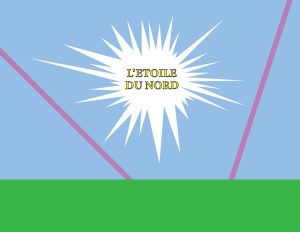
Pardon my French

Image by Sam Fleming

“L’Etoile Du Nord” means “The Star of the North” in French and was featured on the old state flag. 

A few people had mentioned keeping the old state motto in the mix, but no one got as specific in their request as Eric Turner.

“A simple and modern flag design for the state of Minnesota that follows vexillology principles. The flag should have a bright blue background symbolizing Minnesota’s lakes. At the bottom, add a horizontal band of vibrant green representing the state’s farmlands and forests,” Turner said.

Turner went on for another paragraph, give or take, and said the flag should forego any text, rather referencing the motto purely through imagery. But, Turner’s design idea and the text suggestion from others really make it come together, don’t you think?

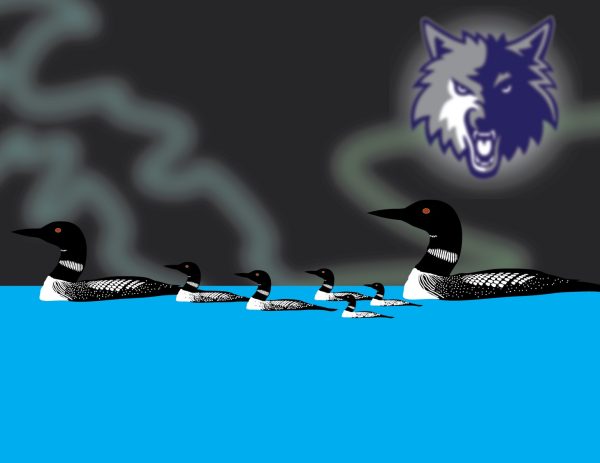
An ode to days gone by

Image by Sam Fleming


Must I sully this image with any outer context? Loons and the old Timberwolves logo. Many mentioned both and got what they desired. 

A beautiful flag for a beautiful state. Bask in its glory.

Posted in UncategorizedComments Off on Campus Caucus: Flag poll?

“Topography” exhibit at MIA uses colorful vinyl to represent Minnesota landscapes

With its recent exhibition, “Topography,” the Minneapolis Institute of Art (MIA) is showcasing an abstract use of color, material and form that will be on display until Feb. 25, 2024.

This exhibition allows viewers to see multicolored vinyl sheets stretched across wooden frames, creating a testament to artist Lisa Bergh’s relationship to rural Minnesota. The end product is a journey of shape, color and depth creating a subjective view of the midwestern landscape.

“The vinyl material is new for me,” Bergh said. “I began working with the material in the same way I manipulated paper. I am always interested in the materiality of things and allow the material of my work to be foregrounded.”

The “Topography” exhibit conveyed how an area’s natural and man-made physical features are arranged. The pieces reference landscapes of vistas and valleys, along with conceptual ideas of mapping.

Along with framed pieces, vinyl sheets are carefully stretched across wooden frames into a three-dimensional sculpture. As the geographical contours that characterize the exhibit perform this function, the structures create a sense of depth and texture.

One large sheet of dark blue vinyl cascading from the wall evokes the image of a waterfall, while another piece in the exhibit “Petite Beacon” uses wooden frames to create a sculpture depicting grain elevators and concrete silos.

“Lisa’s work as an artist is refreshing and unexpected, and the exhibition as a whole is a playful reminder of America’s ever-present constructed landscapes,” said Assistant Curator of Contemporary Art at the MIA, Nicole E. Soukup. “Topography encapsulates what Bergh does masterfully — using spectacle to create space for deeper engagement and dialogue.”

With the use of a broad range of vivid colors, each piece highlights a different aspect of the Minnesotan terrain. Color becomes a language unto itself as the hue of the vinyl creates a bright portrait across the frame.

“I use the language of abstraction in my work. I am always working to find the right balance of play between form, concept, intuition, intention, experience, and surprise,” Bergh said.

Bergh started her art career in photography and is currently an art instructor at Ridgewater College in Willmar, Minnesota. She is also the co-founder of The Traveling Museum, a program providing visual arts experiences in rural Minnesota.

The exhibit is part of the Minnesota Artists Exhibition Program (MAEP) at the MIA. Through the program, artists living and working in Minnesota can submit their artwork to be featured in the US Bank Gallery at the MIA.

“It is rare to encounter platforms that bring rural artists into the national dialogue with such regularity and sincerity as the MAEP does,” Soukup said.

“Topography” at the Minneapolis Institute of Art offers a novel perspective into the intersection of form and color, allowing viewers to actively participate in their visual journey.

The exhibition turns the showroom into a vibrant landscape that captivates and inspires through its creative use of multicolored vinyl. Visitors are sure to appreciate Bergh’s use of color, pattern, and shape as they walk through the gallery.

Posted in UncategorizedComments Off on “Topography” exhibit at MIA uses colorful vinyl to represent Minnesota landscapes