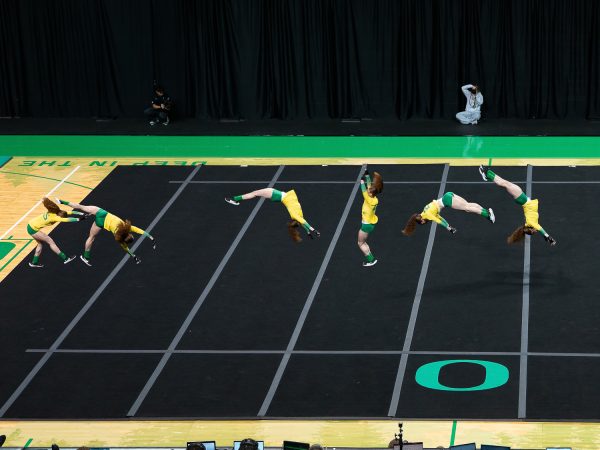
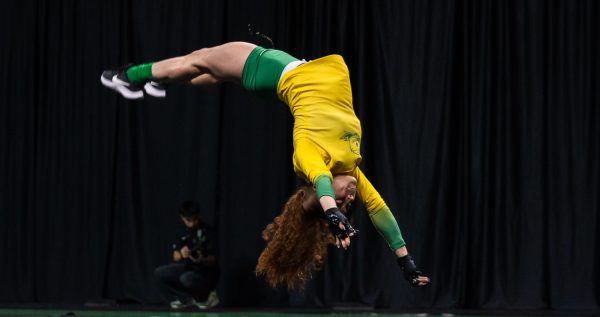
But for Oregon acrobatics and tumbling, Matthew Knight Arena has been home to more than five years of losses to its rival. When No. 1 Baylor University rolled into town on Monday night, it had been over five years since the Bears’ last loss — in Eugene, to the Ducks. If that streak was going to end, those ghosts would have to face eviction.
By the end of the night, Oregon (5-2) had exorcised some of them. Baylor (9-0), though, was happy to supply more ahead of the postseason throughout a dominant performance. The Ducks trailed by just 1.75 points before the team event after hanging with the Bears, but registered multiple falls and couldn’t overcome a start value disadvantage to snap their winless streak against their rival in the 286.810-277.680 loss.
Was Oregon head coach Taylor Susnara satisfied?
“Almost,” she said afterward. “Not quite, but almost.”
Even the second-best team in the nation has some problems to face. Six-element acro has been these Ducks’ most inconsistent heat; they’ve scored anywhere between 9.700 and 6.450 this season. On Monday, every stomp on the mat was mirrored by the athletes on the sideline. None of that noise was made by a fall, or an extra step. Oregon’s 9.500 score was its second-best of the season, and secured its first event win of the meet.
“We did it a lot of times,” Susnara said. “We did a lot of reps. We adjusted personnel just a little bit. But we just repped it out, and we talked about mindset and what you need going into that heat, and they brought it today, so I was really proud of them.”
There’s two ways, it turns out, to confront those ghosts.
One is to consult those who know them best. Base Blessyn McMorris is the most experienced athlete Oregon has. She claimed her third NCATA Athlete of the Week award last week, tying two other former Ducks (including her head coach) for most career wins.
McMorris is all over the Ducks’ meet. She bridges arguably Oregon’s best heat, the open pyramid in which she helped it win a national event title last season. On Saturday, that experience was on full display as the Ducks turned in a 9.900 in the heat.
Cassidy Cu and Angelica Martin are just wrapping up their second year of experience, but they’ve turned the Ducks acro event into a first-half powerhouse. The two were captains in the last home meet. Tonight, they posted a 9.800-point five-element and 9.850-point seven-element heat on Oregon’s way to a season-second-highest 29.250-point total in the event.
The other way is to turn to those who’ve never heard of the ghosts. Freshman Addison Brodie touched the mat in competition for the first time on Monday night, in the Ducks’ quad tumbling heat. The Ducks, facing significant injuries in the heat, inserted the first-time competitor, who turned in a strong, well-synchronized effort.
Also in that quad heat was Shea Barnes, a senior who returned from a midseason setback that saw her in a boot at the Ducks’ last meet to headline the quad group. Oregon totaled 27.70 points through 29.55 possible in group tumbling.
“We’ve been keeping those passes in our back pocket, and this past week, when we had a little bit of downtime to be able to train, they were looking really good, and so we decided to up the start value in that trio pass, and they all stepped up and did really well,” Susnara said.
For all the ghostbusting ability Oregon brought to the mat on Monday, though, there was a higher score on the other side. The Ducks won just one event, that acro set, despite zero non-team-event falls and never scoring less than 8.950.
The Bears’ lead only grew after that acro heat. Their standout pyramid event, in which they registered a fall in the last matchup between the two teams, scored 29.800 — including two 9.950 scores. Reigning All-Americans Washington and Emily Bott turned in matching 9.850-point solo passes, and a shuffled Oregon solo pass group including a 9.850-point six-element pass from Briya Alvarado couldn’t match it.
At least two Ducks fell in team event to complete the loss, on tumbling passes from Logan Davis and Nya Womack. More first-time experience appeared with strength, in freshman Reagan Grigsby, but it wasn’t enough. Baylor, typically, was spotless.
“I think team event has given us our struggles throughout the season, and that’s something that I think we just need to work on mentally and just kind of rep it out. We’ll drill everything else, but I think team event will be a big focus for us.”
Susnara isn’t always a fan of what her team sometimes says about their attitude in these meets, against this team — but she brought it up anyway afterward.
“I kind of joke about it, but we have nothing to lose, so to speak,” she said. “But I think that we have all to gain.”
Tonight, though, they lost.
Oregon advances to the NCATA National Championships in Azusa, California. A new poll will be released on April 8, with final seeds to be announced April 13.
There’s no change at the most important position for the Ducks, where redshirt junior quarterback Dante Moore is returning after forgoing the NFL Draft; but Oregon is sending seven starters to the pros and swapping offensive coordinator Will Stein for new OC Drew Mehringer. Starting running back Noah Whittington, tight end Kenyon Sadiq and wide receiver Malik Benson need replacements.
QB: Dante Moore, Dylan Raiola, Brock Thomas
Moore returns as the undisputed starter for the Ducks, but behind him, it’s an interesting question. Nebraska transfer Raiola has starting experience, but Thomas has been in Oregon’s system for longer, and he earned backup reps last season when Moore missed stretches of games. Expect Raiola to finish the season as the primary backup, but don’t be surprised if Thomas is the go-to in nonconference play.
RB: Jordon Davison, Dierre Hill Jr., Da’Jaun Riggs
It’s difficult to project where four-star recruit Tradarian Ball factors into the equation here, but Davison and Hill’s first years in Eugene leave them with high floors. Balle could be the same. Noah Whittington is headed to the draft, and while Davison missed the Peach Bowl with a broken clavicle, head coach Dan Lanning said on April 1 that he’s practicing, “somewhat, in a limited fashion.” New offensive coordinator Mehringer was a co-offensive coordinator last season, when the Ducks employed heavy 12-personnel usage; and while Davison projects as the more reasonable singleback option with his versatility, there’s still room for those two-back looks. Riggs was still carrying an injury as of that April 1 press conference, but Lanning said he’d “be back.”
TE: Jamari Johnson, Andrew Olesh, Kendre Harrison
Johnson stood out last season, spelling Kenyon Sadiq. The University of Louisville transfer finished with 32 catches for 510 yards and three touchdowns last season in Eugene, and he looks poised to take over full-time responsibilities at the position. Behind him, the Ducks are split between experience elsewhere (Penn State transfer sophomore Andrew Olesh, Clemson TE/DE Markus Dixon) and potential first-time starters (new five-star dual football/basketball recruit Kendre Harrison, redshirt freshman AJ Pugliano). This is Johnson’s room to lead, though.
WR: Dakorien Moore, Jeremiah McClellan, Evan Stewart
Moore, McClellan and Stewart look to be the Ducks’ nailed-on starters here. Moore, despite missing chunks of last year, returns as a dynamic, second-year threat and, with Stewart back from the patellar tendon injury that forced him to miss the entire 2025 season, has another deep threat to play off. McClellan broke out amid the depleted room last season and made a name for himself with some ridiculous catches. There’s more to keep an eye on here, including University of Alabama at Birmingham transfer Iverson Hooks, who could be a slot option, and speedy freshman Gatlin Bair, but expect to see those first three first.
Briya Alvarado hasn’t stopped moving for three-and-a-half minutes now.
It’s Feb. 21, and the sophomore is waiting for the judges to finish scoring the last tumbling pass in No. 2 Oregon acrobatics and tumbling’s meet against No. 3 Quinnipiac University. She’s not still, not sedentary. The Matthew Knight Arena speakers pump the air above the Ducks full of her chosen Ken Carson soundtrack. Alvarado’s constant movement on the edge of the mat, the dancing, jumping, body-shaking activity, has a couple of purposes.
It’s about distraction. She doesn’t get nervous, but she does feel pain. Her spotlight comes hours into the meet, after the cycle of warm-ups and half-minutes on the mat and warm-ups again repeats. All the dancing is about focusing on the present, not on the trainer’s table. She doesn’t have time to feel pain when she’s waiting, so she makes time for dancing and jumping and handstanding. She writhes in joy, not agony, when she waits there.
It’s about entertainment. She believes that her sport is about showing off for the fans. She gets to stand there, in front of a room stocked with seats filled by people — families — who flew to Eugene to watch. When the music stops and her name rings out, she’s going to wave and grin.
It’s not out of fear. She’s never felt it, she said, those nerves that people talk about. Not on a final exam. Not speaking in front of a room. And certainly not on the mat. In her head, it doesn’t exist.
“It’s just a feeling at the end of the day,” the sophomore tumbler said. “Fear is not real. It’s all in your head, so it’s just a mind game. It’s really all it is.”
Oregon top tumbler Briya Alvarado makes her solo pass during the tumbling event. The University of Oregon Acrobatics and Tumbling team beat the Iona Gaels 268.105-265.210 at Matthew Knight Arena in Eugene, Ore. on Mar. 15, 2026. (Saj Sundaram/Emerald) (Saj Sundaram)
When she dances, it’s to the beat. Can’t you tell that she loves this part?
Maybe it’s her rocket-booster-equipped feet — the ones that bounce the sophomore tumbler up and down on the floor as her first walkup song (Carson’s “Freestyle 2”) ticks over to her second (“Overseas,” by the same) on this February evening. Maybe it’s the thought of the first enormous hug she’s going to give Oregon head coach Taylor Susnara afterward, or the second, or the third once she makes it through the tunnel of hands. It’s definitely the stage.
Hers is supposed to be the moment where the pressure comes to a head, when it’s supposed to get in your head. It’s designed that way. Acrobatics and tumbling solo passes are the only time in a three-hour meet that an athlete is on the floor alone, and they come just before the meet’s final, team event. They get a walkup song. They get a captive audience. They get their face on the Jumbotron hanging from the rafters of Matthew Knight Arena.
There’s three passes every night: in order, the aerial, which Alvarado debuted in as a freshman last year; the six-element, in which Morgan Willingham, one of her closest friends, competes; and the open, which is Alvarado’s today. Oregon’s roster is 41 athletes strong, but she is one of just three who gets the chance to make a standalone statement. Its first two tumblers, Nya Womack and Willingham, already made theirs tonight.
Alvarado is the final athlete. She gets the last word, and this is her music, her beat. She’s still dancing, knees in a circle, hands in the air, eyes flitting open and closed between this world and some other one. Fear exists in neither. It’s exactly what used to get her in trouble on the sideline in gymnastics. Now, she turns it up.
Grace
The name Grace is nowhere in Veronica Briya Alvarado’s given three. It’s what her mom, Inez Gutierrez, calls her, though. She doesn’t — didn’t — give herself a lot of it. As a freshman at Oregon, she’d feel the frustration when something new didn’t work the first time. She’d be ushered into the hallway by athletic trainer Bri Dixon, where Alvarado would scream her frustration out.
If there were people in the building, “They could probably hear me,” she said.
First-year acrobatics and tumbling athletes have a lot of new to consume. There’s a new sport, with skill combinations and a thick binder of tenth-of-a-point deductions. They don’t have to memorize it, but they do need to understand it: Keep your feet together on toss landings. Don’t take extra steps in compulsory tumbling. Don’t fall.
The first two decades of Alvarado’s life were spent on elite gymnastics, which came with a need for perfection; “Everything about gymnastics is just more intense,” she said. She was on the elite pathway, through camps, with the Olympics in the front of her mind. She wanted to represent Mexico on the biggest stage in world sports. The constant time she spent staring down the big picture is why, she thinks, she never felt a nerve during those camps.
More intense, too, meant more serious. In gymnastics, Alvarado remembers, she’d get in trouble for having a good time on the sideline — for showing her personality. Now, she keeps dancing.
“I love to perform and have the crowd be engaged with me and enjoy themselves, because this is a show for them at the end of the day, and I like to show them how incredible we really are,” she said.
By the end of her freshman year, Alvarado’s aerial pass had stunned with a debut 9.850 against Morgan State University and steadied at a season-long 9.788 average. She qualified for event finals in the heat with a 9.775 in the first round of the NCATA Championships. Over the summer, though, she didn’t even touch a dead mat. She tumbled maybe three times total in an effort to give her body a break, because she needs to be able to distract herself from the pain when she waits on the edge of the mat. She can’t get frustrated.
“Doctors appointments, you know, or another X-ray or CAT scan or something like that, or anything, can be frustrating,” she said. “I do get frustrated with myself sometimes. But I know it’s gonna be worth it in the end. I’m enjoying myself.”
The GOAT
When Alvarado came back to school for preseason practice, there was something new on the table.
The tumbling style was already a step away from the gymnastics she’d grown up with. Topping was something else entirely — she’d be hoisted in the air, not running across the mat. Susnara wanted her as a top in the Ducks’ six-element acro, a synchronized heat in the second event.
Alvarado had the Greatest Of All Time on her side to help make it happen.
Before every six-element acro heat this year, fifth-year-senior base Blessyn McMorris (whom Alvarado calls “the GOAT”) and Alvarado are away from the crowd, tucked on a corner of the Ducks’ sideline near the stairs. They lock hands. They’re locked in, together; they call it “interlink Bluetooth” when it happens. McMorris is talking to her.
“This is our time,” Alvarado remembers McMorris saying. She doesn’t need cues from someone who holds her up every day.
Duck sophomore tumbler Briya Alvarado (25) performs a solo tumbling routine. On March 15,2026 the University of Oregon Ducks Women’s Acrobatics and Tumbling team beat the Gaels in a tight home meet against Iona University at Matthew Knight Arena in Eugene, Ore. (Katie Poluyansky/Emerald). (Katie Poluyansky)
They take a deep breath. She reminds herself to give grace. For her, it’s not about being perfect — and that’s a word she thinks about a lot.
“To be able to succeed, you have to fail, so I really instilled that in myself this year,” she said. “It’s not going to be perfect the first time, and you literally have to fail to succeed. You can’t just succeed and succeed and succeed. There has to be some failure to be able to succeed.”
There’s plenty of room for failure in that binder of deductions.
“And then it’s not going to be perfection, either,” she said. “It’s kind of humanly impossible, but it can be close to perfection. So let’s try to strive for that and get as close as you can get to perfection and then just take a breather. Just take a deep breath. You’re a human at the end of the day, and so that’s why I do give myself some grace.”
Perfection
Before Alvarado danced to Ken Carson on the mat, she turned it all the way up in her car. She bass-boosted her headphones off her ears. The Alvarado on the mat was the same one who dances around her apartment. In that ultimate moment, she’s totally distracted.
She’s not thinking about her back, which might hurt sometimes. She’s not thinking about the outside world. She’s maybe thinking about the issue at hand. Her problem is the slim, 0.550-point lead that the Ducks are hanging onto. The nation’s No. 3 team would love nothing more than to upset No. 2 in its own house.
Alvarado, though, just loves the spotlight.
The judges are still scoring Quinnipiac’s open pass by the time “Freestyle 2” ends. The playlist clicks over to “Overseas.” Alvarado closes her eyes, then throws them open with another grin. She gets a hug from Ducks assistant coach Jacie Van de Zilver. Willingham and Martin are split behind her. The music cuts off.
Roundoff. Whip. Whip. Whip. Handspring. One-and-a-half. Tonight, there’s too much power to keep her on the floor. Her feet land — one, two — then bounce off the mat. There’s still the big hug. There’s still the tunnel. There’s a sliver of failure there, too, but the smile emerges.
That’s what this year has been about for her: grace in failure, smiles in stepoffs and dancing instead of fear.
On March 15, back in Eugene, Alvarado had the last word again. It wasn’t No. 3, but No. 4 Iona University on the other side. Over the course of the week, Susnara had pushed Alvarado to prioritize quality repetitions over quantity. Six-element acro hadn’t gone the Ducks’ way, and a fall in the heat left her team trailing. This time, the problem was a 1.850-point deficit.
“Freestyle 2” played. The steps were the same they’d always been. Roundoff. Whip. Whip. Whip. Handspring. One-and-a-half. The score came back: a career-high 9.900. It’s perfect — or as close as she’d been, with a little room for grace. Her score turned the deficit into an advantage. Oregon’s team event closed out the win.
“Briya’s growth has been really huge,” Susnara said afterward. “She showed out today and her mental toughness, if you will, or her emotional toughness, really, has gotten so much better from freshman year, and so today I was really proud of her for that.”
Call it whatever you want: toughness, room for grace, her swag. It’s arrived. She’s arrived. When she’s standing there, dancing on the edge of the mat, the world is hers.
You can bet she’s going to own it.
Oregon faces No. 1 Baylor April 6 at Matthew Knight Arena. The meet is scheduled for 6 p.m.
It was the last time Baylor acrobatics and tumbling lost, and it happened in Eugene. Since then, the Ducks have appointed a new head coach (Taylor Susnara, after the 2021 season), and made the national championship meet twice. Both times, they lost to the Bears. The program has grown, but not past that high-water mark set five years and one month from Monday.
No. 2 Oregon acrobatics and tumbling (5-1) faces No. 1 Baylor University (8-0) on April 6 at Matthew Knight Arena. They’re the two best teams in the nation, again, but the historical gap between them and the rest has been matched by the distance between them. Measure it however you want — Baylor’s 10 straight national titles, its 14-straight series wins, or just those 1,857 days — it’s growing until Oregon snaps the streak. The winner of Monday’s matchup will likely take the NCATA’s top seed into the postseason, but the Ducks doing so would mean overcoming a decade of Bears dominance.
Last April in Sioux Falls, South Dakota, then-No. 2 Oregon trailed by 2.1 points entering the team event in the championship meet against No. 1 Baylor. The Bears turned in their worst score of the postseason, but so did the Ducks, who scored their lowest team event of the season in the eventual loss. Afterward, Susnara said if they’d hit, they’d have had a shot.
There’s history between these two that stretches back beyond those 1,857 days, too. Baylor head coach Felecia Mulkey was the Ducks’ inaugural coach. She brought the sport’s first four national titles to Eugene before departing for Waco, Texas, where she built another dynasty. The two programs have continued their home-and-home series, which they’ve competed every season except the pandemic-shortened 2020 (still scheduled) since 2011.
Both have been at the forefront of innovation in the sport. Oregon freshmen Angelica Martin and Cassidy Cu competed an all-new slide-to-split skill in that 2025 season, and Nya Womack’s quad-whip pass was something the 2026 freshman picked up in between the Ducks’ first two meets.
Intheirfirstmeeting,a278.080-272.530 Baylor win in Waco on Feb. 28, the Bears competed their open pyramid heat with four of those slide-to-split skills. A chain reaction of slips, though, sent it tumbling to the ground. Again, Oregon trailed by just over two points before the team event. This time, it turned in its best score of the season to that point. It still, however, wasn’t enough.
Martin and Cu have returned as staples in the Ducks’ acro event. Fifth-year base Blessyn McMorris, tumblers Morgan Willingham and Briya Alvarado and Week 3 NCATA Athlete of the Week Ashlyn Parlett have been more. But the Bears have their stable of stars, too. 2025 Division I Athlete of the Year Payton Washington, tumbler Emily Bott and freshman base Mo Arthur have held them steady. Mulkey is still there. Little has changed between the two schools.
Should the Ducks turn 1,857 into zero on Monday, it won’t win them a national championship. It won’t erase the 10 years of titles, or the five years of losses. It would, however, redefine their relationship with the nation’s top team.
Since March 6, 2021, that definition has been absolute dominance. In Eugene, and then in Azusa, California, at the NCATA National Championship later this month, Oregon wants to change that.
Monday’s meet is scheduled for 6 p.m., to be broadcast on Big Ten Plus
The fifth-year base took home Athlete of the Week honors in the wake of No. 2 Oregon acrobatics and tumbling’s win over No. 15 Hawaii Pacific University in Honolulu last Wednesday. It’s her second win in the category this season, and third all-time. That tally now ranks joint-most in Oregon history, tied with current Ducks head coach Taylor Susnara and Krista Phillips. McMorris was part of Oregon’s 9.95-point open pyramid against the Sharks, plus seven other heats and team event.
Sophomore tumbler Morgan Willingham was named an honorable mention in the specialist of the week category, after she scored 9.875 in her six-element pass.
To explain his leadership philosophy, Oregon football’s new offensive coordinator went back to books.
“I think that there’s a book called ‘Leaders Eat Last,’ and it’s the way the military actually lines up to eat in the mess hall,” Drew Mehringer said at a March 14 press conference, his first since taking the role. “And they all line up from the young guys first, all the way to the most senior officers last, and the point is that the guy behind you should be coaching you or helping you grow, right?”
For four years, Mehringer has been taking steps backwards in line in Eugene. The former Rice University quarterback joined head coach Dan Lanning’s staff as the tight ends coach when he was hired in 2022. After three years, he added co-offensive coordinator responsibilities in 2025 as the Ducks made a run to the College Football Playoff semifinal. Now, stepping into the full-time role as Oregon’s new offensive coordinator, following the departure of three-year OC Will Stein to become the head coach at the University of Kentucky, he’s as close to the end of the line as he’s ever been.
Is it surreal? Sure. Has he pinched himself, like he said Lanning tells coaches sometimes? Maybe. The best way he could describe the feeling was with an homage to “Talladega Nights” and Ricky Bobby: “It is at least a little bit weird,” he said. “At times, it’s like, ‘I don’t know what to do with my hands.’”
That doesn’t mean he’s unprepared. The list of tight ends who’ve come through Mehringer’s room since the 38-year-old coach arrived at Oregon four years ago already approaches illustrious — Terrance Ferguson and Kenyon Sadiq alone are two of the Ducks’ best ever at the position.
“Any time you’re able to promote, it’s because you get to see what guys do every single day,” Lanning said. “It’s a body of work. You might interview with somebody three or four times on Zoom or have them visit, but the best indication of what I’m going to get in the future is how those guys’ positions have performed in the past, how they work with their teammates.”
Mehringer saw the game similarly to Stein, he said, though not completely alike. He remembered Stein being asked a question about offensive makeup before fall camp in 2025 about what the Ducks’ offense was going to look like.
“I think Will would tell you the same thing,” Mehringer said. “Every offense, every year is going to be a little bit different.”
His press conference came just after the Ducks’ first official practice of the spring, months from their Week 1 game against Boise State University. Right now is about piecing together a new puzzle — one that includes a smaller transfer portal class than 2025’s group, and five new blue-chip offensive freshmen.
The door, of course, is still open to change. He doesn’t think anyone saw the Ducks’ heavy use of 12-personnel coming before spring practice last year, or that they could’ve planned for the injuries to their receiver room that encouraged the scheme adjustment.
Those options are what he’s looking for at practice, even if it’s from a different vantage point than he’s used to. He used to be the one running the ball security drill at practice, but before his press conference, he was keeping it organized. He’s almost last in line to eat, he says, but he’s focused on everyone else — he says he’s learning constantly, from the rest of his offensive staff, and from Lanning and new defensive coordinator Chris Hampton, too. He’s talking about a communal project.
“This is never going to be Drew Mehringer’s offense, or anything like that,” he said. “This is going to be our offense.”
A midweek trip to Hawaii, it turned out, was relaxing for No. 2 Oregon acrobatics and tumbling.
The Ducks (5-1) never trailed, scored season-highs and completed a comprehensive victory over No. 15 Hawaii Pacific University with their second-highest team score of the season in a 275.355-263.375 win. The postseason horizon is all-but-here, and the Ducks executed (head coach Taylor Susnara’s buzzword from after their last meet) to what’s essentially the peak of their across-the-board ability.
That doesn’t mean every heat was their best, but it does mean that the Ducks achieved their previously-stated goal to win — really win — their next meet. Events that have spent time out of the spotlight grabbed it in the Shark Tank. Saying the Ducks are good enough to beat their rival is difficult, but this win argued that they’re prepared to do it.
Was this Oregon’s most complete meet?
By the numbers, it might have been. The Ducks finished the night with their second-best total score (275.355) and second-best team score (92.980), both behind the Gannon meet. That win over the Golden Knights still stands out as their top outing, mostly because while the across-the-board floor was equally high, Oregon’s best was better against the Golden Knights.
But what was most impressive about Wednesday night was the consistency with which the Ducks scored. Against Gannon, while they posted a better tumbling event than against Hawaii Pacific, their toss heat and compulsory acro and tumbling — heats which have typically been lower-scoring this season — both took steps forward. There was never a point where Oregon lost control of the meet (not even after instability in six-element acro), and while part of that goes down to the fact that the Sharks never had enough to match the Ducks, they won because they posted high scores across the board.
Oregon scored under 9.000 just once (in compulsory tumbling) and under 9.550 five times. Only one of those sub-9.550 scores came in a non-group-tumbling heat (six-element acro). That’s the standard the Ducks have been seeking, and Wednesday was the first time they’d scored under the 9.550 mark less than six times all season.
The peaks still need to arrive at the same time to win a meet like the Ducks’ next, and probably to win their postseason pathway. This, though, means that the consistency needed to do so is there.
Toss stands out
One of those less-high-scoring heats has been toss, in which Oregon has submitted its 450 Salto heat with a 9.90 start value throughout the 2026 season and capped its total points in the event at 29.90. It’s sandwiched between what’s arguably the Ducks’ two best heats, pyramid and tumbling, and has been able to lean on those for support, too.
Not against Hawaii Pacific. Oregon scored season-highs in synchronized (9.550) and open (9.750) toss, and a season-high event total (28.850). It’s scored more just three times in the past two years, and not since its regular-season-ending meet against Baylor last season, and the open toss score was its joint-best of any toss heat this season.
This is coming full circle in a couple of weeks, when Baylor rolls into Matthew Knight Arena. In the Ducks’ last matchup with the Bears, after Baylor fell in its open pyramid and opened the door for a first Oregon win since 2021, its slim lead grew immediately when the Bears outscored the Ducks 28.750-28.000 in toss.
The most obvious gap? Open toss, where the Ducks’ 9.05 trailed the Bears’ 9.70 and erased what was a near-even meet. Since then, Oregon has scored 9.350, 9.100 and now 9.750 in the heat. It’s not the only key to a win in the next meet, but it was one of their issues in their last loss. Now, it’s at least approaching beneficial status.
What did this meet mean?
Oregon entered its second-to-last meet with a clearly-stated goal: to win its meet, not let the other team lose it. It did so, even though the Sharks weren’t going to capitalize on any mistakes.
The Ducks did make them, for what it’s worth. The save in six-element acro kept a heat that’s troubled Oregon all year from becoming a major problem on the scoresheet. Another fall, in the acro portion of its team event, didn’t end up mattering either. This was the floor of a national-championship-contending team: fairly high scores across the board, with few mistakes and a strong team event. That’s why it stands as the Ducks’ second-best meet of the season, behind that Gannon meet, without the peaks of that outing.
They’ll need more of those high scores, of course, to win the postseason meets. Its best score against Hawaii Pacific, a 9.950 in open pyramid, was a joint-season-best in its best heat. Morgan Willingham and Briya Alvarado continued to trade strong passes, and Carly Garcia’s aerial wasn’t out of place, either. The pieces are there — this meet proved it.
It just all has to come together.
Oregon faces No. 1 Baylor University (7-0) on April 6 at Matthew Knight Arena. The meet is scheduled for 6 p.m. PT.
In the end, it didn’t matter that Hawaii Pacific University made the first mistake — it didn’t matter to Oregon acrobatics and tumbling that its opponent had made one at all.
It took the Sharks somewhere around two-thirds of a heat to do it. But Oregon wasn’t going to win because of its opponent’s mistakes. It had made that goal clear 10 days ago, when it won because it did so. It made it count in its 275.355-263.375 victory 10 days later, when it took a first-event lead and never let go.
After the Ducks’ comeback win over Iona University on March 15, Oregon head coach Taylor Susnara said that they’d had “way too many times” where they won because the other side failed, not because they succeeded. In that meet, despite Oregon’s high scores in tumbling, the spotlight was on the Gaels’ pair of low scores in the same event.
That wasn’t the story in Hawaii.
The No. 15 Sharks (3-2) stumbled and fell, but the Ducks sprinted past them in an 11.98-point victory that would’ve been obvious even without a trip out of the starting blocks. No. 2 Oregon (5-1) recovered its six-element acro heat after a season of struggles, continued to dominate pyramid and turned in a pair of season-high scores in toss. The road toward a national title won’t be this simple again — No. 1 Baylor waits on the other side of their flight home, then the postseason — but Oregon leaves Hawaii with a meet handily won.
The Sharks fell in their first heat of the night, compulsory acro, near the end of the timer. A top went backward during a transition to an inverted skill, and Hawaii Pacific dropped to a season-low 7.300 score.
Oregon’s later acro improvement, meanwhile, was foreshadowed by a season-high 9.550 in the compulsory heat. The Ducks’ lead after the first event was built off a pair of 9.85-plus pyramid and toss scores, but the acro score took advantage of that Hawaii Pacific fall in the same heat to create the advantage that wouldn’t go away.
An event later, Cassidy Cu and Angelica Martin posted a score of 9.900 or higher in five-element acro for the fourth-straight meet, and added a 9.700 in seven-element. Struggles in six-element went from a fall against Iona to a wobble and a save against the Sharks, and their improved-if-not-perfect score (9.150) reflected it.
Against the Gaels, the Ducks were hamstrung through four events by that acro fall, but recovered the deficit with a strong tumbling heat to take that win. That wouldn’t be the script for the Sharks, who struggled to compensate for their early fall and scored sub-9.000 in seven-element acro for the second time this season. Instead, Oregon’s lead grew as it approached its best events. A 9.950 in open pyramid, where the Ducks posted a 10.0 the last time they visited Hawaii, cemented a 3.800-point lead before the half.
A fourth-straight event win, in toss, overcame one of the Ducks’ few non-regularly-10.0 start value heats. They scored 9.55 in synchronized toss and 9.75 in open toss, both season-highs, in heats where already-difficult skills are often more challenging than other events to push toward that 10.0 start value cap. Exceptional scores look lower, and those two were more proof that the Ducks were pushing for, not coasting toward a win.
Tumbling, instead of a must-hit, became the cherry on top of an already-strong night. Carly Garcia entered the aerial tumbling pass in place of regular starter Nya Womack, who still competed in the trio pass, and turned in a 9.775. Morgan Willingham’s 9.875 was another piece of her consistent dominance of the heat, too. By the time the Ducks rolled into the team event, the lead was 8.700.
Of course, the meet ended as it started. Hawaii Pacific made mistakes early in its team event: a pair of tumbling pass step offs. The Ducks had a wobble — this time a dropped acro skill — and raced through the rest of their skills.
Oregon won, but not because the Sharks lost. Its six event wins and second-best total score of the season are testaments to its viability as a potential contender. Its road to a national title is as difficult as ever, but this puts them back in their regular realm, with just one challenger.
The NCATA released its first set of postseason polls on Wednesday. Oregon acrobatics and tumbling (4-1) remains No. 2 in the country.
The Ducks still have three ranked wins, over No. 3 Quinnipiac University, No. 5 Iona University and No. 7 Gannon University. Their opponent later on Wednesday, Hawaii Pacific University, dropped from No. 13 to No. 15. Their only loss, to No. 1 Baylor, is also their final regular-season matchup following tonight’s meet.
Rankings are created by a committee, based on teams’ record, strength of schedule, head-to-head competition, common opponents, team progression and average meet score, average meet start value and score differential without high/low values, according to the NCATA.
If the postseason started today, the Ducks would face No. 7 Gannon in the quarterfinal round. The Ducks took their win over the Golden Knights at Matthew Knight Arena on March 6. A potential matchup with Baylor wouldn’t be possible until the championship meet. Subsequent rankings will be released April 1 and April 8, with the final set released April 13.